
Workshop on Supporting Autistic Students in Tertiary Education
![• [Name of workshop presenter 1] – [Position] – [Organisation] • [Name of](https://slidetodoc.com/presentation_image/d71d590a878bee664c2fe2806cc23623/image-2.jpg "• [Name of workshop presenter 1] – [Position] – [Organisation] • [Name of")
- Slides: 58
Workshop on Supporting Autistic Students in Tertiary Education Settings
• [Name of workshop presenter 1] – [Position] – [Organisation] • [Name of workshop presenter 2] – [Position] – [Organisation] Adapt for workshop
Introductory Activity 1. Write down two things you know about autism spectrum disorder? 2. Write down two things you would like to know more about autism spectrum disorder? 3. Talk with a neighbour about these
Test of Social Know-how Handout 1 • Two stories from Margaret Dewey’s Chapter in book “Autism and Asperger Syndrome” • Some parts of the stories are in italics. Immediately following the italic text there is a pair of brackets ( ). Rate the behaviour which is illustrated by the portion in italics according to how you think most people would judge that behaviour if they witnessed it.
What is Autism Spectrum Disorder? • A cluster of neurodevelopmental conditions 1. Impairments in social and communication 2. Presence of restricted and repetitive patterns of behaviours and interests, and sensory sensitivities (APA, 2013) • Previous diagnoses include: – – – Autistic disorder (autism, high-functioning autism) Asperger’s disorder (or syndrome) Pervasive Developmental Disorder Not Otherwise Specified (PDDNOS)
Autism in History • • • Is autism new? Wolf Children Victor – the wild boy of Aveyron John Howard, prison reformer Dickinson’s cases – Great Ormond Street Hospital Descriptions consistent with ASDs but not recognised as a separate syndrome.
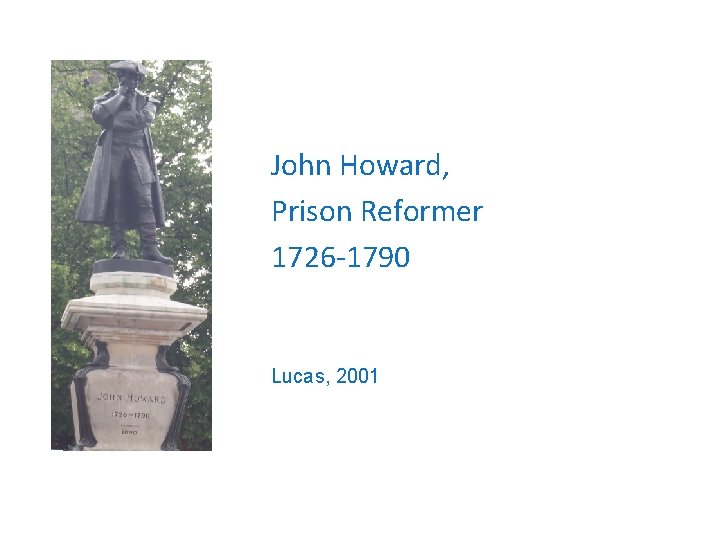
John Howard, Prison Reformer 1726 -1790 Lucas, 2001
DHS Study: Autistic Students • Students attending University or TAFE • Staff and carers • Participated in focus groups about their experiences (also completed online questionnaires ) • Research funded by DHS (Vic)
Diagnosis of Autism Spectrum Disorder: DSM-5 A. Persistent deficits in social communication and social interaction. B. Restricted, repetitive patterns of behaviour, interests or activities (includes sensory sensitivities). C. Symptoms are present in early development D. Clinically significant impairment in important areas of current functioning
Social-Communication • • • Problems with social/emotional reciprocity Difficulty initiating social interactions Social conversation difficulties (pragmatics) Lack of interest, one-sided odd interest Problems understanding other’s emotions Non-verbal behaviours may odd, reduced, different – Eye contact – Body language – Use / understanding gestures • Difficulty with friendships / peer relationships • Odd voice tone, prosody
Social Skills Student: “I've been known to send several emails to the same person or group of people in the one day. Even then someone in the group was sick initially I kept them in contacts because I thought it was polite to keep them in the loop. I soon realised that the other members said best to keep us the loop and just send us the minutes to this other person at this stage. ” Parent: “X often came to me recently and said that in particular with group activities or work requirements that have to be done, she gets extremely angry and upset and stressed when other students don’t contact her with work that has to be done, promptly. ”
Communication Staff: “But he was always anxious - always very literal - I said that I thought he should dictate the work to me and he was horrified and he said, I would never presume to dictate to you. ” Staff: “What is probably now a celebrated case of a student having completed assignment work but not handing it in and failing the course merely because the question was have you done your assignment, not can you hand your assignment to me, please. ”
Communication and Social Skills Parent: Last year, he was doing an assignment and I said “How's it going? ” He said “Oh, I've done question one, two and six”. I said “Can you ask about this” and he said “Oh well, you actually do it in a group but I'm doing it all on my own”. I said “Well, no wonder you're finding it hard”. I said “Have you explained to the lecturer that you find it hard to get into group? ” “No, I didn't think I needed to say that. ”
Behaviour • • • Routines Stereotypical motor movements Rituals Restricted or fixated interests Unusual sensory interests Aversive response to sensory stimuli or under reaction to sensory stimuli
Structure and Routine Parent: “Even just a new room or building is something really bad for him. ” Student: “It was easy for me to make the transition because X uni was very structured and (b) I didn’t have to move out of home and (c) I was able to travel by public transport. ” Student: “I struggled with routines all my life. Like as a child everything had to work in routine. As an adult I can handle change much better but there are days when I get up half an hour later than usual. Sometimes I'll stay up until 1 or 2 am on the odd occasion to get things finished as they were planned to be done so that the next day could start out as planned. ”
Responses to Sensory Stimuli Parent: “My son is very sensitive to noise. If he’s trying to study and there’s a bumble bee, he will get distracted. Quiet rooms are very, very much preferable, but not always possible. Walls without too many things, too many distractions is preferable because he gets distracted, which leads to anxiety. ” Student: “Special provisions for exams were made so I could be in a room on my own. I've got special ear phones which cut out all noise. ”
Other Common Issues • Executive function difficulties • Psychiatric comorbidities – Anxiety – Depression – ADHD • Sleep problems – Insomnia – Circadian sleep/wake rhythm disorders • Eating issues • Variable arousal and attention • Behaviours of concern
Executive Function Student: “For me, when uni forces me to use a structure and doing it in 10 smaller assignments each week, then that’s okay. If I try to set a structure myself I never follow it. I plan but I don’t follow it through. ” Student: “I always assumed I think through high school that uni would be just the same as school. When I got to uni. . lack of structure. It was okay for the first six months but on the second I wasting my time away on computer games, not doing the work, and at the time I was still in denial of my Asperger’s Syndrome. I wasn’t getting the help I could have had. I think I just treated uni like school but less intense. ”
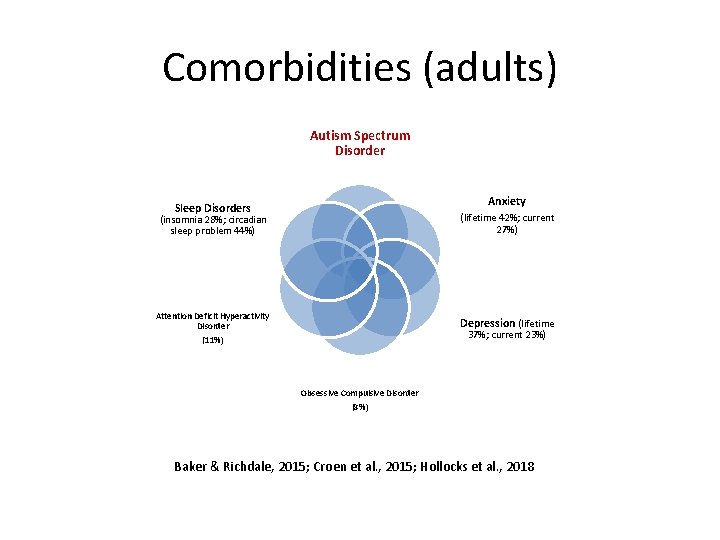
Comorbidities (adults) Autism Spectrum Disorder Anxiety Sleep Disorders (lifetime 42%; current 27%) (insomnia 28%; circadian sleep problem 44%) Attention Deficit Hyperactivity Disorder (11%) Depression (lifetime 37%; current 23%) Obsessive Compulsive Disorder (8%) Baker & Richdale, 2015; Croen et al. , 2015; Hollocks et al. , 2018
Psychopathology Parent: “And she rebels or sometimes she would go into a deep dark depression and it’s quite common for Asperger’s to have depression with what they have as well. She’s on medication for that. ” Student: “Overwhelm is my middle name. When you have OCD on top of ASD it’s just a nightmare. Every surface in the world is a scary thing and every day a process is an obstacle course of stress. Yeah everything is overwhelming. Getting out of bed is overwhelming. Going downstairs to breakfast is overwhelming. ”
Psychopathology in DHS Study • N=30; Parent report • Majority had co-morbid psychiatric problems/diagnoses. • Top 5 problems: – – – generalized anxiety disorders clinical depression ADHD obsessive-compulsive disorder other disabilities such as motor-sensory perception issues
Changes in Adult Outcomes (Howlin & Moss, 2012) • Compared two groups of adult outcome studies – Studies between mid-1960 s and 1999 – Studies between 2000 and 2012 • On average, only one fifth of individuals from both groups had good to very good outcomes • Only minor improvements where fewer adults were in institutional care and number of people living with parents declined
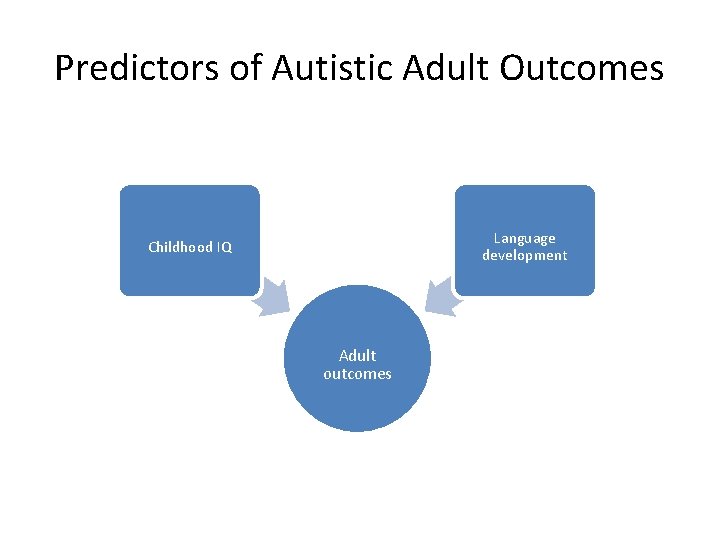
Predictors of Autistic Adult Outcomes Language development Childhood IQ Adult outcomes
Autistic Adults • Diagnostic status of autism generally does not change (Howlin et al. , 2013; Magiati et al. , 2014) • Research on education and employment outcomes of youth aged 19 – 23 years within first 6 years of finishing high school (Shattuck et al. , 2012) – 34. 7% tertiary education qualification – Just over half held paid employment
Tertiary Education • Transition to tertiary education is often unplanned (Cai & Richdale, 2016) • Factors critical to transition into tertiary education (Nuske et al. , 2019) – Individual and flexible approach to transition support – Increased staff awareness and understanding of autism • Lack of or delayed disclosure of autism results in limited access to necessary supports (Anderson et al. , 2018; Cai & Richdale, 2016) • Key support needs for tertiary students (White et al. , 2016) – Social integration, self-determination, and self-regulation
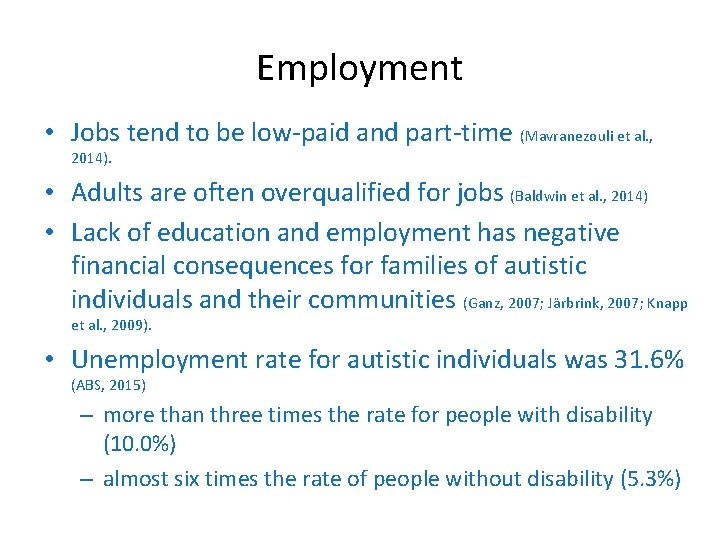
Employment • Jobs tend to be low-paid and part-time (Mavranezouli et al. , 2014). • Adults are often overqualified for jobs (Baldwin et al. , 2014) • Lack of education and employment has negative financial consequences for families of autistic individuals and their communities (Ganz, 2007; Järbrink, 2007; Knapp et al. , 2009). • Unemployment rate for autistic individuals was 31. 6% (ABS, 2015) – more than three times the rate for people with disability (10. 0%) – almost six times the rate of people without disability (5. 3%)
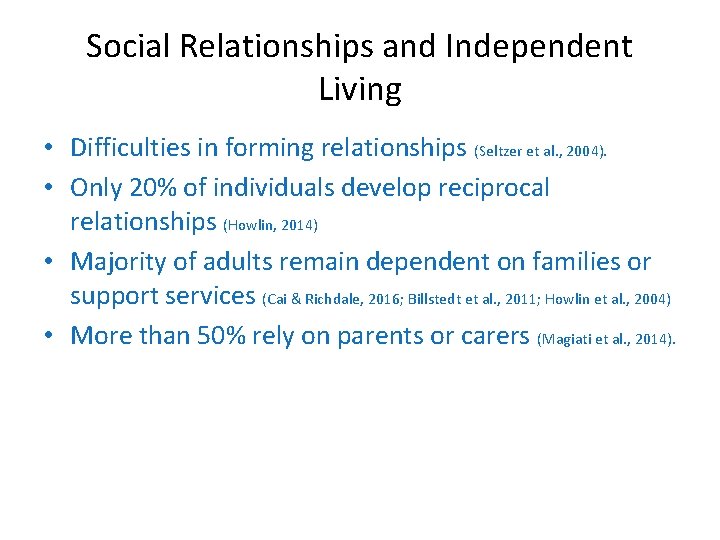
Social Relationships and Independent Living • Difficulties in forming relationships (Seltzer et al. , 2004). • Only 20% of individuals develop reciprocal relationships (Howlin, 2014) • Majority of adults remain dependent on families or support services (Cai & Richdale, 2016; Billstedt et al. , 2011; Howlin et al. , 2004) • More than 50% rely on parents or carers (Magiati et al. , 2014).
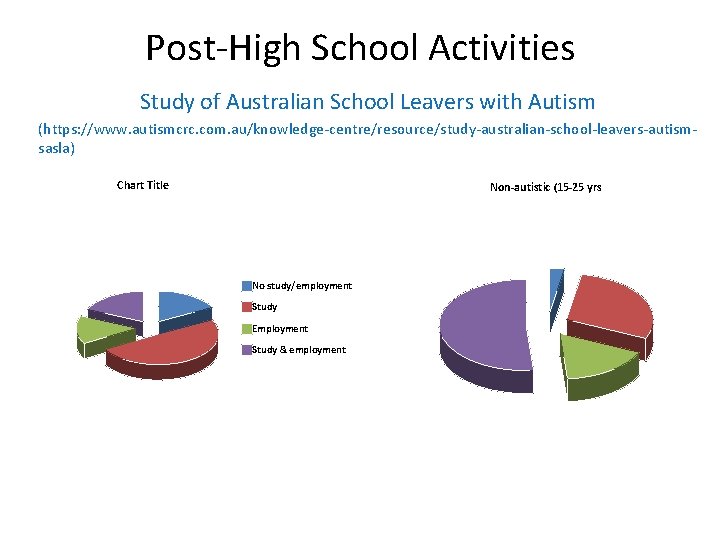
Post-High School Activities Study of Australian School Leavers with Autism (https: //www. autismcrc. com. au/knowledge-centre/resource/study-australian-school-leavers-autismsasla) Chart Title Non-autistic (15 -25 yrs No study/employment Study Employment Study & employment
Adapt for workshop Break Time
Activity: Working with Autistic Students 1. What are the key issues that you have faced when working with an autistic person? Add a question for those without experience 2. What works? 3. What doesn’t work?
Working with Autistic Students It makes sense to identify and understand both what worked and what didn’t work, and to use the effective strategies as much as possible.
Why Make the Effort? • Lecturers, teachers, administration, college residence staff, and support staff may all have contact with students with disabilities • People with disabilities including ASD are covered by the Disability Discrimination Act (DDA) 1992 • The Act has related Disability Standards for Education which became federal law in 2005
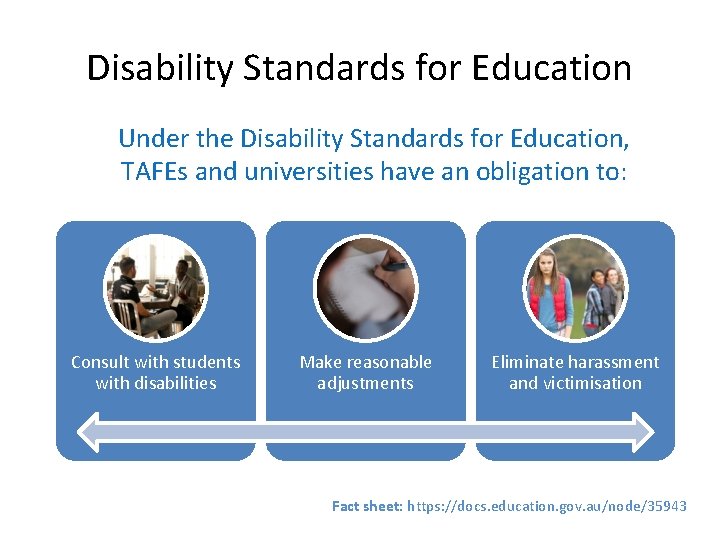
Disability Standards for Education Under the Disability Standards for Education, TAFEs and universities have an obligation to: Consult with students with disabilities Make reasonable adjustments Eliminate harassment and victimisation Fact sheet: https: //docs. education. gov. au/node/35943
Disclosure of Autism • Students can choose to: – Disclose their disability and/or – Register for support from the TAFE/University disability support program – OR Not do any of these • They may register with the disability unit but not wish to disclose to lecturers or teaching staff – check your tertiary institution’s policy around this
Consent, Disclosure and Effective Support • Disclosure and registration for support are the student’s choice and their choice must be respected • Students with a disability have the same rights and responsibilities as any other student
Parental Support • Parents of students with impairments and disabilities have typically had to continue to support and advocate for their child • They are likely have a critical role • It may be useful to continue and encourage that support but ultimately it is the student’s right to consent or not allow contact between the TAFE/University and parents.
Why Should I Care? • You are here because you need and want to understand the “how to…” of working with autistic students • If you understand what is going on, if there is a plan to cope with challenges, if you, the student and the support staff can minimise the stressors then unexpected events are less disruptive
Why Should I Care? • Regard it as an team based investigative process – what works, why does “it” work, and how can we apply “it” across the academic setting and associated TAFE and university environment and services? • A planned support process will save everyone time in the end – it is simply more efficient.
Autism and Communication Handout 2 • Difficulty in various aspects of communication: – learning and using social skills such as eye contact, greetings, appropriate touch – using communication rules i. e. turn taking, volume of speech • Unusual interactions with people or activities • Focus on preferred topics, people, and activities • May appear unaware of or disinterested in other people
Useful Strategies for Staff Handout 3 • Observe how the person communicates – try to match it and work with them e. g. how does this person indicate they are listening to you? • Identify things or events or people that appear to distress them or cause a problem in your contact with the autistic student – avoid those stressors if & when you can
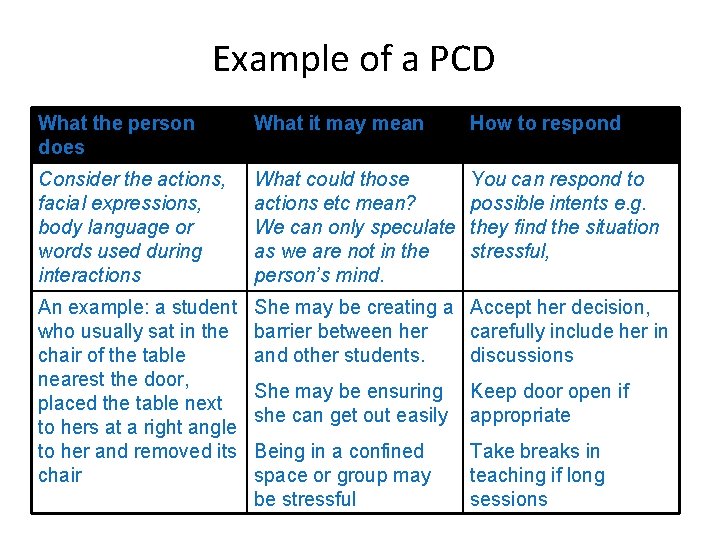
Personal Communication Dictionary The Personal Communication Dictionary (PCD) is a tool developed to support people with very disordered communication – but is useful to analyse the communication style of autistic students and staff
Example of a PCD What the person does What it may mean How to respond Consider the actions, facial expressions, body language or words used during interactions What could those actions etc mean? We can only speculate as we are not in the person’s mind. You can respond to possible intents e. g. they find the situation stressful, An example: a student who usually sat in the chair of the table nearest the door, placed the table next to hers at a right angle to her and removed its chair She may be creating a Accept her decision, barrier between her carefully include her in and other students. discussions She may be ensuring she can get out easily Keep door open if appropriate Being in a confined space or group may be stressful Take breaks in teaching if long sessions
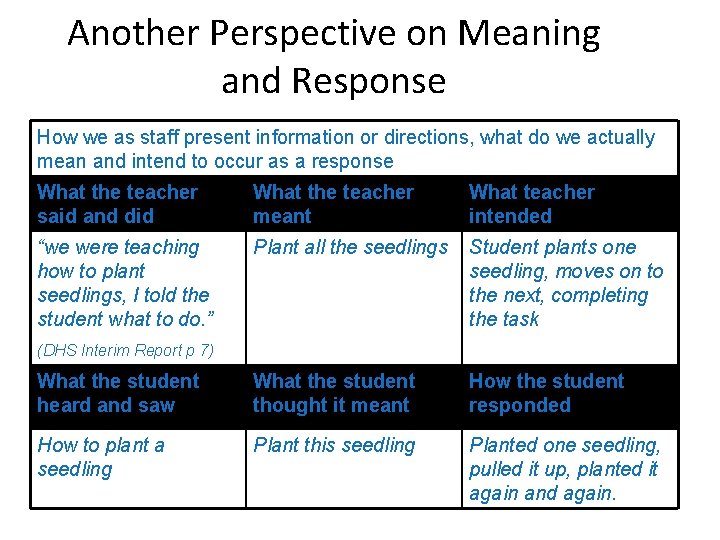
Another Perspective on Meaning and Response How we as staff present information or directions, what do we actually mean and intend to occur as a response What the teacher said and did What the teacher meant What teacher intended “we were teaching how to plant seedlings, I told the student what to do. ” Plant all the seedlings Student plants one seedling, moves on to the next, completing the task What the student heard and saw What the student thought it meant How the student responded How to plant a seedling Plant this seedling Planted one seedling, pulled it up, planted it again and again. (DHS Interim Report p 7)
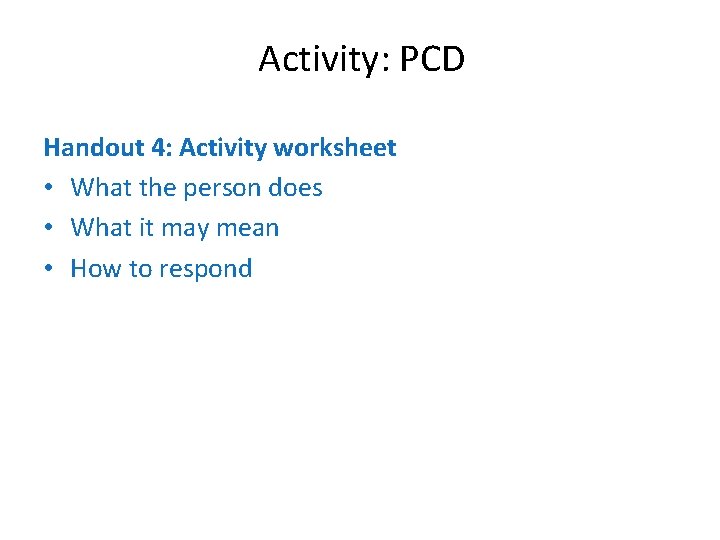
Activity: PCD Handout 4: Activity worksheet • What the person does • What it may mean • How to respond
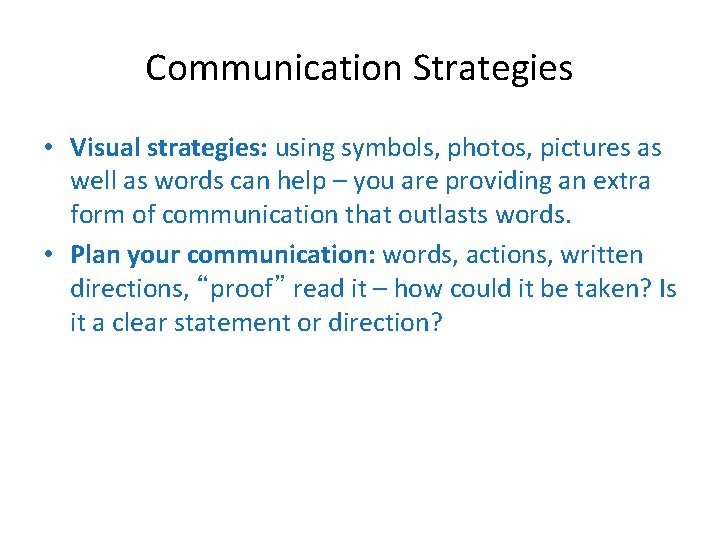
Communication Strategies • Visual strategies: using symbols, photos, pictures as well as words can help – you are providing an extra form of communication that outlasts words. • Plan your communication: words, actions, written directions, “proof” read it – how could it be taken? Is it a clear statement or direction?
Be Aware of Stressors • Identify things that stress people – avoid those stressors if & when you can e. g. some teachers and lecturers have the sound on DVDs or other electronic media turned up very loud. It can be overwhelming.
Routine and Space • Develop a routine in your contact with the student – talk them through it or have a visual timetable and stick with the routine as much as possible • Warn them of any changes to class times, venues, activities, teachers/lecturers • Give the person some space after a stressful or challenging event e. g. a group class activity
Show Appreciation • Appreciate how stressful the world is for autistic students - the student is not likely to be deliberately difficult; they are simply trying to manage a confusing world. • Appreciate the students and the skills and qualities that they have to offer – a person with a disability has had a lifetime of being regarded as a problem. We can imagine that gets very wearing.
Strategies for Academic Staff • Making choices about assessment tasks, activities or syndicate or group work can be stressful. It may be better to limit the options and structure the requirements • It may be useful to set regular meeting times to check on progress • Provide clear instructions for class activities and assessments. Autistic individuals often interpret words literally
Final Activity: Group Discussion Handout 5: Final Activity worksheet a) Consider your role with students including those with a disability b) Consider the purpose of group work/projects in classes, tutorials or for assessment tasks
Transition Support In first year, the student is also coping with the new setting, the social rules and challenges of the university/TAFE world • Would it be possible and appropriate to take on fewer subjects, units or modules? • Is there a balance of style of class – lecture/seminar, laboratory/clinic/studio work • What about free/study time? Does the student know how to use that time?
Use of Technology • Autistic students can find it difficult to respond to questions or contribute to discussions • Technology can be useful – Could the student respond by typing the answer rather than speaking to the group or teacher? – Handwriting can be awkward and hard for teachers to read. Could in-class tasks be completed using a lap top?
Final Messages • Each autistic individual is unique! Understand their needs without preconceptions • A planned support process will save everyone time in the end – it is simply more efficient. • Appreciate the autistic person and the skills and qualities that they have to offer
References Accardo, P. J. , Whitman, B. Y. et al. (2002). Dictionary of Developmental Disabilities Terminology. Baltimore: Paul H. Brookes Anderson, A. H. , Carter, M. , & Stephenson, J. (2018). Perspectives of university students with autism spectrum disorder. Journal of Autism and Developmental Disorders, 48, 651 -665. Attwood, T. (2007). The Complete Guide to Asperger’s Syndrome. London: Jessica Kingsley Publishers. Baldwin, S. , Costley, D. , & Warren, A. (2014). Employment activities and experiences of adults with high-functioning autism and asperger’s disorder. Journal of Autism and Developmental Disorders, 44, 2440 -2449. Billstedt, E. , Gillberg, I. C. , & Gillberg, C. (2011). Aspects of quality of life in adults diagnosed with autism in childhood: A population-based study. Autism, 15, 7 -20. Brugha T. S. , et al. (2011). Epidemiology of autism spectrum disorders in adults in the community in England. Archives of General Psychiatry, 68, 459 -466. Cai, R. Y. , & Richdale, A. L. (2016). Educational experiences and needs of higher education students with autism spectrum disorder. Journal of Autism and Developmental Disorders, 46, 31 -41. Carr, E. G. , et al. (1994). Communication–Based Intervention for Problem Behaviour. A User’s Guide for Producing Positive Change. Baltimore: Paul H. Brookes. Farley, M. A. , et al. (2009). Twenty-year outcome for individuals with autism and average or near average cognitive abilities. Autism Research, 2, 109 -118.
References Ganz, M. L. (2007). The lifetime distribution of the incremental societal costs of autism. Archives of Pediatrics & Adolescent Medicine, 161, 343 -349. Griffith, G. M. , Totsika, V. , Nash, S. , & Hastings, R. P. ‘I just don’t fit anywhere’: Support experiences and future support needs of individuals with Asperger syndrome in middle adulthood. Autism, 16, 532 -546. Holburn, S. , & Vietz, P. M. (2002). Person Centred Planning – Research, Practice and Future Directions. Paul H. Brookes Howlin, P. , Goode, S. , Hutton, J. , & Rutter, M. (2004). Adult outcome for children with autism. Journal of Child Psychology and Psychiatry, 45, 212 -229. Howlin, P. , & Moss, P. (2012). Adults with autism spectrum disorders. The Canadian Journal of Psychiatry, 57, 275 -283. Howlin, P. , Moss, P. , Savage, S. , & Rutter, M. (2013). Social outcomes in mid- to later adulthood among individuals diagnosed with autism and average nonverbal IQ as children. Journal of the American Academy of Child and Adolescent Psychiatry, 52, 572 -581. Howlin, P. , Savage, S. , Moss, P. , Tempier, A. , & Rutter, M. (2014) Cognitive and language skills in adults with autism: A 40 -year follow-up. Journal of Child Psychology and Psychiatry, 55, 49 -58. Järbrink, K. (2007). The economic consequences of autistic spectrum disorder among children in a Swedish municipality. Autism, 11, 453 -463. Knapp, M. , Romeo, R. , & Beecham, J. (2009). Economic cost of autism in the UK. Autism, 13, 317336.
References Koegal, L. K. , Koegal, R. L. , & Dunlap, G. (1996). Positive Behavioural Support. Including People with Difficult Behaviour in the Community. Baltimore: Paul H. Brookes Magiati, I. , Tay, X. W. , & Howlin, P. (2014). Cognitive, language, social and behavioural outcomes in adults with autism spectrum disorders: A systematic review of longitudinal follow-up studies in adulthood. Clinical Psychology Review, 34, 73 -86. Mavranezouli, I. et al. (2014) The cost-effectiveness of supported employment for adults with autism in the United Kingdom. Autism, 18, 975 -984. Nuske, A. , Rillotta, F. , Bellon, M. , & Richdale, A. (2019) Transition to higher education for students with autism: A systematic literature review. Journal of Diversity in Higher Education. Advance online publication. http: //dx. doi. org/10. 1037/dhe 0000108 Richdale, A. , Dissanayake, C. , & Cai, R. Y. (2011, October). Supporting transition to and participation in tertiary education for students with an Autism Spectrum Disorder. Interim Report, Department of Human Services, Vic Seltzer, M. M. , Shattuck, P. , Abbeduto, L. , & Greenberg, J. S. (2004). Trajectory of development in adolescents and adults with autism. Mental Retardation and Developmental Disabilities Research Reviews, 10, 234 -247. Shattuck, P. T. , Narendorf, S. C. , Cooper, B. , Sterzing, P. R. , Wagner, M. , & Taylor, J. L. (2012). Pediatrics, 129, 1041 -1049 White, S. W. et al. (2016). Students with autism spectrum disorder in college: Results from a preliminary mixed methods. Research in Developmental Disabilities, 56, 29 -40.
References: Web Disability Discrimination Act 1992 http: //www. comlaw. gov. au/Details/C 2012 C 00110 Disability Standards for Education 2005 http: //www. deewr. gov. au/schooling/programs/pages/disabilitystandardsfore ducation. aspx Understanding Asperger’s: A professor’s guide. Organization for Autism Research (OAR), USA. 12 minute video can be downloaded or purchased from: http: //www. researchautism. org/resources/Asperger. DVDSeries. asp Educational Professionals in further and higher education. National Autistic Society, UK: http: //www. autism. org. uk/workingwith/education-professionals-in-fe-and-he. aspx
Thank You Acknowledgments: This workshop was originally developed by A/Prof Amanda Richdale (La Trobe University, Olga Tennison Autism Research Centre) and Mary Collins (RMIT TAFE), under a grant funded by the Department of Human Services (Victoria). It has been edited and updated by Dr Ru Cai and A/Prof Amanda Richdale in April 2019.