
Workshop on Physics and Applications of High Brightness
Workshop on Physics and Applications of High Brightness Beams Round table on medical applications Updates in small field dosimetry Current situation in Cuba March 28 -April 1, Havana, Cuba, 2016 Dr. Fernando García Yip * Dr. Rodolfo Alfonso Laguardia ** * Instituto Nacional de Oncología y Radiobiología, INOR ** Instituto Superior de Ciencias y Tecnologías Aplicadas, INSTEC
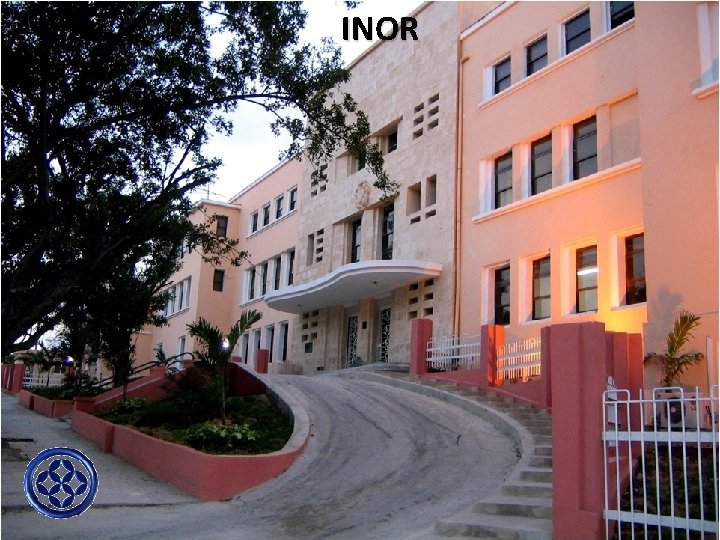
INOR
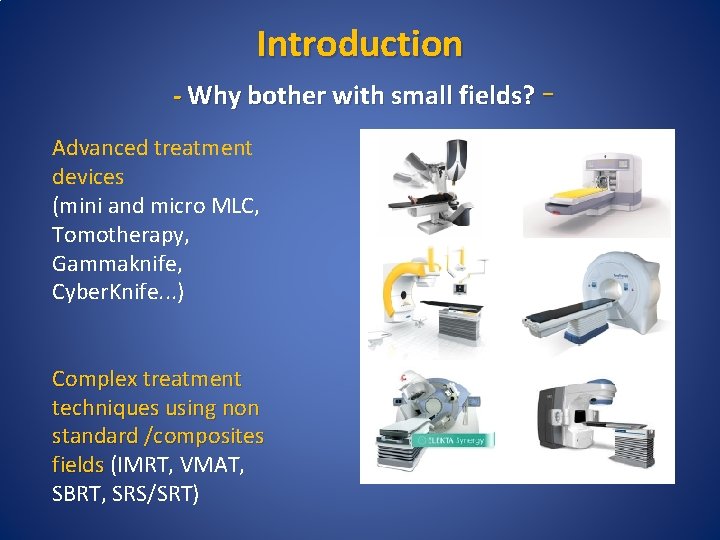
Introduction - Why bother with small fields? Advanced treatment devices (mini and micro MLC, Tomotherapy, Gammaknife, Cyber. Knife. . . ) Complex treatment techniques using non standard /composites fields (IMRT, VMAT, SBRT, SRS/SRT)
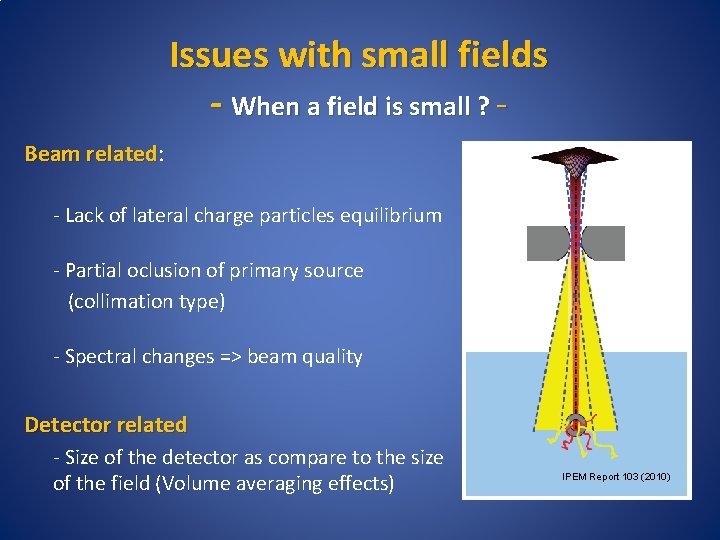
Issues with small fields - When a field is small ? Beam related: related - Lack of lateral charge particles equilibrium - Partial oclusion of primary source (collimation type) - Spectral changes => beam quality Detector related - Size of the detector as compare to the size of the field (Volume averaging effects) IPEM Report 103 (2010)
Clinical consequences/ impact • Reduction of the dose rate (output) of the field • The FWHM of the resulting field is wider than the collimator settings (!) • The changes in beam quality (harder spectrum) carries the definition of beam quality (TPR 20, 10 or D 10) index for the new small ref field • Severe influences on treatment planning data • Uncertainty in dose delivery (traceability) • Risk of misadministration/accident
Small Beam Dosimetry Working Groups IPEM– Report 103, UK AAPM TG 155 – Small field relative dosimetry, USA AAPM TG 178 – Gamma. Knife dosimetry , USA IAEA/AAPM - Small and non-standard fields ICRU Report committee on “Prescribing, recording and reporting of stereotactic radiation therapy” • DIN – Small field subcommittee, Germany • Other national efforts (France, Switzerland, …) • • •
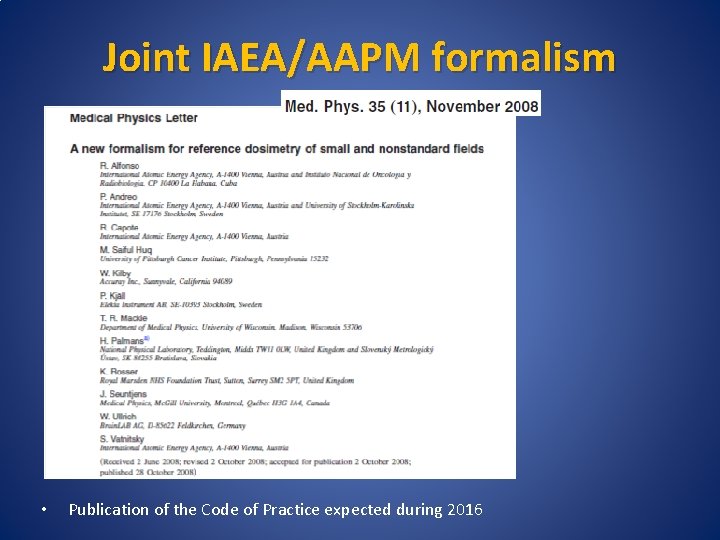
Joint IAEA/AAPM formalism • Publication of the Code of Practice expected during 2016
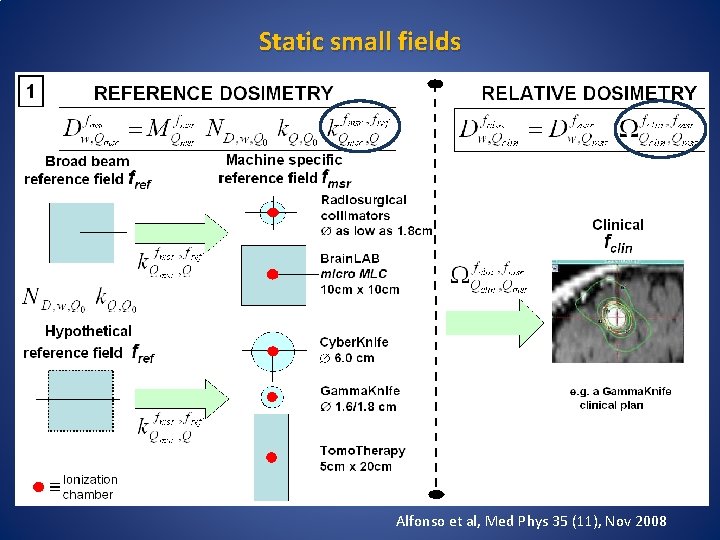
Static small fields Alfonso et al, Med Phys 35 (11), Nov 2008

Small Static Fields Reference Calibration, ref field fmsr is a factor which corrects for the differences between the conditions of field size, geometry, phantom material and beam quality of the conventional reference field fref and the machine-specific reference field fmsr Capote R. , Sánchez-Doblado F, Leal A, et al Med. Phys. 31 (2004) 2416 -2422 Bouchard H and Seuntjens J Med. Phys. 31 (2004) 2454 -2465 Sempau J, Andreo P, Aldana J, et al Phys. Med. Biol. 49 (2004) 4427
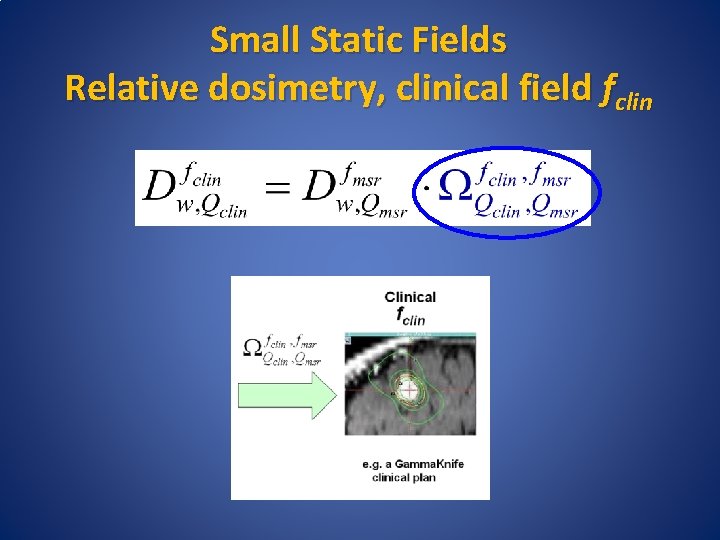
Small Static Fields Relative dosimetry, clinical field fclin

The concept of output factor is “redefined” Is a dose ratio, a field factor (output factor) -- converts absorbed dose to water ! Can be calculated directly as strict ratio of Dw using Monte Carlo alone or measure with a ‘fair’ detector or measured as a ratio of detector readings multiplied by a correction factor. Experimental values depend on the detector Corrects over the conventional output factor (“field correction factor”). Tabulated as function of the detector and field size
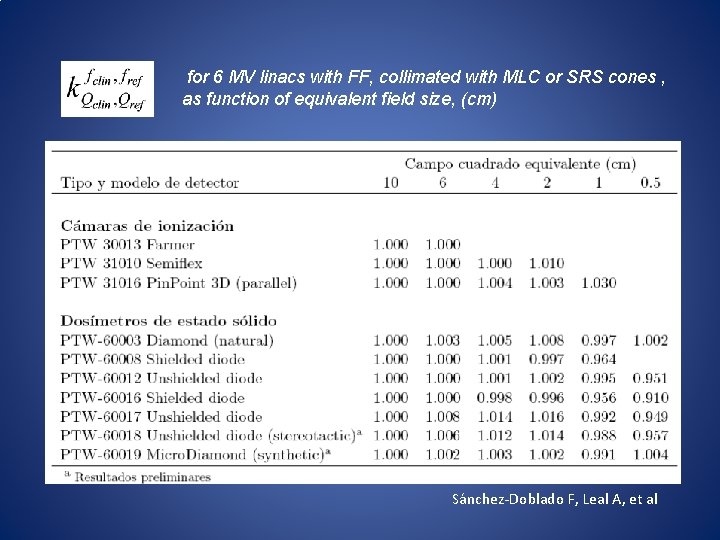
for 6 MV linacs with FF, collimated with MLC or SRS cones , as function of equivalent field size, (cm) Sánchez-Doblado F, Leal A, et al
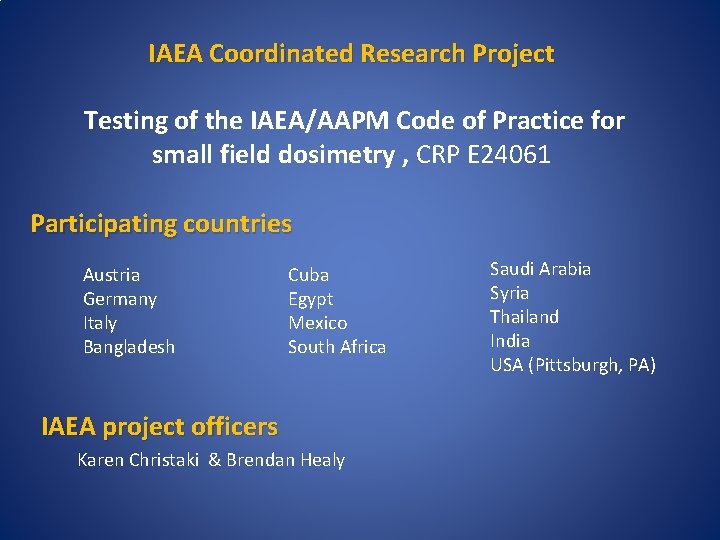
IAEA Coordinated Research Project Testing of the IAEA/AAPM Code of Practice for small field dosimetry , CRP E 24061 Participating countries Austria Germany Italy Bangladesh Cuba Egypt Mexico South Africa IAEA project officers Karen Christaki & Brendan Healy Saudi Arabia Syria Thailand India USA (Pittsburgh, PA)
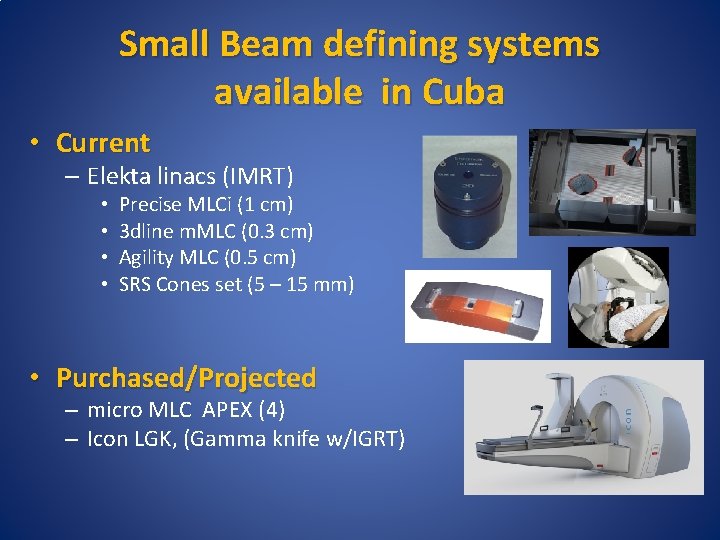
Small Beam defining systems available in Cuba • Current – Elekta linacs (IMRT) • • Precise MLCi (1 cm) 3 dline m. MLC (0. 3 cm) Agility MLC (0. 5 cm) SRS Cones set (5 – 15 mm) • Purchased/Projected – micro MLC APEX (4) – Icon LGK, (Gamma knife w/IGRT)
Dosimetry equipment available for the project • • • Ionization chambers for absolute dosimetry Detectors for relative dosimetry Several electrometers Water and plastic phantoms Anthropomorphic phantoms Other ancillary devices for dosimetry
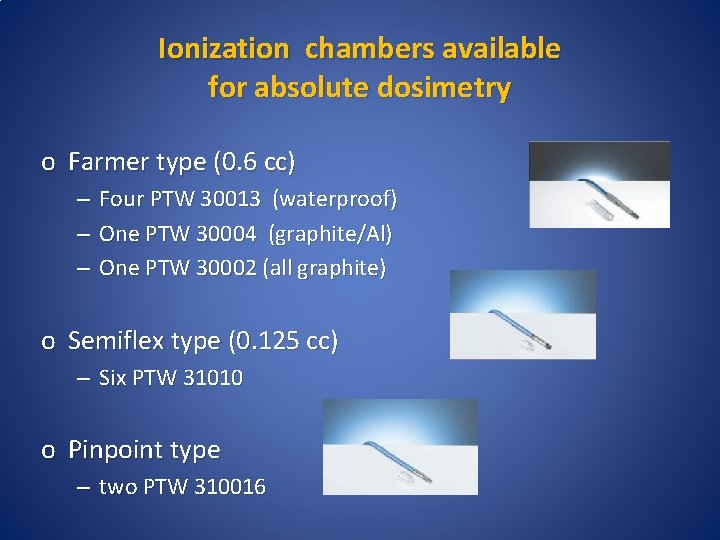
Ionization chambers available for absolute dosimetry o Farmer type (0. 6 cc) – – – Four PTW 30013 (waterproof) One PTW 30004 (graphite/Al) One PTW 30002 (all graphite) o Semiflex type (0. 125 cc) – Six PTW 31010 o Pinpoint type – two PTW 310016
Detectors available for relative dosimetry o o o o Pinpoint chambers Two Markus advanced 34045 Si diodes PTW 60016 (shielded) and 60017 (unshielded) Two microdiamond PTW 60019 One liquid ion chamber PTW microlion 31018 Two bidimensional chamber arrays model PTW Seven 29 EBT 2 and EBT 3 gafchromic films & transmission scanner One RPL glass dosimetry system, model FGD-1000 SE, with Glass Dosimeters GD-301 1. 5 x 8. 5 mm
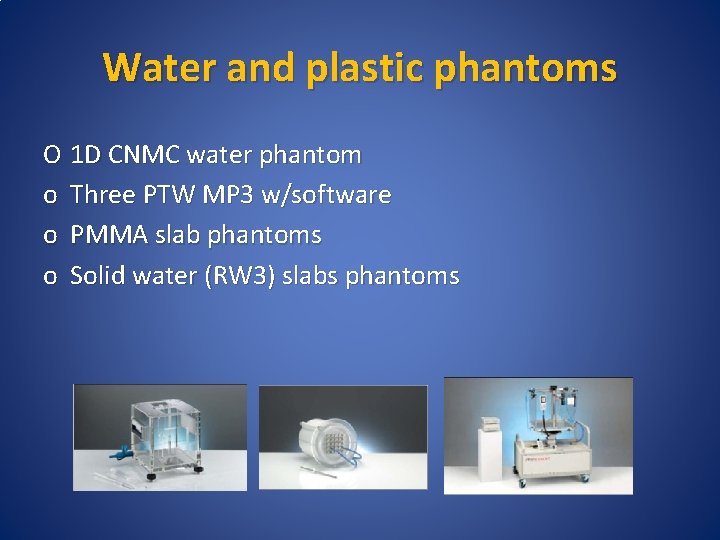
Water and plastic phantoms O 1 D CNMC water phantom o Three PTW MP 3 w/software o PMMA slab phantoms o Solid water (RW 3) slabs phantoms
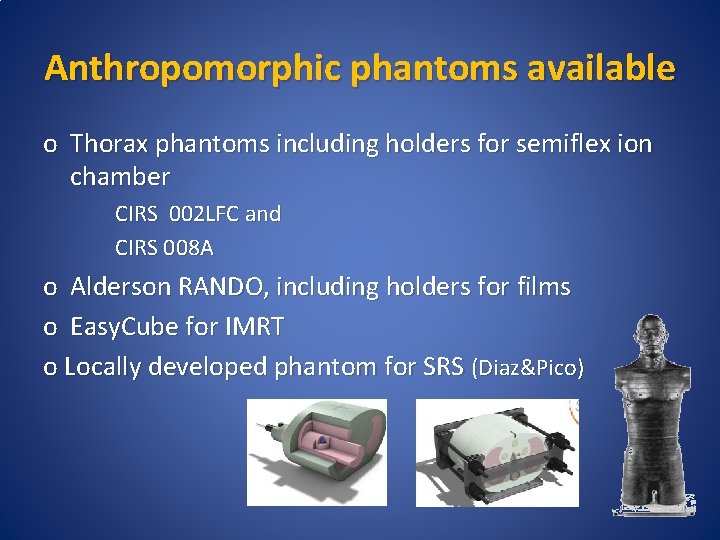
Anthropomorphic phantoms available o Thorax phantoms including holders for semiflex ion chamber CIRS 002 LFC and CIRS 008 A o Alderson RANDO, including holders for films o Easy. Cube for IMRT o Locally developed phantom for SRS (Diaz&Pico)
Scientific Background in Cuba MSc thesis conducted on the subject of small beam dosimetry • Asencio Y. Procedure for preclinical commissioning of the radiosurgery system based on m. MLC collimators (Jan 2013) • González Y. Accuracy Assessment of an Extracraneal Stereotactic System (Jan 2013) • De la Fuente L. Improving physical dosimetry in SRS with small beams (Mar, 2013) • Valdes G. Monte Carlo calculations of corrections factors for 4 different detectors in non-standard radiation fields settings (Sep 2015) • Argota R. Clinical testing of the new formalism for SBD (on going)
National Introductory Course on Small Field Dosimetry • 6 - 7 November 2014 at INOR • 9 medical physicists attended • Theoretical and practical
Expected output / outcome of IAEA - CRP • Based on the contribution of participating institutions and the results of tests, to release guidelines to Member States on the clinical implementation of the small field Code of Practice • Finalize a TECDOC report with recommendations on changes to the Co. P and publish other papers • The ultimate benefit will be the reduction in the uncertainty to the dose delivered to the patients receiving radiotherapy that includes small static photon fields
Conclusions (i) • Standard dosimetry methods do not apply to small and composite non-standard beams. Constrains are due both to machine and detector issues • Dosimetry errors in SBD may be related to both reference and relative determinations • The IAEA/AAPM new formalism (from TRS-398) keeps traceability to a broad beam calibration • The new Co. P will standardize recommendations for dosimetry procedures and detectors
Conclusions (ii) • Due to the technology injection, there is and there will be an increased use of small beams for therapy in Cuba • Contribution of local/external capacities is recommended since investigations on SBD are multidisciplinary • Through the IAEA coordinated project (CRP) we can make a modest contribution to the clinical implementation of the Co. P.

Acknowledgement • The clinical medical physicist colleagues at INOR and HHA, Ins. Tec faculty and students who contributed to the SBD national efforts is very valuable • IAEA/AAPM joint working group: R. Alfonso, P. Andreo, R. Capote, M. Saiful Huq, J. Izewska, J. Johansson, W. Kilby, T. R. Mackie, A. Meghzifene, H. Palmans, K. Kristaki, J. Seuntjens, W. Ullrich • The support of IAEA through the research contract 19149/RB is recognized

Thank you to the Workshop organizers for including this medical applications round table in the program
- Slides: 26