
WORKSHOP ON DESIGN SIMULATION OPTIMIZATION AND CONTROL OF
- Slides: 24
WORKSHOP ON DESIGN, SIMULATION, OPTIMIZATION AND CONTROL OF GREEN VEHICLES AND TRANSPORTATION OPTIMAL STRATEGY TO MINIMIZE MAGNET LOSSES IN VEHICLE PMSM BY FIELD-WEAKENING OPERATION Peter Körös, Dr Istvan Szenasy, Zoltan Szeli, Dr Zoltan Varga Session: Designe 1 st DSOC Workshop Győr, 21 -23 May 2014
Optimal Strategy to Minimize Magnet Losses In Vehicle PMSM by Field. Weakening Operation Introduction We developed a PMSM for a citybus, investigated its features for different voltages in field-weakening domain at constant power and constant speeds to determine: - magnet losses, hysteresis losses, efficiency, power factor determined the most adequate line of workpoints connecting the speed regions of medium and maximum, as an optimisation task determined the Id and Iq components of current vectors v. speed, realising an optimum control 1 st DSOC Workshop Győr, 21 -23 May 2014
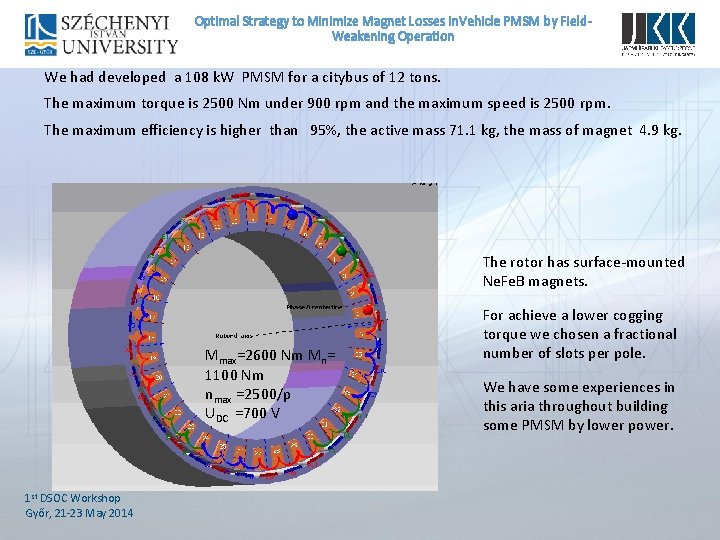
Optimal Strategy to Minimize Magnet Losses In. Vehicle PMSM by Field. Weakening Operation We had developed a 108 k. W PMSM for a citybus of 12 tons. The maximum torque is 2500 Nm under 900 rpm and the maximum speed is 2500 rpm. The maximum efficiency is higher than 95%, the active mass 71. 1 kg, the mass of magnet 4. 9 kg. The rotor has surface-mounted Ne. Fe. B magnets. Mmax=2600 Nm Mn= 1100 Nm nmax =2500/p UDC =700 V 1 st DSOC Workshop Győr, 21 -23 May 2014 For achieve a lower cogging torque we chosen a fractional number of slots per pole. We have some experiences in this aria throughout building some PMSM by lower power.
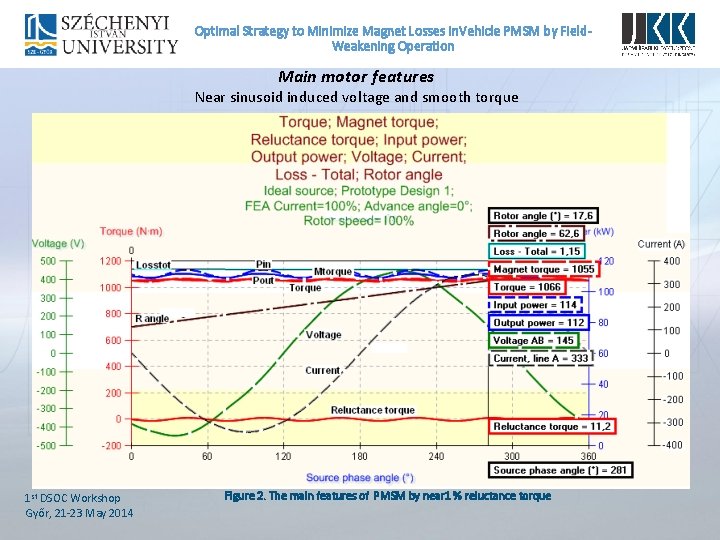
Optimal Strategy to Minimize Magnet Losses In. Vehicle PMSM by Field. Weakening Operation Main motor features Near sinusoid induced voltage and smooth torque 1 st DSOC Workshop Győr, 21 -23 May 2014 Figure 2. The main features of PMSM by near 1 % reluctance torque
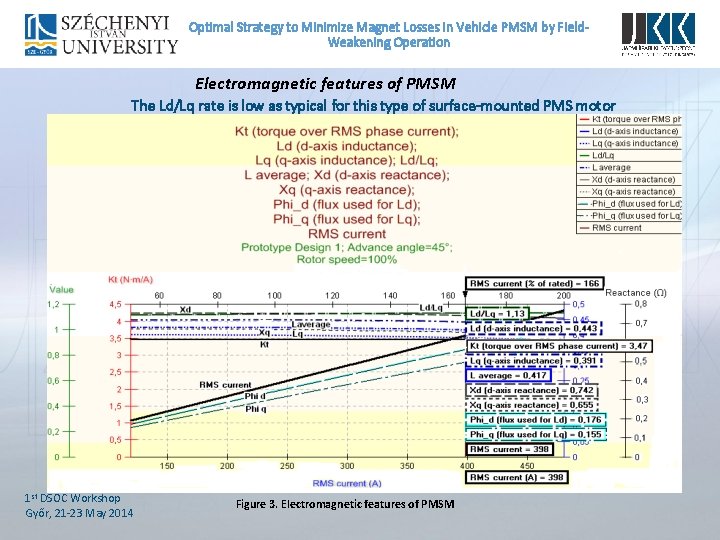
Optimal Strategy to Minimize Magnet Losses In Vehicle PMSM by Field. Weakening Operation Electromagnetic features of PMSM The Ld/Lq rate is low as typical for this type of surface-mounted PMS motor 1 st DSOC Workshop Győr, 21 -23 May 2014 Figure 3. Electromagnetic features of PMSM
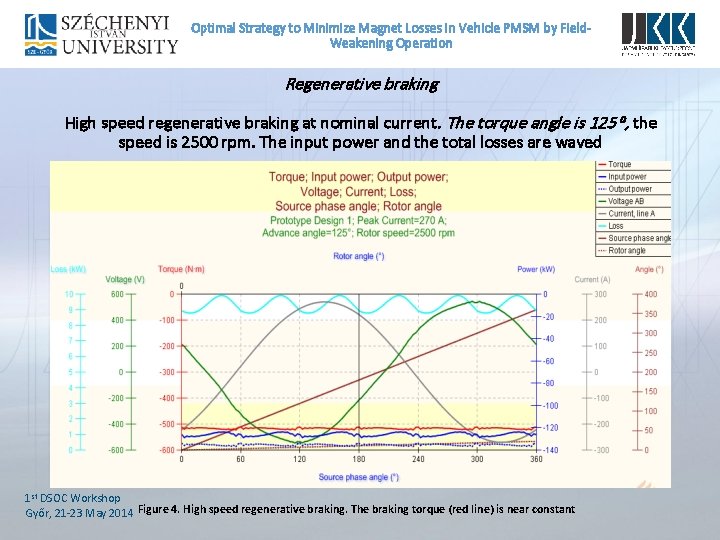
Optimal Strategy to Minimize Magnet Losses In Vehicle PMSM by Field. Weakening Operation Regenerative braking High speed regenerative braking at nominal current. The torque angle is 125 o, the speed is 2500 rpm. The input power and the total losses are waved 1 st DSOC Workshop Győr, 21 -23 May 2014 Figure 4. High speed regenerative braking. The braking torque (red line) is near constant
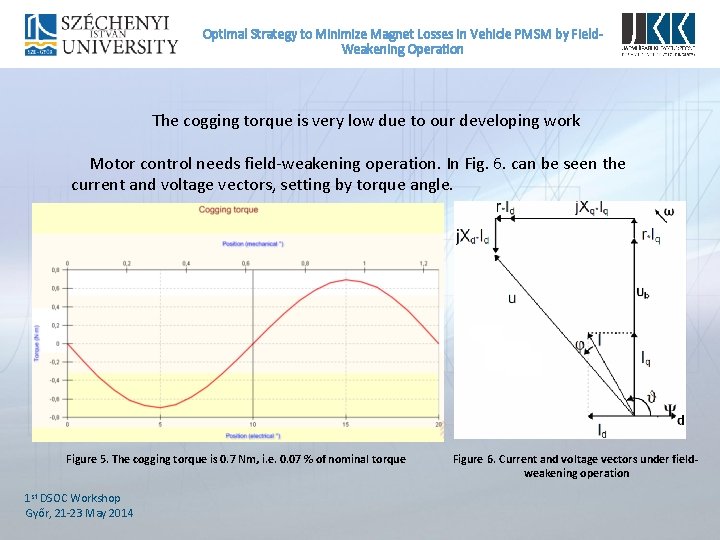
Optimal Strategy to Minimize Magnet Losses In Vehicle PMSM by Field. Weakening Operation The cogging torque is very low due to our developing work Motor control needs field-weakening operation. In Fig. 6. can be seen the current and voltage vectors, setting by torque angle. Figure 5. The cogging torque is 0. 7 Nm, i. e. 0. 07 % of nominal torque 1 st DSOC Workshop Győr, 21 -23 May 2014 Figure 6. Current and voltage vectors under fieldweakening operation
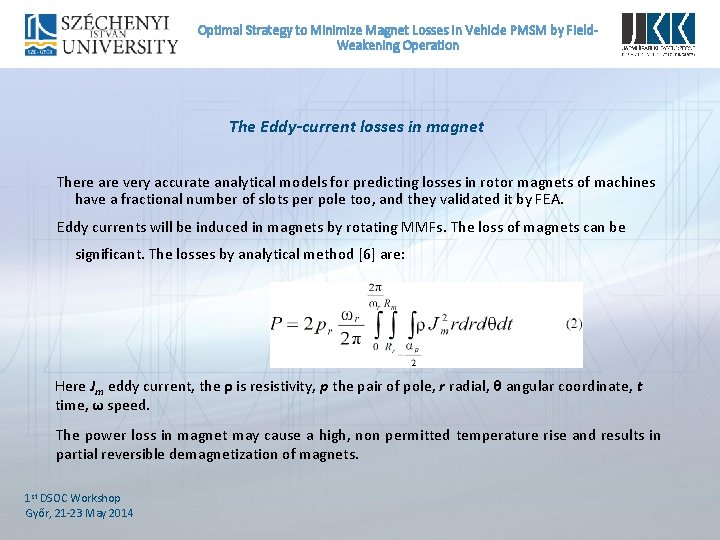
Optimal Strategy to Minimize Magnet Losses In Vehicle PMSM by Field. Weakening Operation The Eddy-current losses in magnet There are very accurate analytical models for predicting losses in rotor magnets of machines have a fractional number of slots per pole too, and they validated it by FEA. Eddy currents will be induced in magnets by rotating MMFs. The loss of magnets can be significant. The losses by analytical method [6] are: Here Jm eddy current, the ρ is resistivity, p the pair of pole, r radial, θ angular coordinate, t time, ω speed. The power loss in magnet may cause a high, non permitted temperature rise and results in partial reversible demagnetization of magnets. 1 st DSOC Workshop Győr, 21 -23 May 2014
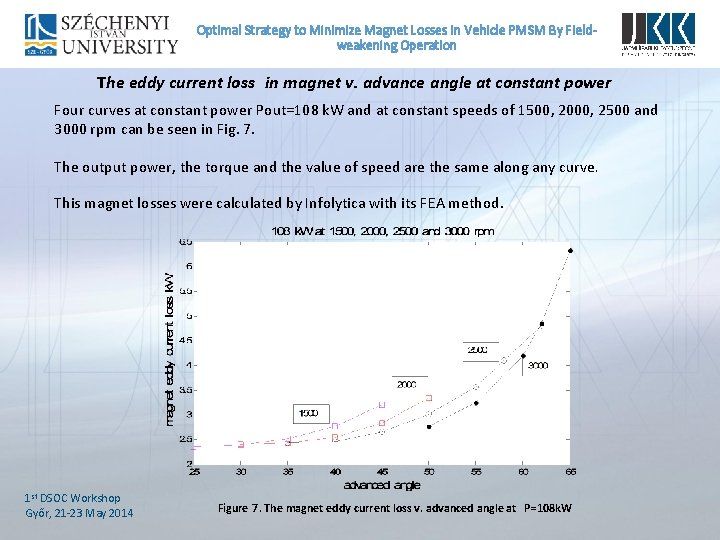
Optimal Strategy to Minimize Magnet Losses In Vehicle PMSM By Fieldweakening Operation The eddy current loss in magnet v. advance angle at constant power Four curves at constant power Pout=108 k. W and at constant speeds of 1500, 2000, 2500 and 3000 rpm can be seen in Fig. 7. The output power, the torque and the value of speed are the same along any curve. This magnet losses were calculated by Infolytica with its FEA method. 1 st DSOC Workshop Győr, 21 -23 May 2014 Figure 7. The magnet eddy current loss v. advanced angle at P=108 k. W
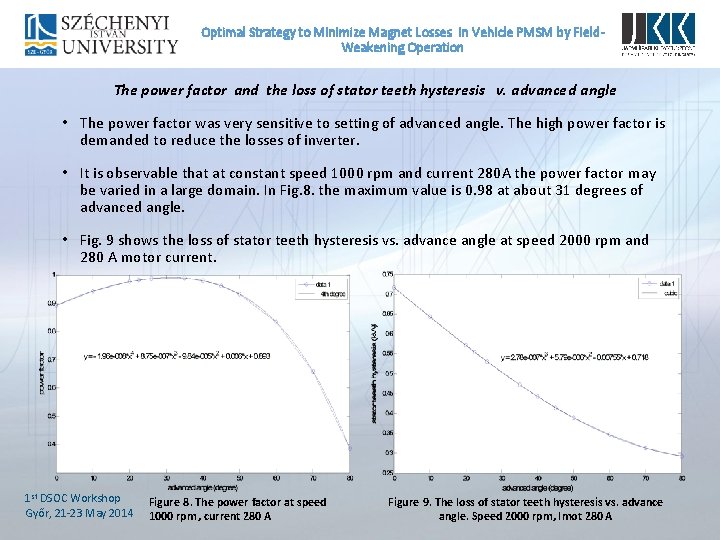
Optimal Strategy to Minimize Magnet Losses In Vehicle PMSM by Field. Weakening Operation The power factor and the loss of stator teeth hysteresis v. advanced angle • The power factor was very sensitive to setting of advanced angle. The high power factor is demanded to reduce the losses of inverter. • It is observable that at constant speed 1000 rpm and current 280 A the power factor may be varied in a large domain. In Fig. 8. the maximum value is 0. 98 at about 31 degrees of advanced angle. • Fig. 9 shows the loss of stator teeth hysteresis vs. advance angle at speed 2000 rpm and 280 A motor current. 1 st DSOC Workshop Győr, 21 -23 May 2014 Figure 8. The power factor at speed 1000 rpm , current 280 A Figure 9. The loss of stator teeth hysteresis vs. advance angle. Speed 2000 rpm, Imot 280 A
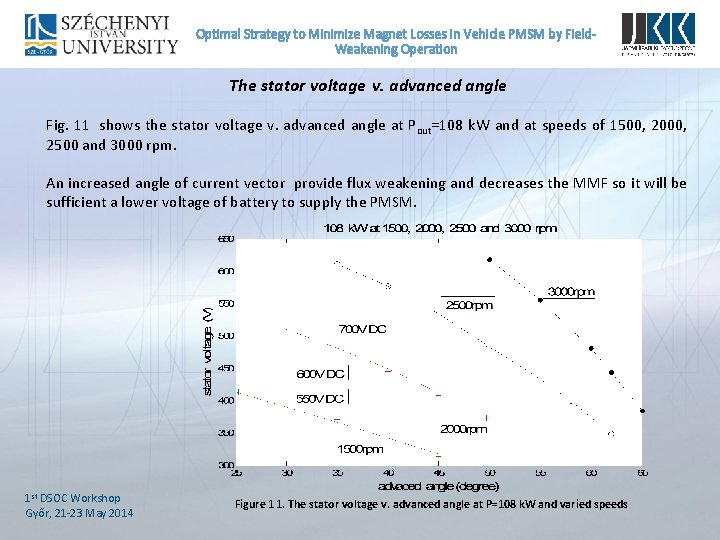
Optimal Strategy to Minimize Magnet Losses In Vehicle PMSM by Field. Weakening Operation The stator voltage v. advanced angle Fig. 11 shows the stator voltage v. advanced angle at Pout=108 k. W and at speeds of 1500, 2000, 2500 and 3000 rpm. An increased angle of current vector provide flux weakening and decreases the MMF so it will be sufficient a lower voltage of battery to supply the PMSM. 1 st DSOC Workshop Győr, 21 -23 May 2014 Figure 1 1. The stator voltage v. advanced angle at P=108 k. W and varied speeds
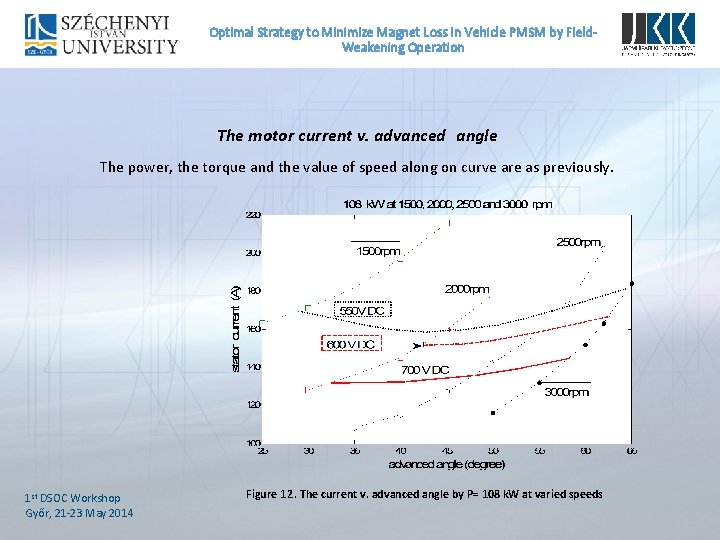
Optimal Strategy to Minimize Magnet Loss In Vehicle PMSM by Field. Weakening Operation The motor current v. advanced angle The power, the torque and the value of speed along on curve are as previously. 1 st DSOC Workshop Győr, 21 -23 May 2014 Figure 1 2. The current v. advanced angle by P= 108 k. W at varied speeds
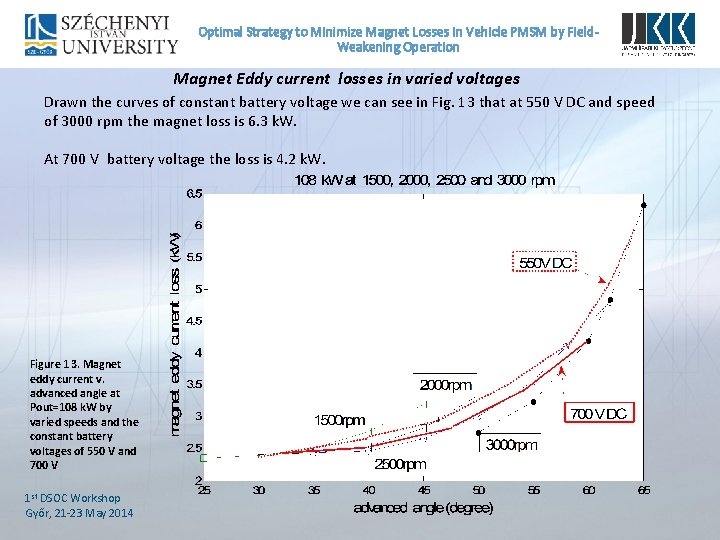
Optimal Strategy to Minimize Magnet Losses In Vehicle PMSM by Field. Weakening Operation Magnet Eddy current losses in varied voltages Drawn the curves of constant battery voltage we can see in Fig. 13 that at 550 V DC and speed of 3000 rpm the magnet loss is 6. 3 k. W. At 700 V battery voltage the loss is 4. 2 k. W. Figure 1 3. Magnet eddy current v. advanced angle at Pout=108 k. W by varied speeds and the constant battery voltages of 550 V and 700 V 1 st DSOC Workshop Győr, 21 -23 May 2014
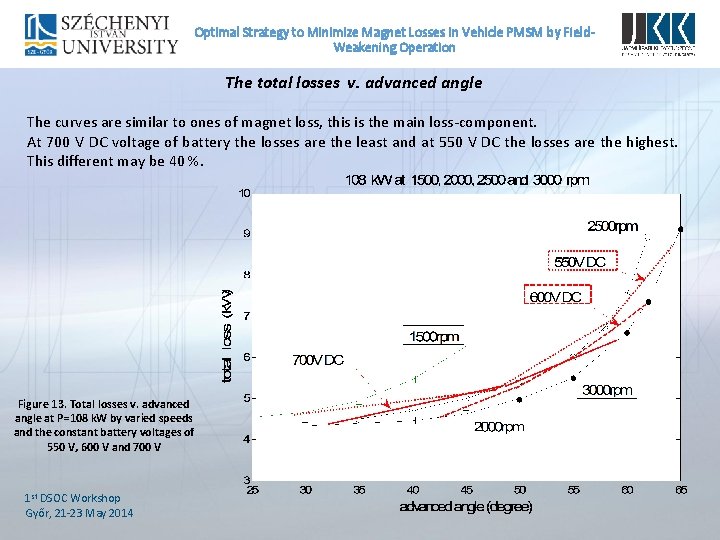
Optimal Strategy to Minimize Magnet Losses In Vehicle PMSM by Field. Weakening Operation The total losses v. advanced angle The curves are similar to ones of magnet loss, this is the main loss-component. At 700 V DC voltage of battery the losses are the least and at 550 V DC the losses are the highest. This different may be 40 %. Figure 13. Total losses v. advanced angle at P=108 k. W by varied speeds and the constant battery voltages of 550 V, 600 V and 700 V 1 st DSOC Workshop Győr, 21 -23 May 2014
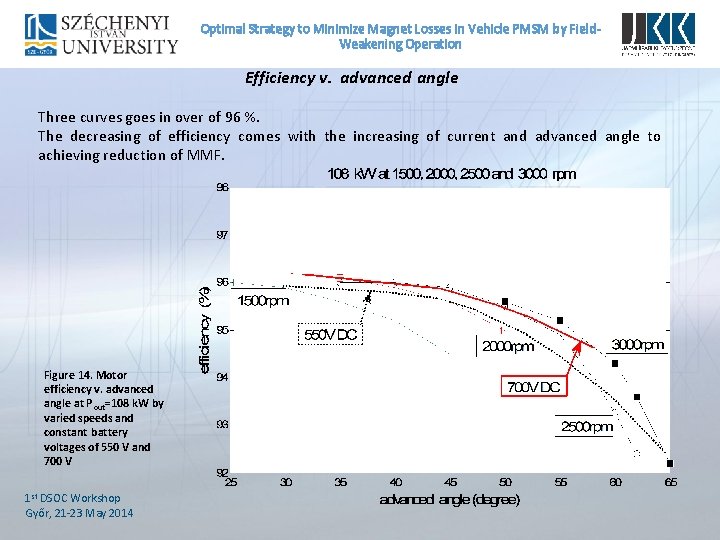
Optimal Strategy to Minimize Magnet Losses In Vehicle PMSM by Field. Weakening Operation Efficiency v. advanced angle Three curves goes in over of 96 %. The decreasing of efficiency comes with the increasing of current and advanced angle to achieving reduction of MMF. Figure 14. Motor efficiency v. advanced angle at P out=108 k. W by varied speeds and constant battery voltages of 550 V and 700 V 1 st DSOC Workshop Győr, 21 -23 May 2014
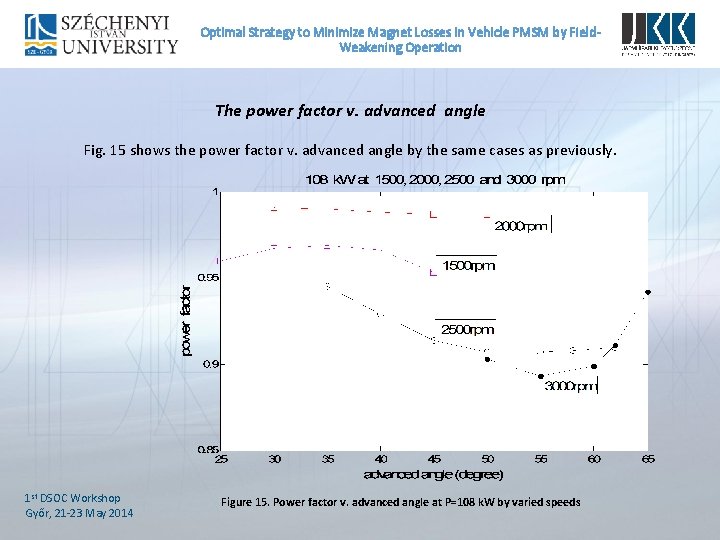
Optimal Strategy to Minimize Magnet Losses In Vehicle PMSM by Field. Weakening Operation The power factor v. advanced angle Fig. 15 shows the power factor v. advanced angle by the same cases as previously. 1 st DSOC Workshop Győr, 21 -23 May 2014 Figure 15. Power factor v. advanced angle at P=108 k. W by varied speeds
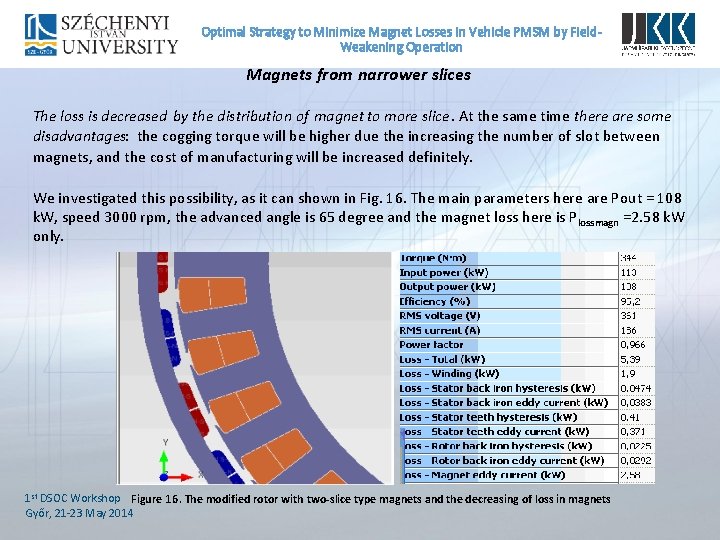
Optimal Strategy to Minimize Magnet Losses In Vehicle PMSM by Field. Weakening Operation Magnets from narrower slices The loss is decreased by the distribution of magnet to more slice. At the same time there are some disadvantages: the cogging torque will be higher due the increasing the number of slot between magnets, and the cost of manufacturing will be increased definitely. We investigated this possibility, as it can shown in Fig. 16. The main parameters here are Pout = 108 k. W, speed 3000 rpm, the advanced angle is 65 degree and the magnet loss here is Plossmagn =2. 58 k. W only. 1 st DSOC Workshop Figure 1 6. The modified rotor with two-slice type magnets and the decreasing of loss in magnets Győr, 21 -23 May 2014
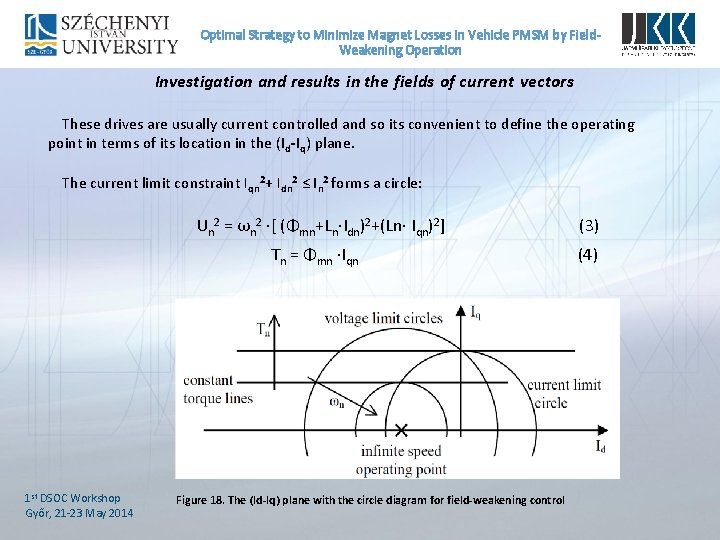
Optimal Strategy to Minimize Magnet Losses In Vehicle PMSM by Field. Weakening Operation Investigation and results in the fields of current vectors These drives are usually current controlled and so its convenient to define the operating point in terms of its location in the (Id-Iq) plane. The current limit constraint Iqn 2+ Idn 2 ≤ In 2 forms a circle: Un 2 = ωn 2 ·[ (Φmn+Ln·Idn)2+(Ln· Iqn)2] Tn = Φmn ·Iqn 1 st DSOC Workshop Győr, 21 -23 May 2014 Figure 18. The (Id-Iq) plane with the circle diagram for field-weakening control (3) (4)
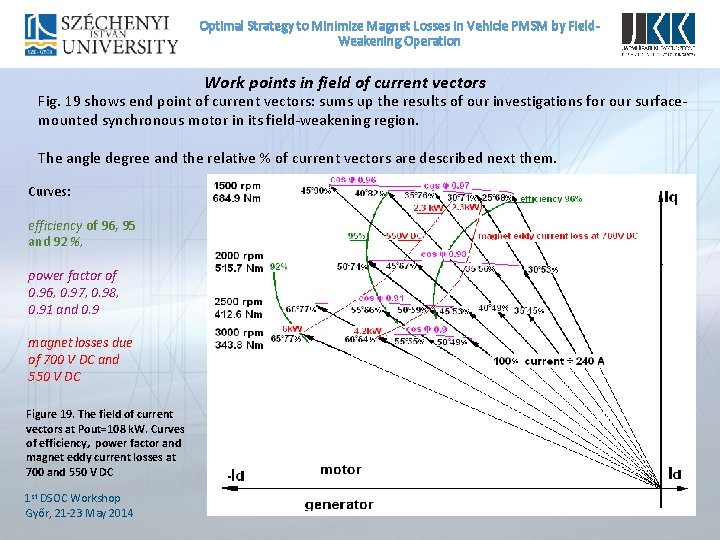
Optimal Strategy to Minimize Magnet Losses In Vehicle PMSM by Field. Weakening Operation Work points in field of current vectors Fig. 19 shows end point of current vectors: sums up the results of our investigations for our surfacemounted synchronous motor in its field-weakening region. The angle degree and the relative % of current vectors are described next them. Curves: efficiency of 96, 95 and 92 %, power factor of 0. 96, 0. 97, 0. 98, 0. 91 and 0. 9 magnet losses due of 700 V DC and 550 V DC Figure 19. The field of current vectors at Pout=108 k. W. Curves of efficiency, power factor and magnet eddy current losses at 700 and 550 V DC 1 st DSOC Workshop Győr, 21 -23 May 2014
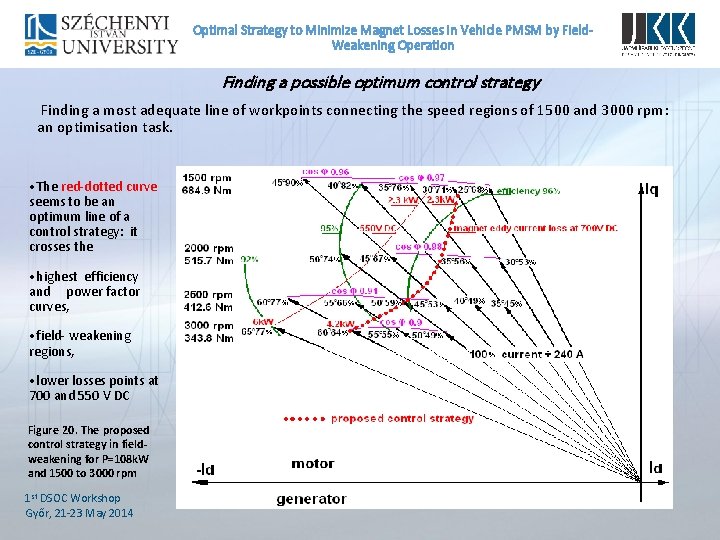
Optimal Strategy to Minimize Magnet Losses In Vehicle PMSM by Field. Weakening Operation Finding a possible optimum control strategy Finding a most adequate line of workpoints connecting the speed regions of 1500 and 3000 rpm: an optimisation task. • The red-dotted curve seems to be an optimum line of a control strategy: it crosses the • highest efficiency and power factor curves, • field- weakening regions, • lower losses points at 700 and 550 V DC Figure 20. The proposed control strategy in fieldweakening for P=108 k. W and 1500 to 3000 rpm 1 st DSOC Workshop Győr, 21 -23 May 2014
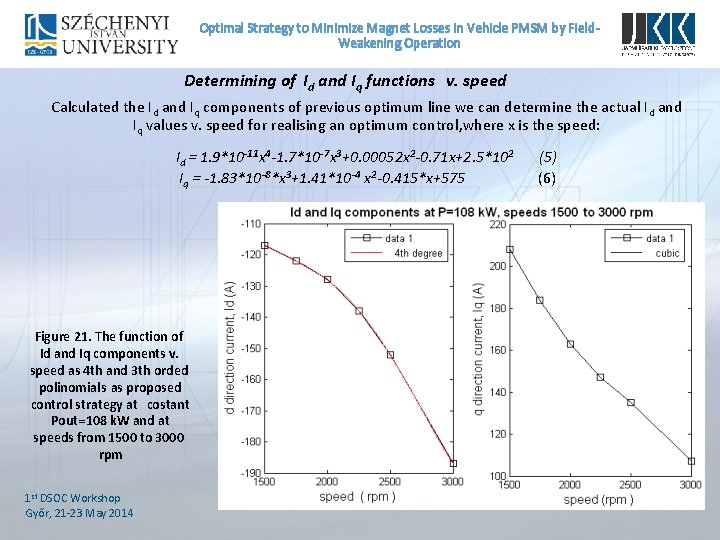
Optimal Strategy to Minimize Magnet Losses In Vehicle PMSM by Field. Weakening Operation Determining of Id and Iq functions v. speed Calculated the Id and Iq components of previous optimum line we can determine the actual Id and Iq values v. speed for realising an optimum control, where x is the speed: Id = 1. 9*10 -11 x 4 -1. 7*10 -7 x 3+0. 00052 x 2 -0. 71 x+2. 5*102 Iq = -1. 83*10 -8 *x 3+1. 41*10 -4 x 2 -0. 415*x+575 Figure 21. The function of Id and Iq components v. speed as 4 th and 3 th orded polinomials as proposed control strategy at costant Pout=108 k. W and at speeds from 1500 to 3000 rpm 1 st DSOC Workshop Győr, 21 -23 May 2014 (5) (6)
Optimal Strategy to Minimize Magnet Losses In Vehicle PMSM by Field. Weakening Operation Conclusions • The result of our work is a possible and achievable optimum strategy in Id -Iq plane. • Computing and drawing the curves of magnet losses, efficiency and power factor, in the field of current vectors it could be find the adequate controlling line. • From values of this line can be determined the (5) and (6) functions of Id and Iq component v. speed, • as actual reference current-signals for the control of PMSM in the field– weakening region, • with approximately a possible best optimum of magnet losses, power factor and efficiency, in case of at a constant DC voltage supplying. Acknowledgment • „TAMOP-4. 2. 2. A-11/1/KONV-2012 -0012: Basic research for the development of hybrid and electric vehicles - The Project is supported by the Hungarian Government and co-financed by the European Social Fund” 1 st DSOC Workshop Győr, 21 -23 May 2014
WORKSHOP ON DESIGN, SIMULATION, OPTIMIZATION AND CONTROL OF GREEN VEHICLES AND TRANSPORTATION THANK YOU FOR YOUR ATTENTION. Names: Peter Körös, Dr Istvan Szenasy, Zoltan Szeli, Dr Zoltan Varga Institute: Szechenyi University JKK Contact: Dr Zoltan Varga Email: vargaz. sze@gmail. com Tel. : +36 -96 503400
WORKSHOP ON DESIGN, SIMULATION, OPTIMIZATION AND CONTROL OF GREEN VEHICLES AND TRANSPORTATION BASIC RESEARCH FOR THE DEVELOPMENT OF HYBRID AND ELECTRIC VEHICLES TÁMOP-4. 2. 2. A-11/1/KONV-2012 -0012 "SMARTER TRANSPORT" - IT FOR CO-OPERATIVE TRANSPORT SYSTEM TÁMOP-4. 2. 2. C-11/1/KONV-2012 -0012 COOPERATION BETWEEN HIGHER EDUCATION, RESEARCH INSTITUTES AND AUTOMOTIVE INDUSTRY TÁMOP-4. 1. 1. C-12/1/KONV-2012 -0002 Nemzeti Fejlesztési Ügynökség www. ujszechenyiterv. gov. hu 06 40 638 1 st DSOC Workshop Győr, 21 -23 May 2014