
Workshop on Affective Haptics Emotion Augmentation through Affective

- Slides: 18
Workshop on Affective Haptics Emotion Augmentation through Affective Haptics and Visual Stimuli Dzmitry Tsetserukou Alena Neviarouskaya
Introduction Communication is a process of transferring information (e. g. , facts, thoughts, opinions, emotions) from one person to another. Channels of face-to-face communication: ü Verbal: • spoken words • prosodic features (intonation, stress, pitch, loudness, etc. ) ü Nonverbal: • gaze and eye movements • facial expressions • tints of facial skin • gestures • body postures • touch “Emotion is what gives communication life. A conversation between emotionally involved partners is bright and lively, but a meeting without feeling is deadly dull. ” Sally Planalp, 1999
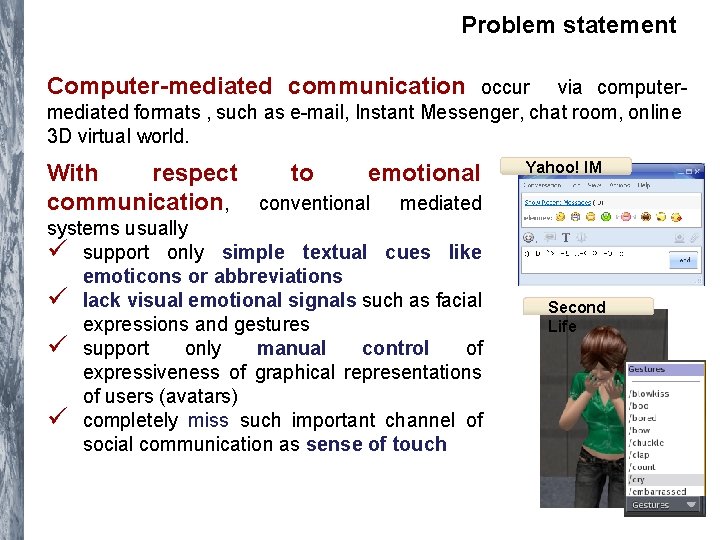
Problem statement Computer-mediated communication occur via computermediated formats , such as e-mail, Instant Messenger, chat room, online 3 D virtual world. With respect to emotional communication, conventional mediated systems usually ü support only simple textual cues like emoticons or abbreviations ü lack visual emotional signals such as facial expressions and gestures ü support only manual control of expressiveness of graphical representations of users (avatars) ü completely miss such important channel of social communication as sense of touch Yahoo! IM Second Life
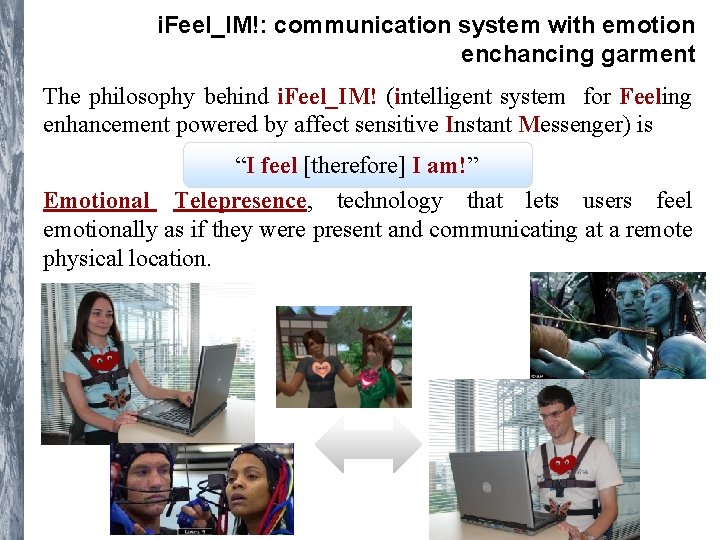
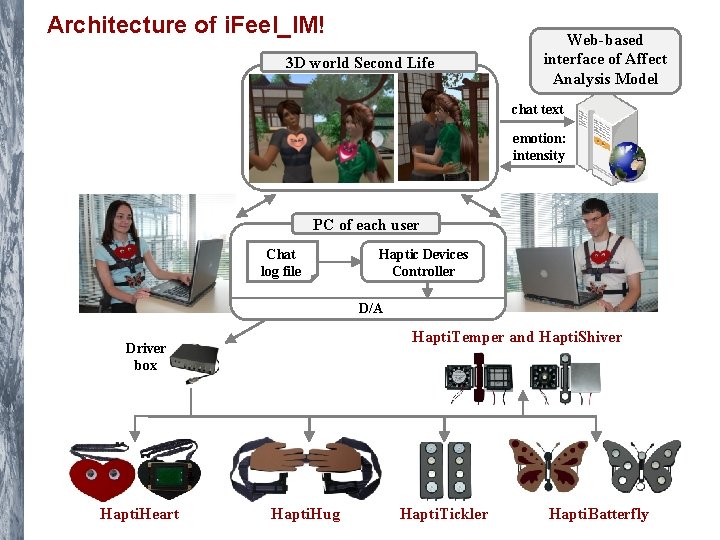
i. Feel_IM!: communication system with emotion enchancing garment The philosophy behind i. Feel_IM! (intelligent system for Feeling enhancement powered by affect sensitive Instant Messenger) is “I feel [therefore] I am!” Emotional Telepresence, technology that lets users feel emotionally as if they were present and communicating at a remote physical location.
Architecture of i. Feel_IM! 3 D world Second Life Web-based interface of Affect Analysis Model chat text emotion: intensity PC of each user Chat log file Haptic Devices Controller D/A Hapti. Temper and Hapti. Shiver Driver box Hapti. Heart Hapti. Hug Hapti. Tickler Hapti. Batterfly
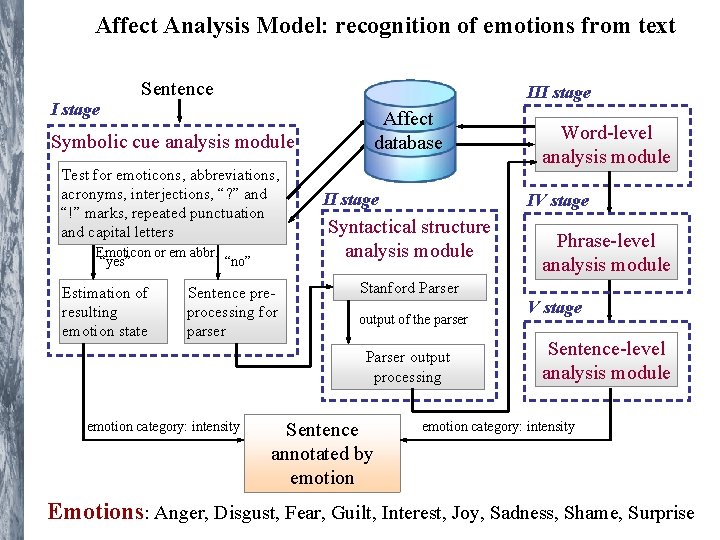
Affect Analysis Model: recognition of emotions from text I stage Sentence III stage Symbolic cue analysis module Test for emoticons, abbreviations, acronyms, interjections, “? ” and “!” marks, repeated punctuation and capital letters Emoticon or em abbr. “yes” “no” Estimation of resulting emotion state Sentence preprocessing for parser Affect database II stage IV stage Syntactical structure analysis module Phrase-level analysis module Stanford Parser output of the parser Parser output processing emotion category: intensity Word-level analysis module Sentence annotated by emotion V stage Sentence-level analysis module emotion category: intensity Emotions: Anger, Disgust, Fear, Guilt, Interest, Joy, Sadness, Shame, Surprise
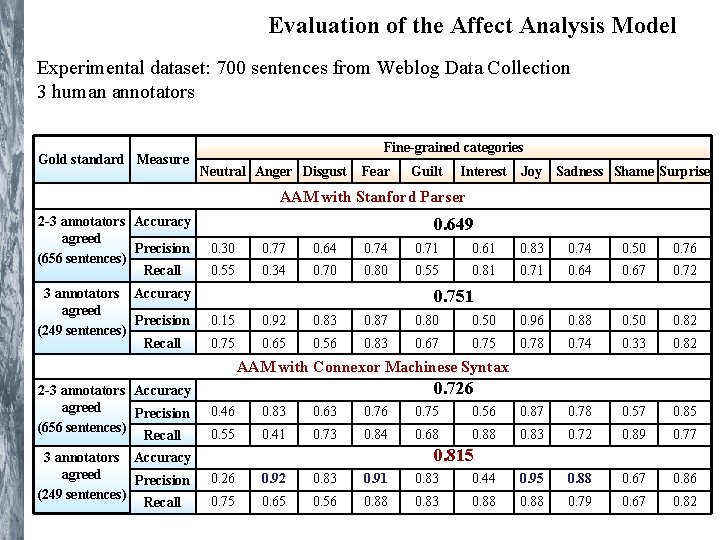
Evaluation of the Affect Analysis Model Experimental dataset: 700 sentences from Weblog Data Collection 3 human annotators Gold standard Measure Fine-grained categories Neutral Anger Disgust Fear Guilt Interest Joy Sadness Shame Surprise AAM with Stanford Parser 2 -3 annotators Accuracy agreed Precision (656 sentences) Recall 3 annotators Accuracy agreed Precision (249 sentences) Recall 0. 649 0. 30 0. 77 0. 64 0. 71 0. 61 0. 83 0. 74 0. 50 0. 76 0. 55 0. 34 0. 70 0. 80 0. 55 0. 81 0. 71 0. 64 0. 67 0. 72 0. 751 0. 15 0. 92 0. 83 0. 87 0. 80 0. 50 0. 96 0. 88 0. 50 0. 82 0. 75 0. 65 0. 56 0. 83 0. 67 0. 75 0. 78 0. 74 0. 33 0. 82 AAM with Connexor Machinese Syntax 2 -3 annotators Accuracy agreed Precision (656 sentences) Recall 3 annotators Accuracy agreed Precision (249 sentences) Recall 0. 726 0. 46 0. 83 0. 63 0. 76 0. 75 0. 56 0. 87 0. 78 0. 57 0. 85 0. 55 0. 41 0. 73 0. 84 0. 68 0. 83 0. 72 0. 89 0. 77 0. 815 0. 26 0. 92 0. 83 0. 91 0. 83 0. 44 0. 95 0. 88 0. 67 0. 86 0. 75 0. 65 0. 56 0. 88 0. 83 0. 88 0. 79 0. 67 0. 82
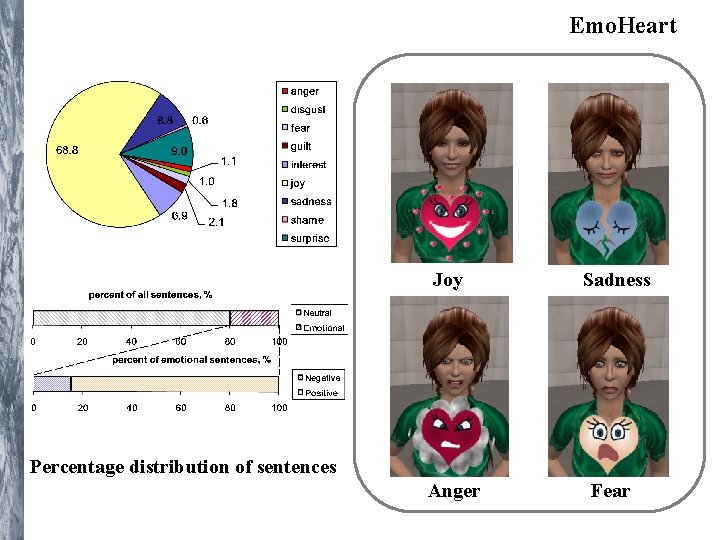
Emo. Heart Joy Sadness Percentage distribution of sentences Anger Fear
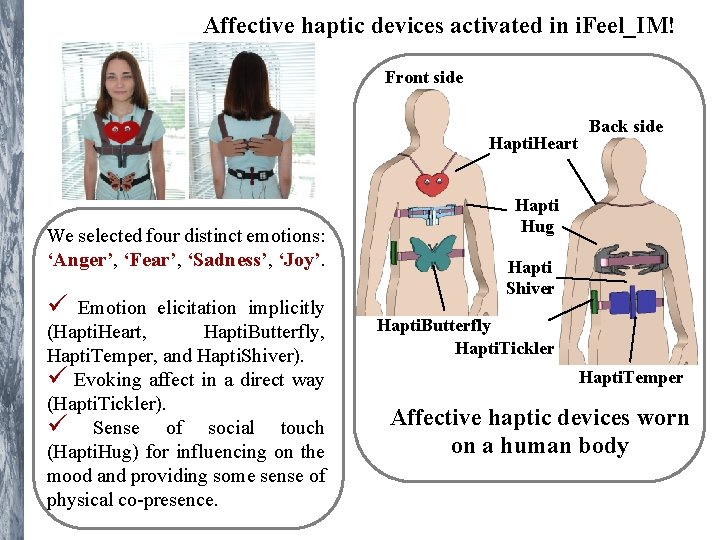
Affective haptic devices activated in i. Feel_IM! Front side Hapti. Heart We selected four distinct emotions: ‘Anger’, ‘Fear’, ‘Sadness’, ‘Joy’. ü Emotion elicitation implicitly (Hapti. Heart, Hapti. Butterfly, Hapti. Temper, and Hapti. Shiver). ü Evoking affect in a direct way (Hapti. Tickler). ü Sense of social touch (Hapti. Hug) for influencing on the mood and providing some sense of physical co-presence. Back side Hapti Hug Hapti Shiver Hapti. Butterfly Hapti. Tickler Hapti. Temper Affective haptic devices worn on a human body
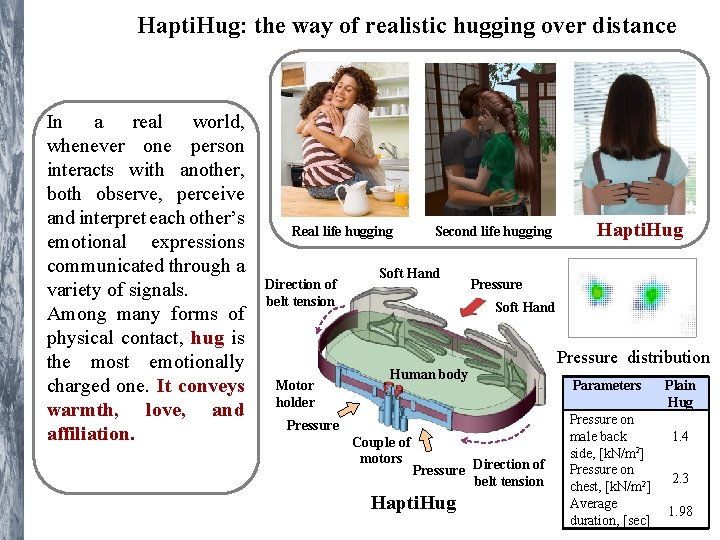
Hapti. Hug: the way of realistic hugging over distance In a real world, whenever one person interacts with another, both observe, perceive and interpret each other’s emotional expressions communicated through a variety of signals. Among many forms of physical contact, hug is the most emotionally charged one. It conveys warmth, love, and affiliation. Real life hugging Direction of belt tension Motor holder Second life hugging Soft Hand Hapti. Hug Pressure Soft Hand Human body Pressure Couple of motors Pressure Direction of belt tension Hapti. Hug Pressure distribution Parameters Pressure on male back side, [k. N/m 2] Pressure on chest, [k. N/m 2] Average duration, [sec] Plain Hug 1. 4 2. 3 1. 98
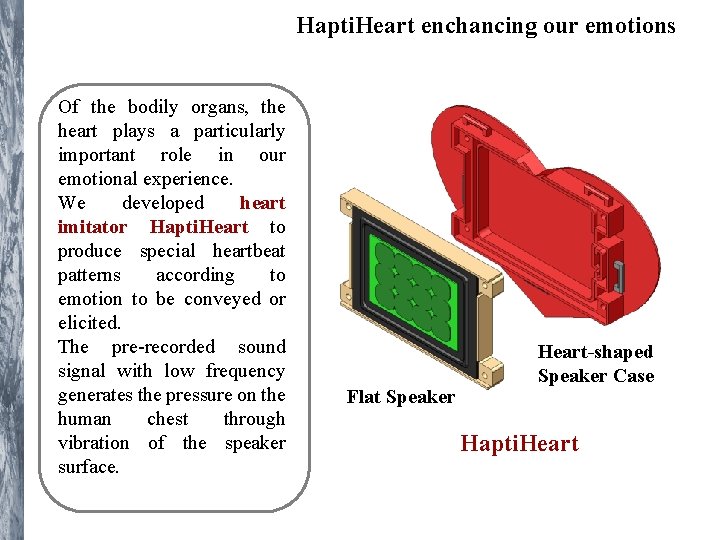
Hapti. Heart enchancing our emotions Of the bodily organs, the heart plays a particularly important role in our emotional experience. We developed heart imitator Hapti. Heart to produce special heartbeat patterns according to emotion to be conveyed or elicited. The pre-recorded sound signal with low frequency generates the pressure on the human chest through vibration of the speaker surface. Flat Speaker Heart-shaped Speaker Case Hapti. Heart
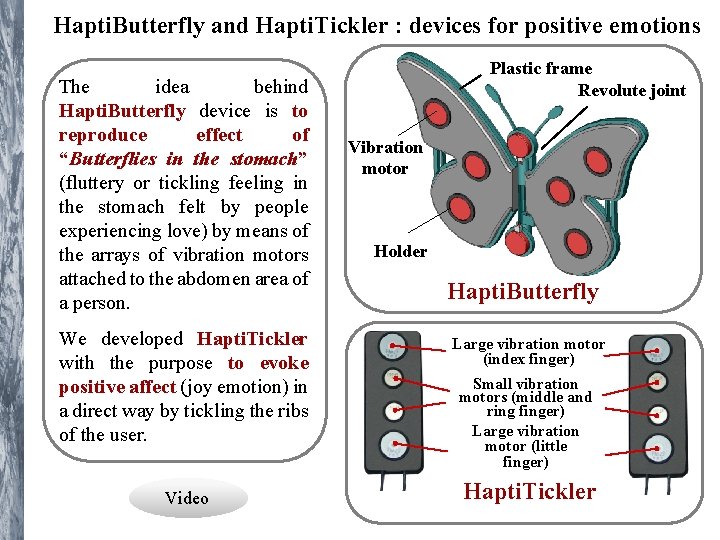
Hapti. Butterfly and Hapti. Tickler : devices for positive emotions The idea behind Hapti. Butterfly device is to reproduce effect of “Butterflies in the stomach” (fluttery or tickling feeling in the stomach felt by people experiencing love) by means of the arrays of vibration motors attached to the abdomen area of a person. We developed Hapti. Tickler with the purpose to evoke positive affect (joy emotion) in a direct way by tickling the ribs of the user. Video Plastic frame Revolute joint Vibration motor Holder Hapti. Butterfly Large vibration motor (index finger) Small vibration motors (middle and ring finger) Large vibration motor (little finger) Hapti. Tickler
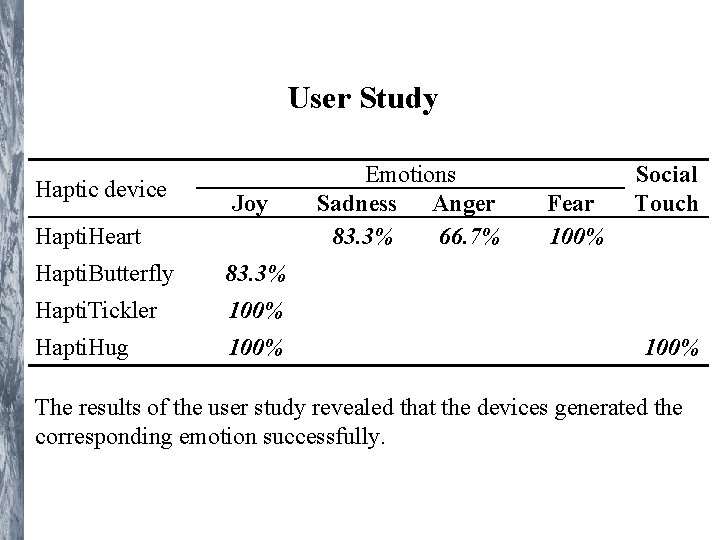
User Study Haptic device Joy Hapti. Heart Hapti. Butterfly 83. 3% Hapti. Tickler 100% Hapti. Hug 100% Emotions Sadness Anger 83. 3% 66. 7% Fear 100% Social Touch 100% The results of the user study revealed that the devices generated the corresponding emotion successfully.
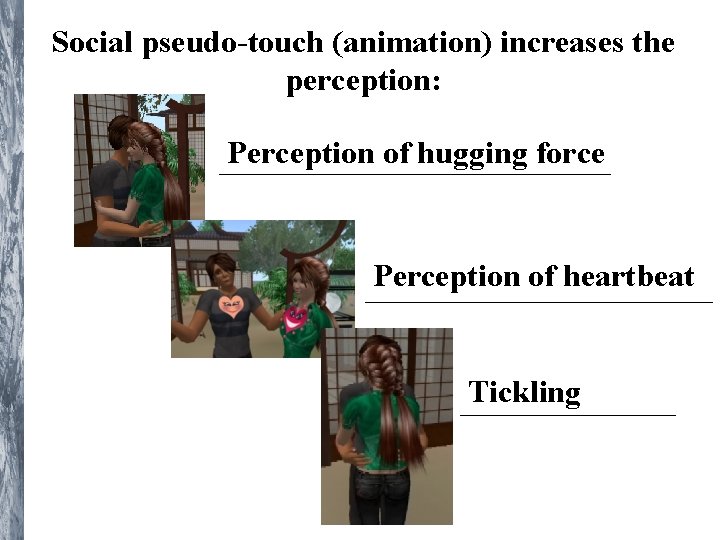
Social pseudo-touch (animation) increases the perception: Perception of hugging force Perception of heartbeat Tickling
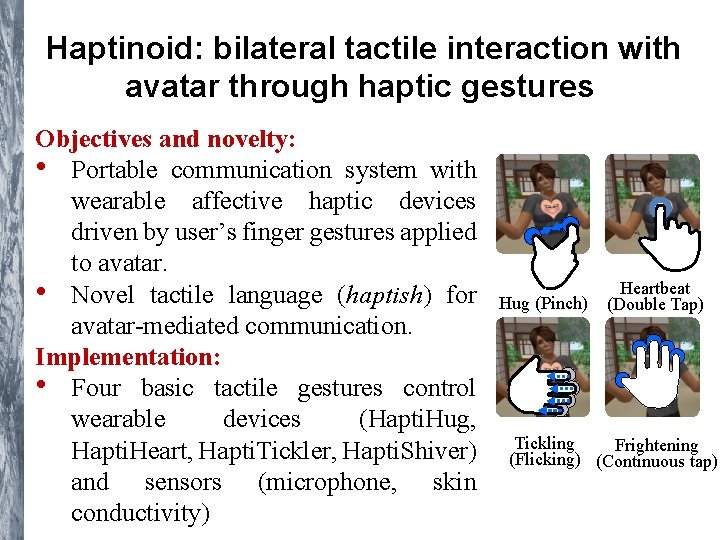
Haptinoid: bilateral tactile interaction with avatar through haptic gestures Objectives and novelty: • Portable communication system with wearable affective haptic devices driven by user’s finger gestures applied to avatar. • Novel tactile language (haptish) for avatar-mediated communication. Implementation: • Four basic tactile gestures control wearable devices (Hapti. Hug, Hapti. Heart, Hapti. Tickler, Hapti. Shiver) and sensors (microphone, skin conductivity) Hug (Pinch) Heartbeat (Double Tap) Tickling Frightening (Flicking) (Continuous tap)
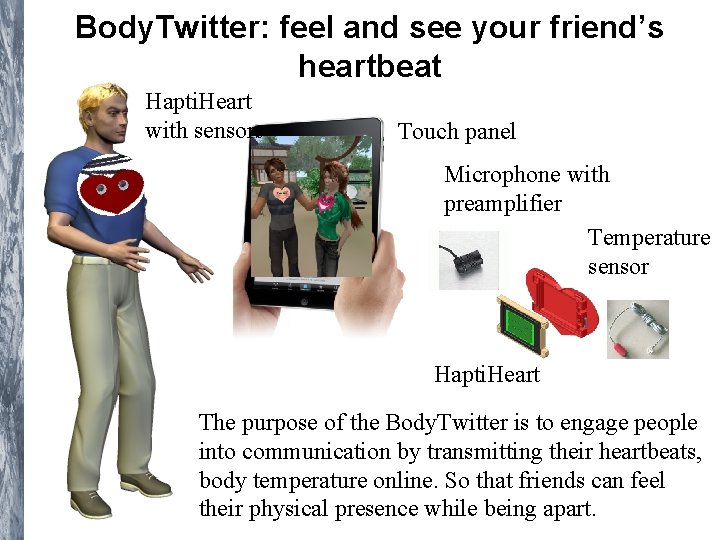
Body. Twitter: feel and see your friend’s heartbeat Hapti. Heart with sensors Touch panel Microphone with preamplifier Temperature sensor Hapti. Heart The purpose of the Body. Twitter is to engage people into communication by transmitting their heartbeats, body temperature online. So that friends can feel their physical presence while being apart.
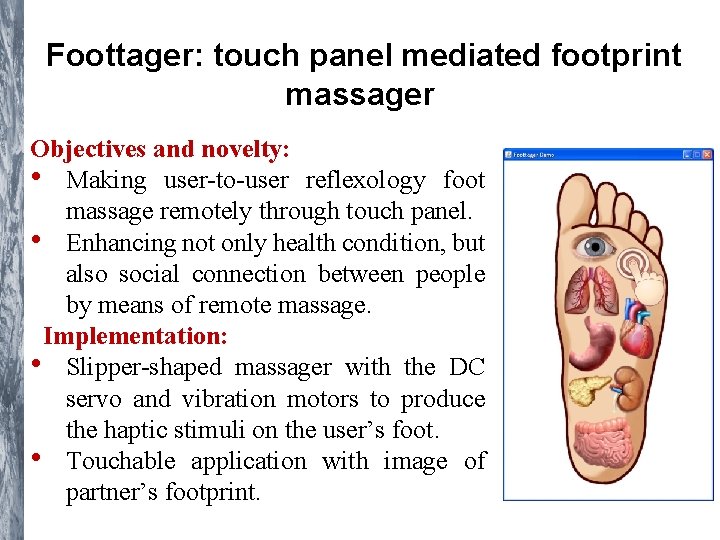
Foottager: touch panel mediated footprint massager Objectives and novelty: • Making user-to-user reflexology foot massage remotely through touch panel. • Enhancing not only health condition, but also social connection between people by means of remote massage. Implementation: • Slipper-shaped massager with the DC servo and vibration motors to produce the haptic stimuli on the user’s foot. • Touchable application with image of partner’s footprint.
Thank you!