
Workshop in ENT Coding Marie Gilbert PAC DFAAPA
Workshop in ENT Coding Marie Gilbert, PA-C, DFAAPA, CMPA Seventh Annual ENT for the PA-C | April 21 -23, 2017| Chicago, IL
Speaker Disclosure • I have no commercial relationships to disclose. • I am a PA-C and a Certified Professional Medical Auditor. Seventh Annual ENT for the PA-C | April 21 -23, 2017| Chicago, IL
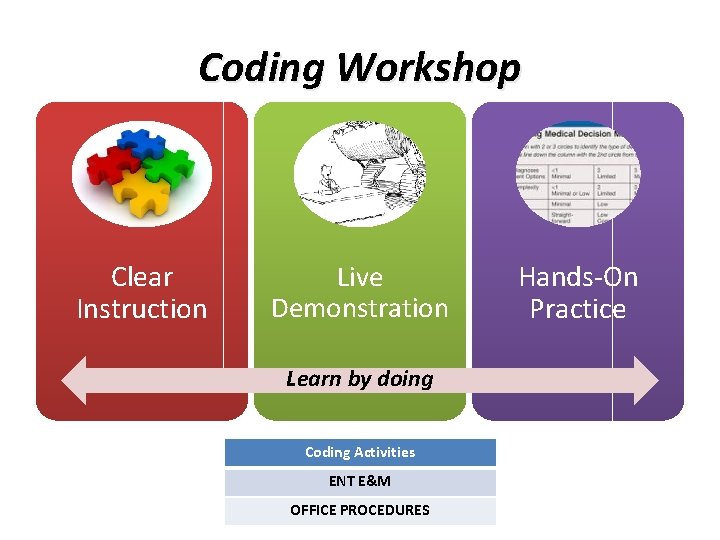
Coding Workshop Clear Instruction Live Demonstration Learn by doing Coding Activities ENT E&M OFFICE PROCEDURES Hands-On Practice
Learning Objectives • Recognize the required components for ENT Specialty Evaluation and Management coding. • Document appropriately to support medically necessary levels of E&M coding. • Employ correct codes for ENT office procedures. Seventh Annual ENT for the PA-C | April 21 -23, 2017| Chicago, IL
CPT® Disclaimer CPT copyright 2017 American Medical Association. All rights reserved. Fee schedules, relative value units, conversion factors and/or related components are not assigned by the AMA, are not part of CPT, and the AMA is not recommending their use. The AMA does not directly or indirectly practice medicine or dispense medical services. The AMA assumes no liability for data contained or not contained herein. CPT is a registered trademark of the American Medical Association. Seventh Annual ENT for the PA-C | April 21 -23, 2017| Chicago, IL
THE BASICS • E&M means “Evaluation and Management” • Different E&M codes apply in the office and hospital • There are two sets of documentation guidelines on office E&M: 1995 and 1997. MOST times 1997 is best for specialties like ENT. • Procedure coding has its own set of rules. Seventh Annual ENT for the PA-C | April 21 -23, 2017| Chicago, IL
Documentation Requirements • Documentation should be legible to someone other than the documenting provider and their staff. • The date of service, name of the patient, and the name of the actual provider of service should be easily demonstrated by the documentation. • The documentation should support the nature of the visit and the medical necessity of the services rendered. Seventh Annual ENT for the PA-C | April 21 -23, 2017| Chicago, IL
A Way to think about Medical Necessity • Does this problem pose a threat to life or bodily function within 24 -48 hours? (Level Five) • Under what circumstances would you see this patient in follow-up sooner than typically required? (Level Four) • Which patient problems have you very concerned for the patient but do not pose an imminent threat to life or bodily function? (Level Four) • Which problems can commonly be diagnosed on the first encounter and do not usually require a prompt follow-up? (Level Three) • Which problems might you bring a patient back for a quick check, and on doing so discover no further medical management is needed? (Level Two) • Which diagnoses are self-limited and require reassurance with no active medical management? (Level One) • Would a non-friendly medical peer agree with your decisions?
Evaluation & Management Seventh Annual ENT for the PA-C | April 21 -23, 2017| Chicago, IL
What are E&M Codes? Evaluation & Management are provider service codes used to bill for • Office Visits • Hospital Inpatient, Outpatient, Emergency Room • Home, nursing facility, etc. E&M are Non-procedural codes that capture elements recalled by the acronym “HEM” – History – Exam – Medical Decision-Making (TIME can also be a factor)
Evaluation & Management History Seventh Annual ENT for the PA-C | April 21 -23, 2017| Chicago, IL
Evaluation & Management History • Three pieces used to determine level of History: 1. HPI – History of Present Illness 2. ROS – Review of Systems 3. PFSH – Past, Family, Social History • Four levels or scores PF = Problem Focused EPF = Expanded Problem Focused D = Detailed C = Comprehensive Seventh Annual ENT for the PA-C | April 21 -23, 2017| Chicago, IL
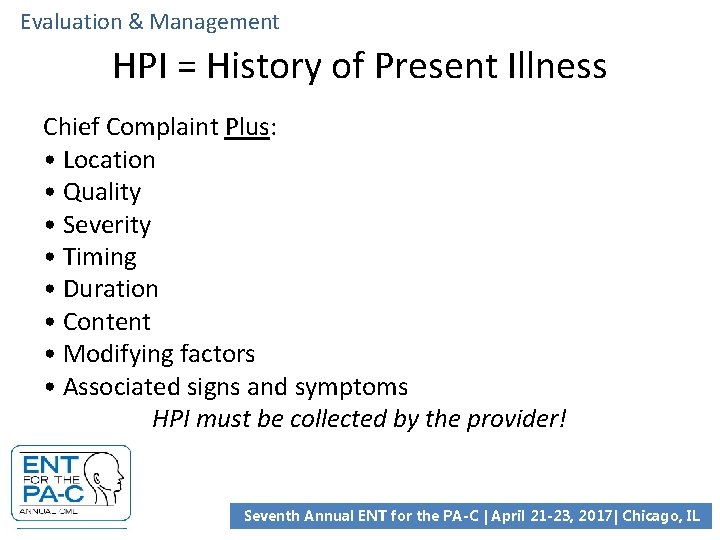
Evaluation & Management HPI = History of Present Illness Chief Complaint Plus: • Location • Quality • Severity • Timing • Duration • Content • Modifying factors • Associated signs and symptoms HPI must be collected by the provider! Seventh Annual ENT for the PA-C | April 21 -23, 2017| Chicago, IL
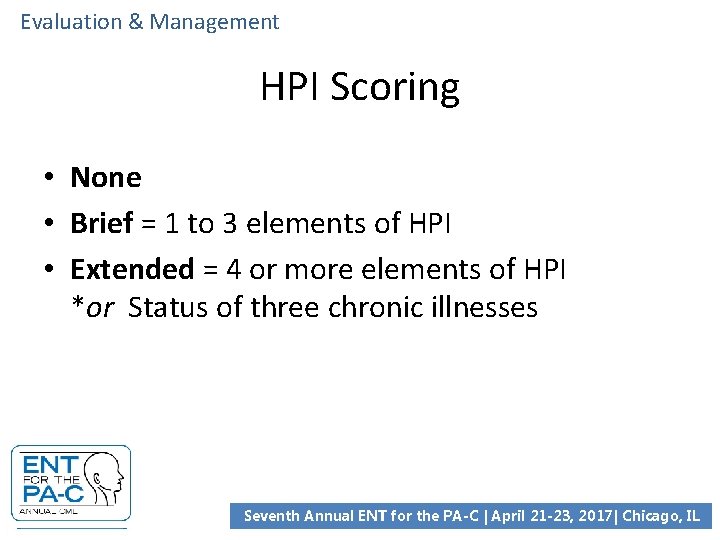
Evaluation & Management HPI Scoring • None • Brief = 1 to 3 elements of HPI • Extended = 4 or more elements of HPI *or Status of three chronic illnesses Seventh Annual ENT for the PA-C | April 21 -23, 2017| Chicago, IL
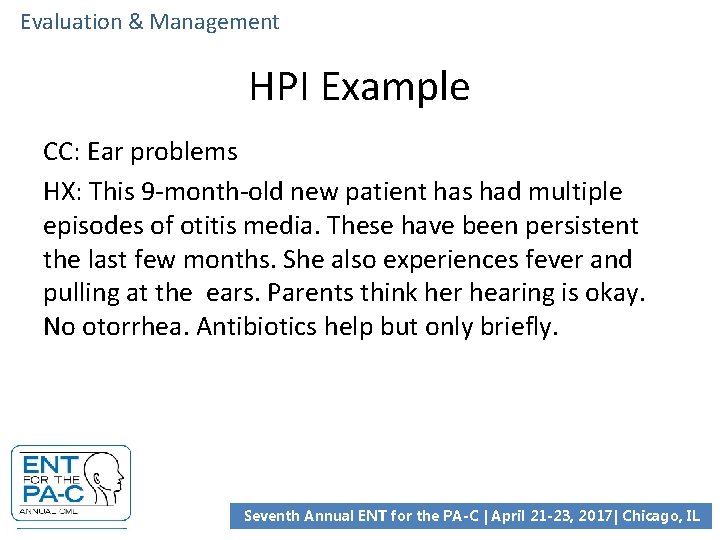
Evaluation & Management HPI Example CC: Ear problems HX: This 9 -month-old new patient has had multiple episodes of otitis media. These have been persistent the last few months. She also experiences fever and pulling at the ears. Parents think her hearing is okay. No otorrhea. Antibiotics help but only briefly. Seventh Annual ENT for the PA-C | April 21 -23, 2017| Chicago, IL
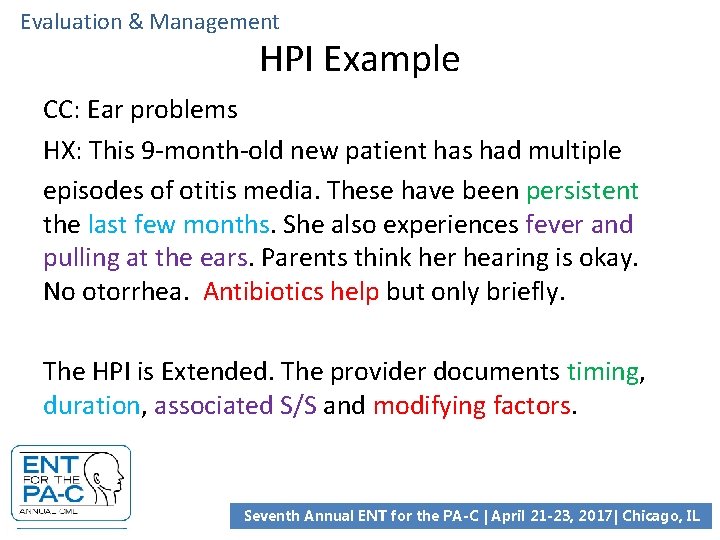
Evaluation & Management HPI Example CC: Ear problems HX: This 9 -month-old new patient has had multiple episodes of otitis media. These have been persistent the last few months. She also experiences fever and pulling at the ears. Parents think her hearing is okay. No otorrhea. Antibiotics help but only briefly. The HPI is Extended. The provider documents timing, duration, associated S/S and modifying factors. Seventh Annual ENT for the PA-C | April 21 -23, 2017| Chicago, IL
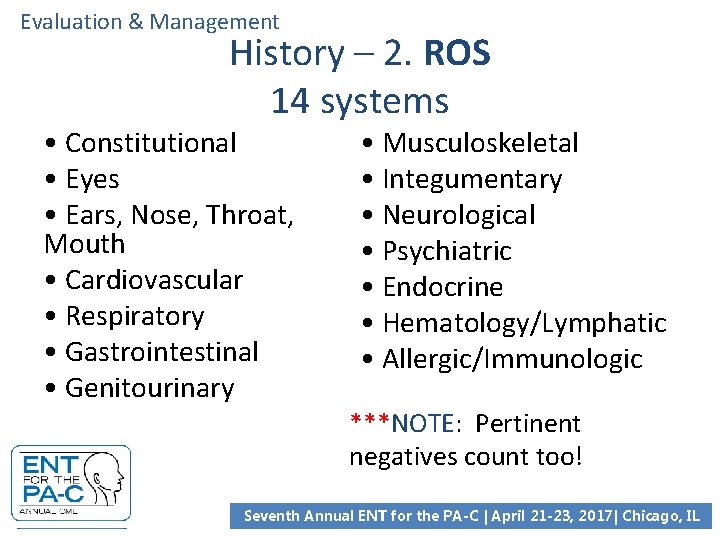
Evaluation & Management History – 2. ROS 14 systems • Constitutional • Eyes • Ears, Nose, Throat, Mouth • Cardiovascular • Respiratory • Gastrointestinal • Genitourinary • Musculoskeletal • Integumentary • Neurological • Psychiatric • Endocrine • Hematology/Lymphatic • Allergic/Immunologic ***NOTE: Pertinent negatives count too! Seventh Annual ENT for the PA-C | April 21 -23, 2017| Chicago, IL
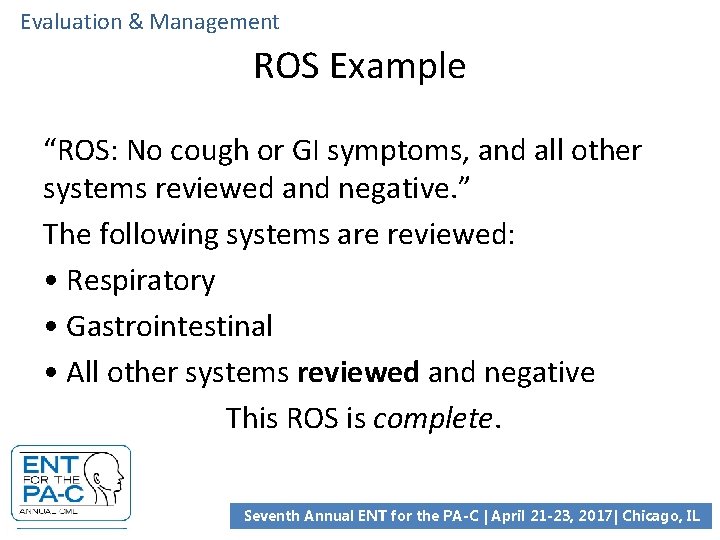
Evaluation & Management ROS Example “ROS: No cough or GI symptoms, and all other systems reviewed and negative. ” The following systems are reviewed: • Respiratory • Gastrointestinal • All other systems reviewed and negative This ROS is complete. Seventh Annual ENT for the PA-C | April 21 -23, 2017| Chicago, IL
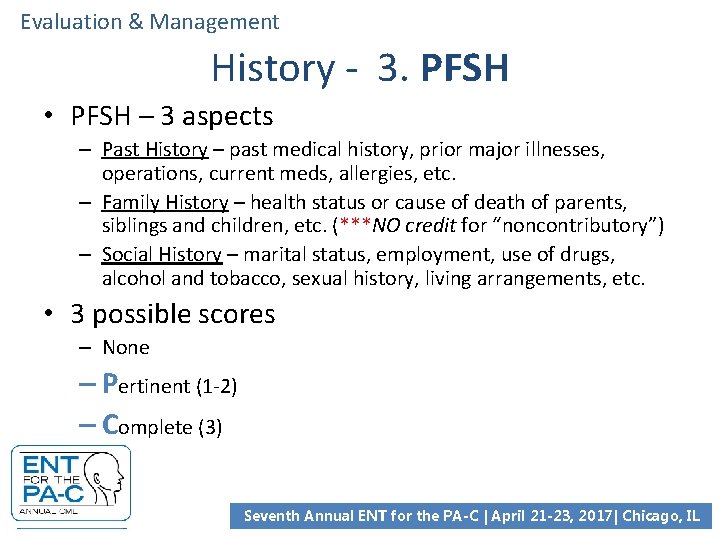
Evaluation & Management History - 3. PFSH • PFSH – 3 aspects – Past History – past medical history, prior major illnesses, operations, current meds, allergies, etc. – Family History – health status or cause of death of parents, siblings and children, etc. (***NO credit for “noncontributory”) – Social History – marital status, employment, use of drugs, alcohol and tobacco, sexual history, living arrangements, etc. • 3 possible scores – None – Pertinent (1 -2) – Complete (3) Seventh Annual ENT for the PA-C | April 21 -23, 2017| Chicago, IL
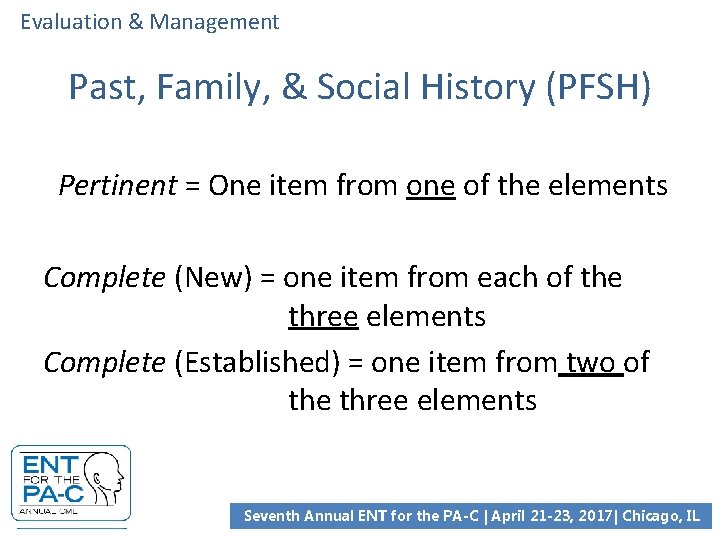
Evaluation & Management Past, Family, & Social History (PFSH) Pertinent = One item from one of the elements Complete (New) = one item from each of the three elements Complete (Established) = one item from two of the three elements Seventh Annual ENT for the PA-C | April 21 -23, 2017| Chicago, IL
Evaluation & Management PFSH Example “PMH: No asthma or diabetes. MEDS: None ALLERGIES: NKDA” This PFSH is pertinent. The provider documents 3 elements of the past medical history, but no Family or Social history. Seventh Annual ENT for the PA-C | April 21 -23, 2017| Chicago, IL
Evaluation & Management What about “Interval History? ” • Linking prior histories while indicating what has changed and not changed will provide documentation for the same history level that was documented in the linked visit. • Adequate documentation of interval history would be a statement similar to: – “Reviewed history of 9/23/14 and there are no remarkable changes” OR – “Reviewed history of 10/3/2014 which only showed the following remarkable changes • D/C Dymista • Congestion increased from 2/5 to 4/5” Seventh Annual ENT for the PA-C | April 21 -23, 2017| Chicago, IL

Evaluation & Management Determine level of HISTORY (3 of 3) HPI ROS PFSH Brief (1 -3) N/A Brief (1 -3) Problem Pertinent (1) N/A Extended (4+) Extended (2 - 9) Pertinent (1) Extended (4+) Complete (10+) Complete (New Patient=3, Established =2) History level PF (99201, 99212) EPF (99202, 99213) D (99203, 99214) C (99204, 99205, 99215)
Evaluation & Management Exam Seventh Annual ENT for the PA-C | April 21 -23, 2017| Chicago, IL
Evaluation & Management Documentation Guidelines on Exam DG: Specific abnormal and relevant negative findings of the examination of the affected or symptomatic body area(s) or organ system(s) should be documented and described. A notation of “abnormal” without elaboration is insufficient. DG: A brief statement or notation indicating “negative” or “normal” is sufficient to document normal findings related to unaffected area(s) or asymptomatic organ system(s). Seventh Annual ENT for the PA-C | April 21 -23, 2017| Chicago, IL
Evaluation & Management Physical Exam The 1995 Guidelines • General Multi-System • Single Systems – referred to, but not defined • For complete written 1995 E&M Guidelines go to: http: //www. cms. gov/Outreach-and-Education/Medicare-Learning-Network. MLN/MLNEd. Web. Guide/Downloads/95 Docguidelines. pdf The 1997 Guidelines • General Multi-System • 10 Single Organ Systems Bulleted Exams including ENT • For complete written 1997 E&M Guidelines go to: http: //www. cms. gov/Outreach-and-Education/Medicare-Learning-Network. MLN/MLNEd. Web. Guide/Downloads/97 Docguidelines. pdf Seventh Annual ENT for the PA-C | April 21 -23, 2017| Chicago, IL
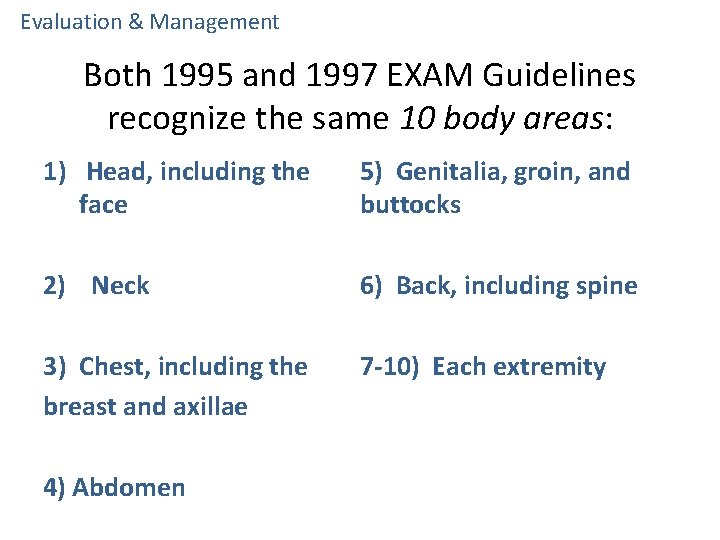
Evaluation & Management Both 1995 and 1997 EXAM Guidelines recognize the same 10 body areas: 1) Head, including the face 2) Neck 3) Chest, including the breast and axillae 4) Abdomen 5) Genitalia, groin, and buttocks 6) Back, including spine 7 -10) Each extremity
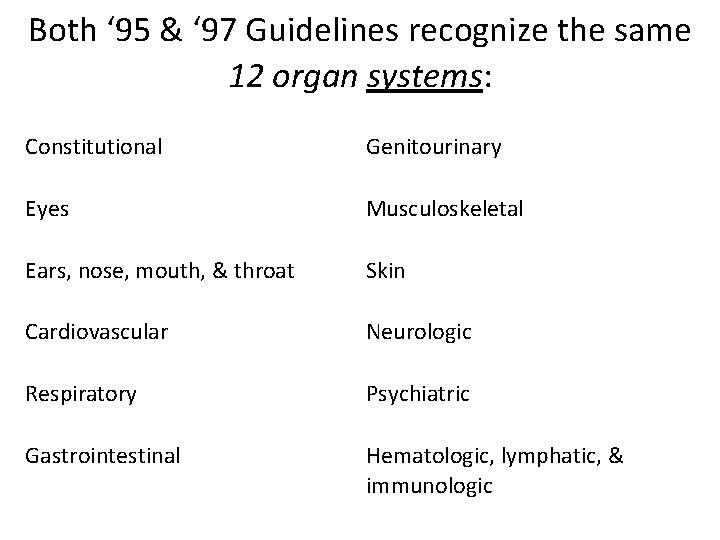
Both ‘ 95 & ‘ 97 Guidelines recognize the same 12 organ systems: Constitutional Eyes Ears, nose, mouth, & throat Cardiovascular Respiratory Gastrointestinal Genitourinary Musculoskeletal Skin Neurologic Psychiatric Hematologic, lymphatic, & immunologic
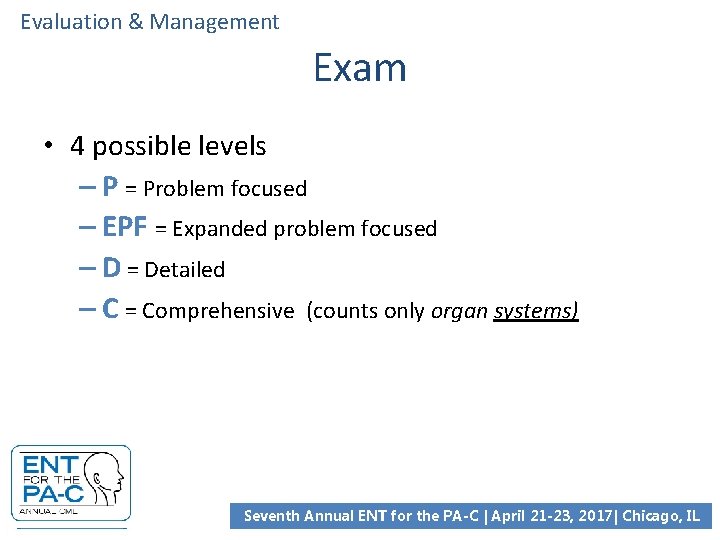
Evaluation & Management Exam • 4 possible levels – P = Problem focused – EPF = Expanded problem focused – D = Detailed – C = Comprehensive (counts only organ systems) Seventh Annual ENT for the PA-C | April 21 -23, 2017| Chicago, IL
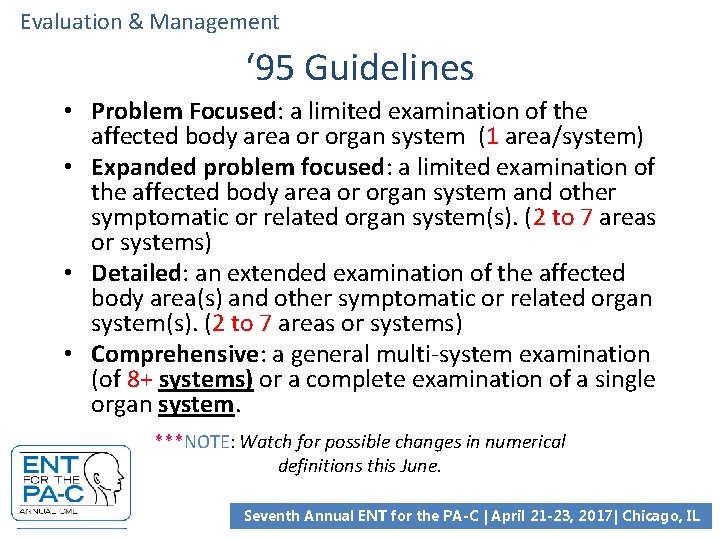
Evaluation & Management ‘ 95 Guidelines • Problem Focused: a limited examination of the affected body area or organ system (1 area/system) • Expanded problem focused: a limited examination of the affected body area or organ system and other symptomatic or related organ system(s). (2 to 7 areas or systems) • Detailed: an extended examination of the affected body area(s) and other symptomatic or related organ system(s). (2 to 7 areas or systems) • Comprehensive: a general multi-system examination (of 8+ systems) or a complete examination of a single organ system. ***NOTE: Watch for possible changes in numerical definitions this June. Seventh Annual ENT for the PA-C | April 21 -23, 2017| Chicago, IL
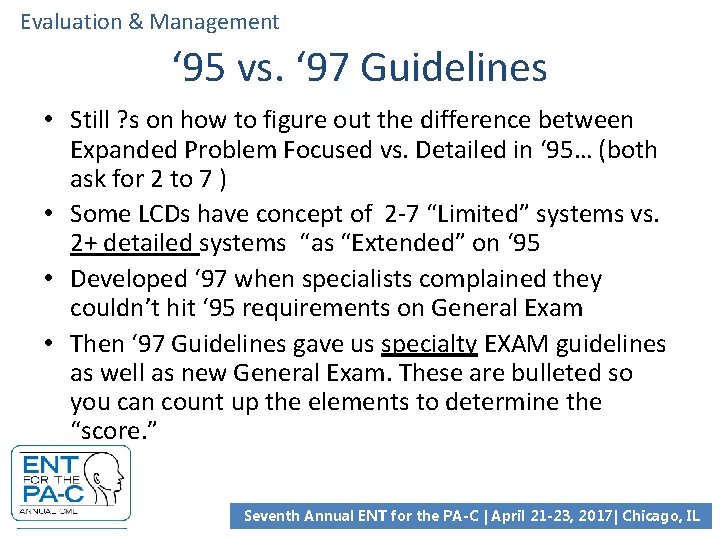
Evaluation & Management ‘ 95 vs. ‘ 97 Guidelines • Still ? s on how to figure out the difference between Expanded Problem Focused vs. Detailed in ‘ 95… (both ask for 2 to 7 ) • Some LCDs have concept of 2 -7 “Limited” systems vs. 2+ detailed systems “as “Extended” on ‘ 95 • Developed ‘ 97 when specialists complained they couldn’t hit ‘ 95 requirements on General Exam • Then ‘ 97 Guidelines gave us specialty EXAM guidelines as well as new General Exam. These are bulleted so you can count up the elements to determine the “score. ” Seventh Annual ENT for the PA-C | April 21 -23, 2017| Chicago, IL
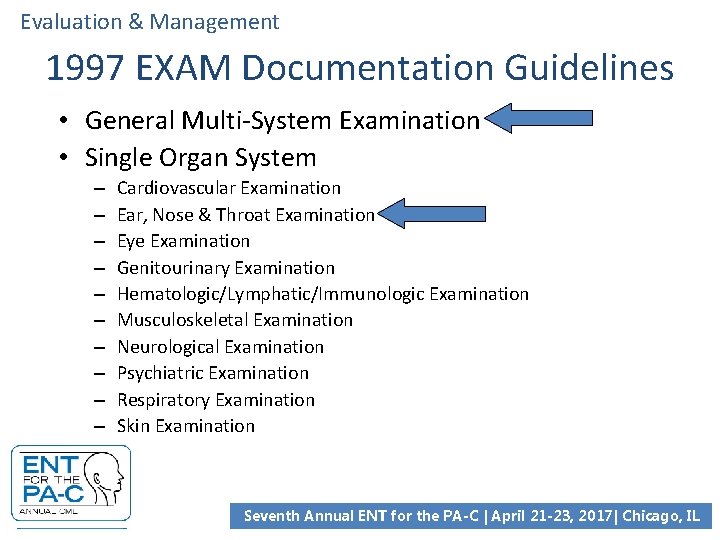
Evaluation & Management 1997 EXAM Documentation Guidelines • General Multi-System Examination • Single Organ System – – – – – Cardiovascular Examination Ear, Nose & Throat Examination Eye Examination Genitourinary Examination Hematologic/Lymphatic/Immunologic Examination Musculoskeletal Examination Neurological Examination Psychiatric Examination Respiratory Examination Skin Examination Seventh Annual ENT for the PA-C | April 21 -23, 2017| Chicago, IL
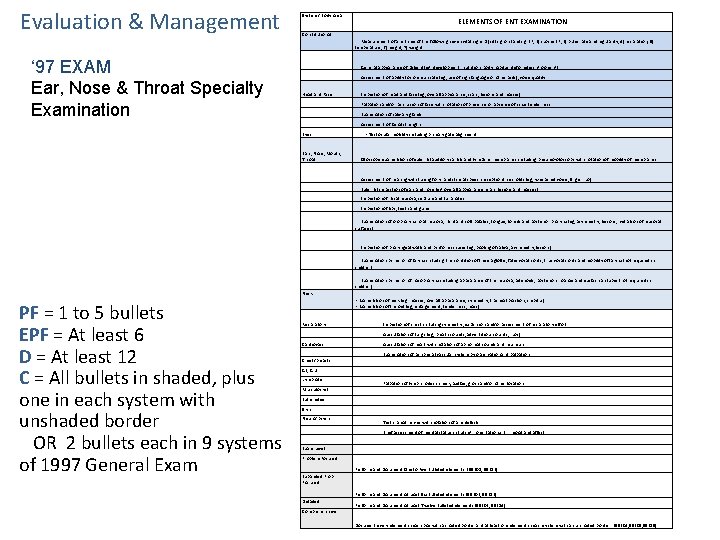
Evaluation & Management System / Body Area ELEMENTS OF ENT EXAMINATION Constitutional · Measurement of any three of the following seven vital signs: 1) sitting or standing BP, 2) supine BP, 3) pulse rate and regularity, 4) respiration, 5) temperature, 6) height, 7) weight ‘ 97 EXAM Ear, Nose & Throat Specialty Examination · General appearance of patient (eg, development, nutrition, body habitus, deformities, grooming) · Assessment of ability to communicate (eg, use of sign language or other aids), voice quality Head and Face · Inspection of head and face (eg, overall appearance, scars, lesions and masses) · Palpation and/or percussion of face with notation of presence or absence of sinus tenderness · Examination of salivary glands · Assessment of facial strength Eyes • Test ocular motility including primary gaze alignment Ears, Nose, Mouth, Throat · Otoscopic examination of external auditory canals and tympanic membranes including pneumo-otoscopy with notation of mobility of membranes · Assessment of hearing with tuning forks and clinical speech reception thresholds (eg, whispered voice, finger rub) · External inspection of ears and nose (eg, overall appearance, scars, lesions and masses) · Inspection of nasal mucosa, septum and turbinates · Inspection of lips, teeth and gums · Examination of oropharynx: oral mucosa, hard and soft palates, tongue, tonsils and posterior pharynx (eg, asymmetry, lesions, hydration of mucosal surfaces) · Inspection of pharyngeal walls and pyriform sinuses (eg, pooling of saliva, asymmetry, lesions) · Examination by mirror of larynx including the condition of the epiglottis, false vocal cords, true vocal cords and mobility of larynx (not required in children) · Examination by mirror of nasopharynx including appearance of the mucosa, adenoids, posterior choanae and eustachian tubes (not required in children) Neck PF = 1 to 5 bullets EPF = At least 6 D = At least 12 C = All bullets in shaded, plus one in each system with unshaded border OR 2 bullets each in 9 systems of 1997 General Exam • Examination of neck (eg. masses, overall appearance, symmetry, tracheal position, crepitus) • Examination of thyroid (eg, enlargement, tenderness, mass) Respiratory · Inspection of chest including symmetry, expansion and/or assessment of respiratory effort · Auscultation of lungs (eg, breath sounds, adventitious sounds, rubs) Cardiovasc. · Auscultation of heart with notation of abnormal sounds and murmurs · Examination of peripheral vascular system by observation and palpation Chest/breasts GI, GU Lymphatic · Palpation of lymph nodes in neck, axillae, groin and/or other location Musculoskel. Extremities Skin Neuro/ psych · Test cranial nerves with notation of any deficits · Brief assessment of mental status including · orientation x 3 · mood and affect Exam Level: Problem Focused Perform and Document One to Five Bulleted elements (99201, 99212) Expanded Prob. Focused Perform and Document At Least Six Bulleted elements (99202, 99213) Detailed Perform and Document At Least Twelve Bulleted elements (99203, 99214) Comprehen- sive Document every element in each box with a shaded border and at least one element in each system with an unshaded border. (99204, 99205, 99215)
Evaluation & Management Medical Decision Making Seventh Annual ENT for the PA-C | April 21 -23, 2017| Chicago, IL
Evaluation & Management Medical Decision Making RISK Seventh Annual ENT for the PA-C | April 21 -23, 2017| Chicago, IL
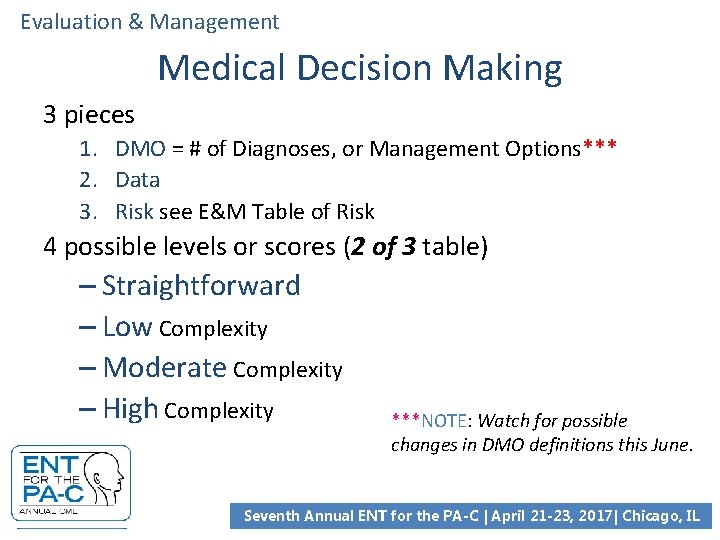
Evaluation & Management Medical Decision Making 3 pieces 1. DMO = # of Diagnoses, or Management Options*** 2. Data 3. Risk see E&M Table of Risk 4 possible levels or scores (2 of 3 table) – Straightforward – Low Complexity – Moderate Complexity – High Complexity ***NOTE: Watch for possible changes in DMO definitions this June. Seventh Annual ENT for the PA-C | April 21 -23, 2017| Chicago, IL
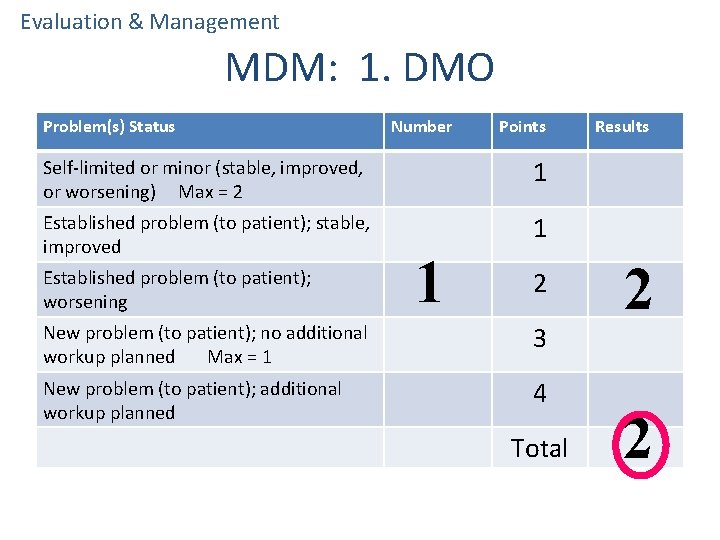
Evaluation & Management MDM: 1. DMO Problem(s) Status Number Points Self-limited or minor (stable, improved, or worsening) Max = 2 1 Established problem (to patient); stable, improved 1 Established problem (to patient); worsening 1 2 New problem (to patient); no additional workup planned Max = 1 3 New problem (to patient); additional workup planned 4 Total Results 2 2
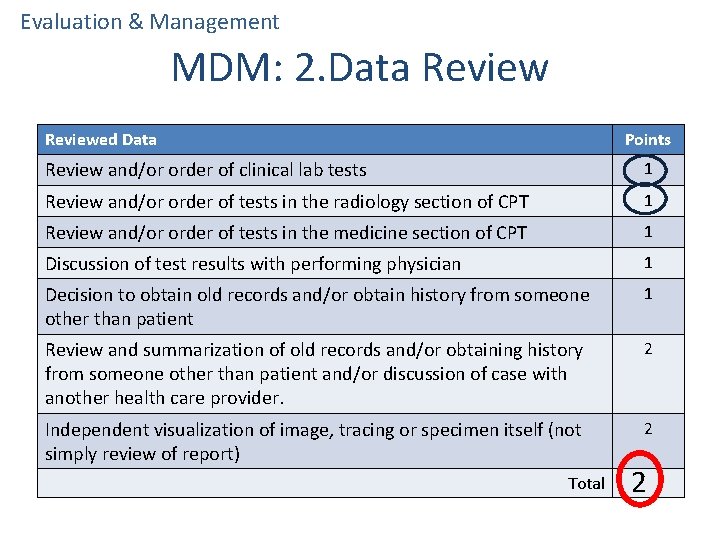
Evaluation & Management MDM: 2. Data Reviewed Data Points Review and/or order of clinical lab tests 1 Review and/or order of tests in the radiology section of CPT 1 Review and/or order of tests in the medicine section of CPT 1 Discussion of test results with performing physician 1 Decision to obtain old records and/or obtain history from someone other than patient 1 Review and summarization of old records and/or obtaining history from someone other than patient and/or discussion of case with another health care provider. 2 Independent visualization of image, tracing or specimen itself (not simply review of report) 2 Total 2
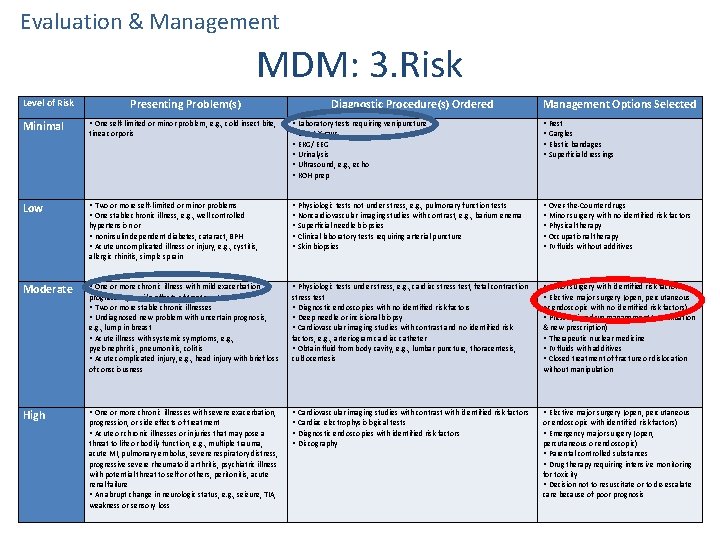
Evaluation & Management MDM: 3. Risk Level of Risk Minimal Presenting Problem(s) • One self-limited or minor problem, e. g. , cold insect bite, tinea corporis Diagnostic Procedure(s) Ordered Management Options Selected • Laboratory tests requiring venipuncture • Chest X-rays • EKG/ EEG • Urinalysis • Ultrasound, e. g. , echo • KOH prep • Rest • Gargles • Elastic bandages • Superficial dressings Low • Two or more self-limited or minor problems • One stable chronic illness, e. g. , well controlled hypertension or • noninsulin dependent diabetes, cataract, BPH • Acute uncomplicated illness or injury, e. g. , cystitis, allergic rhinitis, simple sprain • Physiologic tests not under stress, e. g. , pulmonary function tests • Noncardiovascular imaging studies with contrast, e. g. , barium enema • Superficial needle biopsies • Clinical laboratory tests requiring arterial puncture • Skin biopsies • Over-the-Counter drugs • Minor surgery with no identified risk factors • Physical therapy • Occupational therapy • IV fluids without additives Moderate • One or more chronic illness with mild exacerbation, progression, or side effects of treatment • Two or more stable chronic illnesses • Undiagnosed new problem with uncertain prognosis, e. g. , lump in breast • Acute illness with systemic symptoms, e. g. , pyelonephritis, pneumonitis, colitis • Acute complicated injury, e. g. , head injury with brief loss of consciousness • Physiologic tests under stress, e. g. , cardiac stress test, fetal contraction stress test • Diagnostic endoscopies with no identified risk factors • Deep needle or incisional biopsy • Cardiovascular imaging studies with contrast and no identified risk factors, e. g. , arteriogram cardiac catheter • Obtain fluid from body cavity, e. g. , lumbar puncture, thoracentesis, culdocentesis • Minor surgery with identified risk factors • Elective major surgery (open, percutaneous or endoscopic with no identified risk factors) • Prescription drug management (continuation & new prescription) • Therapeutic nuclear medicine • IV fluids with additives • Closed treatment of fracture or dislocation without manipulation High • One or more chronic illnesses with severe exacerbation, progression, or side effects of treatment • Acute or chronic illnesses or injuries that may pose a threat to life or bodily function, e. g. , multiple trauma, acute MI, pulmonary embolus, severe respiratory distress, progressive severe rheumatoid arthritis, psychiatric illness with potential threat to self or others, peritonitis, acute renal failure • An abrupt change in neurologic status, e. g. , seizure, TIA, weakness or sensory loss • Cardiovascular imaging studies with contrast with identified risk factors • Cardiac electrophysiological tests • Diagnostic endoscopies with identified risk factors • Discography • Elective major surgery (open, percutaneous or endoscopic with identified risk factors) • Emergency major surgery (open, percutaneous or endoscopic) • Parental controlled substances • Drug therapy requiring intensive monitoring for toxicity • Decision not to resuscitate or to de-escalate care because of poor prognosis
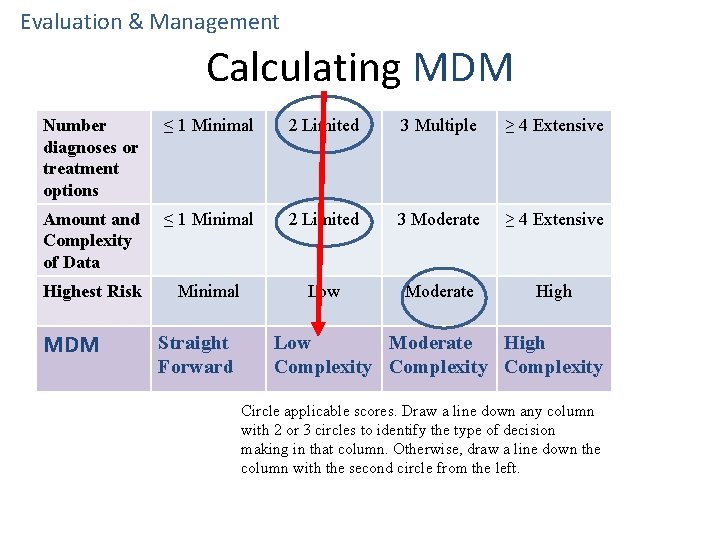
Evaluation & Management Calculating MDM Number diagnoses or treatment options ≤ 1 Minimal 2 Limited 3 Multiple ≥ 4 Extensive Amount and Complexity of Data ≤ 1 Minimal 2 Limited 3 Moderate ≥ 4 Extensive Highest Risk Minimal Low Moderate High MDM Straight Forward Low Moderate High Complexity Circle applicable scores. Draw a line down any column with 2 or 3 circles to identify the type of decision making in that column. Otherwise, draw a line down the column with the second circle from the left.
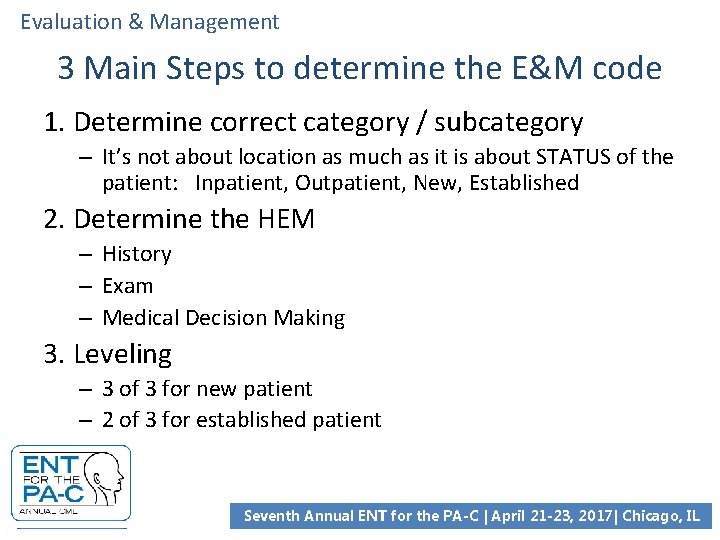
Evaluation & Management 3 Main Steps to determine the E&M code 1. Determine correct category / subcategory – It’s not about location as much as it is about STATUS of the patient: Inpatient, Outpatient, New, Established 2. Determine the HEM – History – Exam – Medical Decision Making 3. Leveling – 3 of 3 for new patient – 2 of 3 for established patient Seventh Annual ENT for the PA-C | April 21 -23, 2017| Chicago, IL
Evaluation & Management Step 1. Category: New vs. Established • New if not seen by same specialty in same practice (same tax ID) within 3 years • Applies to outpatient E&M services only – If they had a flu shot from your practice in January, then came in May for their first E&M visit, code them as a new patient • Q: Our physician in saw a patient in the hospital last week for the first time and now the patient presents at our office for an office visit. The hospital visit was coded as initial hospital care that includes new or established patients. Will the office visit code be new or established? A: Established. Seventh Annual ENT for the PA-C | April 21 -23, 2017| Chicago, IL
Evaluation & Management Step 1: Category / Subcategory • Office / Outpatient – If a patient is not admitted to “inpatient” status, then they are an outpatient • Consults – The 3 “R”s must be met (or 5) • Request for Opinion (with the Reason) • Rendering of an opinion • Reporting of the opinion back to requesting physician (and Return of patient to them after treatment) Seventh Annual ENT for the PA-C | April 21 -23, 2017| Chicago, IL
Evaluation & Management Step 1: Category / Subcategory • Emergency – Must be open 24 hours – Contrary to popular belief more than one physician can bill an ER code if different specialties • Critical Care, Neonatal Care – Documentation must show that the patient is indeed critical – not just in a critical care unit – refer to definition in CPT Seventh Annual ENT for the PA-C | April 21 -23, 2017| Chicago, IL
Evaluation & Management Step 1. Category / Subcategory • Nursing Facility – Assessments vs. problem oriented visits • Domiciliary, Rest Home or Custodial Care – Also used for Assisted Living • Prolonged Services – Add on codes when extra service is greater than 30 minutes more – Medicare seems to be the only payer that will pay for this – Can be appended to E&M or procedures Seventh Annual ENT for the PA-C | April 21 -23, 2017| Chicago, IL
Evaluation & Management Step 2. Determine the HEM • History & Exam Levels (Scores) – – Problem Focused Expanded Problem Focused Detailed Comprehensive • Medical Decision Making Levels (Scores) – – Straightforward Low Moderate High Seventh Annual ENT for the PA-C | April 21 -23, 2017| Chicago, IL
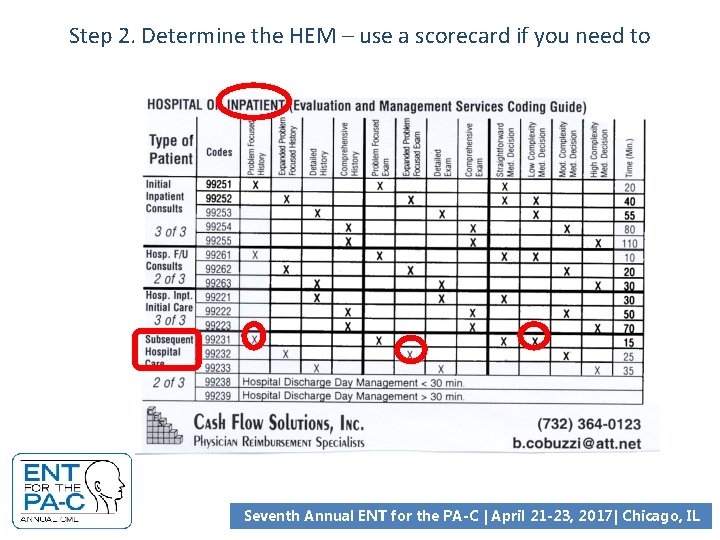
Step 2. Determine the HEM – use a scorecard if you need to Seventh Annual ENT for the PA-C | April 21 -23, 2017| Chicago, IL
Evaluation & Management E&M Step 3. Leveling • When 3 of 3 required, code the lowest • When 2 of 3 required, drop the lowest Let’s see what differs in “ 3 of 3” situation vs. a “ 2 of 3” situation… Seventh Annual ENT for the PA-C | April 21 -23, 2017| Chicago, IL
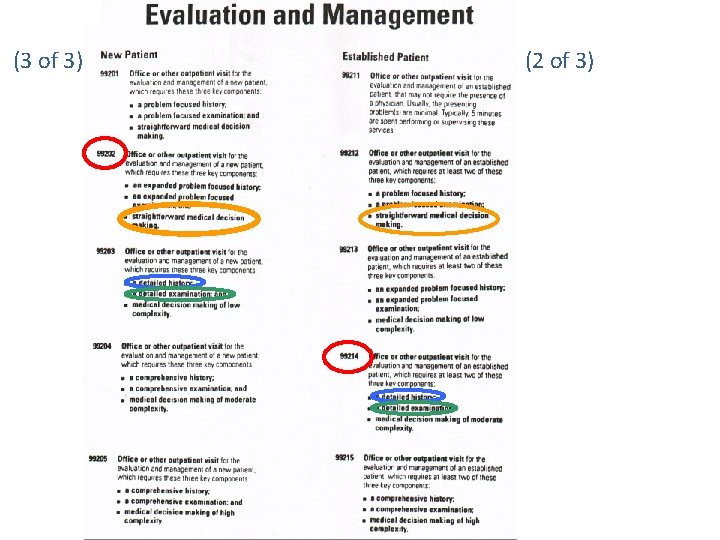
(3 of 3) (2 of 3)
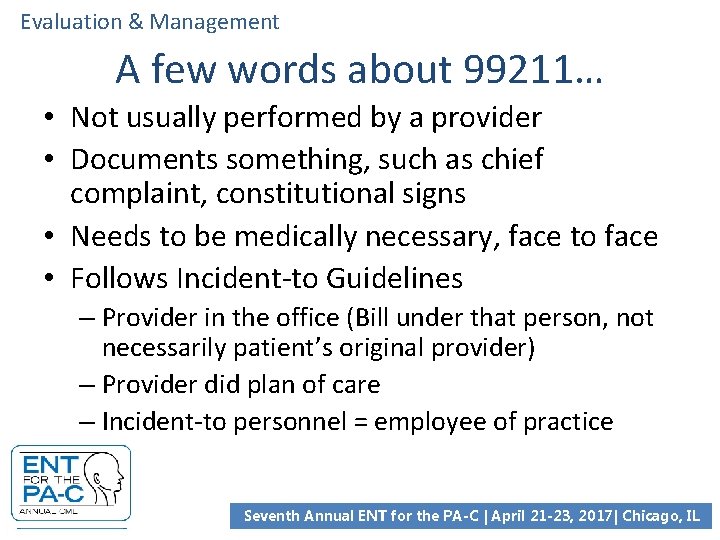
Evaluation & Management A few words about 99211… • Not usually performed by a provider • Documents something, such as chief complaint, constitutional signs • Needs to be medically necessary, face to face • Follows Incident-to Guidelines – Provider in the office (Bill under that person, not necessarily patient’s original provider) – Provider did plan of care – Incident-to personnel = employee of practice Seventh Annual ENT for the PA-C | April 21 -23, 2017| Chicago, IL
Evaluation & Management Time Seventh Annual ENT for the PA-C | April 21 -23, 2017| Chicago, IL
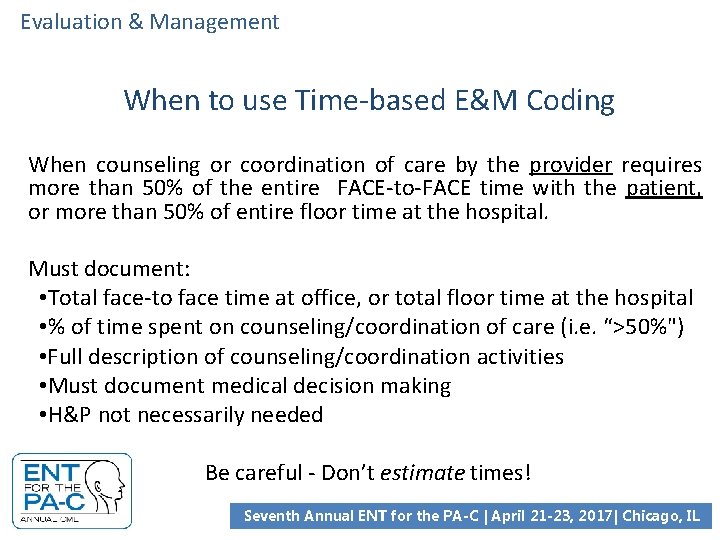
Evaluation & Management When to use Time-based E&M Coding When counseling or coordination of care by the provider requires more than 50% of the entire FACE-to-FACE time with the patient, or more than 50% of entire floor time at the hospital. Must document: • Total face-to face time at office, or total floor time at the hospital • % of time spent on counseling/coordination of care (i. e. “>50%") • Full description of counseling/coordination activities • Must document medical decision making • H&P not necessarily needed Be careful - Don’t estimate times! Seventh Annual ENT for the PA-C | April 21 -23, 2017| Chicago, IL
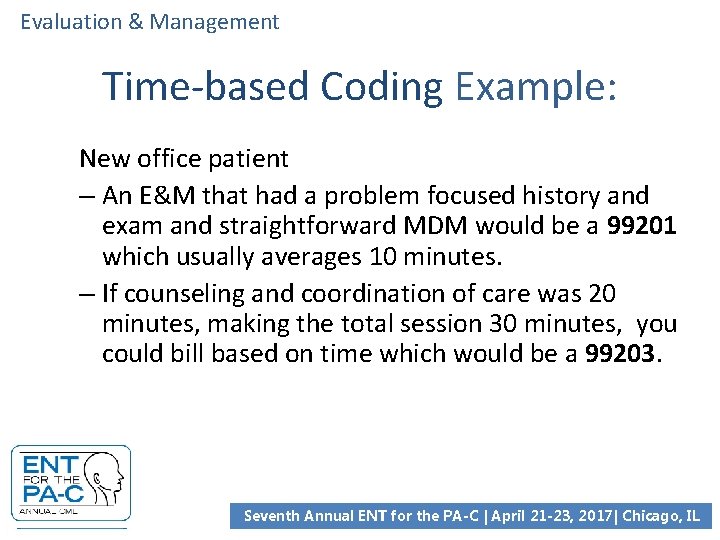
Evaluation & Management Time-based Coding Example: New office patient – An E&M that had a problem focused history and exam and straightforward MDM would be a 99201 which usually averages 10 minutes. – If counseling and coordination of care was 20 minutes, making the total session 30 minutes, you could bill based on time which would be a 99203. Seventh Annual ENT for the PA-C | April 21 -23, 2017| Chicago, IL
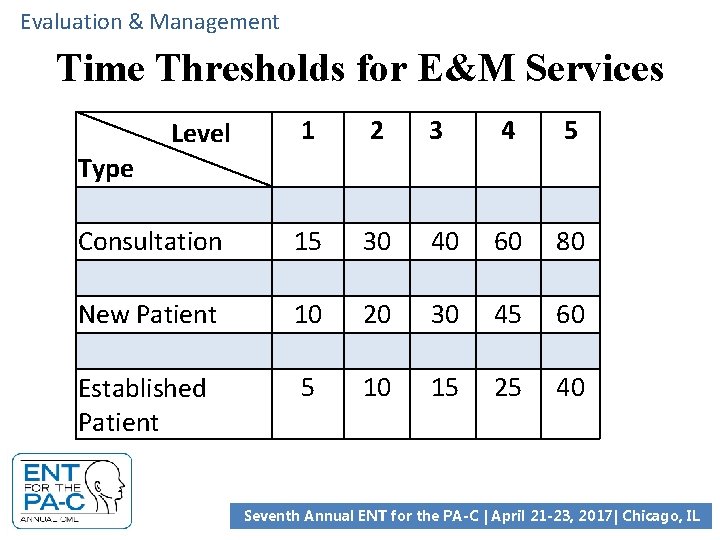
Evaluation & Management Time Thresholds for E&M Services Level Type 1 2 Consultation 15 30 New Patient 10 Established Patient 5 3 4 5 40 60 80 20 30 45 60 10 15 25 40 Seventh Annual ENT for the PA-C | April 21 -23, 2017| Chicago, IL
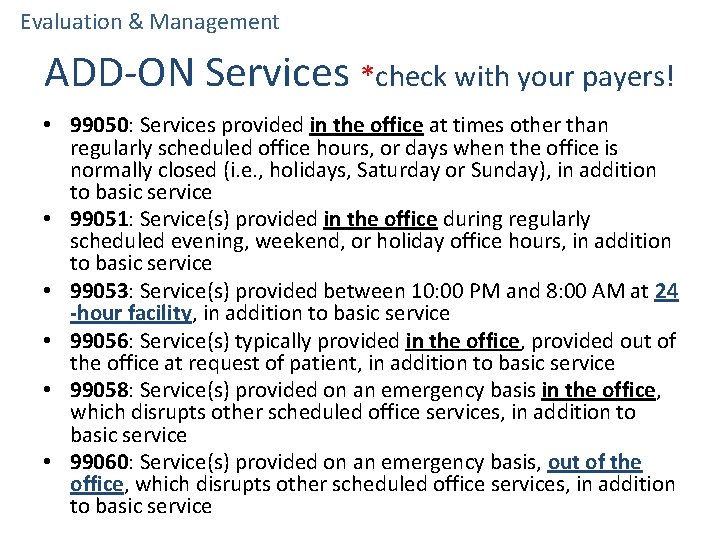
Evaluation & Management ADD-ON Services *check with your payers! • 99050: Services provided in the office at times other than regularly scheduled office hours, or days when the office is normally closed (i. e. , holidays, Saturday or Sunday), in addition to basic service • 99051: Service(s) provided in the office during regularly scheduled evening, weekend, or holiday office hours, in addition to basic service • 99053: Service(s) provided between 10: 00 PM and 8: 00 AM at 24 -hour facility, in addition to basic service • 99056: Service(s) typically provided in the office, provided out of the office at request of patient, in addition to basic service • 99058: Service(s) provided on an emergency basis in the office, which disrupts other scheduled office services, in addition to basic service • 99060: Service(s) provided on an emergency basis, out of the office, which disrupts other scheduled office services, in addition to basic service
Let’s change channels… ICD-10 Seventh Annual ENT for the PA-C | April 21 -23, 2017| Chicago, IL
ICD-10 A Quick Tutorial • ICD-10 codes can be 3, 4, 5, 6 or 7 characters • Your coder needs at least right/left/bilat. info • Initial encounter (A) now means in active treatment for that problem • Subsequent encounter (D) now means healing phase/routine care for that problem • Sequela (S) indicator needs its own code, plus identify the original problem with the S Seventh Annual ENT for the PA-C | April 21 -23, 2017| Chicago, IL
ICD-10 requires more detail on… • TYPE of condition. For example, Otitis Externa: noninfective, actinic, chemical, contact, eczematoid, infective (? organism), reactive, malignant • TIMING of condition. acute, persistent, chronic, recurrent • CONTRIBUTING FACTORS. allergy, trauma, drug induced, etc. • ASSOCIATED WITH /COMPLICATED BY Sleep disorders, alcohol use, tobacco use, immunosuppression, etc. Seventh Annual ENT for the PA-C | April 21 -23, 2017| Chicago, IL

ICD-10 Choosing a diagnosis • Other specified codes = You know what the diagnosis is, but there is no specific code for it. • Unspecified code= You don’t know what the diagnosis is. “Unspecified” codes indicate to an auditor that information in the medical record is insufficient or not detailed well enough to use a more specific code. *Hint: they often end with a 9. J 34. 9 Seventh Annual ENT for the PA-C | April 21 -23, 2017| Chicago, IL
ICD-10 2017 Changes in ICD-10 H 90. A_ Conductive and sensorineural hearing loss with restricted hearing on the contralateral side H 90. A 1 Conductive hearing loss, unilateral, with restricted hearing on the contralateral side • H 90. A 11 Conductive hearing loss, unilateral, right ear with restricted hearing on the contralateral side • H 90. A 12 Conductive hearing loss, unilateral, left ear with restricted hearing on the contralateral side H 90. A 2 Sensorineural hearing loss, unilateral, with restricted hearing on the contralateral side • H 90. A 21 Sensorineural hearing loss, unilateral, right ear, with restricted hearing on the contralateral side • H 90. A 22 Sensorineural hearing loss, unilateral, left ear, with restricted hearing on the contralateral side H 90. A 3 Mixed conductive and sensorineural hearing loss, unilateral with restricted hearing on the contralateral side • H 90. A 31 Mixed conductive and sensorineural hearing loss, unilateral, right ear with restricted hearing on the contralateral side • H 90. A 32 Mixed conductive and sensorineural hearing, unilateral, left ear with restricted hearing on the contralateral side H 93. A_ Pulsatile tinnitus H 93. A 1 Pulsatile tinnitus, right ear H 93. A 2 Pulsatile tinnitus, left ear H 93. A 3 Pulsatile tinnitus, bilateral H 93. A 9 Pulsatile tinnitus, unspecified ear Seventh Annual ENT for the PA-C | April 21 -23, 2017| Chicago, IL
On next… PROCEDURES Seventh Annual ENT for the PA-C | April 21 -23, 2017| Chicago, IL
Procedures Coding Procedures • • • Wax Mastoid Bowl Cleanout M&T Scopes And others… Seventh Annual ENT for the PA-C | April 21 -23, 2017| Chicago, IL
Procedures OFFICE PROCEDURES Follow same documentation rules as E&M: • Date and sign • Document thoroughly – see suggested template items • Using a separate procedure form is recommended. • Suggestions: wax , mastoid debridements, epistaxis, PTA, scopes, FNA, TNE, videostroboscopy • Remember to support an E&M code (if used) as a separately identifiable service. Use modifier -25. • It is OK to use same diagnosis code for visit and procedure. But using different codes is better. Seventh Annual ENT for the PA-C | April 21 -23, 2017| Chicago, IL
Procedures • • • Procedure Note Template- Example Patient Name and D. O. B. Surgeon’s Name Date of Procedure Performed Pre-Op Diagnosis Post-Op Diagnosis • Indications for Procedure • Operative Findings • Procedure Details • Signature • Date of Signature (Graphics are helpful) Seventh Annual ENT for the PA-C | April 21 -23, 2017| Chicago, IL
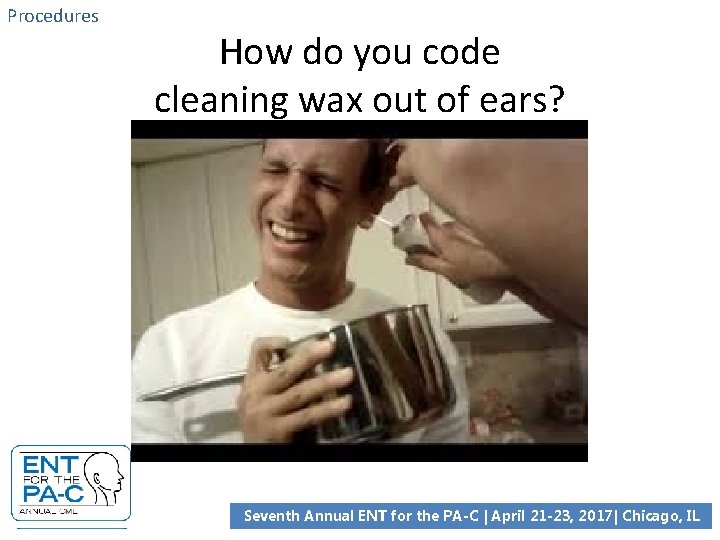
Procedures How do you code cleaning wax out of ears? Seventh Annual ENT for the PA-C | April 21 -23, 2017| Chicago, IL
Procedures Procedure Coding: WAX • Use 69210 when the ear is impacted such that the TM cannot be visualized at all, and the removal is done via instrumentation under scope or microscope. (Use 69209 for removal by irrigation. ) It is OK to bill if the impaction prevents exam for Chief Complaint. • Use ONCE for one or both ears of a Medicare patient. May be considered a unilateral code by some payers. • Use -25 modifier on E&M with CC diagnosis, and 69210 with wax diagnosis code H 61. 2_ Seventh Annual ENT for the PA-C | April 21 -23, 2017| Chicago, IL
Procedures CMS Requirements for 69210 Plus E&M • The initial reason for the patient’s visit was separate from the cerumen removal. • Otoscopic examination of the tympanic membrane is not possible due to the impaction; • Removal of the impacted cerumen requires the expertise of the physician or NPP and is personally performed by him or her; • The procedure requires a significant amount of time and effort; and • All of the above criteria are clearly documented in the patient’s medical record. Seventh Annual ENT for the PA-C | April 21 -23, 2017| Chicago, IL
Procedures 69209 = Lavage • Use 69209 to remove impacted cerumen via lavage. • 69209 is a unilateral code; specify R/L/Bilat • Removing wax that is NOT impacted should be reported with an E&M code regardless of method. Seventh Annual ENT for the PA-C | April 21 -23, 2017| Chicago, IL
Procedures Mastoid Bowl Cleanout • Use code 69220 – unilateral, simple Use code 69222 – unilateral, complex, +/- anesthesia Seventh Annual ENT for the PA-C | April 21 -23, 2017| Chicago, IL
Procedures M & T (local anesthesia) • Use 69433 • This is a unilateral code, so use -50 modifier if bilateral • Removal of previous tube during this procedure is incidental, not billable. Seventh Annual ENT for the PA-C | April 21 -23, 2017| Chicago, IL
Procedures Gentamycin Instillation • • • Code 69801 -allowed ONCE per DAY Includes payment for placing a tube in that ear. Includes any steroid placement too. NO Global for this procedure. Do not bill with 69420 /21/33/36 same ear. Seventh Annual ENT for the PA-C | April 21 -23, 2017| Chicago, IL
Procedures Use of Microscope: To Charge, or not to Charge? • If microscope required, bill code 92504, binocular microscopy. • This code is not paid for routine use. It is considered a separate diagnostic procedure. • You can bill microscope, or cerumen, but you should NOT code both. (check your payers) • 92504 is considered a bilateral code, so specify if ONE ear or both. Seventh Annual ENT for the PA-C | April 21 -23, 2017| Chicago, IL
Procedures 69990 Add on code ✚ 69990, Microsurgical techniques, requiring use of operating microscope (List separately in addition to code for primary procedure) This is a surgical code that should not be reported in office procedures. Seventh Annual ENT for the PA-C | April 21 -23, 2017| Chicago, IL
Procedures Tube Removal in Office • This does not qualify as a procedure, not even “removal foreign body. ” (Code 69424 is to be used only for tube removal under general anesthesia. ) • Use an E&M code • Not billable if removal to be followed by patch; it is considered incidental to the patch (code 69610). • Microscope use is considered included in patch code. Seventh Annual ENT for the PA-C | April 21 -23, 2017| Chicago, IL
Procedures Epley • Use 95992, allowed once per day Seventh Annual ENT for the PA-C | April 21 -23, 2017| Chicago, IL
Procedures Coding Modifier -59 As of January 5, 2015, CPT instructions state that the -59 modifier should not be used when a more descriptive modifier is available. • -XE Separate Encounter: A service that is distinct because it occurred during a separate encounter • -XS Separate Structure: A service that is distinct because it was performed on a separate organ/structure • -XP Separate Practitioner: A service that is distinct because it was performed by a different practitioner • -XU Unusual Non-Overlapping Service: The use of a service that is distinct because it does not overlap usual components of the main service Seventh Annual ENT for the PA-C | April 21 -23, 2017| Chicago, IL
Procedures ENT Procedure code changes for 2017 • “fiberoptic” removed from flex scope descriptors • Multiple revised procedural flex scope codes • Multiple revised trach and bronch codes • Multiple revised esophagoscopy codes Seventh Annual ENT for the PA-C | April 21 -23, 2017| Chicago, IL
Let’s Practice some coding. Seventh Annual ENT for the PA-C | April 21 -23, 2017| Chicago, IL
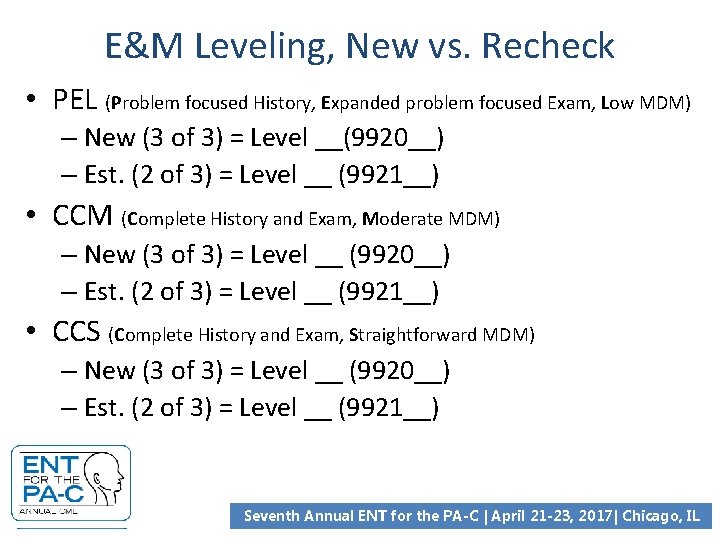
E&M Leveling, New vs. Recheck • PEL (Problem focused History, Expanded problem focused Exam, Low MDM) – New (3 of 3) = Level __(9920__) – Est. (2 of 3) = Level __ (9921__) • CCM (Complete History and Exam, Moderate MDM) – New (3 of 3) = Level __ (9920__) – Est. (2 of 3) = Level __ (9921__) • CCS (Complete History and Exam, Straightforward MDM) – New (3 of 3) = Level __ (9920__) – Est. (2 of 3) = Level __ (9921__) Seventh Annual ENT for the PA-C | April 21 -23, 2017| Chicago, IL
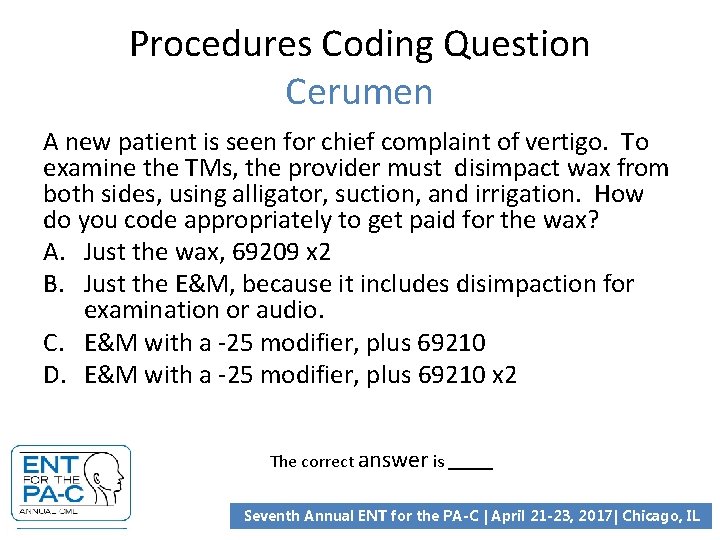
Procedures Coding Question Cerumen A new patient is seen for chief complaint of vertigo. To examine the TMs, the provider must disimpact wax from both sides, using alligator, suction, and irrigation. How do you code appropriately to get paid for the wax? A. Just the wax, 69209 x 2 B. Just the E&M, because it includes disimpaction for examination or audio. C. E&M with a -25 modifier, plus 69210 D. E&M with a -25 modifier, plus 69210 x 2 The correct answer is _____ Seventh Annual ENT for the PA-C | April 21 -23, 2017| Chicago, IL
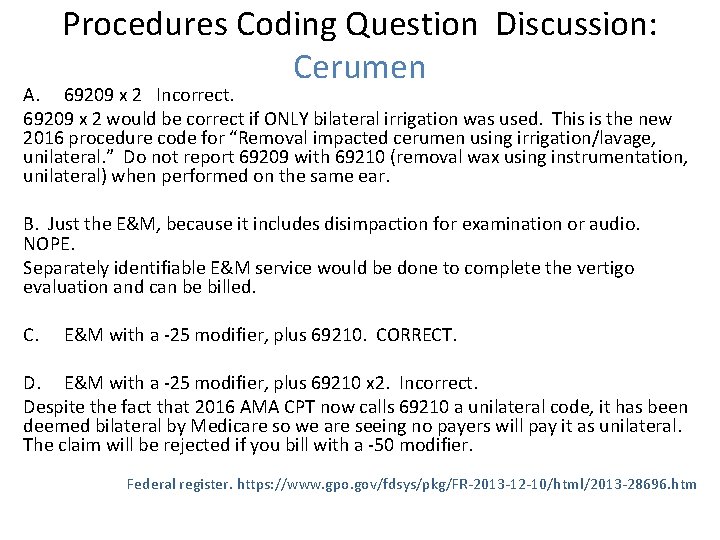
Procedures Coding Question Discussion: Cerumen A. 69209 x 2 Incorrect. 69209 x 2 would be correct if ONLY bilateral irrigation was used. This is the new 2016 procedure code for “Removal impacted cerumen using irrigation/lavage, unilateral. ” Do not report 69209 with 69210 (removal wax using instrumentation, unilateral) when performed on the same ear. B. Just the E&M, because it includes disimpaction for examination or audio. NOPE. Separately identifiable E&M service would be done to complete the vertigo evaluation and can be billed. C. E&M with a -25 modifier, plus 69210. CORRECT. D. E&M with a -25 modifier, plus 69210 x 2. Incorrect. Despite the fact that 2016 AMA CPT now calls 69210 a unilateral code, it has been deemed bilateral by Medicare so we are seeing no payers will pay it as unilateral. The claim will be rejected if you bill with a -50 modifier. Federal register. https: //www. gpo. gov/fdsys/pkg/FR-2013 -12 -10/html/2013 -28696. htm
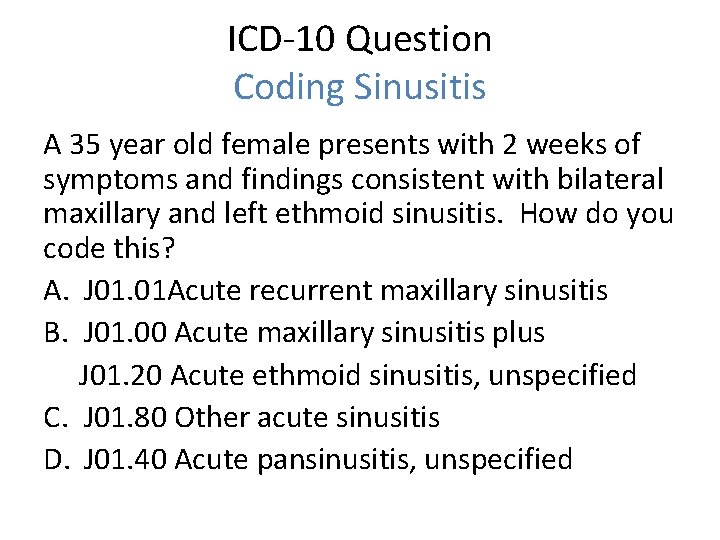
ICD-10 Question Coding Sinusitis A 35 year old female presents with 2 weeks of symptoms and findings consistent with bilateral maxillary and left ethmoid sinusitis. How do you code this? A. J 01. 01 Acute recurrent maxillary sinusitis B. J 01. 00 Acute maxillary sinusitis plus J 01. 20 Acute ethmoid sinusitis, unspecified C. J 01. 80 Other acute sinusitis D. J 01. 40 Acute pansinusitis, unspecified
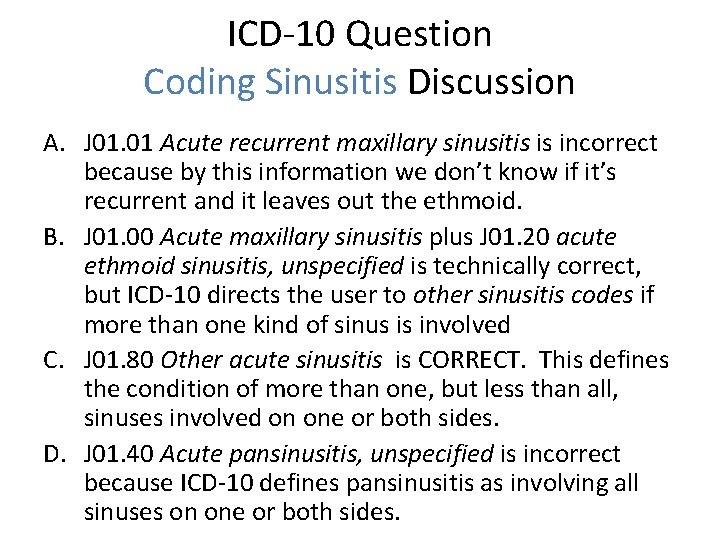
ICD-10 Question Coding Sinusitis Discussion A. J 01. 01 Acute recurrent maxillary sinusitis is incorrect because by this information we don’t know if it’s recurrent and it leaves out the ethmoid. B. J 01. 00 Acute maxillary sinusitis plus J 01. 20 acute ethmoid sinusitis, unspecified is technically correct, but ICD-10 directs the user to other sinusitis codes if more than one kind of sinus is involved C. J 01. 80 Other acute sinusitis is CORRECT. This defines the condition of more than one, but less than all, sinuses involved on one or both sides. D. J 01. 40 Acute pansinusitis, unspecified is incorrect because ICD-10 defines pansinusitis as involving all sinuses on one or both sides.

ICD-10 Question Still Coding Sinusitis This same 35 year old female presents four months later having had 2 other “sinus episodes, ” and continued nasal obstruction despite nasal steroids. CT confirms maxillary, ethmoid and sphenoid disease. How do you code this? A. J 01. 81 Other acute recurrent sinusitis B. J 01. 41 Acute recurrent pansinusitis C. J 32. 4 Chronic pansinusitis D. J 32. 8 Other chronic sinusitis Seventh Annual ENT for the PA-C | April 21 -23, 2017| Chicago, IL
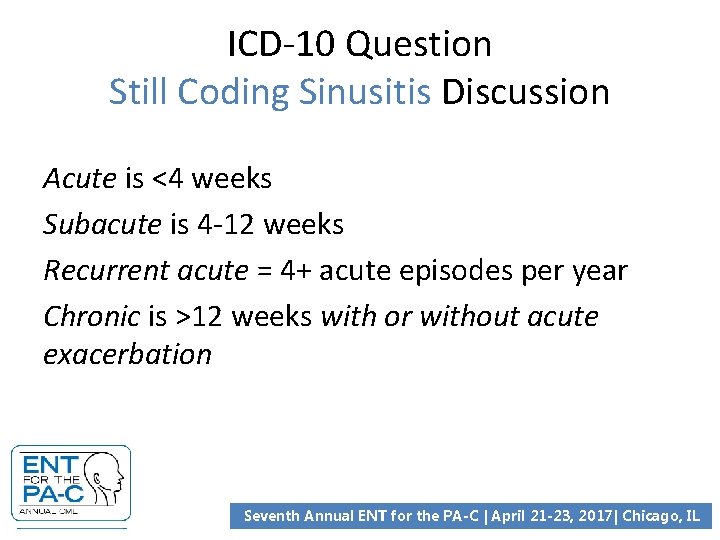
ICD-10 Question Still Coding Sinusitis Discussion Acute is <4 weeks Subacute is 4 -12 weeks Recurrent acute = 4+ acute episodes per year Chronic is >12 weeks with or without acute exacerbation Seventh Annual ENT for the PA-C | April 21 -23, 2017| Chicago, IL
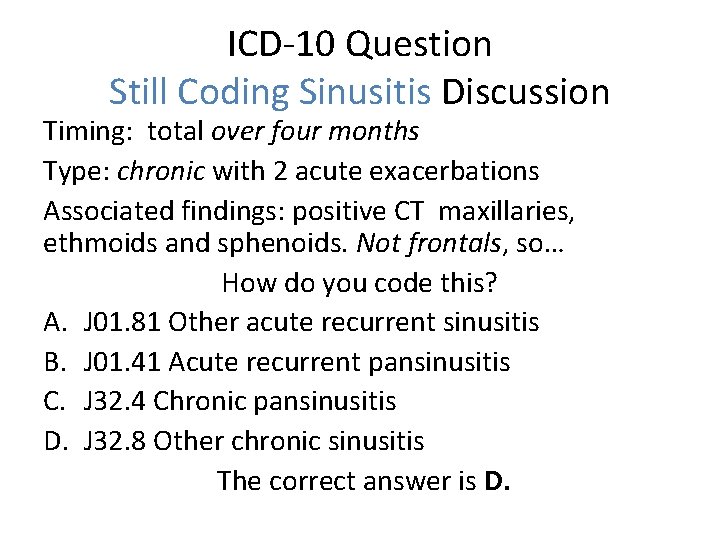
ICD-10 Question Still Coding Sinusitis Discussion Timing: total over four months Type: chronic with 2 acute exacerbations Associated findings: positive CT maxillaries, ethmoids and sphenoids. Not frontals, so… How do you code this? A. J 01. 81 Other acute recurrent sinusitis B. J 01. 41 Acute recurrent pansinusitis C. J 32. 4 Chronic pansinusitis D. J 32. 8 Other chronic sinusitis The correct answer is D.
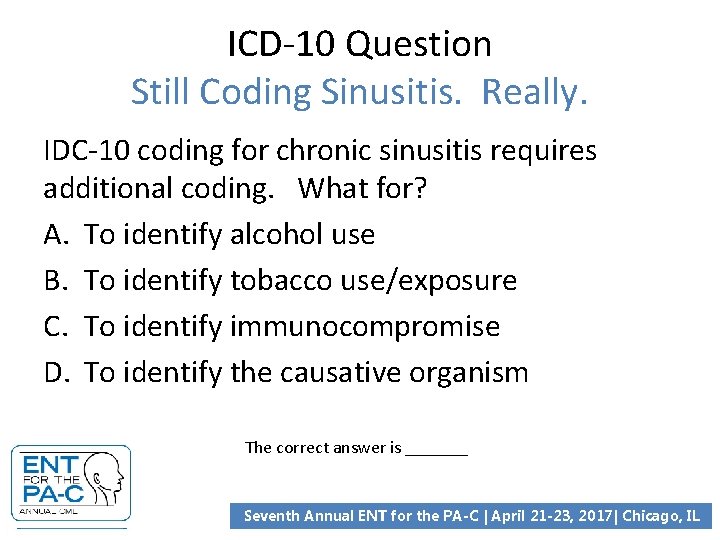
ICD-10 Question Still Coding Sinusitis. Really. IDC-10 coding for chronic sinusitis requires additional coding. What for? A. To identify alcohol use B. To identify tobacco use/exposure C. To identify immunocompromise D. To identify the causative organism The correct answer is _______ Seventh Annual ENT for the PA-C | April 21 -23, 2017| Chicago, IL
Procedures Coding Question Assisting in the O. R. What is the correct way to bill for an NPP assisting on a total thyroid? A. 60240 –AS, under surgeon’s NPI B. 60240 –AS, under NPP’s NPI C. 60240 -80, under surgeon’s NPI D. 60240 -80, under NPP’s NPI The correct answer is ___. Seventh Annual ENT for the PA-C | April 21 -23, 2017| Chicago, IL
Procedures Coding Question Discussion: Assisting in the O. R. • Use the modifier "AS" for assistant at surgery services provided by a Physician Assistant (PA), Nurse Practitioner (NP), or Clinical Nurse Specialist (CNS). • Bill under the NPP’s NPI. • The provider must accept assignment. Medicare allows 85% of the 16% for the assistant at surgery services provided by a PA, NP, or CNS. • -80 modifier is usually reserved for MD 1 st assist. There are very few local carrier exceptions.
Procedures Coding Question Discussion: Assisting in the O. R. How do you know if a surgical assistant is covered? You can look it up. http: //www. ic. nc. gov/ncic/pages/asstsurg. htm This is helpful if your practice is telling you that they are not getting paid for your first assists. When you know that code allows an assist, then you also know the claim was not filed or appealed properly. Seventh Annual ENT for the PA-C | April 21 -23, 2017| Chicago, IL
Medicare Coding for PA services in the O. R. 1. The procedure code must have an indication for “assistant at surgery. ” Indicator “ 2” applies. “ 0” may apply if documentation submitted shows medical necessity. 2. Use the modifier “-AS" for assistant at surgery services provided by a Physician Assistant (PA) or Nurse Practitioner (NP). The provider must accept assignment. Medicare allows 85% of the 16% for the assistant at surgery services (which equals 13. 6% of the surgeon’s fee) if provided by a PA or NP. 3. Other payers may require a different modifier. Seventh Annual ENT for the PA-C | April 21 -23, 2017| Chicago, IL
Pre-Operative Clearance (non- Medicare) • Must meet consultation criteria • At the request of surgeon • Medically Necessary Seventh Annual ENT for the PA-C | April 21 -23, 2017| Chicago, IL
Pre-Operative Clearance… The Diagnosis • List the V Code first based on the appropriate rationale for the exam – V 72. 8 X • V 72. 81 - Preoperative cardiovascular examination • V 72. 82 - Preoperative respiratory examination • V 72. 83 - Other specified preoperative examination – ICD 10: • Z 01. 810 - Encounter for preprocedural cardiovascular exam • Z 01. 811 - Encounter for preprocedural respiratory examination • Z 01. 818 - Encounter for other preprocedural examination
Pre-Operative Clearance… The Diagnosis • List any signs, symptoms or abnormal diagnostic studies that support medical necessity for the consultation. • List the reason for surgery second. • List any pertinent findings from the encounter. Seventh Annual ENT for the PA-C | April 21 -23, 2017| Chicago, IL
• Some extra info slides to follow… Seventh Annual ENT for the PA-C | April 21 -23, 2017| Chicago, IL
APP Questions to think about… • Do you know how to choose what codes to use for your services? • Does someone else code on your behalf? • Do you know if your services are billed under your own provider number, or your supervisor’s? • Do you know how much revenue you generate? • Do you know how many patients you see? Seventh Annual ENT for the PA-C | April 21 -23, 2017| Chicago, IL
APP NECCESITIES FOR BILLING • NPI number = National Provider Identifier Every PA & NP should have their own. • Register as a Medicare Provider. • Register as a Medicaid Provider. • Apply to be credentialed by payers that require NPPs to have their own provider number. AAPA can assist in finding out which ones do, and whether they have different requirements, in your state. • Make sure your practice understands that PA services should not always be billed under the physician. Seventh Annual ENT for the PA-C | April 21 -23, 2017| Chicago, IL
APP Understanding “Incident-to” Billing • It applies ONLY to OFFICE visits of MEDICARE patients. Other payers must specify if they recognize incident-to billing. • It allows NPPs to get paid at the higher Physician rate IF: It is in follow-up of the physician’s patient, under the physician’s Plan of Care, AND that physician or one of the physicians in the group is in the same suite of offices. • You bill under the NPI of the physician who is present. • It does NOT apply to other sites of care, or new problems / new patients seen by the NPP, or when no supervising physician is physically available during a recheck. Those should be billed with the NPP’s provider number.
APP Shared or Split services • According to the Centers for Medicare and Medicaid Services (CMS), shared/split visits are applicable for services rendered in the following settings: • Hospital inpatient or outpatient • Emergency department • Hospital observation • Hospital discharge • Office or clinic when “incident-to” requirements are met Seventh Annual ENT for the PA-C | April 21 -23, 2017| Chicago, IL
APP E&M Question Shared / Split services in the Office A PA sees a new Medicare patient in the office, and gets the CC, HPI, and Exam. The Physician then steps in, reviews the PA’s work, and approves a plan of care. Are both providers’ services payable? A. Yes, billed under physician NPI B. Yes, billed under physician NPI via incident-to. C. No, you can only bill for a new Medicare patient under the physician NPI. D. No, this must be billed under the PA. Seventh Annual ENT for the PA-C | April 21 -23, 2017| Chicago, IL
How do you bill? The correct answer is D. Seventh Annual ENT for the PA-C | April 21 -23, 2017| Chicago, IL
APP E&M Question Discussion Shared / Split services in the Office In an office setting the NPP performs a portion of an E/M encounter and the physician completes the E/M service. If the "incident to" requirements are met, the physician reports the service. If the “incident to” requirements are not met, the service must be reported using the NPP’s NPI. https: //www. cms. gov/Regulations-and- Guidance/Manuals/Downloads/clm 104 c 12. pdf Section 30. 6. 7 Seventh Annual ENT for the PA-C | April 21 -23, 2017| Chicago, IL
APP Shared or Split services • A shared/split visit can only be utilized if the NPP and physician are from the same group practice, including the same specialty. • The NPP and physician must both perform and document their face-to-face encounter with the patient. • The portion of the E/M service performed and documented by both the NPP and physician must be substantive, which includes part or all of the history, exam or medical decision making. Note: The physician must personally document his/her involvement in the patient’s care and cannot leave his/her documentation of the visit to the NPP. Seventh Annual ENT for the PA-C | April 21 -23, 2017| Chicago, IL
APP Shared or Split services are not allowed: • In a skilled nursing facility or nursing facility setting • For consultation services • For critical care services • For procedures • In a patient’s home or domiciliary site Seventh Annual ENT for the PA-C | April 21 -23, 2017| Chicago, IL
APP Shared or Split services for other than Medicare? • Check with your commercial carriers to see if they recognize the shared/split visit guidelines, specifically those carriers who credential NPPs. For carriers who do not credential NPPs, the shared/split visit guidelines would not apply, and all NPP visits would need to be billed under the physician’s PIN. Seventh Annual ENT for the PA-C | April 21 -23, 2017| Chicago, IL
APP Inpatient split/shared services • It is especially important to remember that notes documented by the NPP for E&M services performed independently within a facility, and later reviewed and co-signed by the physician, depict neither a scribe situation nor an appropriate split/shared visit. • Also, "incident to" guidelines do not apply to services in an inpatient setting. In the above situation, the service should be billed under the NPP's provider number, and would be reimbursed at the established rate for that provider.
APP Inpatient Shared or Split services • For a split-shared visit, there must be documentation of the face-to-face portion of the E/M encounter between the patient and the physician. Look up your LMDs to see examples of what they accept. • The medical record should also clearly identify the part(s) of the E/M service which were personally provided by the physician, and which were provided by the NPP. • In the absence of such documentation, the service may only be billed under the NPP's provider number per CMS IOM Publication 100 -04, Chapter 12, Section 30. 6. 1 (B). This applies to the initial history and physical examination, the discharge summary, and subsequent hospital visits. Seventh Annual ENT for the PA-C | April 21 -23, 2017| Chicago, IL
FYI Top coding problems per auditors 1. HISTORY - often incomplete, especially in hospital notes. 2. EXAM- “Check boxes” marked abnormal without detail don’t count as being done. Don’t forget to pull details from EMR to the note. 3. MDM – must be determined by all components, not just by whether an Rx was given, etc. Include orders for labs in plan of care, with a reason. Document status of chronic problems. 4. CODING / DATA ENTRY – Modifiers -25 and -59 are targets. Superbills must be kept as part of the record. 5. GENERAL DOCUMENTATION – inconsistencies in current vs. regurgitated EMR details; procedures lacking details Seventh Annual ENT for the PA-C | April 21 -23, 2017| Chicago, IL
FYI COMMON ERRORS IN DOCUMENTATION • Chief Complaint missing • First entry portrays a well patient. • Insufficient history, tracking of past or current diagnoses, or patient progress • Exam notes are weak, or mostly abbreviated • No diagnosis listed • Medical necessity not supported • No documentation of reason for tests ordered • No documentation of counseling time • Reliance on EMR: “Automation is not documentation. ” Seventh Annual ENT for the PA-C | April 21 -23, 2017| Chicago, IL

FYI Compliance Tools CPT (from AMA) for Procedure Codes ICD-9 (from AMA) for Diagnosis Codes ICD-10 for Diagnosis Codes after 10/1/14 RBRVS (from CMS) for RVUs and Globals www. ENTcodingtoday. com Encoder Pro, or other web tools, by subscription • Otolaryngology Coding Alert, by subscription • • • Seventh Annual ENT for the PA-C | April 21 -23, 2017| Chicago, IL
FYI Resources • www. aapa. org • www. cms. gov/Outreach-and-Education/ for Medicare Learning Network and Products -the PA/APN information is in Booklet ICN 901623 • www. cms. gov for fee schedules, ICD 10 info, etc. • AMA for “cross-walking” • www. ahima. org • www. medicareuniversity. com/ngs/home. html Seventh Annual ENT for the PA-C | April 21 -23, 2017| Chicago, IL
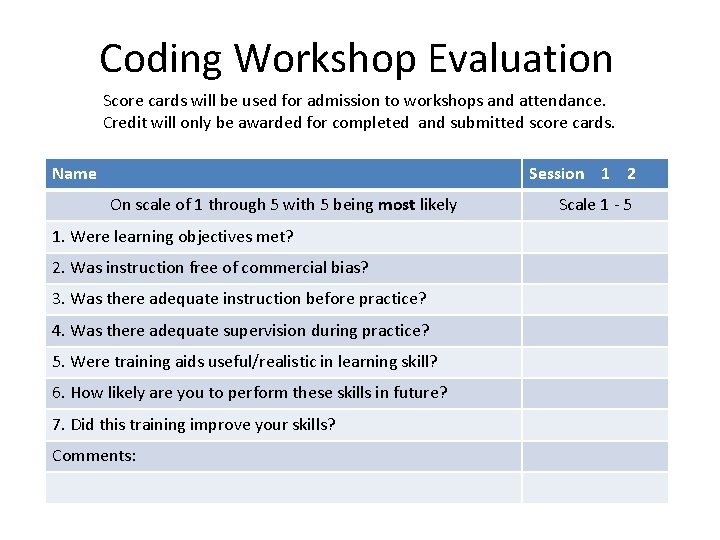
Coding Workshop Evaluation Score cards will be used for admission to workshops and attendance. Credit will only be awarded for completed and submitted score cards. Name Session 1 2 On scale of 1 through 5 with 5 being most likely 1. Were learning objectives met? 2. Was instruction free of commercial bias? 3. Was there adequate instruction before practice? 4. Was there adequate supervision during practice? 5. Were training aids useful/realistic in learning skill? 6. How likely are you to perform these skills in future? 7. Did this training improve your skills? Comments: Scale 1 - 5
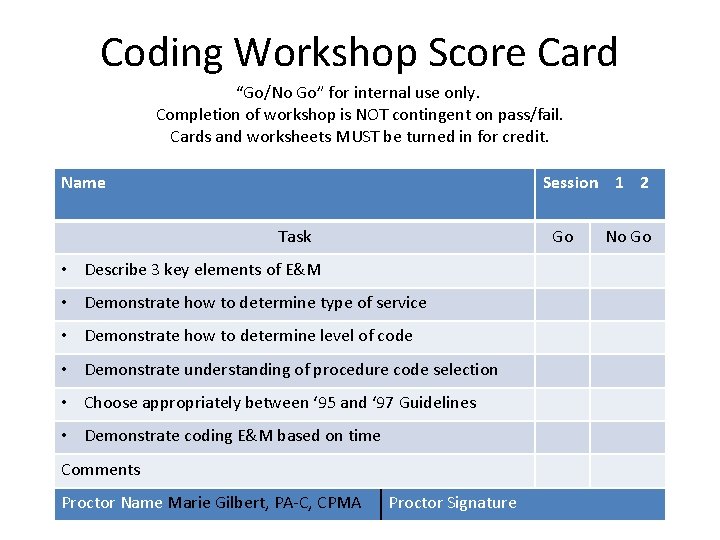
Coding Workshop Score Card “Go/No Go” for internal use only. Completion of workshop is NOT contingent on pass/fail. Cards and worksheets MUST be turned in for credit. Name Session 1 2 Task Go • Describe 3 key elements of E&M • Demonstrate how to determine type of service • Demonstrate how to determine level of code • Demonstrate understanding of procedure code selection • Choose appropriately between ‘ 95 and ‘ 97 Guidelines • Demonstrate coding E&M based on time Comments Proctor Name Marie Gilbert, PA-C, CPMA Proctor Signature No Go
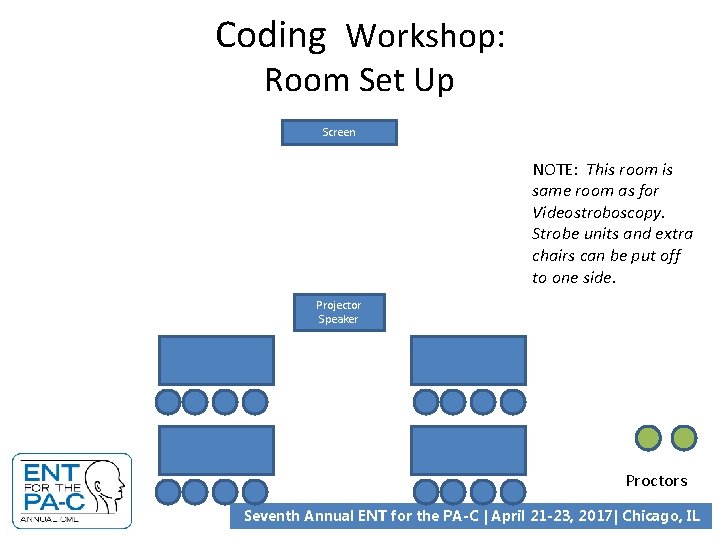
Coding Workshop: Room Set Up Screen NOTE: This room is same room as for Videostroboscopy. Strobe units and extra chairs can be put off to one side. Projector Speaker Proctors Seventh Annual ENT for the PA-C | April 21 -23, 2017| Chicago, IL
- Slides: 114