
WORKSHOP Good teachers drive their students to the
- Slides: 15
WORKSHOP Good teachers drive their students to the sky & help them gain confidence, but through the scaffolding they provide, set them up for success rather than allowing them to fall. Pauline Gibbons 2015 CONSTRUCTI NG E XPERT S CAFFOLDING The importance of providing individualized & specialised support for EAL/D learners LEESA HOLBERT EDLA 345 TESOL Techniques
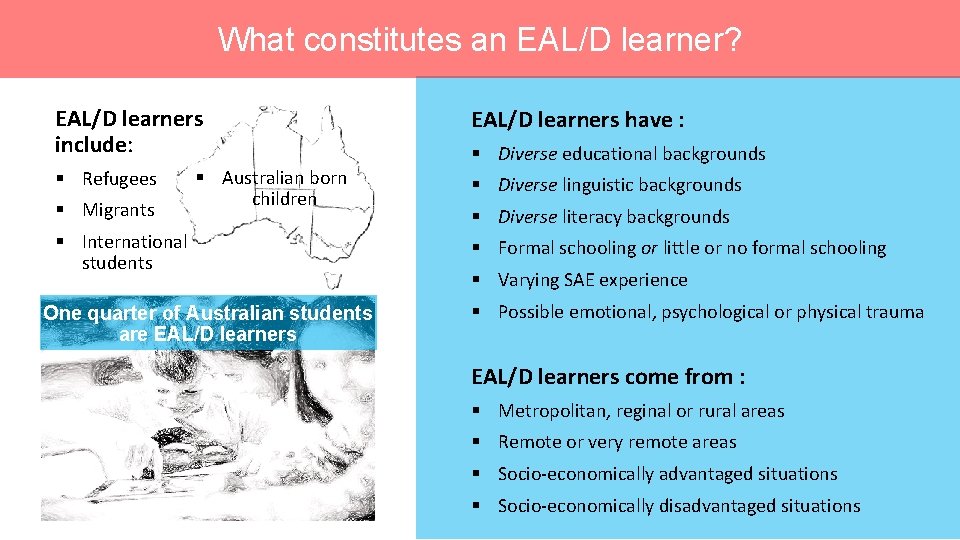
What constitutes an EAL/D learner? ccccccccccccccc EAL/D learners include: § Refugees § Migrants § Australian born children § International students One quarter of Australian students are EAL/D learners have : § Diverse educational backgrounds § Diverse linguistic backgrounds § Diverse literacy backgrounds § Formal schooling or little or no formal schooling § Varying SAE experience § Possible emotional, psychological or physical trauma EAL/D learners come from : § Metropolitan, reginal or rural areas § Remote or very remote areas § Socio-economically advantaged situations § Socio-economically disadvantaged situations
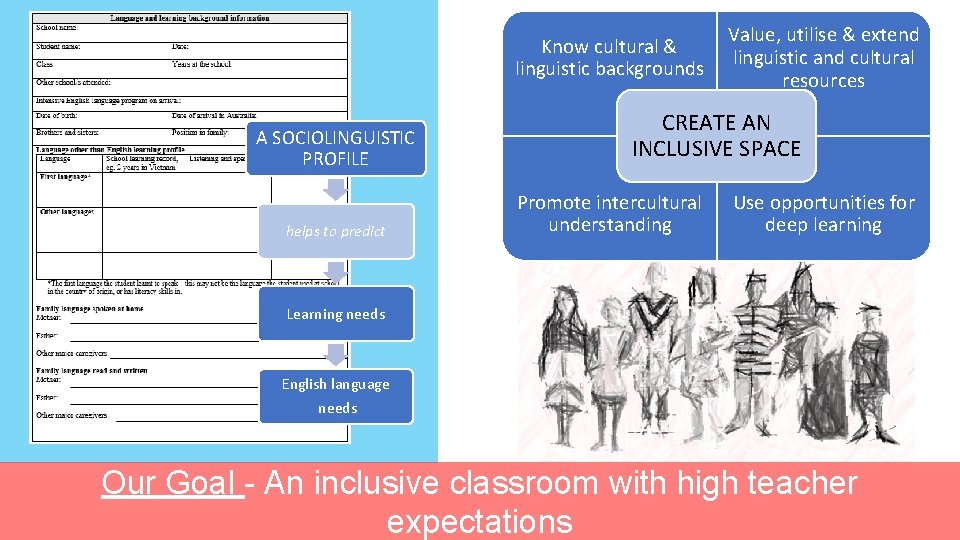
Know cultural & linguistic backgrounds A SOCIOLINGUISTIC PROFILE helps to predict Value, utilise & extend linguistic and cultural resources CREATE AN INCLUSIVE SPACE Promote intercultural understanding Use opportunities for deep learning Learning needs English language needs Our Goal - An inclusive classroom with high teacher expectations
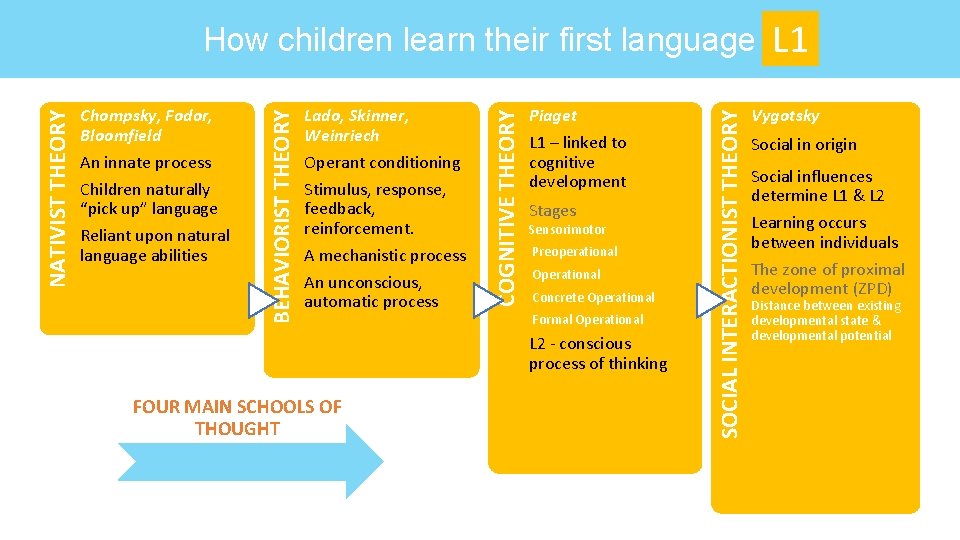
Piaget L 1 – linked to cognitive development Stages Sensorimotor Preoperational Operational Concrete Operational Formal Operational L 2 - conscious process of thinking FOUR MAIN SCHOOLS OF THOUGHT SOCIAL INTERACTIONIST THEORY Lado, Skinner, Weinriech Operant conditioning Stimulus, response, feedback, reinforcement. A mechanistic process An unconscious, automatic process COGNITIVE THEORY Chompsky, Fodor, Bloomfield An innate process Children naturally “pick up” language Reliant upon natural language abilities BEHAVIORIST THEORY NATIVIST THEORY How children learn their first language L 1 Vygotsky Social in origin Social influences determine L 1 & L 2 Learning occurs between individuals The zone of proximal development (ZPD) Distance between existing developmental state & developmental potential
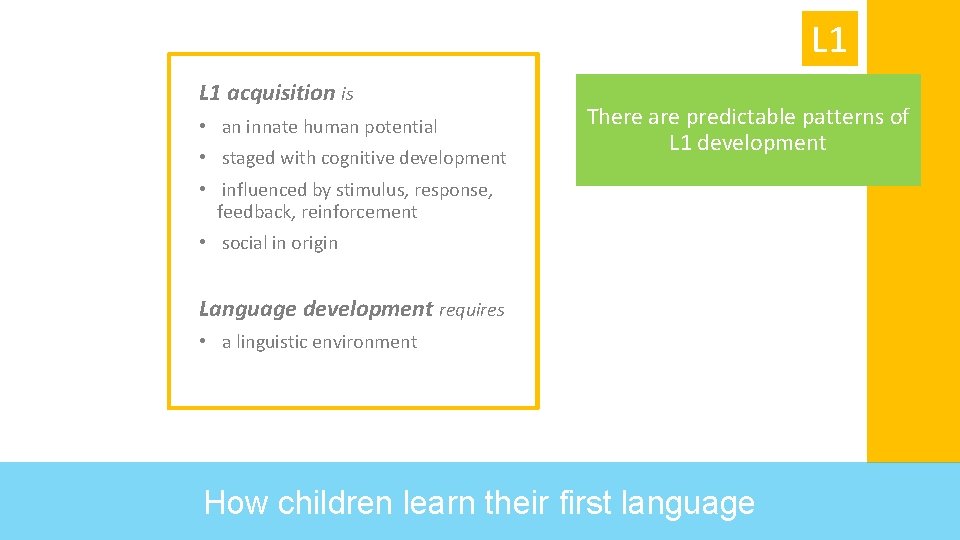
L 1 acquisition is • an innate human potential • staged with cognitive development There are predictable patterns of L 1 development • influenced by stimulus, response, feedback, reinforcement • social in origin Language development requires • a linguistic environment How children learn their first language
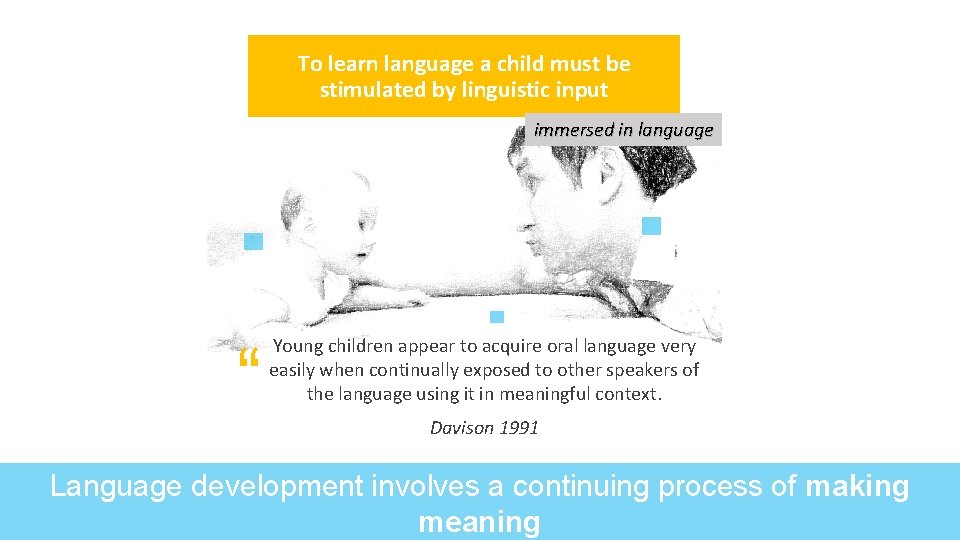
To learn language a child must be stimulated by linguistic input immersed in language “ Young children appear to acquire oral language very easily when continually exposed to other speakers of the language using it in meaningful context. Davison 1991 Language development involves a continuing process of making meaning
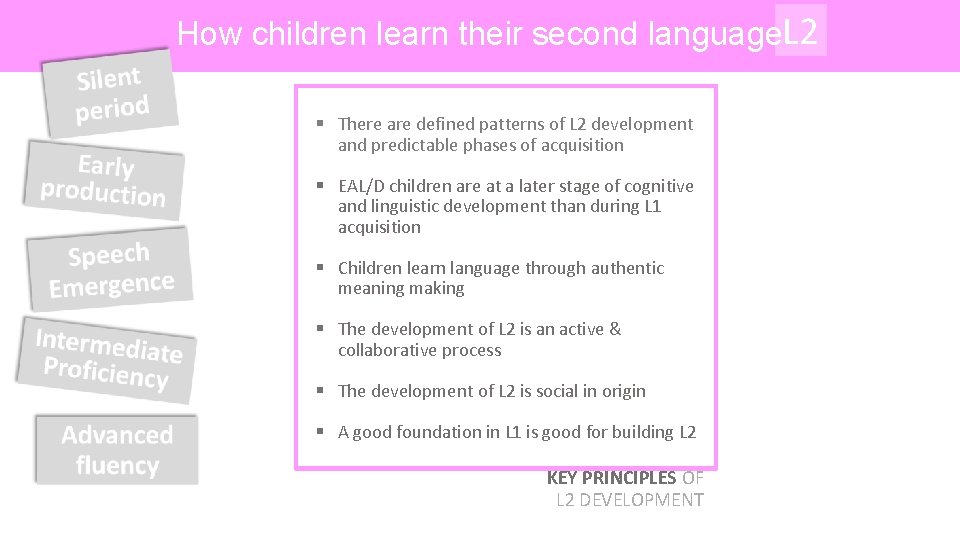
How children learn their second language. L 2 § There are defined patterns of L 2 development and predictable phases of acquisition § EAL/D children are at a later stage of cognitive and linguistic development than during L 1 acquisition § Children learn language through authentic meaning making § The development of L 2 is an active & collaborative process § The development of L 2 is social in origin § A good foundation in L 1 is good for building L 2 KEY PRINCIPLES OF L 2 DEVELOPMENT
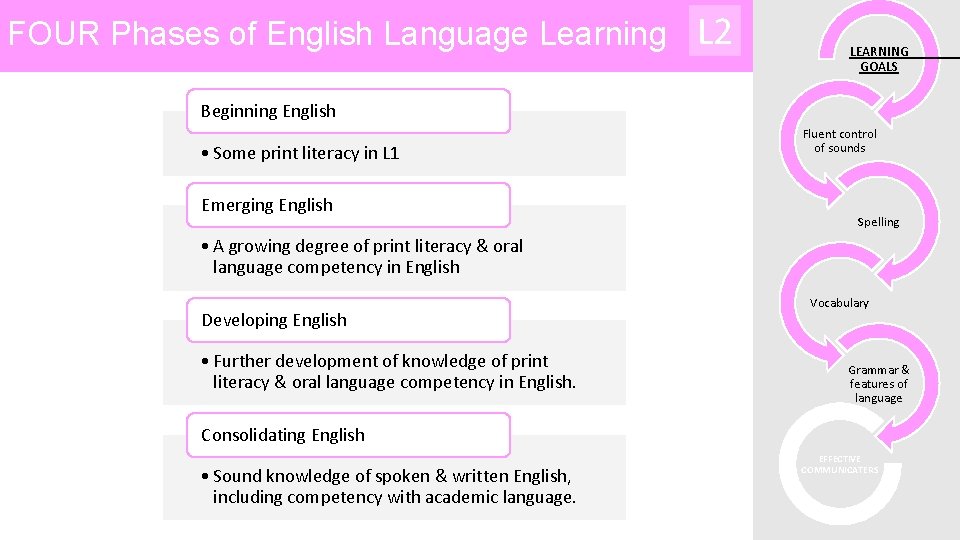
FOUR Phases of English Language Learning L 2 LEARNING GOALS Beginning English • Some print literacy in L 1 Emerging English Fluent control of sounds Spelling • A growing degree of print literacy & oral language competency in English Developing English • Further development of knowledge of print literacy & oral language competency in English. Vocabulary Grammar & features of language Consolidating English • Sound knowledge of spoken & written English, including competency with academic language. EFFECTIVE COMMUNICATERS
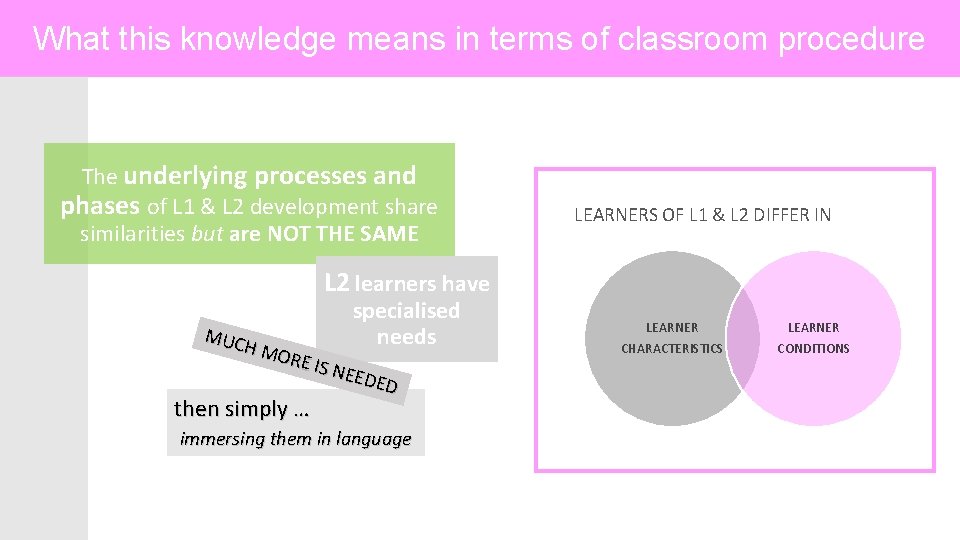
What this knowledge means in terms of classroom procedure The underlying processes and phases of L 1 & L 2 development share similarities but are NOT THE SAME LEARNERS OF L 1 & L 2 DIFFER IN L 2 learners have specialised needs MUC H MO RE IS NEED ED then simply … immersing them in language LEARNER CHARACTERISTICS CONDITIONS
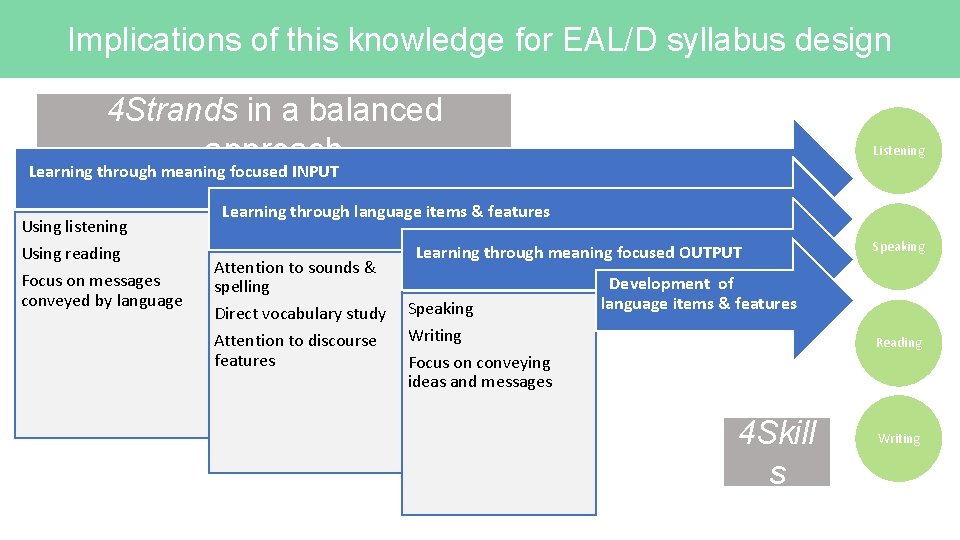
Implications of this knowledge for EAL/D syllabus design 4 Strands in a balanced approach Learning through meaning focused INPUT Using listening Using reading Focus on messages conveyed by language Listening Learning through language items & features Attention to sounds & spelling Direct vocabulary study Attention to discourse features Learning through meaning focused OUTPUT Speaking Development of language items & features Writing Focus on conveying ideas and messages Reading 4 Skill s Writing
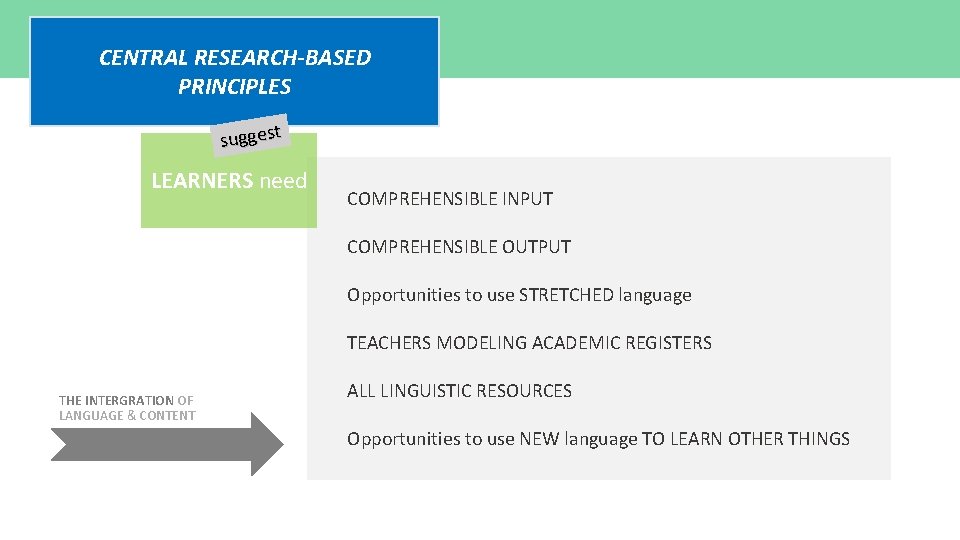
CENTRAL RESEARCH-BASED PRINCIPLES suggest LEARNERS need COMPREHENSIBLE INPUT COMPREHENSIBLE OUTPUT Opportunities to use STRETCHED language TEACHERS MODELING ACADEMIC REGISTERS THE INTERGRATION OF LANGUAGE & CONTENT ALL LINGUISTIC RESOURCES Opportunities to use NEW language TO LEARN OTHER THINGS
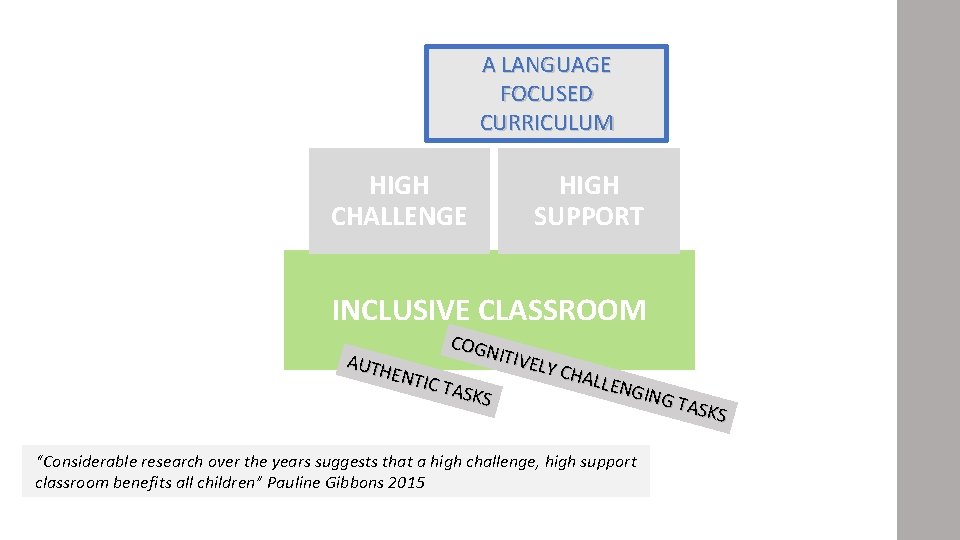
A LANGUAGE FOCUSED CURRICULUM HIGH CHALLENGE HIGH SUPPORT INCLUSIVE CLASSROOM COGN ITIVE AUTH LY CH ENTIC ALLE NGIN TASK S G TA SKS “Considerable research over the years suggests that a high challenge, high support classroom benefits all children” Pauline Gibbons 2015
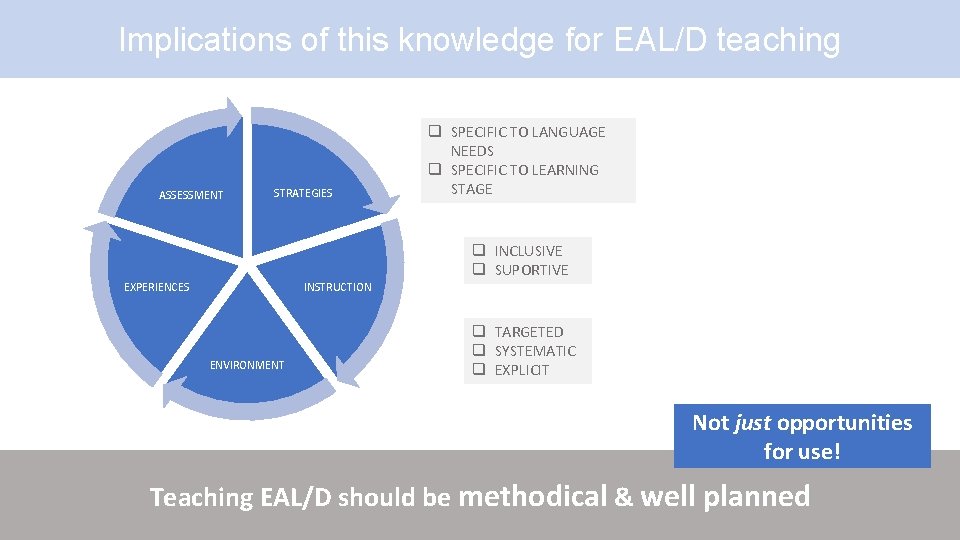
Implications of this knowledge for EAL/D teaching ASSESSMENT STRATEGIES EXPERIENCES INSTRUCTION ENVIRONMENT q SPECIFIC TO LANGUAGE NEEDS q SPECIFIC TO LEARNING STAGE q INCLUSIVE q SUPORTIVE q TARGETED q SYSTEMATIC q EXPLICIT Not just opportunities for use! Teaching EAL/D should be methodical & well planned
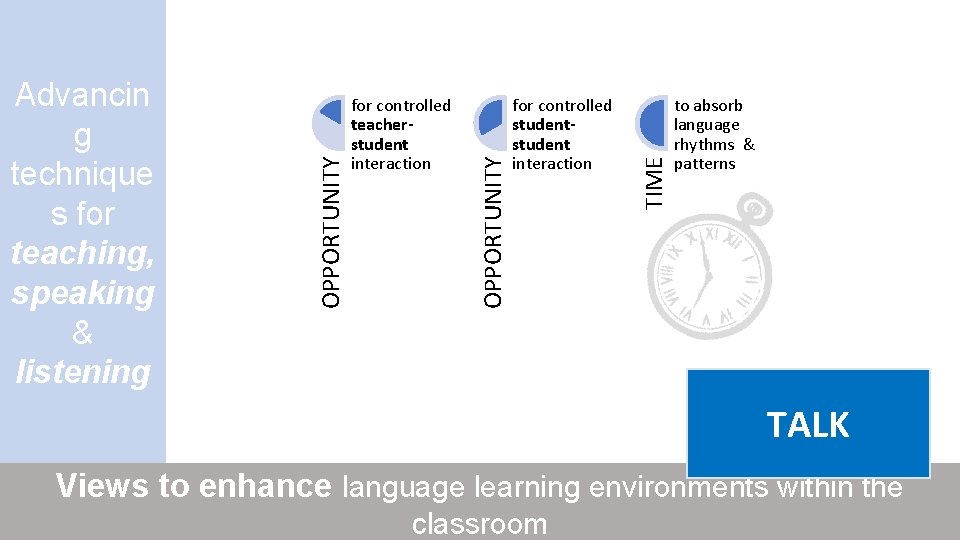
for controlled student interaction TIME for controlled teacherstudent interaction OPPORTUNITY Advancin g technique s for teaching, speaking & listening to absorb language rhythms & patterns TALK Views to enhance language learning environments within the classroom
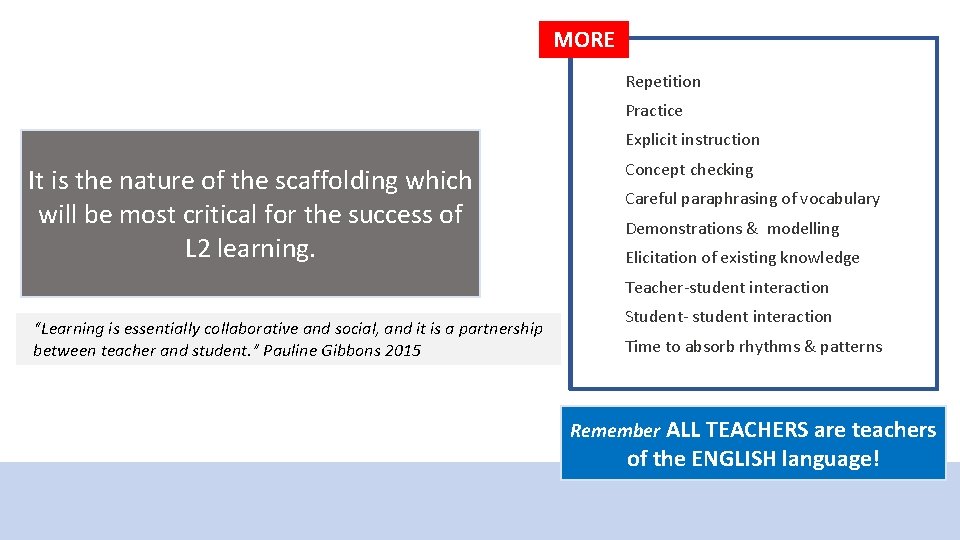
MORE Repetition Practice Explicit instruction It is the nature of the scaffolding which will be most critical for the success of L 2 learning. Concept checking Careful paraphrasing of vocabulary Demonstrations & modelling Elicitation of existing knowledge Teacher-student interaction “Learning is essentially collaborative and social, and it is a partnership between teacher and student. ” Pauline Gibbons 2015 Student- student interaction Time to absorb rhythms & patterns Remember ALL TEACHERS are teachers of the ENGLISH language!