
Workshop Development Sustainability Stormwater PlanningDesign Stormwater Infrastructure Financing
Workshop: Development Sustainability & Stormwater Planning/Design Stormwater Infrastructure Financing: Getting Decision Makers on Board Mike Hall, Public Works Director 3/6/2021
Ø Stormwater Utility Program Development l l l Feasibility Study Develop program with Stakeholder Groups • Neighborhood Associations • Businesses, Organizations • Churches Meet with key potential ratepayers Finalize program goals and financing methods Develop and pass Stormwater Utility Ordinance
Utility Feasibility Study Ø Ø Ø Ø Kickoff meeting with Town staff to discuss goals and objectives. Written summary of financial information (as provided by the Town). Staff interviews and written interview summaries. Written summary of existing stormwater program issues, needs and problems. Written summary of ERU analysis, with example illustrations of GIS mapping with impervious surface calculations. Funding Feasibility Study (DRAFT and FINAL) Presentation of Study to Town Council. 3/6/2021
Project Goals Ø Ø Ø Advisory Committee Process (SWAC Meetings) Determine appropriate program costs (5 -year budget) Public feedback Work with Town Council to establish funding mechanism Implement funding mechanism Enact stormwater program objectives 3/6/2021
SWAC Process Ø Storm Water Advisory Committee (SWAC) l l Recommended by funding feasibility study Consisted of over 20 members • • • l 3/6/2021 Neighbors Association of Normal (NAN) Churches Local businesses Local universities and colleges Schools Town of Normal staff Met 4 times (December 2005 – March 2006)
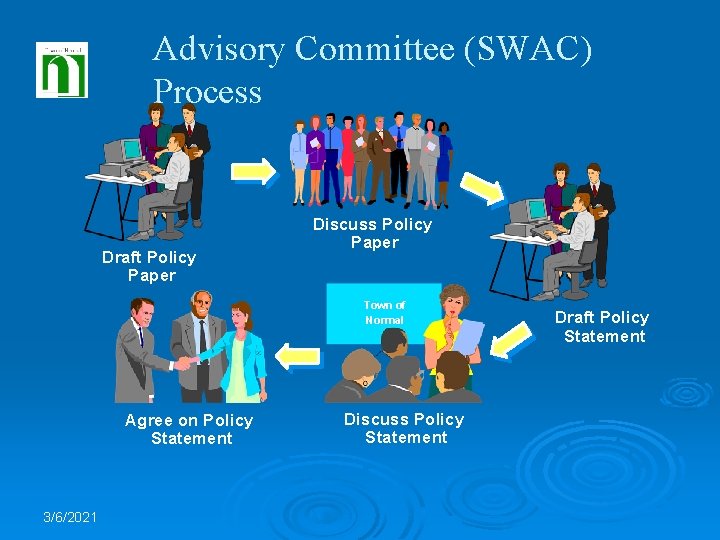
Advisory Committee (SWAC) Process Draft Policy Paper Discuss Policy Paper Town of Normal Agree on Policy Statement 3/6/2021 Discuss Policy Statement Draft Policy Statement

SWAC Process: Meeting Topics 3/6/2021 Existing Program Problems, Needs Goals Program Priorities Planned Program Funding Methods Recommendation

Stormwater Management in Normal Site Plan Review l Review engineering drawings for new developments Ø Planning / Design / Construction l Plan / Design regional stormwater management systems l Stormwater Master Plan development l Design and construction of capital improvements Ø Enforcement l Site inspection (i. e. erosion control enforcement) Ø Administration l Town Engineering and Public Works staff Ø 3/6/2021
Stormwater Management in Normal Ø NPDES Phase II (Stormwater) Permit l New stormwater regulations (federal mandate) l New required activities (Best Management Practices): • Public education / public involvement • Erosion control • Pollution inspection and prevention • Post-development stormwater management • Changes in operations at municipal facilities • New enforcement requirements l Recordkeeping and annual reporting 3/6/2021
Stormwater Problems, Needs, and Goals Ø Proactive approach to stormwater management l Protect public safety • Reduce flood potential • Careful planning for new land development l Meet new regulatory requirements • NPDES Phase II Permit l Keep up with system maintenance needs • Repair eroded drainage channels • Inlet and catch basin cleaning l Focus on environmental sustainability 3/6/2021
SWAC Stormwater Management Program Exercise Ø Part 1: Identify stormwater issues of importance l Round Robin style l Issues written on Post-Its by meeting facilitators Ø Part 2: Pick priority issues l Put a mark beside the five stormwater program issues that in your opinion should be the top priorities l Circle the mark for you r top priority 3/6/2021
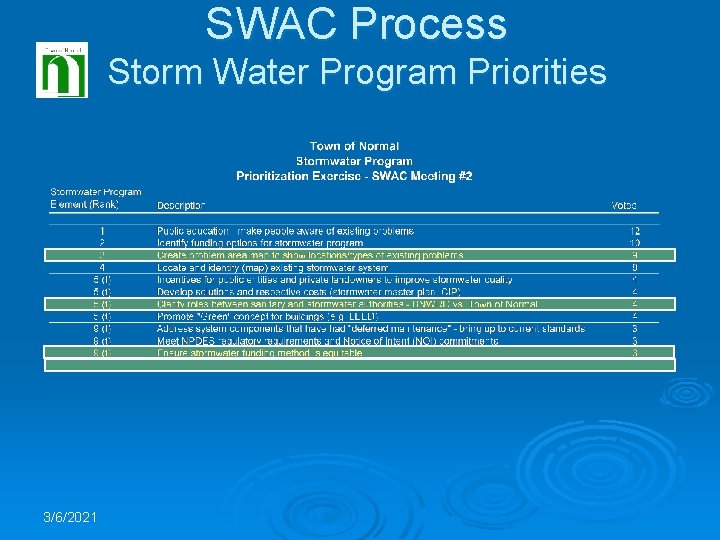
SWAC Process Storm Water Program Priorities 3/6/2021

SWAC Process Policy Issue Paper #1 – Mission Statement Ø The mission of the community’s stormwater management program is to enhance public health, safety, and the environment in order to protect lives and property and provide for a better quality of life. (from Policy Issue Paper #1)
SWAC Process Policy Issue Paper #2 – Service Charge Ø The Town of Normal must have a dedicated source of revenue from which to fund its stormwater management program in order to meet its stormwater management program mission. It has been determined that the primary source of program revenue should be a service charge. (from Policy Issue Paper #2)
SWAC Process Policy Issue Paper #3 – Credit Program Ø A system of credits will be implemented to provide non-residential customers the means by which to lower their stormwater utility bill in recognition of the customer reducing the burden on the Town’s stormwater management program that the property would otherwise create. (from Policy Issue Paper #3)
SWAC Process Policy Issue Paper #4 – Flat Residential Rate Ø There will be a single flat rate (as opposed to a tiered rate) charged to owners of single-family residential properties. (from Policy Issue Paper #4)
Why user fees? Ø Expansion of local government roles Ø Changing stormwater programs Ø Other prevailing priorities competing for general fund dollars - police, schools, etc Ø Shift away from general taxes to fees and demand-based funding - solid waste, waste water Ø Failure of other funding methods
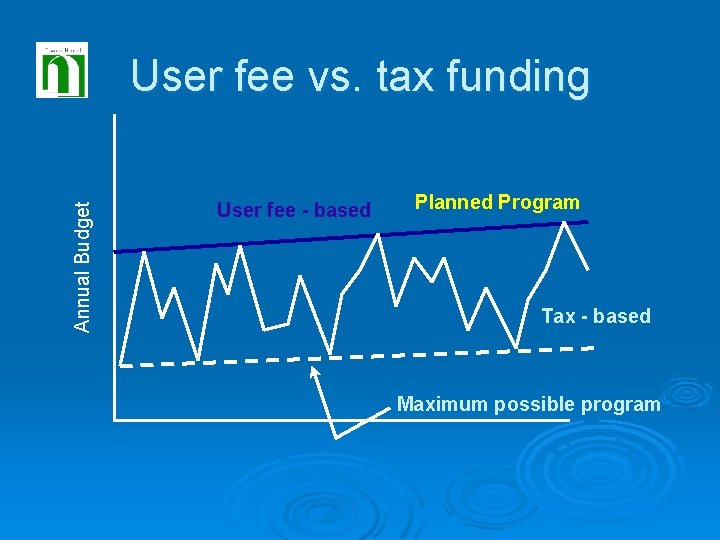
Annual Budget User fee vs. tax funding User fee - based Planned Program Tax - based Maximum possible program
Storm Water Utility Ø Stable – reliable level of funding allows planning – not subject to multiple demands Ø Adequate – program-driven funding levels – planned increases in service levels Ø Flexible Ø Equitable – property owners pay based on demand they place on the program / system – single method or mix of funding methods – can include special districts Town of Normal, Illinois March 28, 2006 Storm Water Program Funding
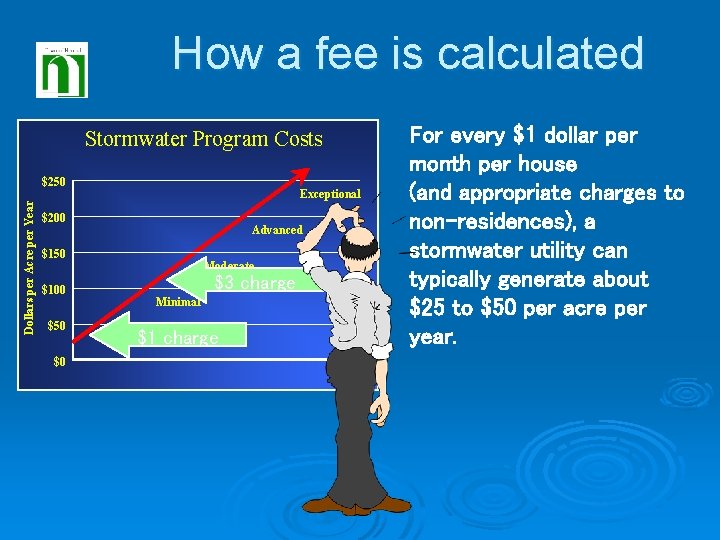
How a fee is calculated Stormwater Program Costs Dollars per Acre per Year $250 Exceptional $200 Advanced $150 $100 $50 $0 Moderate $3 charge Minimal $1 charge Incidental For every $1 dollar per month per house (and appropriate charges to non-residences), a stormwater utility can typically generate about $25 to $50 per acre per year.
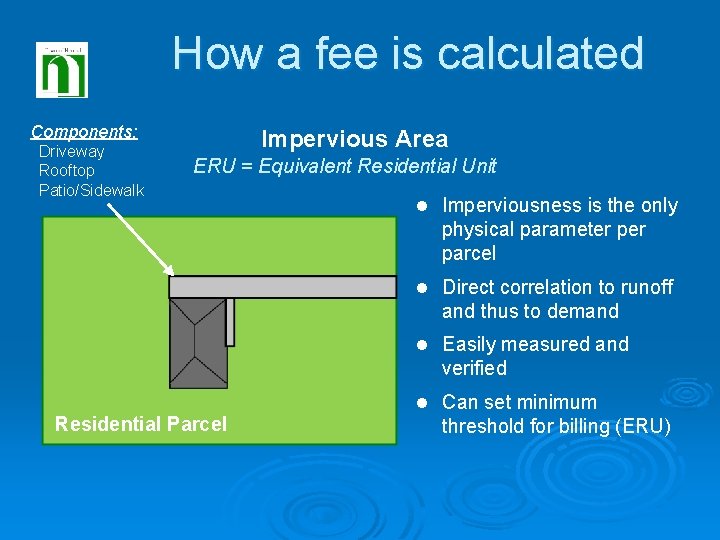
How a fee is calculated Components: Driveway Rooftop Patio/Sidewalk Impervious Area ERU = Equivalent Residential Unit l Imperviousness is the only physical parameter parcel l Direct correlation to runoff and thus to demand l Easily measured and verified Residential Parcel l Can set minimum threshold for billing (ERU)
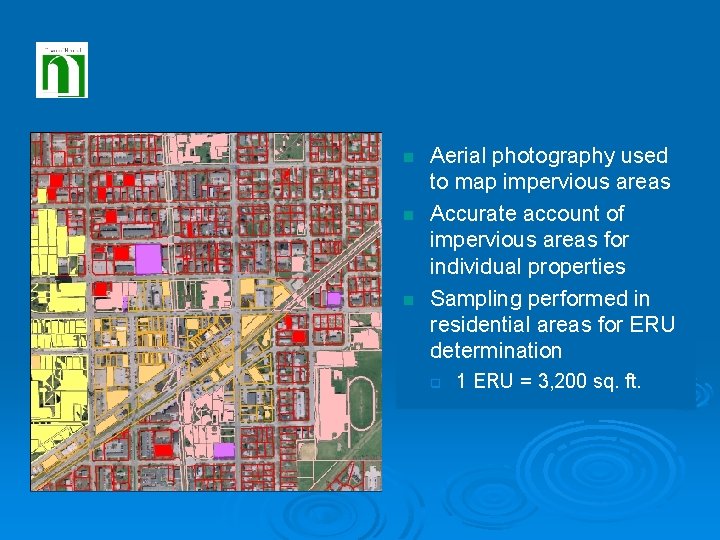
n n n Aerial photography used to map impervious areas Accurate account of impervious areas for individual properties Sampling performed in residential areas for ERU determination q 1 ERU = 3, 200 sq. ft.

Who Will Pay the User Fee?
Credits Allowed Ø Credit programs provide rate reductions for property owners in recognition of the impact that on-site runoff control may have on the Town’s stormwater management program. Ø Credits are given for: l Peak runoff rate reduction l Runoff volume control l Water quality control
How do credits work? Ø Direct reduction of service charges Ø Applied after service charges are calculated Ø Must be applied for; l Criteria set by the Town l Maintenance of stormwater controls required
Questions
- Slides: 26