
Workshop 6 Problem Solving Rationale 2 Timetable 19

Workshop 6 Problem Solving
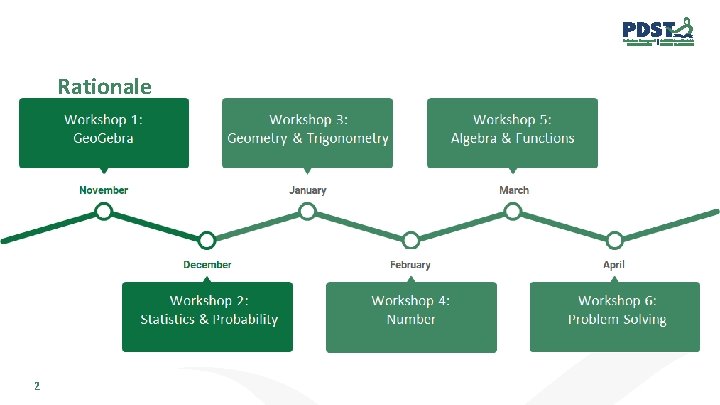
Rationale 2
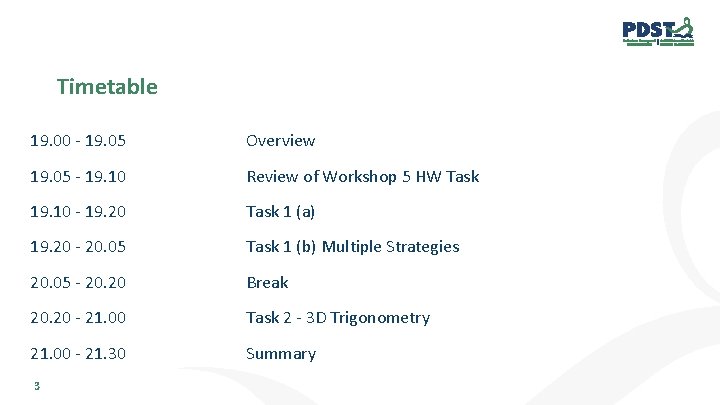
Timetable 19. 00 - 19. 05 Overview 19. 05 - 19. 10 Review of Workshop 5 HW Task 19. 10 - 19. 20 Task 1 (a) 19. 20 - 20. 05 Task 1 (b) Multiple Strategies 20. 05 - 20. 20 Break 20. 20 - 21. 00 Task 2 - 3 D Trigonometry 21. 00 - 21. 30 Summary 3
Review of Workshop 5 How did you bring your learning from Workshop 5 Algebra & Functions back to your classroom? 4

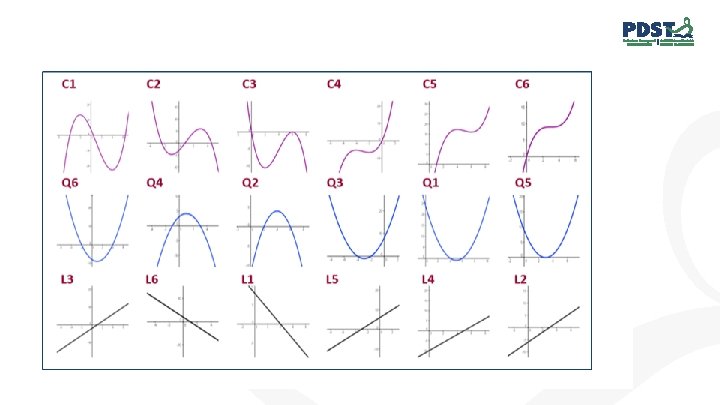
Matching Activity 5
Key Messages ● Problem-solving should form an integral part of students’ daily experience of studying mathematics. ● Multiple approaches are needed to encourage students to move away from functional fixedness ● Students need to be able to apply a variety of strategies and skills in order to develop their problem-solving abilities. ● Building deep knowledge and making connections across the syllabus strands is important.
Task 1 Learning Outcomes ● Understand what problem-solving is and that it is not a separate topic but rather an integral part of teaching and learning across the syllabus. ● Understand the importance of student’s having access to practical strategies to approach a problem. ● Reflect on classroom culture regarding problem-solving. ● Understand the importance of deep knowledge of curriculum content. 9
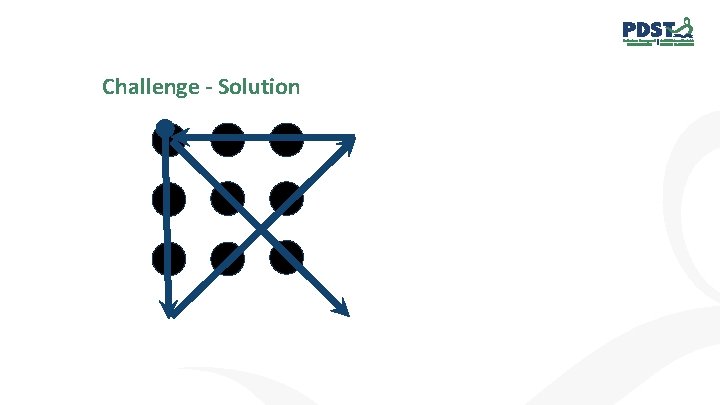
Challenge - Solution
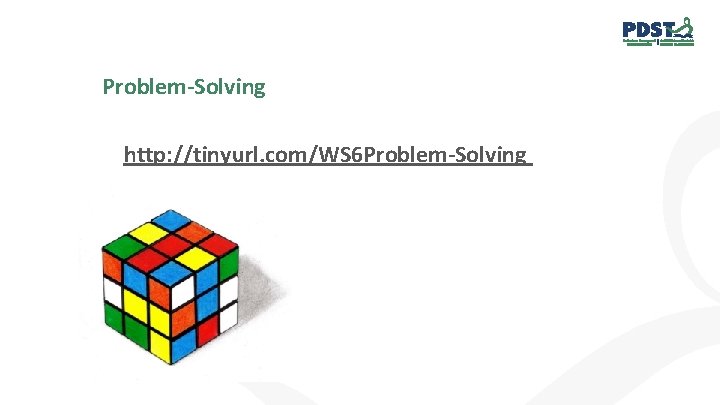
Problem-Solving http: //tinyurl. com/WS 6 Problem-Solving
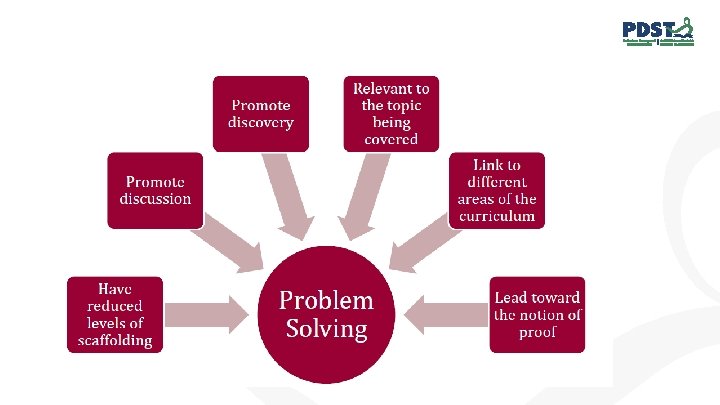
What is a good problem? ● Interesting ● Multiple approaches ● Layers ● Linked to syllabus ● Group work ● Discussion 12
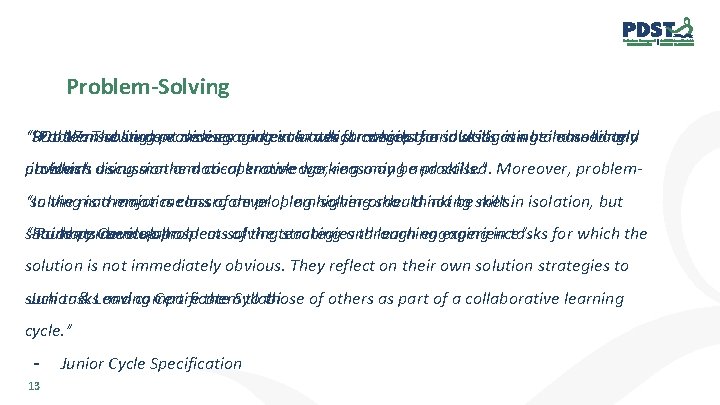
Problem-Solving “Problem-solving provides a and context which concepts and skills can beand learned and “SOL “Problem 17: The solving student means devises engaging evaluates in aintask for strategies which the for solution investigating is not immediately solving in which discussion and co-operative working may beand practised. problems obvious”. using mathematical knowledge, reasoning skills. ” Moreover, problemsolving is a major means of developing thinking “In the mathematics classroom problemhigher-order solving should not be skills. met in isolation, but -Primary Curriculum “Students should permeate developallproblem-solving aspects of the teaching strategiesand through learning engaging experience”. in tasks for which the solution is not immediately obvious. They reflect on their own solution strategies to -Junior such tasks & Leaving and compare Certificate them. Syllabi to those of others as part of a collaborative learning cycle. ” 13 Junior Cycle Specification
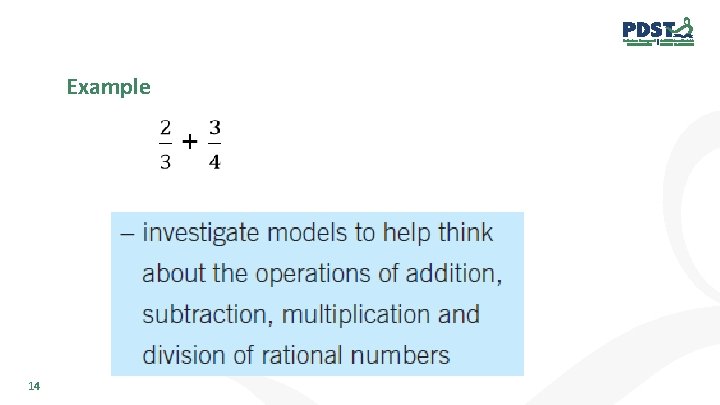
Example 14
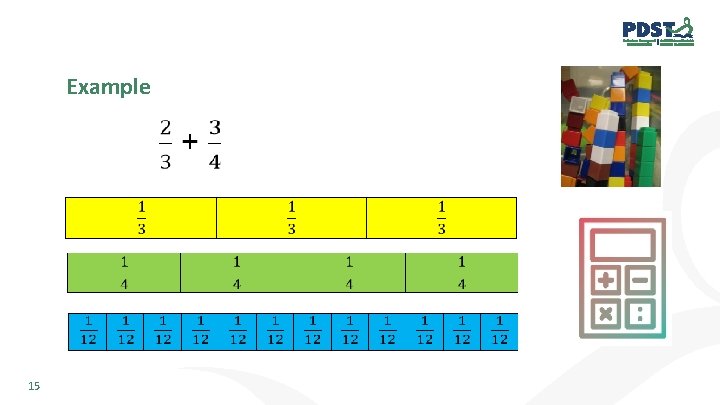
Example 15
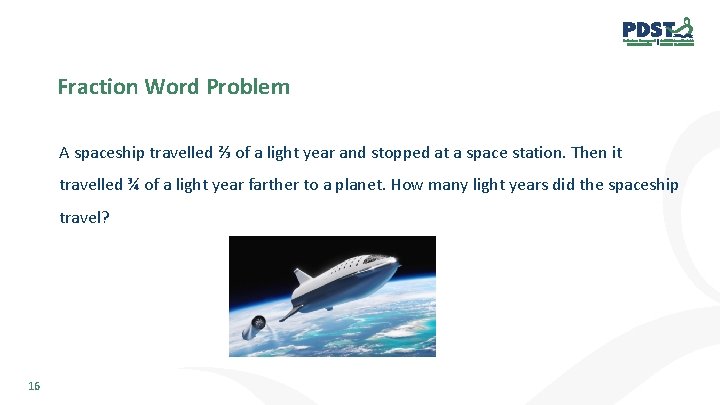
Fraction Word Problem A spaceship travelled ⅔ of a light year and stopped at a space station. Then it travelled ¾ of a light year farther to a planet. How many light years did the spaceship travel? 16
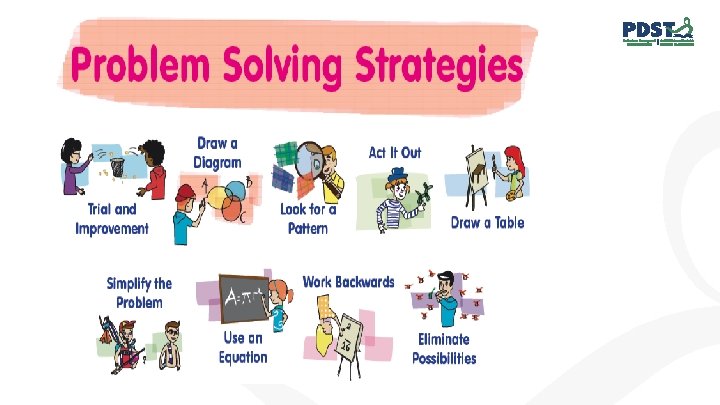
Multiple Approaches “Learners are encouraged to solve problems in a variety of ways and are required to evaluate methods and arguments and to justify their claims and results”. 17
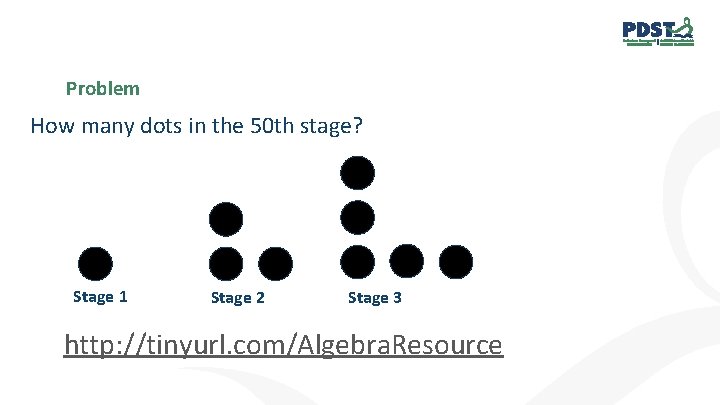
Problem How many dots in the 50 th stage? Stage 1 Stage 2 Stage 3 http: //tinyurl. com/Algebra. Resource
“By encouraging learners to share and explain their solution strategies, those that work as well as those that don’t work, teachers can help learners to develop robust and deep mathematical understanding as well as confidence in their mathematical ability” “Problem-solving tasks activate creative mathematical thinking processes as opposed to imitative thinking processes activated by routine tasks”. “ Reasoning mathematically about tasks empowers learners to make connections within mathematics and to develop deep conceptual understanding”. Page 10. Leaving Certificate Mathematics Syllabus

23
Reflection What does a problem-solving classroom looks like? How can we develop a problem-solving culture in the classroom? What can we as teachers do to encourage a problem-solving disposition among students? How can we help students reflect upon their thinking?
Culture in the Classroom “ In a mathematics problem-solving environment it is recognised that there are three things learners need to do: ● make sense of the problem ● make sense of the mathematics they can learn and use when doing the problem ● arrive at a correct solution to the problem”. -Junior & Leaving Certificate Syllabus Page 10 25
Task 1 Learning Outcomes ● Understand what problem-solving is and that it is not a separate topic but rather an integral part of teaching and learning across the syllabus. ● Understand the importance of student’s having access to practical strategies to approach a problem. ● Reflect on classroom culture regarding problem-solving. ● Understand the importance of deep knowledge of curriculum content. 26
Task 2 Learning Outcomes ● Recognise the importance of modelling to develop students’ spatial thinking. ● Understand the value of using 3 D models to help students to understand 3 D problems. ● Identify connections and build on prior knowledge. 27
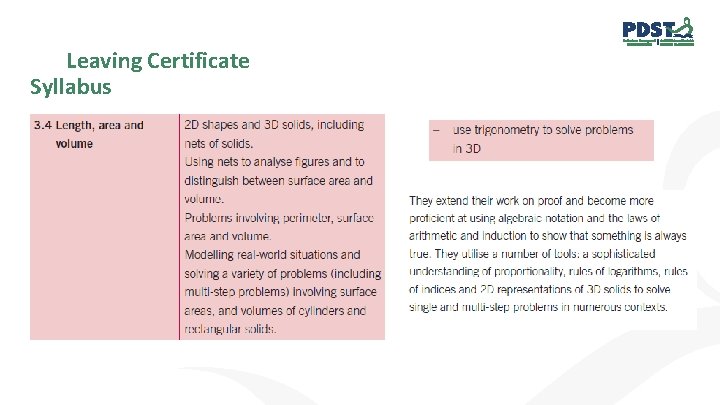
Leaving Certificate Syllabus
3 D Problems What do students find difficult about 3 D trigonometry? How do you help students gain an understanding of 3 D trigonometry? … (The) study found a relationship between young children’s construction skills and strong number sense and success in solving mathematical word problems (Nath & Szücs, 2014) Children are as nonresponsive to short term explicit instruction on spatial transformation tasks as adults. (Ehrlich, Levine & Goldin. Meadow, 2006)
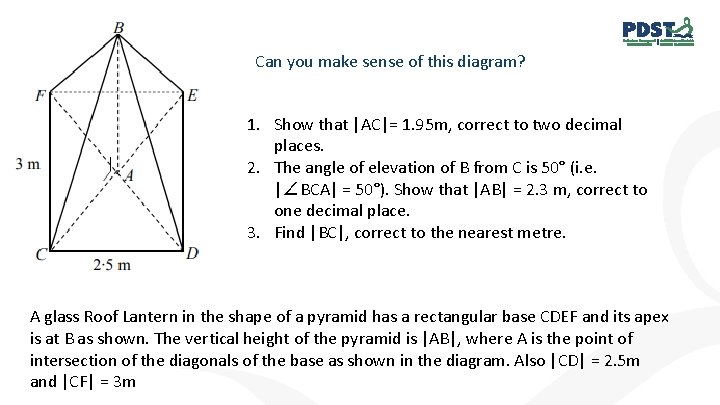
Can you make sense of this diagram? 1. Show that |AC|= 1. 95 m, correct to two decimal places. 2. The angle of elevation of B from C is 50° (i. e. |∠BCA| = 50°). Show that |AB| = 2. 3 m, correct to one decimal place. 3. Find |BC|, correct to the nearest metre. A glass Roof Lantern in the shape of a pyramid has a rectangular base CDEF and its apex is at B as shown. The vertical height of the pyramid is |AB|, where A is the point of intersection of the diagonals of the base as shown in the diagram. Also |CD| = 2. 5 m and |CF| = 3 m
How can we model this problem in 3 D? ● Describe the model and how you interacted with it? ● What insights will students gain after working with the model? ● What are the advantages/disadvantages of students working with each model? ● How will we know when students can visualise a model in their mind's eye?
Task 2 Learning Outcomes ● Recognise the importance of modelling to develop students spatial thinking. ● Understand the value of using 3 D models to help students to understand 3 D problems. ● Identify connections and build on prior knowledge. 32
Key Messages ● Problem-solving should form an integral part of students’ daily experience of studying Mathematics ● Multiple approaches are needed to encourage students to move away from functional fixedness ● Students need to be able to apply a variety of strategies in order to develop their problem-solving abilities. ● Building deep knowledge and making connections across the strands is important.

34
Summary Evaluation Form http: //tinyurl. com/WS 6 Evaluation advisorname@pdst. ie 35

36
- Slides: 34