
Workshop 2 Problem Based Learning PBL online quizzes
Workshop 2: Problem Based Learning (PBL), online quizzes, and logical tasks Introduction to the Workshop 2 The sole responsibility for the content of this presentation lies with the authors. It does not necessarily reflect the opinion of the European Union.
Authors and licence Authors: • Nataša Hoić-Božić, University of Rijeka, Department of Informatics natasah@inf. uniri. hr • Jasminka Mezak, University of Rijeka, Faculty of Teacher Education jasminka. mezak@ufri. uniri. hr This work is licensed under a Creative Commons Attribution-Share. Alike 4. 0 International License. Attribution should be given in the following way: GLAT project, https: //ec. europa. eu/programmes/erasmusplus/projects/eplus-project-details/#project/2017 -1 -HR 01 -KA 201 -035362 2 The sole responsibility for the content of this presentation lies with the authors. It does not necessarily reflect the opinion of the European Union.
Agenda • Reminder to the purpose of the workshops • Results of the Workshop 1 • Introduction to Workshop 2 3 The sole responsibility for the content of this presentation lies with the authors. It does not necessarily reflect the opinion of the European Union.
Main goals of the project • Encouraging the integration of algorithmic thinking into daily teaching through different subjects from the first to fourth grade of primary school • Training of teachers including the acquisition of contemporary knowledge and skills connected to different ICT related innovative teaching methodologies such as Problem-Based Learning (PBL), Inquiry-Based Learning (IBL), Game-Based Learning (GBL) • Creating blended learning e-course in LMS (syllabus, materials in English and (partly) in Croatian) for further using in the partner countries and beyond 4 The sole responsibility for the content of this presentation lies with the authors. It does not necessarily reflect the opinion of the European Union.
Purpose of workshops • Encouraging the integration of coding and algorithmic thinking into daily teaching through different subjects in students' younger ages in a fun and attractive way • Special focus will be on using educational strategies of Game. Based Learning (GBL) and gamification in order to foster creativity, logical thinking, and problem-solving skills. • General goal: Improving students’ attitudes towards coding and the development of algorithmic thinking of younger students, reducing the “fear” towards coding and increasing students’ interest in the selection of future careers in the ICT and STEM areas (in the long term). 5 The sole responsibility for the content of this presentation lies with the authors. It does not necessarily reflect the opinion of the European Union.
Workshops • Three workshops: • Workshop 1: Game-Based Learning (GBL) and unplugged activities • Workshop 2: Problem-Based Learning (PBL), online quizzes and logical tasks • Workshop 3: Games and tools for learning programming 6 The sole responsibility for the content of this presentation lies with the authors. It does not necessarily reflect the opinion of the European Union.
What have we done so far? The sole responsibility for the content of this presentation lies with the authors. It does not necessarily reflect the opinion of the European Union. 7
Reminder about the Workshop 1 • Workshop 1: GBL and unplugged activities • Learning outcomes: • describe principles of Game-Based Learning • use Web 2. 0 tools for creating content for unplugged activities • create learning scenarios in order to develop innovative ideas for carrying out unplugged activities in different school subjects 8 The sole responsibility for the content of this presentation lies with the authors. It does not necessarily reflect the opinion of the European Union.
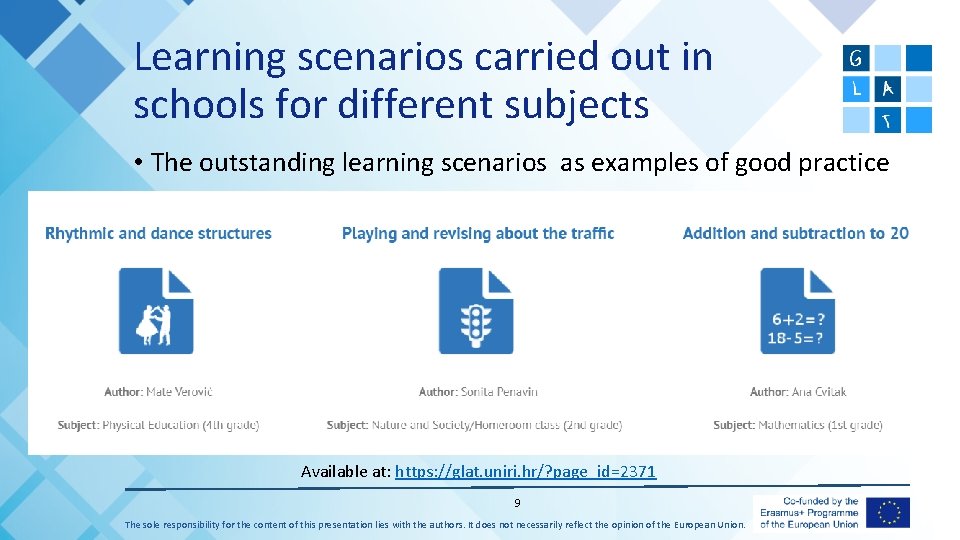
Learning scenarios carried out in schools for different subjects • The outstanding learning scenarios as examples of good practice Available at: https: //glat. uniri. hr/? page_id=2371 9 The sole responsibility for the content of this presentation lies with the authors. It does not necessarily reflect the opinion of the European Union.
What is next? The sole responsibility for the content of this presentation lies with the authors. It does not necessarily reflect the opinion of the European Union. 10
Workshop 2: Problem-Based Learning (PBL), online quizzes, and logical tasks • Learning outcomes: • Describe the principles of Problem-Based Learning • Use Web 2. 0 tools for creating logical tasks and online quizzes • Create learning scenarios in order to develop innovative ideas for carrying out logical tasks and online quizzes • Implement learning scenarios for different courses in the classroom with the students from 1 st to 4 th grades of primary school 11 The sole responsibility for the content of this presentation lies with the authors. It does not necessarily reflect the opinion of the European Union.
In the following workshop pay attention to… 1/3 Computational and algorithmic thinking (CT & AT) • Include elements in learning scenarios - along with the learning outcomes related to the courses, include those that relate to CT & AT Learning scenarios • After the Workshop 2, it is mandatory to implement at least one scenario • Use games, quizzes or logical tasks prepared for computer/tablet/smartphone for at least one example (not only unplugged activities) • Use PBL and group work 12 The sole responsibility for the content of this presentation lies with the authors. It does not necessarily reflect the opinion of the European Union.
In the following workshop pay attention to… 2/3 About a review of the activity conducted in the classroom • The teacher’s review or reflection is very important. • Write more extensive reflections, particularly on whether the learning outcomes related to algorithmic and computational thinking have been achieved. • State the number of students who participated in the learning activity. • Describe how your students have accepted learning activity. • Describe the achievement of all learning outcomes in the scenario. • Define what would you like to change before the next implementation of the scenario. 13 The sole responsibility for the content of this presentation lies with the authors. It does not necessarily reflect the opinion of the European Union.
In the following workshop pay attention to… 3/3 Other • Pay attention to the copyright for images, videos, and other materials collected from the web. • Photographing and interviewing students requires written parents’ consent 14 The sole responsibility for the content of this presentation lies with the authors. It does not necessarily reflect the opinion of the European Union.

Questions 15 The sole responsibility for the content of this presentation lies with the authors. It does not necessarily reflect the opinion of the European Union.
Let’s start… The sole responsibility for the content of this presentation lies with the authors. It does not necessarily reflect the opinion of the European Union. 16
- Slides: 16