
Worksheet Acids Bases p H Key 1 Label
Worksheet: Acids, Bases & p. H Key
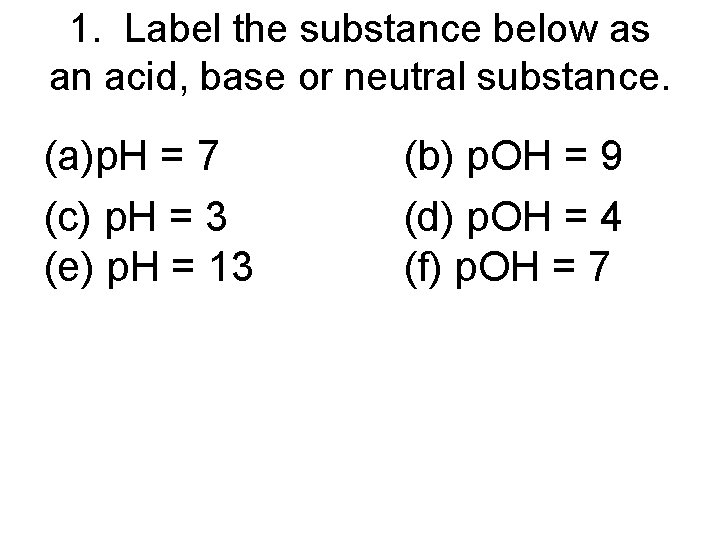
1. Label the substance below as an acid, base or neutral substance. (a)p. H = 7 (c) p. H = 3 (e) p. H = 13 (b) p. OH = 9 (d) p. OH = 4 (f) p. OH = 7
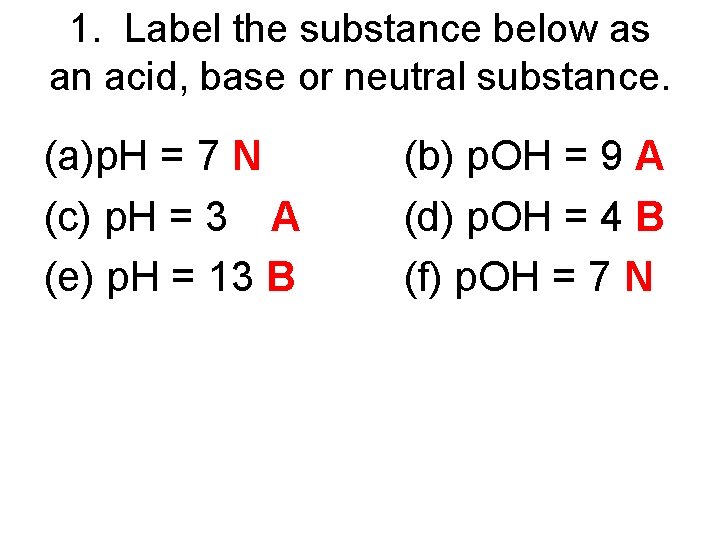
1. Label the substance below as an acid, base or neutral substance. (a)p. H = 7 N (c) p. H = 3 A (e) p. H = 13 B (b) p. OH = 9 A (d) p. OH = 4 B (f) p. OH = 7 N
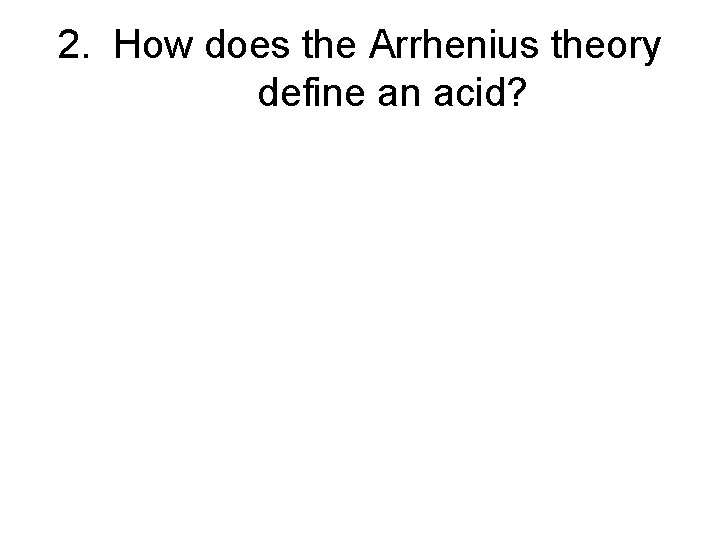
2. How does the Arrhenius theory define an acid?
2. How does the Arrhenius theory define an acid? • An acid produces H 3 O+ ions when dissolved in water.
3. How does the Arrhenius theory define an base?
3. How does the Arrhenius theory define an base? • A base produces OH- ions when dissolved in water.
4. Differentiate between an electrolyte and a nonelectrolyte.
4. Differentiate between an electrolyte and a nonelectrolyte. • An electrolyte dissolves into ions when placed in water whereas a nonelectrolyte dissolves into molecules.
5. What type of substances are electrolytes?
5. What type of substances are electrolytes? Acids, Bases, Salts
6. When H+ ions are dissolved in water they become hydronium ions. What is the formula for a hydronium ion?
6. When H+ ions are dissolved in water they become hydronium ions. What is the formula for a hydronium ion? H 3 O +
7. What is the p. H of a solution with a [H+] = 4. 32 x 10 -12?
7. What is the p. H of a solution with a [H+] = 4. 32 x 10 -12? p. OH = 11. 365
8. What is the p. OH of a solution with a [OH-] = 6. 83 x 10 -3?
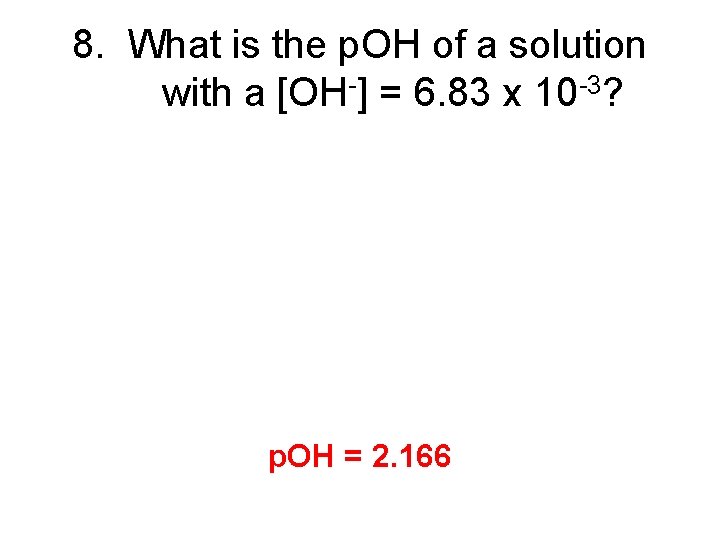
8. What is the p. OH of a solution with a [OH-] = 6. 83 x 10 -3? p. OH = 2. 166
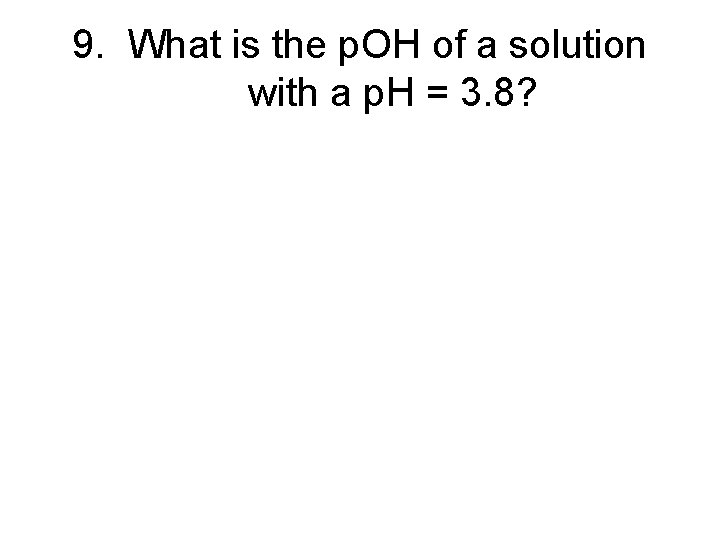
9. What is the p. OH of a solution with a p. H = 3. 8?
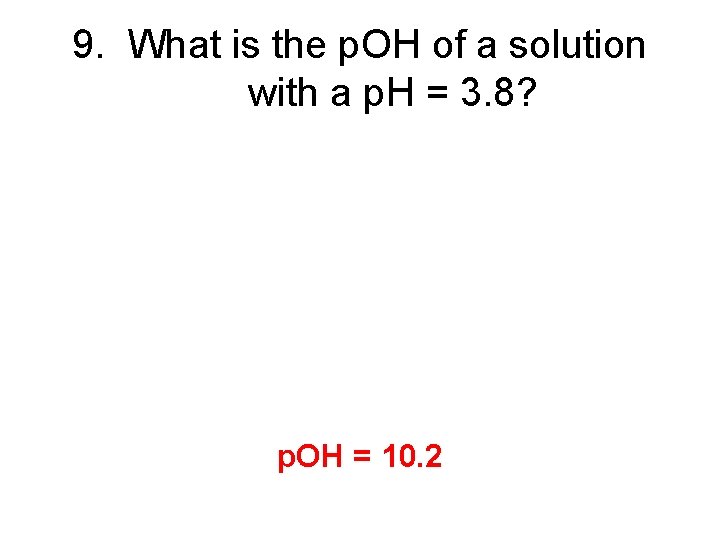
9. What is the p. OH of a solution with a p. H = 3. 8? p. OH = 10. 2
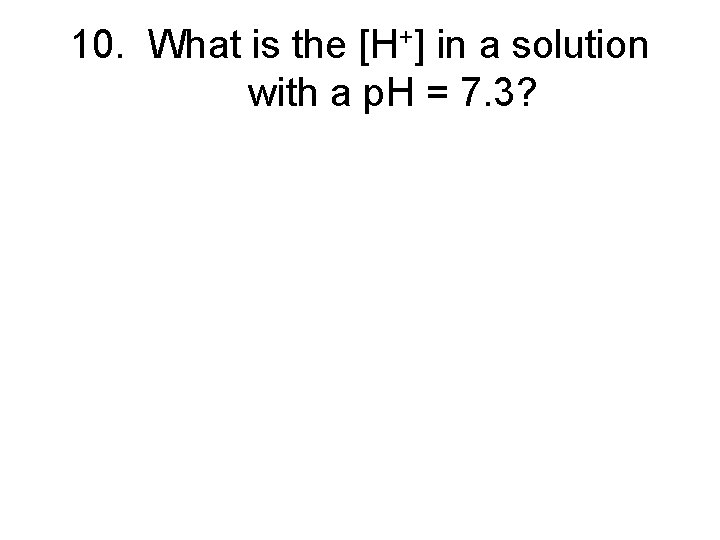
10. What is the [H+] in a solution with a p. H = 7. 3?
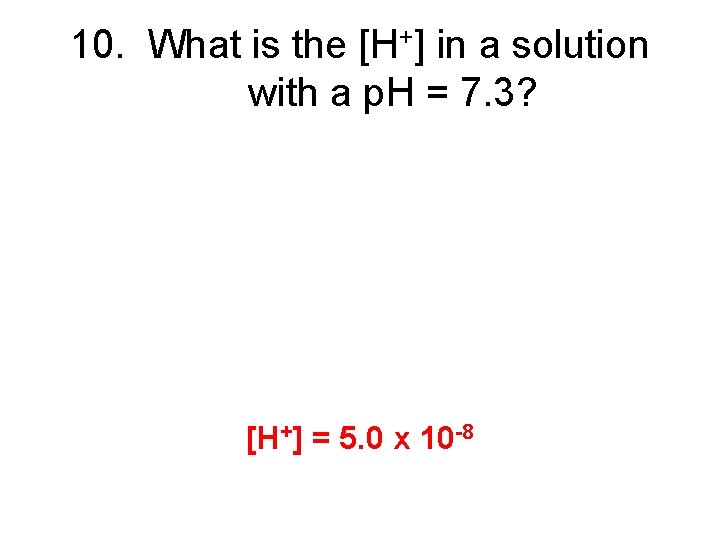
10. What is the [H+] in a solution with a p. H = 7. 3? [H+] = 5. 0 x 10 -8
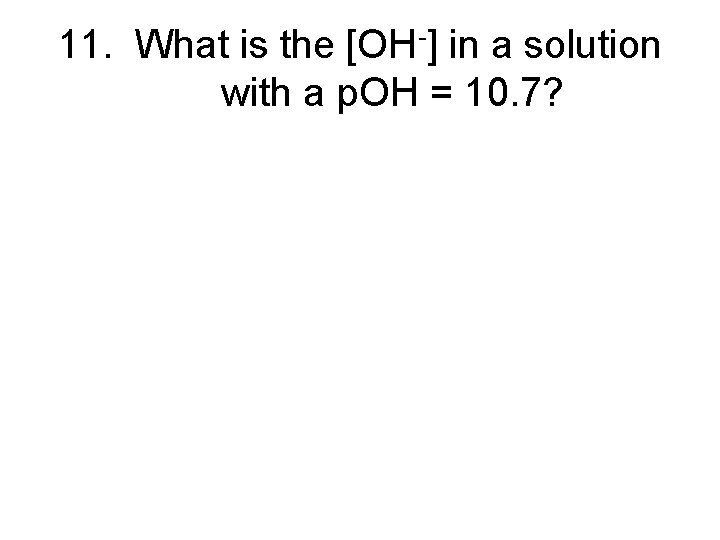
11. What is the [OH-] in a solution with a p. OH = 10. 7?
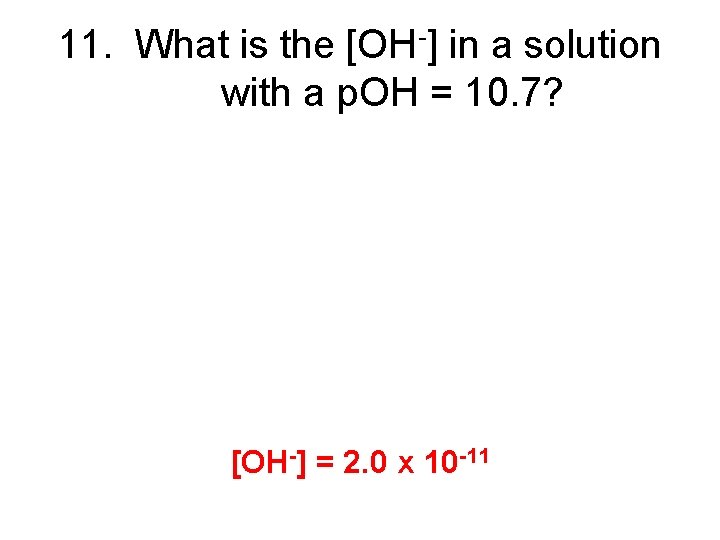
11. What is the [OH-] in a solution with a p. OH = 10. 7? [OH-] = 2. 0 x 10 -11
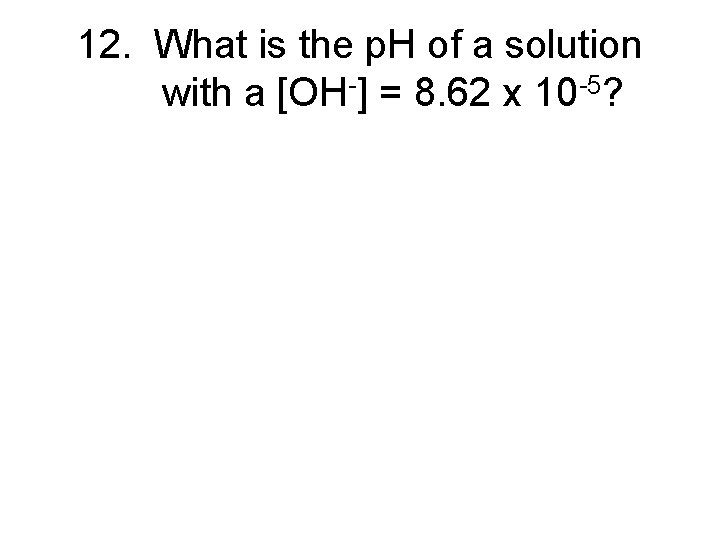
12. What is the p. H of a solution with a [OH-] = 8. 62 x 10 -5?
12. What is the p. H of a solution with a [OH-] = 8. 62 x 10 -5? p. H = 9. 936
13 a) Write the balanced equation for the acid-base neutralization of H 2 SO 4 and Ba(OH)2.
13 a) Write the balanced equation for the acid-base neutralization of H 2 SO 4 and Ba(OH)2. H 2 SO 4 + Ba(OH)2 → Ba. SO 4 + 2 H 2 O
13 b) Write the balanced equation for the acid-base neutralization of HF and Na. OH.
13 b) Write the balanced equation for the acid-base neutralization of HF and Na. OH. HF + Na. OH → Na. F + H 2 O
13 c) Write the balanced equation for the acid-base neutralization of HI and Sr(OH)2.
13 c) Write the balanced equation for the acid-base neutralization of HI and Sr(OH)2. 2 HI + Sr(OH)2 → Sr. I 2 + 2 H 2 O
13 d) We often use the equation Macid x Vacid = Mbase x Vbase. Which of the acid-base neutralization reactions above could we not use this formula for? Explain.
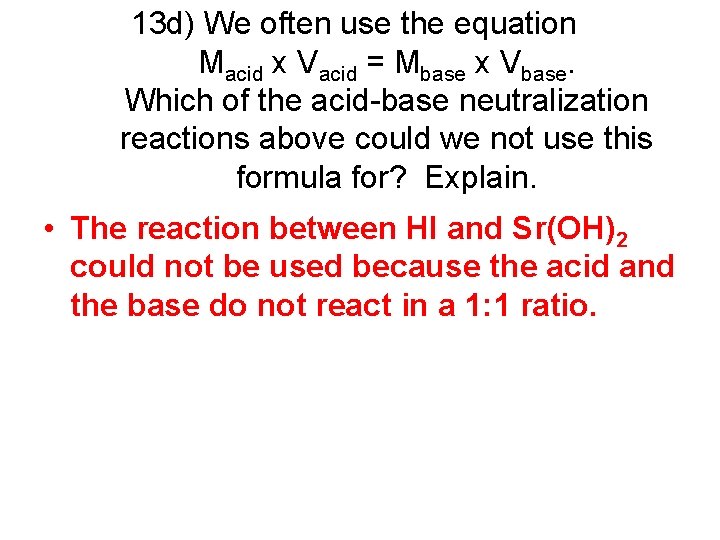
13 d) We often use the equation Macid x Vacid = Mbase x Vbase. Which of the acid-base neutralization reactions above could we not use this formula for? Explain. • The reaction between HI and Sr(OH)2 could not be used because the acid and the base do not react in a 1: 1 ratio.
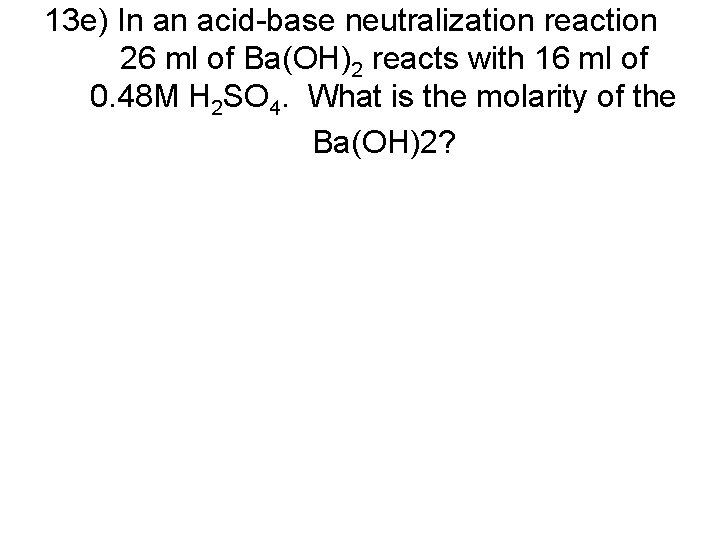
13 e) In an acid-base neutralization reaction 26 ml of Ba(OH)2 reacts with 16 ml of 0. 48 M H 2 SO 4. What is the molarity of the Ba(OH)2?
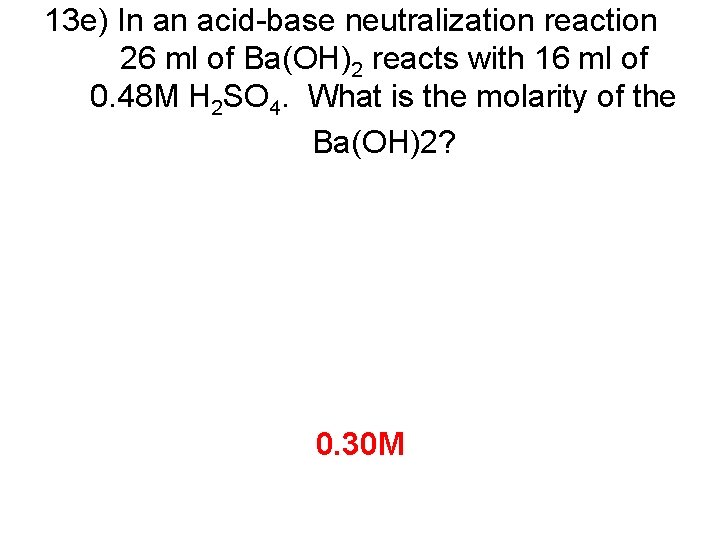
13 e) In an acid-base neutralization reaction 26 ml of Ba(OH)2 reacts with 16 ml of 0. 48 M H 2 SO 4. What is the molarity of the Ba(OH)2? 0. 30 M
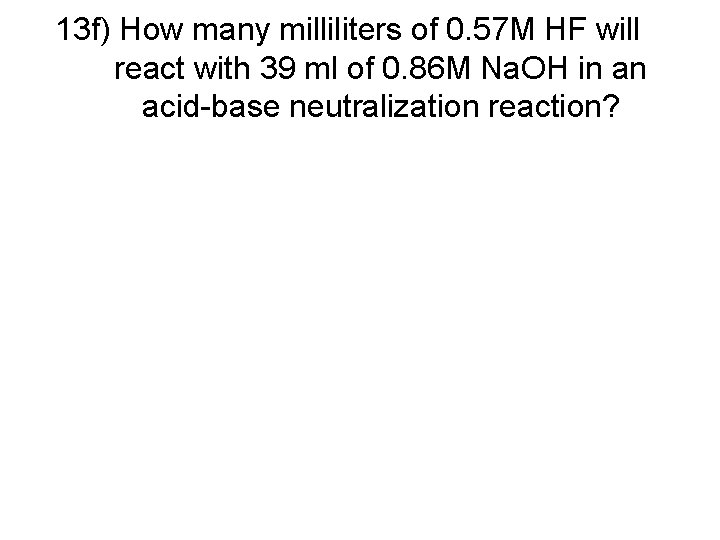
13 f) How many milliliters of 0. 57 M HF will react with 39 ml of 0. 86 M Na. OH in an acid-base neutralization reaction?
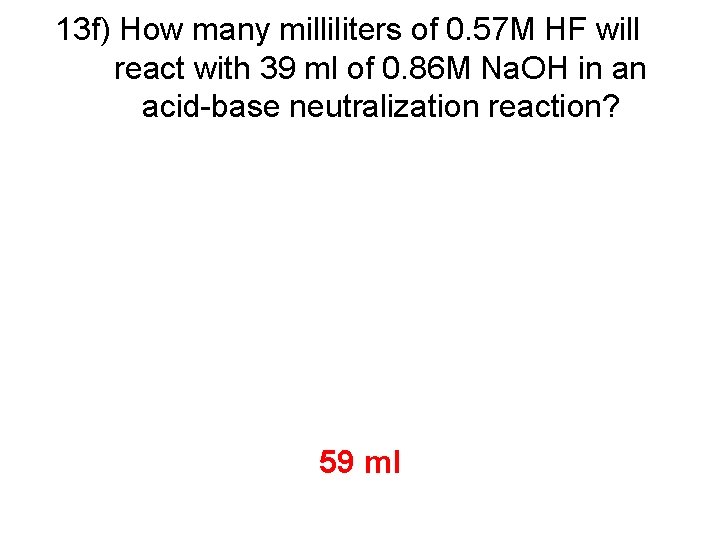
13 f) How many milliliters of 0. 57 M HF will react with 39 ml of 0. 86 M Na. OH in an acid-base neutralization reaction? 59 ml
- Slides: 37