
Workplans being developed by Standing Committees Monitoring Assessment
Workplans being developed by… • Standing Committees – Monitoring & Assessment – Data Management – Program Coordination • Stakeholder groups – – – Federal government State government Local government Academia Industry/Consultants Volunteer/Watershed 19 -Aug-2003 Focus on these three stakeholder groups— 1. articulate the value of the Council to these constituencies 2. determine what these groups need from the Council--develop activities designed specifically to meet their needs MWMC presentation to NWQMC 1
Stakeholder Group Plans-Academic Community • Contact all academic researchers in the aquatic field (community college and above) – Describe the Council structure, goals/vision, activities – Describe benefits that MWMC could have to academic community – Request basic information regarding research activity of faculty member – Request participation in Council events (workshops, annual conference, newsletter) – Share information about the MWMC with colleagues and students • The final product will be an inventory (telephone book) of the academic community doing research involving water monitoring which will be linked to the MWMC web page 19 -Aug-2003 MWMC presentation to NWQMC 2
Stakeholder Group Plans-Business Community • ID key private sector players--poll counties, MDE, DOT, MDA, ag extension agencies, NRCS for good contacts. Seek broad geographic spread. • Develop message/materials tailored to private sector, including MWMC vision/mission and stressing participation from this sector needed to reach goals. List examples and success stories demonstrating MWMC effectiveness. Examples can include successful public/private partnerships and may come from other state/basin councils. MWMC Board should request that NWQMC compile success stories and provide material to state councils. • 2003 annual conference - the focus on restoration is excellent forum for involving developers or private consultants, especially those designing/implementing restoration projects. Invite speakers, posters. • Invite member of business community to join Board (developer or other interest) 19 -Aug-2003 MWMC presentation to NWQMC 3
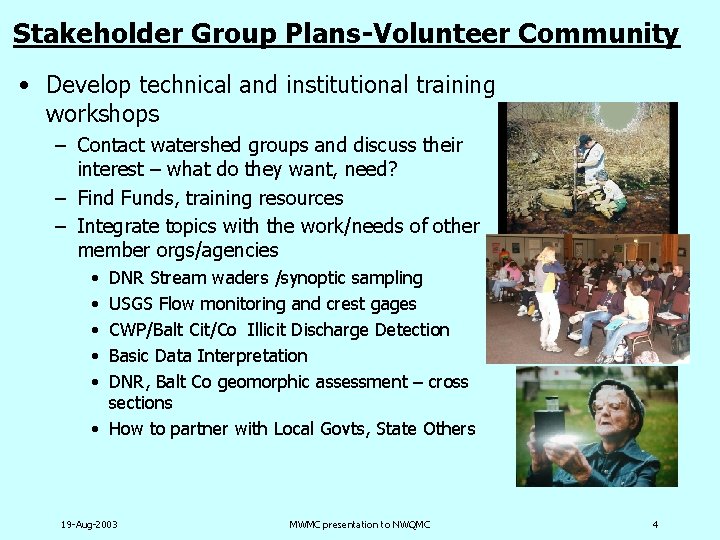
Stakeholder Group Plans-Volunteer Community • Develop technical and institutional training workshops – Contact watershed groups and discuss their interest – what do they want, need? – Find Funds, training resources – Integrate topics with the work/needs of other member orgs/agencies • • • DNR Stream waders /synoptic sampling USGS Flow monitoring and crest gages CWP/Balt Cit/Co Illicit Discharge Detection Basic Data Interpretation DNR, Balt Co geomorphic assessment – cross sections • How to partner with Local Govts, State Others 19 -Aug-2003 MWMC presentation to NWQMC 4
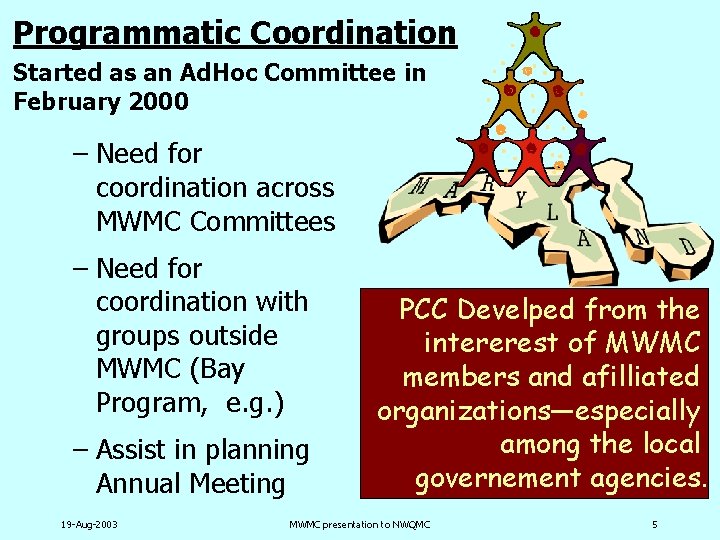
Programmatic Coordination Started as an Ad. Hoc Committee in February 2000 – Need for coordination across MWMC Committees – Need for coordination with groups outside MWMC (Bay Program, e. g. ) – Assist in planning Annual Meeting 19 -Aug-2003 PCC Develped from the intererest of MWMC members and afilliated organizations—especially among the local governement agencies. MWMC presentation to NWQMC 5
Programmatic Coordination Summer 2000: MWMC consensus items approved by MWMC as needed to improve coordination among monitoring groups in the state • Clearinghouse with program metadata • Comprehensive Statement – Water monitoring goals for Maryland agencies, – Approaches to meet these goals, – Programs currently in place in relation to these goals. • Process for routine information exchange • Process for routine information • Collaborative effort in the exchange development of a statewide • Collaborative effort in the development monitoring strategy of a statewide monitoring strategy 19 -Aug-2003 MWMC presentation to NWQMC 6
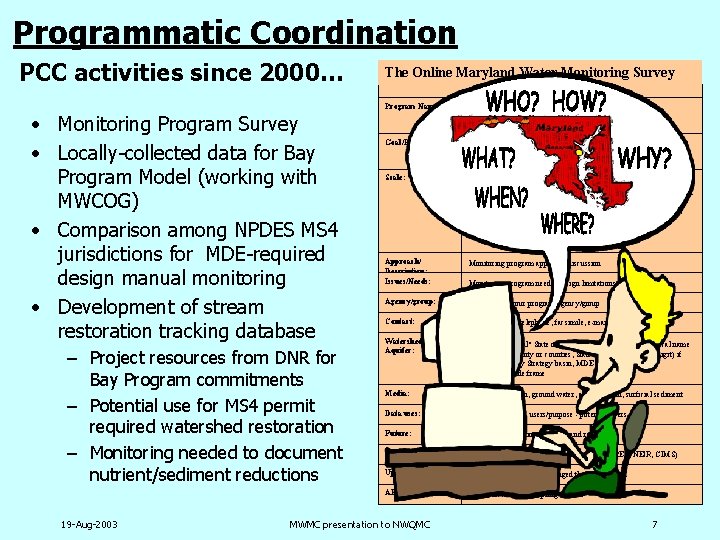
Programmatic Coordination PCC activities since 2000… The Online Maryland Water Monitoring Survey INSTRUCTIONS Program Name : • Monitoring Program Survey • Locally-collected data for Bay Program Model (working with MWCOG) • Comparison among NPDES MS 4 jurisdictions for MDE-required design manual monitoring • Development of stream restoration tracking database – Project resources from DNR for Bay Program commitments – Potential use for MS 4 permit required watershed restoration – Monitoring needed to document nutrient/sediment reductions 19 -Aug-2003 Goal/Purpose: The name of your program Project objectives and brief narrative - Data Quality Objectives, if available Scale: Intended assessment/reporting scale - other known use scales. (Option - determine sampling density or range of densities by dividing representative length/area by number of sampling stations - e. g. , 57 CORE stations representing 898 miles -- 898/57=average 15. 8 miles/station) Approach/ Description: Issues/Needs: Monitoring program approach/discussion Agency/group: The name of your program agency/group Contact: Name, address, telephone, facsimile, e-mail, Web-site Monitoring program needs; design limitations/restrictions • Monitoring Plans (with Monitoring and Assessment Committee) Watersheds/ Aquifer: If known, "official" State or US Geological Survey name, local name (if different), county or counties, State watershed (6, 8, 12 -digit) if known, Tributary Strategy basin, MDE permit basin, latitude/longitude frame Media: e. g. , water column, ground water, air deposition, surficial sediment Data uses: Identify other data users/purpose - potential users Future: Planned modifications/changes and rationale Publications: QAPP reference, citations, data indices (STORET, NEIR, CIMS) Updated: The date you entered or changed this information APPENDIX List or location of sampling stations MWMC presentation to NWQMC 7

Programmatic Coordination Workplan 2003… • Work with Data Subcommittee on webbased clearinghouse of program meta-data • By Annual meeting, draft statement of monitoring goals and approaches – Update and expand responses to Monitoring Program Survey 19 -Aug-2003 • Continue liaison with Bay Program, Tributary Strategies, MS 4 program, to assure collection methods and data analysis comparability MWMC presentation to NWQMC 8

Monitoring & Assessment 1995 --Formed as Assessment & Reporting Committee 2001—Merged with Monitoring Methods Committee Active members… ü Jim Cummins – Co-Chair (ICPRB) ü Ron Klauda – Co-Chair (MD/DNR) ü Brian Clevenger (MDE) ü Doug Redmond (MNCPPC) ü Sherm Garrison (MD/DNR) ü Bob Shedlock (USGS) ü Paul Jacobson (Langhei Ecology) ü Bill Stack (Baltimore City DPW) 19 -Aug-2003 MWMC presentation to NWQMC 9

Monitoring & Assessment Objectives… • Promote collection of high quality and easily-shared water monitoring data • Disseminate information about water monitoring programs to all interested parties • Promote use of appropriate analytical procedures to prepare meaningful assessments of water quality conditions • Promote presentation of understandable findings in technical and non-technical forums • Assist in planning annual MWMC conferences 19 -Aug-2003 MWMC presentation to NWQMC 10
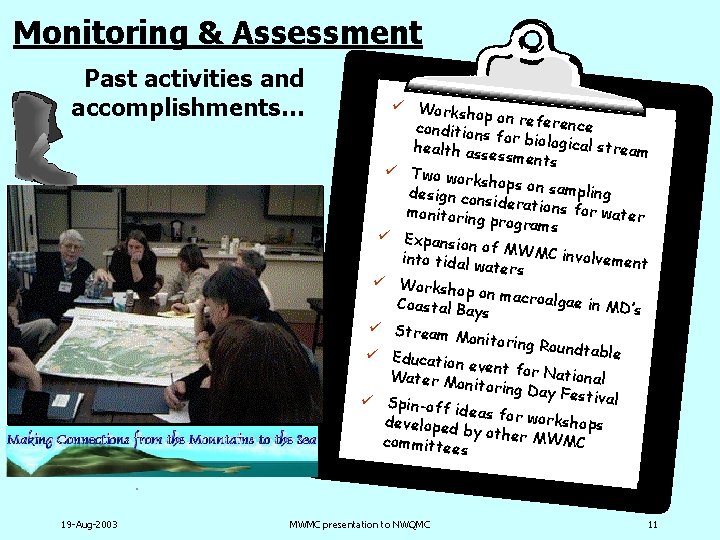
Monitoring & Assessment Past activities and accomplishments… 19 -Aug-2003 ü Worksh op on refe rence conditions for biologic al stream health asse ssments ü Two wo rkshops on sampling design con siderations for water monitoring programs ü Expans ion of MW MC involve into tidal w ment aters ü Worksh op on macr oalgae in M Coastal Ba D’s ys ü Stream Monitoring Roundtable ü Educatio n event for National Water Mon itoring Day Festival ü Spin-of f ideas for workshops developed by other M WMC committee s MWMC presentation to NWQMC 11
Monitoring & Assessment Ongoing & future activities… 19 -Aug-2003 ü Prepare summary o f M&A Committee accomplish ments for 2003 Annu al Confere nce ü Collabor ate with D ata Manage Committee ment to organize and host expanded S tream Mon itoring Roundtable – early 200 4 ü Review s ections of draft 305 b reports pr epared by MD/DNR – beginning e arly 2004 ü Organize and host Q A/QC workshop: “Generatin g Co in the Data ” – late 200 nfidence 4 ü Develop periodic pr ess release stream/wa s on tershed co n d itions in M - beginning D late 2004 MWMC presentation to NWQMC 12
Data Management Mission… 19 -Aug-2003 To explore data management procedures employed in Maryland develop recommended procedures for data management and quality assurance. MWMC presentation to NWQMC 13
Data Management Past activities and accomplishments… • Developed a Minimum data elements document standardizing a baseline set of data fields to facilitate data sharing • Initiated implementation of the “clickable” map concept where monitoring data and information could be accessed through a GIS interface 19 -Aug-2003 • Developed a database of Non-tidal Tributary Water-Quality Monitoring Programs in the Chesapeake Bay Watershed MWMC presentation to NWQMC 14
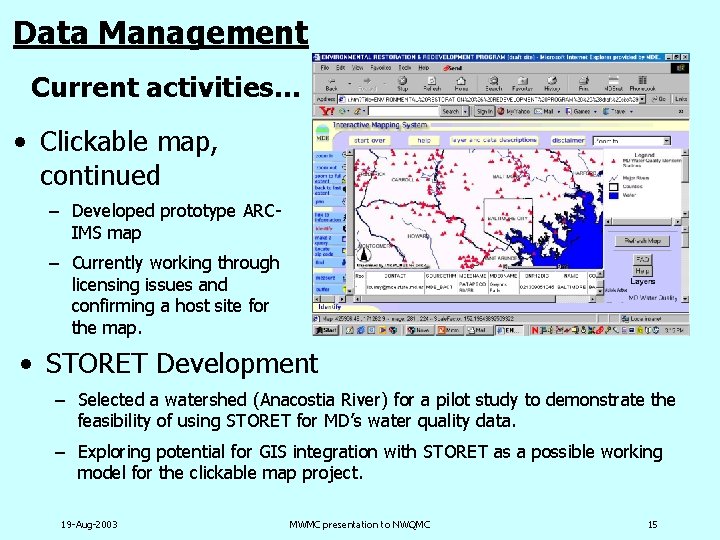
Data Management Current activities… • Clickable map, continued – Developed prototype ARCIMS map – Currently working through licensing issues and confirming a host site for the map. • STORET Development – Selected a watershed (Anacostia River) for a pilot study to demonstrate the feasibility of using STORET for MD’s water quality data. – Exploring potential for GIS integration with STORET as a possible working model for the clickable map project. 19 -Aug-2003 MWMC presentation to NWQMC 15
Data Management Future activities & objectives… • Host a workshop on data management and/or data quality issues. • Pursue grants to fund a full-time staff member for Data Management • Expand active membership to activities include: • Coordinate more with the National – All metropolitan counties, Council, as well as federal agencies – At least one consultant, (EPA, USGS on Data Standards) – At least one volunteer • Provide better public access to Maryland’s water quality data • Reaffirm the DMC’s mission and purpose 19 -Aug-2003 organization, – At least one academic organization – Seek involvement of the State Highway Administration. MWMC presentation to NWQMC 16
- Slides: 16