
Workplace Safety Guidelines Why Work Safely Work safely

- Slides: 21
Workplace Safety Guidelines
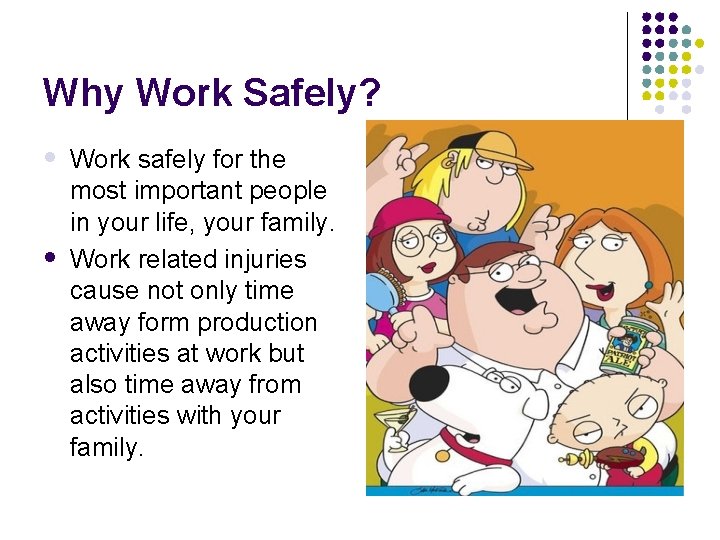
Why Work Safely? Work safely for the most important people in your life, your family. Work related injuries cause not only time away form production activities at work but also time away from activities with your family.
What is working safely? Wearing required PPE Completing every task the correct way, not taking hazardous shortcuts Paying attention to the task at hand Asking for instruction when completing unfamiliar tasks.
Emergency Evacuation of the building may be required if an emergency situation threatens the life or safety of employees. Situations that may require evacuation: fire or smoke; chemical spill – (five (5) gallons or more); bomb threat; violence; power failure; terrorist attacks.
Emergency Evacuation If there is an emergency: Proceed to the nearest EXIT. Do not stop to pick up personal property. After exiting building, proceed to the assigned outside Evacuation Area. The Emergency Coordinator will verify all employees are accounted for. The Emergency Coordinator will notify the Manager on the status of employees.
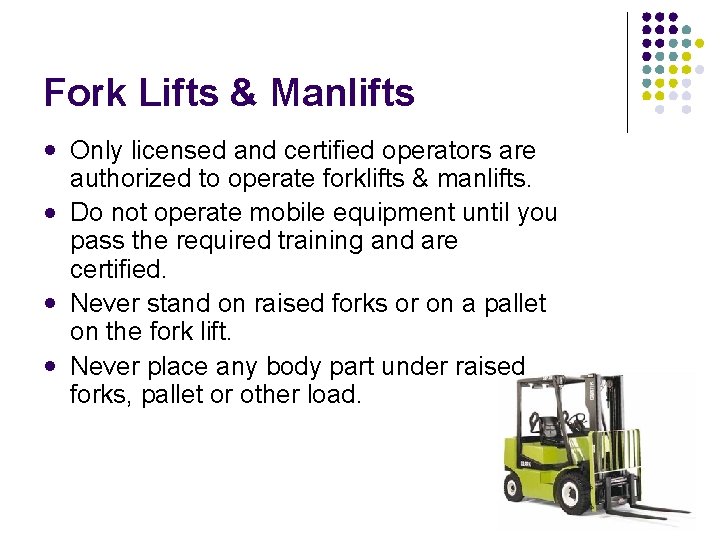
Fork Lifts & Manlifts Only licensed and certified operators are authorized to operate forklifts & manlifts. Do not operate mobile equipment until you pass the required training and are certified. Never stand on raised forks or on a pallet on the fork lift. Never place any body part under raised forks, pallet or other load.
Fork Lifts & Manlifts Always keep a buffer distance of at least 6 feet from all directions of possible travel. Always insure the lift operator knows you will walk in front of or behind the lift. Never stand in an area where a load could fall off forks and strike you. Never ride on a fork lift as a passenger.
Death Zones These areas are called death zones because if the load fell or shifted and you were in a death zone you would be killed. Examples of Death Zones are as follows: Positioning yourself between a raised load and a fixed object. In an area where the load would strike you if it fell.
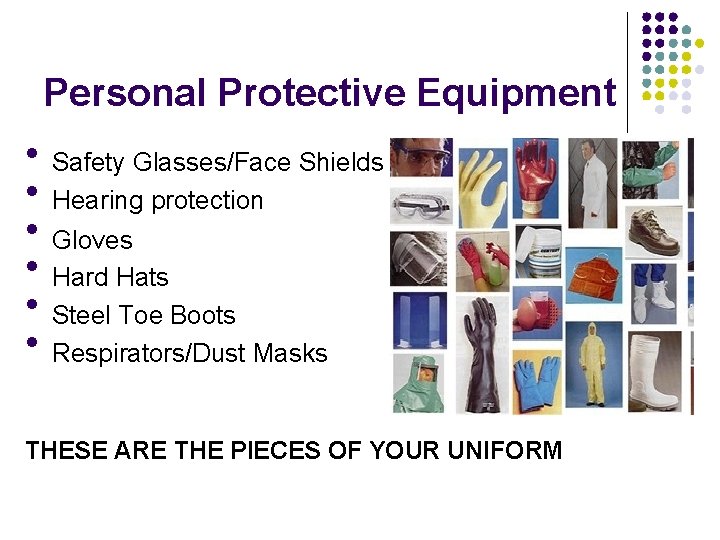
Personal Protective Equipment Safety Glasses/Face Shields Hearing protection Gloves Hard Hats Steel Toe Boots Respirators/Dust Masks THESE ARE THE PIECES OF YOUR UNIFORM
Care of PPE Inspect all PPE prior to using each time. If any part of your PPE is damaged, seek repair or replacement Store all PPE in a clean, dry and secure place.
Limitations of PPE Hardhats will protect you from falling bolts from cranes but not heavy falling objects. Dust, airborne dirt, and sparks can travel underneath and around the lens of safety glasses. Leather gloves can be be cut through.
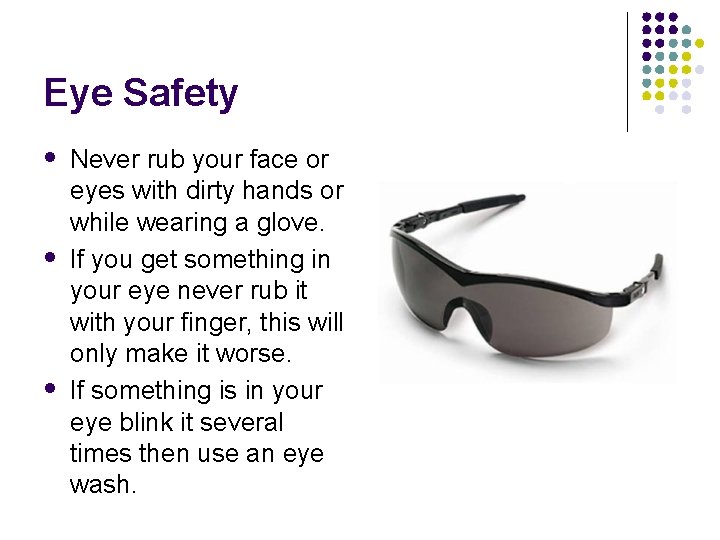
Eye Safety Never rub your face or eyes with dirty hands or while wearing a glove. If you get something in your eye never rub it with your finger, this will only make it worse. If something is in your eye blink it several times then use an eye wash.
Hearing Conservation Always wear hearing protection in required areas. Prolonged exposure to noise without protection will cause permanent hearing loss. To insert earplugs pull up on top of ear and insert. Earmuffs should cover the entire outer ear and be snug.
Electrical Safety Only trained maintenance employees are authorized to conduct trouble shooting or electrical repairs. Do not attempt any maintenance activities you are not trained or authorized to conduct. Never use a damaged extension cord or any other piece of damaged equipment. Never used electrical equipment in damp or wet areas.
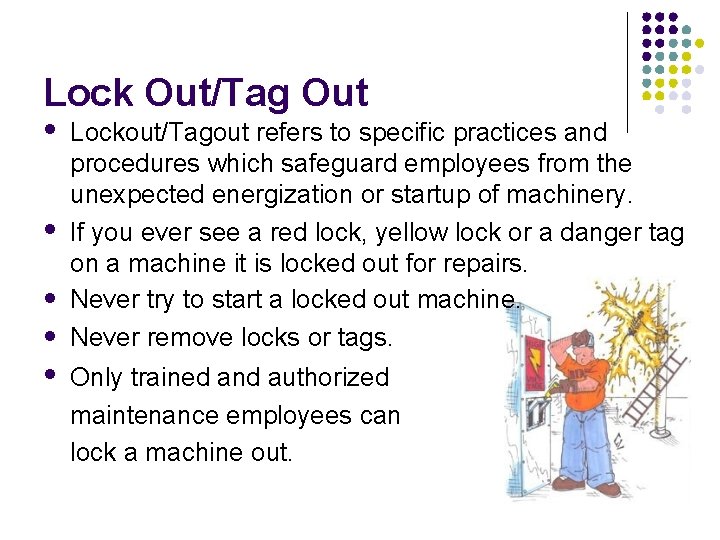
Lock Out/Tag Out Lockout/Tagout refers to specific practices and procedures which safeguard employees from the unexpected energization or startup of machinery. If you ever see a red lock, yellow lock or a danger tag on a machine it is locked out for repairs. Never try to start a locked out machine. Never remove locks or tags. Only trained and authorized maintenance employees can lock a machine out.
Lifting and Moving Material Always check the weight of an object prior to lifting it. If it seems heavy get help from another person, use a fork lift or a crane. Stretch and plan the path of travel before the lift. Always lift with your legs keeping your back straight. Never twist while carrying a load.
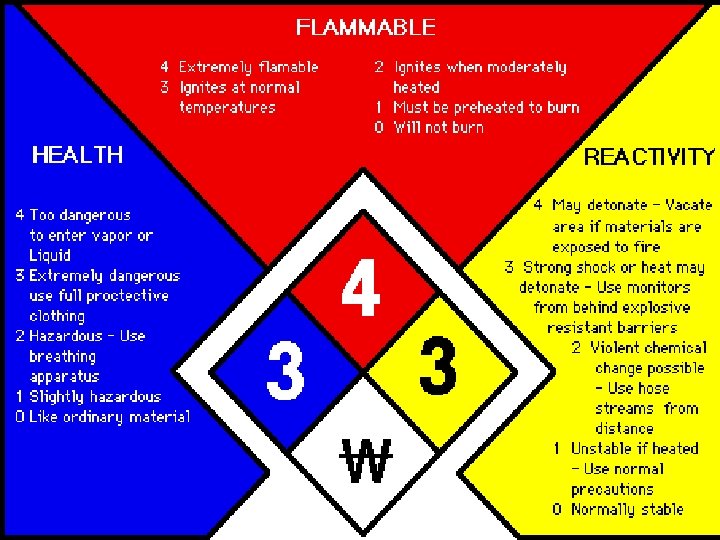
Hazard Communication All chemicals must be labeled with the name of the chemical & manufacturer Bulk chemicals and chemicals with a hazard must be labeled with the Hazard Management Information System Label shown on the next page. The higher the number rating the more hazardous the chemical.
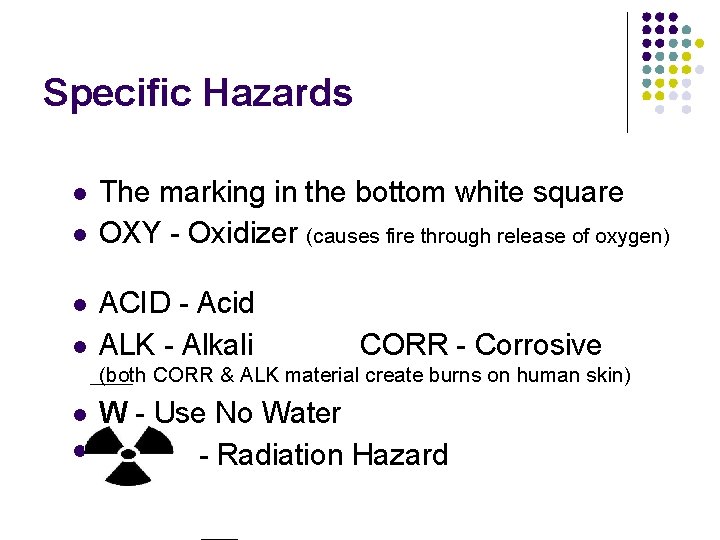
Specific Hazards The marking in the bottom white square OXY - Oxidizer (causes fire through release of oxygen) ACID - Acid ALK - Alkali CORR - Corrosive (both CORR & ALK material create burns on human skin) W - Use No Water - Radiation Hazard
MSDS = Material Safety Data Sheets In-depth information on health hazards, reactivity, flammability chemical properties, guidelines on usage and storage. MSDS for all products used at facility are in binders onsite. See supervisor/manager for MSDS binder location.
THANK YOU Visit Flojects. in for Question Papers, Activities & Presentations