
Workplace Readiness Training including Independent Living Skills PETS

- Slides: 52
Workplace Readiness Training (including Independent Living Skills) PETS Webinar Series: Part 4 Thursday, November 7, 2019, 10 am-11 am Melissa Wert-Thrush Central Region Transition Specialist 1
Overview: Mission Statement To assist Pennsylvanians with disabilities to secure and maintain employment and independence. 2
Objectives Participants will be able to: • Define Workplace Readiness Training and Independent Living Skills. • Describe potential outcomes for Workplace Readiness Training. • Explain the service format. • Provide examples of Workplace Readiness Training. • Explain how to document Workplace Readiness Training and Independent Living Skills and what PETS forms to use. • Provide resources and tools for Workplace Readiness Training. 3
WIOA The Workforce Innovation and Opportunity Act (WIOA) amended the Rehabilitation Act of 1973 to require vocational rehabilitation (VR) agencies to set aside at least 15% of their federal funds to provide “preemployment transition services” to “Students with Disabilities who are eligible or potentially eligible for VR services. ” 4
5 Required PETS What are the 5 Required Pre-Employment Transition Services? Self-Advocacy Instruction Counseling On Postsecondary Options Job Exploration Counseling Work Based Learning Workplace Readiness Training 5
Review of PETS and VR Services • PETS provide a generalized early start to job exploration. • PETS assist students with disabilities in identifying career interests that may be further explored through individualized Vocational Rehabilitation services. • PETS must be provided or arranged in collaboration with LEAs. • The goal of both PETS and individualized Vocational Rehabilitation services is assisting individuals with disabilities to prepare for and achieve competitive integrated employment. 6
Workplace Readiness Training Service definition, intended outcomes, and format 7
Definition Workplace Readiness Training teaches students with disabilities how to get and keep a job. 8
Topics and Outcomes • To ensure the quality of our services and accurately record PETS data for RSA reporting, we have also developed a list of topics and potential outcomes. • These topics and outcomes should be documented in CPNs or in the “Notes” section of PETS rosters. 9
Career Exploration and Preparation Workplace Readiness Topics for the PETS Continuum under “Career Exploration and Preparation” include: • Soft Skills • Independent Living Skills • Budgeting and Finance • Photo ID and Records • Transportation Methods • Group Travel Training 10
Soft Skills Potential Outcomes: • Identify soft skills necessary for job attainment and retention • Learn about specific types of soft skills (Ex: communication, teamwork, networking, critical thinking, professionalism, time management, accepting constructive feedback) and the type of behaviors associated 11
Independent Living Skills gives students with disabilities skills to access and use community services and supports to increase self-reliance and self -confidence in the workplace. Potential Outcomes: • Identify housing options • Demonstrate basic daily living skills concepts and behaviors such as hygiene, self-care and laundry skills • Identify healthy eating habits • Manage personal health needs such as medication management and accessing healthcare 12
Budgeting and Finance Potential Outcomes: • Understand how much money you earn and spend over a period of time • Creating a plan for spending and saving money • Learn what a budget is, why it’s important, and how to set up a simple budget • Understand the costs of housing, utilities, food, and clothing 13
Photo ID and Records Potential Outcomes: • Learn how to obtain a photo ID and other vital records 14
Transportation Methods Potential Outcomes: • Identify available methods of transportation in your community • Describe how to get to identified areas using public transportation 15
Group Travel Training Potential Outcomes: • • • Communicate full address and phone number Learn traffic signs and signals Safely walk across streets Learn to read subway/bus maps Safely transfer subway/bus Safely use Lyft, Uber, or taxi services Add money to bus/subway card Identify which bus/subway stop to get off Display awareness of surroundings when using public transportation Understand what to do in an emergency 16
Career Engagement Workplace Readiness Topics for the PETS Continuum under “Career Engagement”: • Navigating Community Resources • Safety, including Internet Usage • Relationships and Boundaries • Resumes, Cover Letters and References • Job Interview Preparation 17
Navigating Community Resources Potential Outcomes: • Identify community resources to support independent living and employment 18
Safety including Internet Usage Potential Outcomes: • Demonstrate basic skills for personal safety in the community, in employment, at home and online • Demonstrate knowledge of the impact of personal social media on employment • Learn how to safely navigate the Internet 19
Relationships and Boundaries Potential Outcomes: • Identify basic relationship and boundary skills to use socially, in the community, in employment, at home and online 20
Job Searches and Applications Potential Outcomes: • Learn job search techniques • Practice filling out job applications correctly 21
Resumes, Cover Letters and References Potential Outcomes: • Learn components of a basic resume • Create a personal resume • Learn components of a cover letter • Create a cover letter for a specific job interest 22
Job Interview Preparation Potential Outcomes: • Learn basic job interview skills • Practice interviewing for jobs 23
Career Experience and Planning Workplace Readiness Topics for the PETS Continuum under “Career Experience and Planning”: • Requesting Reasonable Accommodations • Assistive Technology Options 24
Requesting Reasonable Accommodations Potential Outcomes: • Learn about reasonable accommodations in the workplace • Know how to request a reasonable accommodation in the workplace 25
Assistive Technology Options Potential Outcomes: • Identify some devices, software, or equipment that can be used to increase, maintain or improve the functional capabilities of your disability • Learn where you can obtain the assistive technology you need 26
Service Format – Individual Counseling OVR staff may provide individual Workplace Readiness Training to eligible and potentially eligible students. • Individual counseling may occur in-person, over the phone, or through other means like Skype. • It may occur once or be a series of meetings. 27
Service Format – Group Presentations OVR staff may provide Workplace Readiness Training to groups of eligible and potentially eligible students. • Group presentations may occur in-person or via technology • It may occur once or be a series of meetings 28
Service Format – Purchased Services OVR staff may purchase Workplace Readiness Training and Independent Living Skills for eligible and potentially eligible students. • Group presentations must occur in-person at a school or community location. • It may occur once or be a series of meetings. *Some administrative memos or other OVR programs may also contain parts of Workplace Readiness Training and/or Independent Living Skills. 29
How to Authorize Service authorizations and forms for providers 30
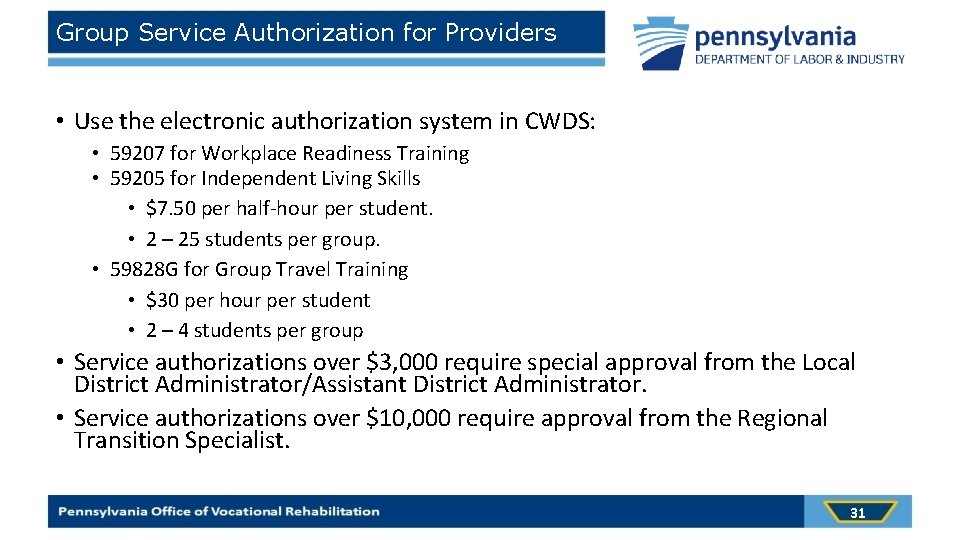
Group Service Authorization for Providers • Use the electronic authorization system in CWDS: • 59207 for Workplace Readiness Training • 59205 for Independent Living Skills • $7. 50 per half-hour per student. • 2 – 25 students per group. • 59828 G for Group Travel Training • $30 per hour per student • 2 – 4 students per group • Service authorizations over $3, 000 require special approval from the Local District Administrator/Assistant District Administrator. • Service authorizations over $10, 000 require approval from the Regional Transition Specialist. 31
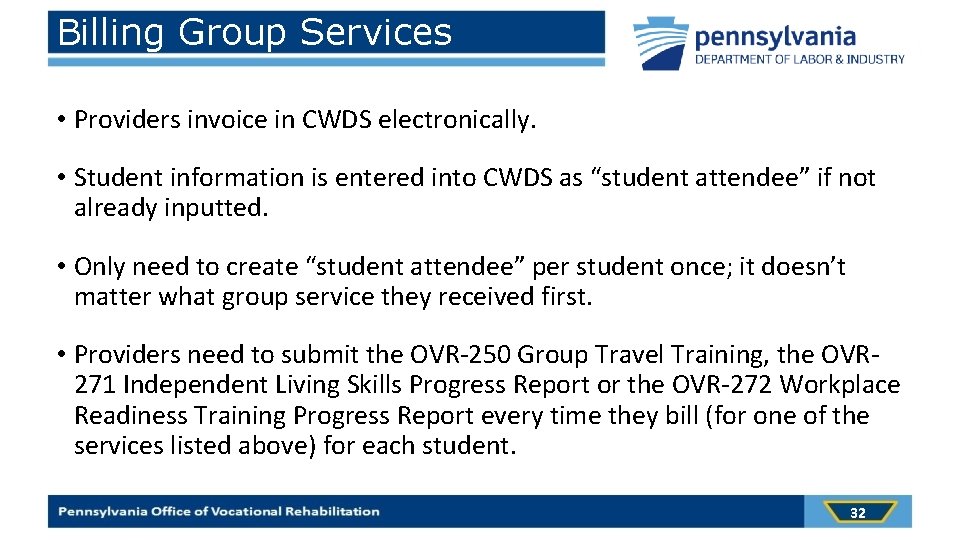
Billing Group Services • Providers invoice in CWDS electronically. • Student information is entered into CWDS as “student attendee” if not already inputted. • Only need to create “student attendee” per student once; it doesn’t matter what group service they received first. • Providers need to submit the OVR-250 Group Travel Training, the OVR 271 Independent Living Skills Progress Report or the OVR-272 Workplace Readiness Training Progress Report every time they bill (for one of the services listed above) for each student. 32
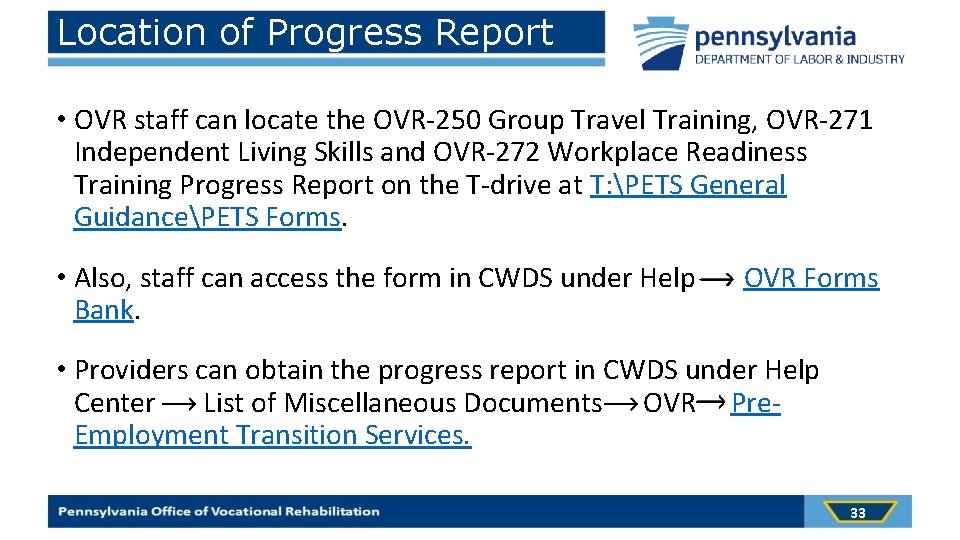
Location of Progress Report • OVR staff can locate the OVR-250 Group Travel Training, OVR-271 Independent Living Skills and OVR-272 Workplace Readiness Training Progress Report on the T-drive at T: PETS General GuidancePETS Forms. • Also, staff can access the form in CWDS under Help Bank. OVR Forms • Providers can obtain the progress report in CWDS under Help Center List of Miscellaneous Documents OVR Pre. Employment Transition Services. 33
Examples Ways to provide Workplace Readiness Training and Independent Living Skills 34
Engaging Students • Watch videos and ask self-reflection questions • Conduct mock interviews • Complete Workplace Readiness worksheets • Role play shopping, writing out a check, filling out a job application • Research costs of living and develop personal budgets • Demonstrate online job searches • Complete Independent Living checklist/inventories • Create a Transition game of Life or Monopoly 35
Videos • PACER: Employment Accommodations Explained • PACER: Connecting Youth to Careers • Skills to Pay the Bills 36
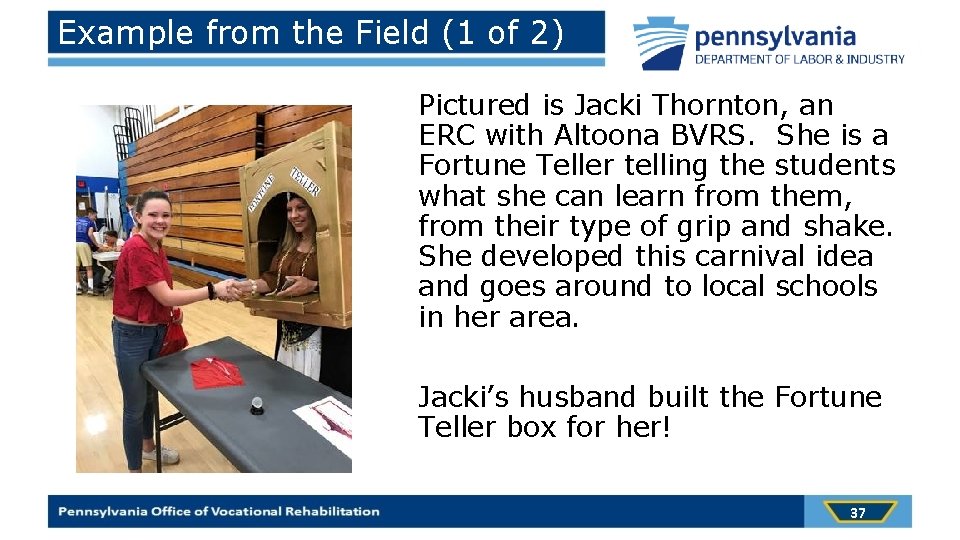
Example from the Field (1 of 2) Pictured is Jacki Thornton, an ERC with Altoona BVRS. She is a Fortune Teller telling the students what she can learn from them, from their type of grip and shake. She developed this carnival idea and goes around to local schools in her area. Jacki’s husband built the Fortune Teller box for her! 37
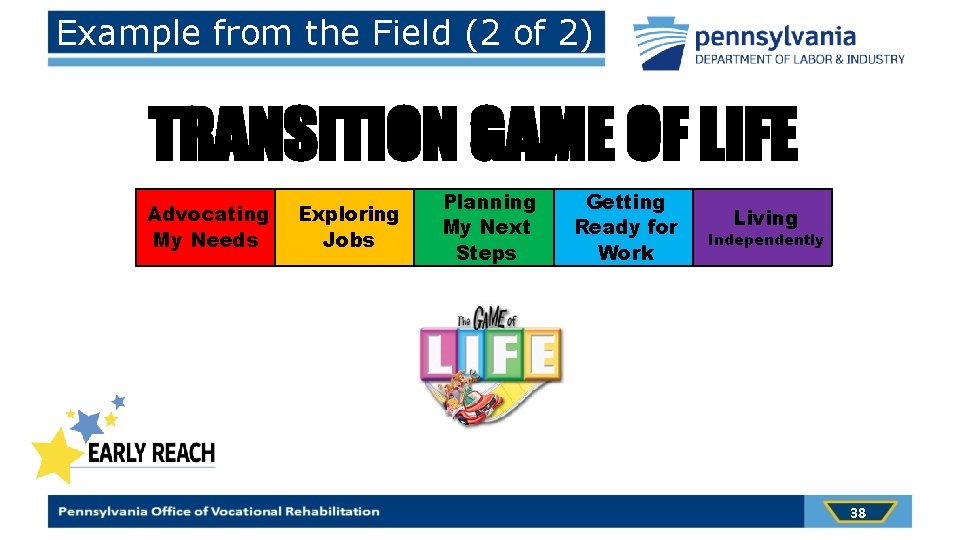
Example from the Field (2 of 2) TRANSITION GAME OF LIFE Advocating My Needs Exploring Jobs Planning My Next Steps Getting Ready for Work Living Independently 38
Documentation Review of how to document Workplace Readiness Training and Independent Living Skills 39
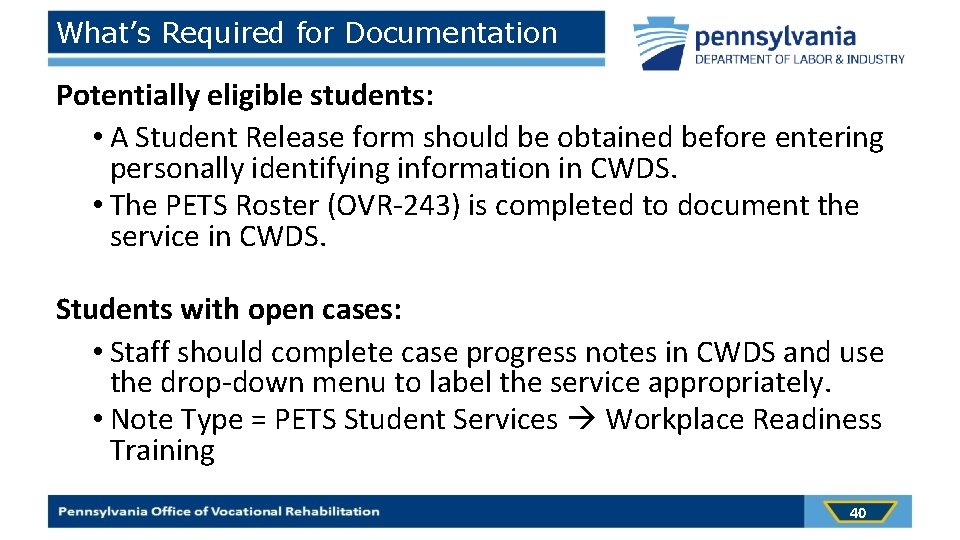
What’s Required for Documentation Potentially eligible students: • A Student Release form should be obtained before entering personally identifying information in CWDS. • The PETS Roster (OVR-243) is completed to document the service in CWDS. Students with open cases: • Staff should complete case progress notes in CWDS and use the drop-down menu to label the service appropriately. • Note Type = PETS Student Services Workplace Readiness Training 40
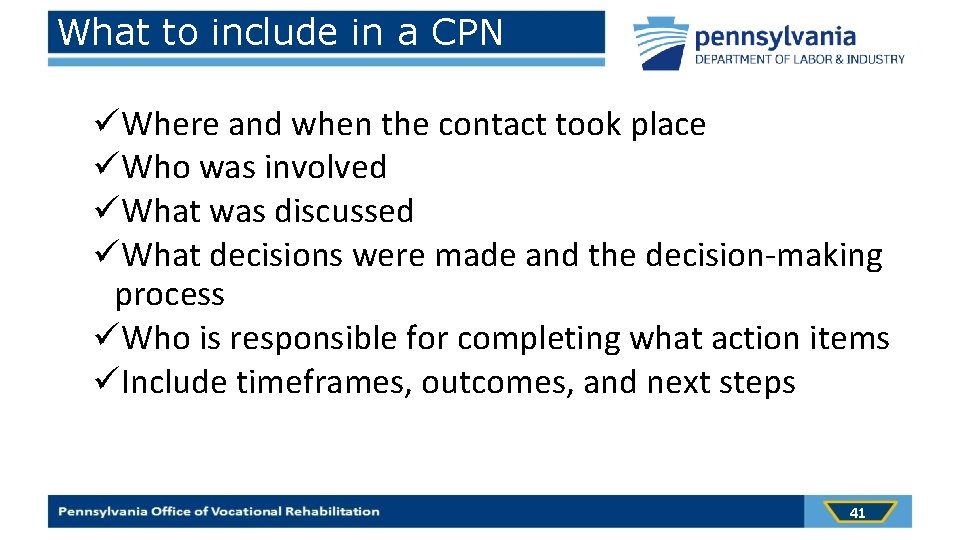
What to include in a CPN üWhere and when the contact took place üWho was involved üWhat was discussed üWhat decisions were made and the decision-making process üWho is responsible for completing what action items üInclude timeframes, outcomes, and next steps 41
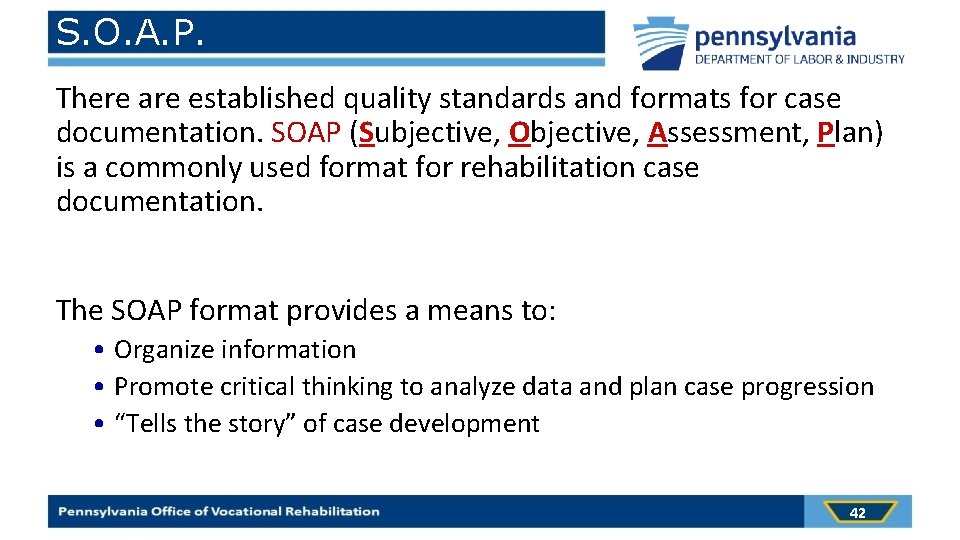
S. O. A. P. There are established quality standards and formats for case documentation. SOAP (Subjective, Objective, Assessment, Plan) is a commonly used format for rehabilitation case documentation. The SOAP format provides a means to: • Organize information • Promote critical thinking to analyze data and plan case progression • “Tells the story” of case development 42
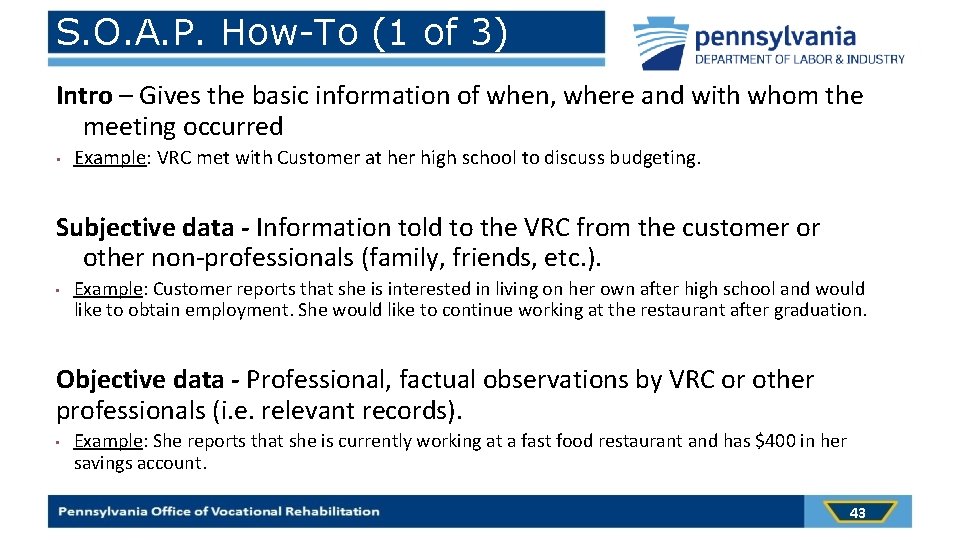
S. O. A. P. How-To (1 of 3) Intro – Gives the basic information of when, where and with whom the meeting occurred • Example: VRC met with Customer at her high school to discuss budgeting. Subjective data - Information told to the VRC from the customer or other non-professionals (family, friends, etc. ). • Example: Customer reports that she is interested in living on her own after high school and would like to obtain employment. She would like to continue working at the restaurant after graduation. Objective data - Professional, factual observations by VRC or other professionals (i. e. relevant records). • Example: She reports that she is currently working at a fast food restaurant and has $400 in her savings account. 43
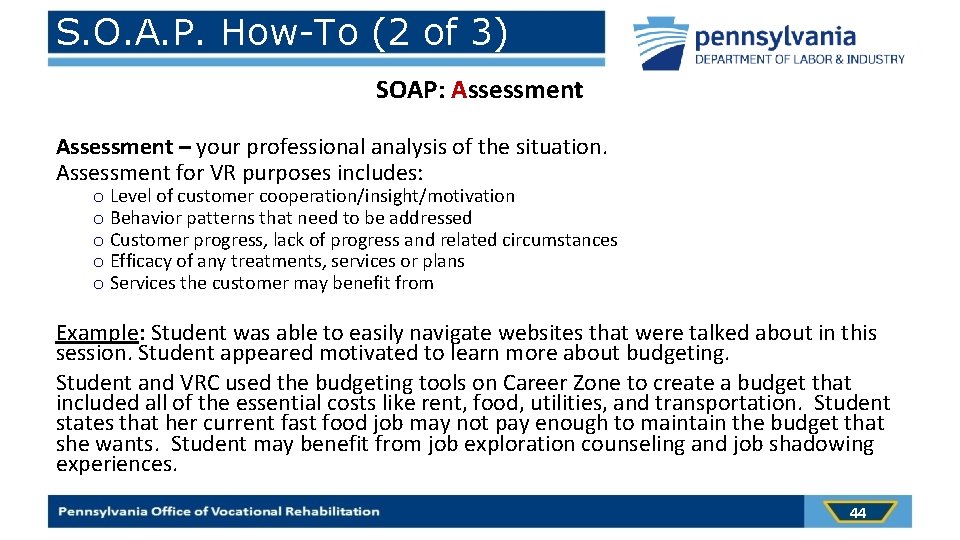
S. O. A. P. How-To (2 of 3) SOAP: Assessment – your professional analysis of the situation. Assessment for VR purposes includes: o Level of customer cooperation/insight/motivation o Behavior patterns that need to be addressed o Customer progress, lack of progress and related circumstances o Efficacy of any treatments, services or plans o Services the customer may benefit from Example: Student was able to easily navigate websites that were talked about in this session. Student appeared motivated to learn more about budgeting. Student and VRC used the budgeting tools on Career Zone to create a budget that included all of the essential costs like rent, food, utilities, and transportation. Student states that her current fast food job may not pay enough to maintain the budget that she wants. Student may benefit from job exploration counseling and job shadowing experiences. 44
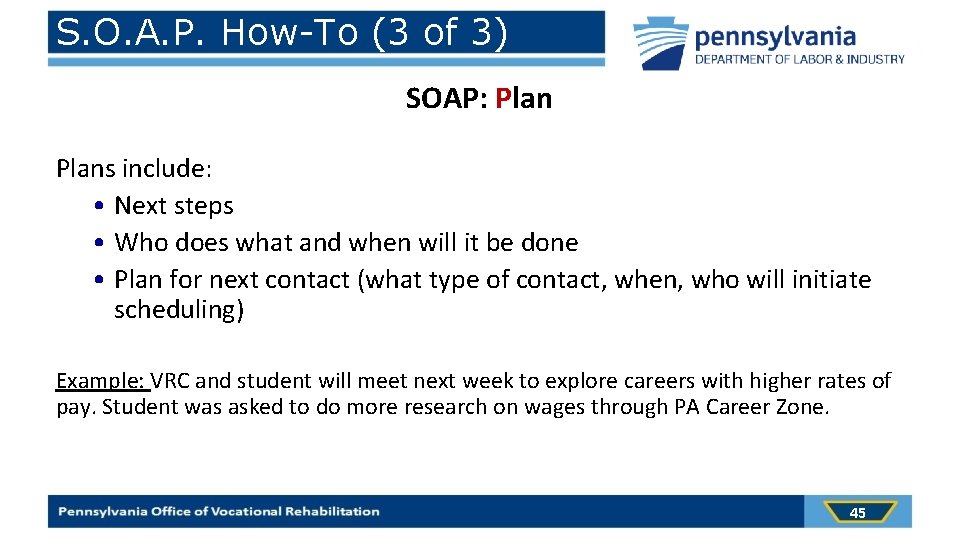
S. O. A. P. How-To (3 of 3) SOAP: Plans include: • Next steps • Who does what and when will it be done • Plan for next contact (what type of contact, when, who will initiate scheduling) Example: VRC and student will meet next week to explore careers with higher rates of pay. Student was asked to do more research on wages through PA Career Zone. 45
Resources Potential tools and websites you might consider using 46
Resources for Workplace Readiness Training • Center on Disability and Technology • Goodwill Community Foundation (GCF) Learn Free • Job Accommodation Network (JAN) • Live Career • Mid-Atlantic ADA Center • Columbia University Center for Career Education • National Work Readiness Council • T: Early Reach Coordinator ResourcesWorkshop, Presentation, Outreach Materials & ResourcesWorkshop, Presentation Materials & ResourcesWork Readiness • T: Business Services ResourcesJob Readiness ToolsInterviewing • T: Business Services ResourcesJob Readiness ToolsResumes 47
Job Accommodation Network (JAN) • JAN is the leading source of free, expert, and confidential guidance on workplace accommodations and disability employment issues. • Provides guidance on the Americans with Disabilities Act (ADA) and related legislation. • JAN is funded by a contract from the U. S. Department of Labor, Office of Disability Employment Policy (ODEP) 48
Resources for Independent Living Skills • Center for Parent Information & Resources • project 10: Transition Education Network • National Disability Institute • PA Career Zone • Cents and Sensibility • T: Early Reach Coordinator ResourcesWorkshop, Presentation, Outreach Materials & ResourcesWorkshop, Presentation Materials & ResourcesWork ReadinessLesson Plans, Activities & Activity HandoutsIndependent Living 49
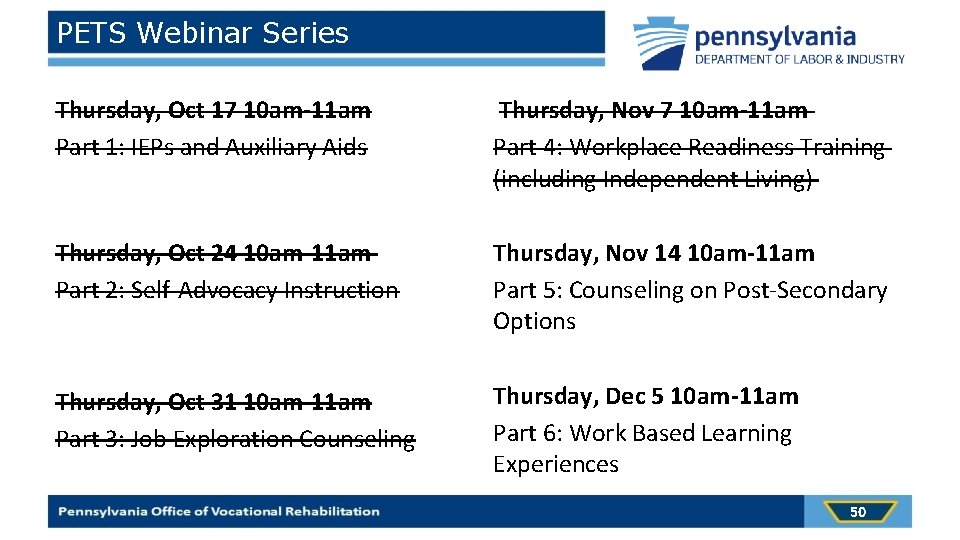
PETS Webinar Series Thursday, Oct 17 10 am-11 am Part 1: IEPs and Auxiliary Aids Thursday, Nov 7 10 am-11 am Part 4: Workplace Readiness Training (including Independent Living) Thursday, Oct 24 10 am-11 am Part 2: Self-Advocacy Instruction Thursday, Nov 14 10 am-11 am Part 5: Counseling on Post-Secondary Options Thursday, Oct 31 10 am-11 am Part 3: Job Exploration Counseling Thursday, Dec 5 10 am-11 am Part 6: Work Based Learning Experiences 50
Questions 51
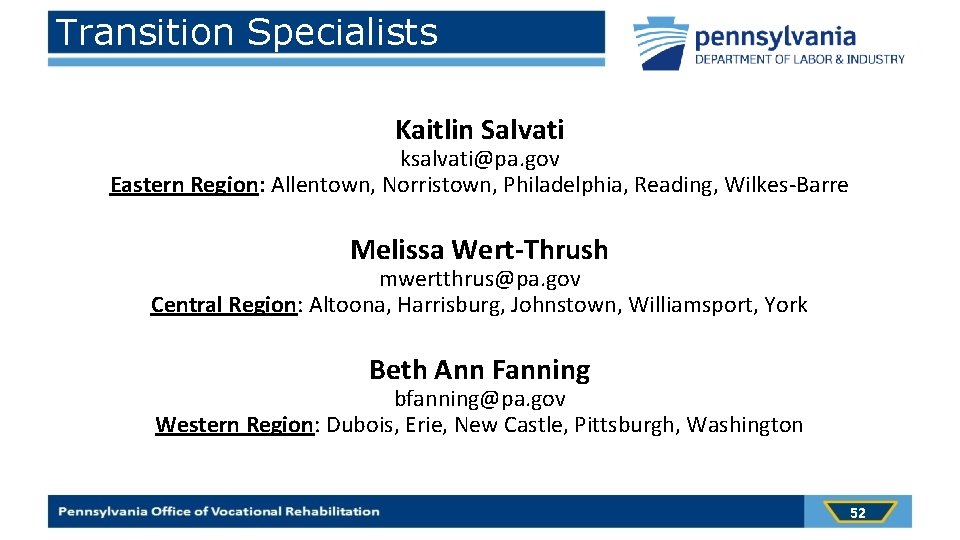
Transition Specialists Kaitlin Salvati ksalvati@pa. gov Eastern Region: Allentown, Norristown, Philadelphia, Reading, Wilkes-Barre Melissa Wert-Thrush mwertthrus@pa. gov Central Region: Altoona, Harrisburg, Johnstown, Williamsport, York Beth Ann Fanning bfanning@pa. gov Western Region: Dubois, Erie, New Castle, Pittsburgh, Washington 52