
Workplace Hazardous Materials Information System WHMIS GOPAL DUTT
- Slides: 56
Workplace Hazardous Materials Information System (WHMIS) GOPAL DUTT PANDEY JOINT SECRETARY, NSC UP CHAPTER
“No employer may allow the use, handling or storage of a Controlled Product in a workplace unless the product carries a label and a material safety data sheet which meet the requirements of this Act and the regulations and unless the worker has received the training and information required to carry out the work entrusted to him safely” MSIHC RULES 1989 (AMMENDED 2000) GOPAL DUTT PANDEY JOINT SECRETARY, NSC UP CHAPTER
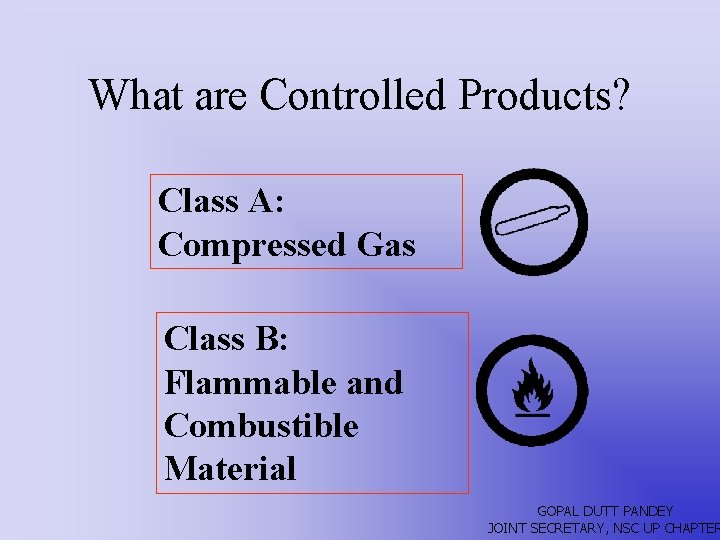
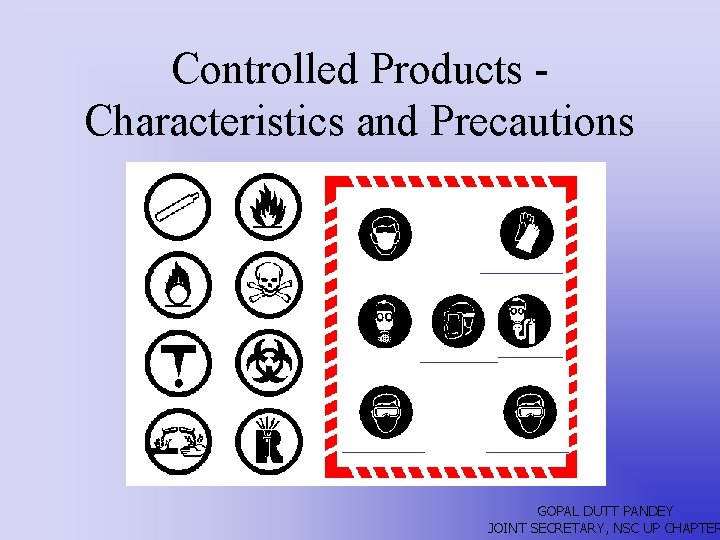
What are Controlled Products? Class A: Compressed Gas Class B: Flammable and Combustible Material GOPAL DUTT PANDEY JOINT SECRETARY, NSC UP CHAPTER
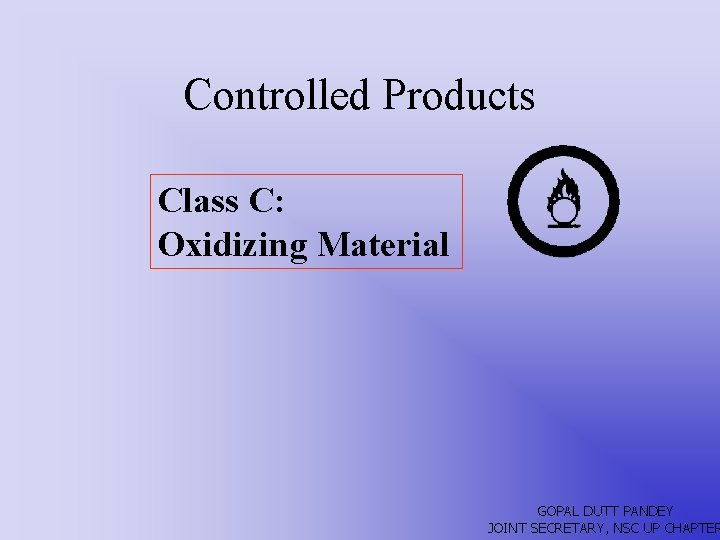
Controlled Products Class C: Oxidizing Material GOPAL DUTT PANDEY JOINT SECRETARY, NSC UP CHAPTER
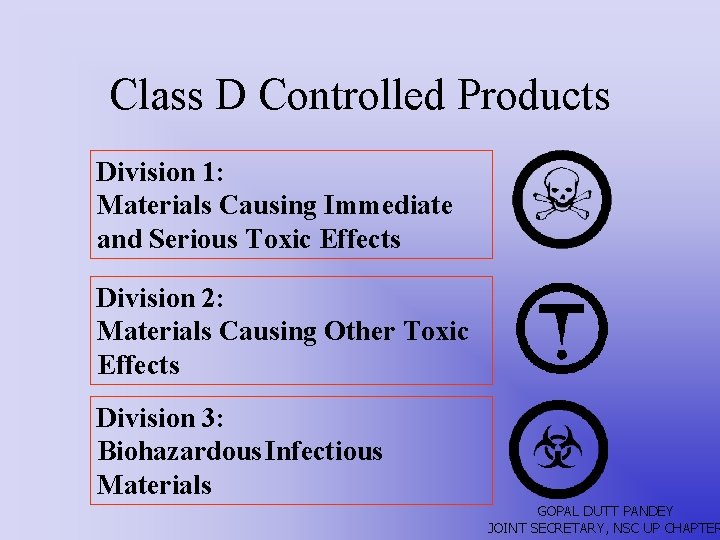
Class D Controlled Products Division 1: Materials Causing Immediate and Serious Toxic Effects Division 2: Materials Causing Other Toxic Effects Division 3: Biohazardous Infectious Materials GOPAL DUTT PANDEY JOINT SECRETARY, NSC UP CHAPTER
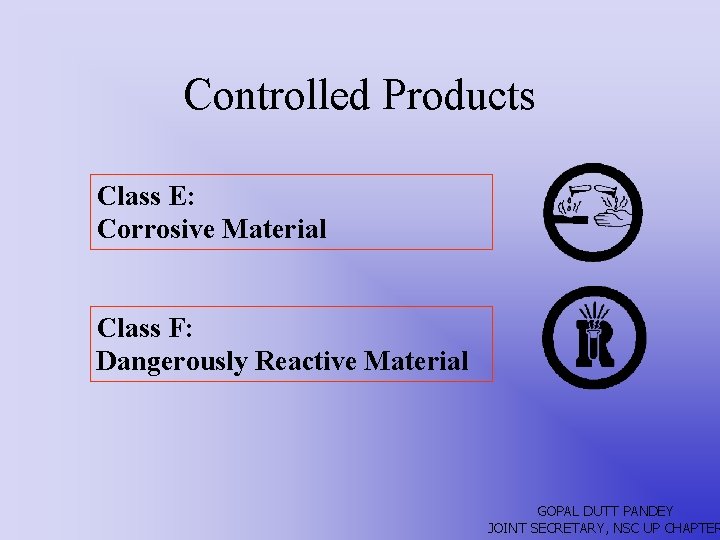
Controlled Products Class E: Corrosive Material Class F: Dangerously Reactive Material GOPAL DUTT PANDEY JOINT SECRETARY, NSC UP CHAPTER
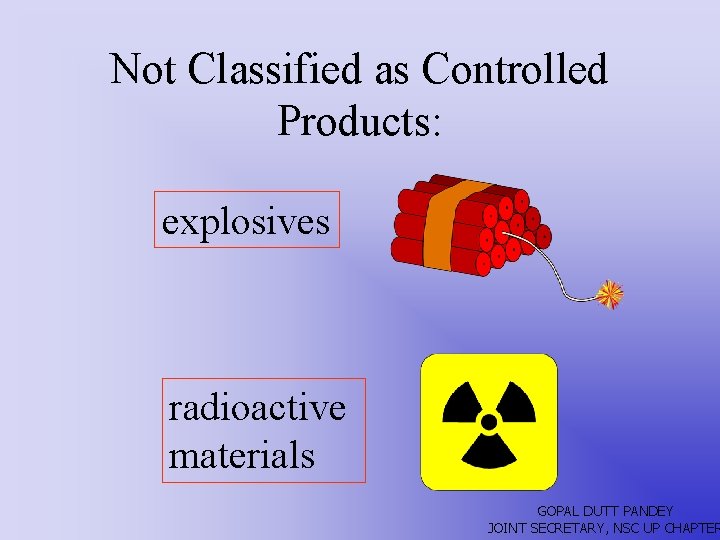
Not Classified as Controlled Products: explosives radioactive materials GOPAL DUTT PANDEY JOINT SECRETARY, NSC UP CHAPTER
Not Classified as Controlled Products: domestic goods cosmetics GOPAL DUTT PANDEY JOINT SECRETARY, NSC UP CHAPTER
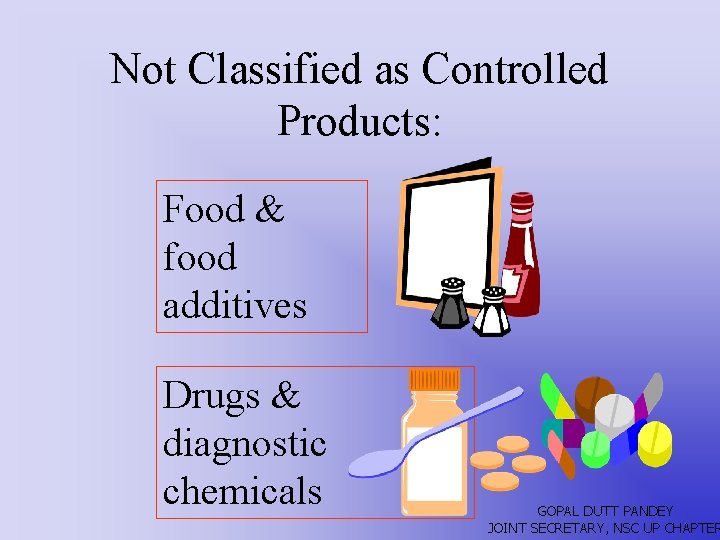
Not Classified as Controlled Products: Food & food additives Drugs & diagnostic chemicals GOPAL DUTT PANDEY JOINT SECRETARY, NSC UP CHAPTER
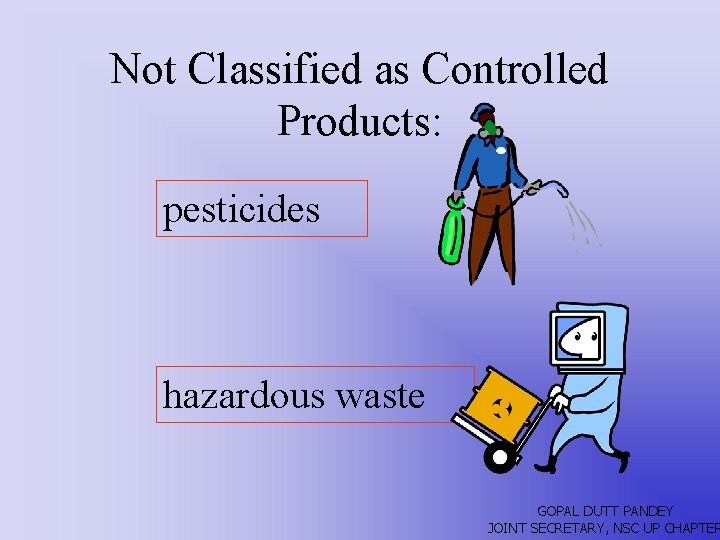
Not Classified as Controlled Products: pesticides hazardous waste GOPAL DUTT PANDEY JOINT SECRETARY, NSC UP CHAPTER
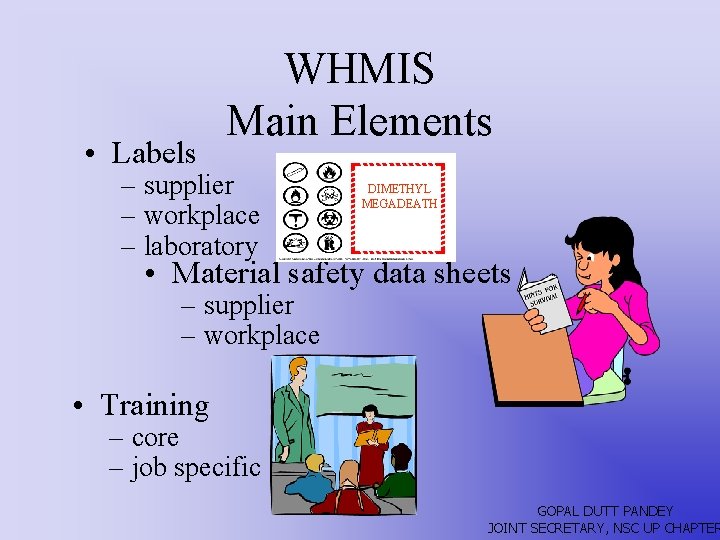
• Labels WHMIS Main Elements – supplier – workplace – laboratory DIMETHYL MEGADEATH • Material safety data sheets – supplier – workplace • Training – core – job specific GOPAL DUTT PANDEY JOINT SECRETARY, NSC UP CHAPTER
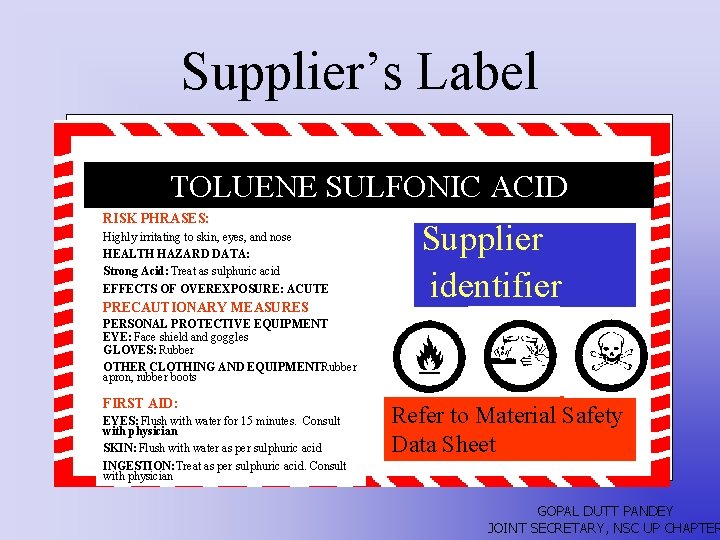
Supplier’s Label TOLUENE PRODUCT SULFONIC IDENTIFIER ACID RISK PHRASES: Highly irritating to skin, eyes, and nose HEALTH HAZARD DATA: Strong Acid: Treat as sulphuric acid EFFECTS OF OVEREXPOSURE: ACUTE PRECAUTIONARY MEASURES: Supplier identifier ABC Chemicals 123 Chemical Drive Chemical City 1 -800 -CHE-MICAL PERSONAL PROTECTIVE EQUIPMENT EYE: Face shield and goggles GLOVES: Rubber OTHER CLOTHING AND EQUIPMENT: Rubber apron, rubber boots FIRST AID: EYES: Flush with water for 15 minutes. Consult with physician SKIN: Flush with water as per sulphuric acid INGESTION: Treat as per sulphuric acid. Consult with physician Refer to Material Safety Data Sheet GOPAL DUTT PANDEY JOINT SECRETARY, NSC UP CHAPTER
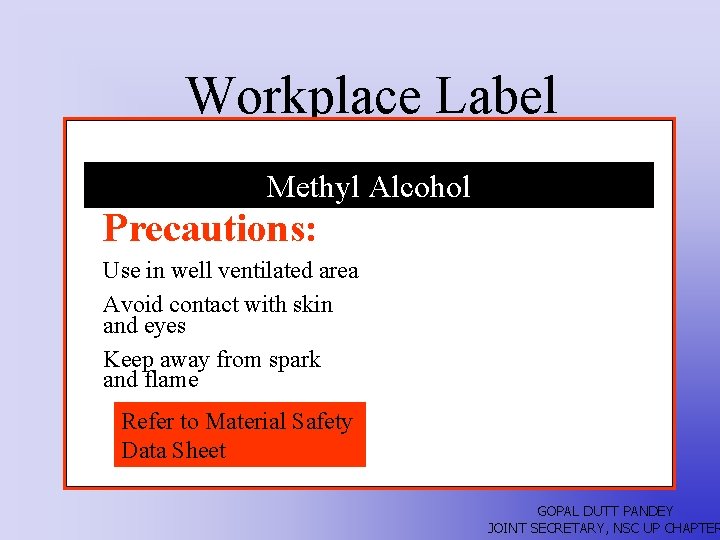
Workplace Label PRODUCT Methyl. IDENTIFIER Alcohol Precautions: Use in well ventilated area Avoid contact with skin and eyes Keep away from spark and flame Refer to Material Safety Data Sheet GOPAL DUTT PANDEY JOINT SECRETARY, NSC UP CHAPTER
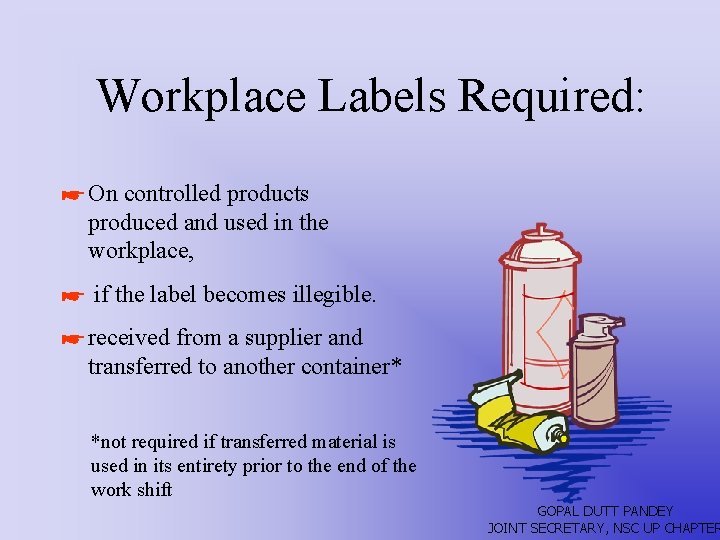
Workplace Labels Required: * On controlled products produced and used in the workplace, * if the label becomes illegible. * received from a supplier and transferred to another container* *not required if transferred material is used in its entirety prior to the end of the work shift GOPAL DUTT PANDEY JOINT SECRETARY, NSC UP CHAPTER
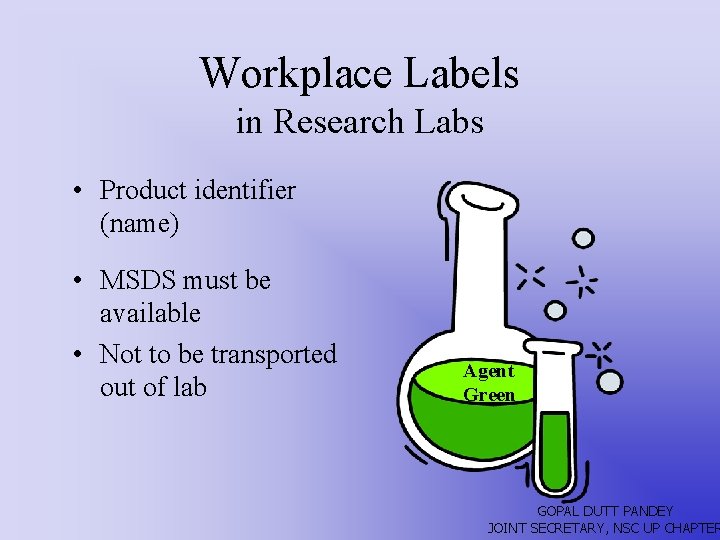
Workplace Labels in Research Labs • Product identifier (name) • MSDS must be available • Not to be transported out of lab Agent Green GOPAL DUTT PANDEY JOINT SECRETARY, NSC UP CHAPTER
Material Safety Data Sheets • Supplier must provide • Accessible to ALL workers in the workplace • Must be kept up to date • Must be made available to doctor in the event of exposure GOPAL DUTT PANDEY JOINT SECRETARY, NSC UP CHAPTER
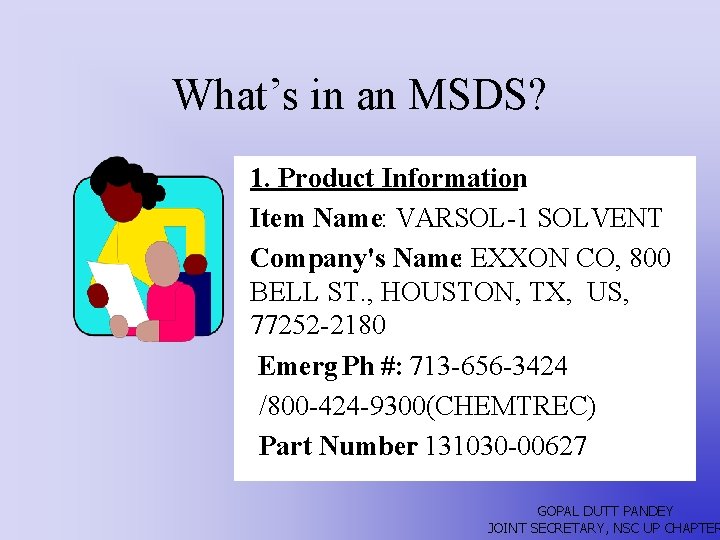
What’s in an MSDS? 1. Product Information Item Name: VARSOL-1 SOLVENT Company's Name: EXXON CO, 800 BELL ST. , HOUSTON, TX, US, 77252 -2180 Emerg Ph #: 713 -656 -3424 /800 -424 -9300(CHEMTREC) Part Number: 131030 -00627 GOPAL DUTT PANDEY JOINT SECRETARY, NSC UP CHAPTER
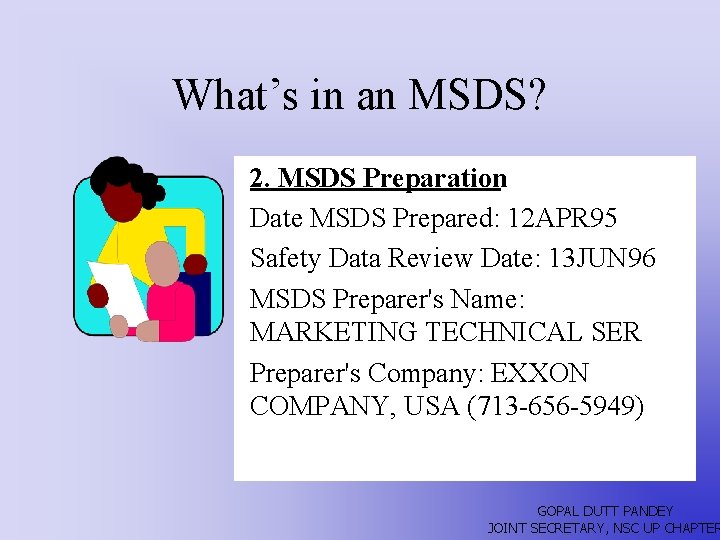
What’s in an MSDS? 2. MSDS Preparation Date MSDS Prepared: 12 APR 95 Safety Data Review Date: 13 JUN 96 MSDS Preparer's Name: MARKETING TECHNICAL SER Preparer's Company: EXXON COMPANY, USA (713 -656 -5949) GOPAL DUTT PANDEY JOINT SECRETARY, NSC UP CHAPTER
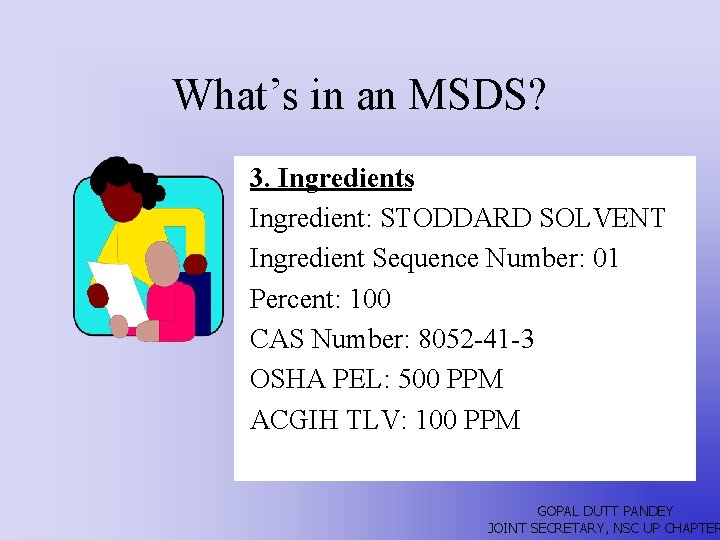
What’s in an MSDS? 3. Ingredients Ingredient: STODDARD SOLVENT Ingredient Sequence Number: 01 Percent: 100 CAS Number: 8052 -41 -3 OSHA PEL: 500 PPM ACGIH TLV: 100 PPM GOPAL DUTT PANDEY JOINT SECRETARY, NSC UP CHAPTER
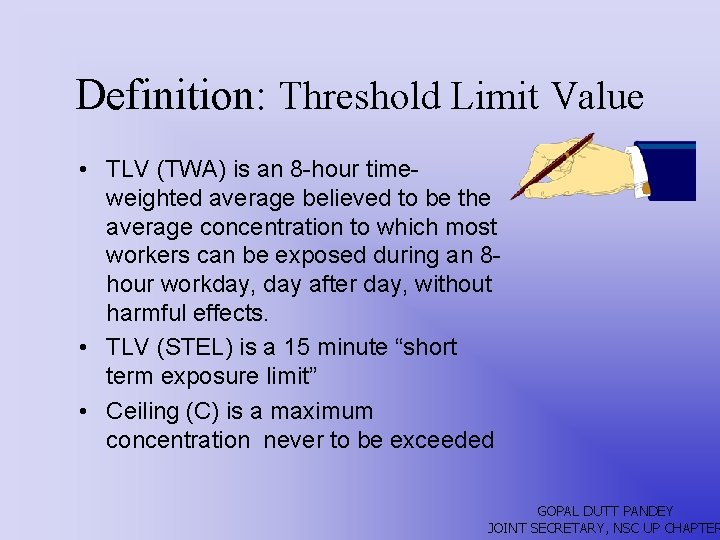
Definition: Threshold Limit Value • TLV (TWA) is an 8 -hour timeweighted average believed to be the average concentration to which most workers can be exposed during an 8 hour workday, day after day, without harmful effects. • TLV (STEL) is a 15 minute “short term exposure limit” • Ceiling (C) is a maximum concentration never to be exceeded GOPAL DUTT PANDEY JOINT SECRETARY, NSC UP CHAPTER
Stoddard Solvent? Ingredient: C*7 -C*10 saturated hydrocarbon, Percent: 83. 0 Ingredient: 1, 2, 4 -trimethylbenzene. Percent: 4. 0 Ingredient: C 8+ aromatics, Percent: 17. 0 GOPAL DUTT PANDEY JOINT SECRETARY, NSC UP CHAPTER
What’s in an MSDS? 4. Physical Properties Appearance and Odor: clear waterwhite liquid, mineral spirits odor. Boiling Point: 315 F, 157 C Melting Point: <0 F, <-18 C Vapor Pressure (MM Hg/70 F): 1. 6 MM @20 C GOPAL DUTT PANDEY JOINT SECRETARY, NSC UP CHAPTER
What’s in an MSDS? 4. Physical Properties (cont’d) Vapor Density (Air=1): 3. 5 Specific Gravity: 0. 80 Evaporation Rate And Ref: 0. 1 (Nbutyl acetate=1) Solubility In Water: negligible Percent Volatiles By Volume: 100 p. H: NEUTRAL GOPAL DUTT PANDEY JOINT SECRETARY, NSC UP CHAPTER
What’s in an MSDS? 5. Fire and Explosion Data Flash Point: 104 F, 40 C Flash Point Method: TCC Lower Explosive Limit: 2. 1% Upper Explosive Limit: 13. 3% GOPAL DUTT PANDEY JOINT SECRETARY, NSC UP CHAPTER
Definition: Flash Point • The flash point is the lowest temperature at which a liquid produces enough vapour to ignite in the presence of a source of ignition. • The lower the flash point, the greater the risk of fire. GOPAL DUTT PANDEY JOINT SECRETARY, NSC UP CHAPTER
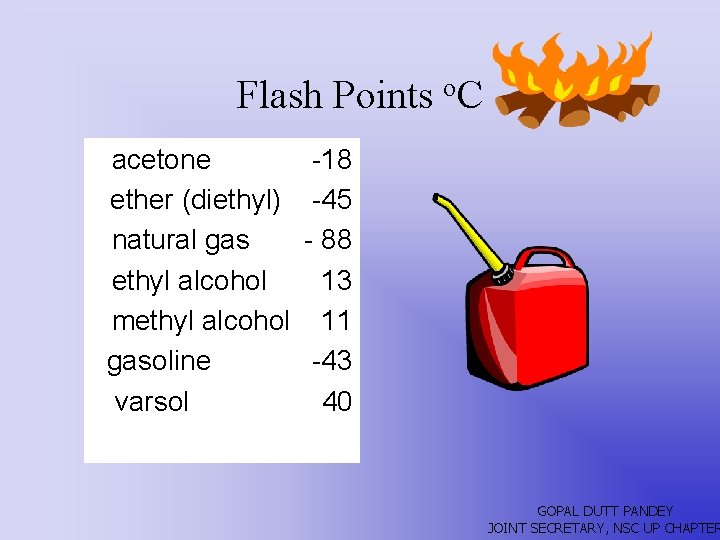
Flash Points o. C acetone ether (diethyl) natural gas ethyl alcohol methyl alcohol gasoline varsol -18 -45 - 88 13 11 -43 40 GOPAL DUTT PANDEY JOINT SECRETARY, NSC UP CHAPTER
What’s in an MSDS? 5. Fire and Explosion Data, cont’d Extinguishing Media: foam, H 2 O spray(fog), dry chem, CO 2 Special Fire Fighting Proc: keep fireexposed containers cool w/H 2 O Unusual Fire And Expl Hazards: liq is volatile/gives off invisible vapour; may settle in low areas GOPAL DUTT PANDEY JOINT SECRETARY, NSC UP CHAPTER
What’s in an MSDS? 6. Product Reactivity Stability: YES Cond To Avoid: keep product away from ignition sources such as heat, sparks, pilot lights, static electricity, open flames. Materials To Avoid: strong oxidants e. g. , chlorine; O 2, sodium and calcium hypochlorite. GOPAL DUTT PANDEY JOINT SECRETARY, NSC UP CHAPTER
What’s in an MSDS? 6. Product Reactivity • Hazardous Decomposition Products: fumes, smoke, CO, sulfur oxides, aldehydes • Hazardous Polymerization? : NO GOPAL DUTT PANDEY JOINT SECRETARY, NSC UP CHAPTER
What’s in an MSDS? 7. Toxicological information LD 50 -LC 50 Mixture: ORAL LD 50 (RABBIT) >3. 16 G/KG OF BODY WT Route Of Entry - Inhalation: YES Route Of Entry - Skin: YES Route Of Entry - Ingestion: NO GOPAL DUTT PANDEY JOINT SECRETARY, NSC UP CHAPTER
Definition: LD 50 • LD 50 (Lethal Dose 50) is the amount of a substance that, when administered by a defined route of entry (e. g. oral or dermal) over a specified period of time, is expected to cause the death of 50 per cent of a defined animal population. GOPAL DUTT PANDEY JOINT SECRETARY, NSC UP CHAPTER
Definition: LC 50 • LC 50 (Lethal Concentration 50) is the amount of a substance in air that, when given by inhalation over a specified period of time, is expected to cause the death in 50 per cent of a defined animal population. GOPAL DUTT PANDEY JOINT SECRETARY, NSC UP CHAPTER
What’s in an MSDS? 7. Tox. information, cont’d Signs/Symptoms Of Overexp: high vap concentration (>1000 ppm) irritation of eyes, resp tract. headaches, dizziness, anesthesia, drowsiness, unconsciousness, other CNS effects including death. GOPAL DUTT PANDEY JOINT SECRETARY, NSC UP CHAPTER
What’s in an MSDS? 7. Tox. information, cont’d Carcinogenicity - IARC: NO Carcinogenicity - OSHA: NO GOPAL DUTT PANDEY JOINT SECRETARY, NSC UP CHAPTER
What’s in an MSDS? 8. Preventive measures Respiratory Protection: none specified by manufacturer. ventilation: use only w/venti sufficient to prevent exceeding recommended exposure limit buildup of explo concen. No smoke/flame use/ign source. GOPAL DUTT PANDEY JOINT SECRETARY, NSC UP CHAPTER
What’s in an MSDS? 8. Preventive measures cont’d Protective. Gloves: chem-resist gloves. Eye Protection: splash gogg, face shields. Other Protective Equipment: chemresist apron/other imperv cloth if needed. GOPAL DUTT PANDEY JOINT SECRETARY, NSC UP CHAPTER
What’s in an MSDS? 8. Preventive measures cont’d Storage: Keep cntnr clsd when not in use. Do not store near heat/sparks/flame/strong oxid. Effectively ground. NFPA: Use approp eqmpt. NFPA-70. GOPAL DUTT PANDEY JOINT SECRETARY, NSC UP CHAPTER
What’s in an MSDS? 8. Preventive measures cont’d Spills : elimnate ign sources. keep people away. Recover free portion. Add sand/earth/suitable absorbent. Min breath vap/skin contact. Venti confined spaces. Opn windows/doors. Keep out of sewers/ watercourses w/dike/impound. Conform to applicable gov’t regs. GOPAL DUTT PANDEY JOINT SECRETARY, NSC UP CHAPTER
What’s in an MSDS? 9. First Aid Measures Emergency/First Aid Procedure: EYE: flush w/clear water for 15 mins/til irritation subsides. If irrit persists call physician. SKIN: remove contaminated clothing. Wash skin w/soap/water. GOPAL DUTT PANDEY JOINT SECRETARY, NSC UP CHAPTER
Controlled Products Characteristics and Precautions GOPAL DUTT PANDEY JOINT SECRETARY, NSC UP CHAPTER
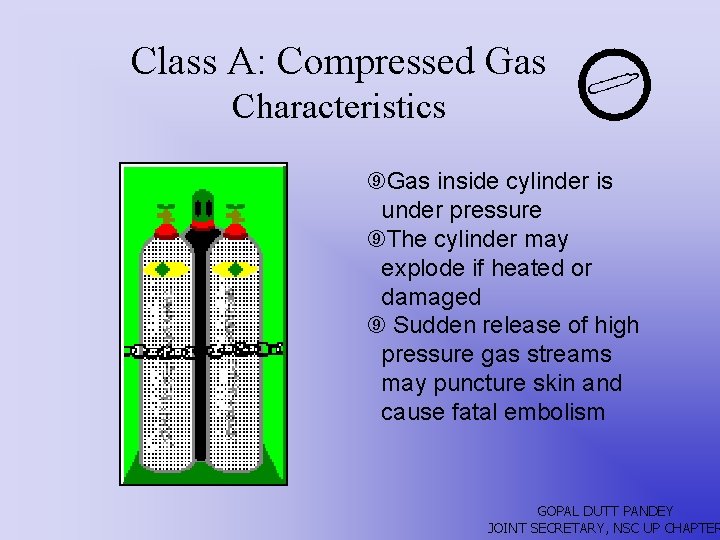
Class A: Compressed Gas Characteristics ´Gas inside cylinder is under pressure ´The cylinder may explode if heated or damaged ´ Sudden release of high pressure gas streams may puncture skin and cause fatal embolism GOPAL DUTT PANDEY JOINT SECRETARY, NSC UP CHAPTER
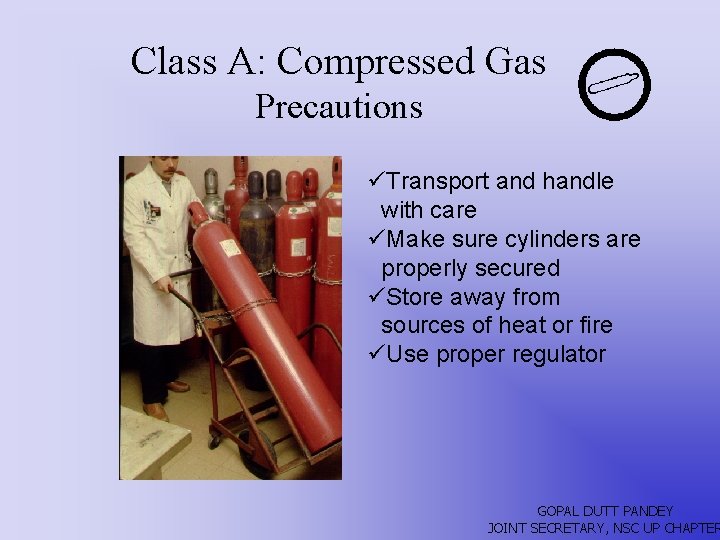
Class A: Compressed Gas Precautions üTransport and handle with care üMake sure cylinders are properly secured üStore away from sources of heat or fire üUse proper regulator GOPAL DUTT PANDEY JOINT SECRETARY, NSC UP CHAPTER
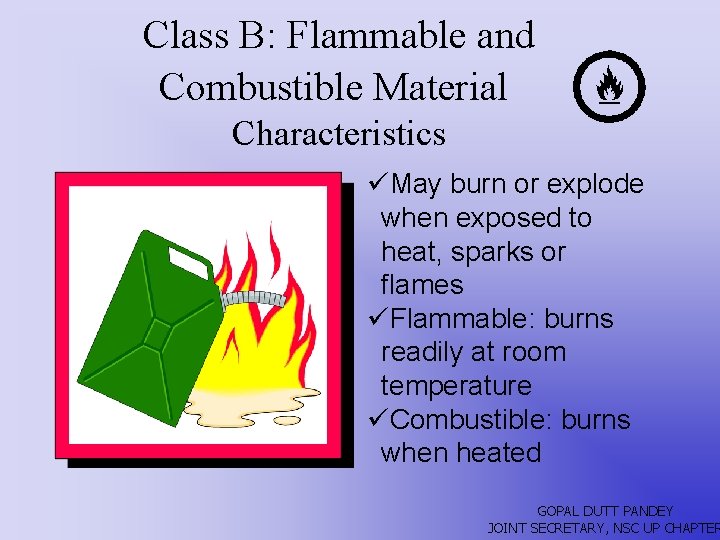
Class B: Flammable and Combustible Material Characteristics üMay burn or explode when exposed to heat, sparks or flames üFlammable: burns readily at room temperature üCombustible: burns when heated GOPAL DUTT PANDEY JOINT SECRETARY, NSC UP CHAPTER
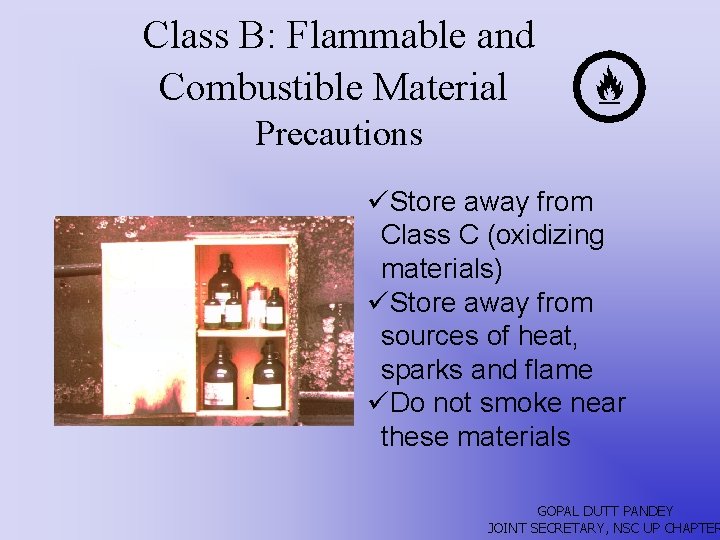
Class B: Flammable and Combustible Material Precautions üStore away from Class C (oxidizing materials) üStore away from sources of heat, sparks and flame üDo not smoke near these materials GOPAL DUTT PANDEY JOINT SECRETARY, NSC UP CHAPTER
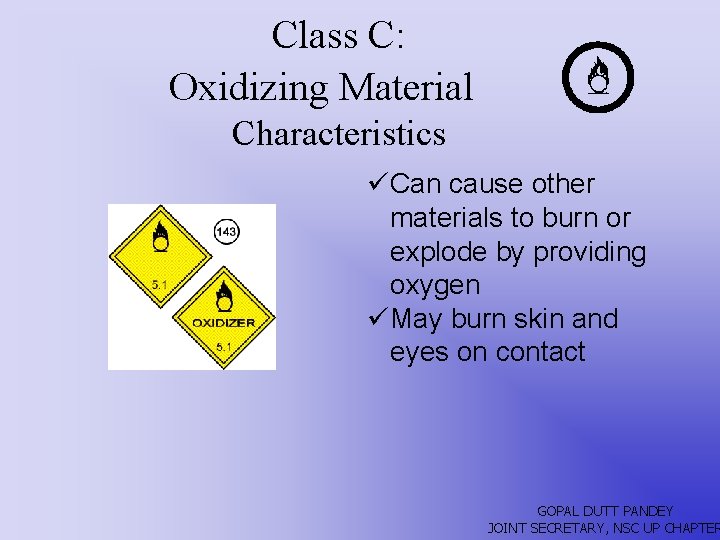
Class C: Oxidizing Material Characteristics üCan cause other materials to burn or explode by providing oxygen üMay burn skin and eyes on contact GOPAL DUTT PANDEY JOINT SECRETARY, NSC UP CHAPTER
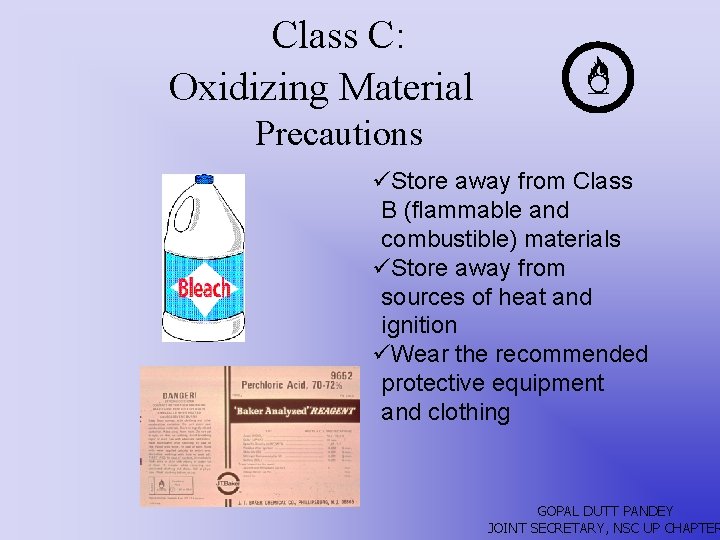
Class C: Oxidizing Material Precautions üStore away from Class B (flammable and combustible) materials üStore away from sources of heat and ignition üWear the recommended protective equipment and clothing GOPAL DUTT PANDEY JOINT SECRETARY, NSC UP CHAPTER
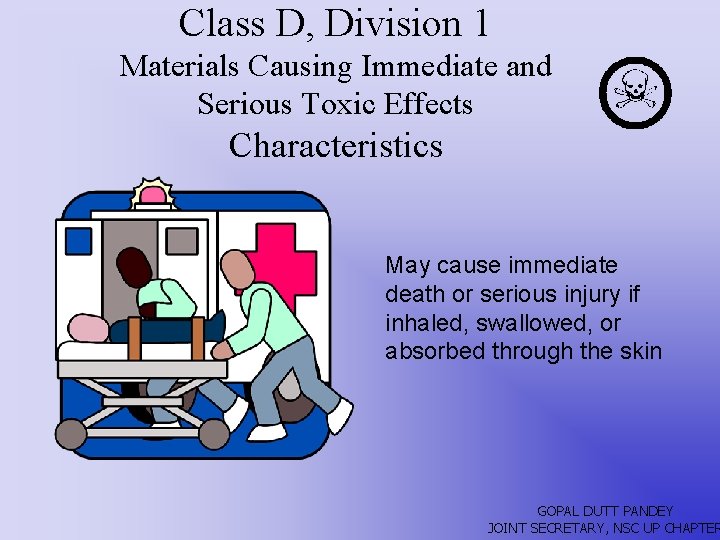
Class D, Division 1 Materials Causing Immediate and Serious Toxic Effects Characteristics May cause immediate death or serious injury if inhaled, swallowed, or absorbed through the skin GOPAL DUTT PANDEY JOINT SECRETARY, NSC UP CHAPTER
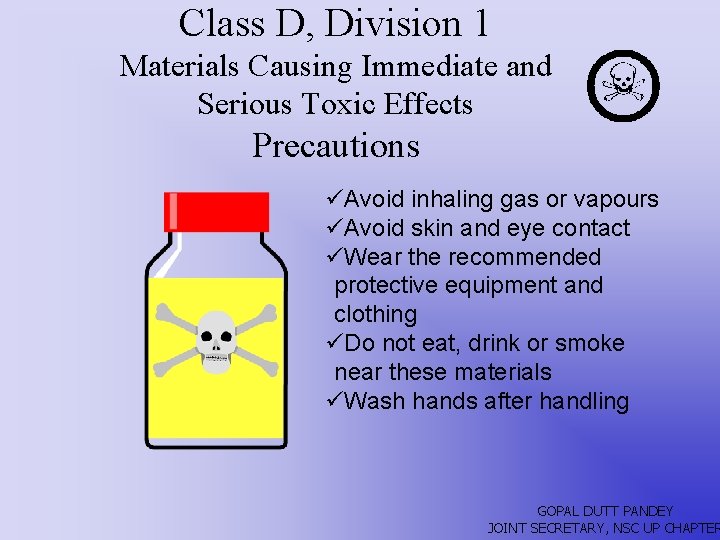
Class D, Division 1 Materials Causing Immediate and Serious Toxic Effects Precautions üAvoid inhaling gas or vapours üAvoid skin and eye contact üWear the recommended protective equipment and clothing üDo not eat, drink or smoke near these materials üWash hands after handling GOPAL DUTT PANDEY JOINT SECRETARY, NSC UP CHAPTER
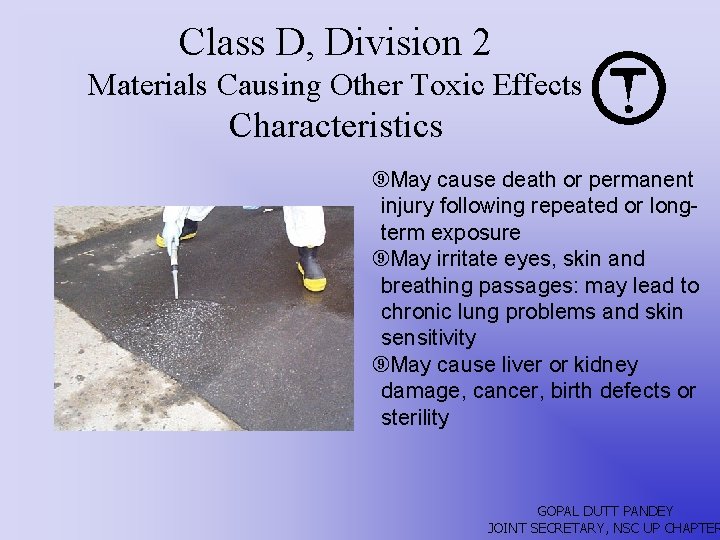
Class D, Division 2 Materials Causing Other Toxic Effects Characteristics ´May cause death or permanent injury following repeated or longterm exposure ´May irritate eyes, skin and breathing passages: may lead to chronic lung problems and skin sensitivity ´May cause liver or kidney damage, cancer, birth defects or sterility GOPAL DUTT PANDEY JOINT SECRETARY, NSC UP CHAPTER
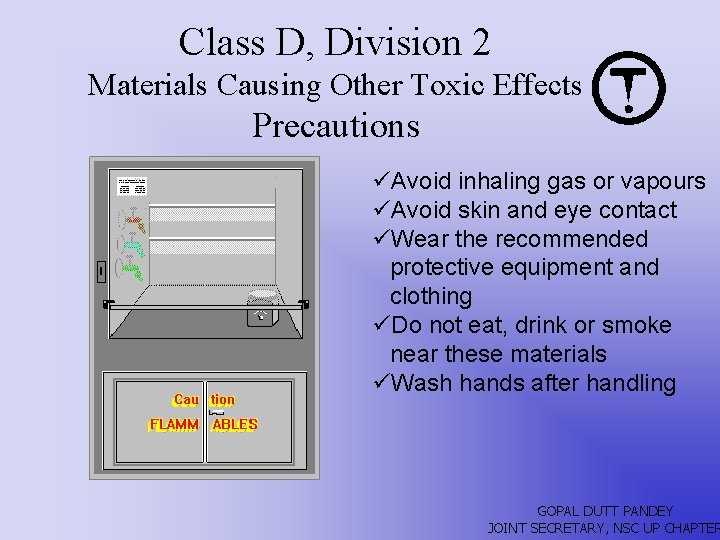
Class D, Division 2 Materials Causing Other Toxic Effects Precautions üAvoid inhaling gas or vapours üAvoid skin and eye contact üWear the recommended protective equipment and clothing üDo not eat, drink or smoke near these materials üWash hands after handling GOPAL DUTT PANDEY JOINT SECRETARY, NSC UP CHAPTER
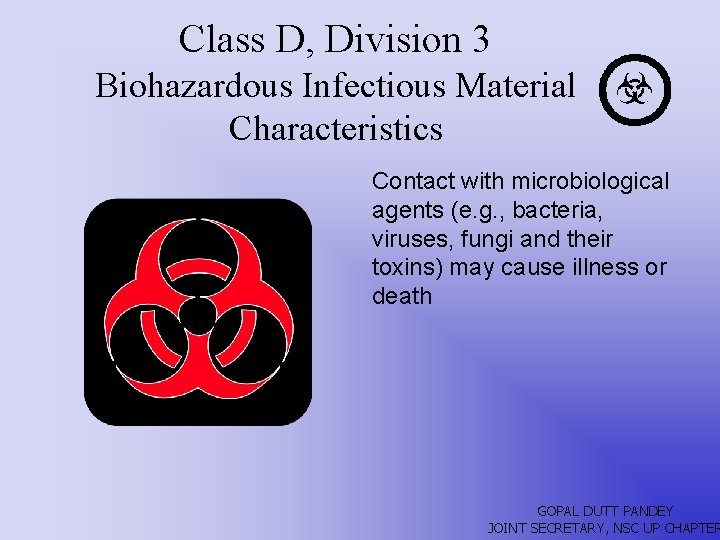
Class D, Division 3 Biohazardous Infectious Material Characteristics Contact with microbiological agents (e. g. , bacteria, viruses, fungi and their toxins) may cause illness or death GOPAL DUTT PANDEY JOINT SECRETARY, NSC UP CHAPTER
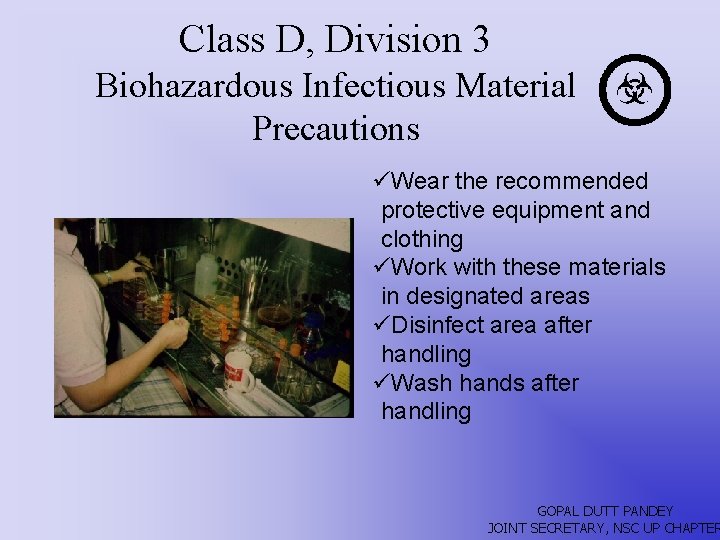
Class D, Division 3 Biohazardous Infectious Material Precautions üWear the recommended protective equipment and clothing üWork with these materials in designated areas üDisinfect area after handling üWash hands after handling GOPAL DUTT PANDEY JOINT SECRETARY, NSC UP CHAPTER
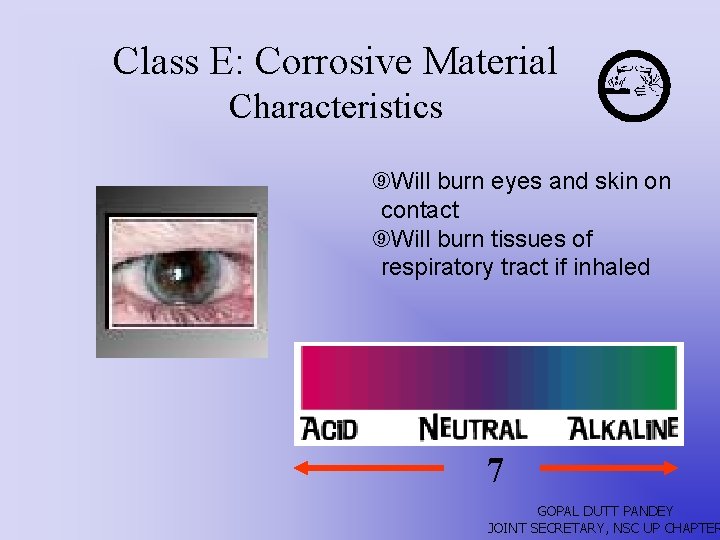
Class E: Corrosive Material Characteristics ´Will burn eyes and skin on contact ´Will burn tissues of respiratory tract if inhaled 7 GOPAL DUTT PANDEY JOINT SECRETARY, NSC UP CHAPTER
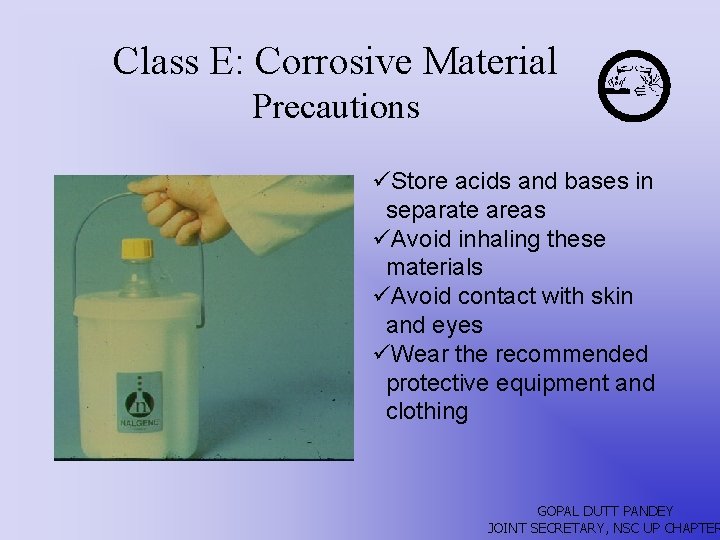
Class E: Corrosive Material Precautions üStore acids and bases in separate areas üAvoid inhaling these materials üAvoid contact with skin and eyes üWear the recommended protective equipment and clothing GOPAL DUTT PANDEY JOINT SECRETARY, NSC UP CHAPTER
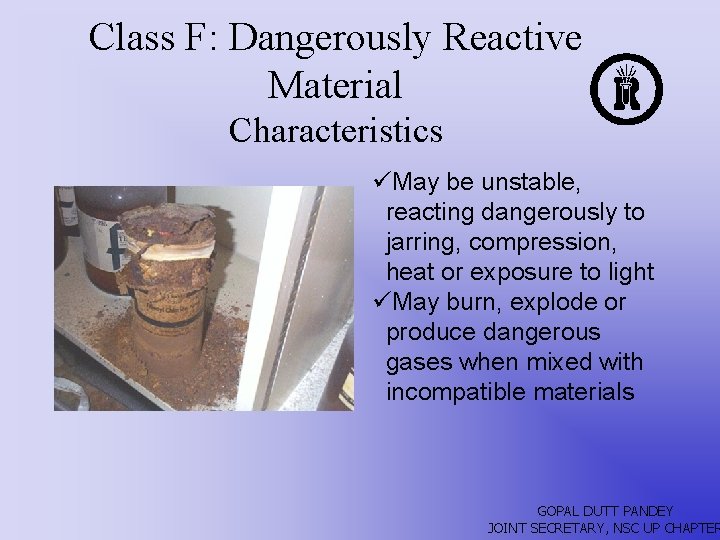
Class F: Dangerously Reactive Material Characteristics üMay be unstable, reacting dangerously to jarring, compression, heat or exposure to light üMay burn, explode or produce dangerous gases when mixed with incompatible materials GOPAL DUTT PANDEY JOINT SECRETARY, NSC UP CHAPTER
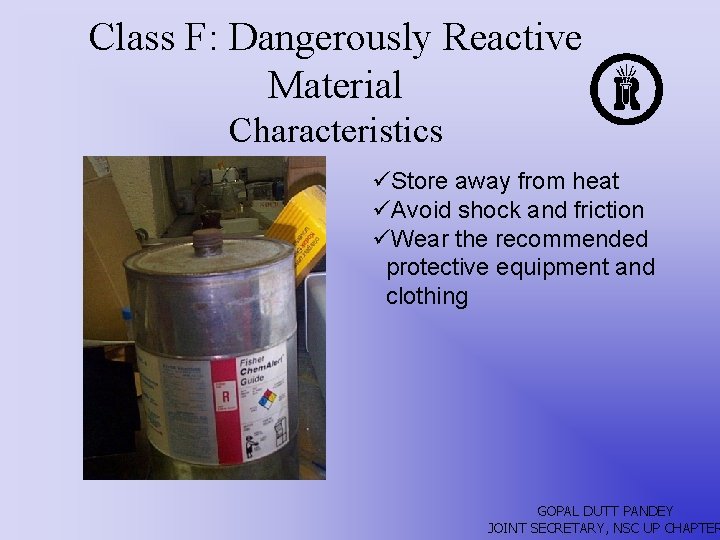
Class F: Dangerously Reactive Material Characteristics üStore away from heat üAvoid shock and friction üWear the recommended protective equipment and clothing GOPAL DUTT PANDEY JOINT SECRETARY, NSC UP CHAPTER