
Workplace Harassment Prevention Presented by UT Employee Assistance
Workplace Harassment Prevention Presented by: UT Employee Assistance Program
A Few Quick Points This presentation is not legal advice. The examples and case studies offered here are for educational purposes only. If you are involved in a potential workplace harassment situation, you should report the incident to Human Resources or another appropriate member of management. This training was developed in cooperation with oversight of legal counsel, however, certain laws may differ from state to state. Please review the specific laws relating to workplace harassment in your state. You will find a wealth of information on Federal and State sexual harassment policy and can submit questions at www. eeoc. gov/laws/types/sexual_harassment. cfm
Goals for Today's Training Define harassment in the workplace Review solid policies related to harassment Please review your organization’s specific harassment policy. Discuss case examples involving questionable workplace behavior and learn how to prevent and respond to harassment Pass the post-training quiz
Policy Regarding Harassment Please review your organization’s policy regarding harassment. In general, such policies include: “Our organization will not tolerate workplace harassment by any employee toward another employee or toward any persons with whom our organization does business nor by anyone who does business with our organizations toward any of our employees”
History of Harassment Laws and Actions 1964 Congress passed Title VII of the Civil Rights Act 1972 Congress passed the Equal Employment Opportunity Act giving the EEOC power to enforce Title VII 1976 The concept of Quid Pro Quo was recognized by the US Supreme Court 1992 A steadily increasing number Harassment filings began to emerge 1993 The US Supreme Court defined the elements of a “hostile environment” harassment claim 1994 A Trial Court in California ruled that a law firm failed to end harassment and awarded plaintiff $7. 1 million
History of Harassment Laws and Actions 1998 Supreme Court ruled employees who refuse sexual advances of a supervisor, yet suffer no adverse, tangible job consequences may still recover damages against the Employer without showing the Employer is negligent or at fault for the supervisor’s actions 1998 The US Supreme Court ruled same-sex harassment is actionable under Title VII therefore protecting men as well as women 2005 The State of California requires that all supervisors receive two hours of sexual harassment prevention training every two years (AB 1825)
What is Sexual Harassment? Hostile work environment sexual harassment is defined as unwelcome sexual conduct which creates an intimidating or abusive work environment on the basis of sex Sexual Harassment is a form of employment discrimination prohibited under Title VII of the Civil Rights Act of 1964 and under the laws of many states

What is Harassment in General? Harassment refers to behavior which is personally offensive, impairs morale and interferes with the work effectiveness of employees Harassment is usually an issue of one person’s abuse of power over another In 1998, the Supreme Court ruled that “An employer can be held liable even if there was no knowledge of the harassing behavior” An Employer/Supervisor is required to provide a safe and hostile-free work environment in compliance with applicable law Harassment is a form of discrimination related to one or more legally protected personal characteristics of an employee
Examples of Prohibited Types of Harassment/Discrimination AGE: Derogatory comments about someone over/under a certain age RACE/COLOR: Comments about the color of a person’s skin or the use of slang expressions to describe someone’s race NATIONAL ORIGIN/ANCESTRY: Comments about an individual from another country – using ethnic slurs or telling ethnic jokes DISABILITY (mental/physical): Making reference to or labeling the handicapping condition or limiting the individual’s activities on the job – talking softly to the hearing impaired, placing obstacles in the path of a blind person, putting items out of reach for someone in a wheelchair SEXUAL: Comments, jokes, brushing against, blocking way, touching, asking out, printed material or dominant behavior GENDER & GENDER STEREOTYPING: Harassment based on perceived differences from typical gender expectations
Who Decides When It’s Discrimination or Harassment: The Victim A few troubling comments made by employees and supervisors “ Just how many times a week do you have sex? ” “Why don’t you meet me after work to discuss this problem? ” “Wow, you look great! Did you lose weight? ” “We were just treating her like one of the guys!” “How about if I call you at home tonight? ” “I usually take all the people who work on my team out for a beer on Friday nights; you should join us. ” “Did you hear the joke about…? ”
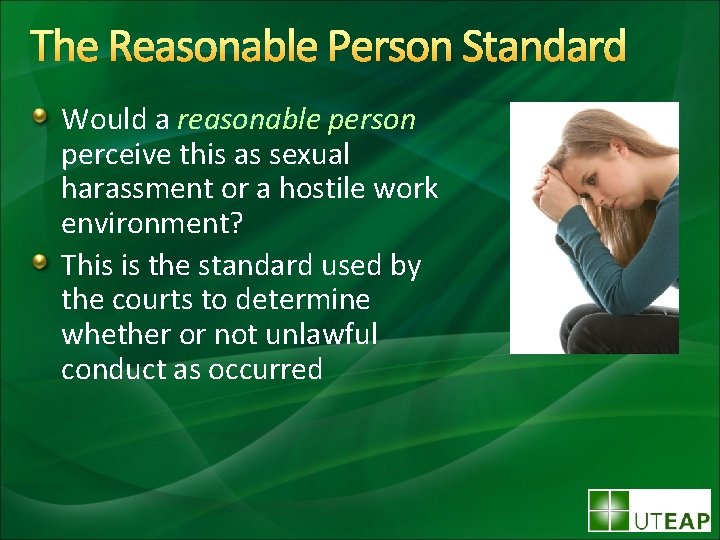
The Reasonable Person Standard Would a reasonable person perceive this as sexual harassment or a hostile work environment? This is the standard used by the courts to determine whether or not unlawful conduct as occurred
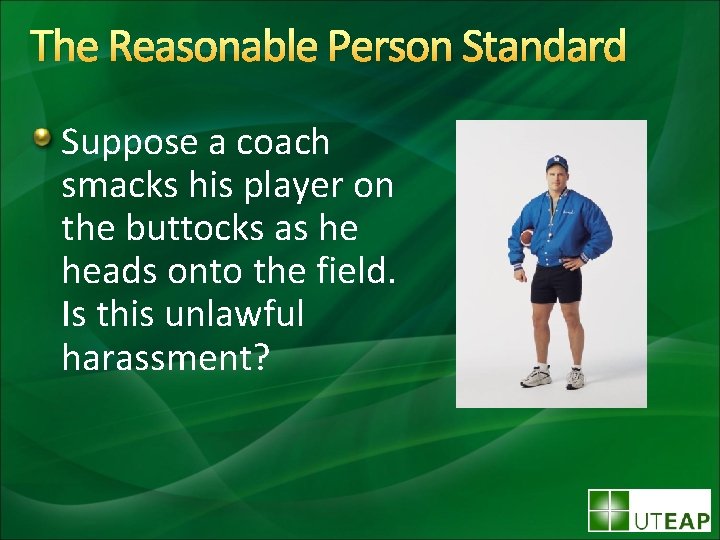
The Reasonable Person Standard Suppose a coach smacks his player on the buttocks as he heads onto the field. Is this unlawful harassment?
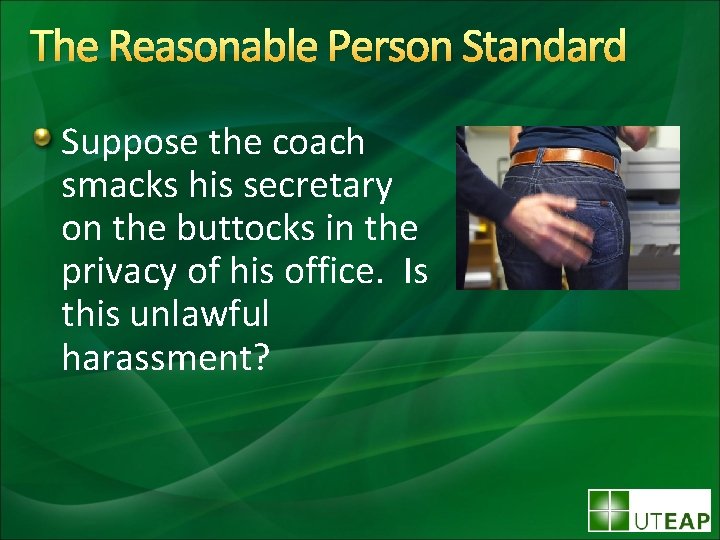
The Reasonable Person Standard Suppose the coach smacks his secretary on the buttocks in the privacy of his office. Is this unlawful harassment?
Who is Liable for Harassment? The Organization/Employer The organization can be held liable for the conduct of its supervisors even if it does not know that harassment is taking place. The organization is responsible for proving a safe work environment The organization is also responsible for the conduct of non-supervisors if they know or should have known that the harassment is taking place Supervisors The supervisor/manager can be held personally liable for their own harassment of co-workers or employees that they supervise Employees The offending employee(s) can be held individually liable for harassing actions towards a co-worker Damages could include: actual damage, emotional distress, punitive amounts and attorney’s fees.
Employer Liability: Who is a Supervisor? An employer is subject to vicarious liability for unlawful harassment if the harassment was committed by “a supervisor with immediate authority over the employee” The actions of the supervisor are imputed to the employer An individual qualifies as an employee’s supervisor if: The individual has authority to undertake or recommend tangible employment decisions affecting the employee; or The individual has authority to direct the employee’s daily work activities
Employer Liability: Non-Direct Supervisor An employer also may be subject to vicarious liability for harassment by a supervisor who does not have actual authority over the employee Liability is present if the employee reasonable believes that the harasser had such supervisory power Example: Chain of command may be unclear Not a direct supervisor but responsible for the employee’s work
Employer Liability: When There is "Tangible Employment Action" An employer is always liable for harassment by a supervisor that culminates in Tangible Employment Action Examples of Tangible Employment Action Any action that inflicts economic harm (termination, failure to promote, reassignment or shift change) Tangible Employment Action can only be caused by a supervisor or other person acting with authority of the Employer
Employer Liability May Include Claims in Addition to Harassment Harassing conduct may also result in claims for: Assault and battery Intentional infliction of emotional distress Constructive termination Defamation Remember that individual liability can also exist!
Two Types of Harassment QUID PRO QUO: “This for That” or “Something for Something” – also refers to an exchange HOSTILE WORK ENVIRONMENT: Unwelcome conduct of a sexual nature and severe enough to create an intimidating, offensive, abusive or disruptive work environment
Quid Pro Quo Occurs when an employment decision or condition is based upon whether an employee is willing to grant sexual favors “Have sex with me and I will give you that promotion you want. ” “If you want to stay with this company, you will meet me after work and convince me why you should keep this job. ” “If you are…you know…nice to me, I will change your shift. ”
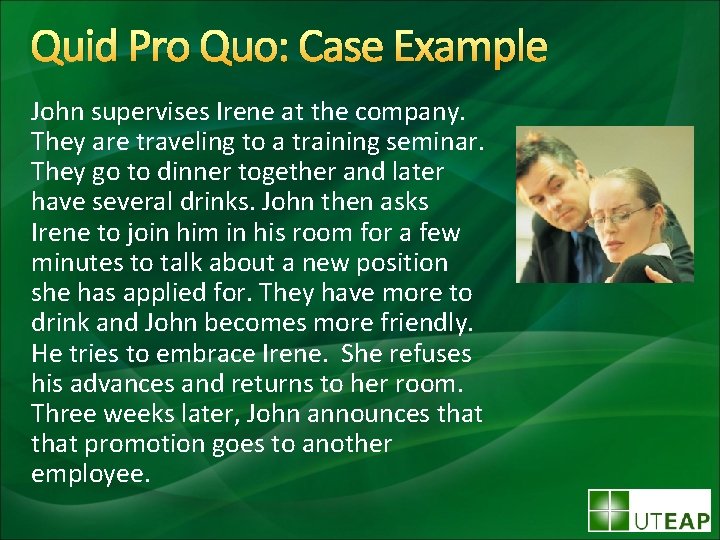
Quid Pro Quo: Case Example John supervises Irene at the company. They are traveling to a training seminar. They go to dinner together and later have several drinks. John then asks Irene to join him in his room for a few minutes to talk about a new position she has applied for. They have more to drink and John becomes more friendly. He tries to embrace Irene. She refuses his advances and returns to her room. Three weeks later, John announces that promotion goes to another employee.
Quid Pro Quo John and Irene: A harassment case? Since John is Irene’s supervisor, he has to take extra care that his actions will not be misinterpreted. It’s important to remember that traveling for company business or in the role as a company employee means you are always in the workplace. By inviting Irene to his room and making advances, a reasonable person could conclude that Irene was denied the promotion based on her rejection of John’s advances.
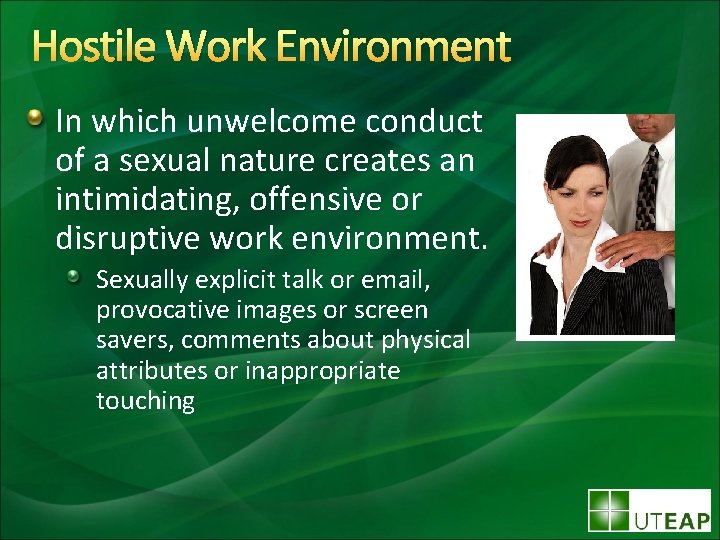
Hostile Work Environment In which unwelcome conduct of a sexual nature creates an intimidating, offensive or disruptive work environment. Sexually explicit talk or email, provocative images or screen savers, comments about physical attributes or inappropriate touching
Hostile Work Environment: Case Example Rhonda is the only female working at the company. At times, she wears very tight clothing (although it does not violate company dress code) and other co -workers think it is amusing to make sexual comments about her dress and her relationship with her boyfriend. At one time, someone left sex toys in her work area. Rhonda complained to her shift supervisor and his response was to counsel her on dressing in a less revealing manner. Rhonda feels she is following the written dress code and the behavior and comments continue.
Hostile Work Environment Rhonda: A harassment case? Rhonda’s rights may be violated when her physical attributes (protected characteristics) are being discussed. Sexual comments and sex toys should never be tolerated in the workplace. Rhonda’s supervisor did not take her complaint seriously and is not doing his job. His job is to stop the harassing behavior.
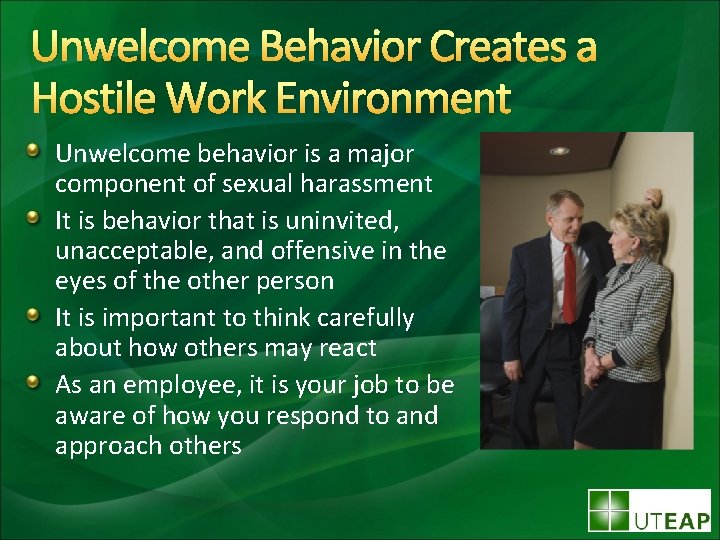
Unwelcome Behavior Creates a Hostile Work Environment Unwelcome behavior is a major component of sexual harassment It is behavior that is uninvited, unacceptable, and offensive in the eyes of the other person It is important to think carefully about how others may react As an employee, it is your job to be aware of how you respond to and approach others
Supervisors Must Also Take "Reasonable Care" The Supreme Court has given employers a defense in some hostile environment cases. To take advantage of the defense, an Employer must show that it exercised reasonable care to prevent and correct promptly any sexually harassing behavior.
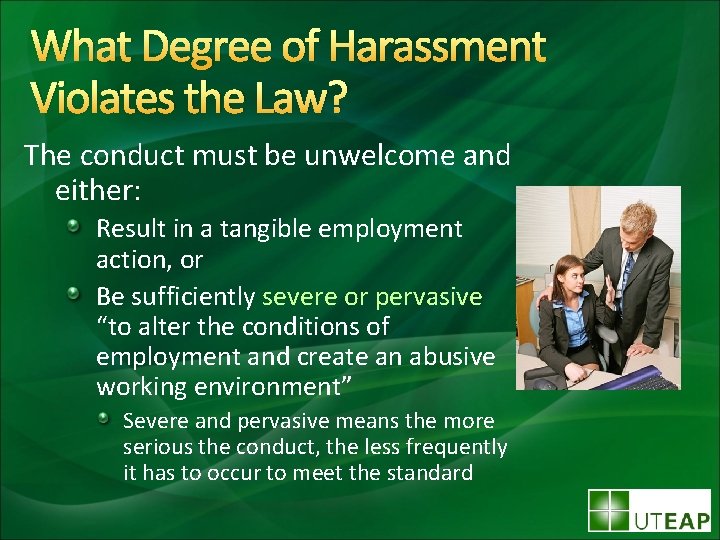
What Degree of Harassment Violates the Law? The conduct must be unwelcome and either: Result in a tangible employment action, or Be sufficiently severe or pervasive “to alter the conditions of employment and create an abusive working environment” Severe and pervasive means the more serious the conduct, the less frequently it has to occur to meet the standard
Questions for Assessing Sexual Harassment Complaints How frequent is the conduct? How severe is the conduct? Is the conduct sexual in nature? Is the conduct physically threatening or humiliating? Is it a “mere offensive utterance? ” Does it interfere with work performance?
Common Forms of Sexual Harassment VERBAL: Offensive jokes, asking personal questions, language, threats, comments about appearance or body, spreading rumors or lies, sexual slurs, pet names, graphic language or descriptions of sexual encounters or innuendos NON VERBAL: Leering or staring at a person’s body, offensive gestures, blocking a person’s path, facial expressions such as winking, throwing kisses, giving gifts, having “elevator eyes” PHYSICAL: Stalking, touching a person’s hair, blocking a person’s path, giving a massage, brushing against someone, giving back rubs, “hanging around” a person, holding or grabbing, sexual relations ENVIRONMENTAL: Voice mail, email, screen savers, blogs, website postings, suggestive or sexually oriented posters, calendars, cards, notes, etc.
Unwelcome Behavior: Case Example Jesse has a habit of touching people on the shoulder or arm when he talks to them and most people see him as a friendly outgoing person. Jesse has worked with Joan for over two years. Jesse comes over to Joan and tells her how nice her hair looks. He begins to touch her hair and also tells her how soft it feels. Joan walks away and later tells another employee what Jesse did and that it made her feel uneasy.
Unwelcome Behavior Jesse and Joan: A harassment case? Jesse needs to be made aware that his behavior might be offending someone. Joan may have encouraged the behavior in the past, but that no longer matters. If the behavior offends her today, it must stop. Sometimes we do not know what might be offensive to someone else; once we learn that our actions have been improperly interpreted, it’s best to apologize and not repeat the offensive action.
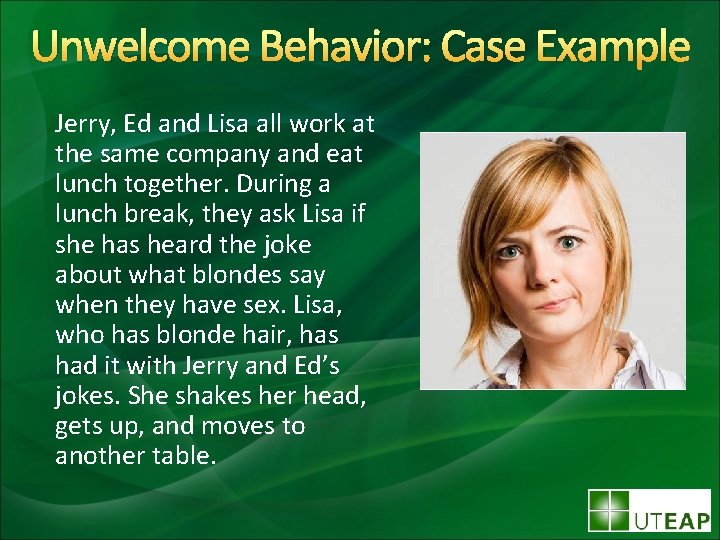
Unwelcome Behavior: Case Example Jerry, Ed and Lisa all work at the same company and eat lunch together. During a lunch break, they ask Lisa if she has heard the joke about what blondes say when they have sex. Lisa, who has blonde hair, has had it with Jerry and Ed’s jokes. She shakes her head, gets up, and moves to another table.
Unwelcome Behavior Jerry, Ed and Lisa: A harassment case? Lisa may not have told Jerry and Ed that she is offended, but her response needs to be properly interpreted. If Lisa is supervised by Jerry or Ed, she might not feel she can tell them she is offended, for fear of retaliation. Jerry and Ed are making references to sex in the workplace and this should not be tolerated.
Unwelcome Behavior Case Examples Could the following behavior be perceived as unwelcome? You have a screen saver on your computer of your wife in a bikini. q Welcome q Unwelcome q Depends
Unwelcome Behavior Case Examples Could the following behavior be perceived as unwelcome? Standing behind someone and putting your hand on their shoulder. q Welcome q Unwelcome q Depends
Unwelcome Behavior Case Examples Could the following behavior be perceived as unwelcome? You feel very strongly about your political opinions and talk about them at work. q Welcome q Unwelcome q Depends
Variations in Harassment Sexual Harassment may occur in and under a variety of circumstances: PEER TO PEER HARASSMENT: Effective complaint procedure needed SUBORDINATE HARASSMENT OF A SUPERVISOR: As a supervisor, you must seek help from a higher level of management MEN CAN BE SEXUALLY HARASSED BY WOMEN SAME SEX HARASSMENT: Harassment is unwelcome sexual behavior regardless of gender THIRD PARTY HARASSMENT: Non-employees can harass your staff or vice versa (customers, the soft drink vendor, or delivery person) OFFENDERS CAN BE: Supervisors, co-workers, vendors, and/or customers
Review: Key Points to Keep in Mind Everyone interprets events based upon their own background, experiences, and sense of personal space and privacy. You cannot be sure that someone will interpret your questionable behavior as innocent. Remember the reasonable person standard – other people will get to decide. Current events will be interpreted in light of subsequent events – very important for supervisors.
If You Believe That You Have Been Harassed or Witnessed Harassment You are encouraged to tell the individual causing the harassment that his or her behavior is offensive and must stop. If the behavior does not stop immediately or you are uncomfortable telling the individual to stop, you must immediately report the incident to your supervisor, the Human Resources department, or another appropriate supervisor. The Human Resources department will investigate all reports of harassment. Investigations will be kept confidential, consistent with the organization’s need to investigate. No retaliation will be tolerated against any employee who makes a good faith complaint of harassment to the company.
What About Confidentiality? Confidentiality is protected within certain limits. Those involved in the incident or investigation will be interviewed. Confidentiality will be protected where possible with only those having a “need to know” having access to information. Those with a “need to know” are required to keep matters confidential and are not to discuss with co-workers, other supervisors, etc. If the issue later becomes a legal proceeding, applicable law will determine the scope of confidentiality regarding any released information that the company can provide.
If You Receive a Harassment Complaint PROTECT THE VICTIM: No contact with aggressor; defuse the situation CONTACT HUMAN RESOURCES: Immediately alert personnel of the situation to determine action to be taken. SEPARATE THE PARTIES: Physically separate the parties from sight and hearing. DOCUMENT CAREFULLY: There will be an investigation. Listen seriously to the complaint (witnesses, time, etc). Take notes and don’t make light of the situation or defend the aggressor. OFFER THE EAP: Advise both parties that the EAP is available to them in talking about the event. May be mandatory for the aggressor. Draw no conclusions until you have all the facts!
Encourage Employees to Report Promptly! By making it safe for an employee to speak up By setting an example of how to behave By being receptive to employee concerns By reminding employees of policies related to harassment By reminding employees of the various ways they can raise concerns By reminding employees of the protections against retaliation By educating employees about harassment in the workplace as a measure of prevention
A Few Reasons Employees May Hesitate to Complain Fear of retaliation Fear of job loss Fear of not being believed Fear of humiliation Fear of being blamed Fear of ostracism by co-workers Embarrassment or shame Lack of understanding about the complaint procedure of policies about harassment in the workplace
Information to Be Gathered and Documented Where did the behavior occur? Who was involved? Were there any witnesses? Did the employee talk with anybody else about what happened? Has this happened before? How long has this been occurring? Was the person told the behavior was unwelcome? Is there anything else that the person has done that has not been reported or discussed? What does the employee want to have happen?
What Not to Do DEFEND THE SITUATION: “That’s just the way Charlie is; we just tolerate him. ” “Perhaps you are overacting to this. ” WHY QUESTIONS: “Why didn’t you do something about this before? ” Why questions are often considered judgmental. MULTIPLE CHOICE QUESTIONS: “Did she touch you on the arm, the shoulder, or the face? ” Instead ask “Where did the person touch you? ” or “Can you be more specific? ” LEADING QUESTIONS: “I think we can handle this informally, don’t you? ” MINIMIZE THE PERSON’S EXPERIENCE
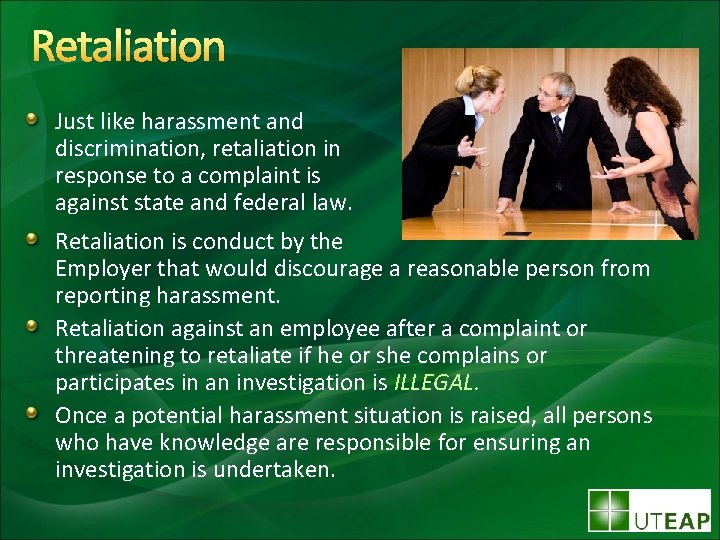
Retaliation Just like harassment and discrimination, retaliation in response to a complaint is against state and federal law. Retaliation is conduct by the Employer that would discourage a reasonable person from reporting harassment. Retaliation against an employee after a complaint or threatening to retaliate if he or she complains or participates in an investigation is ILLEGAL. Once a potential harassment situation is raised, all persons who have knowledge are responsible for ensuring an investigation is undertaken.
False Accusations Both men and women sometimes attempt to file false claims of discrimination or harassment. Once harassment is reported, the organization, MUST investigate all claims, including those that later turn out to be false. False claims can lead to disciplinary and financial costs for the accuser.
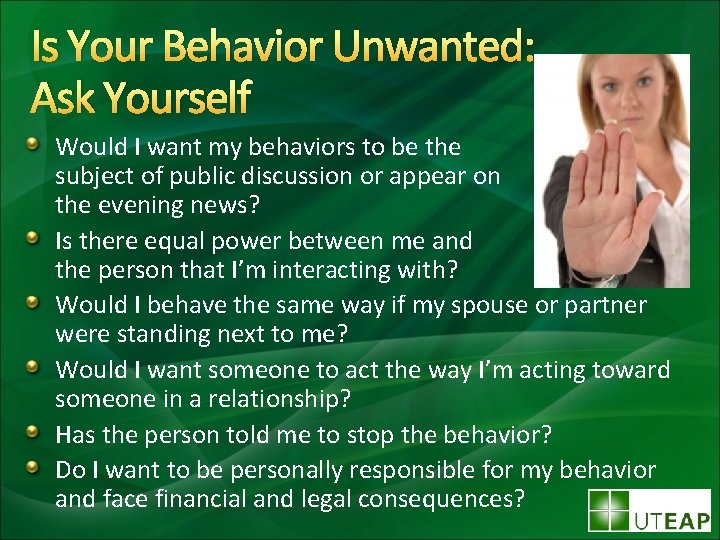
Is Your Behavior Unwanted: Ask Yourself Would I want my behaviors to be the subject of public discussion or appear on the evening news? Is there equal power between me and the person that I’m interacting with? Would I behave the same way if my spouse or partner were standing next to me? Would I want someone to act the way I’m acting toward someone in a relationship? Has the person told me to stop the behavior? Do I want to be personally responsible for my behavior and face financial and legal consequences?
The Bottom Line Most people do not want to file a harassment complaint. Most people do not want to bring legal action against their employer or supervisor. Most people want to come to work and do a good job and then go home. Most people expect employers to provide a safe and harassment-free workplace. Most people, from time to time, make mistakes in comments, behavior, and interactions with others and a simple “I’m Sorry” is appreciated.
- Slides: 50