
Workplace exposure standards and biological exposure indices What
Workplace exposure standards and biological exposure indices
What are the Workplace Exposure Standards? (WES) • A WES is the ‘expected amount’ of substance exposure that an average person can tolerate without adverse reaction (short or long term). • WES values are calculated on work schedules of five shifts of eight hours duration over a 40 -hour work week. • Longer shifts or exposure over a day or a week require the WES-Time Weighted Average (TWA) to be adjusted to account for longer periods of exposure and shorter recovery times. • PCBUs have a legal duty to minimise worker exposure to workplace hazardous substances. • The WES provide a guide to maximum recommendations around levels of exposure in a workplace. PCBUs must monitor the workplace exposure levels if the exposure to a substance cannot be eliminated. 2

Why have workplace exposure standards changed? Work. Safe have reviewed ongoing research that indicates that levels of exposure previously considered safe need to be reviewed downwards. Ø All proposed changes are designed to produce a better health outcome workers. Ø These changes are part of the Work. Safe strategic plan to reduce workplace related illness. 3
Why we need to Monitor Section 36 of Health and Safety At Work Act 2015 requires PCBUs to ensure worker health and safety ‘so far as is reasonably practicable’. Regulation 30 of Health and Safety at Work (General Risk and Workplace Management) Regulations 2016 requires a person in charge of a businesses or undertaking (PCBU) to conduct exposure monitoring to determine the concentration of a hazardous substance. Regulation 32 of the GRWM Regulations also requires the PCBU to make the results of exposure monitoring available to any person in the workplace. https: //besafe. nz/wes-work-place-exposure-standards/ 4
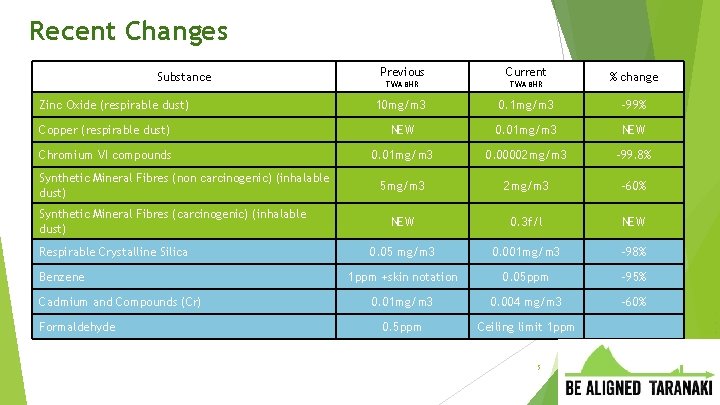
Recent Changes Previous Current TWA 8 HR 10 mg/m 3 0. 1 mg/m 3 -99% Copper (respirable dust) NEW 0. 01 mg/m 3 NEW Chromium VI compounds 0. 01 mg/m 3 0. 00002 mg/m 3 -99. 8% 5 mg/m 3 2 mg/m 3 -60% NEW 0. 3 f/l NEW 0. 05 mg/m 3 0. 001 mg/m 3 -98% 1 ppm +skin notation 0. 05 ppm -95% 0. 01 mg/m 3 0. 004 mg/m 3 -60% 0. 5 ppm Ceiling limit 1 ppm Substance Zinc Oxide (respirable dust) Synthetic Mineral Fibres (non carcinogenic) (inhalable dust) Synthetic Mineral Fibres (carcinogenic) (inhalable dust) Respirable Crystalline Silica Benzene Cadmium and Compounds (Cr) Formaldehyde 5 % change
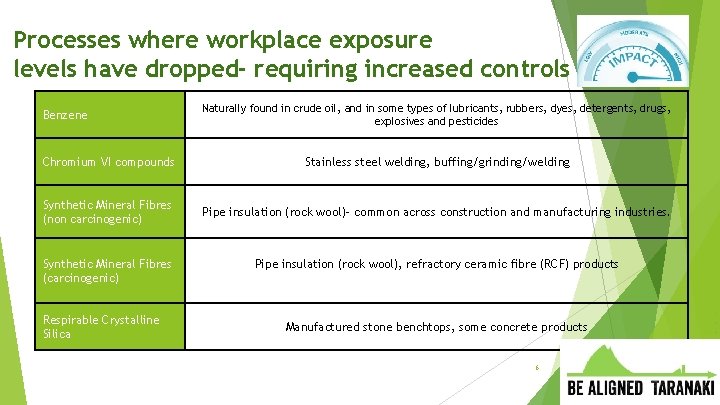
Processes where workplace exposure levels have dropped- requiring increased controls Benzene Naturally found in crude oil, and in some types of lubricants, rubbers, dyes, detergents, drugs, explosives and pesticides Chromium VI compounds Stainless steel welding, buffing/grinding/welding Synthetic Mineral Fibres (non carcinogenic) Pipe insulation (rock wool)- common across construction and manufacturing industries. Synthetic Mineral Fibres (carcinogenic) Respirable Crystalline Silica Pipe insulation (rock wool), refractory ceramic fibre (RCF) products Manufactured stone benchtops, some concrete products 6
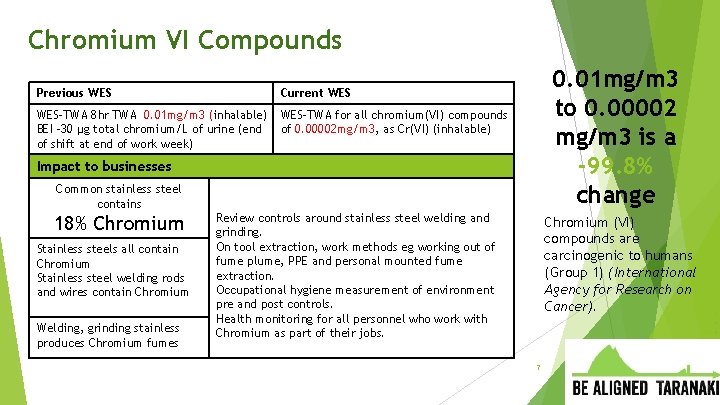
Chromium VI Compounds Previous WES Current WES-TWA 8 hr TWA 0. 01 mg/m 3 (inhalable) BEI -30 μg total chromium/L of urine (end of shift at end of work week) WES-TWA for all chromium(VI) compounds of 0. 00002 mg/m 3, as Cr(VI) (inhalable) 0. 01 mg/m 3 to 0. 00002 mg/m 3 is a -99. 8% change Impact to businesses Common stainless steel contains 18% Chromium Stainless steels all contain Chromium Stainless steel welding rods and wires contain Chromium Welding, grinding stainless produces Chromium fumes Review controls around stainless steel welding and grinding. On tool extraction, work methods eg working out of fume plume, PPE and personal mounted fume extraction. Occupational hygiene measurement of environment pre and post controls. Health monitoring for all personnel who work with Chromium as part of their jobs. Chromium (VI) compounds are carcinogenic to humans (Group 1) (International Agency for Research on Cancer). 7
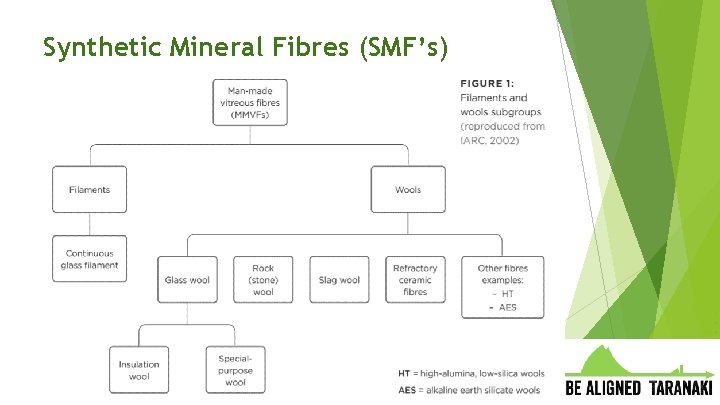
Synthetic Mineral Fibres (SMF’s) 8
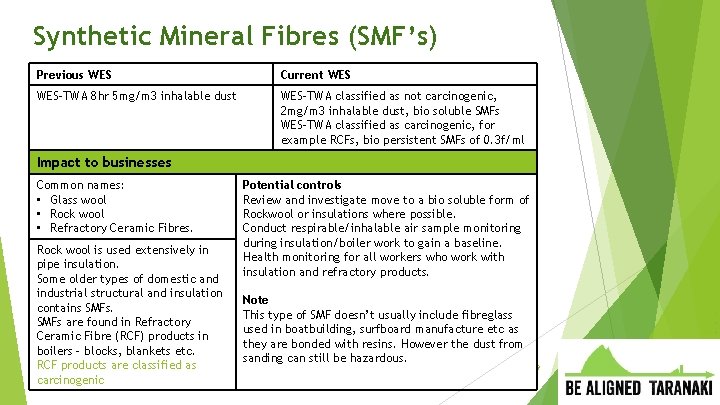
Synthetic Mineral Fibres (SMF’s) Previous WES Current WES-TWA 8 hr 5 mg/m 3 inhalable dust WES-TWA classified as not carcinogenic, 2 mg/m 3 inhalable dust, bio soluble SMFs WES-TWA classified as carcinogenic, for example RCFs, bio persistent SMFs of 0. 3 f/ml Impact to businesses Common names: • Glass wool • Rock wool • Refractory Ceramic Fibres. Rock wool is used extensively in pipe insulation. Some older types of domestic and industrial structural and insulation contains SMFs are found in Refractory Ceramic Fibre (RCF) products in boilers – blocks, blankets etc. RCF products are classified as carcinogenic Potential controls Review and investigate move to a bio soluble form of Rockwool or insulations where possible. Conduct respirable/inhalable air sample monitoring during insulation/boiler work to gain a baseline. Health monitoring for all workers who work with insulation and refractory products. Note This type of SMF doesn’t usually include fibreglass used in boatbuilding, surfboard manufacture etc as they are bonded with resins. However the dust from sanding can still be hazardous. 9
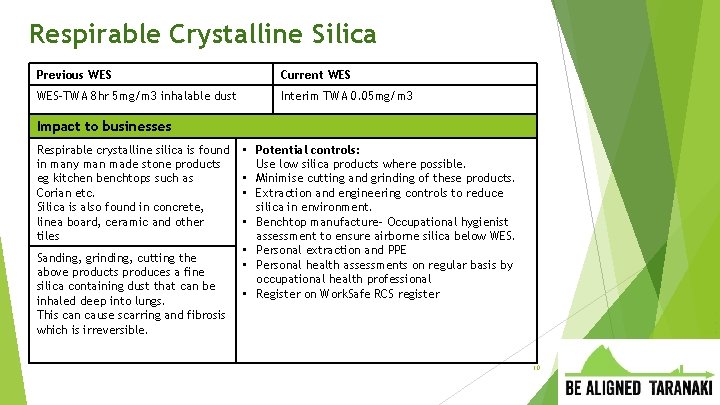
Respirable Crystalline Silica Previous WES Current WES-TWA 8 hr 5 mg/m 3 inhalable dust Interim TWA 0. 05 mg/m 3 Impact to businesses Respirable crystalline silica is found in many man made stone products eg kitchen benchtops such as Corian etc. Silica is also found in concrete, linea board, ceramic and other tiles Sanding, grinding, cutting the above products produces a fine silica containing dust that can be inhaled deep into lungs. This can cause scarring and fibrosis which is irreversible. • Potential controls: Use low silica products where possible. • Minimise cutting and grinding of these products. • Extraction and engineering controls to reduce silica in environment. • Benchtop manufacture- Occupational hygienist assessment to ensure airborne silica below WES. • Personal extraction and PPE • Personal health assessments on regular basis by occupational health professional • Register on Work. Safe RCS register 10
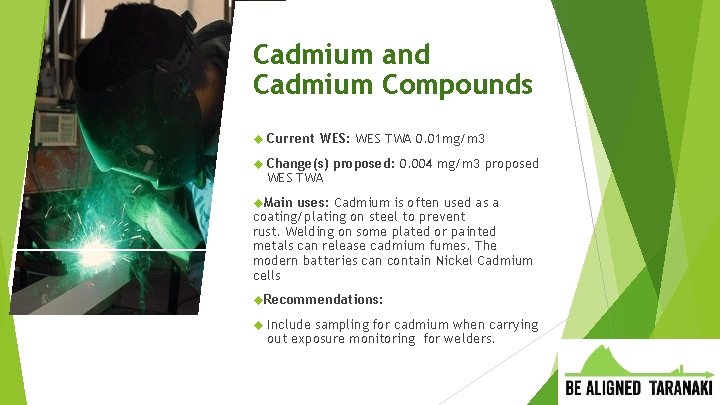
Cadmium and Cadmium Compounds Current WES: WES TWA 0. 01 mg/m 3 Change(s) proposed: 0. 004 mg/m 3 proposed WES TWA Main uses: Cadmium is often used as a coating/plating on steel to prevent rust. Welding on some plated or painted metals can release cadmium fumes. The modern batteries can contain Nickel Cadmium cells Recommendations: Include sampling for cadmium when carrying out exposure monitoring for welders.
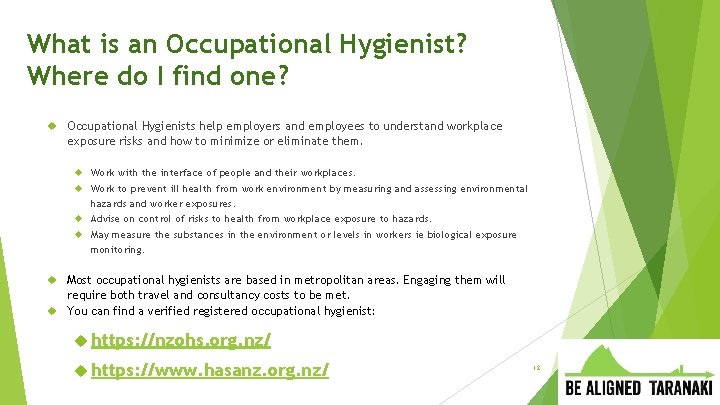
What is an Occupational Hygienist? Where do I find one? Occupational Hygienists help employers and employees to understand workplace exposure risks and how to minimize or eliminate them. Work with the interface of people and their workplaces. Work to prevent ill health from work environment by measuring and assessing environmental hazards and worker exposures. Advise on control of risks to health from workplace exposure to hazards. May measure the substances in the environment or levels in workers ie biological exposure monitoring. Most occupational hygienists are based in metropolitan areas. Engaging them will require both travel and consultancy costs to be met. You can find a verified registered occupational hygienist: https: //nzohs. org. nz/ https: //www. hasanz. org. nz/ 12
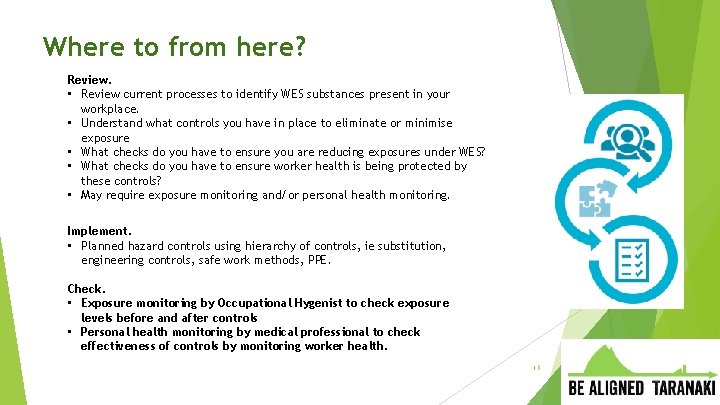
Where to from here? Review. • Review current processes to identify WES substances present in your workplace. • Understand what controls you have in place to eliminate or minimise exposure • What checks do you have to ensure you are reducing exposures under WES? • What checks do you have to ensure worker health is being protected by these controls? • May require exposure monitoring and/or personal health monitoring. Implement. • Planned hazard controls using hierarchy of controls, ie substitution, engineering controls, safe work methods, PPE. Check. • Exposure monitoring by Occupational Hygenist to check exposure levels before and after controls • Personal health monitoring by medical professional to check effectiveness of controls by monitoring worker health. 13
- Slides: 13