
Workplace Diversity Practices How Has Diversity and Inclusion
- Slides: 35
Workplace Diversity Practices: How Has Diversity and Inclusion Changed Over Time? A Comparative Examination: 2010 and 2005 October 12, 2010
Introduction Workplace Diversity Practices: How Has Diversity and Inclusion Changed Over Time? • In 2005, SHRM released the Workplace Diversity Practices research report, which addressed diversity practices in organizations from the perspective of HR professionals. Several of the survey questions from this report were included in a recent 2010 study to determine how diversity and inclusion in the workplace has changed over the last five years. • When possible, analyses of the 2010 survey results by organizations’ staff size, sector and operations locations are presented. • For the purpose of this research, workplace diversity is broadly defined as an inclusive corporate culture that strives to respect variations in employee personality, work style, age, ethnicity, gender, religion, socioeconomics, education and other dimensions in the workplace. Workplace Diversity Practices: How Has Diversity and Inclusion Changed Over Time? | ©SHRM 2010 2
Summary This SHRM study provides mostly encouraging news about the state of diversity in the workplace. The study shows increases in the percentage of companies that provide training on diversity issues, the number of organizations that have a diverse board of directors and the percentage of organizations reporting that their diversity practices were effective in achieving their organization’s desired outcomes. However, over the last five years, there has been a slight decrease in the percentage of organizations with practices that address workplace diversity. This slight decline is not surprising, as it is likely attributable to the unprecedented global economic downturn that began in late 2007. Other research conducted by SHRM has revealed that the downturn resulted in across-the-board cuts to many HR initiatives and practices. [1] Society for Human Resource Management. (2010, June). SHRM Poll: Financial Challenges to the U. S. and Global Economy and Their Impact on Organizations. Retrieved from www. shrm. org/surveys. Society for Human Resource Management. (2010, October). The Post-Recession Workplace Competitive Strategies for Recovery and Beyond. Alexandria, VA: SHRM. Workplace Diversity Practices: How Has Diversity and Inclusion Changed Over Time? | ©SHRM 2010 3
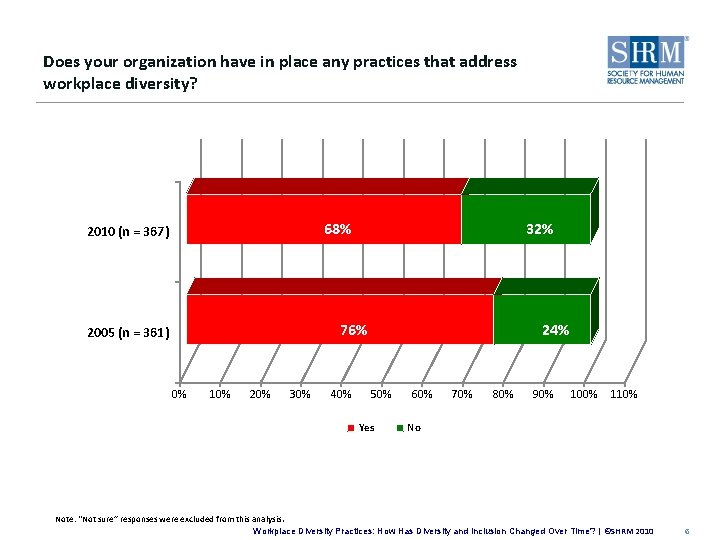
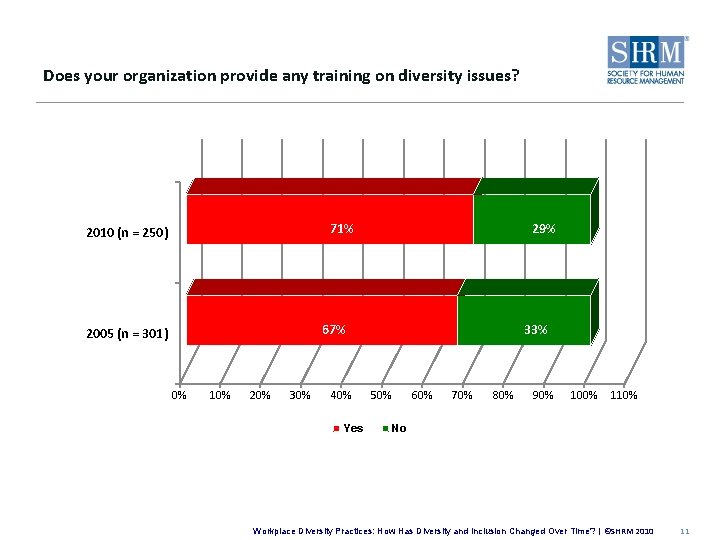
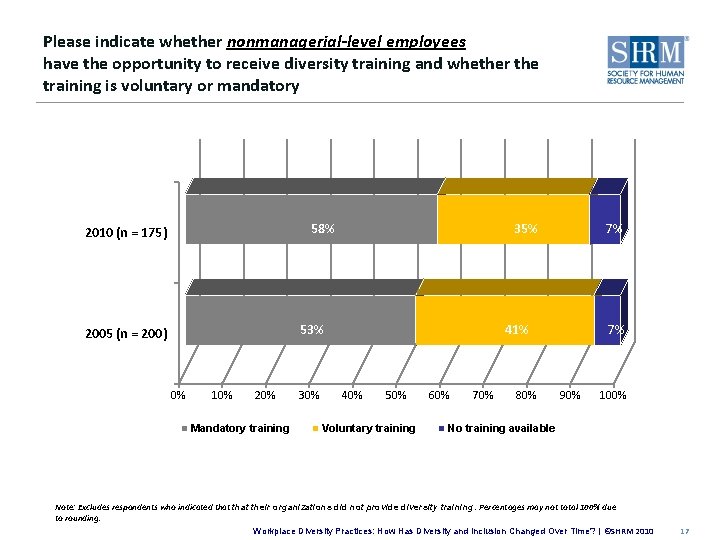
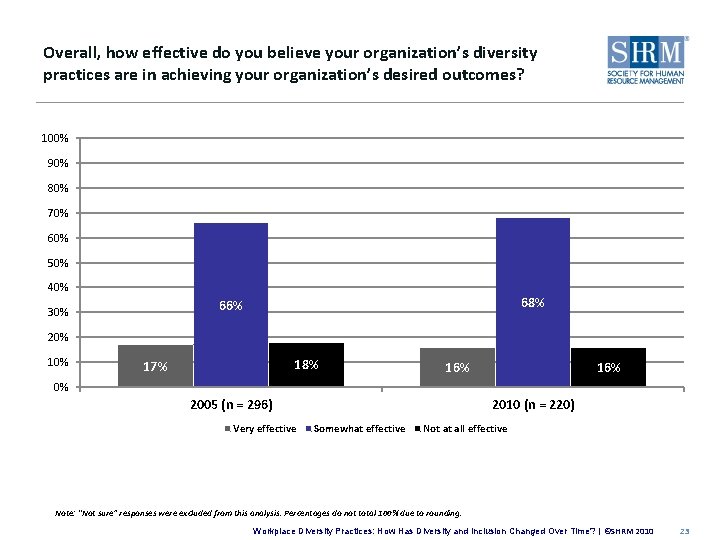
Key Findings • The prevalence of diversity practices in the workplace has decreased slightly in some organization size ranges. In 2010, 68% of organizations indicated that they have practices in place that address workplace diversity, compared with 76% of organizations surveyed in 2005. Larger organizations (those with 2, 500 or more employees), government agencies, publicly owned for -profit companies, nonprofit organizations and those with multinational operations were more likely to address workplace diversity. • Are companies still leveraging diversity training opportunities? Yes; among companies with diversity practices in place, the percentage offering training opportunities increased slightly from 67% in 2005 to 71% in 2010. The percentage of companies providing mandatory training for top-level executives and nonmanagerial-level employees increased over the last five years, while mandatory training for nonexecutive managerial-level employees was unchanged. • Most organizations report their diversity practices were effective. Eighty-four percent of businesses believed their diversity practices were either “very effective” or “somewhat effective” in achieving their organization’s desired outcomes. This percentage increased slightly from 83% in 2005. Workplace Diversity Practices: How Has Diversity and Inclusion Changed Over Time? | ©SHRM 2010 4
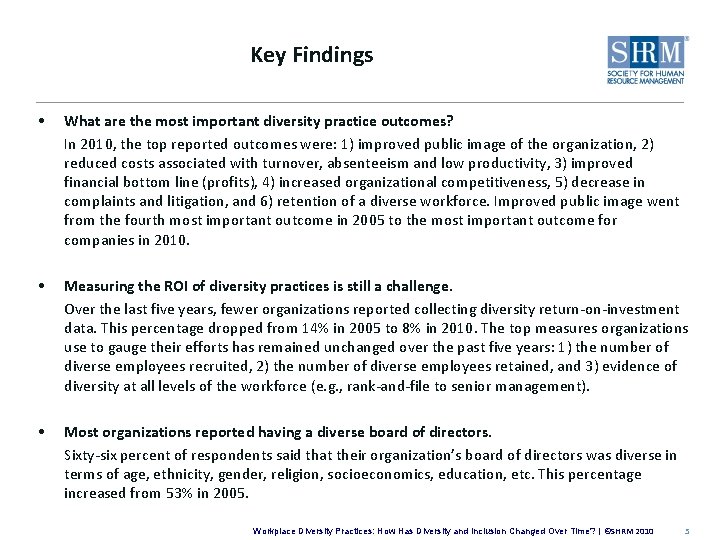
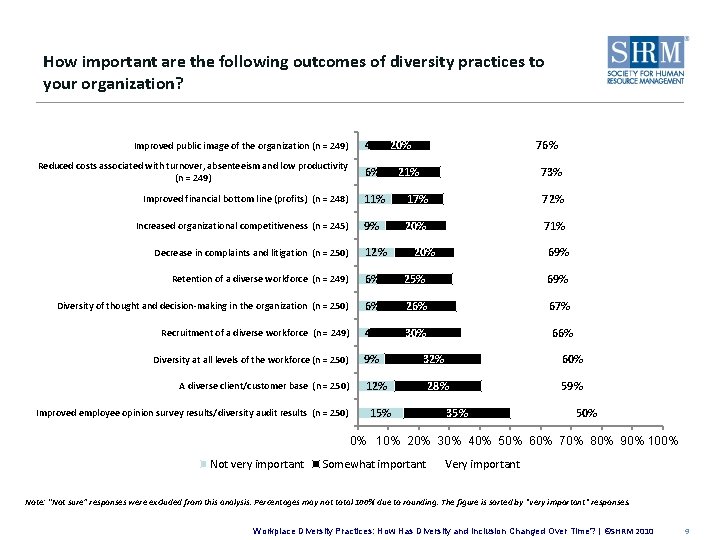
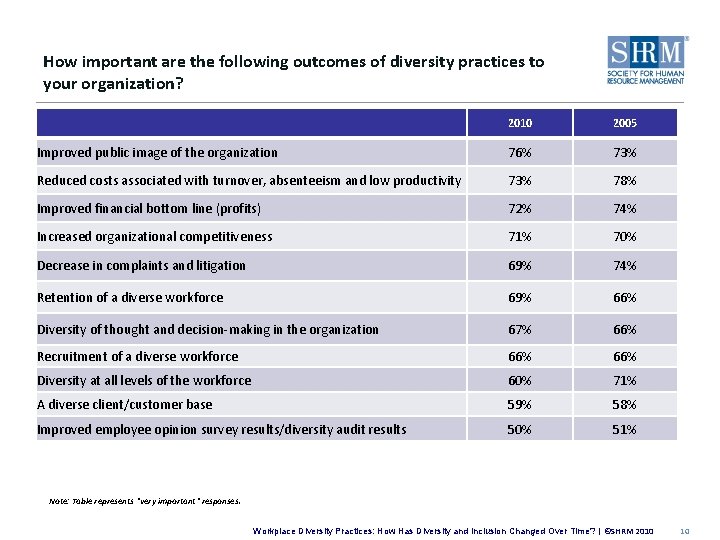
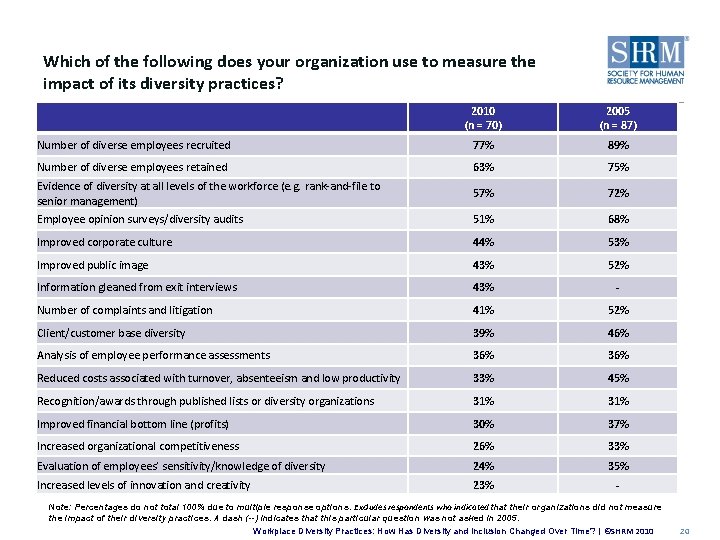
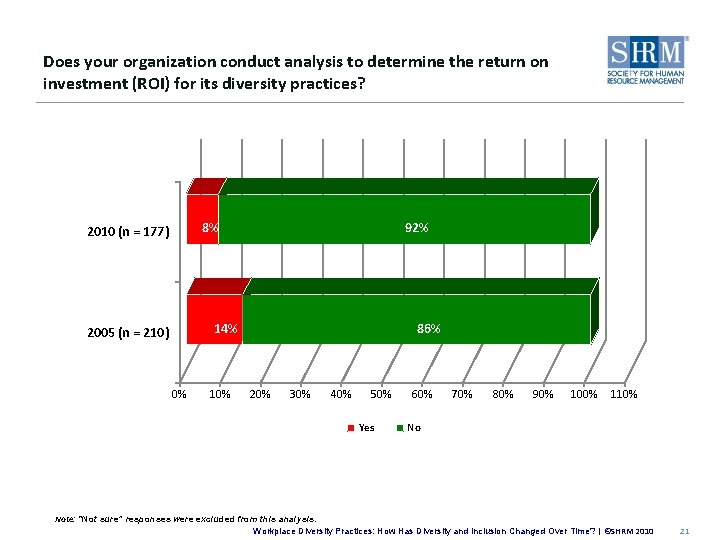
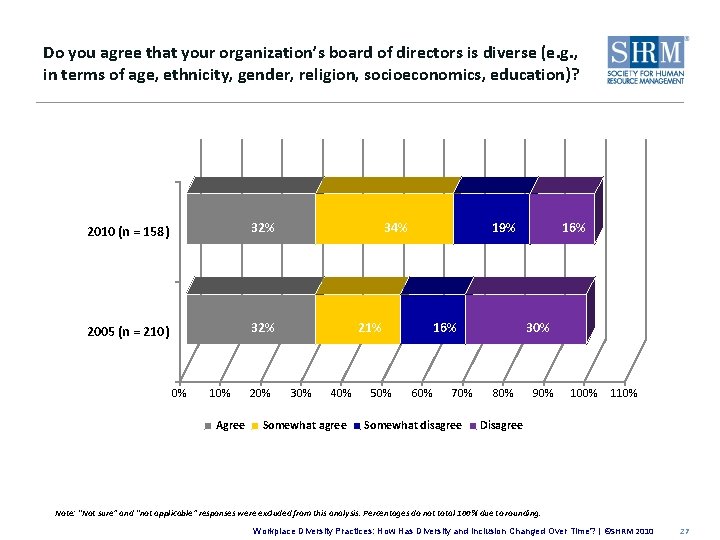
Key Findings • What are the most important diversity practice outcomes? In 2010, the top reported outcomes were: 1) improved public image of the organization, 2) reduced costs associated with turnover, absenteeism and low productivity, 3) improved financial bottom line (profits), 4) increased organizational competitiveness, 5) decrease in complaints and litigation, and 6) retention of a diverse workforce. Improved public image went from the fourth most important outcome in 2005 to the most important outcome for companies in 2010. • Measuring the ROI of diversity practices is still a challenge. Over the last five years, fewer organizations reported collecting diversity return-on-investment data. This percentage dropped from 14% in 2005 to 8% in 2010. The top measures organizations use to gauge their efforts has remained unchanged over the past five years: 1) the number of diverse employees recruited, 2) the number of diverse employees retained, and 3) evidence of diversity at all levels of the workforce (e. g. , rank-and-file to senior management). • Most organizations reported having a diverse board of directors. Sixty-six percent of respondents said that their organization’s board of directors was diverse in terms of age, ethnicity, gender, religion, socioeconomics, education, etc. This percentage increased from 53% in 2005. Workplace Diversity Practices: How Has Diversity and Inclusion Changed Over Time? | ©SHRM 2010 5
Does your organization have in place any practices that address workplace diversity? 68% 2010 (n = 367) 32% 76% 2005 (n = 361) 0% 10% 20% 30% 40% 24% 50% Yes 60% 70% 80% 90% 100% 110% No Note: “Not sure” responses were excluded from this analysis. Workplace Diversity Practices: How Has Diversity and Inclusion Changed Over Time? | ©SHRM 2010 6
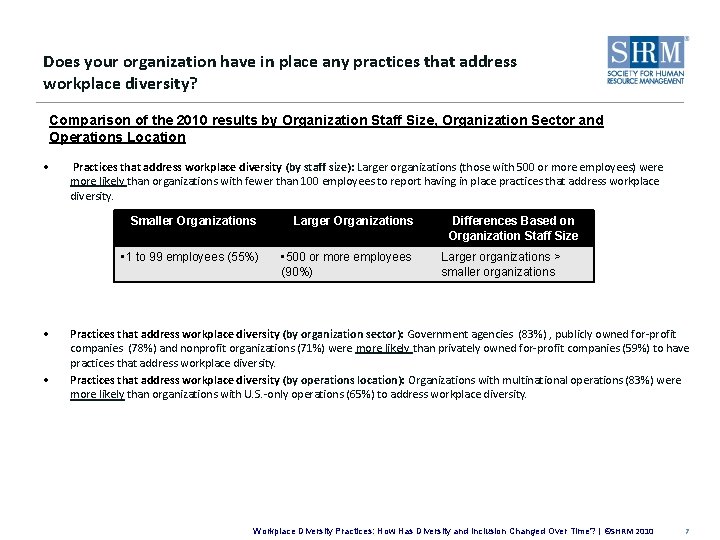
Does your organization have in place any practices that address workplace diversity? Comparison of the 2010 results by Organization Staff Size, Organization Sector and Operations Location • • • Practices that address workplace diversity (by staff size): Larger organizations (those with 500 or more employees) were more likely than organizations with fewer than 100 employees to report having in place practices that address workplace diversity. Smaller Organizations Larger Organizations • 1 to 99 employees (55%) • 500 or more employees (90%) Differences Based on Organization Staff Size Larger organizations > smaller organizations Practices that address workplace diversity (by organization sector): Government agencies (83%) , publicly owned for-profit companies (78%) and nonprofit organizations (71%) were more likely than privately owned for-profit companies (59%) to have practices that address workplace diversity. Practices that address workplace diversity (by operations location): Organizations with multinational operations (83%) were more likely than organizations with U. S. -only operations (65%) to address workplace diversity. Workplace Diversity Practices: How Has Diversity and Inclusion Changed Over Time? | ©SHRM 2010 7
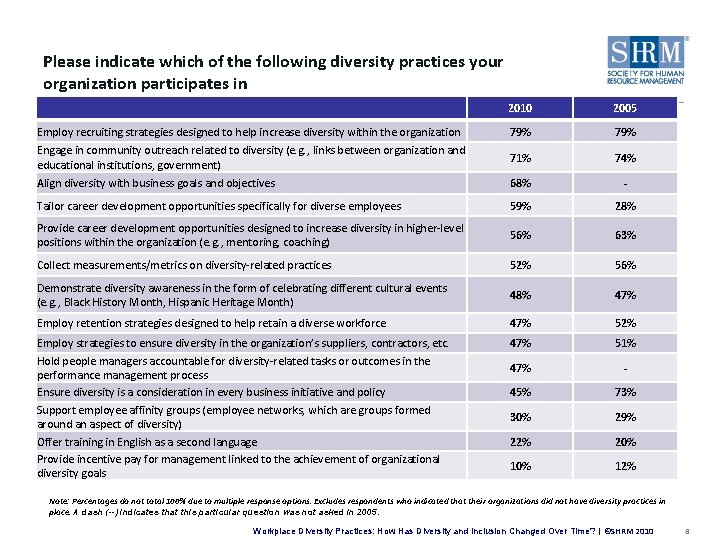
Please indicate which of the following diversity practices your organization participates in 2010 2005 Employ recruiting strategies designed to help increase diversity within the organization 79% Engage in community outreach related to diversity (e. g. , links between organization and educational institutions, government) 71% 74% Align diversity with business goals and objectives 68% - Tailor career development opportunities specifically for diverse employees 59% 28% Provide career development opportunities designed to increase diversity in higher-level positions within the organization (e. g. , mentoring, coaching) 56% 63% Collect measurements/metrics on diversity-related practices 52% 56% Demonstrate diversity awareness in the form of celebrating different cultural events (e. g. , Black History Month, Hispanic Heritage Month) 48% 47% Employ retention strategies designed to help retain a diverse workforce 47% 52% Employ strategies to ensure diversity in the organization’s suppliers, contractors, etc. Hold people managers accountable for diversity-related tasks or outcomes in the performance management process Ensure diversity is a consideration in every business initiative and policy Support employee affinity groups (employee networks, which are groups formed around an aspect of diversity) Offer training in English as a second language Provide incentive pay for management linked to the achievement of organizational diversity goals 47% 51% 47% - 45% 73% 30% 29% 22% 20% 12% Note: Percentages do not total 100% due to multiple response options. Excludes respondents who indicated that their organizations did not have diversity practices in place. A dash (--) indicates that this particular question was not asked in 2005. Workplace Diversity Practices: How Has Diversity and Inclusion Changed Over Time? | ©SHRM 2010 8
How important are the following outcomes of diversity practices to your organization? Improved public image of the organization (n = 249) Reduced costs associated with turnover, absenteeism and low productivity (n = 249) Improved financial bottom line (profits) (n = 248) Increased organizational competitiveness (n = 245) Decrease in complaints and litigation (n = 250) 4% 20% 6% 76% 21% 73% 11% 17% 72% 9% 20% 71% 12% 20% 69% Retention of a diverse workforce (n = 249) 6% 25% 69% Diversity of thought and decision-making in the organization (n = 250) 6% 26% 67% Recruitment of a diverse workforce (n = 249) 4% 30% 66% Diversity at all levels of the workforce (n = 250) 9% A diverse client/customer base (n = 250) Improved employee opinion survey results/diversity audit results (n = 250) 32% 15% 60% 28% 35% 59% 50% 0% 10% 20% 30% 40% 50% 60% 70% 80% 90% 100% Not very important Somewhat important Very important Note: “Not sure” responses were excluded from this analysis. Percentages may not total 100% due to rounding. The figure is sorted by "very important" responses. Workplace Diversity Practices: How Has Diversity and Inclusion Changed Over Time? | ©SHRM 2010 9
How important are the following outcomes of diversity practices to your organization? 2010 2005 Improved public image of the organization 76% 73% Reduced costs associated with turnover, absenteeism and low productivity 73% 78% Improved financial bottom line (profits) 72% 74% Increased organizational competitiveness 71% 70% Decrease in complaints and litigation 69% 74% Retention of a diverse workforce 69% 66% Diversity of thought and decision-making in the organization 67% 66% Recruitment of a diverse workforce 66% Diversity at all levels of the workforce 60% 71% A diverse client/customer base 59% 58% Improved employee opinion survey results/diversity audit results 50% 51% Note: Table represents "very important" responses. Workplace Diversity Practices: How Has Diversity and Inclusion Changed Over Time? | ©SHRM 2010 10
Does your organization provide any training on diversity issues? 71% 2010 (n = 250) 29% 67% 2005 (n = 301) 0% 10% 20% 30% 40% Yes 33% 50% 60% 70% 80% 90% 100% 110% No Workplace Diversity Practices: How Has Diversity and Inclusion Changed Over Time? | ©SHRM 2010 11
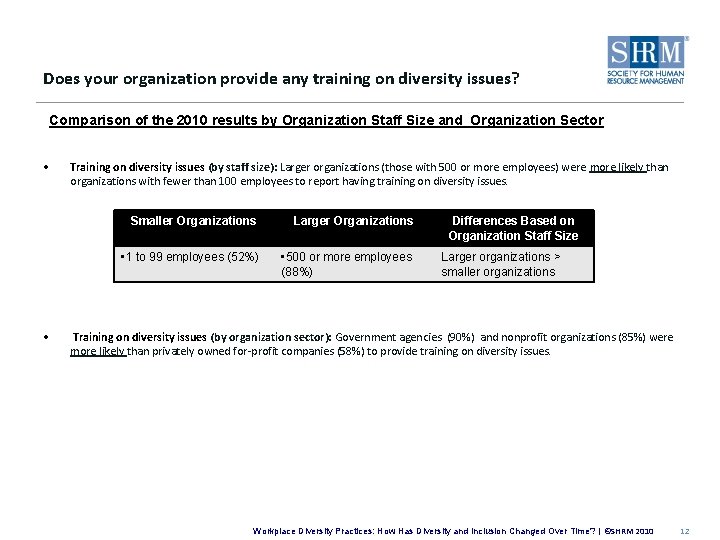
Does your organization provide any training on diversity issues? Comparison of the 2010 results by Organization Staff Size and Organization Sector • • Training on diversity issues (by staff size): Larger organizations (those with 500 or more employees) were more likely than organizations with fewer than 100 employees to report having training on diversity issues. Smaller Organizations Larger Organizations • 1 to 99 employees (52%) • 500 or more employees (88%) Differences Based on Organization Staff Size Larger organizations > smaller organizations Training on diversity issues (by organization sector): Government agencies (90%) and nonprofit organizations (85%) were more likely than privately owned for-profit companies (58%) to provide training on diversity issues. Workplace Diversity Practices: How Has Diversity and Inclusion Changed Over Time? | ©SHRM 2010 12
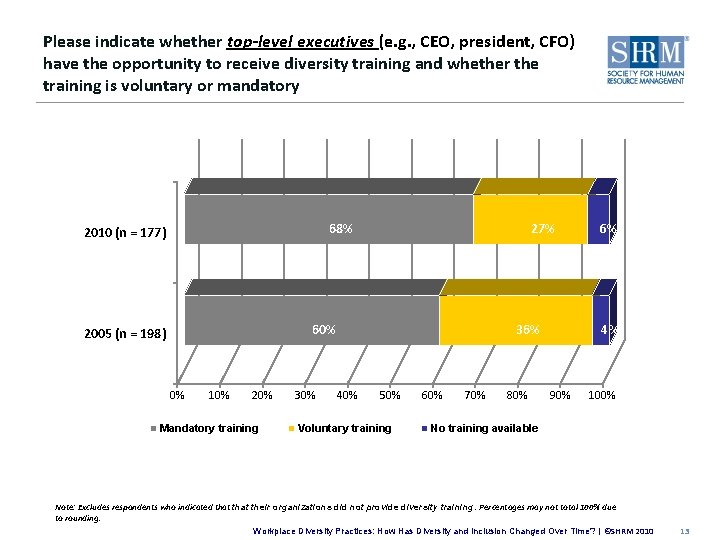
Please indicate whether top-level executives (e. g. , CEO, president, CFO) have the opportunity to receive diversity training and whether the training is voluntary or mandatory 68% 2010 (n = 177) 27% 60% 2005 (n = 198) 0% 10% 20% Mandatory training 30% 36% 40% 50% Voluntary training 60% 70% 80% 6% 4% 90% 100% No training available Note: Excludes respondents who indicated that their organizations did not provide diversity training. Percentages may not total 100% due to rounding. Workplace Diversity Practices: How Has Diversity and Inclusion Changed Over Time? | ©SHRM 2010 13
Please indicate whether top-level executives (e. g. , CEO, president, CFO) have the opportunity to receive diversity training and whether the training is voluntary or mandatory Comparison of the 2010 results by Organization Sector and Operations Location • • Mandatory training for top-level executives (by organization sector): Publicly owned for-profit companies (86%) were more likely than government agencies (44%) to have mandatory training on diversity for their top -level executives. Mandatory training for top-level executives (by operations location): Organizations with multinational operations (80%) were more likely than organizations with U. S. -only operations (61%) to have mandatory training for their top -level executives. Workplace Diversity Practices: How Has Diversity and Inclusion Changed Over Time? | ©SHRM 2010 14
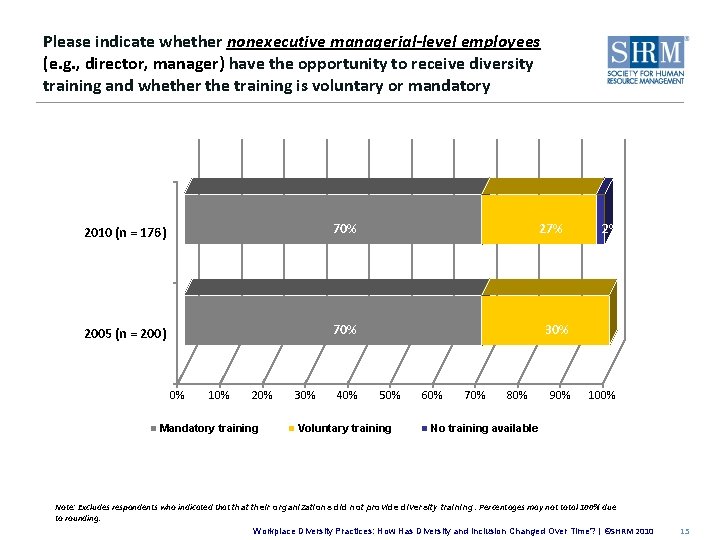
Please indicate whether nonexecutive managerial-level employees (e. g. , director, manager) have the opportunity to receive diversity training and whether the training is voluntary or mandatory 2010 (n = 176) 70% 2005 (n = 200) 70% 0% 10% 20% Mandatory training 30% 40% 27% 2% 30% 50% Voluntary training 60% 70% 80% 90% 100% No training available Note: Excludes respondents who indicated that their organizations did not provide diversity training. Percentages may not total 100% due to rounding. Workplace Diversity Practices: How Has Diversity and Inclusion Changed Over Time? | ©SHRM 2010 15
Please indicate whether nonexecutive managerial-level employees (e. g. , director, manager) have the opportunity to receive diversity training and whether the training is voluntary or mandatory Comparison of the 2010 results by Organization Sector • Mandatory training for nonexecutive managerial-level employees (by organization sector): Publicly owned for-profits (77%) and privately owned for-profit companies (76%) were more likely than government agencies (44%) to have mandatory training on diversity for their nonexecutive managerial-level employees. Workplace Diversity Practices: How Has Diversity and Inclusion Changed Over Time? | ©SHRM 2010 16
Please indicate whether nonmanagerial-level employees have the opportunity to receive diversity training and whether the training is voluntary or mandatory 58% 2010 (n = 175) 35% 53% 2005 (n = 200) 0% 10% 20% Mandatory training 30% 7% 41% 40% 50% Voluntary training 60% 70% 80% 7% 90% 100% No training available Note: Excludes respondents who indicated that their organizations did not provide diversity training. Percentages may not total 100% due to rounding. Workplace Diversity Practices: How Has Diversity and Inclusion Changed Over Time? | ©SHRM 2010 17
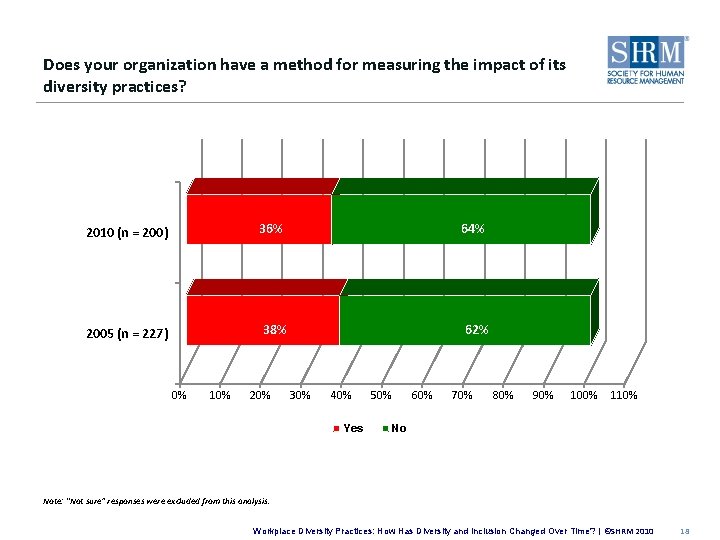
Does your organization have a method for measuring the impact of its diversity practices? 2010 (n = 200) 36% 64% 2005 (n = 227) 38% 62% 0% 10% 20% 30% 40% Yes 50% 60% 70% 80% 90% 100% 110% No Note: “Not sure” responses were excluded from this analysis. Workplace Diversity Practices: How Has Diversity and Inclusion Changed Over Time? | ©SHRM 2010 18
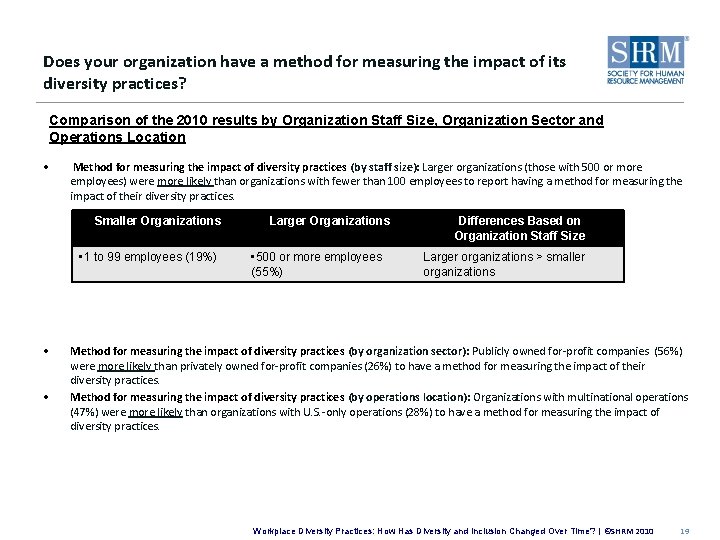
Does your organization have a method for measuring the impact of its diversity practices? Comparison of the 2010 results by Organization Staff Size, Organization Sector and Operations Location • Method for measuring the impact of diversity practices (by staff size): Larger organizations (those with 500 or more employees) were more likely than organizations with fewer than 100 employees to report having a method for measuring the impact of their diversity practices. Smaller Organizations • 1 to 99 employees (19%) • • Larger Organizations • 500 or more employees (55%) Differences Based on Organization Staff Size Larger organizations > smaller organizations Method for measuring the impact of diversity practices (by organization sector): Publicly owned for-profit companies (56%) were more likely than privately owned for-profit companies (26%) to have a method for measuring the impact of their diversity practices. Method for measuring the impact of diversity practices (by operations location): Organizations with multinational operations (47%) were more likely than organizations with U. S. -only operations (28%) to have a method for measuring the impact of diversity practices. Workplace Diversity Practices: How Has Diversity and Inclusion Changed Over Time? | ©SHRM 2010 19
Which of the following does your organization use to measure the impact of its diversity practices? 2010 (n = 70) 2005 (n = 87) Number of diverse employees recruited 77% 89% Number of diverse employees retained 63% 75% Evidence of diversity at all levels of the workforce (e. g. rank-and-file to senior management) 57% 72% Employee opinion surveys/diversity audits 51% 68% Improved corporate culture 44% 53% Improved public image 43% 52% Information gleaned from exit interviews 43% - Number of complaints and litigation 41% 52% Client/customer base diversity 39% 46% Analysis of employee performance assessments 36% Reduced costs associated with turnover, absenteeism and low productivity 33% 45% Recognition/awards through published lists or diversity organizations 31% Improved financial bottom line (profits) 30% 37% Increased organizational competitiveness 26% 33% Evaluation of employees’ sensitivity/knowledge of diversity 24% 35% Increased levels of innovation and creativity 23% - Note: Percentages do not total 100% due to multiple response options. Excludes respondents who indicated that their organizations did not measure the impact of their diversity practices. A dash (--) indicates that this particular question was not asked in 2005. Workplace Diversity Practices: How Has Diversity and Inclusion Changed Over Time? | ©SHRM 2010 20
Does your organization conduct analysis to determine the return on investment (ROI) for its diversity practices? 8% 2010 (n = 177) 92% 14% 2005 (n = 210) 0% 10% 86% 20% 30% 40% 50% Yes 60% 70% 80% 90% 100% 110% No Note: “Not sure” responses were excluded from this analysis. Workplace Diversity Practices: How Has Diversity and Inclusion Changed Over Time? | ©SHRM 2010 21
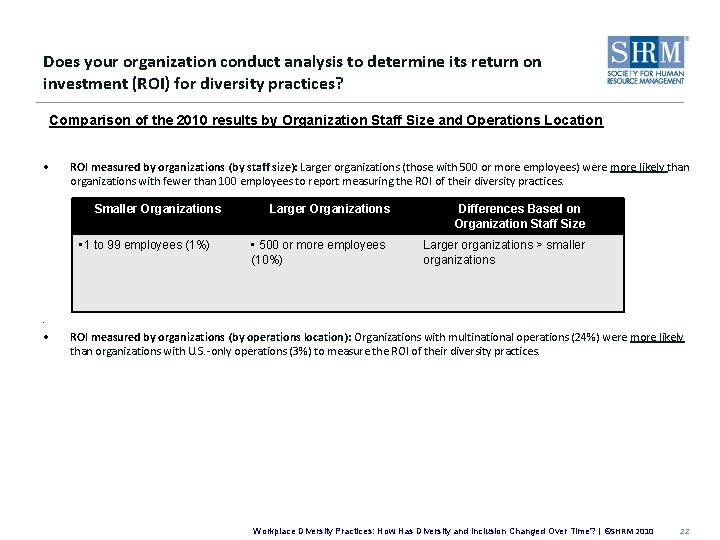
Does your organization conduct analysis to determine its return on investment (ROI) for diversity practices? Comparison of the 2010 results by Organization Staff Size and Operations Location • ROI measured by organizations (by staff size): Larger organizations (those with 500 or more employees) were more likely than organizations with fewer than 100 employees to report measuring the ROI of their diversity practices. Smaller Organizations • 1 to 99 employees (1%) . • Larger Organizations • 500 or more employees (10%) Differences Based on Organization Staff Size Larger organizations > smaller organizations ROI measured by organizations (by operations location): Organizations with multinational operations (24%) were more likely than organizations with U. S. -only operations (3%) to measure the ROI of their diversity practices. Workplace Diversity Practices: How Has Diversity and Inclusion Changed Over Time? | ©SHRM 2010 22
Overall, how effective do you believe your organization’s diversity practices are in achieving your organization’s desired outcomes? 100% 90% 80% 70% 60% 50% 40% 68% 66% 30% 20% 18% 17% 16% 0% 2005 (n = 296) Very effective 2010 (n = 220) Somewhat effective Not at all effective Note: “Not sure” responses were excluded from this analysis. Percentages do not total 100% due to rounding. Workplace Diversity Practices: How Has Diversity and Inclusion Changed Over Time? | ©SHRM 2010 23
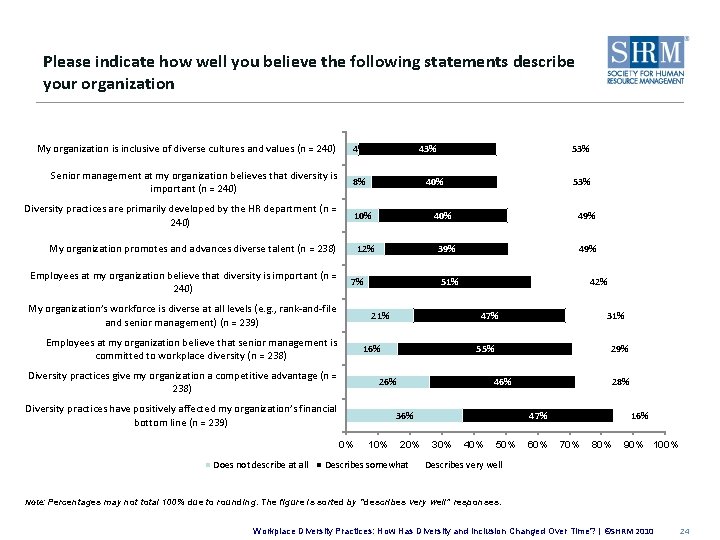
Please indicate how well you believe the following statements describe your organization My organization is inclusive of diverse cultures and values (n = 240) 4% Senior management at my organization believes that diversity is important (n = 240) 43% 8% Diversity practices are primarily developed by the HR department (n = 240) 40% 10% My organization promotes and advances diverse talent (n = 238) Diversity practices give my organization a competitive advantage (n = 238) Does not describe at all 42% 47% 16% 29% 46% 36% 10% 31% 55% 26% Diversity practices have positively affected my organization’s financial bottom line (n = 239) 0% 49% 51% 21% Employees at my organization believe that senior management is committed to workplace diversity (n = 238) 49% 39% 7% My organization’s workforce is diverse at all levels (e. g. , rank-and-file and senior management) (n = 239) 53% 40% 12% Employees at my organization believe that diversity is important (n = 240) 53% 20% Describes somewhat 28% 47% 30% 40% 50% 60% 16% 70% 80% 90% 100% Describes very well Note: Percentages may not total 100% due to rounding. The figure is sorted by “describes very well” responses. Workplace Diversity Practices: How Has Diversity and Inclusion Changed Over Time? | ©SHRM 2010 24
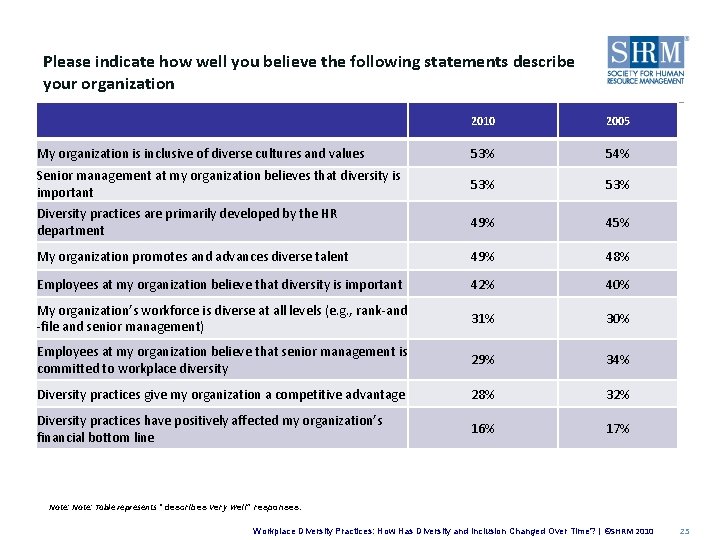
Please indicate how well you believe the following statements describe your organization 2010 2005 My organization is inclusive of diverse cultures and values 53% 54% Senior management at my organization believes that diversity is important 53% Diversity practices are primarily developed by the HR department 49% 45% My organization promotes and advances diverse talent 49% 48% Employees at my organization believe that diversity is important 42% 40% My organization’s workforce is diverse at all levels (e. g. , rank-and -file and senior management) 31% 30% Employees at my organization believe that senior management is committed to workplace diversity 29% 34% Diversity practices give my organization a competitive advantage 28% 32% Diversity practices have positively affected my organization’s financial bottom line 16% 17% Note: Table represents " describes very well” responses. Workplace Diversity Practices: How Has Diversity and Inclusion Changed Over Time? | ©SHRM 2010 25
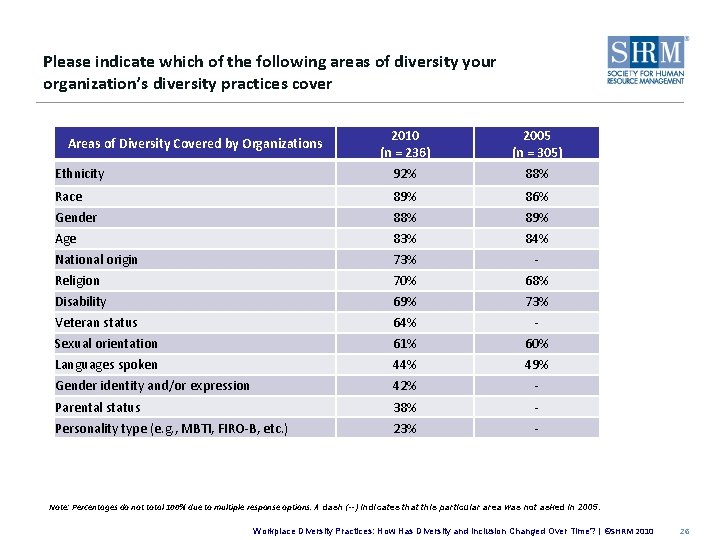
Please indicate which of the following areas of diversity your organization’s diversity practices cover 2010 (n = 236) 2005 (n = 305) Ethnicity 92% 88% Race Gender Age National origin Religion Disability Veteran status Sexual orientation Languages spoken 89% 88% 83% 70% 69% 64% 61% 44% 86% 89% 84% 68% 73% 60% 49% Gender identity and/or expression 42% - Parental status 38% - Personality type (e. g. , MBTI, FIRO-B, etc. ) 23% - Areas of Diversity Covered by Organizations Note: Percentages do not total 100% due to multiple response options. A dash (--) indicates that this particular area was not asked in 2005. Workplace Diversity Practices: How Has Diversity and Inclusion Changed Over Time? | ©SHRM 2010 26
Do you agree that your organization’s board of directors is diverse (e. g. , in terms of age, ethnicity, gender, religion, socioeconomics, education)? 2010 (n = 158) 32% 2005 (n = 210) 32% 0% 10% Agree 20% 34% 19% 21% 30% 40% Somewhat agree 50% 16% 60% 70% Somewhat disagree 16% 30% 80% 90% 100% 110% Disagree Note: “Not sure” and “not applicable” responses were excluded from this analysis. Percentages do not total 100% due to rounding. Workplace Diversity Practices: How Has Diversity and Inclusion Changed Over Time? | ©SHRM 2010 27
2010 Organizational Demographics Workplace Diversity Practices: How Has Diversity and Inclusion Changed Over Time? | ©SHRM 2010 28
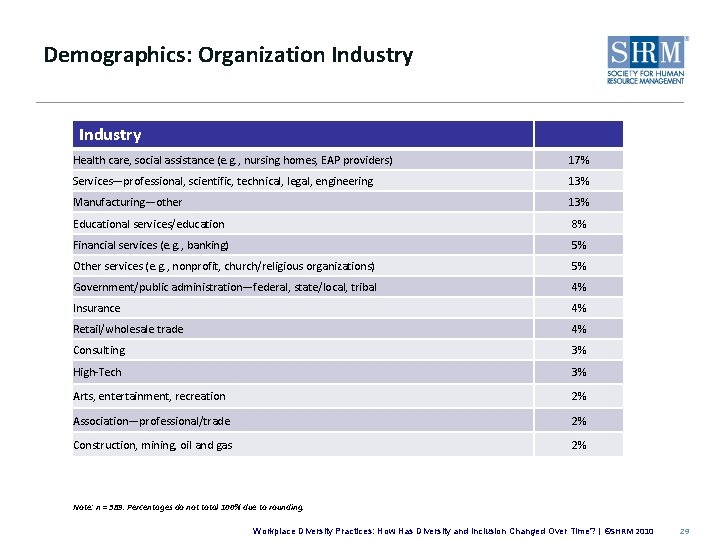
Demographics: Organization Industry Health care, social assistance (e. g. , nursing homes, EAP providers) 17% Services—professional, scientific, technical, legal, engineering 13% Manufacturing—other 13% Educational services/education 8% Financial services (e. g. , banking) 5% Other services (e. g. , nonprofit, church/religious organizations) 5% Government/public administration—federal, state/local, tribal 4% Insurance 4% Retail/wholesale trade 4% Consulting 3% High-Tech 3% Arts, entertainment, recreation 2% Association—professional/trade 2% Construction, mining, oil and gas 2% Note: n = 389. Percentages do not total 100% due to rounding. Workplace Diversity Practices: How Has Diversity and Inclusion Changed Over Time? | ©SHRM 2010 29
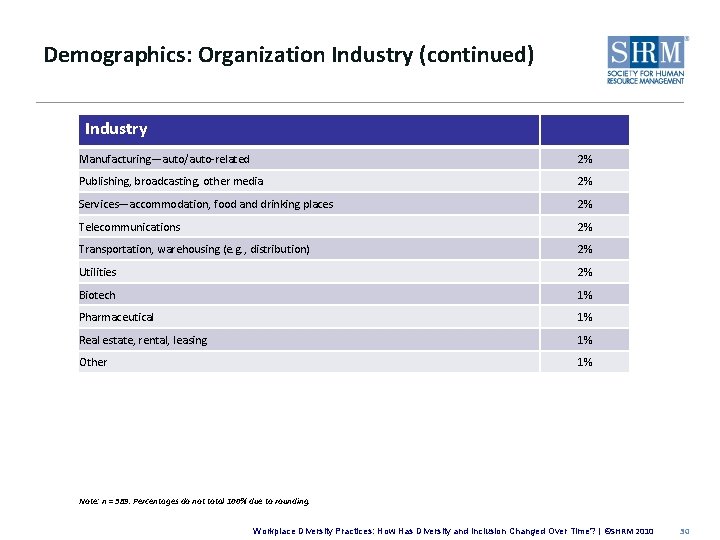
Demographics: Organization Industry (continued) Industry Manufacturing—auto/auto-related 2% Publishing, broadcasting, other media 2% Services—accommodation, food and drinking places 2% Telecommunications 2% Transportation, warehousing (e. g. , distribution) 2% Utilities 2% Biotech 1% Pharmaceutical 1% Real estate, rental, leasing 1% Other 1% Note: n = 389. Percentages do not total 100% due to rounding. Workplace Diversity Practices: How Has Diversity and Inclusion Changed Over Time? | ©SHRM 2010 30
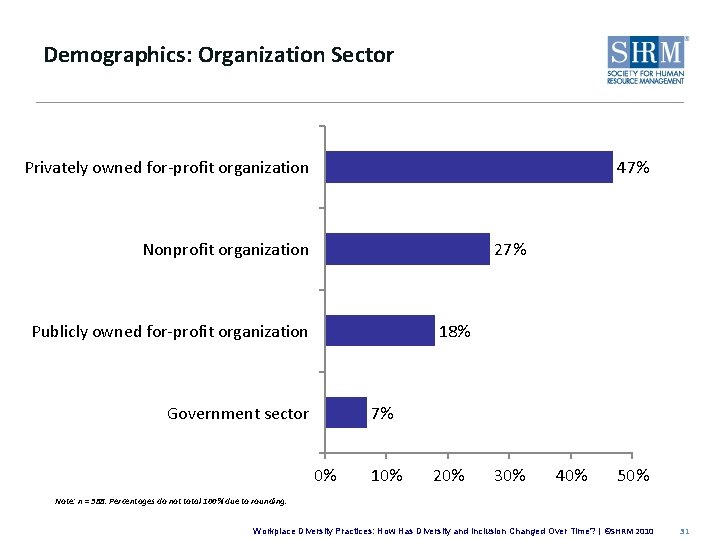
Demographics: Organization Sector Privately owned for-profit organization 47% Nonprofit organization 27% Publicly owned for-profit organization 18% Government sector 7% 0% 10% 20% 30% 40% 50% Note: n = 388. Percentages do not total 100% due to rounding. Workplace Diversity Practices: How Has Diversity and Inclusion Changed Over Time? | ©SHRM 2010 31
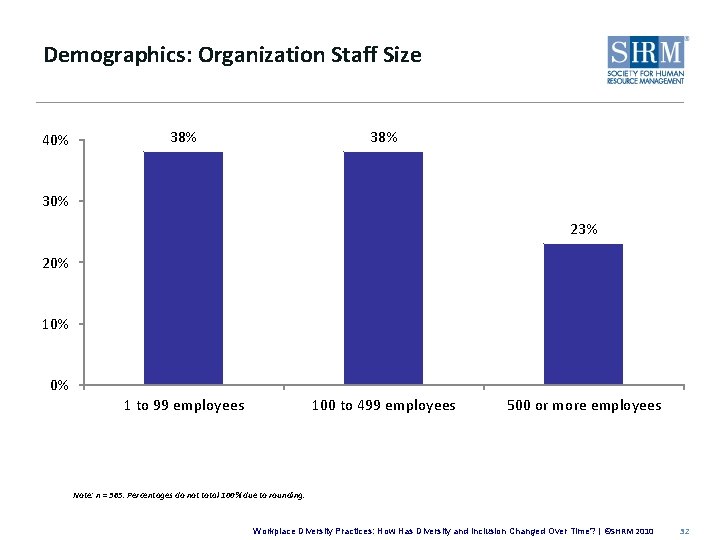
Demographics: Organization Staff Size 40% 38% 30% 23% 20% 10% 0% 1 to 99 employees 100 to 499 employees 500 or more employees Note: n = 365. Percentages do not total 100% due to rounding. Workplace Diversity Practices: How Has Diversity and Inclusion Changed Over Time? | ©SHRM 2010 32
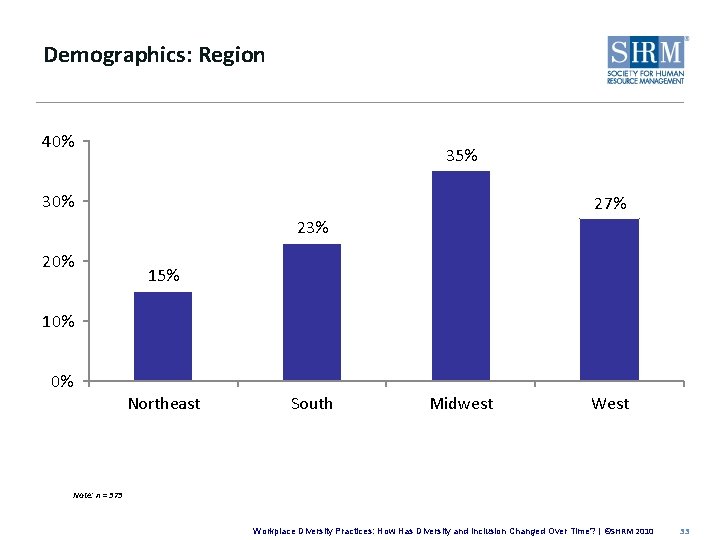
Demographics: Region 40% 35% 30% 27% 23% 20% 15% 10% 0% Northeast South Midwest West Note: n = 373 Workplace Diversity Practices: How Has Diversity and Inclusion Changed Over Time? | ©SHRM 2010 33
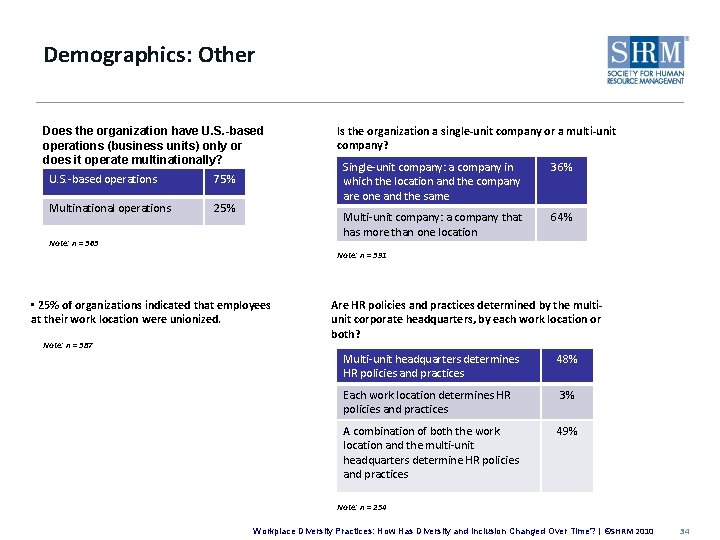
Demographics: Other Does the organization have U. S. -based operations (business units) only or does it operate multinationally? U. S. -based operations 75% Multinational operations 25% Note: n = 363 Is the organization a single-unit company or a multi-unit company? Single-unit company: a company in which the location and the company are one and the same 36% Multi-unit company: a company that has more than one location 64% Note: n = 391 • 25% of organizations indicated that employees at their work location were unionized. Note: n = 387 Are HR policies and practices determined by the multiunit corporate headquarters, by each work location or both? Multi-unit headquarters determines HR policies and practices 48% Each work location determines HR policies and practices 3% A combination of both the work location and the multi-unit headquarters determine HR policies and practices 49% Note: n = 254 Workplace Diversity Practices: How Has Diversity and Inclusion Changed Over Time? | ©SHRM 2010 34
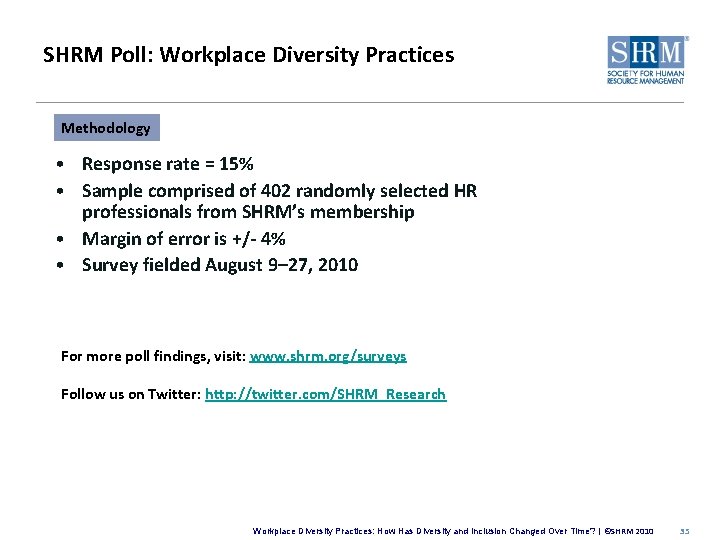
SHRM Poll: Workplace Diversity Practices Methodology • Response rate = 15% • Sample comprised of 402 randomly selected HR professionals from SHRM’s membership • Margin of error is +/- 4% • Survey fielded August 9– 27, 2010 For more poll findings, visit: www. shrm. org/surveys Follow us on Twitter: http: //twitter. com/SHRM_Research Workplace Diversity Practices: How Has Diversity and Inclusion Changed Over Time? | ©SHRM 2010 35