
Workplace communication TakeAway Points How do roles and









- Slides: 25
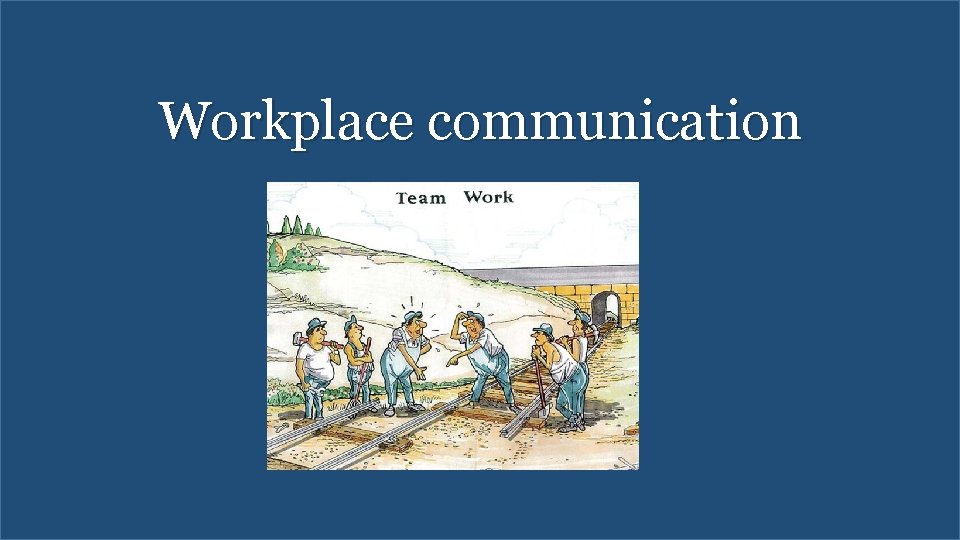
Workplace communication
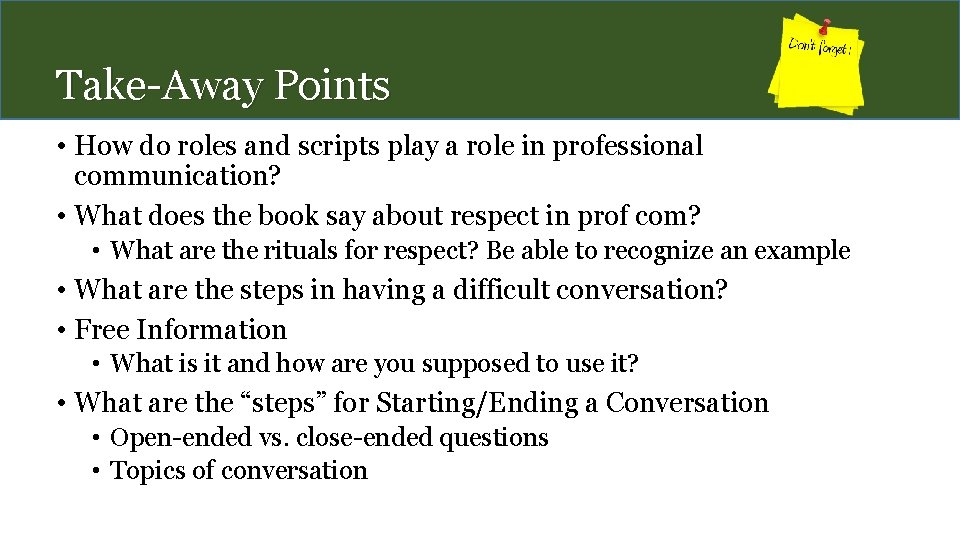
Take-Away Points • How do roles and scripts play a role in professional communication? • What does the book say about respect in prof com? • What are the rituals for respect? Be able to recognize an example • What are the steps in having a difficult conversation? • Free Information • What is it and how are you supposed to use it? • What are the “steps” for Starting/Ending a Conversation • Open-ended vs. close-ended questions • Topics of conversation
Interacting in the Public Realm • Why does the book use this title to describe professional/workplace relationships? 1. Enacting roles and scripts 2. Showing and deserving respect • Rituals • Avoidance • Presentational • Demeanor
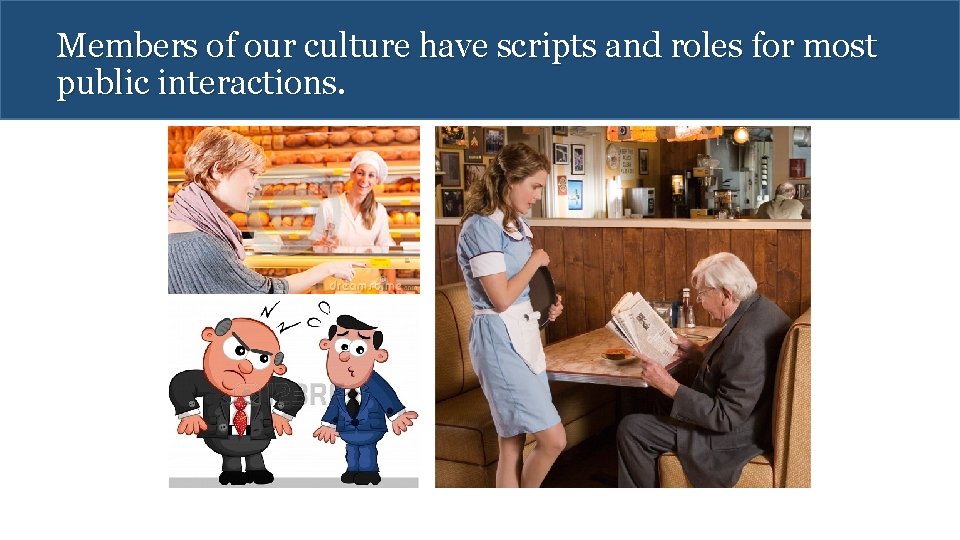
Members of our culture have scripts and roles for most public interactions.
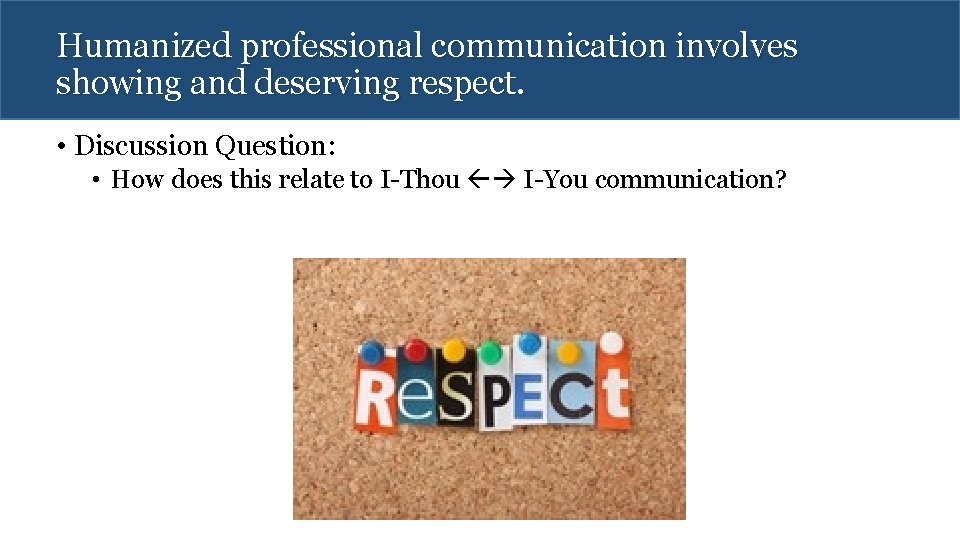
Humanized professional communication involves showing and deserving respect. • Discussion Question: • How does this relate to I-Thou I-You communication?
Types of Respect • Avoidance rituals: • Showing respect by keeping an appropriate physical and psychological distance • Presentational rituals: • Showing respect by including others • Demeanor: • The way we behave towards others
How to have a difficult conversation
How to Hold a Difficult Conversation • What types of difficult conversations do you have to have with people at work? • • Dressing inappropriately Personal hygiene Flirtatious behavior Obnoxious behavior
How to Hold a Difficult Conversation • You are responsible for giving them feedback • Primary goal: have them understand the problem • Secondary goal: not to ruin your relationship with them, damage their face, be professional
How to Hold a Difficult Conversation 1. Ask for permission to talk to them • Time/place of employees choosing • If you’re the boss, why ask for permission? 2. Use a soft entry • Give them time to mental prepare for an embarrassing conversation • Tell them you need to talk about something that may be embarrassing, that you’re uncomfortable with, etc
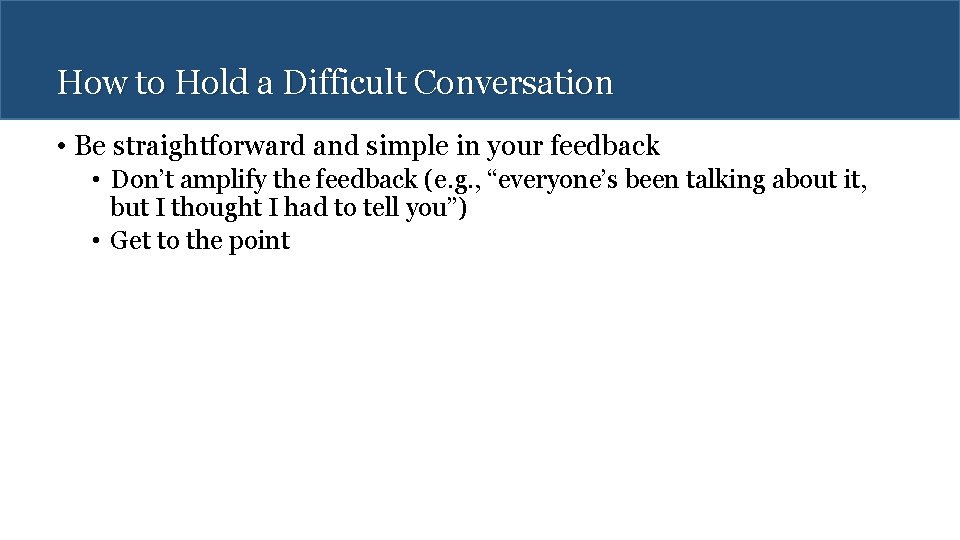
How to Hold a Difficult Conversation • Be straightforward and simple in your feedback • Don’t amplify the feedback (e. g. , “everyone’s been talking about it, but I thought I had to tell you”) • Get to the point
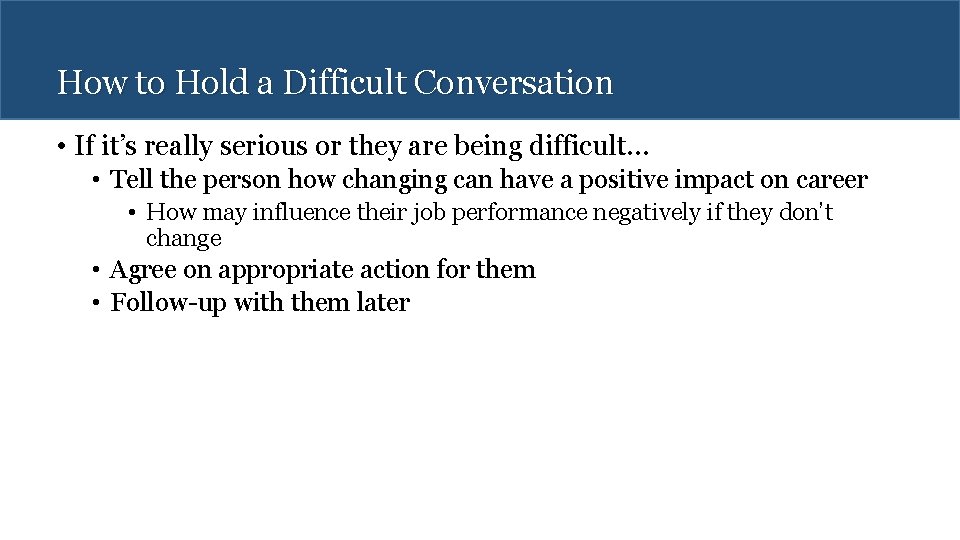
How to Hold a Difficult Conversation • If it’s really serious or they are being difficult… • Tell the person how changing can have a positive impact on career • How may influence their job performance negatively if they don’t change • Agree on appropriate action for them • Follow-up with them later
Skill Building: Small Talk
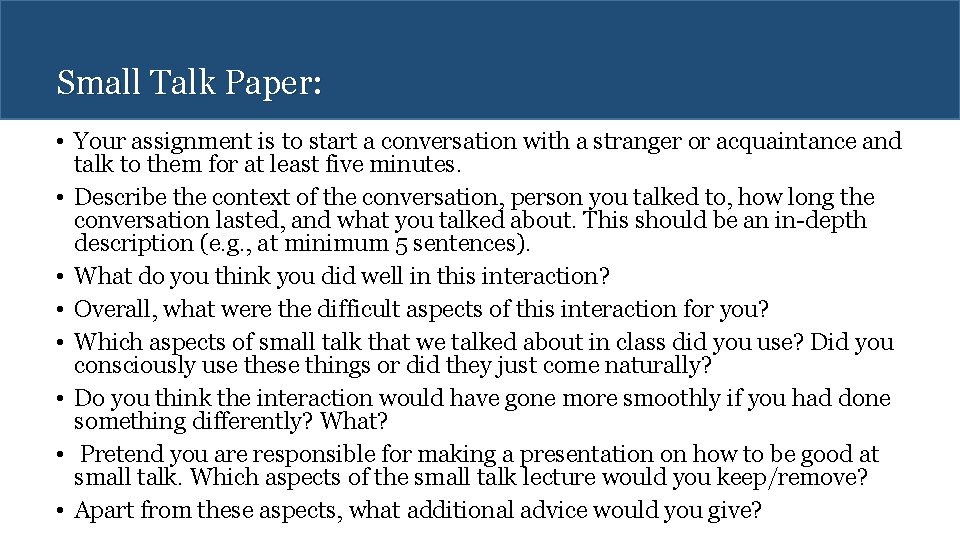
Small Talk Paper: • Your assignment is to start a conversation with a stranger or acquaintance and talk to them for at least five minutes. • Describe the context of the conversation, person you talked to, how long the conversation lasted, and what you talked about. This should be an in-depth description (e. g. , at minimum 5 sentences). • What do you think you did well in this interaction? • Overall, what were the difficult aspects of this interaction for you? • Which aspects of small talk that we talked about in class did you use? Did you consciously use these things or did they just come naturally? • Do you think the interaction would have gone more smoothly if you had done something differently? What? • Pretend you are responsible for making a presentation on how to be good at small talk. Which aspects of the small talk lecture would you keep/remove? • Apart from these aspects, what additional advice would you give?
How can small talk situations go wrong? Examples?
Why do we use small talk? • To flirt with someone • Business networking • Social settings • For entertainment • To meet new people • Because we feel obligated
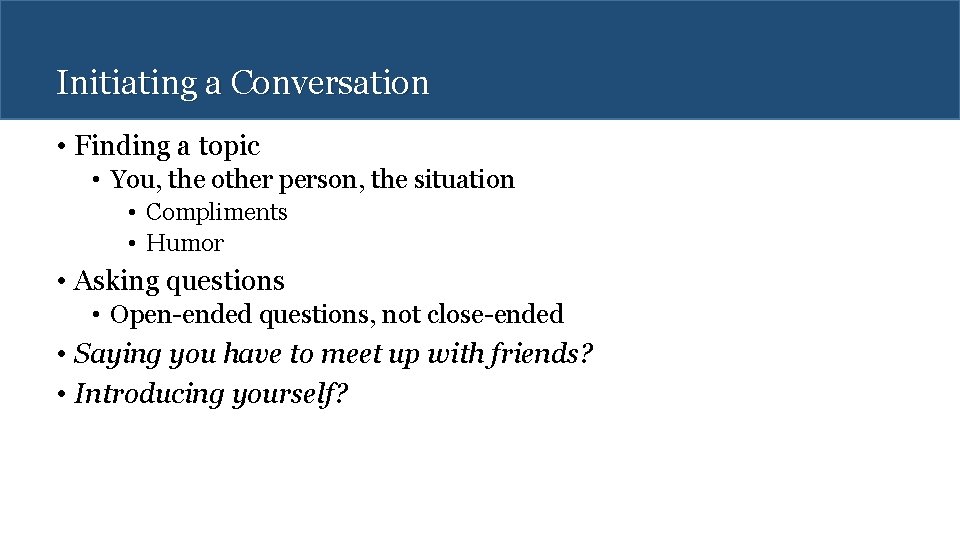
Initiating a Conversation • Finding a topic • You, the other person, the situation • Compliments • Humor • Asking questions • Open-ended questions, not close-ended • Saying you have to meet up with friends? • Introducing yourself?
Free Information • Extra information contained in a response that can suggest further topics of discussion • Jimmy-Bob: Hi. It’s really raining out today, isn’t it? • Sally-Lou: Yes. It never rains like this where I’m from.
Who should be offering/using free information?
Closing Conversation • Watch for nonverbals the conversation is winding down • Use body language to signal convo is ending • Leaving phrases • “It was great talking to you” • Apologize for keeping the person from something • Excuse to leave • Appreciation for the convo • Smile • Summarize main points of convo?
Bad Example • http: //www. youtube. com/watch? v=VU 90 Wb. Qya. Ug&feature=relat ed
Good Example • http: //www. youtube. com/watch? v=Ml. Lzs. Ufc 44 w
Class Networking Event! • Going to practice • Starting conversation • Using/giving free information • Ending conversation • You have 10 minutes • You must talk to at least three different people/groups during this time
Debriefing Questions • What were things that you found to be easy? Difficult? • How does free information work in small talk conversations? • How do you handle groups of people (rather than one-on-one conversations)?
Take-Away Points • How do roles and scripts play a role in professional communication? • What does the book say about respect in prof com? • What are the rituals for respect? Be able to recognize an example • What are the steps in having a difficult conversation? • Free Information • What is it and how are you supposed to use it? • What are the “steps” for Starting/Ending a Conversation • Open-ended vs. close-ended questions • Topics of conversation