
Workplace Bullying IS AN OCCUPATIONAL HEALTH AND SAFETY
Workplace Bullying IS AN OCCUPATIONAL HEALTH AND SAFETY ISSUE THAT SHOULD NOT BE TOLERATED. Written by Tony Vinckx, 2007
Workplace bullying is behaviour that is: l often repeated, unreasonable behaviour l by the employer, or one or more employees that humiliates, victimises, undermines or threatens another employee or employees, l and thereby creates a work related risk to personal health or safety. l
The following behaviour may be considered bullying: • verbal abuse, offensive language & inappropriate or insulting comments • excluding or isolating employees • underwork, and assigning meaningless tasks unrelated to the job • overwork, giving employees impossible assignments • undermining work performance, deliberately withholding information that is necessary for effective work performance, supplying incorrect information or inadequate training • deliberately changing work rosters to inconvenience particular employees
Types of Bullying Behaviour Continued: • constant intensive surveillance or monitoring • constant and unjustified criticism of a worker’s performance or abilities • imposing restrictive and petty work rules • ‘bad-mouthing’ • unreasonable administrative sanctions, such as undue delay in processing applications for training, leave or payment of wages • giving workers no say about how the job is done • open or implied threats of sack or disciplinary action
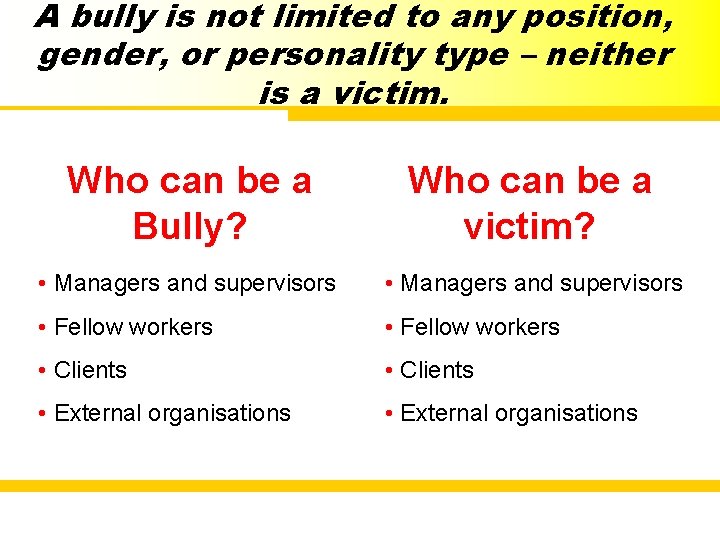
A bully is not limited to any position, gender, or personality type – neither is a victim. Who can be a Bully? Who can be a victim? • Managers and supervisors • Fellow workers • Clients • External organisations
The effects of Bullying Intimidation, victimisation, and bullying are a form of workplace violence that can have serious health consequences. It can cause a range of symptoms, including: • Headaches, back or neck problems • Poor memory or reduced concentration • Difficulty sleeping and fatigue • Skin rashes • Loss of confidence • Tearfulness • Gastrointestinal problems • Nausea
At worst, bullying can cause stress related illnesses, depression, panic attacks and anxiety disorders, suicidal thoughts, heart disease and high blood pressure.
The effect on the workplace: Workplace bullying can have harmful effects on the organisation in which it takes place, including: • reduced efficiency productivity and profitability • increased absenteeism, sick leave and staff turnover adverse publicity and poor public image • poor morale, erosion of worker loyalty and commitment • costs associated with counselling, employee assistance, mediation, workers’ compensation claims, management time and recruitment and training of new staff • costs resulting from failure to meet legislative provisions, civil action and criminal action.
It’s illegal! Employers have an obligation under workplace health and safety legislation to ensure the health and safety of all workers. Workplace bullying may harm the health and safety of workers, therefore your employer’s obligations extend to ensuring that workplace bullying is prevented or stopped. Employers also have a common law duty of care to their employees. Where workplace bullying involves acts such as sexual harassment or discrimination, employers may also be liable under anti-discrimination legislation.
Studies! • 1997/1998 Work. Cover NSW - costs of violence-related injuries in NSW in excess of $13 million (estimate). • 1998: Morgan poll find that 46% of employees had been verbally abused or physically assaulted by a co-worker or manager. • 2001/2002 Workcover VIC reports workplace bullying claims exceed $57 million. • 2003: Victorian Survey finds that 14% had experienced bullying at work in the preceding 6 months. Of those who reported they had been bullied, 71% had been bullied by a manager. • 2004: National Study finds Bullying costs Australian Business $6 to $13 billion a year (estimated). Includes indirect costs, such as absenteeism, labour, turnover, productivity loss & legal costs. • 2004: Griffith University finds 3. 5 per cent of the working population is bullied, and the average cost of serious bullying is $20, 000 per employee. • 2007: Commonwealth - Bullying and harassment make up about 20% of all mental stress workers’ comp claims.
Why does it happen? Workplace bullying is not a new problem – however it may be argued that the problem is more prevalent now because of the increasing pressure due to cutbacks on staff and resourcing, heavy workloads and impossible deadlines. A workplace culture of bullying, poor peoplemanagement practices and skills and the impact of organisational change are other factors that also contribute to the incidence of workplace bullying.
Occupational Health and Safety Legislation A. C. T. Act, 1989 Amended 5 August 2004 • The legislation imposes a general Duty of Care on employers. It also imposes specific duties on employers to safeguard the health and safety of their employees and others, and on employees to safeguard their own safety and the safety of others (ACT Sects 37, 40);
Duties of Employers in relation to employees ACT section 37 (1). • An employer must take all reasonably practicable steps to protect the health and safety and welfare at work of the employer’s employees
Duties of Employees ACT section 40. • An employee must at ALL times while at work take all reasonably practicable steps to ensure that they do not: – Take any action or – Make any omission that creates a risk or increases an existing risk to the health and safety of the employee or others at or near the workplace.
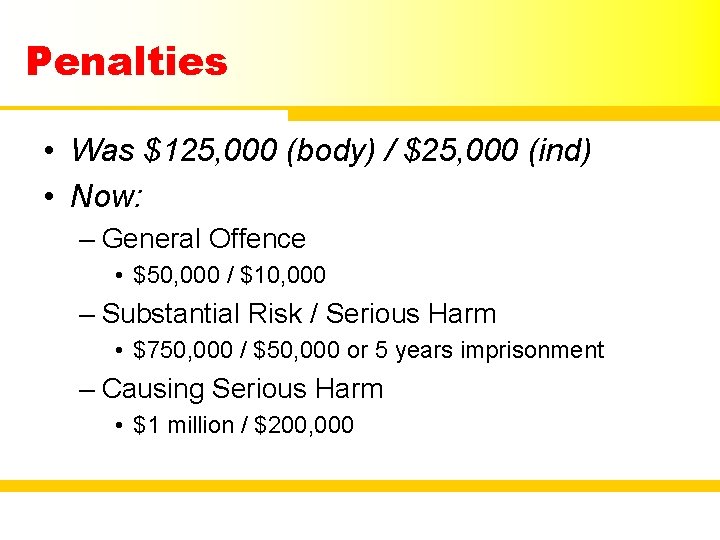
Penalties • Was $125, 000 (body) / $25, 000 (ind) • Now: – General Offence • $50, 000 / $10, 000 – Substantial Risk / Serious Harm • $750, 000 / $50, 000 or 5 years imprisonment – Causing Serious Harm • $1 million / $200, 000
DO NOT ACCEPT EXCUSES! These are unacceptable answers: • “We need strong, robust management to get things done” • “It’s just a personality clash” • “Everyone has their own interpersonal style” • “But they do that to everyone!”
What can be done for the individual? : There is no one-size-fits-all solution to workplace bullying. Here are some suggestions that may apply to your situation: Write Everything Down Bullying can be difficult to define and prove. It is vital to keep a written record of events & behaviours that you find intimidating, humiliating, undermining, victimising or threatening. A diary may help the victim realise the extent of the bullying & assist them identify occasions when they are most at risk.
What can be done for the individual? : Involve / Support Staff often know what should be done to solve the situation – ask them. If the victim hasn’t got a solution – give them options, but keep it simple: Have they talked to their manager, workmates, HSR, HR, Union, family, doctor, etc? Never go alone Never go into a meeting alone. Always insist that minutes be taken and a third person is present at any meeting.
What can be done for the individual? : Approach the bully • Be aware that in some bullying cases a Victim may feel too intimidated to attempt this… Some bullies (depending on the type) do not realise the effect of their behaviour. Sometimes, telling them you object to their behaviour and ask them to stop, this may solve the problem. • If the person being bullied does not feel comfortable approaching the bully yourself, ask someone else, such as a contact officer or supervisor, to approach the bully on your behalf; or to mediate or facilitate face-to-face discussions to find an acceptable resolution.
What can be done for the individual? : Do Not Retaliate • Victims of Bullying should never retaliate, try to get even or become a bully themselves. Policies & Procedures in the Workplace • What are the policies and practices in your workplace or grievance procedures in your industrial award or employment agreement. Is there a code of conduct to establish the behaviour as unacceptable? Consult any bullying, harassment, anti-discrimination & code of conduct policies in your workplace. Make sure you have a clear understanding of your rights and responsibilities.
What can be done for the individual? : Consider grievance procedures – most workplaces will have grievance or complaints procedures by which concerns about bullying can be raised and addressed. These have varying degrees of effectives and you will need to carefully consider, and seek advice, about how this can help your situation. Also consult any bullying and harassment, anti-discrimination and code of conduct policies that apply to your workplace. Union Support - Your union also provides a support network, advice and representation that can be vital in dealing with workplace bullying. It has been proven that Union workplaces are safer workplaces!
What can be done in the workplace? : There is no one-size-fits-all solution to workplace bullying. Here are some suggestions that may apply to your situation: Find out information / options – A Victim might not realize their options so support and information from coworkers is essential. Contact Work. Cover / Comcare or your Union for anti-bullying information. These organisations can even provide you with simple surveys to help you collect information about bullying in your workplace. Perhaps there is a poster to put up in your workplace?
What can be done in the workplace? : Anti-Bullying Policy – Anti-bullying policies have been found to be one of the most effective anti-bullying tools in the workplace. Workplace Support – A workplace that communicates is a powerful force against bullying. Remember that a bully may often play workers off against each other, play ‘favorites’ or undermine those they see as threatening, so it’s important that you support each other.

Questions!

Thank you for your time.
- Slides: 25