
Working With Reverse Engineering Output for Benchmarking and

Working With Reverse Engineering Output for Benchmarking and Further Use David Cutting and Joost Noppen University of East Anglia david. cutting@uea. ac. uk, j. noppen@uea. ac. uk David Cutting; University of East Anglia, Norfolk, UK 1
Presentation Outline • Problem Statement • Benchmarking of Reverse Engineering • Working Further with Reverse Engineering Output for Analysis and Comparison • Next Steps David Cutting; University of East Anglia, Norfolk, UK 2
The Problem • Software grows organically • Links with documentation easily lost through uncontrolled change • Pressure for further change still present • Very difficult to perform change impact analysis if we don’t know what components relate to one another David Cutting; University of East Anglia, Norfolk, UK 3
Reverse Engineering • One of the main sources of information about software is the software itself • Reverse engineering offers a powerful tool for program comprehension • There a lot of reverse engineering tools but… David Cutting; University of East Anglia, Norfolk, UK 4
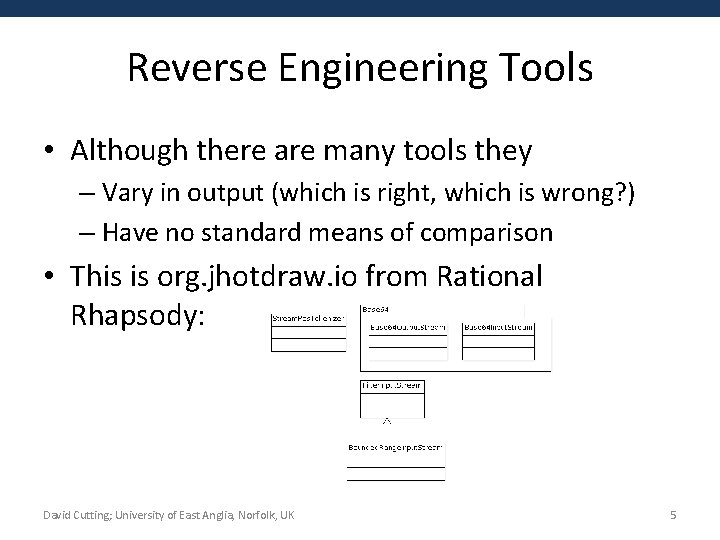
Reverse Engineering Tools • Although there are many tools they – Vary in output (which is right, which is wrong? ) – Have no standard means of comparison • This is org. jhotdraw. io from Rational Rhapsody: David Cutting; University of East Anglia, Norfolk, UK 5
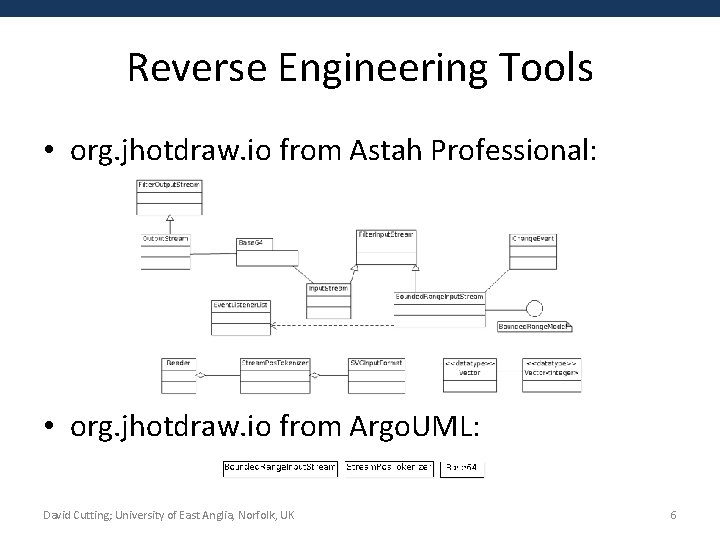
Reverse Engineering Tools • org. jhotdraw. io from Astah Professional: • org. jhotdraw. io from Argo. UML: David Cutting; University of East Anglia, Norfolk, UK 6
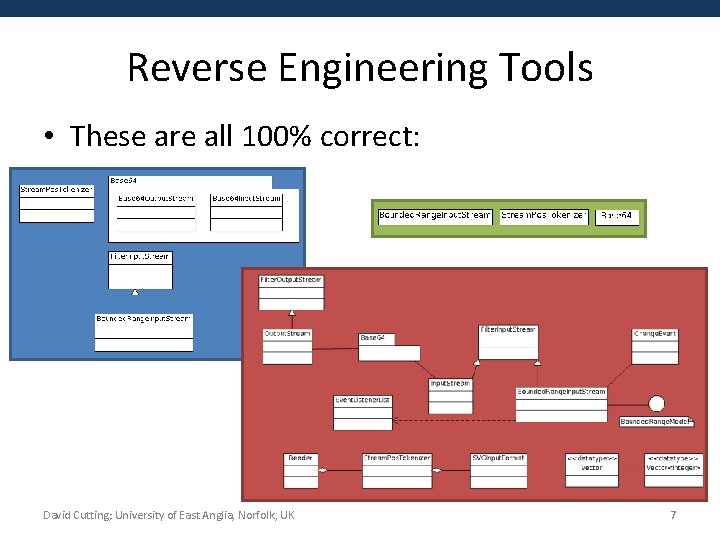
Reverse Engineering Tools • These are all 100% correct: David Cutting; University of East Anglia, Norfolk, UK 7
The Benchmark • To compare and rank different tools we created a benchmark (the Reverse Engineering to Design Benchmark: RED-BM) • 16 target artifacts – Varying from 100 to 40, 000 lines of code – From 7 to 450 classes – Range of architecture styles and complexity – “Gold standard” for each in terms of contained classes and sampled relationships David Cutting; University of East Anglia, Norfolk, UK 8
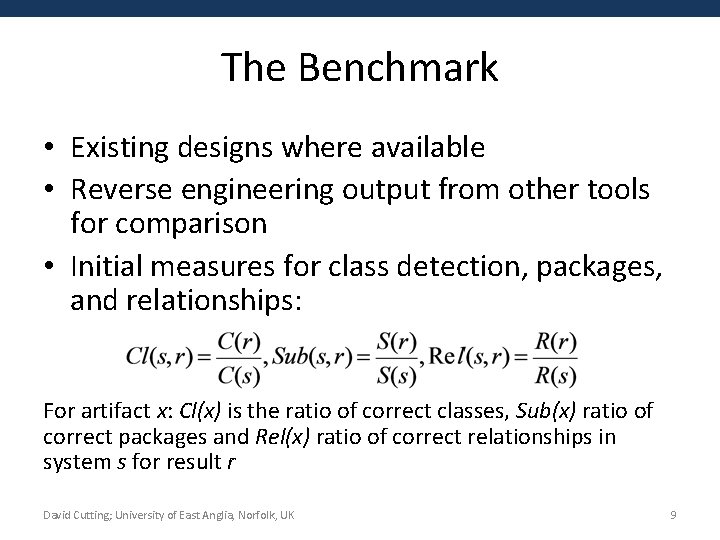
The Benchmark • Existing designs where available • Reverse engineering output from other tools for comparison • Initial measures for class detection, packages, and relationships: For artifact x: Cl(x) is the ratio of correct classes, Sub(x) ratio of correct packages and Rel(x) ratio of correct relationships in system s for result r David Cutting; University of East Anglia, Norfolk, UK 9
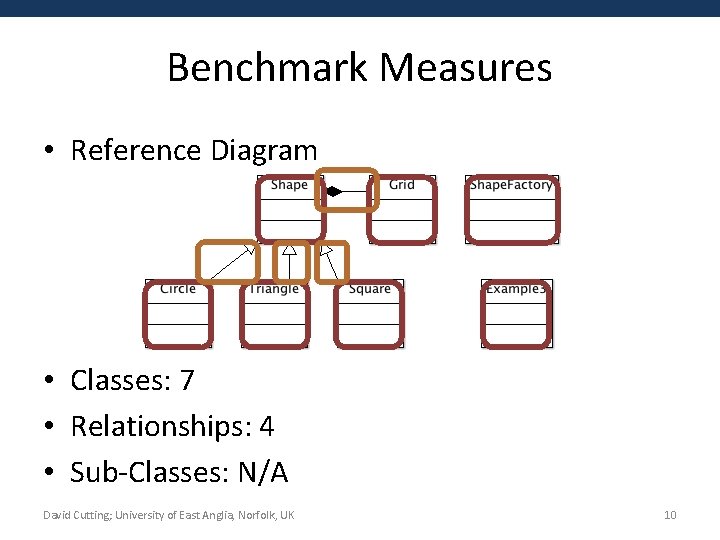
Benchmark Measures • Reference Diagram • Classes: 7 • Relationships: 4 • Sub-Classes: N/A David Cutting; University of East Anglia, Norfolk, UK 10
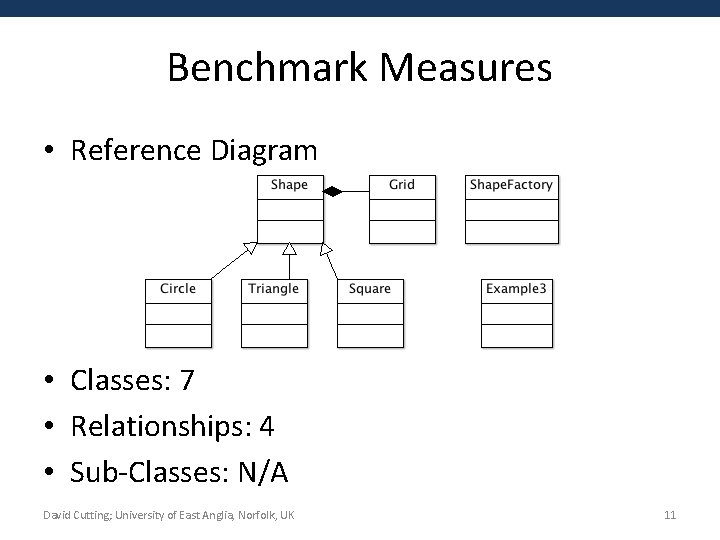
Benchmark Measures • Reference Diagram • Classes: 7 • Relationships: 4 • Sub-Classes: N/A David Cutting; University of East Anglia, Norfolk, UK 11

Benchmark Measures Measure Reference Classes 7 Relationships 4 David Cutting; University of East Anglia, Norfolk, UK 12
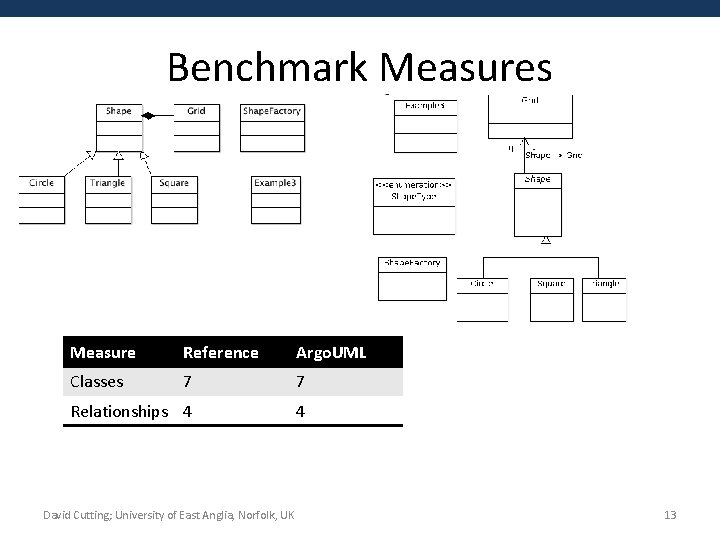
Benchmark Measures Measure Reference Argo. UML Classes 7 7 Relationships 4 4 David Cutting; University of East Anglia, Norfolk, UK 13
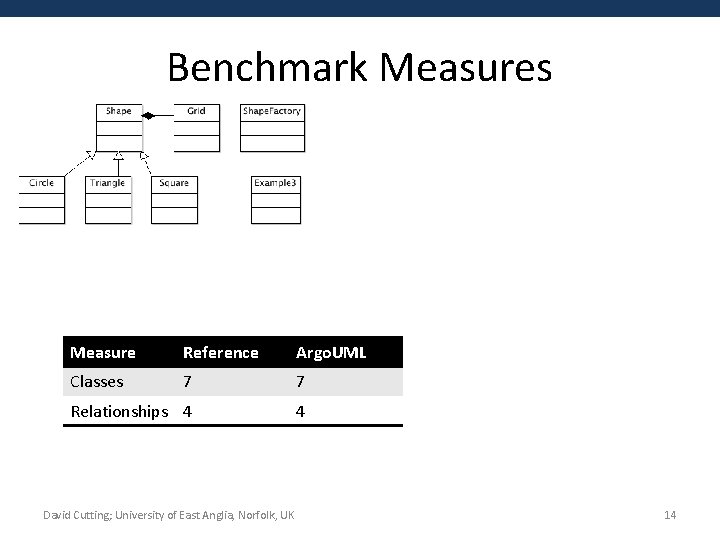
Benchmark Measures Measure Reference Argo. UML Classes 7 7 Relationships 4 4 David Cutting; University of East Anglia, Norfolk, UK 14
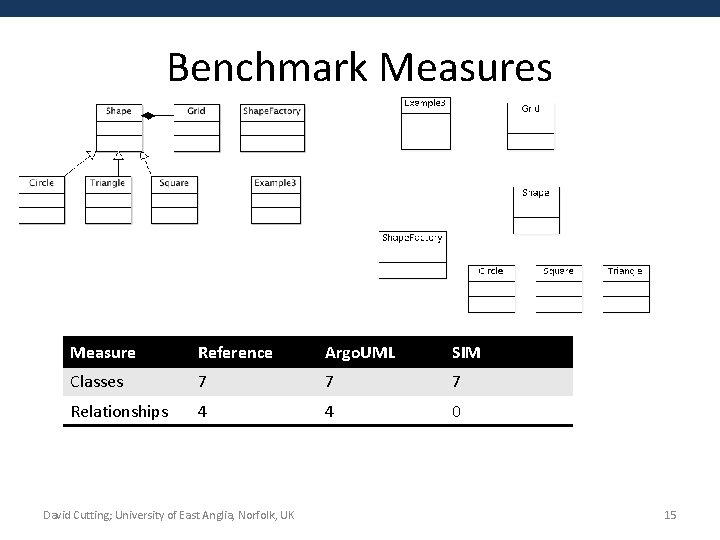
Benchmark Measures Measure Reference Argo. UML SIM Classes 7 7 7 Relationships 4 4 0 David Cutting; University of East Anglia, Norfolk, UK 15
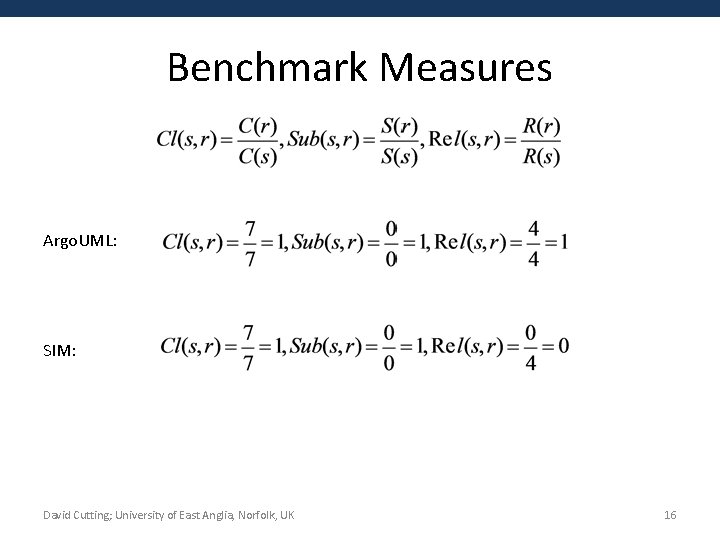
Benchmark Measures Argo. UML: SIM: David Cutting; University of East Anglia, Norfolk, UK 16
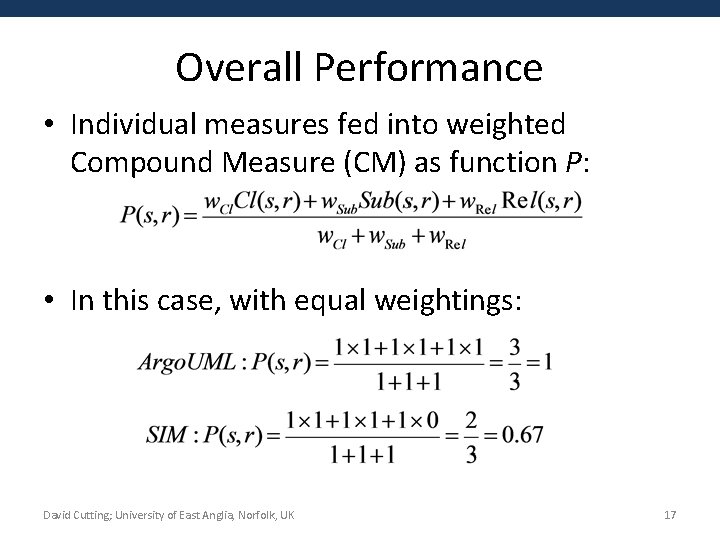
Overall Performance • Individual measures fed into weighted Compound Measure (CM) as function P: • In this case, with equal weightings: David Cutting; University of East Anglia, Norfolk, UK 17
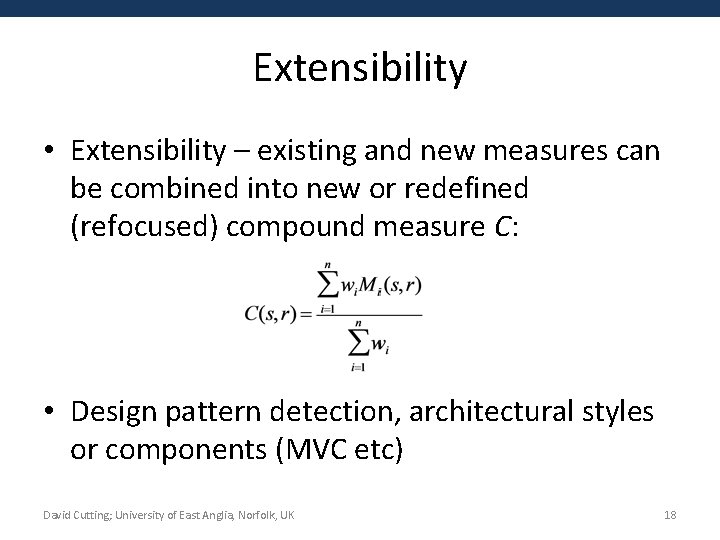
Extensibility • Extensibility – existing and new measures can be combined into new or redefined (refocused) compound measure C: • Design pattern detection, architectural styles or components (MVC etc) David Cutting; University of East Anglia, Norfolk, UK 18
Benchmark Analysis • We ran a 12 industry reverse engineering tools against the 16 target artifacts • We then compared output against our “Gold Standard” – Rather than doing this manually we used the XMI output from tools (more on this later) • What we found was quite surprising… David Cutting; University of East Anglia, Norfolk, UK 19
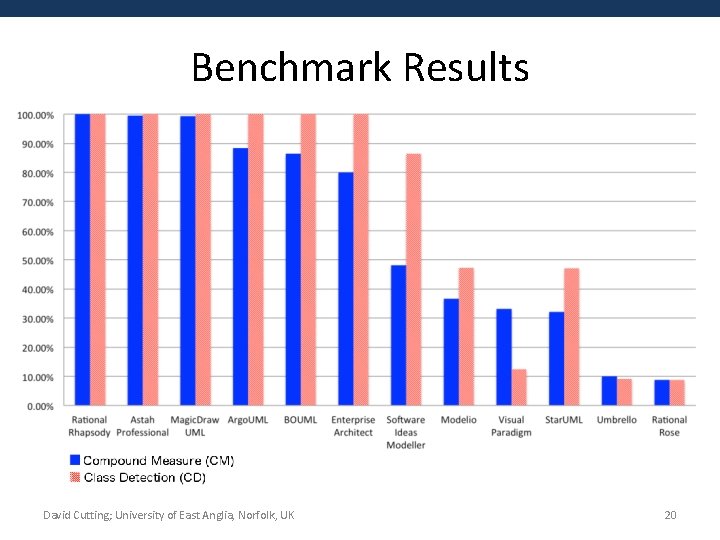
Benchmark Results David Cutting; University of East Anglia, Norfolk, UK 20
Key Findings • Wide variance in performance between tools (8. 8% to 100%) • RED-BM is effective at differentiating tool performance • You don’t always get what you pay for! David Cutting; University of East Anglia, Norfolk, UK 21
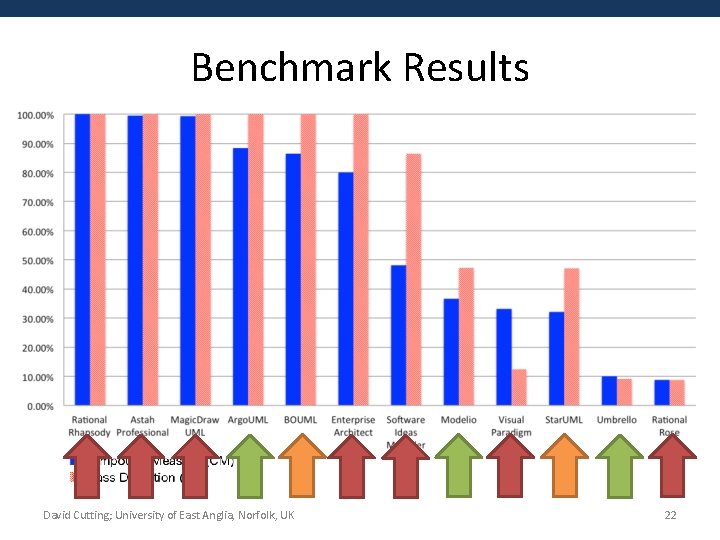
Benchmark Results David Cutting; University of East Anglia, Norfolk, UK 22
Working Further With Reverse Engineering Output • Benchmarking shows clear differences but we want to be able to use output from reverse engineering for further use – Aggregation of output (bringing together multiple imperfect outputs) – Combination with other sources of information – Making better use of the information than we can with generated diagrams David Cutting; University of East Anglia, Norfolk, UK 23
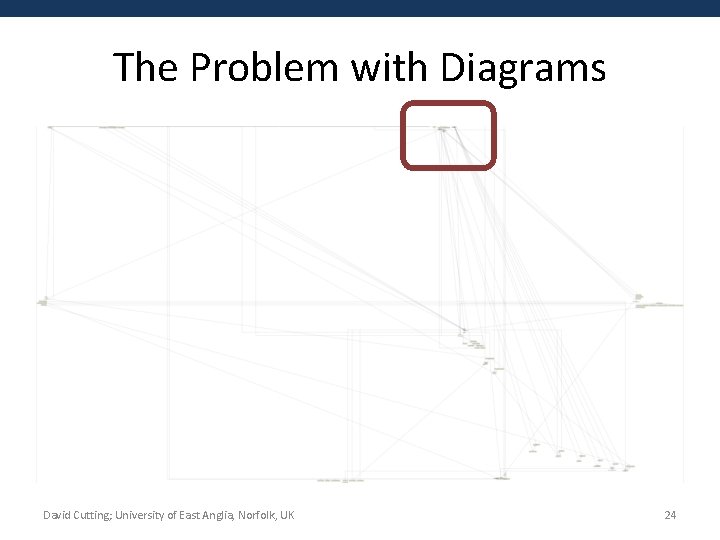
The Problem with Diagrams David Cutting; University of East Anglia, Norfolk, UK 24
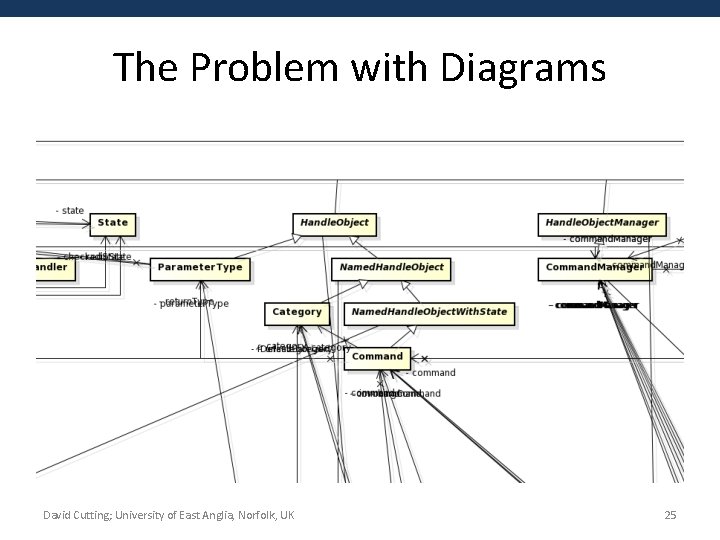
The Problem with Diagrams David Cutting; University of East Anglia, Norfolk, UK 25
XML Metadata Interchange (XMI) • XMI is an Object Management Group (OMG) Meta-Object Facility (MOF) for exchange of Unified Modeling Language (UML) – So XMI = OMG MOF UML (OMG is right!) • This is a standard but one offering extensibility on many levels • So effective interchange between tools is pretty much non-existent David Cutting; University of East Anglia, Norfolk, UK 26
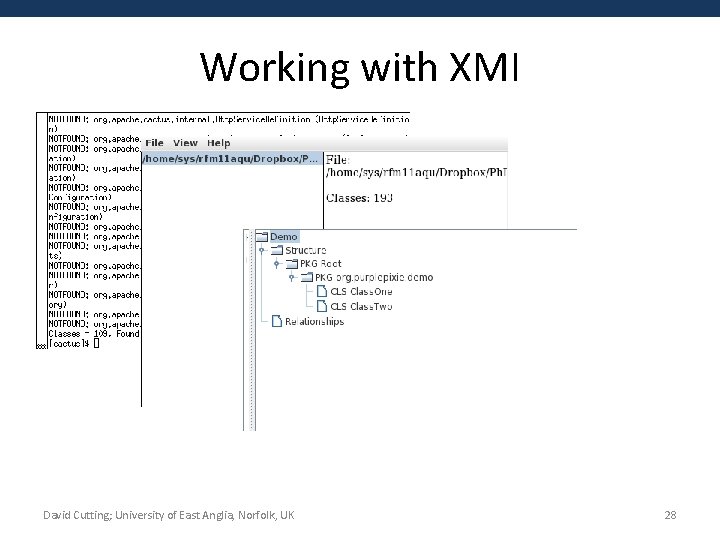
Working with XMI • To create the benchmark we wanted to be able to analyse XMI rather than counting classes by hand • This entailed the creation of a generic XMI class finder • In turn this work led to a generic XMI parser to load XMI models into a standard format in memory David Cutting; University of East Anglia, Norfolk, UK 27
Working with XMI David Cutting; University of East Anglia, Norfolk, UK 28
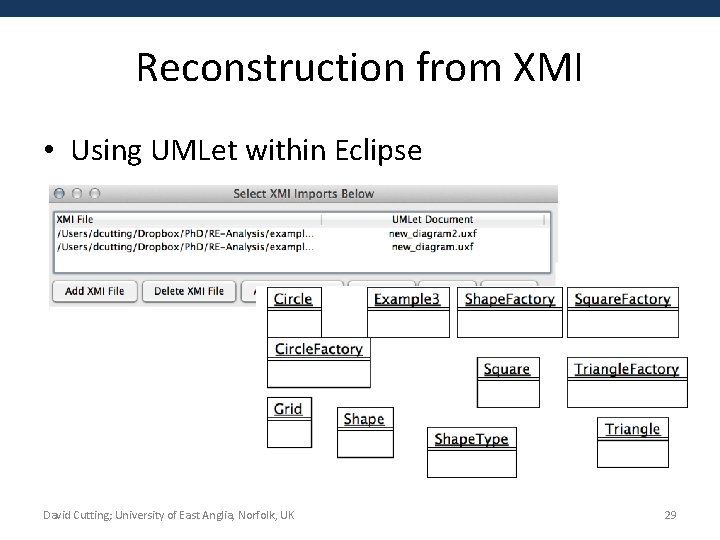
Reconstruction from XMI • Using UMLet within Eclipse David Cutting; University of East Anglia, Norfolk, UK 29
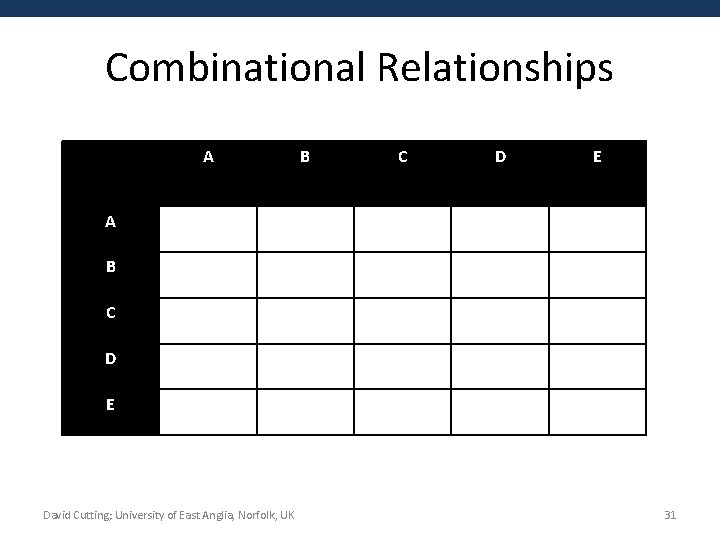
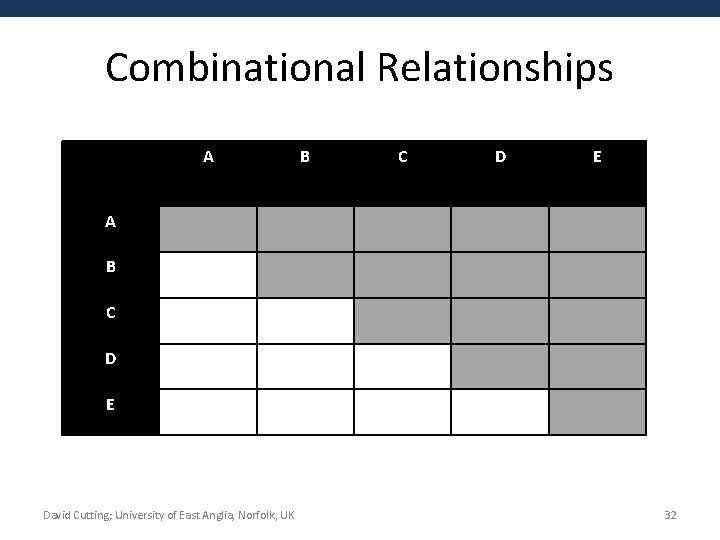
Combinational Relationships • In addition to other (cool) stuff we can do with reverse engineering output, we can build a relationship matrix • This is just a simple matrix showing all class pairings, and the count of relationships found between them David Cutting; University of East Anglia, Norfolk, UK 30
Combinational Relationships A B C D E David Cutting; University of East Anglia, Norfolk, UK 31
Combinational Relationships A B C D E David Cutting; University of East Anglia, Norfolk, UK 32
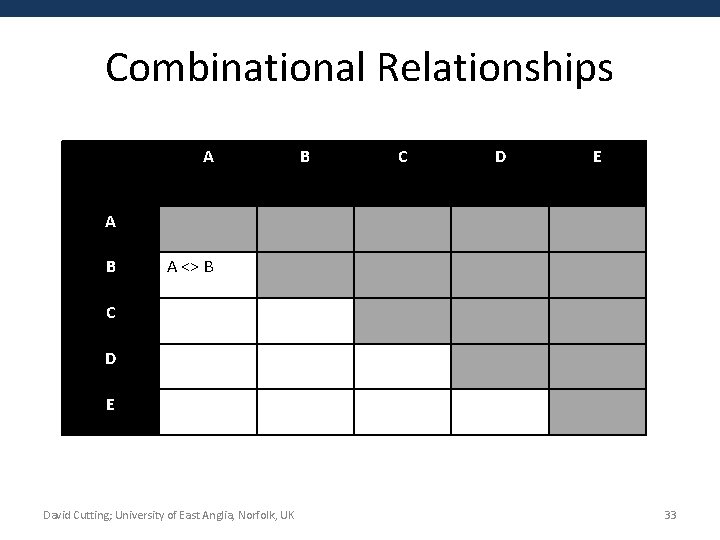
Combinational Relationships A B C D E A B A <> B C D E David Cutting; University of East Anglia, Norfolk, UK 33
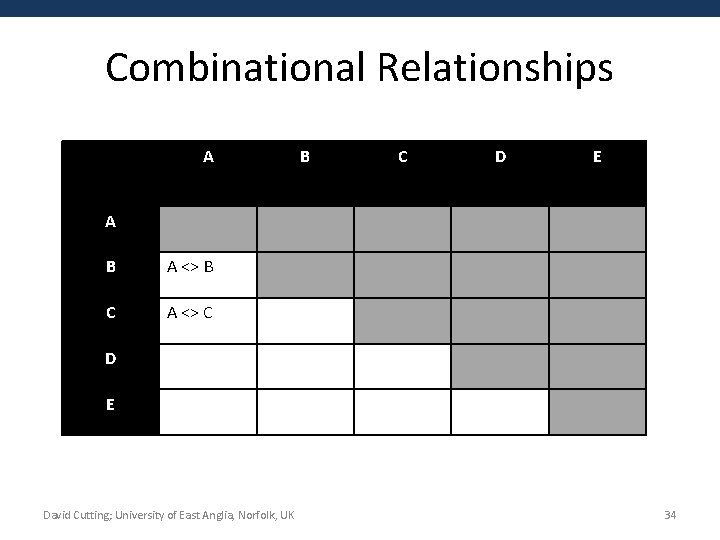
Combinational Relationships A B C D E A B A <> B C A <> C D E David Cutting; University of East Anglia, Norfolk, UK 34
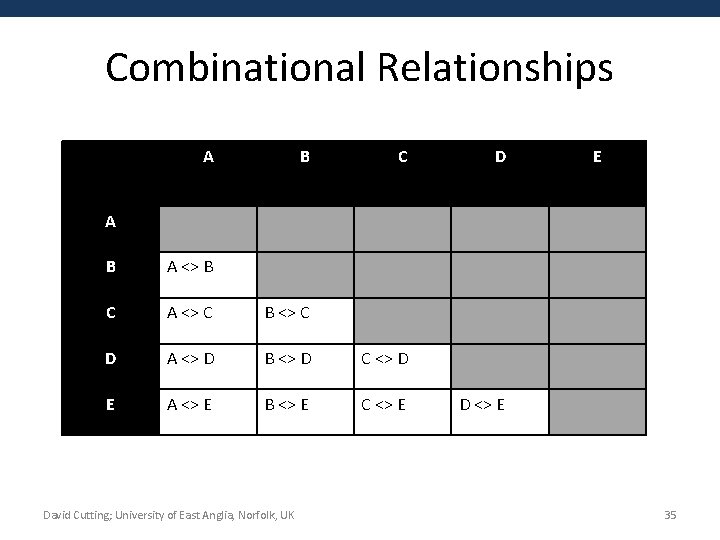
Combinational Relationships A B C D E A B A <> B C A <> C B <> C D A <> D B <> D C <> D E A <> E B <> E C <> E David Cutting; University of East Anglia, Norfolk, UK D <> E 35
Relationship Matrix • Simple representation of shared relationships • Can be generated from multiple different sources and is lowest common denominator • Many other possible sources of information of this type… David Cutting; University of East Anglia, Norfolk, UK 36
Relationship Matrices… • Not limited to just object pairings – any pairings of components – Requirements and Classes – Documents and Requirements –… • As long as a compatible “view” can be easily used in combination with each other David Cutting; University of East Anglia, Norfolk, UK 37
Next Steps • • Refine matrix modeler Analysis of larger and real-world software Improve XMI parser utility More information sources – Documentation / Natural Language / Repositories – Stack traces / call stacks • How can we bring this together? • How we can set filters/thresholds sensibly? David Cutting; University of East Anglia, Norfolk, UK 38
Thank You Any questions? Feel free to email: david. cutting@uea. ac. uk David Cutting; University of East Anglia, Norfolk, UK 39
- Slides: 39