
Working with People with Complex Communication Needs Tracy
- Slides: 22
Working with People with Complex Communication Needs Tracy Rackensperger Public Service Faculty University of Georgia Institute on Human Development and Disability June 10, 2020
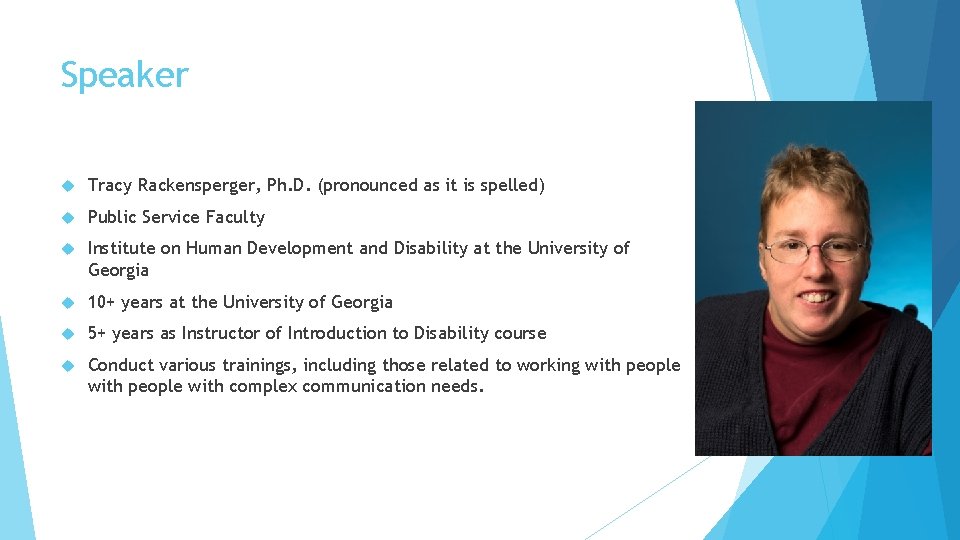
Speaker Tracy Rackensperger, Ph. D. (pronounced as it is spelled) Public Service Faculty Institute on Human Development and Disability at the University of Georgia 10+ years at the University of Georgia 5+ years as Instructor of Introduction to Disability course Conduct various trainings, including those related to working with people with complex communication needs.
Session overview This session provides information about the best ways to interact with and accommodate people with complex communication needs. It additionally covers some challenges this population faces in working with agencies or organizations. This session will be presented by someone who has lived experience as a person with complex communication needs and has professional experience working with the same population.
Session objectives Identify the importance of knowing who people with complex communication needs are and working with them Understand at least three methods for communicating with people with complex communication needs Learn at least two ways to avoid pitfalls when communicating with people with complex communication needs
Who has complex communication needs? People who experience: Difficulty expressing themselves verbally, due to a variety of communicative disorders Anxiety in socially interacting with others, causing difficulty with the communication process Difficulty with comprehending what is being relayed to them
Difficulty expressing themselves verbally, due to a variety of communicative disorders People can experience difficulty expressing themselves verbally, due to a variety of communicative disorders. A communication disorder is “an impairment in the ability to receive, send, process, and comprehend concepts or verbal, nonverbal and graphic symbol systems. ” 1 Some disabilities causing communicative disorders are: hearing loss and deafness, voice issues such as dysphonia or those caused by cleft lip or palate, speech issues like stuttering, and a variety of developmental disabilities such as cerebral palsy. 1 American Speech-Language Hearing Association (2020). Definitions of Communication Disorders and Variations: Ad Hoc Committee on Service Delivery in the Schools. Available: https: //www. asha. org/policy/RP 1993 -00208/
Anxiety in socially interacting with others, causing difficulty with the communication process People can experience anxiety in socially interacting with others, causing difficulty with the communication process. People with Autism Spectrum Disorders (ASDs) may have difficulty with the communication process. They may have significant social, communication, and behavioral difficulties with the communication process. They may experience anxiety and/or have difficulty interpreting social and non-verbal cues in the communication process. People experiencing mental health issues, such as social anxiety disorder, may have difficulty with the communication process. They may attempt to avoid direct interactions with others.
Difficulty with comprehending what is being relayed People can experience difficulty with comprehending what is being relayed to them. Due to intellectual, social, or processing disabilities, people may have difficulty understanding or interpreting information in the intended manner.
Importance of knowing who people with complex communication needs are and working with them Upwards of eight million people in the United States experience some form of language impairment. 2 There an estimated two million people in the United States who rely on alternative methods to communicate. 3 People with complex communication needs are your neighbors, family, friends, co-workers, tenants, consumers of goods, clients of services, etc. 2 National Institute on Deafness and Other Communication Disorders (2016). Statistics on Voice, Speech, and Language. Available: https: //www. nidcd. nih. gov/health/statistics-voicespeech-and-language 3 American Speech-Language Hearing Association (2020). Augmentative and Alternative Communication (AAC). Available: https: //www. asha. org/NJC/AAC
Methods for communicating with people with complex communication needs There are many ways to support people with complex communication needs Be patient with the communication process Respect the methods in which people choose to communicate Offer a wide array of ways people can communicate Learn about new technologies available for interaction Focus on peoples' abilities Ask people how to support them Provide reasonable accommodations to policies, procedures, and practices
Be patient with the communication process People may be difficult to understand – they may have to repeat themselves several times. They may need alternatives ways to communicate. People may not want to communicate face-to-face – they may seek alternatives ways to communicate. People may not understand what you are saying – they may have to have you repeat or restate things several times.
Respect the methods in which people choose to communicate People may not use the most “efficient” ways to communicate – offer suggestions about how to communicate better, but don’t force them to use certain techniques. People may choose to communicate over a period of time, rather than one brief conversation. People may need multiple ways to process information.
Offer a wide array of ways people can communicate People tend to use multiple ways to communicate – be willing to offer a wide array of ways people can communicate. People may like using text, e-mail, and other forms of asynchronous communication – be prepared to communicate over an extended period of time. People may need concrete or visual representations of what you are communicating.
Learn about new technologies available for interaction People may use augmentative and alternative communication (AAC) devices and techniques. AAC) refers to ways (other than speech) that are used to send a message from one person to another. 4 AAC is utilized by individuals whose speech is either difficult to understand or nonexistent. AAC methods can range from sign language to sophisticated voice-output devices. 4 American Speech-Language Hearing Association (2020). Augmentative and Alternative Communication (AAC). Available: https: //www. asha. org/NJC/AAC
Focus on peoples' abilities See people for what they can do. Don’t totally ignore challenges, but focus on abilities. Strengths-based approaches are opposites of deficit or readiness models. Deficit or readiness models focus on what people can’t do. These models often wrongly deny people access to education, employment, and community living opportunities.
Ask people how to support them Directly communicate with people about their needs Have a conversation Suggest ideas
Provide reasonable accommodations to policies, procedures, and practices Consider requests to provide reasonable accommodations to policies, procedures, and practices.
Common pitfalls made when working with people with complex communication needs These are common mistakes made working with people with complex communication needs Making assumptions about peoples' level of independence Assuming incompetence rather than competence Denying access to communication techniques that work for them
Making assumptions about peoples' level of independence When communicating with people… talk directly to them do not automatically inquire if someone is “with us” refrain from calling the police
Assuming incompetence rather than competence Difficulty communicating = intellectual disability = incompetence (intellectual disability is often wrongly associated with incompetence).
Denying access to communication techniques that work for them Forcing people to use communication techniques that don’t work for them.
Questions?