
Working WITH our kids Parenting through restorative relations


- Slides: 39
Working WITH our kids: Parenting through restorative relations NACE - December 7, 2015 @Owen_webb Owen Webb (BEd, MEd) Shalem Mental Health Network 1
Check-In • Who you are • Role with children • What you would like to take from tonight Owen Webb (BEd, MEd) Shalem Mental Health Network 2
Norms for being together (CCS Drayton) Ø We are stronger through collaboration—we are for the whole, not the self. Ø We give space and time for each voice to speak. Ø When I speak, it’s with honesty and courage. Ø We take time to celebrate (both successes and failures!) Ø We want passion and awe. Owen Webb (BEd, MEd) Shalem Mental Health Network 3
2 Corinthians 5: A Ministry of Reconciliation 16 So from now on we regard no one from a worldly point of view. Though we once regarded Christ in this way, we do so no longer. 17 Therefore, if anyone is in Christ, the new creation has come: The old has gone, the new is here! 18 All this is from God, who reconciled us to himself through Christ and gave us the ministry of reconciliation: Owen Webb (BEd, MEd) Shalem Mental Health Network 4
2 Corinthians 5: A Ministry of Reconciliation 19 that God was reconciling the world to himself in Christ, not counting people’s sins against them. And he has committed to us the message of reconciliation. 20 We are therefore Christ’s ambassadors, as though God were making his appeal through us. We implore you on Christ’s behalf: Be reconciled to God. 21 God made him who had no sin to be sin for us, so that in him we might become the righteousness of God. Owen Webb (BEd, MEd) Shalem Mental Health Network 5
Why do we parent like we parent? Why do we teach like we teach? - M. Thorsborne Our own experience Expectations/ dreams about what good parents do Expectations/ dreams about what good children/students do Our own temperament/ characteristics These blend together to shape how we act toward our children/ students Owen Webb (BEd, MEd) Shalem Mental Health Network 6
Discipline comes from the Latin discuplus Disculpus: To Teach Owen Webb (BEd, MEd) Shalem Mental Health Network 7
“Why do we feel like we need to make people feel worse to make them better? ” – Alfie Kohn Owen Webb (BEd, MEd) Shalem Mental Health Network 8
Working at our best Owen Webb (BEd, MEd) Shalem Mental Health Network 9
Our children do not differ from us Needs of our children for working at their best Needs of our children when they encounter ditches Qualities they admire in adults around them Owen Webb (BEd, MEd) Shalem Mental Health Network 10
What is restorative? • Making something into what it can be • Supporting individuals to be who they can be • Making relationships what they can be • “Know who you are and be it… not know who you aren’t and fix it” – Bob Perkins Owen Webb (BEd, MEd) Shalem Mental Health Network 11
Justice Perspectives • Adversarial approach: the more you punish the less likely they will do it again; • Restorative approach: the stronger the relationship the less likely we will act inappropriately towards each other (IIRP, 2000) Owen Webb (BEd, MEd) Shalem Mental Health Network 12
What is restorative justice? It is not: • A way to discipline • A way to control children • A code of conduct for children • A packaged program Owen Webb (BEd, MEd) Shalem Mental Health Network 13
What is restorative justice? It is a philosophy that: • Honours the worth of all regardless of who they are or what they do; • Recognizes the importance of community in individual lives; • Focuses on relationships instead of rules; • Believes healing of relationships is possible. Owen Webb (BEd, MEd) Shalem Mental Health Network 14
I and Thou The world is twofold for man in accordance with his twofold attitude. The attitude of man is twofold in accordance with the two basic words he can speak. The basic words are not single words but word pairs. One basic word is the word pair I-You (or I-Thou). The other basic word is the word pair I-It; but this basic word is not changed when He or She takes the place of It. Thus the I of man is also twofold. For the I of the basic word I-You is different from that in the basic I-It. Owen Webb (BEd, MEd) Shalem Mental Health Network 15
• RJ acknowledges justice as honouring the inherent worth of all and being enacted through relationship. When something occurs that undermines the well-being of some, a space is provided for dialogue whereby the dignity of all involved and affected can be restored so that each can once again become a fully contributing member of the community of which they are a part. (Dorothy Vaandering) Owen Webb (BEd, MEd) Shalem Mental Health Network 16
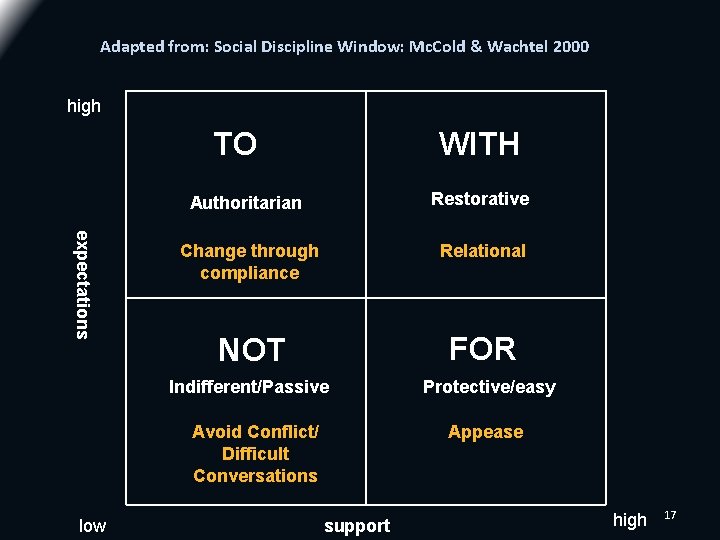
Adapted from: Social Discipline Window: Mc. Cold & Wachtel 2000 high TO WITH expectations Authoritarian Restorative Change through compliance Relational NOT FOR Indifferent/Passive Avoid Conflict/ Difficult Conversations low Protective/easy Appease support high 17
Treat children/ students like adults Treat children/students as worthy Owen Webb (BEd, MEd) Shalem Mental Health Network 18
The key question Are we seeking to change behaviour? (Compliance - External) Or Are we seeking to build relationships? (Compelled – Internal) Owen Webb (BEd, MEd) Shalem Mental Health Network 19
Healthy Relational Styles The way we engage one another needs to be based on the strengthening and building of relationships, not shutting them down. Owen Webb - Shalem Mental Health Network - August 2012
What message am I sending to my children? Am I measuring? Or… Am I honouring? Owen Webb (BEd, MEd) Shalem Mental Health Network 21
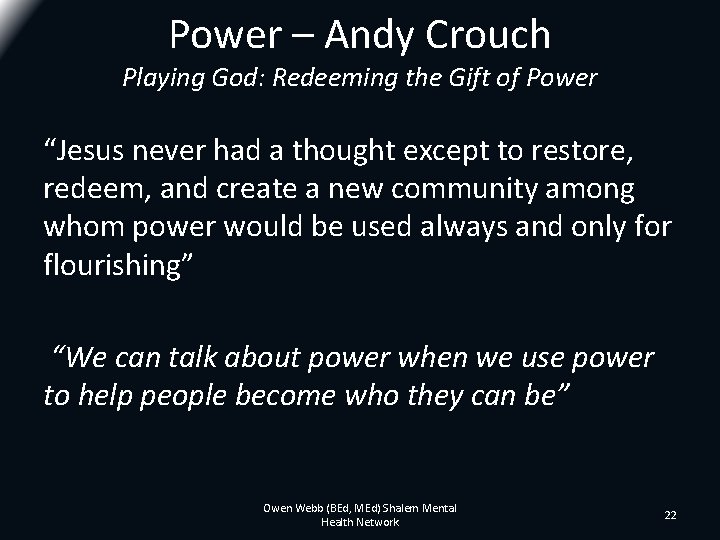
Power – Andy Crouch Playing God: Redeeming the Gift of Power “Jesus never had a thought except to restore, redeem, and create a new community among whom power would be used always and only for flourishing” “We can talk about power when we use power to help people become who they can be” Owen Webb (BEd, MEd) Shalem Mental Health Network 22
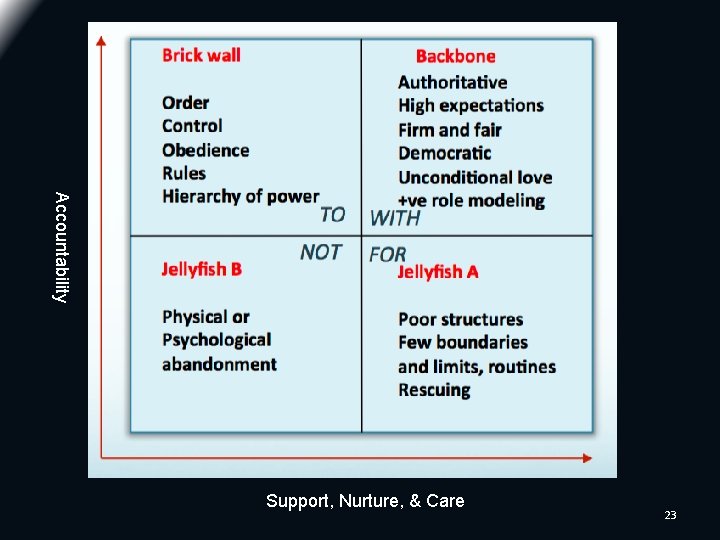
Accountability Support, Nurture, & Care 23
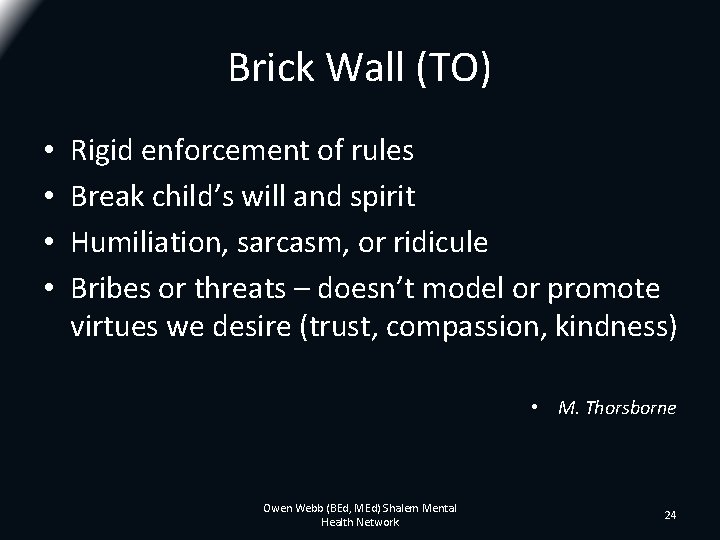
Brick Wall (TO) • • Rigid enforcement of rules Break child’s will and spirit Humiliation, sarcasm, or ridicule Bribes or threats – doesn’t model or promote virtues we desire (trust, compassion, kindness) • M. Thorsborne Owen Webb (BEd, MEd) Shalem Mental Health Network 24
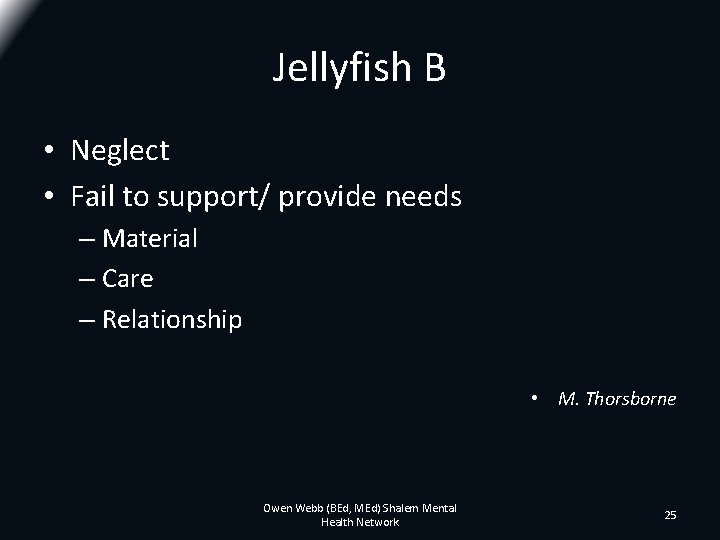
Jellyfish B • Neglect • Fail to support/ provide needs – Material – Care – Relationship • M. Thorsborne Owen Webb (BEd, MEd) Shalem Mental Health Network 25
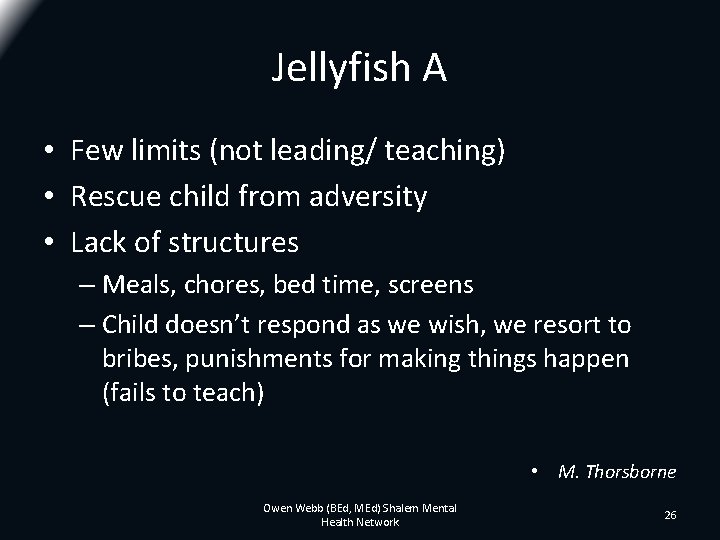
Jellyfish A • Few limits (not leading/ teaching) • Rescue child from adversity • Lack of structures – Meals, chores, bed time, screens – Child doesn’t respond as we wish, we resort to bribes, punishments for making things happen (fails to teach) • M. Thorsborne Owen Webb (BEd, MEd) Shalem Mental Health Network 26
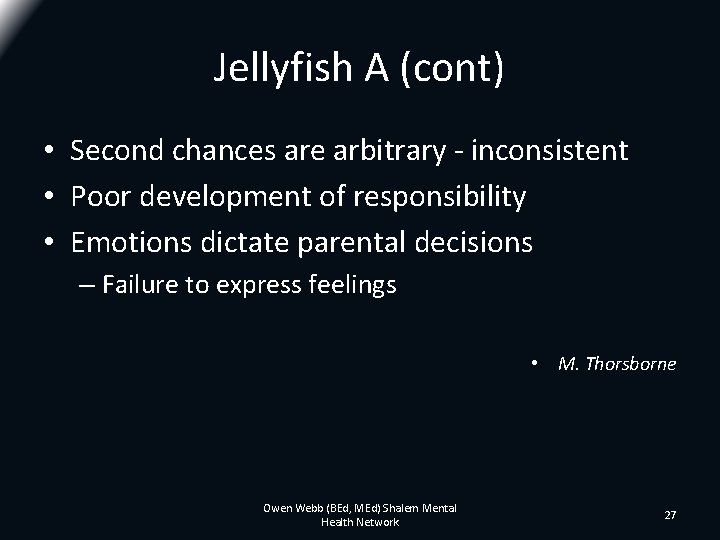
Jellyfish A (cont) • Second chances are arbitrary - inconsistent • Poor development of responsibility • Emotions dictate parental decisions – Failure to express feelings • M. Thorsborne Owen Webb (BEd, MEd) Shalem Mental Health Network 27
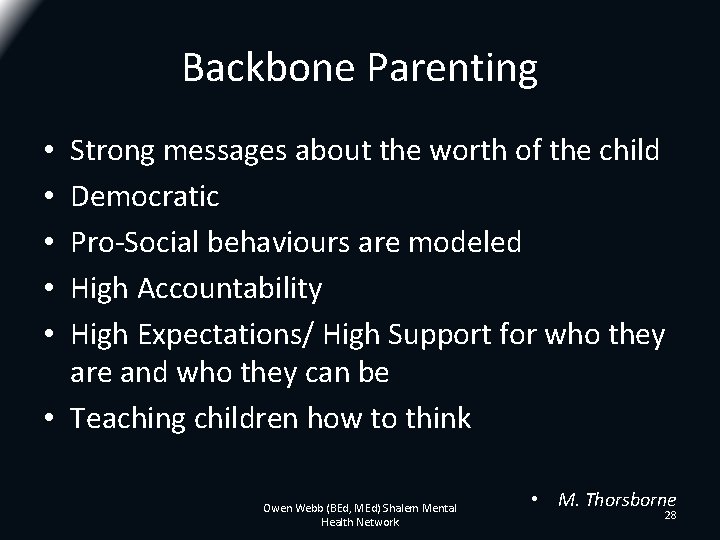
Backbone Parenting Strong messages about the worth of the child Democratic Pro-Social behaviours are modeled High Accountability High Expectations/ High Support for who they are and who they can be • Teaching children how to think • • • Owen Webb (BEd, MEd) Shalem Mental Health Network • M. Thorsborne 28
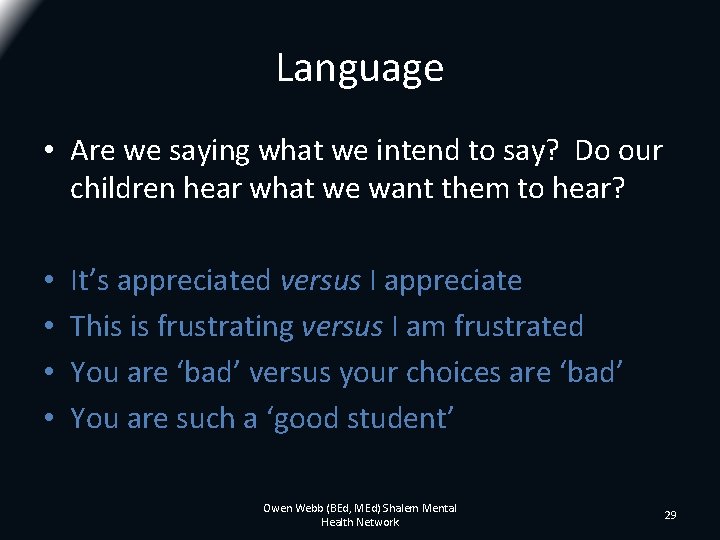
Language • Are we saying what we intend to say? Do our children hear what we want them to hear? • • It’s appreciated versus I appreciate This is frustrating versus I am frustrated You are ‘bad’ versus your choices are ‘bad’ You are such a ‘good student’ Owen Webb (BEd, MEd) Shalem Mental Health Network 29
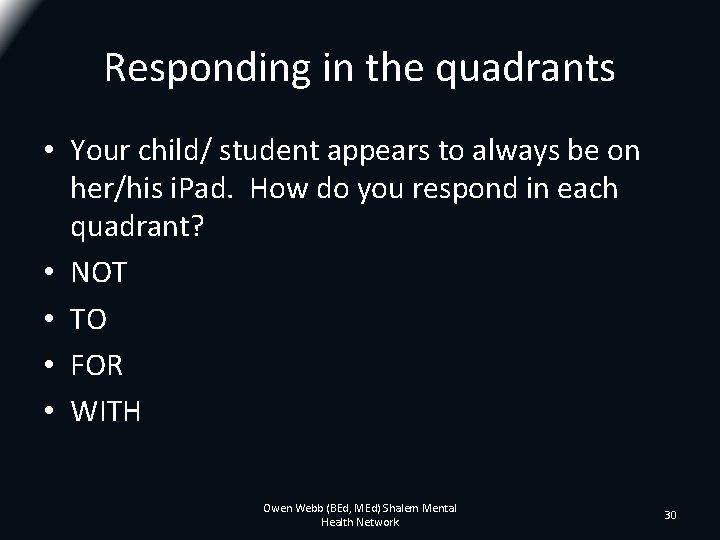
Responding in the quadrants • Your child/ student appears to always be on her/his i. Pad. How do you respond in each quadrant? • NOT • TO • FOR • WITH Owen Webb (BEd, MEd) Shalem Mental Health Network 30
Dialogue • We need to create opportunities for dialogue rather than negate them • Encourage stories – Do we allows children/ students to tell their stories – Do we tell our stories • When we don’t know stories, we make them up Owen Webb (BEd, MEd) Shalem Mental Health Network 31
Dialogue • • Invite into story We need to let people name things We need to be listeners It needs to be (and feel) safe Owen Webb (BEd, MEd) Shalem Mental Health Network 32
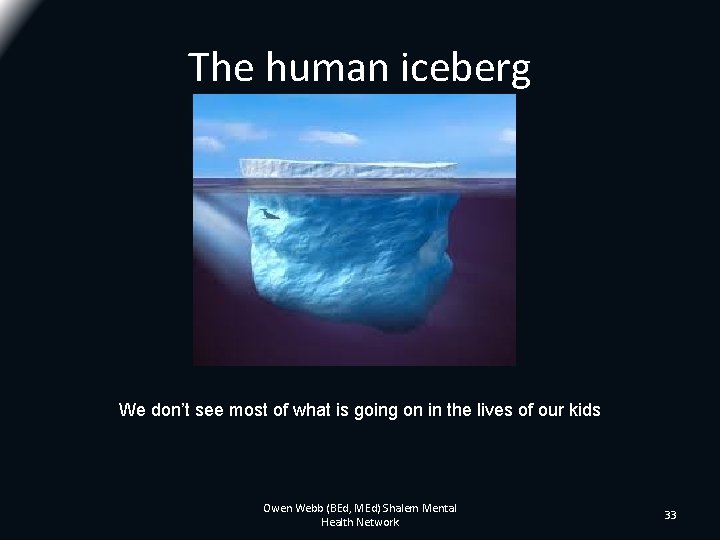
The human iceberg We don’t see most of what is going on in the lives of our kids Owen Webb (BEd, MEd) Shalem Mental Health Network 33
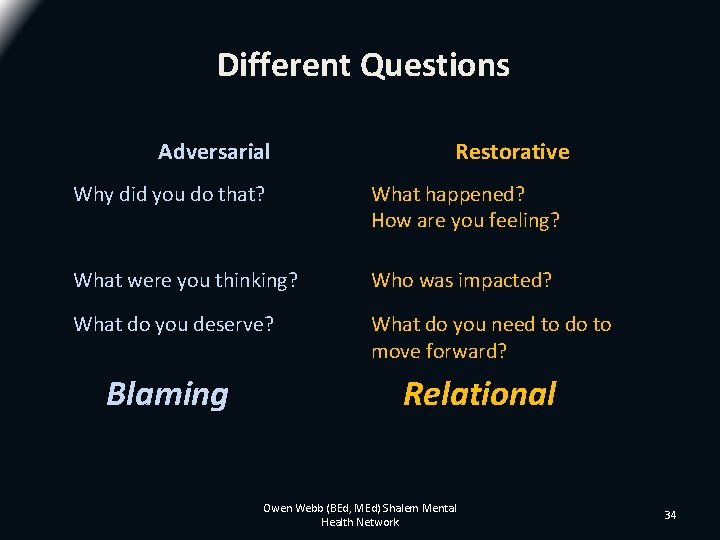
Different Questions Adversarial Restorative Why did you do that? What happened? How are you feeling? What were you thinking? Who was impacted? What do you deserve? What do you need to do to move forward? Blaming Relational Owen Webb (BEd, MEd) Shalem Mental Health Network 34
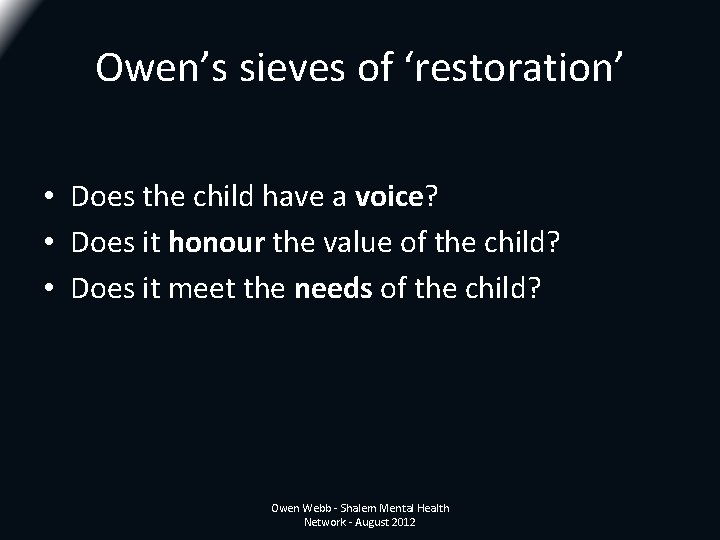
Owen’s sieves of ‘restoration’ • Does the child have a voice? • Does it honour the value of the child? • Does it meet the needs of the child? Owen Webb - Shalem Mental Health Network - August 2012
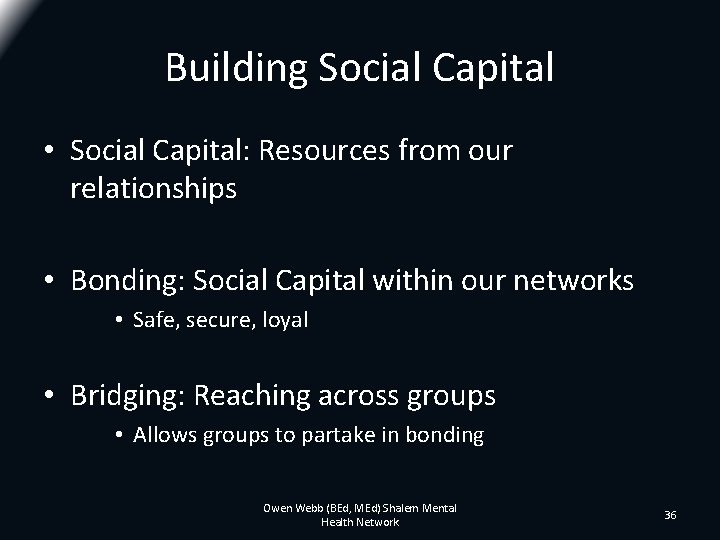
Building Social Capital • Social Capital: Resources from our relationships • Bonding: Social Capital within our networks • Safe, secure, loyal • Bridging: Reaching across groups • Allows groups to partake in bonding Owen Webb (BEd, MEd) Shalem Mental Health Network 36
Joys of Parenting/ Working with Children Share a recent joy you’ve experienced as a parent/ teacher What happened? How did you feel? What do you hope for moving forward? Owen Webb (BEd, MEd) Shalem Mental Health Network 37
Challenges of Parenting/ Working with Children Share a recent challenge you’ve experienced as a parent/ teacher What happened? How did you feel? What do you hope for moving forward? Owen Webb (BEd, MEd) Shalem Mental Health Network 38
References • Kohn, A. (1996). Beyond discipline. Alexandria, VA: Association for Supervision and Curriculum development. • Thorsborne, M. (2013). Restorative parenting: Parenting for a peaceful home. Margaret Thorsborne & Associates. Retrieved from: http: //www. discovery. edu. hk/dcwebsite/wpcontent/uploads/2014/09/20130111_Parent_session_HK. pdf • Vaandering, D. (2014). Implementing restorative justice practice in schools: What pedagogy reveals. Journal of Peace Education, 11(1), 64 -80. doi: 10. 1080/17400201. 2013. 794335 Owen Webb (BEd, MEd) Shalem Mental Health Network 39