
Working with LiteracyLevel Adult English Language Learners April
- Slides: 32
Working with Literacy-Level Adult English Language Learners April 23 and 24, 2007 Abromson Center, University of Southern Maine Portland, Maine Lynda Terrill Technical Assistance and Web Coordinator CAELA, Washington, DC Center for Adult English Language Acquisition
Overview Agenda Objectives Introductions Warm-up Center for Adult English Language Acquisition 2
Objectives Understand the importance of learner needs assessment for developing effective lessons for literacy-level adult English language learners. Enhance knowledge of the diverse linguistic, cultural, social, and educational backgrounds of adults in literacy- and beginning- level adult ESL classes. Identify and begin to develop activities that may promote communication, reading, and writing among literacy-level learners in their classes and programs. Center for Adult English Language Acquisition 3
Objectives, cont. Investigate project-based learning as a process that can integrate language learning and real-life needs, goals, and interests. Develop or expand the practitioner network by sharing lessons, challenges, reflections and resources related to working with adult English language learners in Maine. Center for Adult English Language Acquisition 4
Who are the literacy-level learners? Literacy-level learners are generally those with 6 or fewer years of education in native country Need focused instruction on learning to read and write English Diverse backgrounds Wide range of oral skills May have experienced trauma (which may affect the speed with which they learn English) Center for Adult English Language Acquisition 5
Learners in literacy classes Preliterate Nonliterate Semiliterate Nonalphabet literate Non-Roman alphabet literate Roman-alphabet literate Center for Adult English Language Acquisition 6
Center for Adult English Language Acquisition 7
Strengths of literacy-level learners We need to be careful in looking at undereducated adults, however. They may be beginning learners, but they are not beginning thinkers. They have budgeted their time and resources, handled everyday survival needs for themselves and their families, and solved the myriad of problem which face any adult. We need to recognize their abilities as adults we while we provide opportunities for them to acquire basic English skills. ” What Non-Readers or Beginning Readers Need to Know: Performance-Based ESL Adult Literacy by Shirley Brod, Spring Institute for International Studies, 1999 (p. 5 -6) Center for Adult English Language Acquisition 8
What is culture? “…a system of beliefs, values, and assumptions about life that guide behavior and are shared by a group of people. It includes customs, language, and material artifacts. These are transmitted from generation to generation, rarely with explicit instructions. ” Building Bridges: A Peace Corps Classroom Guide to Cross-Cultural Understanding by Paul Coverdell (n. d) Center for Adult English Language Acquisition 9
Advice Give refugees and immigrants time to adjust to their new situations Look for the individual qualities of each learner Respect the knowledge, skills, and experiences of the refugees and immigrants you work with. Learn about values outside your own culture Investigate and find information you need Remember that we are more alike than we are different Center for Adult English Language Acquisition 10
Refugee and immigrant learners in Maine Somalis Somali Bantu Sudanese ? ? ? Challenges, successes, and solutions Center for Adult English Language Acquisition 11
Learner Needs Assessment Needs assessment is a continual process that takes place throughout the instructional program (Beginning, during, end, future planning) Needs assessment influences Placement Materials selection Curriculum design Teaching approaches Teacher training Center for Adult English Language Acquisition 12
Learner Needs Assessment: Further Purposes Assures a flexible, responsive curriculum rather than a fixed, linear curriculum (solely) determined ahead of time by instructors or administrators Provides information to the instructor and learner about what the learner brings to the course, want and needs from the course and for the future, and what the learner accomplishes in the course Center for Adult English Language Acquisition 13
Needs Assessment in the Classroom Information grid Topic selection Priority cards Vote with your feet Brainstorming: Learner-generated list; mind mapping Questionnaires: Learners’ needs and goals Timelines Dialogue Journals Inventories of language and literacy use Other? Center for Adult English Language Acquisition 14
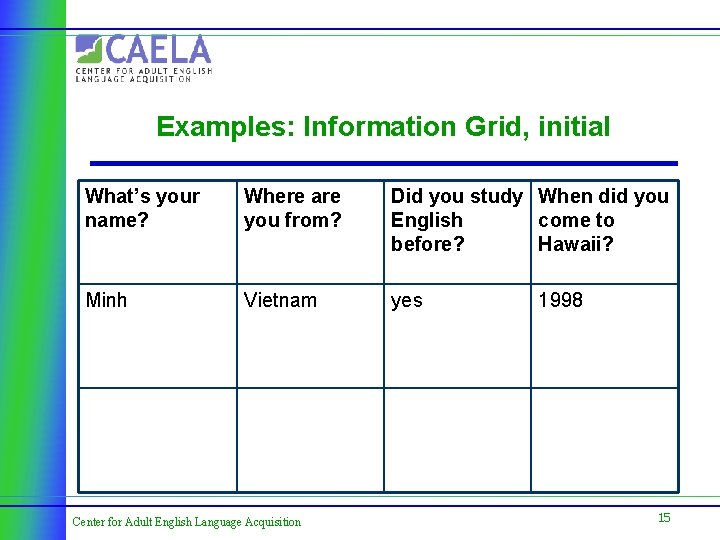
Examples: Information Grid, initial What’s your name? Where are you from? Did you study When did you English come to before? Hawaii? Minh Vietnam yes Center for Adult English Language Acquisition 1998 15
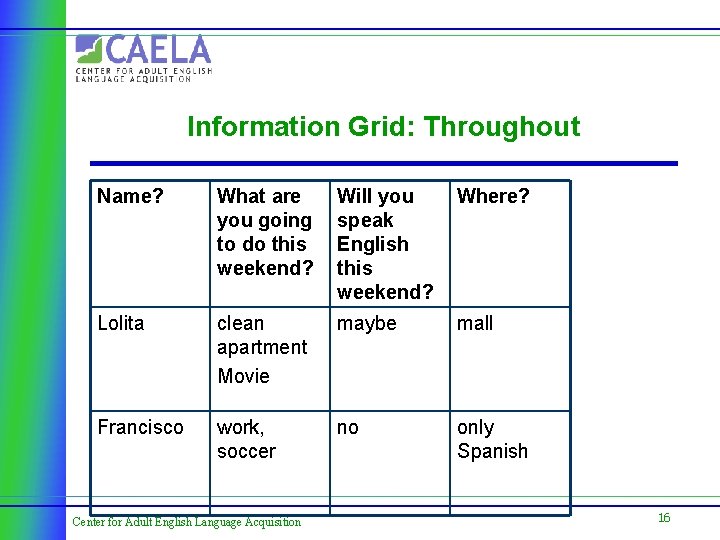
Information Grid: Throughout Name? What are you going to do this weekend? Will you speak English this weekend? Where? Lolita clean apartment Movie maybe mall Francisco work, soccer no only Spanish Center for Adult English Language Acquisition 16
Individual Goal-Setting Process Mirrors and enhances the benefits of class needs assessment Uses what we know about how adults learn Provides a way to addresses individual needs in large classes May increase learner motivation and confidence May increase learner input outside of class Provides a holistic and real-life assessment of learner and program gains Center for Adult English Language Acquisition 17
Goals: Definitions A goal is a wish that your heart makes. A goal is a dream with a deadline (Meta Potts, email correspondence 10/12/98) The end toward which effort is directed. (Webster’s New Collegiate Dictionary) Goals are expected learning outcomes given the needs and abilities of learners, the types of educational/tutoring services provided, and the designated time periods assigned for goal attainments (Goal Attainment Scaling) Center for Adult English Language Acquisition 18
Goals: Definitions A goal is a short-term learning objective that can be realistically be accomplished within one instructional cycle, i. e. 4 -15 hours per week over 12 weeks. (REEP) Achievement, purpose, winning, career, being an expert, reaching, dreams and wishes (REEP learners, 10/98) Center for Adult English Language Acquisition 19
Activities to promote communication What the research suggests What practical experience suggests Strategies Activities Center for Adult English Language Acquisition 20
Activities to Promote Reading and Writing What the research suggests What practical experience suggests Strategies Activities Center for Adult English Language Acquisition 21
Overview of Day 2 Center for Adult English Language Acquisition 22
Class Description Proficiency level Class hours weekly Open or managed entry (length of course) Number of learners in class Setting Access to computers/internet Results of class needs assessment/learner goal-setting Description of the class (age, culture, gender, religion, educational background and expectations; alphabet, years in the United States, special needs, etc. ) More Center for Adult English Language Acquisition 23
One literacy-level class Literacy Level #1 Most of the class has less than 6 years of education in native country. Several had attended schools where the focus was mainly on memorizing the Koran. The learners are mostly young, single men. All learners speak the same native language. The needs assessment shows that most of the class wants to concentrate on speaking even though many in class have trouble with filling out even basic forms Center for Adult English Language Acquisition 24
One literacy-level class, cont. A few of the learners—undocumented, mostly migrant agricultural workers—may not stay in the area long. Some have questions about how to get a green card. Approximately 12 enrolled in class, non-intensive (4 hours a week), and open enrollment No access to computers/internet Mixed setting (draws learners from rural and suburban areas) Center for Adult English Language Acquisition 25
Activities or Project Framework Use the class description, Add Topic/Theme Content Focus Language Focus (reading, writing, speaking, listening Objectives Activities Resources Evaluation Center for Adult English Language Acquisition 26
A framework for project work involves the learners in choosing the focus of the project and in the planning process. engages learners in activities where they need to acquire new information that is important to them. has clearly articulated outcomes. incorporates self-evaluation, peer evaluation, and teacher evaluation. enhances the development of real-life skills. From: Project Based Learning and Assessment: A Resource Manual for Teachers, Arlington Education and Employment Program (REEP), Arlington Public Schools, 1997(ERIC No. ED 442 306) Center for Adult English Language Acquisition 27
Project framework, cont. A project: builds on previous work. integrates the four skill areas-speaking, listening, reading and writing. incorporates collaborative team work, problem-solving, negotiating and other interpersonal skills. challenges learners to engage in independent work. challenges learners to authentically use English in new and different contexts outside the class. develops life-long learning strategies. Center for Adult English Language Acquisition 28
What one learner said One of the purposes of the education that schools provide is to enable students to live in their society. Schools can not ignore what is going on in real life. Today students are tomorrow workers and they must be ready to succeed in their lives. What does this have to do with the oral presentations we do at CEC? Let’s see. First of all, I’ll tell you that I like the idea of doing this kind of work. It’s difficult, I know, but it is also useful for every student. You have to make use of your English in a different way than fill a grammar exercise. You have to use your English in a real context: Giving information to other people. You will have to do this thousand of times in your life, so doing this at school is not a sad idea. But not only this, you have to learn how to with your partner. Live is not only competition, but also cooperation. Besides you can not stay all your life hidden behind a desk. One day, your opportunity arrives and you have to jump. I’ll be useful if you are ready to face your chances. Center for Adult English Language Acquisition 29
Rita, cont. As to the students who will listen to us, this a way of telling then that they will be also to do the same in a not so distant future. Maybe they are going to fall asleep if our presentation is boring, but even thought They will have learned a lesson: “This not the way to do this, when my turn arrives, I will do it better”. I applaud to schools who are concerned about real life and, in this way, I applaud to the idea of doing this difficult, hard, make-you-nervous…but useful presentations. Center for Adult English Language Acquisition 30
Bring the parts together Needs assessment Literacy-level learners Cultural considerations Promoting communication and reading and writing Project-based learning Center for Adult English Language Acquisition 31
Finally, Thank you for your participation in this workshop. For further information, please go to www. cal. org/caela/scb/maine. html or contact me at lterrill@cal. org Thanks, Lynda Center for Adult English Language Acquisition 32