
Working with HFAs Structured Financing Programs Andrew Baldwin
Working with HFAs Structured Financing Programs Andrew Baldwin Corporation for Supportive Housing July 17, 2006 www. csh. org
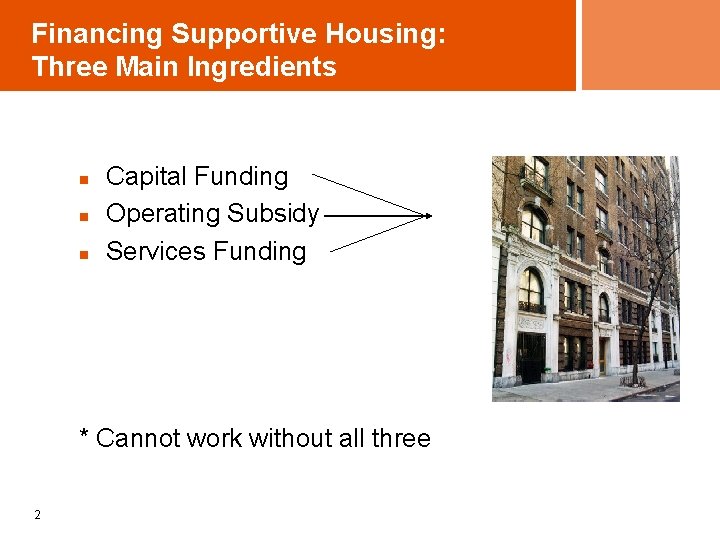
Financing Supportive Housing: Three Main Ingredients n n n Capital Funding Operating Subsidy Services Funding * Cannot work without all three 2
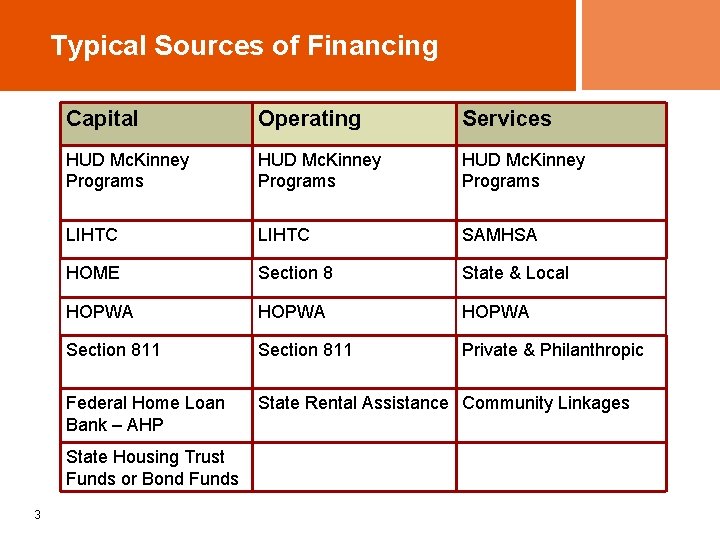
Typical Sources of Financing Capital Operating Services HUD Mc. Kinney Programs LIHTC SAMHSA HOME Section 8 State & Local HOPWA Section 811 Private & Philanthropic Federal Home Loan Bank – AHP State Rental Assistance Community Linkages State Housing Trust Funds or Bond Funds 3
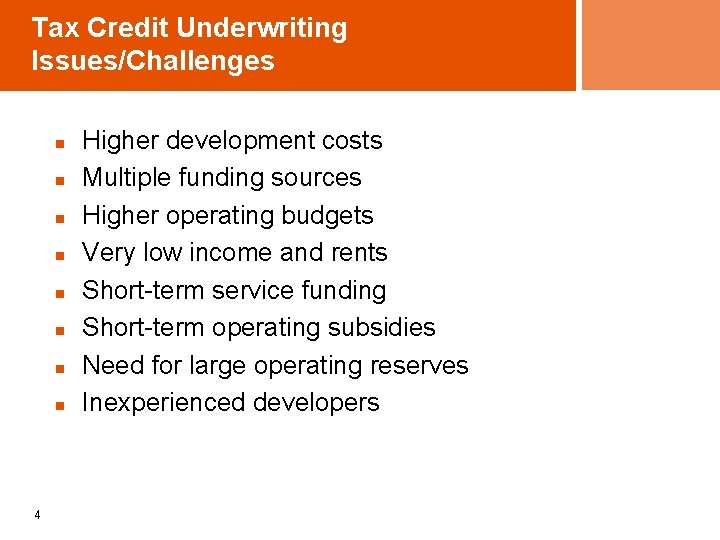
Tax Credit Underwriting Issues/Challenges n n n n 4 Higher development costs Multiple funding sources Higher operating budgets Very low income and rents Short-term service funding Short-term operating subsidies Need for large operating reserves Inexperienced developers
Structured Financing Programs n n 5 Provide a comprehensive “package” of financing to help meet the challenges of supportive housing. Can provide a “one stop shop” for providers. As production programs, can stimulate development of large numbers of units. Award of tax credits more straightforward due to HFA role and projects’ financing readiness.

Challenges of Developing Structured Programs n Political will to allocate resources. n Buy-in from multiple parties/agencies. n Coordinating effort by HFA. n 6 Developer capacity to produce units and provide services.
Two Examples: n Connecticut (1993 to Present): – Pilots Initiative – Next Steps n California (2005 to Present): – Mental Health Services Act – Governor’s Initiative 7
CT’s Supportive Housing Pilots Initiative 650 units n Approximately 300 scattered-site, existing apartments n 350 new construction and rehab Over 40 community-based nonprofit organizations involved 8
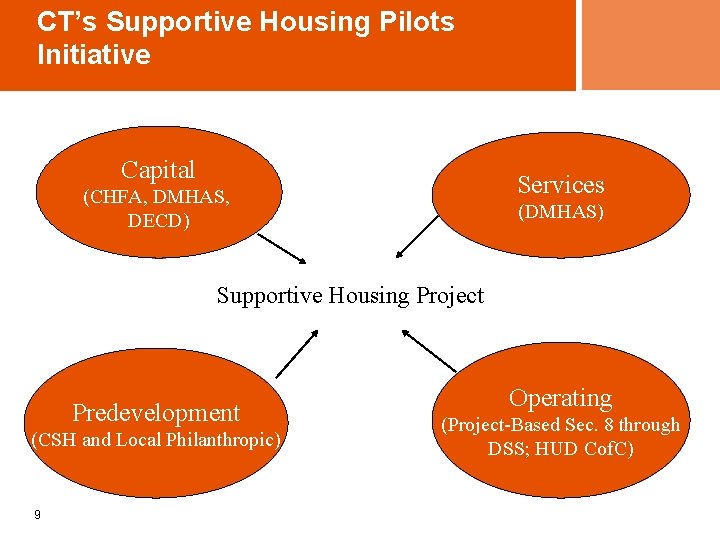
CT’s Supportive Housing Pilots Initiative Capital Services (CHFA, DMHAS, DECD) (DMHAS) Supportive Housing Project Predevelopment (CSH and Local Philanthropic) 9 Operating (Project-Based Sec. 8 through DSS; HUD Cof. C)
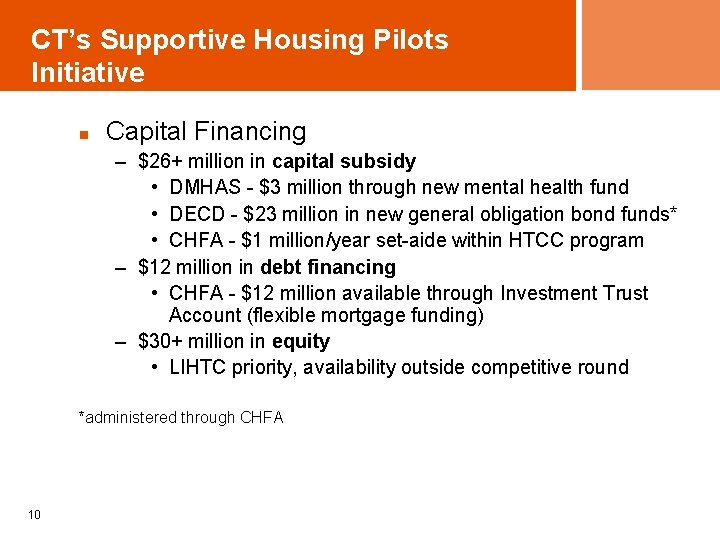
CT’s Supportive Housing Pilots Initiative n Capital Financing – $26+ million in capital subsidy • DMHAS - $3 million through new mental health fund • DECD - $23 million in new general obligation bond funds* • CHFA - $1 million/year set-aide within HTCC program – $12 million in debt financing • CHFA - $12 million available through Investment Trust Account (flexible mortgage funding) – $30+ million in equity • LIHTC priority, availability outside competitive round *administered through CHFA 10
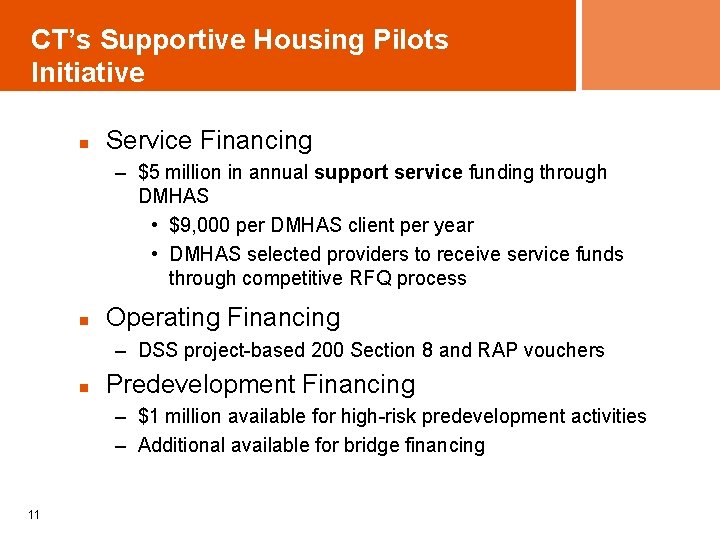
CT’s Supportive Housing Pilots Initiative n Service Financing – $5 million in annual support service funding through DMHAS • $9, 000 per DMHAS client per year • DMHAS selected providers to receive service funds through competitive RFQ process n Operating Financing – DSS project-based 200 Section 8 and RAP vouchers n Predevelopment Financing – $1 million available for high-risk predevelopment activities – Additional available for bridge financing 11
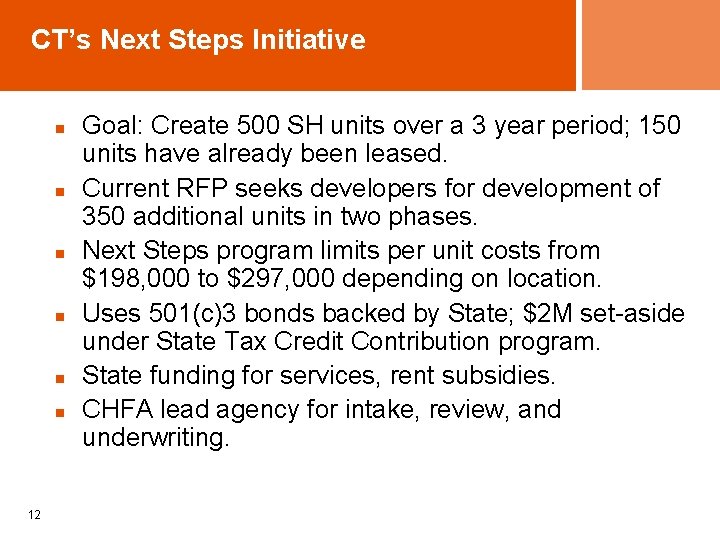
CT’s Next Steps Initiative n n n 12 Goal: Create 500 SH units over a 3 year period; 150 units have already been leased. Current RFP seeks developers for development of 350 additional units in two phases. Next Steps program limits per unit costs from $198, 000 to $297, 000 depending on location. Uses 501(c)3 bonds backed by State; $2 M set-aside under State Tax Credit Contribution program. State funding for services, rent subsidies. CHFA lead agency for intake, review, and underwriting.
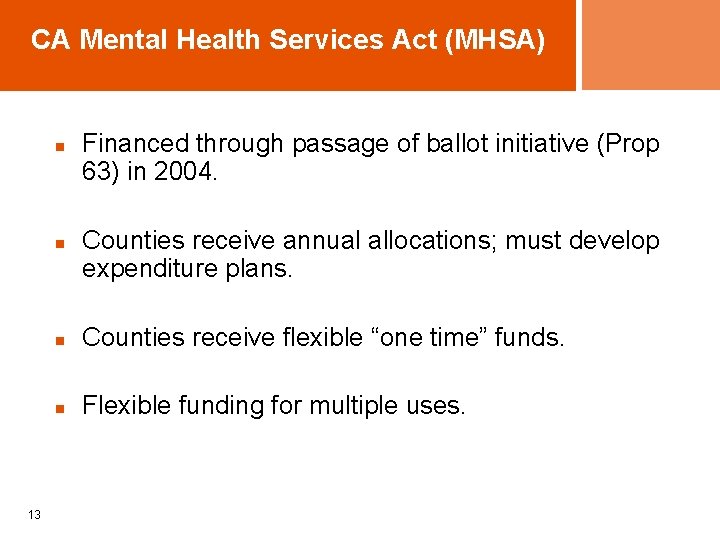
CA Mental Health Services Act (MHSA) n n 13 Financed through passage of ballot initiative (Prop 63) in 2004. Counties receive annual allocations; must develop expenditure plans. n Counties receive flexible “one time” funds. n Flexible funding for multiple uses.
MHSA Capital Facilities Costs May Include (Proposed) § Purchasing land or buildings. § Construction or rehabilitation costs for housing and/or office/meeting spaces. § Adequate reserves for projects to cover gaps in operating costs in future years. § Related “soft” costs for development including strategies to build community acceptance for projects. 14
Governor’s Chronic Homeless Initiative (CHI): Phase II n n n 15 Announced in May 2006. $75 million of MHSA funds per year will be “pooled” at the State. Goal is leveraging other funds. The pooled funds will be administered by the California Housing Finance Agency (Cal. HFA). Partnership with Cal. HFA, State DMH, and Dept. of Housing & Community Development (HCD).
CHI: What we know now…. n n n 16 Cal. HFA establishing a special needs lending program; the goal is flexibility. Projects receiving capital funds must be linked to MHSA services and operating support funded by the county. State will work in partnership with counties to determine allocation goals and process and to ensure small county set aside.
CHI: What we know now… n n 17 State will work with counties to further define program and process. Flow of projects is anticipated to be: developer/sponsor seeks county approval and partnership then goes to state DMH and Cal. HFA. Goals include: – leverage bonds, tax credits and other existing instruments – link to existing Ten Year Plans – partner with other local investments First funds may be available in early 2007.
For More Information: Check out the following resources at www. csh. org: SH Financing Guide Toolkit for Ending Long Term Homelessness CSH Policy Pages andrew. baldwin@csh. org
- Slides: 18