
Working with Diversity social creative development Dr Caryl
- Slides: 47
Working with Diversity: social & creative development Dr Caryl Sibbett Art Psychotherapist (HCPC Reg. ) Reg. MBACP (Senior Accredited) Counsellor/Psychotherapist. Fellow BACP. Ret’d Senior Lecturer. Fellow Higher Education Academy. www. kairosconsultancy. net
Working with DIVERSITY Dr Caryl Sibbett, Kairos Consultancy (c) 2019 2
DEVELOPMENTAL ART THERAPY § Informed by: Ø Ø Development theories, e. g. Erikson (1959, 1963, 1977, 1987) Creative development theories: e. g. Lowenfeld (1957), Gardner (1980), Kellogg (1970), Golomb (1990) Ø Cognitive development theories, e. g. Piaget (1952, 1960) § When working with any age. (Malchiodi, Kim & Choi, 2002: 94) Dr Caryl Sibbett, Kairos Consultancy (c) 2019 3
§ “Bronfenbrenner's (1979) seminal ecological model of human development gives insights into how young children are situated as learners by the societies in which they are nurtured and educated. ” (Ring, 2001) Dr Caryl Sibbett, Kairos Consultancy (c) 2019 4
Diversity of modes of expression § Through drawing, children can re-present action, emotion, ideas or experiences (Malchiodi, 1998) § “action representations” – art / mind / body expression (Matthews, 1999). § “children act multi-modally, both in the things they use, the objects they make, and in the engagement of their bodies; there is no separation of body and mind” (Kress, 1997, p. 97). Sense / meaning making (Ring, 2001) Dr Caryl Sibbett, Kairos Consultancy (c) 2019 5
Diversity of modes of expression § '. . . Children do not naturally limit the forms that their expressions take. Because adult communication relies so heavily on spoken and written language, however, schools necessarily reflect that orientation and channel children's narratives into a very narrow realm of expressions, in effect limiting rather than broadening the child's expressive capabilities. ' (Gallas, 1994: xv) (Ring, 2001) Dr Caryl Sibbett, Kairos Consultancy (c) 2019 6
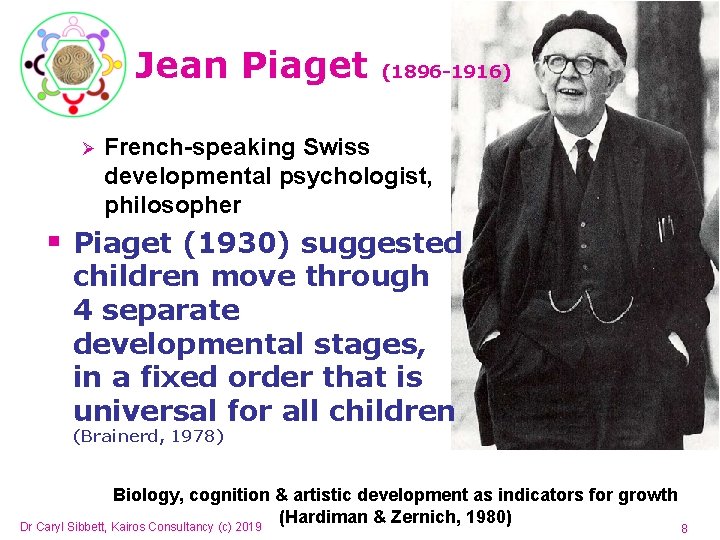
Jean Piaget (1896 -1916) Ø French-speaking Swiss developmental psychologist, philosopher § Piaget (1930) suggested children move through 4 separate developmental stages, in a fixed order that is universal for all children (Brainerd, 1978) Biology, cognition & artistic development as indicators for growth (Hardiman & Zernich, 1980) Dr Caryl Sibbett, Kairos Consultancy (c) 2019 8
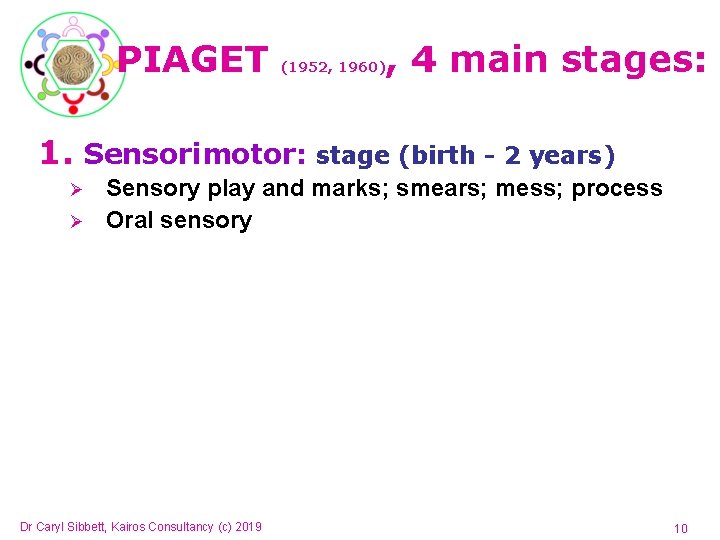
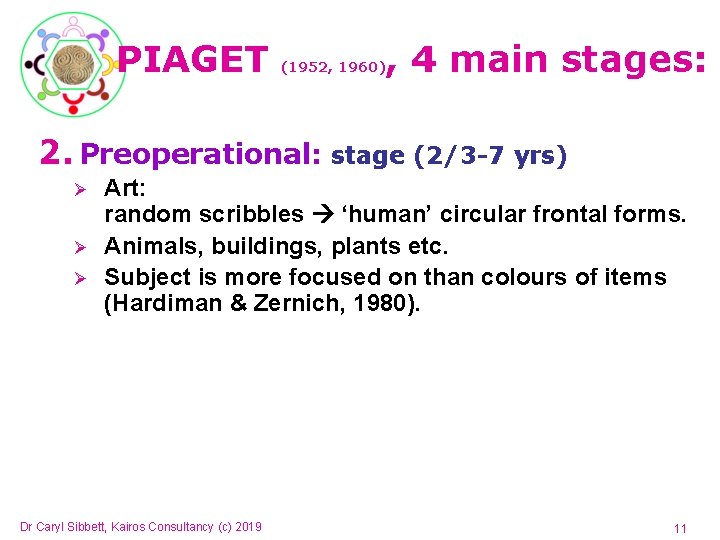
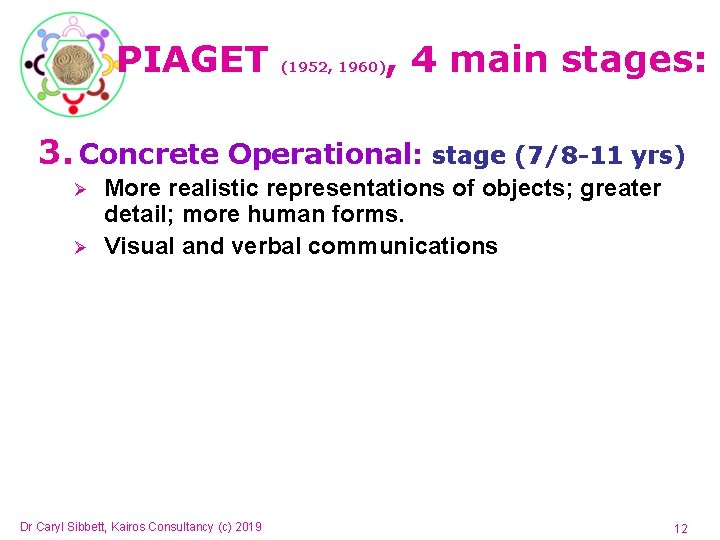
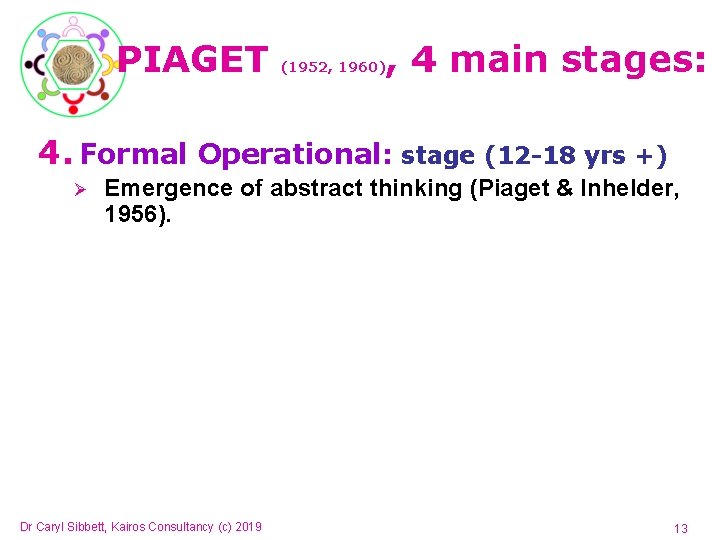
PIAGET (1952, 1960) , 4 main stages: 1. Sensorimotor: stage (birth - 2 years) Ø Knowledge develops through sensory and motor abilities. 2. Preoperational: stage (2/3 -7 yrs) Ø Knowledge is represented by language, mental imagery and symbolic thought. Magical thinking. Egocentric (then this weakens) 3. Concrete Operational: stage (7/8 -11 yrs) Ø Children can reason logically about concrete objects and events. 4. Formal Operational: stage (12 -18 yrs +) Can think deeply about concrete events and can Dr Caryl Sibbett, Kairos Consultancy (c) 2019 reason abstractly and hypothetically. Ø 9
PIAGET (1952, 1960) , 4 main stages: 1. Sensorimotor: stage (birth - 2 years) Ø Ø Sensory play and marks; smears; mess; process Oral sensory Dr Caryl Sibbett, Kairos Consultancy (c) 2019 10
PIAGET (1952, 1960) , 4 main stages: 2. Preoperational: stage (2/3 -7 yrs) Ø Ø Ø Art: random scribbles ‘human’ circular frontal forms. Animals, buildings, plants etc. Subject is more focused on than colours of items (Hardiman & Zernich, 1980). Dr Caryl Sibbett, Kairos Consultancy (c) 2019 11
PIAGET (1952, 1960) , 4 main stages: 3. Concrete Operational: stage (7/8 -11 yrs) Ø Ø More realistic representations of objects; greater detail; more human forms. Visual and verbal communications Dr Caryl Sibbett, Kairos Consultancy (c) 2019 12
PIAGET (1952, 1960) , 4 main stages: 4. Formal Operational: stage (12 -18 yrs +) Ø Emergence of abstract thinking (Piaget & Inhelder, 1956). Dr Caryl Sibbett, Kairos Consultancy (c) 2019 13
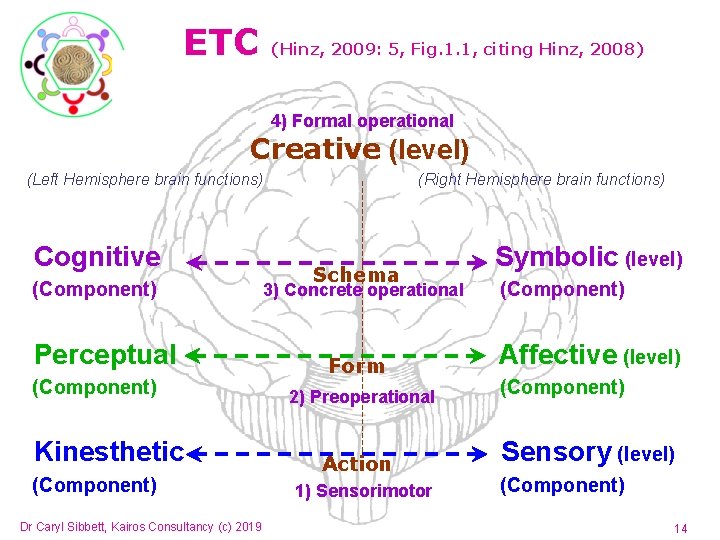
ETC (Hinz, 2009: 5, Fig. 1. 1, citing Hinz, 2008) 4) Formal operational Creative (level) (Left Hemisphere brain functions) Cognitive (Component) Perceptual (Component) Kinesthetic (Component) Dr Caryl Sibbett, Kairos Consultancy (c) 2019 (Right Hemisphere brain functions) Schema 3) Concrete operational Form 2) Preoperational Action 1) Sensorimotor Symbolic (level) (Component) Affective (level) (Component) Sensory (level) (Component) 14
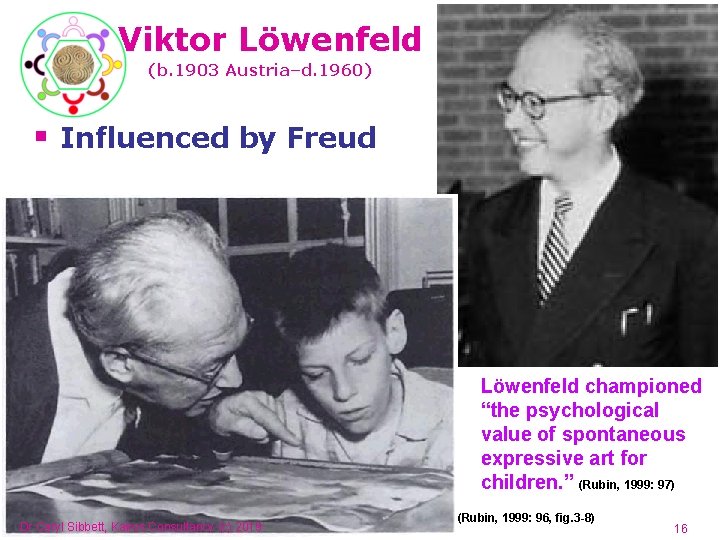
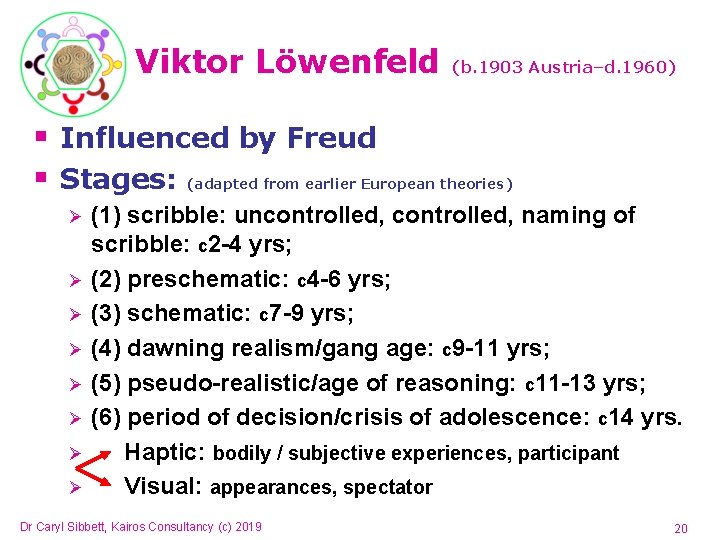
Viktor Löwenfeld (b. 1903 Austria–d. 1960) § Influenced by Freud Löwenfeld championed “the psychological value of spontaneous expressive art for children. ” (Rubin, 1999: 97) Dr Caryl Sibbett, Kairos Consultancy (c) 2019 (Rubin, 1999: 96, fig. 3 -8) 16
§ Löwenfeld (1957), an art educator influenced by psychoanalytic theories, is “one of the most important influences on the practice of developmental art therapy” (Malchiodi, Kim & Choi, 2002: 94) Dr Caryl Sibbett, Kairos Consultancy (c) 2019 17
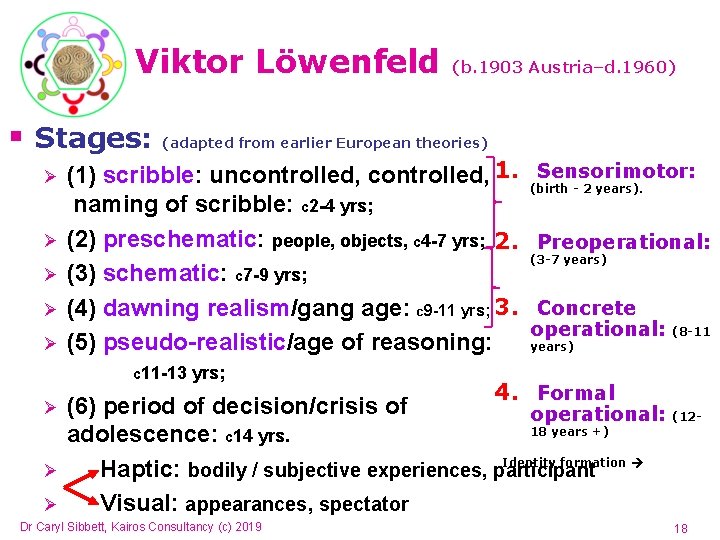
Viktor Löwenfeld (b. 1903 Austria–d. 1960) § Stages: (adapted from earlier European theories) Ø Ø Ø (1) scribble: uncontrolled, 1. naming of scribble: c 2 -4 yrs; (2) preschematic: people, objects, c 4 -7 yrs; 2. (3) schematic: c 7 -9 yrs; (4) dawning realism/gang age: c 9 -11 yrs; 3. (5) pseudo-realistic/age of reasoning: c 11 -13 Ø Ø Ø yrs; Sensorimotor: (birth - 2 years). Preoperational: (3 -7 years) Concrete operational: (8 -11 years) 4. Formal (6) period of decision/crisis of operational: (1218 years +) adolescence: c 14 yrs. Identity formation Haptic: bodily / subjective experiences, participant Visual: appearances, spectator Dr Caryl Sibbett, Kairos Consultancy (c) 2019 18
Viktor Löwenfeld (b. 1903 Austria–d. 1960) § Influenced by Freud § Stages: (adapted from earlier European theories) Ø Ø Ø Ø (1) scribble: uncontrolled, naming of scribble: c 2 -4 yrs; (2) preschematic: c 4 -6 yrs; (3) schematic: c 7 -9 yrs; (4) dawning realism/gang age: c 9 -11 yrs; (5) pseudo-realistic/age of reasoning: c 11 -13 yrs; (6) period of decision/crisis of adolescence: c 14 yrs. Haptic: bodily / subjective experiences, participant Visual: appearances, spectator Dr Caryl Sibbett, Kairos Consultancy (c) 2019 20
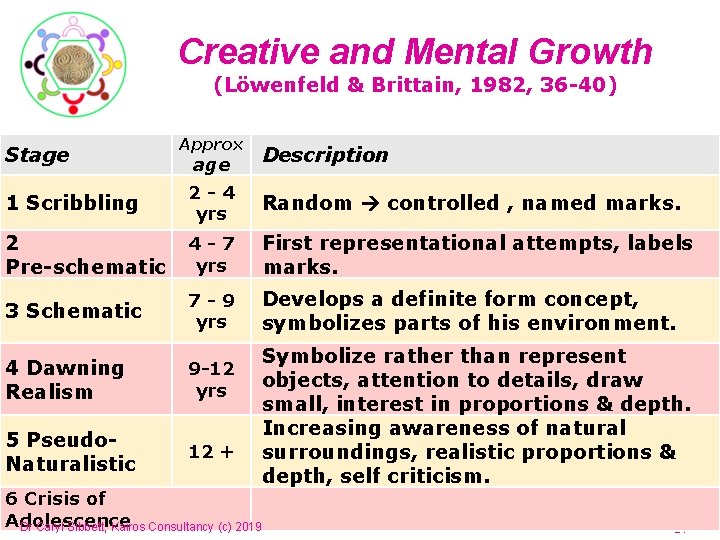
Creative and Mental Growth (Löwenfeld & Brittain, 1982, 36 -40) Stage Approx age Description 1 Scribbling 2 - 4 yrs Random controlled , named marks. 2 Pre-schematic 4 - 7 yrs First representational attempts, labels marks. 3 Schematic 7 - 9 yrs Develops a definite form concept, symbolizes parts of his environment. 4 Dawning Realism 9 -12 yrs 5 Pseudo. Naturalistic 12 + Symbolize rather than represent objects, attention to details, draw small, interest in proportions & depth. Increasing awareness of natural surroundings, realistic proportions & depth, self criticism. 6 Crisis of Adolescence Dr Caryl Sibbett, Kairos Consultancy (c) 2019 21
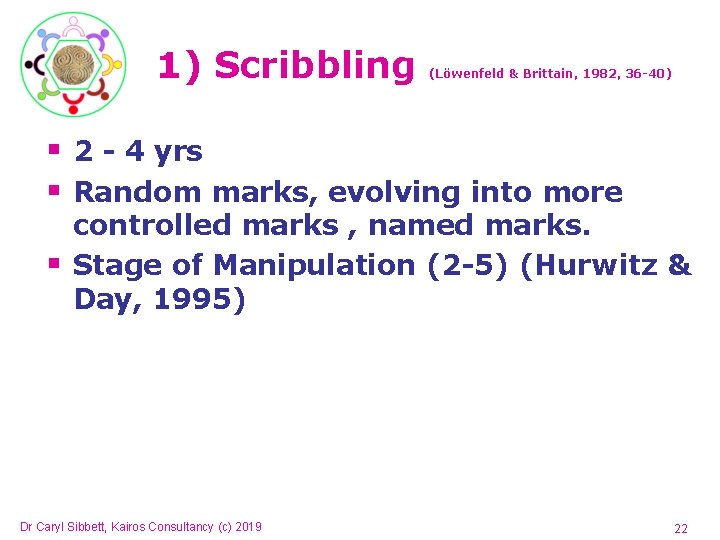
1) Scribbling (Löwenfeld & Brittain, 1982, 36 -40) § 2 - 4 yrs § Random marks, evolving into more controlled marks , named marks. § Stage of Manipulation (2 -5) (Hurwitz & Day, 1995) Dr Caryl Sibbett, Kairos Consultancy (c) 2019 22
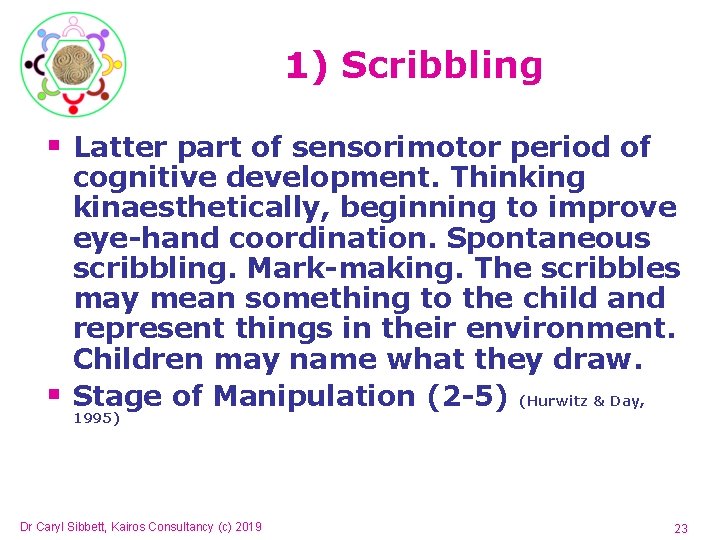
1) Scribbling § Latter part of sensorimotor period of cognitive development. Thinking kinaesthetically, beginning to improve eye-hand coordination. Spontaneous scribbling. Mark-making. The scribbles may mean something to the child and represent things in their environment. Children may name what they draw. § Stage of Manipulation (2 -5) (Hurwitz & Day, 1995) Dr Caryl Sibbett, Kairos Consultancy (c) 2019 23
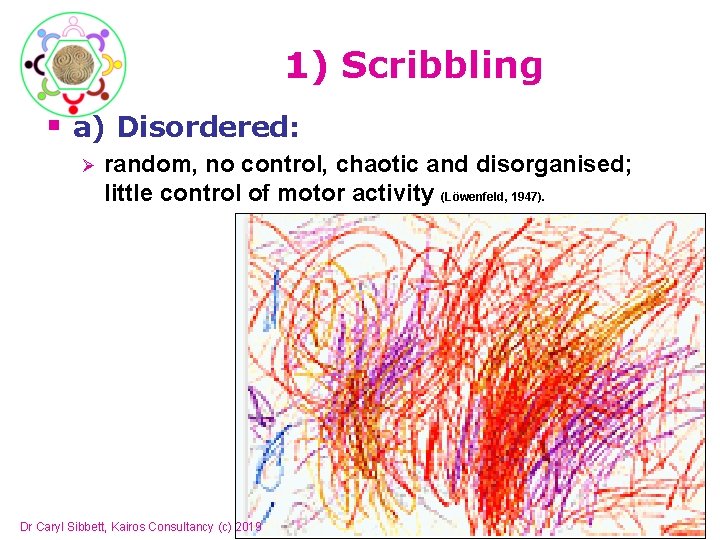
1) Scribbling § a) Disordered: Ø random, no control, chaotic and disorganised; little control of motor activity (Löwenfeld, 1947). Dr Caryl Sibbett, Kairos Consultancy (c) 2019 24
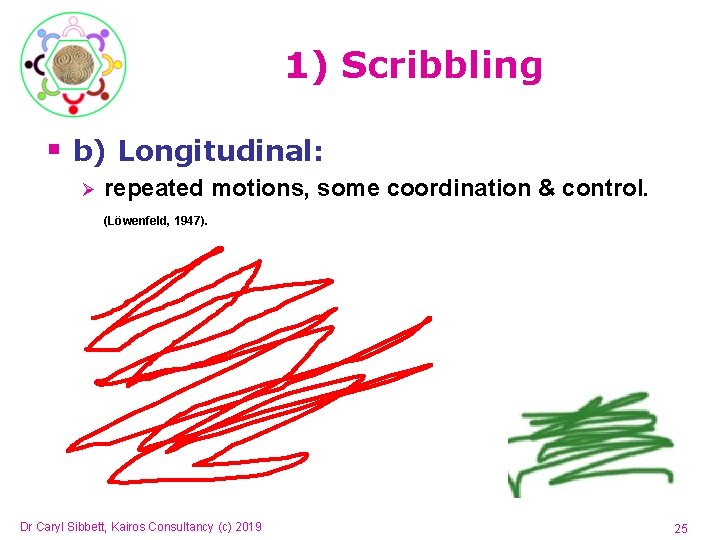
1) Scribbling § b) Longitudinal: Ø repeated motions, some coordination & control. (Löwenfeld, 1947). Dr Caryl Sibbett, Kairos Consultancy (c) 2019 25
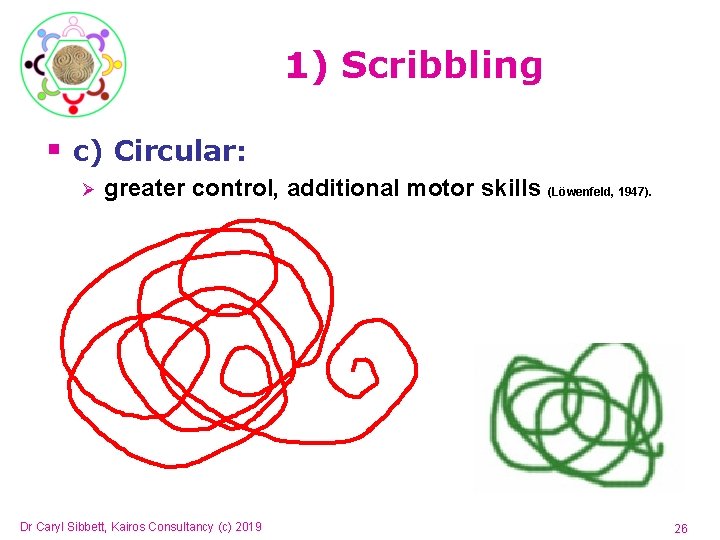
1) Scribbling § c) Circular: Ø greater control, additional motor skills (Löwenfeld, 1947). Dr Caryl Sibbett, Kairos Consultancy (c) 2019 26
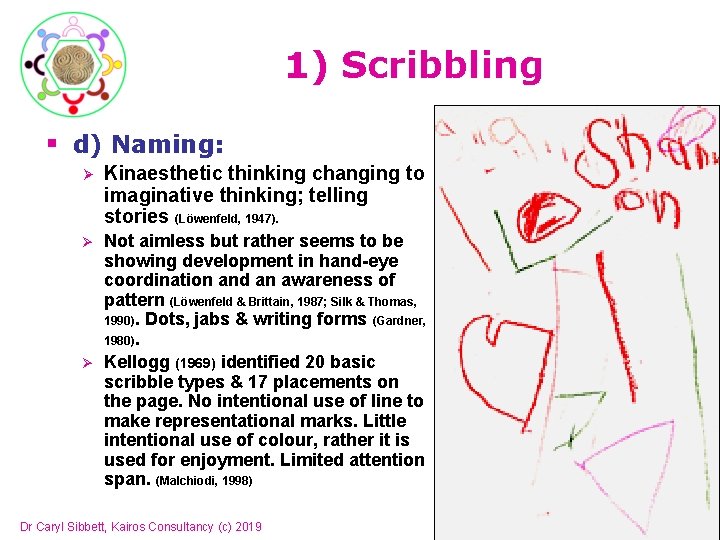
1) Scribbling § d) Naming: Ø Kinaesthetic thinking changing to imaginative thinking; telling stories (Löwenfeld, 1947). Ø Not aimless but rather seems to be showing development in hand-eye coordination and an awareness of pattern (Löwenfeld & Brittain, 1987; Silk & Thomas, 1990). Dots, jabs & writing forms (Gardner, 1980). Kellogg (1969) identified 20 basic scribble types & 17 placements on the page. No intentional use of line to make representational marks. Little intentional use of colour, rather it is used for enjoyment. Limited attention span. (Malchiodi, 1998) Ø Dr Caryl Sibbett, Kairos Consultancy (c) 2019 27
2) Pre-schematic (Löwenfeld & Brittain, 1982, 36 -40) § c 4 - 7 yrs § First representational attempts, labels marks. § Stage of Symbols (6 -9) (Hurwitz & Day, 1995) § More identifiable images, greater use of colours, seek encouragement, easily tired, imaginative. Dr Caryl Sibbett, Kairos Consultancy (c) 2019 28
2) Pre-schematic (c 4 -7) § People, objects. Able to talk not self-conscious. § More involved in naming and inventing stories about the scribbles, or “romancing” (Gardner, 1980). Egocentric and beginning to have a subjective notion of cause and effect. Increasing importance of language. Symbolic thought is emerging. Classification of the world through form, colour and size. Children will actively seek to talk about the art, though it may not resemble anything to the adult. Naming and re-naming may occur as meaning is changeable at this stage. Some children may be “patterners” - interested in patterns (colours, size & shape) & tending not to comment on the art unless prompted, or “dramatists” - interested in stories and tales & tending to talk about the image (Gardner, 1980). Other shapes appear: mandalas, triangles, circles, crosses, squares, rectangles. (Malchiodi, 1998) Dr Caryl Sibbett, Kairos Consultancy (c) 2019 29
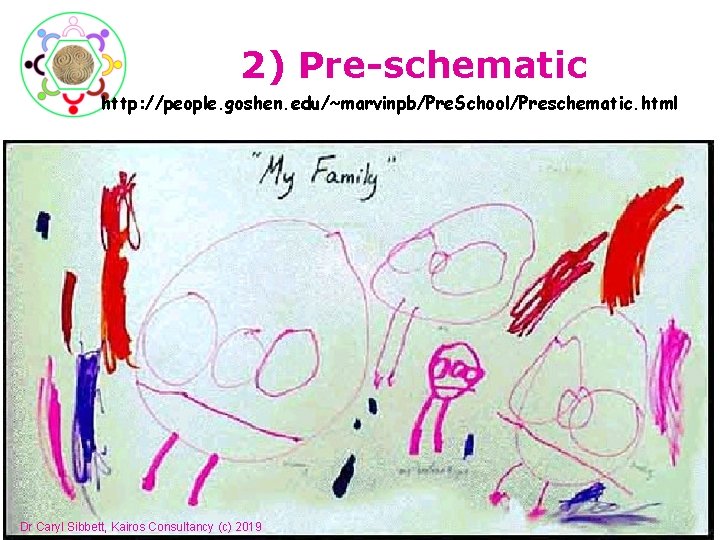
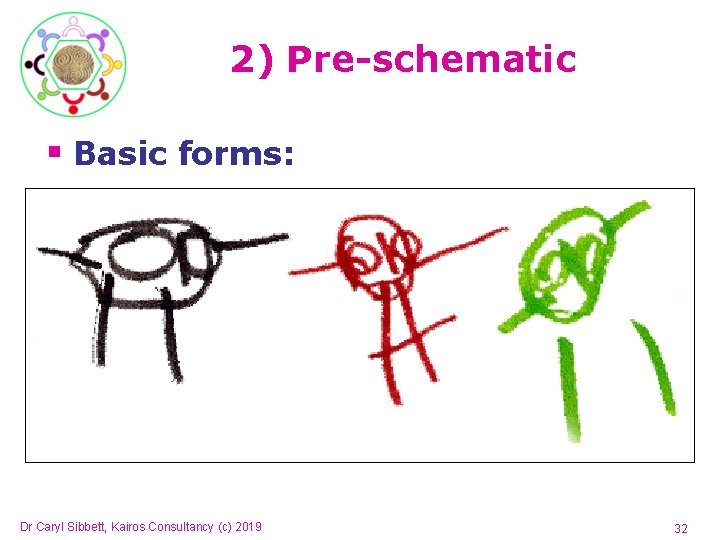
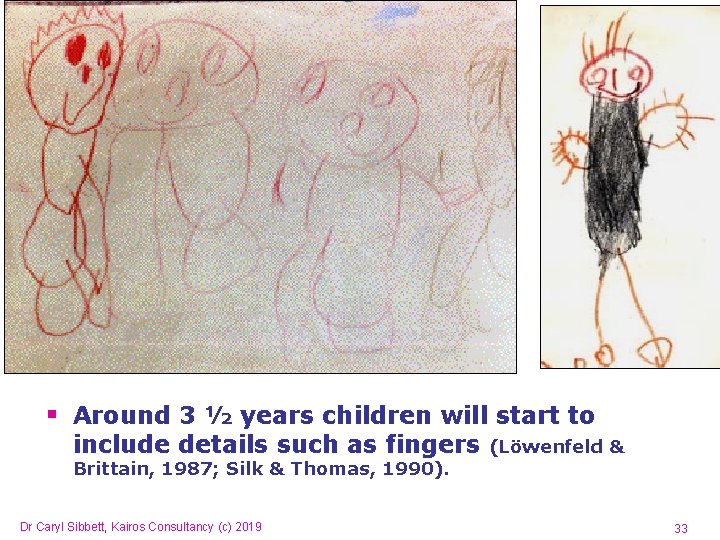
2) Pre-schematic § Basic forms: Ø Around 3 ½ years children will start to include details such as fingers (Löwenfeld & Brittain, 1987; Silk & Thomas, 1990). Ø May draw human as circle with lines for legs - tadpole schema used for humans and animals. This can be described as symbolic realism as the shape symbolises the thing. (Löwenfeld & Brittain, 1987; Silk & Thomas, 1990). Ø ‘Cephalopods’ - may indicate regression of adult. Dr Caryl Sibbett, Kairos Consultancy (c) 2019 30
2) Pre-schematic http: //people. goshen. edu/~marvinpb/Pre. School/Preschematic. html Dr Caryl Sibbett, Kairos Consultancy (c) 2019 31
2) Pre-schematic § Basic forms: Dr Caryl Sibbett, Kairos Consultancy (c) 2019 32
§ Around 3 ½ years children will start to include details such as fingers (Löwenfeld & Brittain, 1987; Silk & Thomas, 1990). Dr Caryl Sibbett, Kairos Consultancy (c) 2019 33
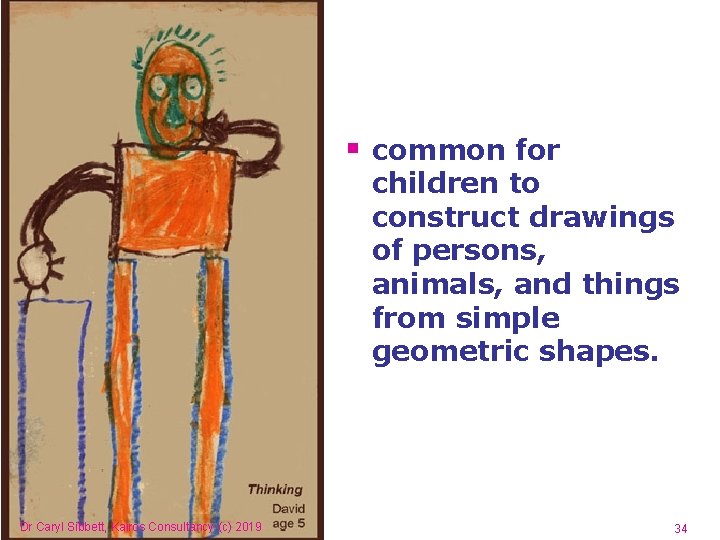
§ common for children to construct drawings of persons, animals, and things from simple geometric shapes. Dr Caryl Sibbett, Kairos Consultancy (c) 2019 34
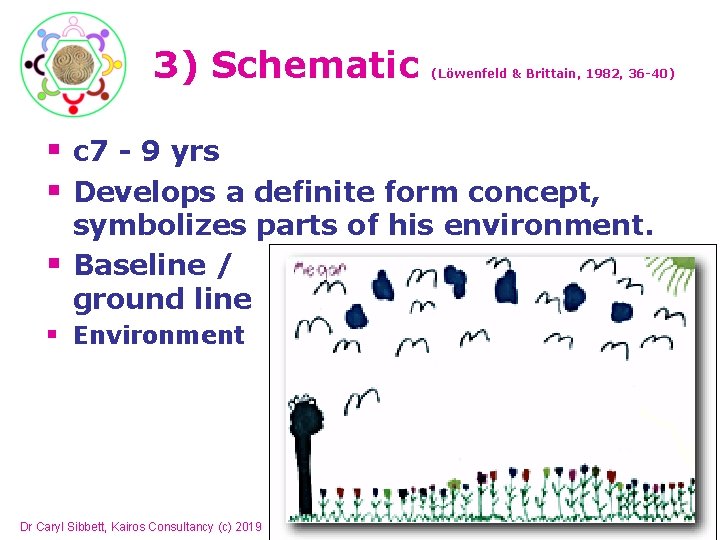
3) Schematic (Löwenfeld & Brittain, 1982, 36 -40) § c 7 - 9 yrs § Develops a definite form concept, symbolizes parts of his environment. § Baseline / ground line § Environment Dr Caryl Sibbett, Kairos Consultancy (c) 2019 35
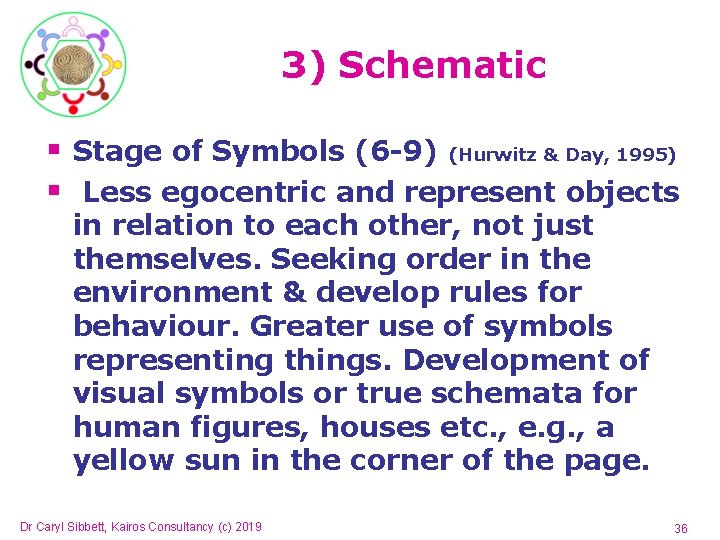
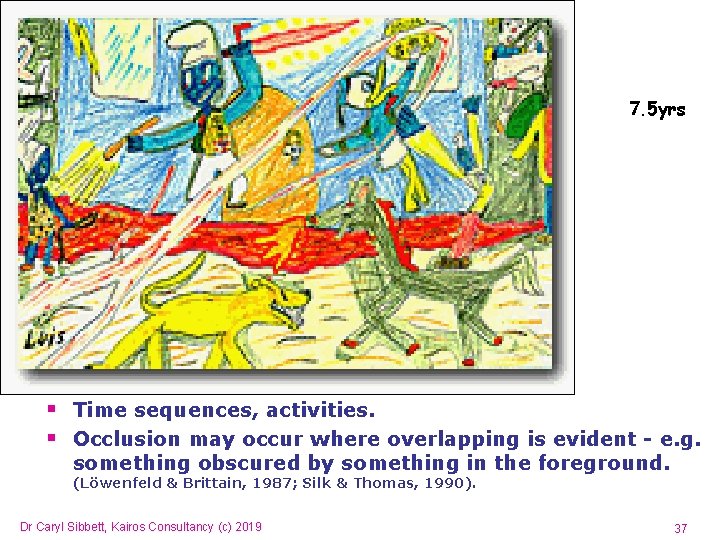
3) Schematic § Stage of Symbols (6 -9) (Hurwitz & Day, 1995) § Less egocentric and represent objects in relation to each other, not just themselves. Seeking order in the environment & develop rules for behaviour. Greater use of symbols representing things. Development of visual symbols or true schemata for human figures, houses etc. , e. g. , a yellow sun in the corner of the page. Dr Caryl Sibbett, Kairos Consultancy (c) 2019 36
7. 5 yrs § Time sequences, activities. § Occlusion may occur where overlapping is evident - e. g. something obscured by something in the foreground. (Löwenfeld & Brittain, 1987; Silk & Thomas, 1990). Dr Caryl Sibbett, Kairos Consultancy (c) 2019 37
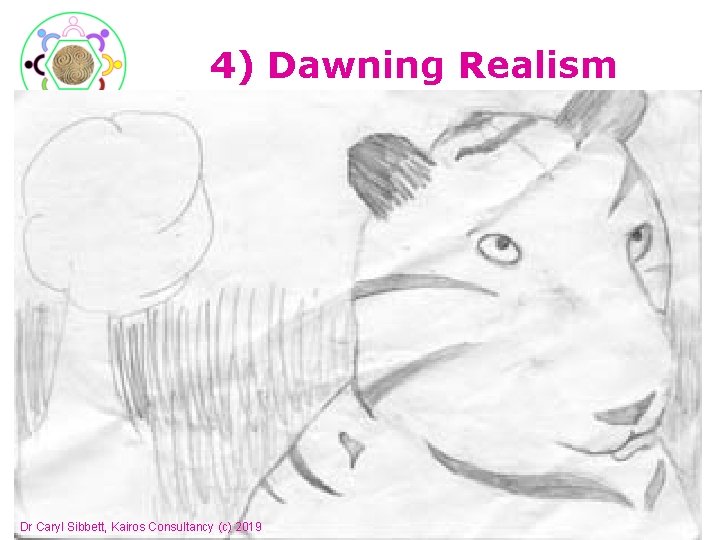
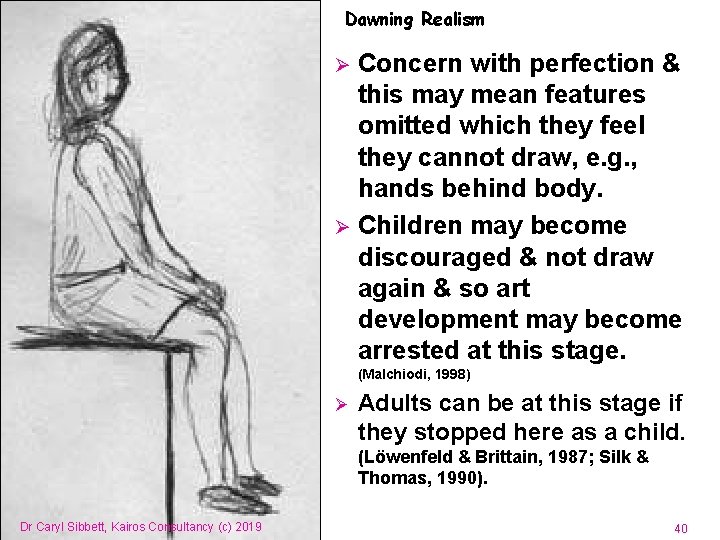
4) Dawning Realism (Löwenfeld & Brittain, 1982, 36 -40) § c 9 - 12 yrs. Peers > importance; “Gang Age”; § Pre-Adolescent Stage (10 -13) (Hurwitz & Day, 1995) § Influenced by peers, TV & comic heroes etc. Increased detail. Values are developing. Want to do it “right”. Ø > self-conscious; <openness to show art § Symbolize rather than represent objects, attention to details, draw small, interest in proportions & depth. Dr Caryl Sibbett, Kairos Consultancy (c) 2019 38
4) Dawning Realism Dr Caryl Sibbett, Kairos Consultancy (c) 2019 39
Dawning Realism Concern with perfection & this may mean features omitted which they feel they cannot draw, e. g. , hands behind body. Ø Children may become discouraged & not draw again & so art development may become arrested at this stage. Ø (Malchiodi, 1998) Ø Adults can be at this stage if they stopped here as a child. (Löwenfeld & Brittain, 1987; Silk & Thomas, 1990). Dr Caryl Sibbett, Kairos Consultancy (c) 2019 40
4. Dawning Realism § More movement from egotistic thinking. § Awareness of space between baseline and sky. 3 -d appearance, shading. § > empathy, understanding of interrelationships, cause & effect. § Interested in depicting realistic elements in the art. Movement away from schematic representations. First attempts at perspective. More accurate colours (leaves may be more than one green). More differentiated figures. Dr Caryl Sibbett, Kairos Consultancy (c) 2019 41
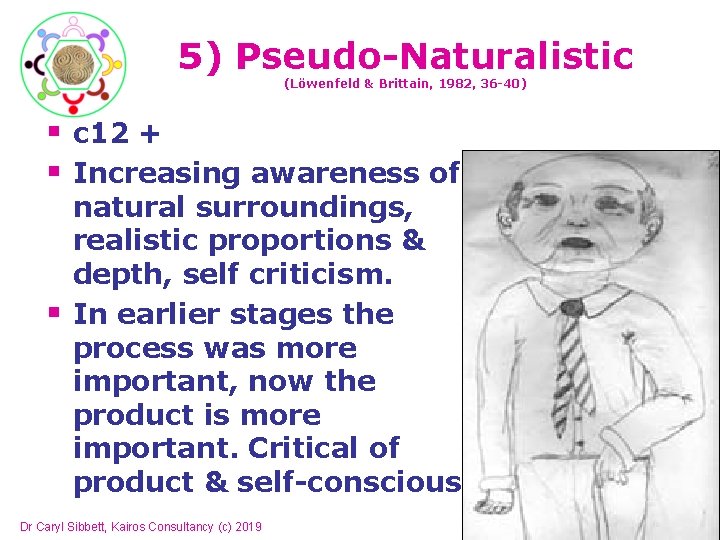
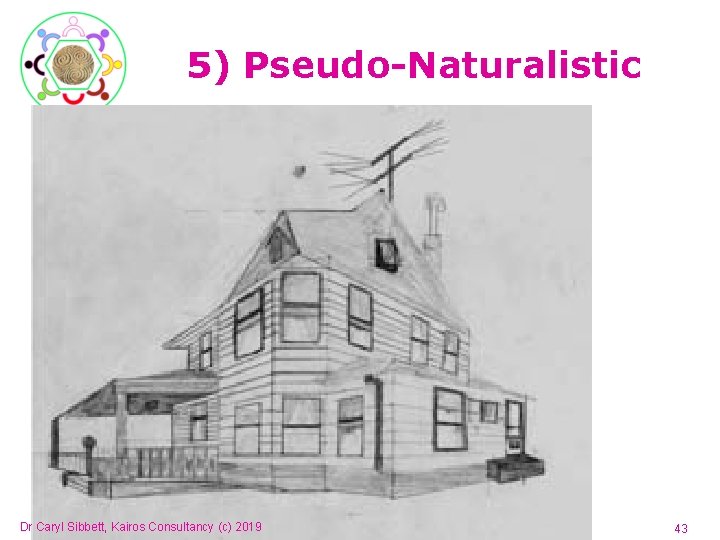
5) Pseudo-Naturalistic (Löwenfeld & Brittain, 1982, 36 -40) § c 12 + § Increasing awareness of natural surroundings, realistic proportions & depth, self criticism. § In earlier stages the process was more important, now the product is more important. Critical of product & self-conscious. Dr Caryl Sibbett, Kairos Consultancy (c) 2019 42
5) Pseudo-Naturalistic Dr Caryl Sibbett, Kairos Consultancy (c) 2019 43
6. Crisis of Adolescence (Löwenfeld 1947); Löwenfeld & Brittain, 1982, 36 -40) § Can be resistance to drawing. By c 13 -14 they can use perspective more accurately and include greater detail. Greater technical competency. Able to create abstract images. They may use figures, animals and environments not just for themselves, but to symbolise and communicate ideas about issues, personal philosophies and themselves. Teenagers commonly draw in stage 4 style (Malchiodi, 1998). Dr Caryl Sibbett, Kairos Consultancy (c) 2019 44
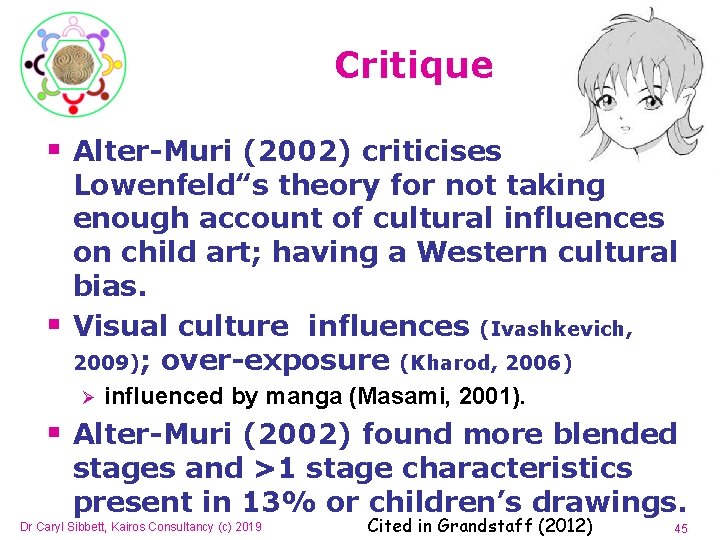
Critique § Alter-Muri (2002) criticises Lowenfeld‟s theory for not taking enough account of cultural influences on child art; having a Western cultural bias. § Visual culture influences (Ivashkevich, 2009); over-exposure (Kharod, 2006) Ø influenced by manga (Masami, 2001). § Alter-Muri (2002) found more blended stages and >1 stage characteristics present in 13% or children’s drawings. Dr Caryl Sibbett, Kairos Consultancy (c) 2019 Cited in Grandstaff (2012) 45
Critique § Thompson (2003) found that children more likely these days to represent things viewed from secondary sources, rather than seen directly, e. g. TV, movies… (Thompson, 2003). Cited in Grandstaff (2012) Dr Caryl Sibbett, Kairos Consultancy (c) 2019 46
Visual or Haptic § either: § Visual artist experiences world as a more literal observer. The main concern is careful representation of detail of the outward appearance. Inspired by visual stimuli. Feel as if they are looking at their art from the outside. Views colour as realistic and changing depending on external conditions. § or Dr Caryl Sibbett, Kairos Consultancy (c) 2019 47
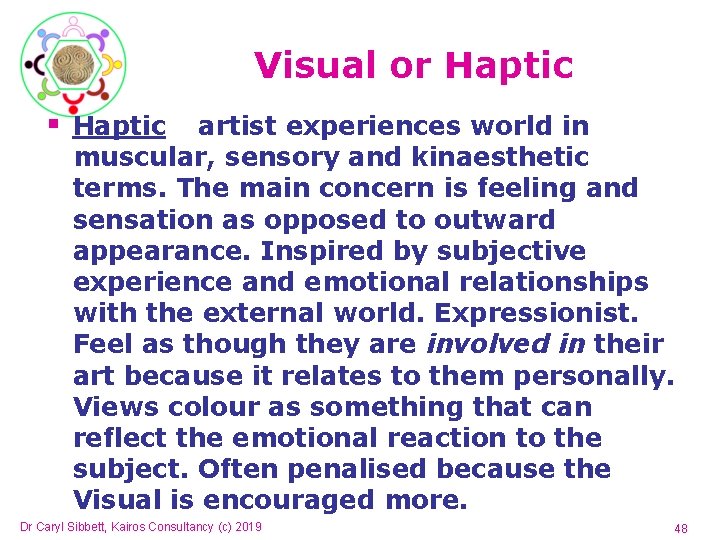
Visual or Haptic § Haptic artist experiences world in muscular, sensory and kinaesthetic terms. The main concern is feeling and sensation as opposed to outward appearance. Inspired by subjective experience and emotional relationships with the external world. Expressionist. Feel as though they are involved in their art because it relates to them personally. Views colour as something that can reflect the emotional reaction to the subject. Often penalised because the Visual is encouraged more. Dr Caryl Sibbett, Kairos Consultancy (c) 2019 48
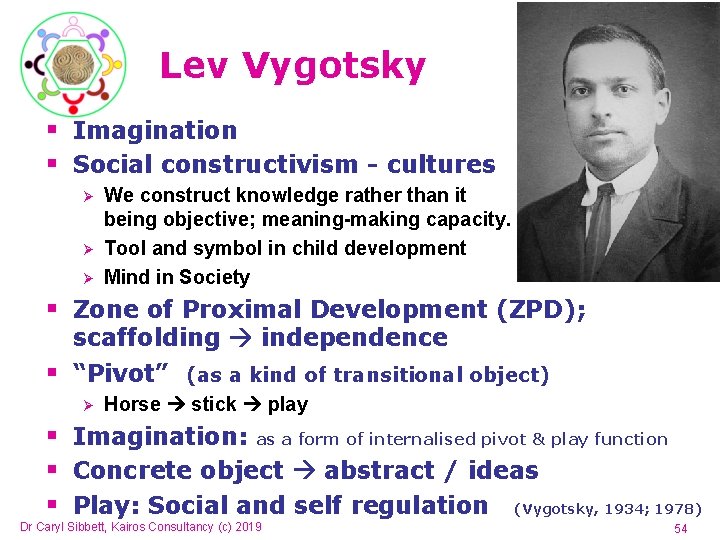
Lev Vygotsky § Imagination § Social constructivism - cultures Ø Ø Ø We construct knowledge rather than it being objective; meaning-making capacity. Tool and symbol in child development Mind in Society § Zone of Proximal Development (ZPD); scaffolding independence § “Pivot” (as a kind of transitional object) Ø Horse stick play § Imagination: as a form of internalised pivot & play function § Concrete object abstract / ideas § Play: Social and self regulation (Vygotsky, 1934; 1978) Dr Caryl Sibbett, Kairos Consultancy (c) 2019 54
Working with DIVERSITY Dr Caryl Sibbett, Kairos Consultancy (c) 2019 67