
Working With Deaf and Hard of Hearing English
![“ “It fills me with astonishment to read […] such assertions as these: ‘The](https://slidetodoc.com/presentation_image/36d86886edf5ac8232e485c09ce703e9/image-10.jpg "“ “It fills me with astonishment to read […] such assertions as these: ‘The")
![“ We have a parent group at [a state residential school] that’s […] actively](https://slidetodoc.com/presentation_image/36d86886edf5ac8232e485c09ce703e9/image-12.jpg "“ We have a parent group at [a state residential school] that’s […] actively")
![Bilingual-Bicultural • E. Drasgow asserts that “exposure to an artificial language […] results in](https://slidetodoc.com/presentation_image/36d86886edf5ac8232e485c09ce703e9/image-27.jpg "Bilingual-Bicultural • E. Drasgow asserts that “exposure to an artificial language […] results in")
- Slides: 35
Working With Deaf and Hard of Hearing English Language Learners
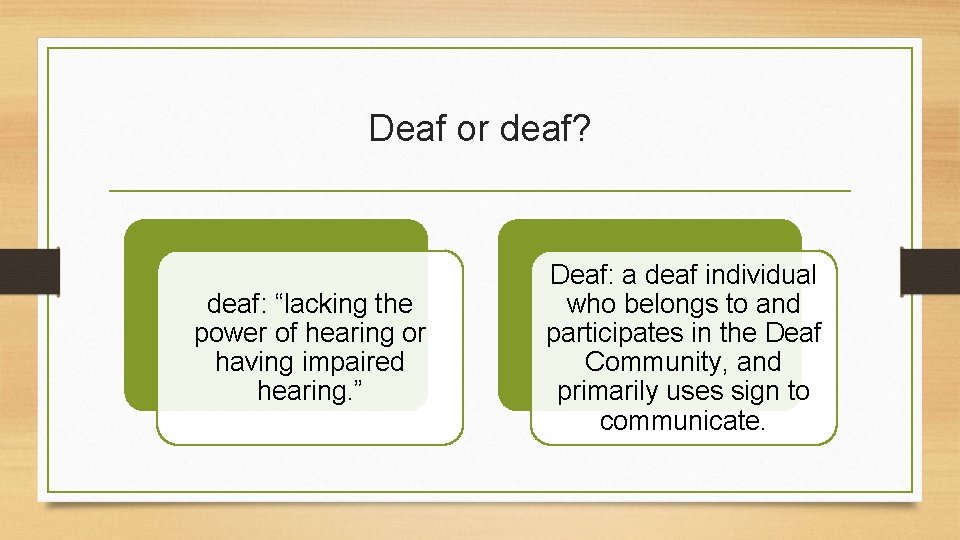
Deaf or deaf? deaf: “lacking the power of hearing or having impaired hearing. ” Deaf: a deaf individual who belongs to and participates in the Deaf Community, and primarily uses sign to communicate.
Is Deafness a Disability? • As of 2013 hearing loss affects about 1. 1 billion people to some degree. • Traditionally, deafness has been treated as an impairment or disability. • However, those belonging to the Deaf community often do not consider themselves disabled. • They instead consider themselves as part of a social and linguistic community. • This community is known in ASL as “Deaf-World. ”
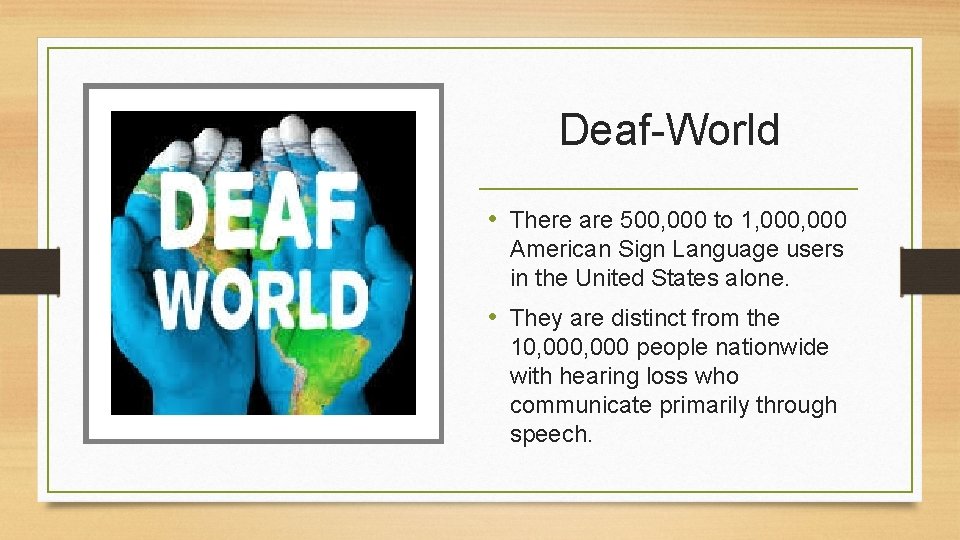
Deaf-World • There are 500, 000 to 1, 000 American Sign Language users in the United States alone. • They are distinct from the 10, 000 people nationwide with hearing loss who communicate primarily through speech.
• Historically, the deaf were isolated from one another and very few learned to communicate with others. American Sign Language : History • There was a notable exception in the case of Martha’s Vineyard, where the occurrence of deafness was twenty times the national average. An islandwide sign language was adopted to accommodate the large Deaf population. • Martha’s Vineyard sign language was an early contributor to what would become American Sign Language.
Gallaudet and Clerc: Fathers of ASL • Thomas Hopkins Gallaudet was a hearing divinity student hired by the family of Alice Cogswell, a young girl who lost her hearing. • Gallaudet traveled to Europe to learn how other countries educated their deaf. • In France he met Laurent Clerc, a Deaf teacher, who agreed to come to the United States to found a school for the Deaf. • The American School for the Deaf was founded in 1817 and was the first permanent school for the deaf on the continent. It is still in service today.
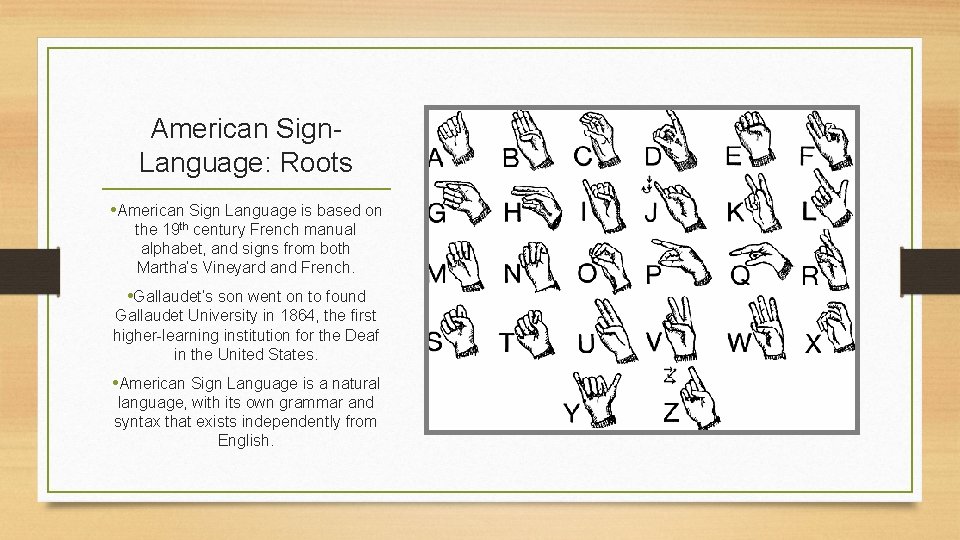
American Sign. Language: Roots • American Sign Language is based on the 19 th century French manual alphabet, and signs from both Martha’s Vineyard and French. • Gallaudet’s son went on to found Gallaudet University in 1864, the first higher-learning institution for the Deaf in the United States. • American Sign Language is a natural language, with its own grammar and syntax that exists independently from English.
Residential Schools • This was not only the beginning of American Sign Language, but also the beginning of residential schools for the deaf in The United States. • Until the push for mainstreaming deaf and hard of hearing children in the last thirty odd years, one of the only options for educating a deaf child was to send them to a residential school. • For many generations of Deaf students, residential schools were places where their Deaf identity was formed, both by their exposure to ASL and their validation as members of the Deaf community, united by their common experiences.
Evolution of Deaf Education • In the 19 th century, the language of instruction was ASL, with large percentages of the teachers at residential institutions being Deaf themselves. In 1850, 36. 6% of the teachers in deaf education programs were Deaf themselves; in 1863, 40. 8% were Deaf. • This changed in 1880 with the International Congress on Deafness in Milan. At this conference, hearing educators of deaf students decided that sign languages of any type would prevent the ability to learn speech and language skills. • Despite protests from Deaf adults, oralism persisted in the United States until the 1970 s.
“ “It fills me with astonishment to read […] such assertions as these: ‘The less the deaf are associated with the deaf the better for them in every way, ’ and ‘It would be better for a deaf child if he didn’t know that another deaf child existed in the world!’” These words were written in 1886 by deaf educator George Wing, but they are also reminiscent of current attitudes towards deaf education. ”
Audism • Audism: placing a higher value on spoken English and on oral/aural education. • Audism affects teacher preparation and practices- impeding the achievement of deaf/Ho. H students through lowered expectations.
“ We have a parent group at [a state residential school] that’s […] actively trying to encourage the school to be more on the level of the hearing schools and promoting a curriculum that is the same to teach our deaf children as if they’re normal and not ‘Oh, they’re deaf, they can’t do this or we don’t expect that. ’ I mean, their expectations can be too low. Research into Deaf parents with Deaf children echoes these fears, along with worries that not being exposed to ASL in an academic context devalues the language in the eyes of the students. ”
Deaf Education and Audism • Though various methods have been tried over the years, the end goal has always remained the same: for deaf students to achieve fluency in reading and writing (and often speaking) English. For the last hundred years or so, formal deaf education was entirely oral and focused on speech reading. • ASL was long forbidden in many residential schools for the deaf, because it was viewed as a “contagious menace” by educators, and who decided without research that it would inhibit the acquisition of speech.
Manually Coded English • It was long suspected that knowledge of ASL was a barrier to learning spoken English. Around 1960, when ASL was finally considered a “real” language, manually coded English (i. e. signed English with the addition of signs to include spoken English syntax and morphology) became the norm in deaf education classrooms. • Manually coded English follows English word order and requires signing each individual word, including word endings, articles, and conjunctions.
Manually Coded English: Failure • Manually coded English’s supporters were disappointed in its success compared to ASL. This is likely due to several reasons: 1. . First and foremost, ASL is a natural sign language. Unlike signed codes, a natural sign language is “an entity unto itself, with its own grammatical rules […] which are in some cases quite different from those of a spoken language. ” Conversely, signed codes are “by definition parasitic on spoken language to a greater or lesser extent 2. Signed codes are also ineffective at transmitting the rhythm of the English language. In spoken English there is more time allocated to content words than to function words, whereas in signed codes, the content signs and the auxiliary signs (such as inflectional morphemes) are equally stressed.
Academic Achievement • Despite the widespread use of signed code, the scholastic achievement of deaf and hard of hearing students remains low. Even though manually coded English (MCE) was supposed to help deaf students achieve fluency in English, the average reading achievement of deaf high school graduates in 1983 was at a third or fourth grade level, and math scores were below a seventh grade level. • Low expectations of deaf and hard of hearing students lead to lower academic performance and low self-esteem. Teachers who have been trained to believe that deaf students are mentally deficient often unknowingly pass this belief on to their students.
Deaf Education Teachers • Teachers of deaf and hard of hearing students have “low expectations of deaf students and view them as unable or slow to learn. ” • An additional point of friction in the education of deaf children is that hearing people have historically been in control, and therefore have emphasized the importance of spoken English in the “successful” integration of deaf children into the hearing world. • Another factor complicating English language learning in Deaf students is the lack of knowledge among hearing teachers as to the complexities of ASL.
“ These special educators, with no experience of growing up Deaf, think they understand the education of deaf children and are able to assess our children to figure out what the future holds for them in this world. - G. E. Mowl, author and Deaf parent of a Deaf child. ”
Deaf Students in the English Classroom
Deaf Education Today • A deaf education classroom usually employs one of two methods: the oral approach, where sign language is not used in any form; and the signed approach, which uses either manually coded English or ASL. • Both types assume unusual cognitive development patterns and emphasize English speech and language skills. • While learning to read and write English is an important part of a deaf child’s education, ASL is an important part of their linguistic, cognitive, and cultural development.
Deaf Culture and ASL • The Deaf community in the United States is defined by its use of ASL, a factor which unites people of diverse backgrounds in a much different way than a spoken language. • While the same could be said about most languages, ASL is different in that a deaf child of hearing parents could experience cultural conflict within their family, up to the point that the family might not even have a language in common without the teaching of ASL to the parents and English to the child.
Multi-cultural Deaf Students • Deaf and hard of hearing children are not homogenous; they come from a variety of linguistic backgrounds and levels of familiarity with spoken English. They may also come into the classroom with knowledge of different sign languages. • Most deaf education pedagogy does not consider variation in the language and culture of the child and their family. • Teachers must be able to “critically analyze, select, adapt, or redesign curriculum practices that will help children make connections between the varieties of language used at home, in the community, and at school. ”
ASL and Learning English • While the language learning histories of Deaf students are very different than those of a hearing English language learner, they nevertheless make similar errors and can therefore benefit from many of the same techniques used with hearing ELLs. • While it is a common belief that deaf students’ difficulties in acquiring English stem from interference from ASL, this is not held up by research. A study investigating similarities and differences in written errors of deaf and ESL students found only three language errors that could possibly be contributed to ASL.
Students’ Attitudes Towards English • A deaf student’s attitude towards learning English is often complicated by several factors: their difficulty with acquiring the language combined with the prestige of English in greater society can lead to internal conflict. • The fact that the language they are most likely to have fluency in (ASL) is a minority language and is less valued in educational contexts is also difficult. • Since ASL was once so devalued by mainstream academia, it has affected the way that deaf students perceive themselves as learners. Bicultural elements must be incorporated into their curriculum for deaf students to perceive themselves as fully competent learners.
Differing Attitudes • Since students are coming into an English classroom with a variety of views about ASL and English, teachers should be prepared for a mix of opinions among their deaf students, and even conflicting opinions within an individual. • “One cannot assume that deaf students have been exposed to ASL or predict with any certainty what their language attitudes will be. One can predict, however, that English is likely to have been an issue for them for most of their lives. ” • Because of this, teachers must also be aware of their own biases, and how they present the learning of English to their students.
Complications • Language acquisition in children with severe hearing loss is complicated because in most cases, they simply cannot perceive the majority of spoken linguistic data, and it therefore cannot apply that input into their concept of grammar and convert it into comprehensible output. • Unlike students who have fluency in another spoken language before attempting to learn English, Deaf ASL users cannot initially be taught the grammar of English, because they do not have the vocabulary to talk about its use. • Metalinguistic skills must first be developed in ASL, then similarities and differences noted in the second language (English).
Bilingual-Bicultural • E. Drasgow asserts that “exposure to an artificial language […] results in an impoverished, idiosyncratic, or incomplete language system. ” • Many deaf educators feel similarly and have begun to advocate for a bilingual/bicultural approach to teaching- where ASL is taught as the first or native language, and English as a second language. • This stance is strengthened by the fact that studies show deaf children who are exposed to ASL at an early age acquire it in the same way that hearing children acquire spoken language.
Deaf Child, Hearing Parent • Roughly 95% of deaf children are born to hearing parents. This means that many children are theoretically exposed to English, but because so much of spoken English is inaccessible to a deaf/Ho. H child, it does not actually function as a mother tongue. • This means that hearing parents are often scared about what impact being deaf will have on their child’s future. It is important that these parents are exposed to successful adult Deaf role models to allay their fears. • Ideally, with exposure to the Deaf community, parents will understand that ASL does not interfere with English acquisition, and that ASL provides another avenue of communication between them and their children.
The Way Forward • While experts remain unconvinced about the effectiveness of bilingual/bicultural models, they generally agree that there must be parental acceptance and involvement, administrative support, and more Deaf adults involved in every level; from role models in the classroom to being part of administrative and educational policy decisions. • Deaf adults are the product of the deaf education system, and as such their input is incredibly valuable in determining the success of future generations of deaf students.
Accepting Deaf Culture • Part of the work that needs to be done is at a cultural level, with the Deaf community being recognized not as “a loosely knit group of audiologically impaired individuals” but as “a linguistic and cultural minority whose complex history, language, and literature warrant sustained recognition. ” • As teachers, we can do this by including Deaf culture in our multicultural classrooms, and changing our language surrounding deaf students from the pathological to the practical.
Redefining Deaf Education • Deaf education professionals and parents of deaf and hard of hearing students are often frustrated, believing that their students are under-prepared and undereducated compared to their hearing peers. • Humphries and Allen propose a new approach: moving away from the “special education” school of thought that assumes deaf and hard of hearing children are deficient or developmentally delayed. Instead, understand that deaf/Ho. H children are emergent language learners that require environments similar to other ELLs.
Integrating TESOL and ASL • As TESOL teachers who might work with deaf and hard of hearing students, we must recognize and utilize the rich linguistic and cultural resources they already have, using them as building blocks for English language literacy. • An example of English being aided by ASL: Fingerspelling, an important component in literacy development for deaf and hard of hearing children. Like a hearing child sounding out the words, it serves as a tool to decode English words, and can also be used as a placeholder until more context is given to identify the word.
Successfully Bilingual: CODA • Deaf children of Deaf families, and hearing children of Deaf adults (referred to as “Child of Deaf Adult” or CODA) that use ASL in the home tend to be more successful at reading and writing. These families produce functionally bilingual children in ASL and English.
Scientific Advances • We are now identifying hearing loss at an earlier age than ever before. Prior to the 21 st century, children were often not discovered to be deaf or hard of hearing until parents realized their child wasn’t learning to talk, around age two or three. • Advances in technology and Early Detection and Hearing Intervention (EHDI) programs mean that deaf children are being diagnosed younger than ever. This is good news for their linguistic development- the sooner they are given linguistic input that they can process (e. g. ASL) the higher their chance of academic success.
Our Goal • As TESOL teachers, we can aid deaf educators in creating bilingual classrooms, drawing on our experiences and research-based practices. • Working with deaf educators, we can modify successful practices used with hearing ELLs to better serve all deaf and hard of hearing students, allowing them to gain fluency in written English.