
Working towards building a robust implementation technology for
Working towards building a robust implementation technology for the Revised Code of Practice Athanasios C. Thanopoulos President Hellenic Statistical Authority - ELSTAT European Conference on Quality in Official Statistics Krakow 26 -29 June 2018
1. Introduction • The recent revision of the Code of Practice (Co. P) was the result of an effort aiming to adjust and/or fine-tune the existing text of the Code to new facts related to the data revolution and to the forthcoming challenges stemming thereof. 2
1. Introduction This has to be coupled with a solid implementation and monitoring framework through tools that would measure implementation of the Co. P in an: a. Objective b. Uniform c. Coordinated d. Transparent manner, in order to fully benefit from the momentum of the recent revision. 3
1. Introduction The main channel used so far for the implementation of the Co. P was the incorporation to the national legal order. Typically, this would take either: (a) a direct form, i. e. , mot-a-mot transposition of the text of the Co. P into the national Statistical Law, or, (b) an indirect form, i. e. , through legal instruments such as Commitments on Confidence in Statistics (Co. C). 4
1. Introduction Salient drawbacks • of (a) : The Co. P is not meant to be directly used as stricto sensu legal text, • of (b) : It requires updating and adaptation, it may have become (partly) obsolete or irrelevant. Co. Cs are implementing apparata. Neither legal texts regulating Official Statistics are meant to be altered with a high frequency, nor is it the case that the Co. P gets revised in a pre-scheduled and linear manner (with respect to time and with respect to the importance of its revised text), 5

1. Introduction This presentation should address the following questions: • Is the above implementation (and monitoring) technology still relevant in light of the revised code? • Have there been identified inherent inconsistencies/ conflicts that weaken the effectiveness of this implementation framework? • What are the desired properties that an implementation / monitoring technology should have in order to be robust to future revisions of the Co. P? 6
2. Implementation of Co. Cs Implementation of the Co. P can have different shades: • Strong Co. C • Standalone Co. C • Weak Co. C • Pick what could make your Co. C • No Co. C. 7
2. Implementation of Co. Cs I order the strength of the implementation concept in terms of: • How “solid” and separate, as a text, it appears in the law • The political level at which a statement is made • The level of concreteness of actions it provides for (as opposed to a statement about adherence to broad principles) 8
3. Helicopter view of Co. Cs • We will confine ourselves on the first three shades of green since there is not enough information on the other two categories in order to engage in any meaningful comparison. • A wide array of differences both at the level of subjects, the level of granularity these subjects are dealt with, but also with respect to other characteristics, such as time of adoption. 9
3. Dimensions of variation So, within these shades of green, one could see variations broken down even further. The observed wide array of variation takes place with respect to the following desirable properties: Degree of Commitment (PA) Level of political skin-in-the-game (PA) Time of Adoption (-) Coverage of Subjects (R) Granularity and concreteness in the treatment of different Subjects (R) • Binded-ness and Verifiability (R) • • • PA stands for (“Promoting Awareness”) R stands for “Restrictiveness” 10

"STAND-ALONE" COMMITMENTS ON CONFIDENCE (Co. C) STATUS AS OF JUNE 2018 COUNTRY GREECE TYPE OF Co. C SUMMARY OF COMMITMENTS specific commitments -respect international and European standards - guarantee and defend professional independence of ELSTAT and ELSS and promote it to the public -support ELSTAT in upholding public confidence and defend Greek statistics - secure adequate and stable resources - achieve compliance of ELSS with the Co. P - further reform the statistical governance system in Greece (replace the collective body of ELSTAT by GPAC) - report annually to the Hellenic Parliament and to the European Commission on the implementation of the Co. C -reestablish the Co. C, if needed TIME OF ADOPTION/ PRESENTATION/ APPROVAL SIGNATORY Signed by the Hellenic Government. 29/2/2012 (adopted) Countersigned by a member of European Commission (the only MS) Includes an Annex with very detailed improvement actions. 11

"STAND-ALONE" COMMITMENTS ON CONFIDENCE (Co. C) STATUS AS OF JUNE 2018 COUNTRY SWEDEN TYPE OF Co. C SUMMARY OF COMMITMENTS specific commitments - commitment to further develop the system of official statistics by strengthening the coordination of the statistical system and the quality follow -up of statistics - Ordinance clarifying the coordination responsibility of Statistics Sweden - establishing a council for the official statistics that will assist Statistics Sweden in its coordination tasks, requiring from all government agencies producing official statistics to evaluate the quality of these statistics Sweden to report annually to the Government on the evaluation findings - commitment to be prepared to take measures to maintain confidence in statistics TIME OF ADOPTION/ PRESENTATION/ APPROVAL 14/9/2016 (presented) SIGNATORY Presented by the Government 12
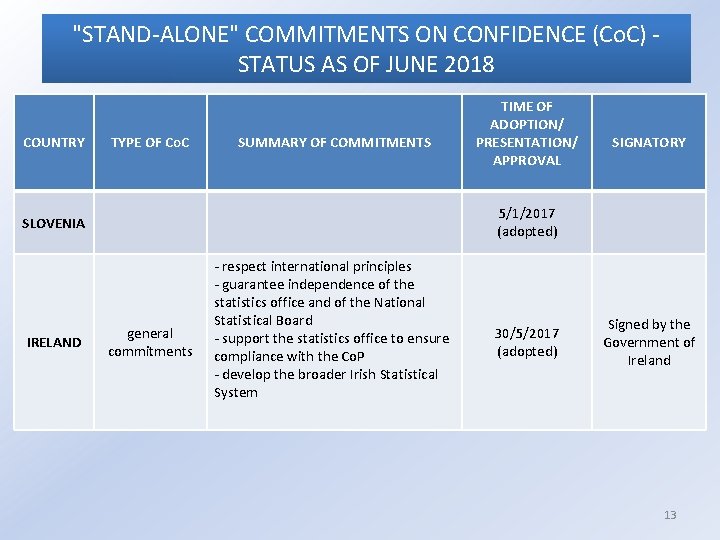
"STAND-ALONE" COMMITMENTS ON CONFIDENCE (Co. C) STATUS AS OF JUNE 2018 COUNTRY TYPE OF Co. C SUMMARY OF COMMITMENTS SIGNATORY 5/1/2017 (adopted) SLOVENIA IRELAND TIME OF ADOPTION/ PRESENTATION/ APPROVAL general commitments - respect international principles - guarantee independence of the statistics office and of the National Statistical Board - support the statistics office to ensure compliance with the Co. P - develop the broader Irish Statistical System 30/5/2017 (adopted) Signed by the Government of Ireland 13
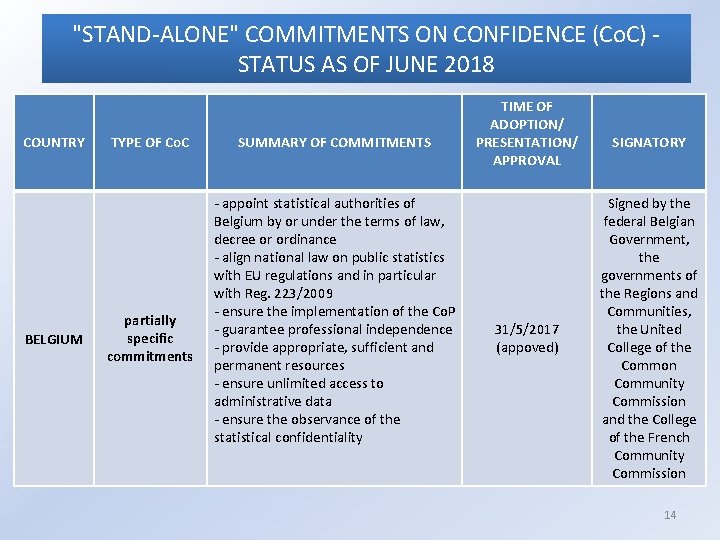
"STAND-ALONE" COMMITMENTS ON CONFIDENCE (Co. C) STATUS AS OF JUNE 2018 COUNTRY BELGIUM TYPE OF Co. C partially specific commitments SUMMARY OF COMMITMENTS - appoint statistical authorities of Belgium by or under the terms of law, decree or ordinance - align national law on public statistics with EU regulations and in particular with Reg. 223/2009 - ensure the implementation of the Co. P - guarantee professional independence - provide appropriate, sufficient and permanent resources - ensure unlimited access to administrative data - ensure the observance of the statistical confidentiality TIME OF ADOPTION/ PRESENTATION/ APPROVAL 31/5/2017 (appoved) SIGNATORY Signed by the federal Belgian Government, the governments of the Regions and Communities, the United College of the Common Community Commission and the College of the French Community Commission 14
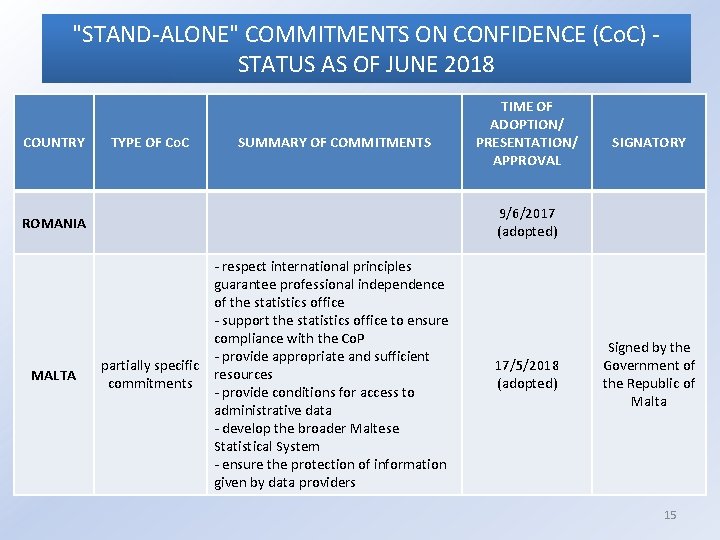
"STAND-ALONE" COMMITMENTS ON CONFIDENCE (Co. C) STATUS AS OF JUNE 2018 COUNTRY TYPE OF Co. C SUMMARY OF COMMITMENTS SIGNATORY 9/6/2017 (adopted) ROMANIA MALTA TIME OF ADOPTION/ PRESENTATION/ APPROVAL - respect international principles guarantee professional independence of the statistics office - support the statistics office to ensure compliance with the Co. P - provide appropriate and sufficient partially specific resources commitments - provide conditions for access to administrative data - develop the broader Maltese Statistical System - ensure the protection of information given by data providers 17/5/2018 (adopted) Signed by the Government of the Republic of Malta 15
4. Remarks • Why so much variation? • Different statistical systems, whose operation hinges on different budgets, but also different philosophies with respect to the functioning of the state, face different challenges at different points in time. • Restrictiveness (and the dimensions it breaks down to) of a Co. C is a key concept. It constitutes the dimension along which an honor code (HC) is essentially transcribed to a legal text. • The level of concreteness is important because it may define “regions” where an Honor Code might be more/less restrictive by the legal framework. 16
4. Remarks From an institutional standpoint, who, ultimately, becomes in charge of verifying and certifying the degree to which the provisions in the Co. C are observed or not observed? 17
4. Areas of Interest • In particular, there are two cases: • The Co. P is less restrictive than the law. Trivial case. By definition the Co. P is an ambitious text and aspires to pave the way for the highest professional standards in statistical practice. There is no point of writing a Code of Honor if it merely translates what it is already stipulated in the law. Interesting case: an enforcement mechanism for issues not stipulated in the Law • If the Co. P is more restrictive than the law. Situation consistent with a forward looking statistical system aspiring to go well and beyond what is stipulated by law. Need for devising a way to make it binding and enforceable, outside the legal artillery and its paraphernalia. - Peer reviews - Co. Cs (? ) 18
5. Fundamental tradeoff The stronger the implementation concept, and the more R the actions to be observed are stipulated by a concrete law, the more a Statistics Honor Code becomes a matter to be decided at the courts. 19
6. Inconsistencies • This could point out to an internal inconsistency: • The ESS, according to the Co. P is a self-regulatory system. • “The European Statistics Code of Practice is the cornerstone of the common quality framework of the European Statistical System. It is a self-regulatory instrument and is based on 16 Principles covering the institutional environment, statistical processes and statistical outputs. ” (Preamble) 20
6. Inconsistencies Meaning that: • Adherence to all its principles is a sine-qua-non condition for its existence (violating statistical confidentiality – you are out of business. Same for Co. P 6. 7: cornerstone of the perception of independence) • There should be no need for an external “forcing” mechanism (such as courts) to oblige to adhere to the Co. P. The perception of an NSI’s peers is sufficient to establish or not credibility. 21
6. Pitfalls (ct’d) • Transcription of Co. P Principles into legal text and over-specification of these principles in the law, attributes a normative character to the Co. P. • Doing so in a varying way with respect to the PA and R properties we end up eroding its universal character and, ultimately, its credibility. • In our effort to enforce the Co. P , a manifestly and self-proclaimed as “self-regulatory” Honor Code, and subsequently have Governments committing to adhere to it, we end up choosing too restrictive frameworks as implementing apparata that, at the end of the day, lead to a de-facto limitation of the self-regulatory nature of the ESS, since this type of competence is assigned to the regular Courts. 22
CONCLUSION Co. Cs: • If considered apt, they should have a(n almost) uniform subject coverage and uniform level of granularity in the issues they deal with. • Ideally, they should refer to the same level of political skin-inthe-game. • Variations in the level of implementability / enforceability erode the credibility of a Co. C as an implementation tool. 23

Thank you www. statistics. gr @Statistics. GR 24
- Slides: 24