
Working Together An EMG Decomposition Users Group XVIIth




- Slides: 47
Working Together: An EMG (Decomposition) User’s Group XVIIth Congress of the International Society for Electrophysiology and Kinesiology Workshop: EMG Decomposition Copyright Edward A. Clancy and Kevin C. Mc. Gill, 2008. Some rights reserved. Content in this presentation is licensed under a Creative Commons Attribution-Noncommercial. Share Alike 3. 0 License. This license is more fully described at: http: //creativecommons. org/licenses/by-nc-sa/3. 0/. EAC 08– 100
Purpose of a User’s Group • Develop SHARING of data, software, etc. – Data, annotation formats – “Blue Ribbon” annotations, comparison – Decomposition accuracy (overall & individual MUAPT) – Post-processing of decomp data – Quality control for all the above! – IRB, intellectual property issues EAC 08– 101
Why Share Data, Software, Etc. ? (“Pros”) • Avoid repeated efforts • Gain from research of others • Spend time on research advances, not incorporating past knowledge • Advance collaboration (virtual labs) • Develop community that shares well beyond data, software • Get others to use, cite your research EAC 08– 102
Data/Software Sharing Challenges (“Cons”) • Do I trust the quality of the work? • Will other data/software fit my needs? • Lack of standards to exchange data, annotations (Some exist for data!) • Different processing environments – MATLAB is common to many • Much harder to prepare a shared tool – Documentation, tool organization, ease of use by others • Credit for my work? • Will others use my work competently? • Proprietary concerns (for businesses & academics!) EAC 08– 103
Who Should Participate? • Contributors – Any who agree to open source model – Academic & commercial • Users – Open to all, including those NOT contributing! • Q: What makes contribution beneficial? EAC 08– 104
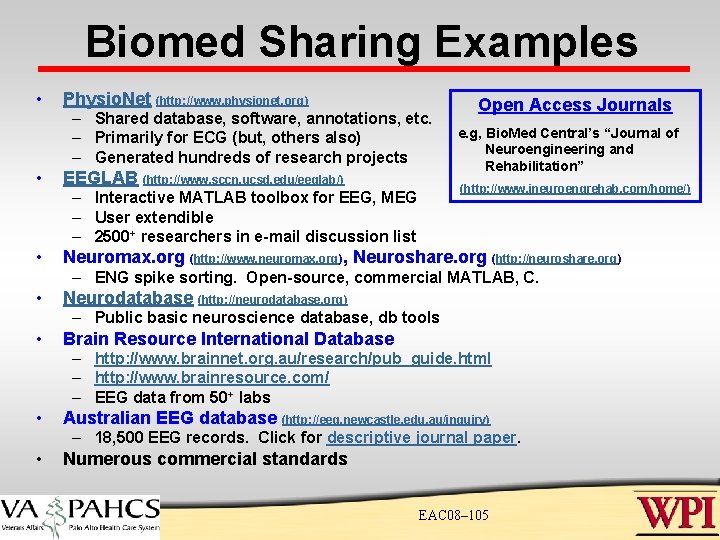
Biomed Sharing Examples • Physio. Net (http: //www. physionet. org) – Shared database, software, annotations, etc. – Primarily for ECG (but, others also) – Generated hundreds of research projects • EEGLAB (http: //www. sccn. ucsd. edu/eeglab/) e. g, Bio. Med Central’s “Journal of Neuroengineering and Rehabilitation” (http: //www. jneuroengrehab. com/home/) – Interactive MATLAB toolbox for EEG, MEG – User extendible – 2500+ researchers in e-mail discussion list • Open Access Journals Neuromax. org (http: //www. neuromax. org), Neuroshare. org (http: //neuroshare. org) – ENG spike sorting. Open-source, commercial MATLAB, C. • Neurodatabase (http: //neurodatabase. org) – Public basic neuroscience database, db tools • Brain Resource International Database – http: //www. brainnet. org. au/research/pub_guide. html – http: //www. brainresource. com/ – EEG data from 50+ labs • Australian EEG database (http: //eeg. newcastle. edu. au/inquiry) – 18, 500 EEG records. Click for descriptive journal paper. • Numerous commercial standards EAC 08– 105
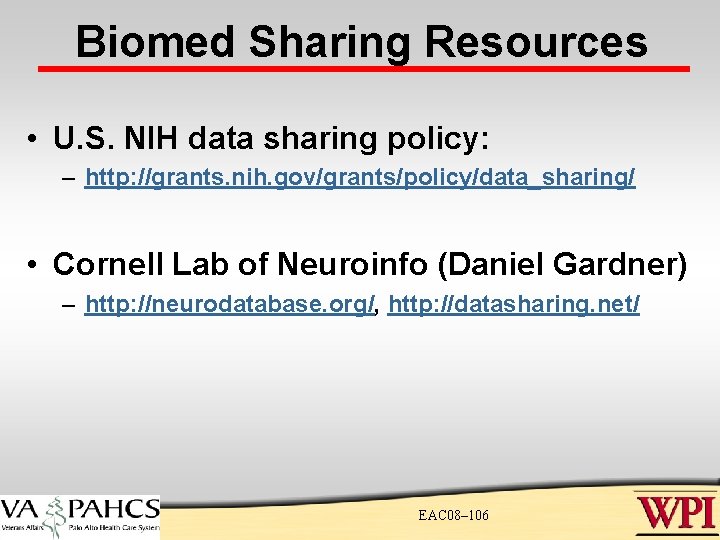
Biomed Sharing Resources • U. S. NIH data sharing policy: – http: //grants. nih. gov/grants/policy/data_sharing/ • Cornell Lab of Neuroinfo (Daniel Gardner) – http: //neurodatabase. org/, http: //datasharing. net/ EAC 08– 106
Sharing Data EAC 08– 107
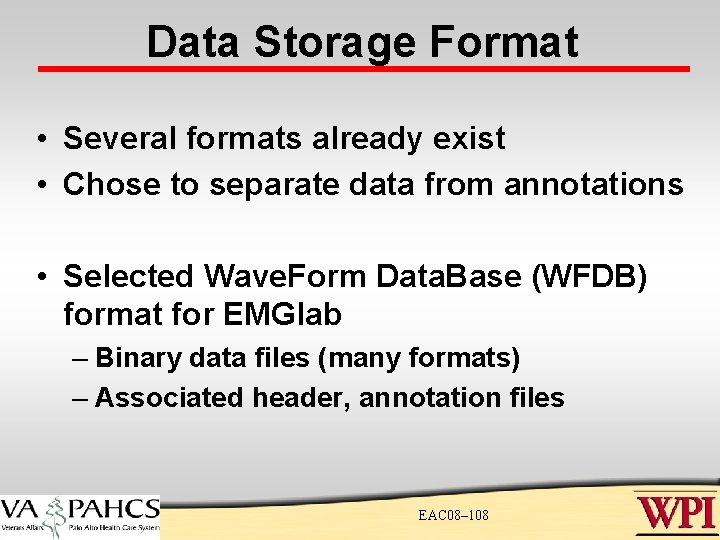
Data Storage Format • Several formats already exist • Chose to separate data from annotations • Selected Wave. Form Data. Base (WFDB) format for EMGlab – Binary data files (many formats) – Associated header, annotation files EAC 08– 108
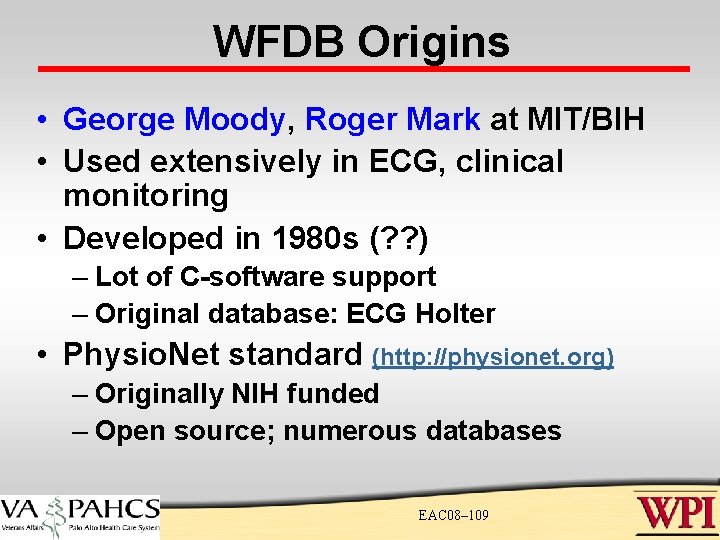
WFDB Origins • George Moody, Roger Mark at MIT/BIH • Used extensively in ECG, clinical monitoring • Developed in 1980 s (? ? ) – Lot of C-software support – Original database: ECG Holter • Physio. Net standard (http: //physionet. org) – Originally NIH funded – Open source; numerous databases EAC 08– 109
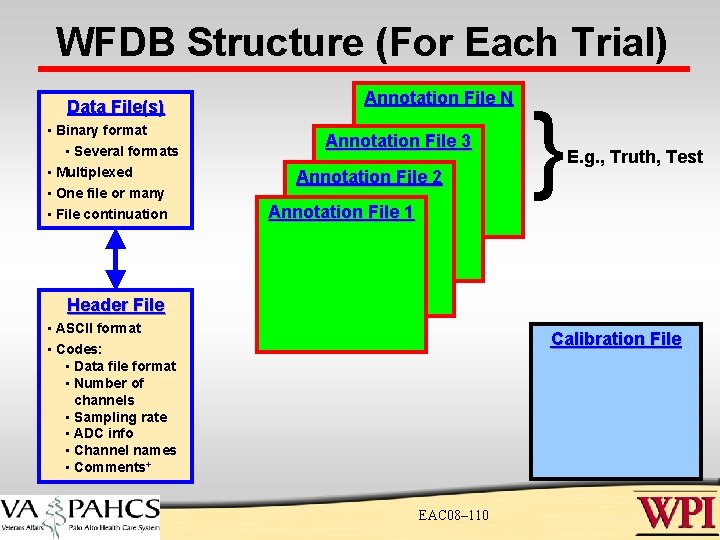
WFDB Structure (For Each Trial) Data File(s) • Binary format • Several formats • Multiplexed • One file or many • File continuation Annotation File N Annotation File 3 Annotation File 2 } E. g. , Truth, Test Annotation File 1 Header File • ASCII format • Codes: • Data file format • Number of channels • Sampling rate • ADC info • Channel names • Comments+ Calibration File EAC 08– 110
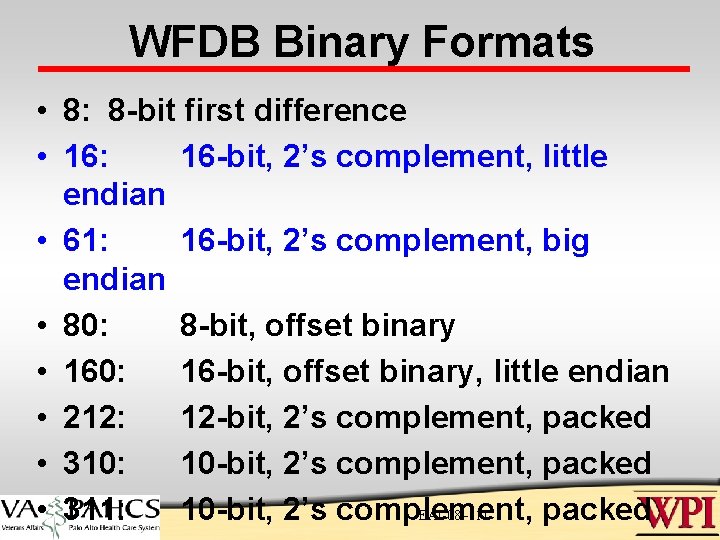
WFDB Binary Formats • 8: 8 -bit first difference • 16: 16 -bit, 2’s complement, little endian • 61: 16 -bit, 2’s complement, big endian • 80: 8 -bit, offset binary • 160: 16 -bit, offset binary, little endian • 212: 12 -bit, 2’s complement, packed • 310: 10 -bit, 2’s complement, packed EAC 08– 111 • 311: 10 -bit, 2’s complement, packed
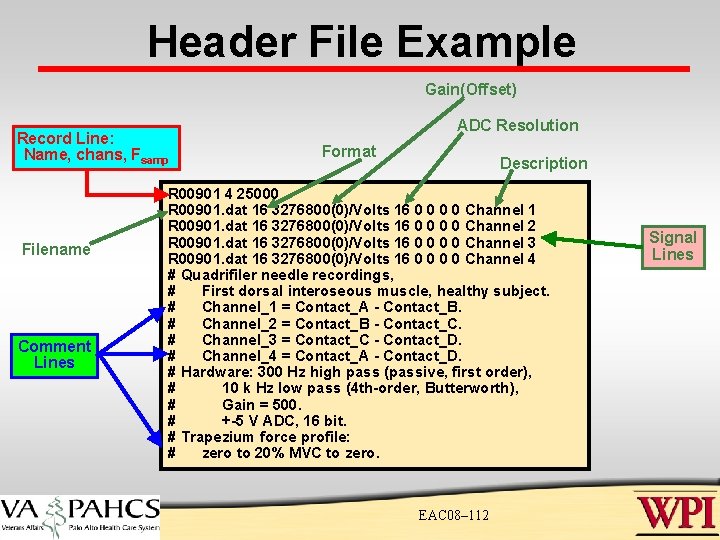
Header File Example Gain(Offset) Record Line: Name, chans, Fsamp Filename Comment Lines ADC Resolution Format Description R 00901 4 25000 R 00901. dat 16 3276800(0)/Volts 16 0 0 Channel 1 R 00901. dat 16 3276800(0)/Volts 16 0 0 Channel 2 R 00901. dat 16 3276800(0)/Volts 16 0 0 Channel 3 R 00901. dat 16 3276800(0)/Volts 16 0 0 Channel 4 # Quadrifiler needle recordings, # First dorsal interoseous muscle, healthy subject. # Channel_1 = Contact_A - Contact_B. # Channel_2 = Contact_B - Contact_C. # Channel_3 = Contact_C - Contact_D. # Channel_4 = Contact_A - Contact_D. # Hardware: 300 Hz high pass (passive, first order), # 10 k Hz low pass (4 th-order, Butterworth), # Gain = 500. # +-5 V ADC, 16 bit. # Trapezium force profile: # zero to 20% MVC to zero. EAC 08– 112 Signal Lines
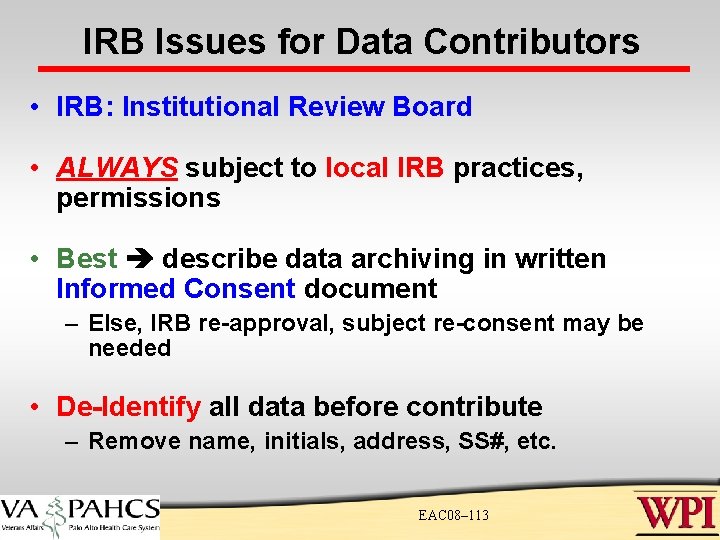
IRB Issues for Data Contributors • IRB: Institutional Review Board • ALWAYS subject to local IRB practices, permissions • Best describe data archiving in written Informed Consent document – Else, IRB re-approval, subject re-consent may be needed • De-Identify all data before contribute – Remove name, initials, address, SS#, etc. EAC 08– 113
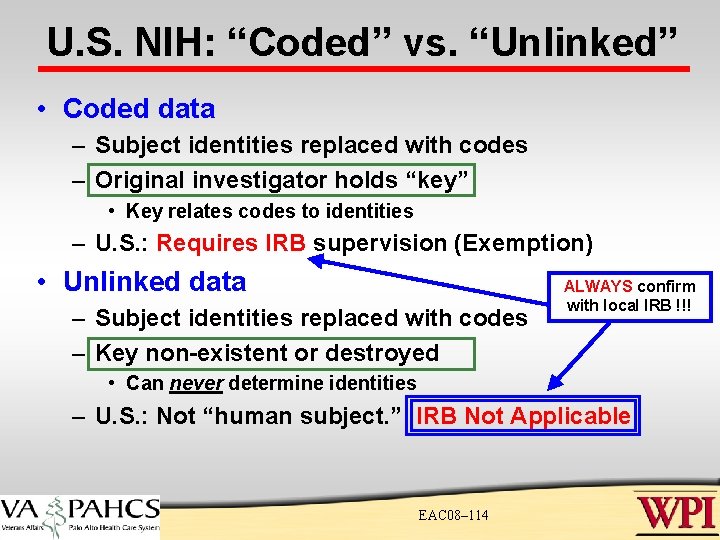
U. S. NIH: “Coded” vs. “Unlinked” • Coded data – Subject identities replaced with codes – Original investigator holds “key” • Key relates codes to identities – U. S. : Requires IRB supervision (Exemption) • Unlinked data – Subject identities replaced with codes – Key non-existent or destroyed ALWAYS confirm with local IRB !!! • Can never determine identities – U. S. : Not “human subject. ” IRB Not Applicable EAC 08– 114
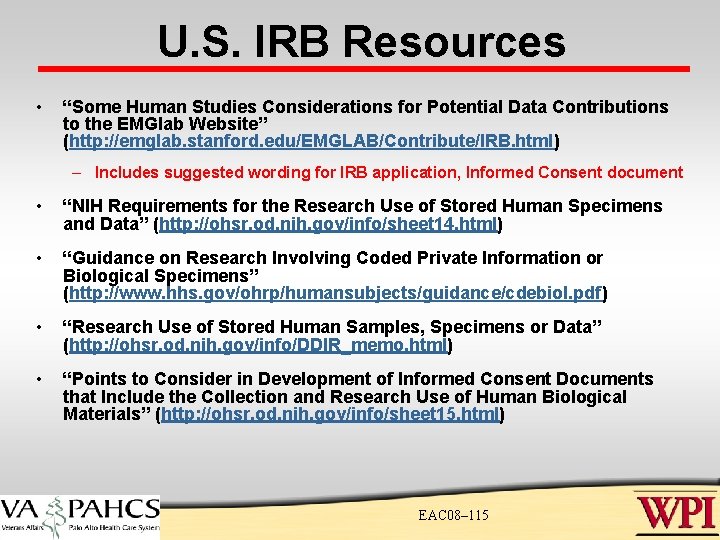
U. S. IRB Resources • “Some Human Studies Considerations for Potential Data Contributions to the EMGlab Website” (http: //emglab. stanford. edu/EMGLAB/Contribute/IRB. html) – Includes suggested wording for IRB application, Informed Consent document • “NIH Requirements for the Research Use of Stored Human Specimens and Data” (http: //ohsr. od. nih. gov/info/sheet 14. html) • “Guidance on Research Involving Coded Private Information or Biological Specimens” (http: //www. hhs. gov/ohrp/humansubjects/guidance/cdebiol. pdf) • “Research Use of Stored Human Samples, Specimens or Data” (http: //ohsr. od. nih. gov/info/DDIR_memo. html) • “Points to Consider in Development of Informed Consent Documents that Include the Collection and Research Use of Human Biological Materials” (http: //ohsr. od. nih. gov/info/sheet 15. html) EAC 08– 115
Sharing Annotations EAC 08– 116
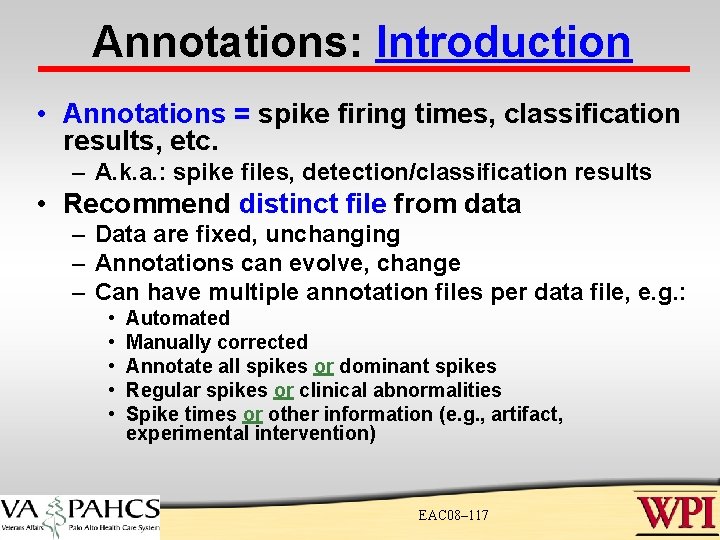
Annotations: Introduction • Annotations = spike firing times, classification results, etc. – A. k. a. : spike files, detection/classification results • Recommend distinct file from data – Data are fixed, unchanging – Annotations can evolve, change – Can have multiple annotation files per data file, e. g. : • • • Automated Manually corrected Annotate all spikes or dominant spikes Regular spikes or clinical abnormalities Spike times or other information (e. g. , artifact, experimental intervention) EAC 08– 117
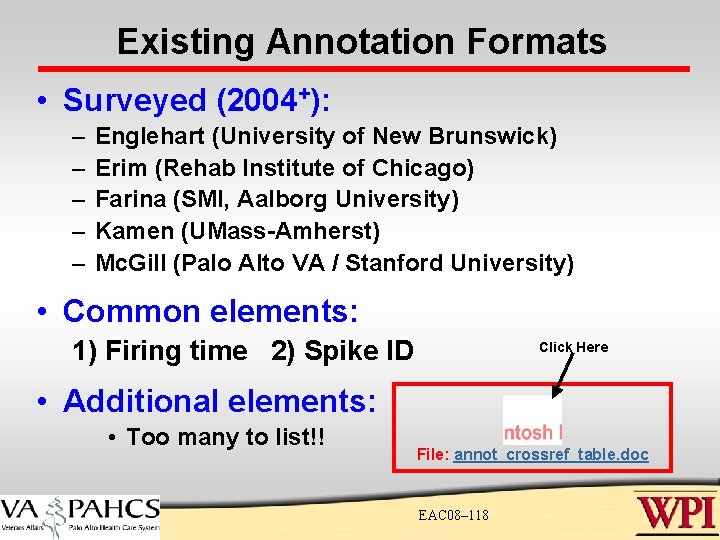
Existing Annotation Formats • Surveyed (2004+): – – – Englehart (University of New Brunswick) Erim (Rehab Institute of Chicago) Farina (SMI, Aalborg University) Kamen (UMass-Amherst) Mc. Gill (Palo Alto VA / Stanford University) • Common elements: 1) Firing time 2) Spike ID Click Here • Additional elements: • Too many to list!! File: annot_crossref_table. doc EAC 08– 118
Existing Annotation Formats: Summary • Many existing formats • Varying information preserved – Each format stores spike times, identities • Existing formats conflicting No existing format could be used to satisfy every user EAC 08– 119
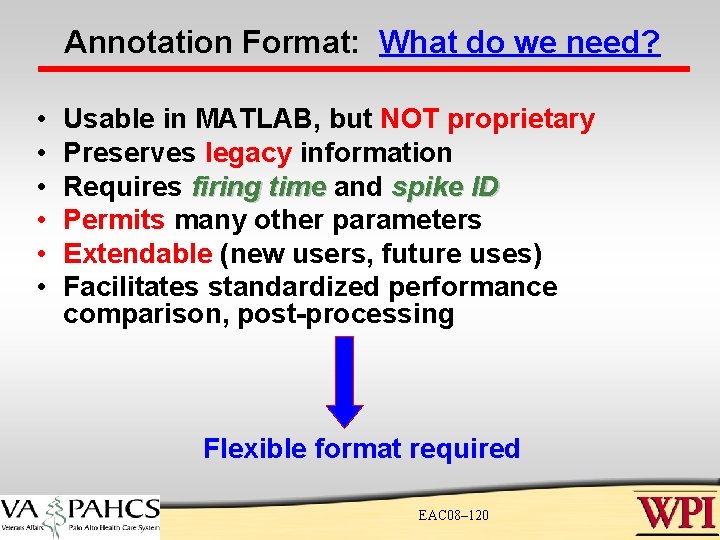
Annotation Format: What do we need? • • • Usable in MATLAB, but NOT proprietary Preserves legacy information Requires firing time and spike ID Permits many other parameters Extendable (new users, future uses) Facilitates standardized performance comparison, post-processing Flexible format required EAC 08– 120
Binary Format vs. ASCII • Usually: “ASCII is for amateurs!” – E. g. : Never store ADC data in ASCII • But: – Annotation info much smaller size than data – ASCII very flexible, extensible, not machinespecific, variable length lines – Existing information standards, e. g. XML EAC 08– 121
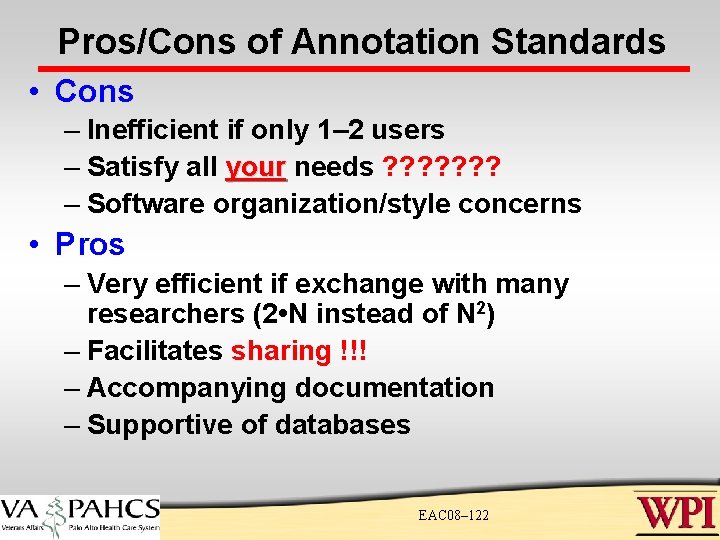
Pros/Cons of Annotation Standards • Cons – Inefficient if only 1– 2 users – Satisfy all your needs ? ? ? ? – Software organization/style concerns • Pros – Very efficient if exchange with many researchers (2 • N instead of N 2) – Facilitates sharing !!! – Accompanying documentation – Supportive of databases EAC 08– 122
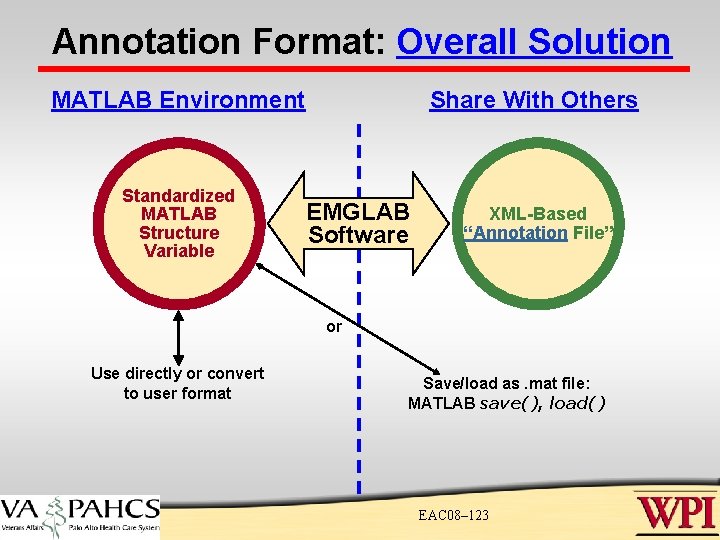
Annotation Format: Overall Solution Share With Others MATLAB Environment Standardized MATLAB Structure Variable EMGLAB Software XML-Based “Annotation File” or Use directly or convert to user format Save/load as. mat file: MATLAB save(), load() EAC 08– 123
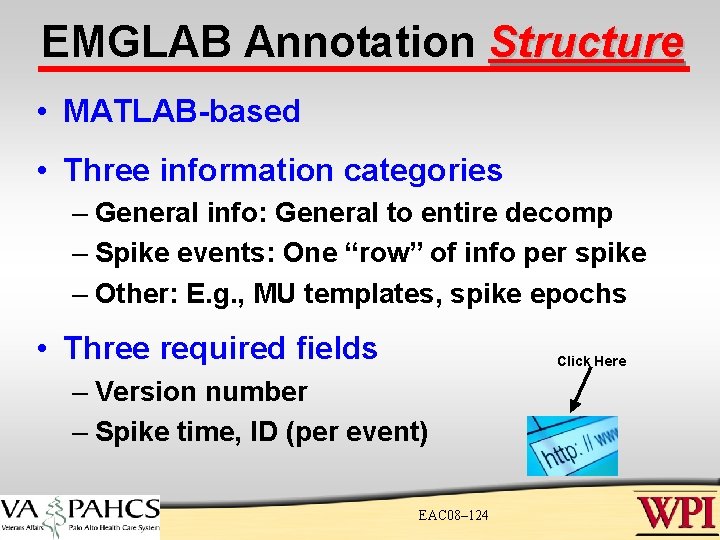
EMGLAB Annotation Structure • MATLAB-based • Three information categories – General info: General to entire decomp – Spike events: One “row” of info per spike – Other: E. g. , MU templates, spike epochs • Three required fields Click Here – Version number – Spike time, ID (per event) EAC 08– 124
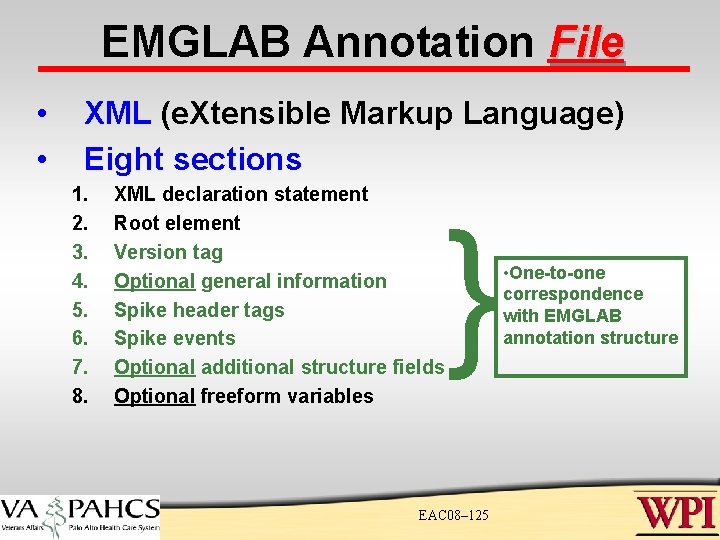
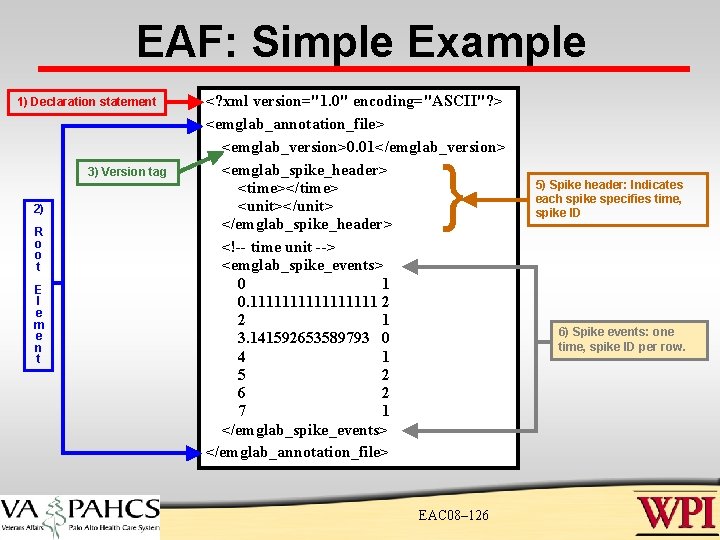
EMGLAB Annotation File • • XML (e. Xtensible Markup Language) Eight sections 1. 2. 3. 4. 5. 6. 7. 8. XML declaration statement Root element Version tag Optional general information Spike header tags Spike events Optional additional structure fields Optional freeform variables } EAC 08– 125 • One-to-one correspondence with EMGLAB annotation structure
EAF: Simple Example 1) Declaration statement 3) Version tag 2) R o o t E l e m e n t <? xml version="1. 0" encoding="ASCII"? > <emglab_annotation_file> <emglab_version>0. 01</emglab_version> <emglab_spike_header> <time></time> <unit></unit> </emglab_spike_header> <!-- time unit --> <emglab_spike_events> 0 1 0. 11111111 2 2 1 3. 141592653589793 0 4 1 5 2 6 2 7 1 </emglab_spike_events> </emglab_annotation_file> } EAC 08– 126 5) Spike header: Indicates each spike specifies time, spike ID 6) Spike events: one time, spike ID per row.
EAF: Complete Example • Example includes all optional sections – All required, optional structure fields – Freeform variables • Includes structures, cell arrays, strings Click Here EAC 08– 127
Comparing Annotations EAC 08– 128
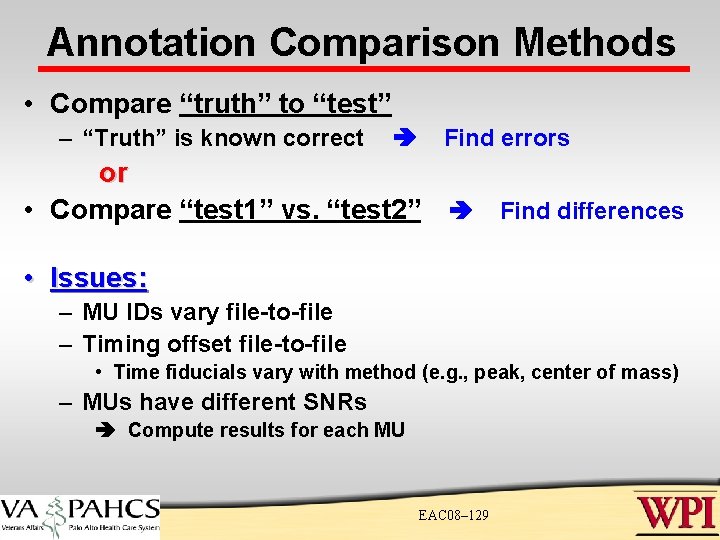
Annotation Comparison Methods • Compare “truth” to “test” – “Truth” is known correct Find errors or • Compare “test 1” vs. “test 2” Find differences • Issues: – MU IDs vary file-to-file – Timing offset file-to-file • Time fiducials vary with method (e. g. , peak, center of mass) – MUs have different SNRs Compute results for each MU EAC 08– 129
Annotation Comparison: Resources • Ambulatory electrocardiographs. American National Standard, ANSI/AAMI EC 38: 1998. Assoc Advance Med Instru, 1999. • Farina D, Colombo R, Merletti R, Olsen HB. Evaluation of intramuscular EMG signal decomposition algorithms. J Electromyo Kinesiol 11: 175– 187, 2001. – Largely the method used in EMGlab • Stashuk DW, Farina D, Søgaard K. Decomposition of Intramuscular EMG Signals. In: Electromyography: Physiology, Engineering and Noninvasive Applications, R Merletti and PA Parker eds. , John Wiley and Sons, Inc. , New Jersey, 47– 80, 2004. • Carey RM, Clancy EA. EMG decomposition annotation comparison method. Proc IEEE 31 st Ann Northeast Bioeng Conf, IEEE, 100– 101, 2005. EAC 08– 130
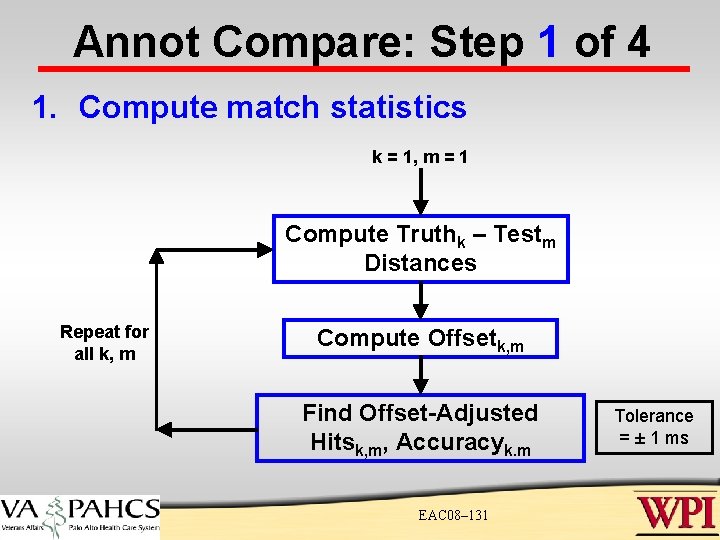
Annot Compare: Step 1 of 4 1. Compute match statistics k = 1, m = 1 Compute Truthk – Testm Distances Repeat for all k, m Compute Offsetk, m Find Offset-Adjusted Hitsk, m, Accuracyk. m EAC 08– 131 Tolerance = ± 1 ms
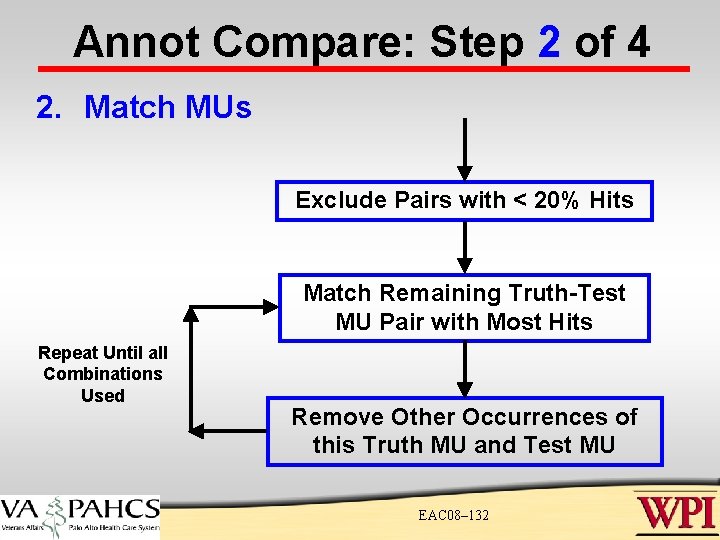
Annot Compare: Step 2 of 4 2. Match MUs Exclude Pairs with < 20% Hits Match Remaining Truth-Test MU Pair with Most Hits Repeat Until all Combinations Used Remove Other Occurrences of this Truth MU and Test MU EAC 08– 132
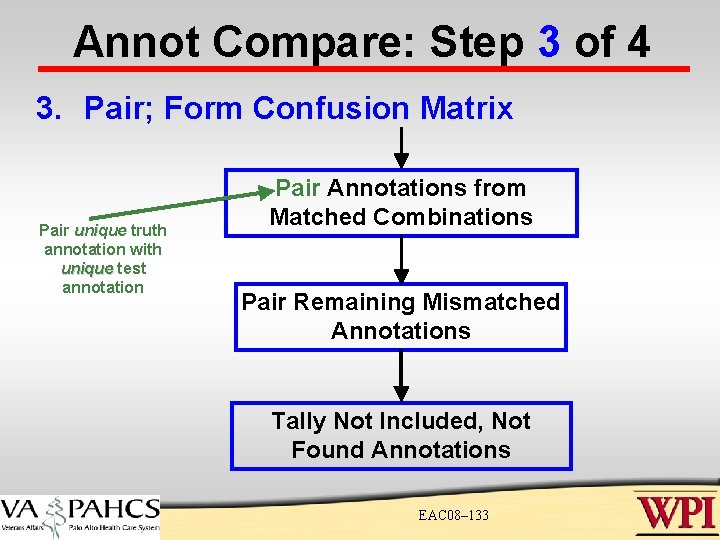
Annot Compare: Step 3 of 4 3. Pair; Form Confusion Matrix Pair unique truth annotation with unique test annotation Pair Annotations from Matched Combinations Pair Remaining Mismatched Annotations Tally Not Included, Not Found Annotations EAC 08– 133
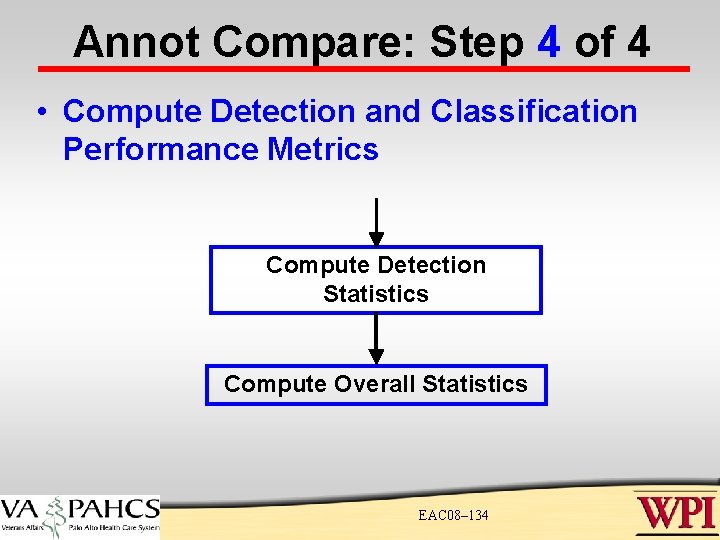
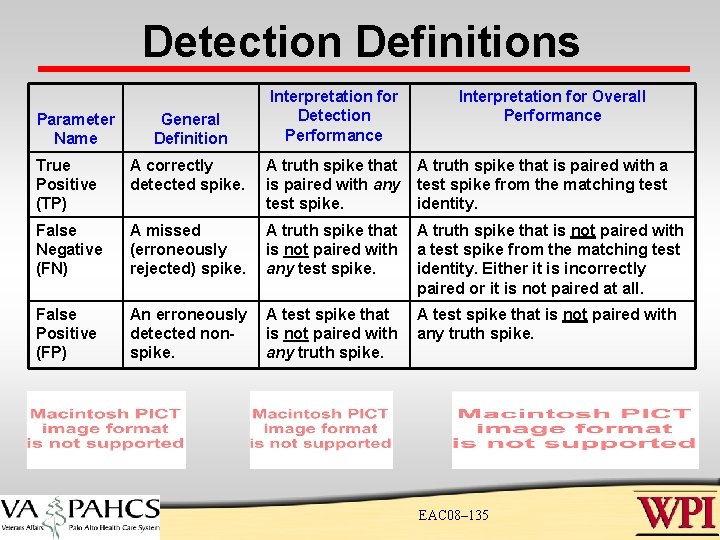
Annot Compare: Step 4 of 4 • Compute Detection and Classification Performance Metrics Compute Detection Statistics Compute Overall Statistics EAC 08– 134
Detection Definitions Parameter Name General Definition Interpretation for Detection Performance Interpretation for Overall Performance True Positive (TP) A correctly detected spike. A truth spike that is paired with any test spike. A truth spike that is paired with a test spike from the matching test identity. False Negative (FN) A missed (erroneously rejected) spike. A truth spike that is not paired with any test spike. A truth spike that is not paired with a test spike from the matching test identity. Either it is incorrectly paired or it is not paired at all. False Positive (FP) An erroneously detected nonspike. A test spike that is not paired with any truth spike. EAC 08– 135
Intellectual Property (IP) Issues EAC 08– 136
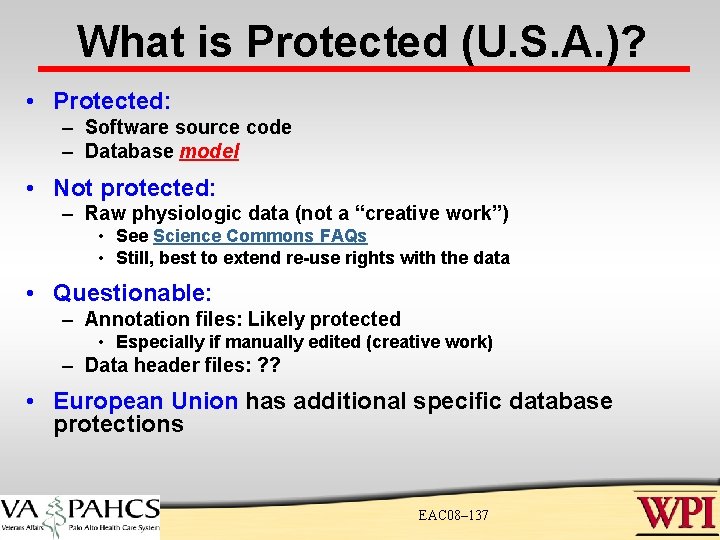
What is Protected (U. S. A. )? • Protected: – Software source code – Database model • Not protected: – Raw physiologic data (not a “creative work”) • See Science Commons FAQs • Still, best to extend re-use rights with the data • Questionable: – Annotation files: Likely protected • Especially if manually edited (creative work) – Data header files: ? ? • European Union has additional specific database protections EAC 08– 137
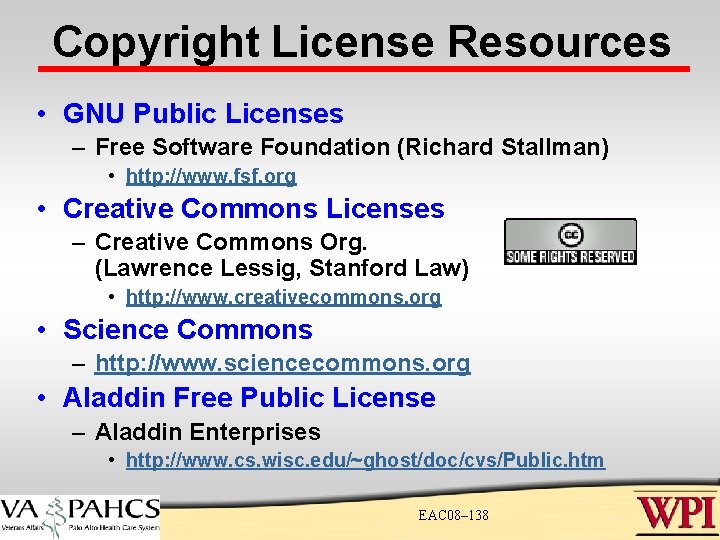
Copyright License Resources • GNU Public Licenses – Free Software Foundation (Richard Stallman) • http: //www. fsf. org • Creative Commons Licenses – Creative Commons Org. (Lawrence Lessig, Stanford Law) • http: //www. creativecommons. org • Science Commons – http: //www. sciencecommons. org • Aladdin Free Public License – Aladdin Enterprises • http: //www. cs. wisc. edu/~ghost/doc/cvs/Public. htm EAC 08– 138
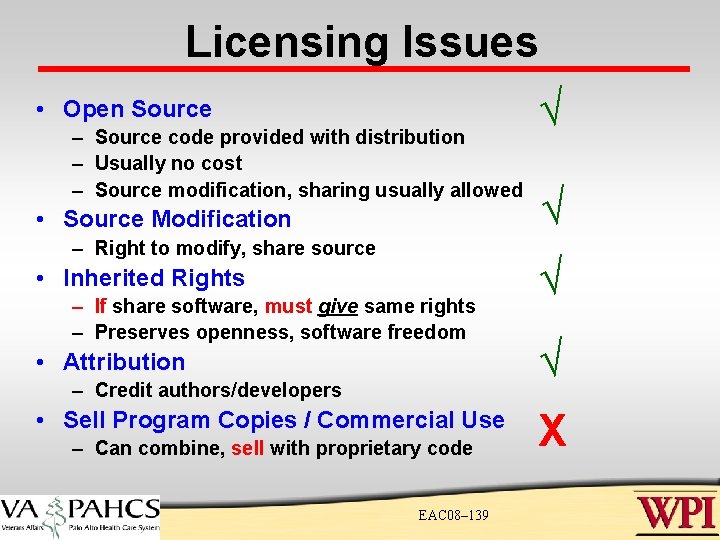
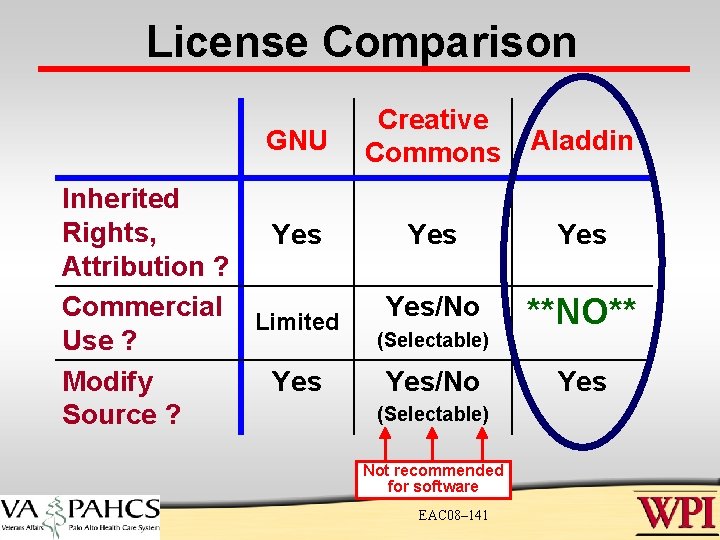
Licensing Issues • Open Source – Source code provided with distribution – Usually no cost – Source modification, sharing usually allowed • Source Modification – Right to modify, share source • Inherited Rights – If share software, must give same rights – Preserves openness, software freedom • Attribution – Credit authors/developers • Sell Program Copies / Commercial Use – Can combine, sell with proprietary code EAC 08– 139 √ √ X
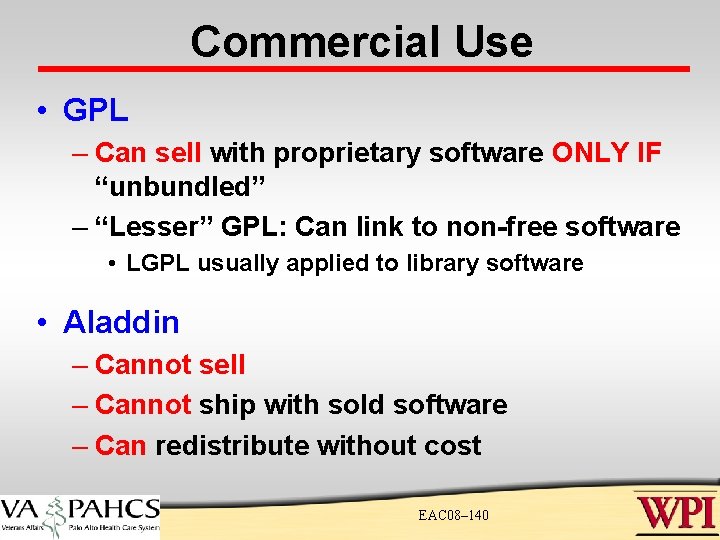
Commercial Use • GPL – Can sell with proprietary software ONLY IF “unbundled” – “Lesser” GPL: Can link to non-free software • LGPL usually applied to library software • Aladdin – Cannot sell – Cannot ship with sold software – Can redistribute without cost EAC 08– 140
License Comparison GNU Inherited Rights, Yes Attribution ? Commercial Limited Use ? Modify Yes Source ? Creative Commons Aladdin Yes Yes/No **NO** (Selectable) Yes/No (Selectable) Not recommended for software EAC 08– 141 Yes
The Future of Open-Source EMG Software … EAC 08– 142
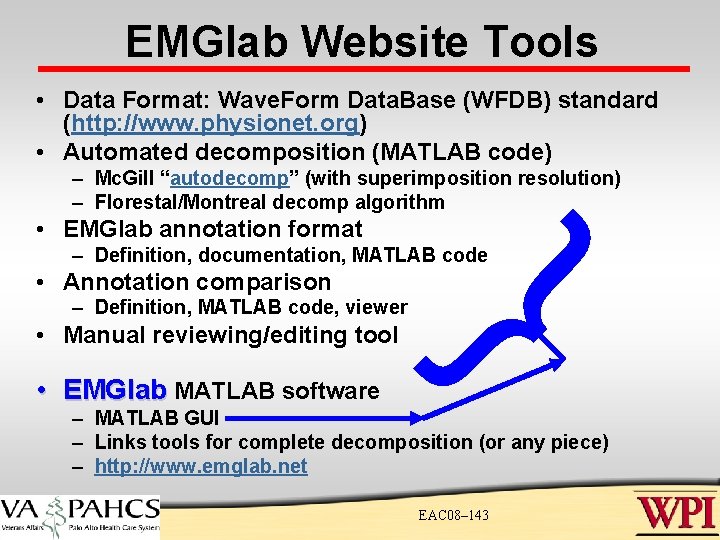
EMGlab Website Tools • Data Format: Wave. Form Data. Base (WFDB) standard (http: //www. physionet. org) • Automated decomposition (MATLAB code) – Mc. Gill “autodecomp” (with superimposition resolution) – Florestal/Montreal decomp algorithm • EMGlab annotation format – Definition, documentation, MATLAB code • Annotation comparison – Definition, MATLAB code, viewer • EMGlab MATLAB software } • Manual reviewing/editing tool – MATLAB GUI – Links tools for complete decomposition (or any piece) – http: //www. emglab. net EAC 08– 143
EMGlab Extensions/Development • Multiple-channel, single site – Some aspects already available • Coordinated modification by other users – Mechanisms to share enhancements – Additional features of use to others – Extensions EAC 08– 144
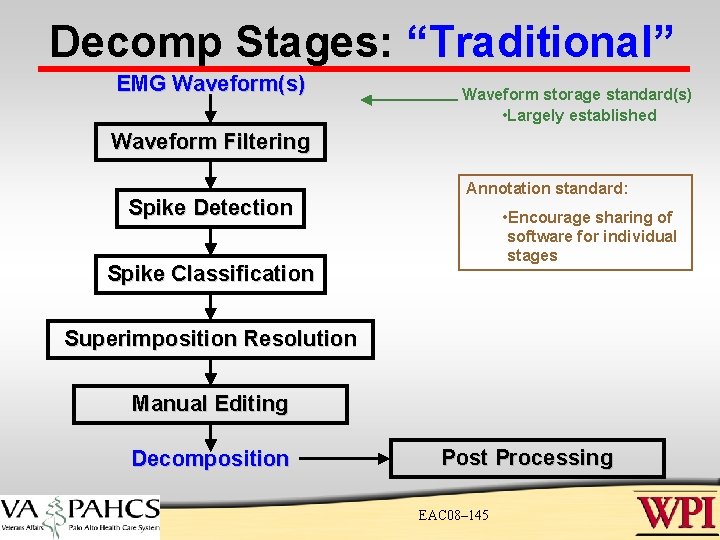
Decomp Stages: “Traditional” EMG Waveform(s) Waveform storage standard(s) • Largely established Waveform Filtering Spike Detection Annotation standard: • Encourage sharing of software for individual stages Spike Classification Superimposition Resolution Manual Editing Decomposition Post Processing EAC 08– 145
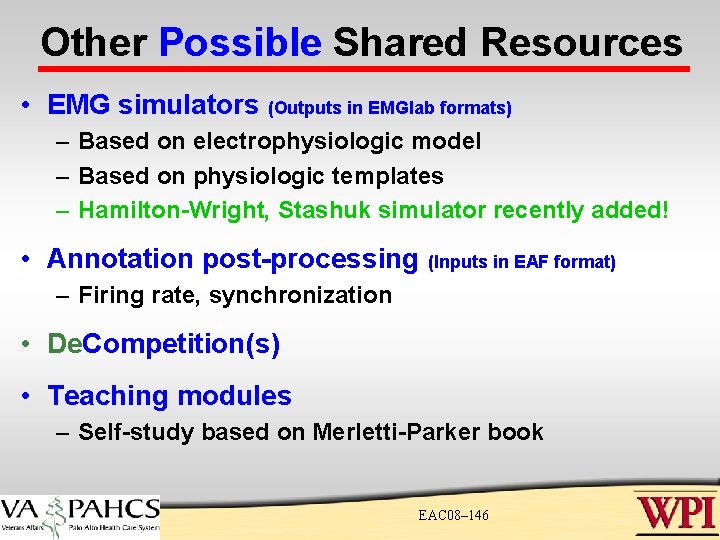
Other Possible Shared Resources • EMG simulators (Outputs in EMGlab formats) – Based on electrophysiologic model – Based on physiologic templates – Hamilton-Wright, Stashuk simulator recently added! • Annotation post-processing (Inputs in EAF format) – Firing rate, synchronization • De. Competition(s) • Teaching modules – Self-study based on Merletti-Parker book EAC 08– 146