
Working Therapeutically with Dissociation Claire Pooley www bacp
Working Therapeutically with Dissociation Claire Pooley www. bacp. co. uk Claire Pooley BACP
Aims of presentation • To offer a brief overview of dissociation and the various disorders (according to DSM-5) • To consider common features and manifestations of dissociation • To explore the effects of this in therapy room • To share some research on a variety of interventions – including my own (unpublished) Claire Pooley BACP Conference - Belfast March 2017
What do we understand by the term “Dissociation”? “A disruption in the normally occurring linkages between subjective awareness, feelings, thoughts, behaviour and memories, consciously or unconsciously invoked to reduce psychological distress. ” Briere & Scott (2006) Claire Pooley BACP Conference - Belfast March 2017
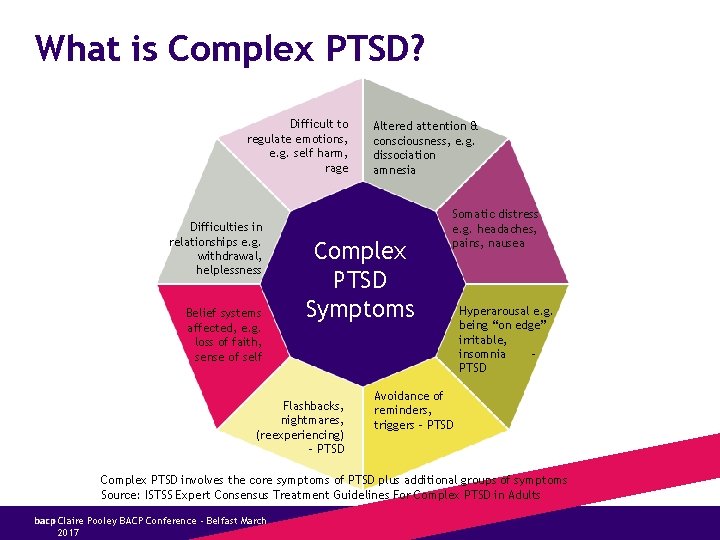
What is Complex PTSD? Difficult to regulate emotions, e. g. self harm, rage Difficulties in relationships e. g. withdrawal, helplessness Belief systems affected, e. g. loss of faith, sense of self Altered attention & consciousness, e. g. dissociation amnesia Complex PTSD Symptoms Flashbacks, nightmares, (reexperiencing) - PTSD Somatic distress e. g. headaches, pains, nausea Hyperarousal e. g. being “on edge” irritable, insomnia PTSD Avoidance of reminders, triggers - PTSD Complex PTSD involves the core symptoms of PTSD plus additional groups of symptoms Source: ISTSS Expert Consensus Treatment Guidelines For Complex PTSD in Adults Claire Pooley BACP Conference - Belfast March 2017
The freeze response to trauma David Livingstone’s reflection – as quoted by Peter Levine (1997) https: //www. youtube. com/watch? v=Up. Gwt_ba. Exk Claire Pooley BACP Conference - Belfast March 2017
The range of dissociation • Primary – in the face of overwhelming trauma or threat. An inability to integrate the experience – the recall remains fragmented • Secondary – leaving the body - psychic anaesthetising and withdrawal • Tertiary – distinct ego states contain the traumatic experience – fragmentation. Can lead to Dissociation Identity Disorder Claire Pooley BACP Conference - Belfast March 2017
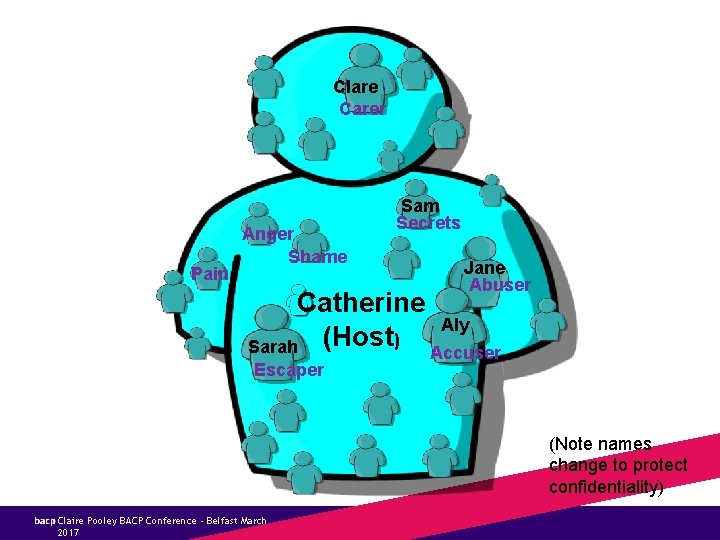
Clare Carer Pain Anger Shame Sam Secrets Jane Abuser Catherine Aly Sarah (Host) Accuser Escaper (Note names change to protect confidentiality) Claire Pooley BACP Conference - Belfast March 2017
Dissociative Identity Disorder (DID) 2 or more distinct identities/personalities/alters/parts Aspects may include: A host (main identity) Personality changes Changed Perceptions or beliefs and ways of relating to the world Identities may be conflictual Other adults/children/animals/cartoon characters/ages/genders Voice changes A lack of control of those identities Reports of amnesia when one identity takes control Claire Pooley BACP Conference - Belfast March 2017
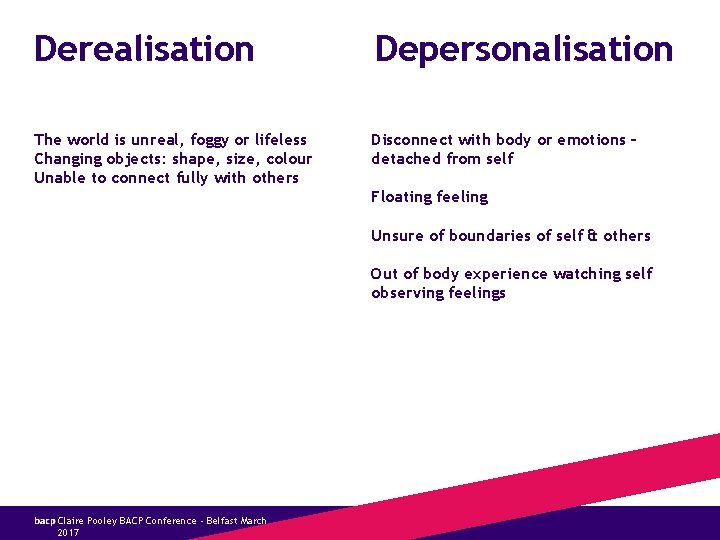
Derealisation Depersonalisation The world is unreal, foggy or lifeless Changing objects: shape, size, colour Unable to connect fully with others Disconnect with body or emotions – detached from self Floating feeling Unsure of boundaries of self & others Out of body experience watching self observing feelings Claire Pooley BACP Conference - Belfast March 2017
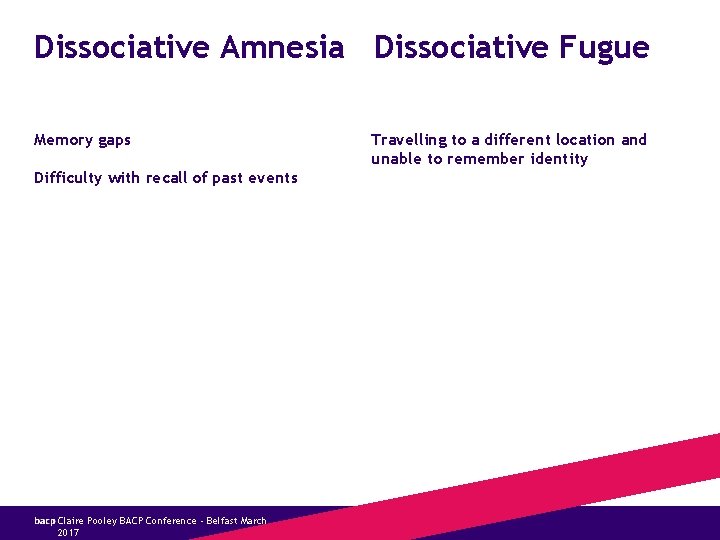
Dissociative Amnesia Dissociative Fugue Memory gaps Difficulty with recall of past events Claire Pooley BACP Conference - Belfast March 2017 Travelling to a different location and unable to remember identity
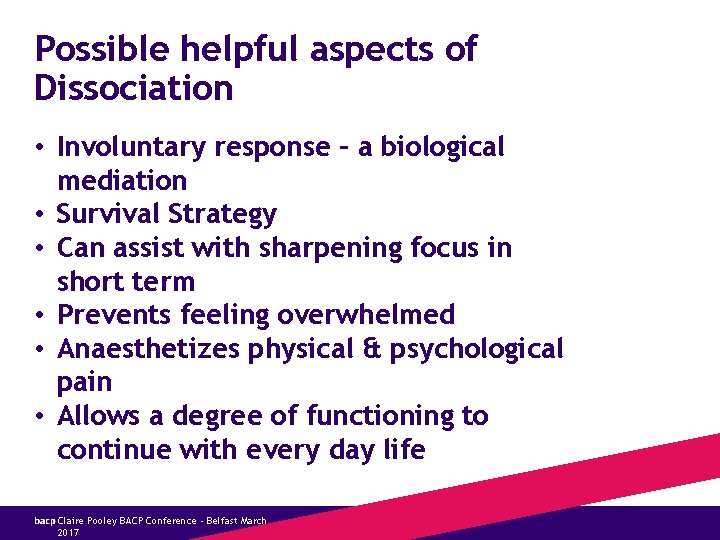
Possible helpful aspects of Dissociation • Involuntary response – a biological mediation • Survival Strategy • Can assist with sharpening focus in short term • Prevents feeling overwhelmed • Anaesthetizes physical & psychological pain • Allows a degree of functioning to continue with every day life Claire Pooley BACP Conference - Belfast March 2017
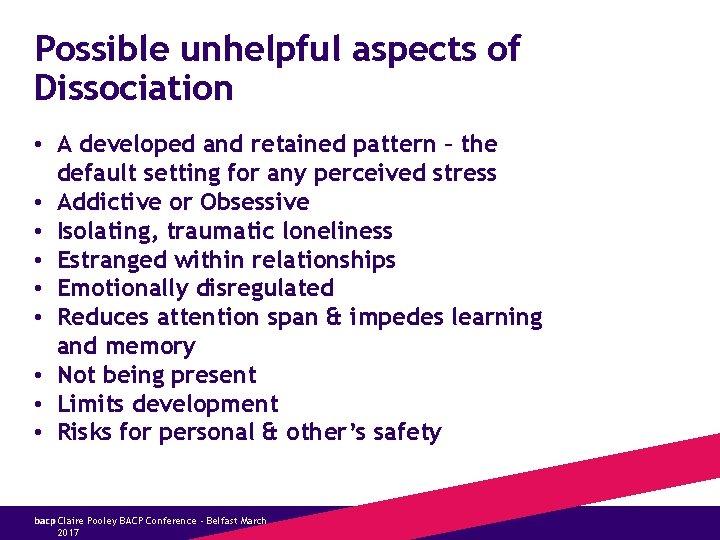
Possible unhelpful aspects of Dissociation • A developed and retained pattern – the default setting for any perceived stress • Addictive or Obsessive • Isolating, traumatic loneliness • Estranged within relationships • Emotionally disregulated • Reduces attention span & impedes learning and memory • Not being present • Limits development • Risks for personal & other’s safety Claire Pooley BACP Conference - Belfast March 2017
You. Tube Mind. og. uk/dissociation https: //www. youtube. com/watch? v=Uvht. DZ 7 G 6 j. I&list=PLw 8 TLv. Rge. KJ 4 U 0 Ibyn. Sz. UKoj. AIe. L-Ec. Z 2 Claire Pooley BACP Conference - Belfast March 2017
Clinical Implications Discuss in pairs: The professional and personal challenges for therapist? Claire Pooley BACP Conference - Belfast March 2017
Clinical Implications • Confusion • Miscommunication and misinterpretation • Not present – unable to process • Defensive reactions, mistrust, criticism, projection and fear of therapist - projection • A risk of additional trauma • Could create barriers & rupture therapeutic relationship • Counter-transference Claire Pooley BACP Conference - Belfast March 2017
Assessments • Dissociative Events Scale (DES) • EB Carlson &FW Putnam • Somatoform Dissociation Questionnaires • (SDQ 5 & 20) Nijenhuis 1996 • Clinical Administration PTSD Scale (CAPS) • Impact of Events Scale (Revised) DS Weiss Claire Pooley BACP Conference - Belfast March 2017
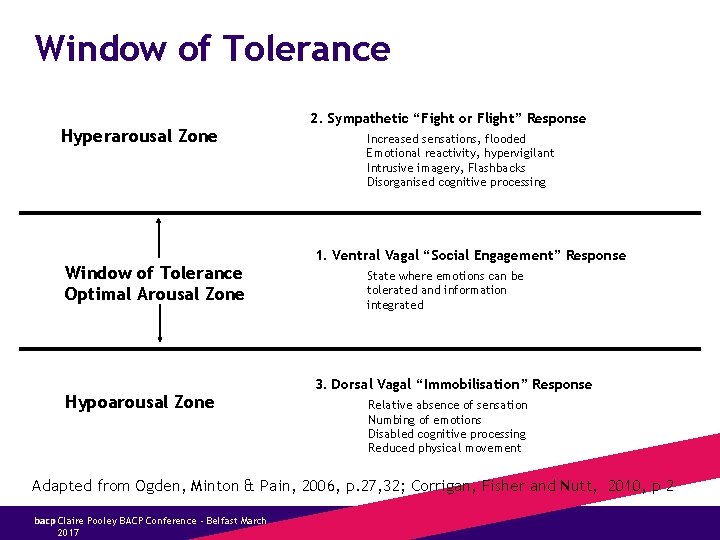
Window of Tolerance Hyperarousal Zone Window of Tolerance Optimal Arousal Zone Hypoarousal Zone 2. Sympathetic “Fight or Flight” Response Increased sensations, flooded Emotional reactivity, hypervigilant Intrusive imagery, Flashbacks Disorganised cognitive processing 1. Ventral Vagal “Social Engagement” Response State where emotions can be tolerated and information integrated 3. Dorsal Vagal “Immobilisation” Response Relative absence of sensation Numbing of emotions Disabled cognitive processing Reduced physical movement Adapted from Ogden, Minton & Pain, 2006, p. 27, 32; Corrigan, Fisher and Nutt, 2010, p 2 Claire Pooley BACP Conference - Belfast March 2017
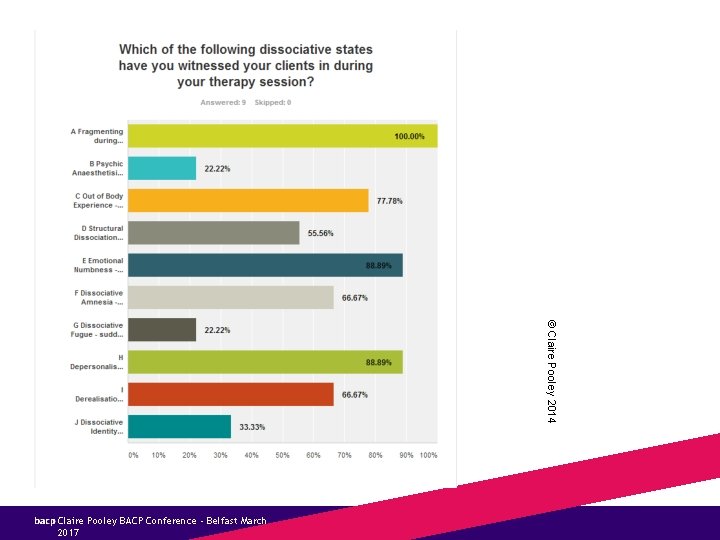
© Claire Pooley 2014 Claire Pooley BACP Conference - Belfast March 2017
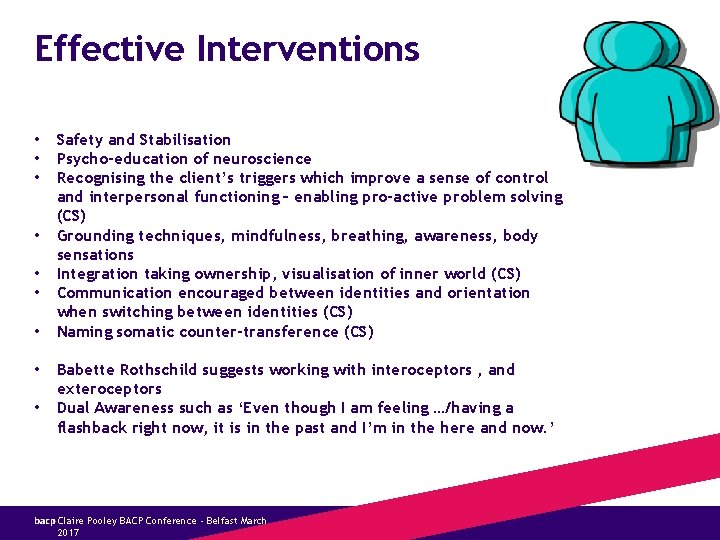
Effective Interventions • • • Safety and Stabilisation Psycho-education of neuroscience Recognising the client’s triggers which improve a sense of control and interpersonal functioning – enabling pro-active problem solving (CS) Grounding techniques, mindfulness, breathing, awareness, body sensations Integration taking ownership, visualisation of inner world (CS) Communication encouraged between identities and orientation when switching between identities (CS) Naming somatic counter-transference (CS) Babette Rothschild suggests working with interoceptors , and exteroceptors Dual Awareness such as ‘Even though I am feeling …/having a flashback right now, it is in the past and I’m in the here and now. ’ Claire Pooley BACP Conference - Belfast March 2017
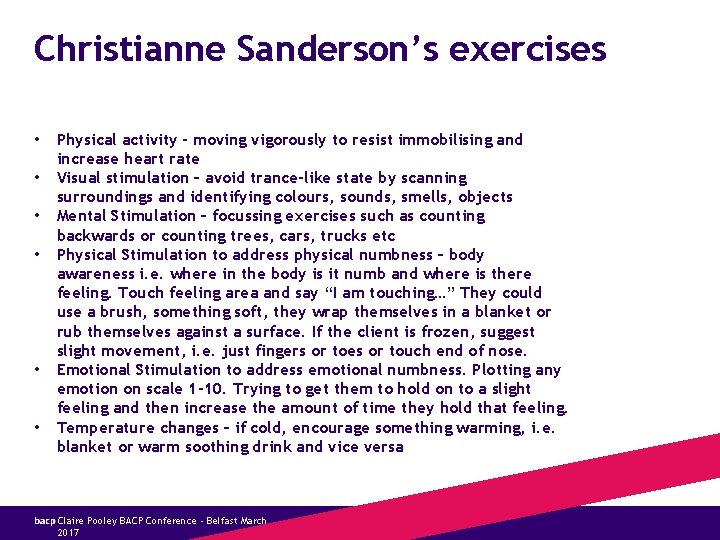
Christianne Sanderson’s exercises • • • Physical activity - moving vigorously to resist immobilising and increase heart rate Visual stimulation – avoid trance-like state by scanning surroundings and identifying colours, sounds, smells, objects Mental Stimulation – focussing exercises such as counting backwards or counting trees, cars, trucks etc Physical Stimulation to address physical numbness – body awareness i. e. where in the body is it numb and where is there feeling. Touch feeling area and say “I am touching…” They could use a brush, something soft, they wrap themselves in a blanket or rub themselves against a surface. If the client is frozen, suggest slight movement, i. e. just fingers or toes or touch end of nose. Emotional Stimulation to address emotional numbness. Plotting any emotion on scale 1 -10. Trying to get them to hold on to a slight feeling and then increase the amount of time they hold that feeling. Temperature changes – if cold, encourage something warming, i. e. blanket or warm soothing drink and vice versa Claire Pooley BACP Conference - Belfast March 2017
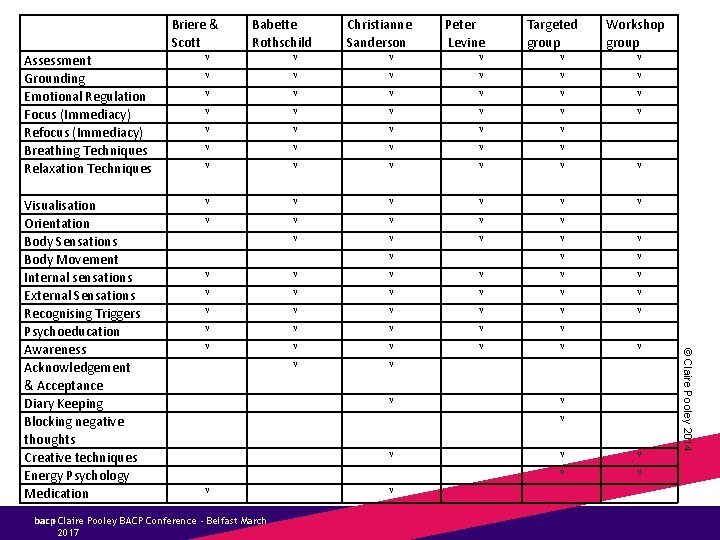
Briere & Scott Babette Rothschild Christianne Sanderson Peter Levine Targeted group Workshop group √ √ √ √ √ √ √ √ √ √ Visualisation Orientation Body Sensations Body Movement Internal sensations External Sensations Recognising Triggers Psychoeducation Awareness Acknowledgement & Acceptance Diary Keeping Blocking negative thoughts Creative techniques Energy Psychology Medication √ √ √ √ √ √ √ √ √ √ √ √ √ √ Claire Pooley BACP Conference - Belfast March 2017 √ √ √ © Claire Pooley 2014 Assessment Grounding Emotional Regulation Focus (Immediacy) Refocus (Immediacy) Breathing Techniques Relaxation Techniques
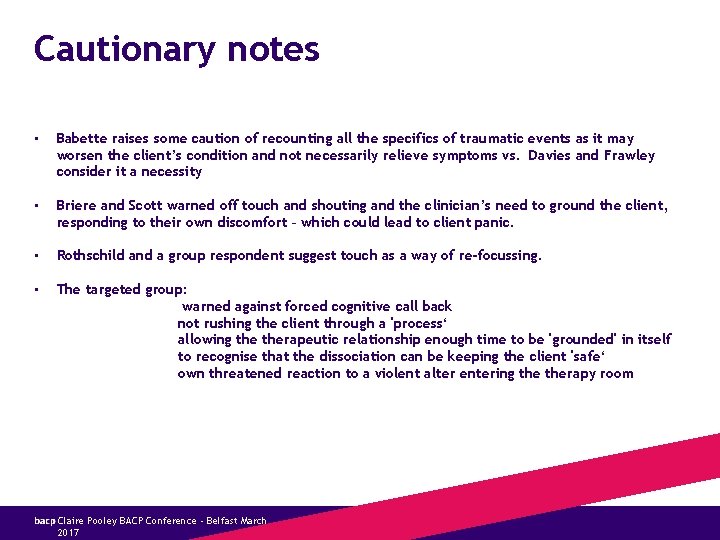
Cautionary notes • Babette raises some caution of recounting all the specifics of traumatic events as it may worsen the client’s condition and not necessarily relieve symptoms vs. Davies and Frawley consider it a necessity • Briere and Scott warned off touch and shouting and the clinician’s need to ground the client, responding to their own discomfort – which could lead to client panic. • Rothschild and a group respondent suggest touch as a way of re-focussing. • The targeted group: warned against forced cognitive call back not rushing the client through a 'process‘ allowing therapeutic relationship enough time to be 'grounded' in itself to recognise that the dissociation can be keeping the client 'safe‘ own threatened reaction to a violent alter entering therapy room Claire Pooley BACP Conference - Belfast March 2017
References • Brier, J. N. and Scott, C. (2013) Principles of trauma therapy, 2 nd edition, London: SAGE Publications Ltd • DSM-5 (2013) • Ford, J. D. and Courtois, C. A. (2014) ‘Defining and understanding complex trauma and complex traumatic stress disorders’, in Courtois, C. A. and Ford, J. D. (ed. ) Treating Complex Traumatic Stress Disorders, New York: The Guilford Press. • National Institute for Health and Care Excellence, (2005) Post-traumatic stress disorder. CG 26. London: NICE • Sanderson, C. (2013) Counselling Skills for Working with Trauma, Jessica Kingsley Publishers • www. dissociative. identity. disorder. net/wiki/Complex_PTSD • http: //www. mind. org. uk/information-support/types-of-mental-healthproblems/dissociative-disorders • Levine, P. A. (1997 • Rothschild, B. (year unknown) You. Tube interviews of 8 Keys to Trauma Recovery ) Waking the Tiger Healing Trauma Claire Pooley BACP Conference - Belfast March 2017
- Slides: 23