
Working Scientifically Years 5 and 6 Working Scientifically
- Slides: 6
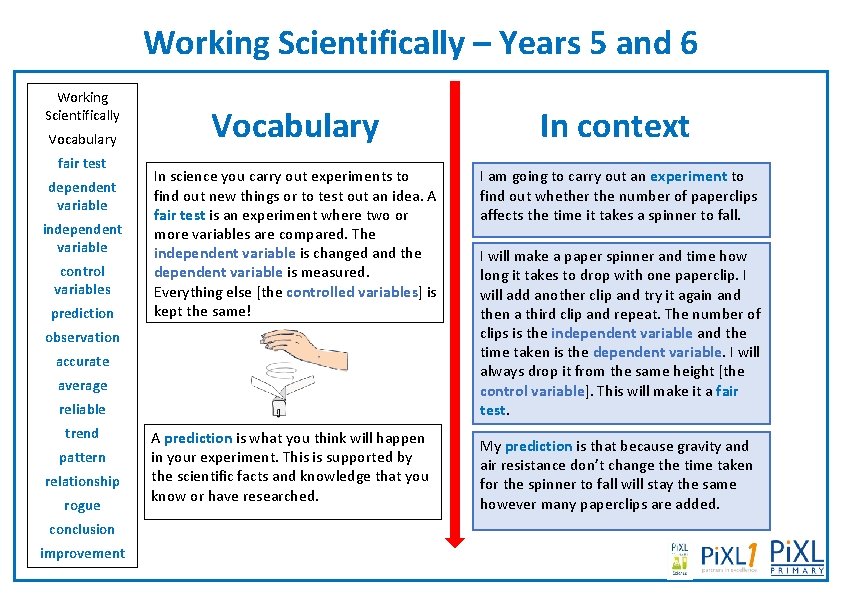
Working Scientifically – Years 5 and 6 Working Scientifically Vocabulary fair test dependent variable independent variable control variables prediction Vocabulary In context In science you carry out experiments to find out new things or to test out an idea. A fair test is an experiment where two or more variables are compared. The independent variable is changed and the dependent variable is measured. Everything else [the controlled variables] is kept the same! I am going to carry out an experiment to find out whether the number of paperclips affects the time it takes a spinner to fall. observation accurate average reliable trend pattern relationship rogue conclusion improvement A prediction is what you think will happen in your experiment. This is supported by the scientific facts and knowledge that you know or have researched. I will make a paper spinner and time how long it takes to drop with one paperclip. I will add another clip and try it again and then a third clip and repeat. The number of clips is the independent variable and the time taken is the dependent variable. I will always drop it from the same height [the control variable]. This will make it a fair test. My prediction is that because gravity and air resistance don’t change the time taken for the spinner to fall will stay the same however many paperclips are added.
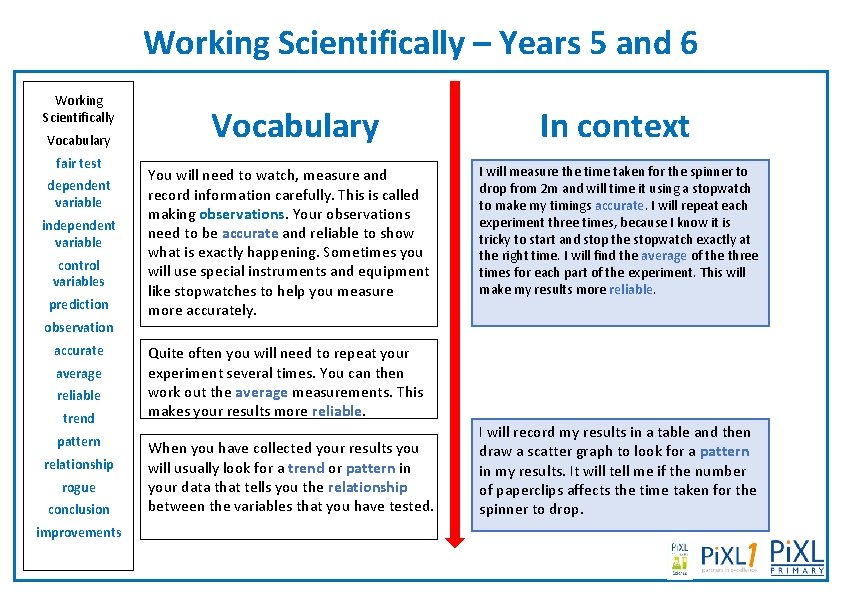
Working Scientifically – Years 5 and 6 Working Scientifically Vocabulary fair test dependent variable independent variable control variables prediction observation accurate average reliable trend pattern relationship rogue conclusion improvements Vocabulary You will need to watch, measure and record information carefully. This is called making observations. Your observations need to be accurate and reliable to show what is exactly happening. Sometimes you will use special instruments and equipment like stopwatches to help you measure more accurately. In context I will measure the time taken for the spinner to drop from 2 m and will time it using a stopwatch to make my timings accurate. I will repeat each experiment three times, because I know it is tricky to start and stop the stopwatch exactly at the right time. I will find the average of the three times for each part of the experiment. This will make my results more reliable. Quite often you will need to repeat your experiment several times. You can then work out the average measurements. This makes your results more reliable. When you have collected your results you will usually look for a trend or pattern in your data that tells you the relationship between the variables that you have tested. I will record my results in a table and then draw a scatter graph to look for a pattern in my results. It will tell me if the number of paperclips affects the time taken for the spinner to drop.
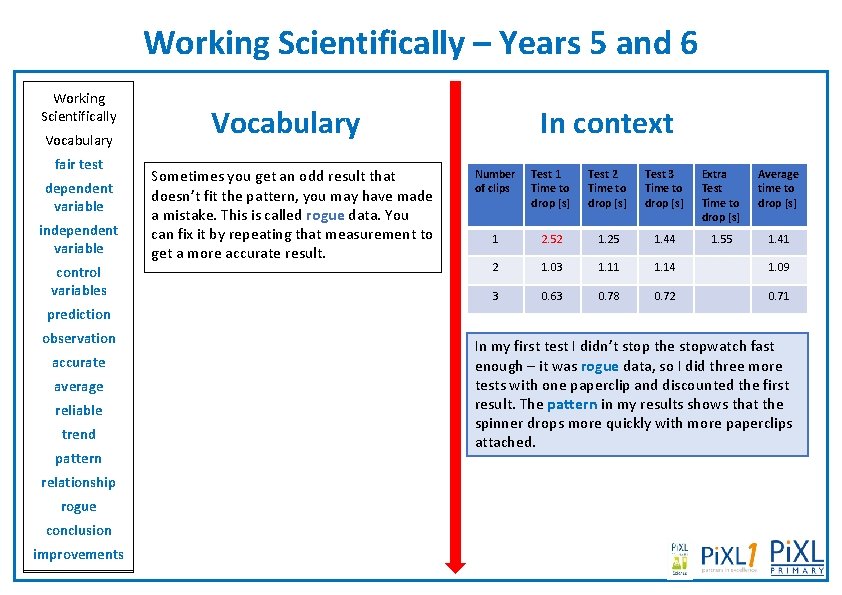
Working Scientifically – Years 5 and 6 Working Scientifically Vocabulary fair test Working Scientifically. Vo dependent cabulary variable experiment independent fair test variables control prediction variables Vocabulary Sometimes you get an odd result that doesn’t fit the pattern, you may have made a mistake. This is called rogue data. You can fix it by repeating that measurement to get a more accurate result. In context Number of clips Test 1 Time to drop [s] Test 2 Time to drop [s] Test 3 Time to drop [s] Extra Test Time to drop [s] Average time to drop [s] 1 2. 52 1. 25 1. 44 1. 55 1. 41 2 1. 03 1. 11 1. 14 1. 09 3 0. 63 0. 78 0. 72 0. 71 observation prediction thermometer observation temperature accurate microscope average accuracy reliable results trend diagram pattern conclusion relationship rogue conclusion improvements In my first test I didn’t stop the stopwatch fast enough – it was rogue data, so I did three more tests with one paperclip and discounted the first result. The pattern in my results shows that the spinner drops more quickly with more paperclips attached.
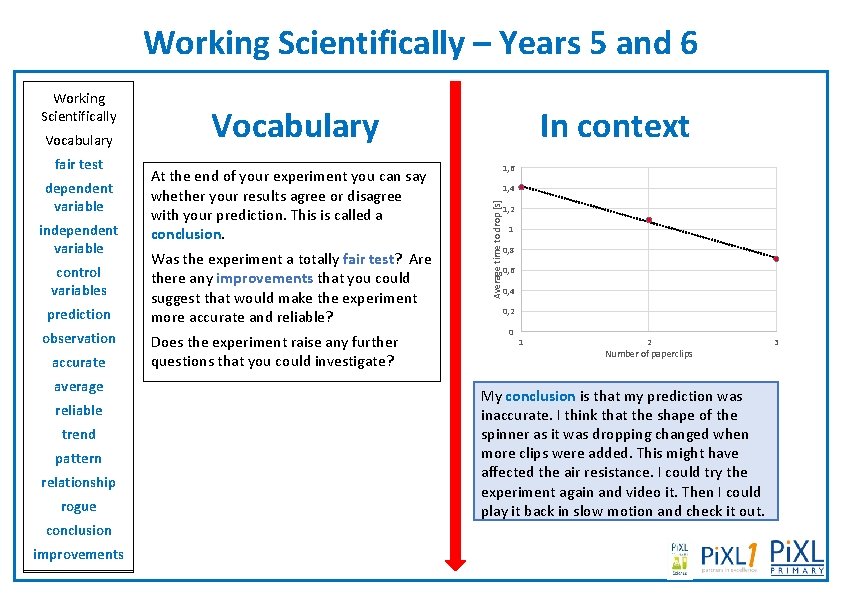
Working Scientifically – Years 5 and 6 Vocabulary fair test Working Scientifically. Vo dependent cabulary variable experiment independent fair test variables control prediction variables observation prediction thermometer observation temperature accurate microscope average accuracy reliable results trend diagram pattern conclusion relationship rogue conclusion improvements Vocabulary At the end of your experiment you can say whether your results agree or disagree with your prediction. This is called a conclusion. Was the experiment a totally fair test? Are there any improvements that you could suggest that would make the experiment more accurate and reliable? Does the experiment raise any further questions that you could investigate? In context 1, 6 1, 4 Average time to drop [s] Working Scientifically 1, 2 1 0, 8 0, 6 0, 4 0, 2 0 1 2 Number of paperclips My conclusion is that my prediction was inaccurate. I think that the shape of the spinner as it was dropping changed when more clips were added. This might have affected the air resistance. I could try the experiment again and video it. Then I could play it back in slow motion and check it out. 3
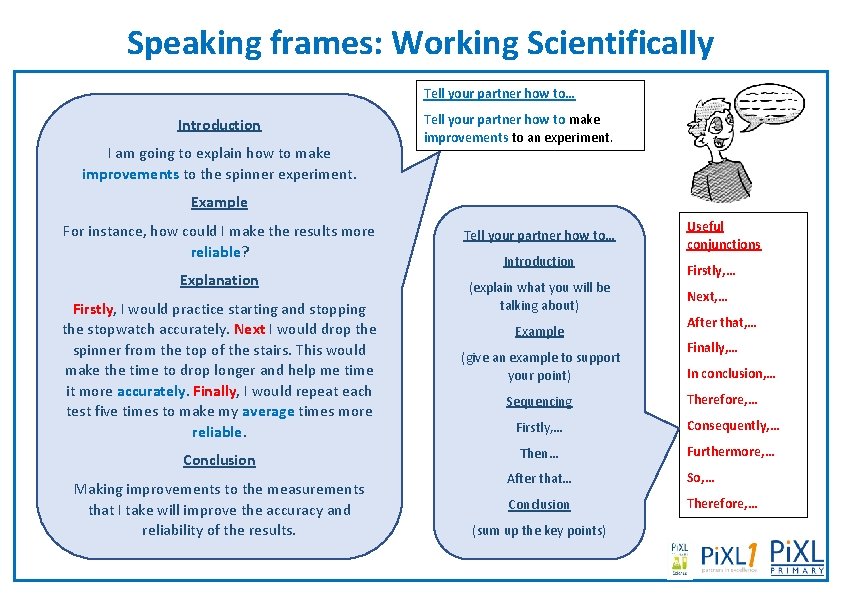
Speaking frames: Working Scientifically Tell your partner how to… Introduction I am going to explain how to make improvements to the spinner experiment. Tell your partner how to make improvements to an experiment. Example For instance, how could I make the results more reliable? Explanation Firstly, I would practice starting and stopping the stopwatch accurately. Next I would drop the spinner from the top of the stairs. This would make the time to drop longer and help me time it more accurately. Finally, I would repeat each test five times to make my average times more reliable. Conclusion Making improvements to the measurements that I take will improve the accuracy and reliability of the results. Tell your partner how to… Introduction (explain what you will be talking about) Example (give an example to support your point) Sequencing Useful conjunctions Firstly, … Next, … After that, … Finally, … In conclusion, … Therefore, … Firstly, … Consequently, … Then… Furthermore, … After that… So, … Conclusion Therefore, … (sum up the key points)
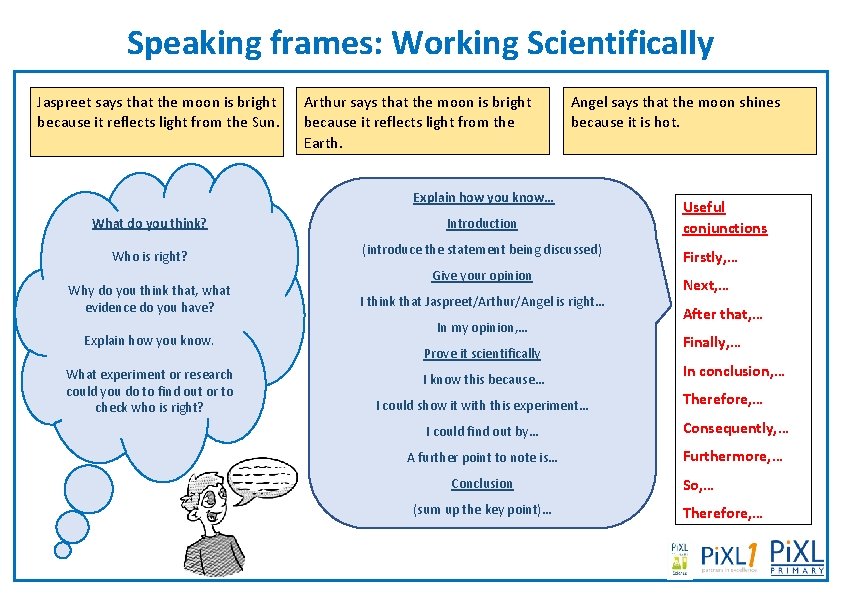
Speaking frames: Working Scientifically Jaspreet says that the moon is bright because it reflects light from the Sun. Arthur says that the moon is bright because it reflects light from the Earth. Angel says that the moon shines because it is hot. Explain how you know… What do you think? Introduction Who is right? (introduce the statement being discussed) Why do you think that, what evidence do you have? Explain how you know. What experiment or research could you do to find out or to check who is right? Give your opinion I think that Jaspreet/Arthur/Angel is right… In my opinion, … Prove it scientifically I know this because… I could show it with this experiment… Useful conjunctions Firstly, … Next, … After that, … Finally, … In conclusion, … Therefore, … I could find out by… Consequently, … A further point to note is… Furthermore, … Conclusion (sum up the key point)… So, … Therefore, …