
WORKING OUT RELATIONSHIPS LESSON 1 Learning Objectives To
WORKING OUT RELATIONSHIPS – LESSON 1 Learning Objectives: To learn about healthy and unhealthy one-to-one intimate relationships and strategies to build healthy lasting relationships including accessing support where needed
WORKING OUT RELATIONSHIPS – LESSON 1 Learning Outcomes Pupils will be able to: Evaluate whether a relationship is healthy or unhealthy Identify strategies to build a healthy lasting relationship Explain how to access support in relation to unhealthy relationships
WORKING OUT RELATIONSHIPS Think of a key word that you would associate with a healthy relationship
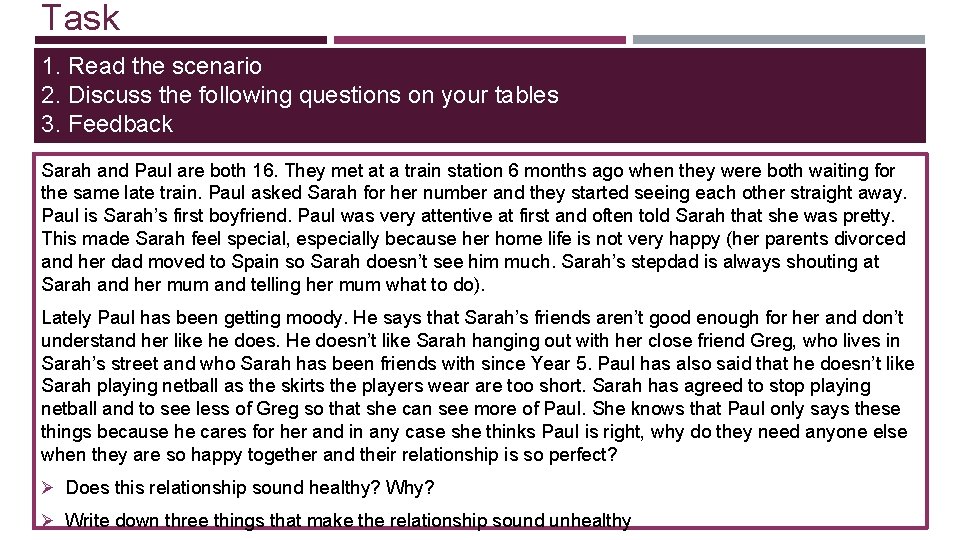
Task 1. Read the scenario 2. Discuss the following questions on your tables 3. Feedback Sarah and Paul are both 16. They met at a train station 6 months ago when they were both waiting for the same late train. Paul asked Sarah for her number and they started seeing each other straight away. Paul is Sarah’s first boyfriend. Paul was very attentive at first and often told Sarah that she was pretty. This made Sarah feel special, especially because her home life is not very happy (her parents divorced and her dad moved to Spain so Sarah doesn’t see him much. Sarah’s stepdad is always shouting at Sarah and her mum and telling her mum what to do). Lately Paul has been getting moody. He says that Sarah’s friends aren’t good enough for her and don’t understand her like he does. He doesn’t like Sarah hanging out with her close friend Greg, who lives in Sarah’s street and who Sarah has been friends with since Year 5. Paul has also said that he doesn’t like Sarah playing netball as the skirts the players wear are too short. Sarah has agreed to stop playing netball and to see less of Greg so that she can see more of Paul. She knows that Paul only says these things because he cares for her and in any case she thinks Paul is right, why do they need anyone else when they are so happy together and their relationship is so perfect? Ø Does this relationship sound healthy? Why? Ø Write down three things that make the relationship sound unhealthy
WORKING OUT RELATIONSHIPS – VIDEO What are the key strengths of a healthy relationship? How do you keep your relationship ‘fit’? As you watch this video make a note of the four things that it suggests are needed to keep a relationship strong. Working Out Relationships?
WORKING OUT RELATIONSHIPS Researchers at the University of Exeter have come up with ten questions it is important for partners to ask themselves and then their partner before committing to a serious relationship. The ‘Working Out Relationships? ’ video brings some of these key questions together. Task Ø Read the 10 questions on the next slide. Ø On your table, discuss what would Sarah say if she asked herself these questions about her and Paul’s relationship?
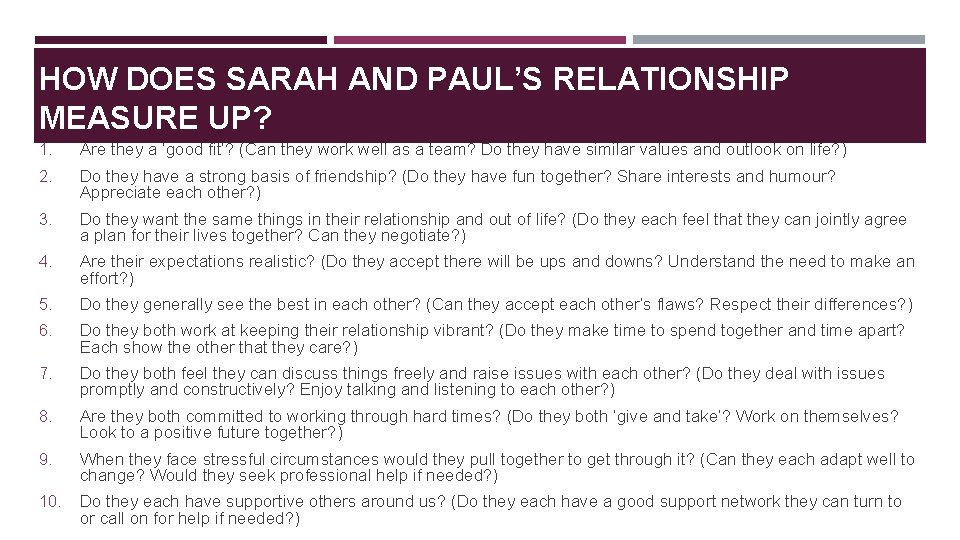
HOW DOES SARAH AND PAUL’S RELATIONSHIP MEASURE UP? 1. Are they a ‘good fit’? (Can they work well as a team? Do they have similar values and outlook on life? ) 2. Do they have a strong basis of friendship? (Do they have fun together? Share interests and humour? Appreciate each other? ) 3. Do they want the same things in their relationship and out of life? (Do they each feel that they can jointly agree a plan for their lives together? Can they negotiate? ) 4. Are their expectations realistic? (Do they accept there will be ups and downs? Understand the need to make an effort? ) 5. Do they generally see the best in each other? (Can they accept each other’s flaws? Respect their differences? ) 6. Do they both work at keeping their relationship vibrant? (Do they make time to spend together and time apart? Each show the other that they care? ) 7. Do they both feel they can discuss things freely and raise issues with each other? (Do they deal with issues promptly and constructively? Enjoy talking and listening to each other? ) 8. Are they both committed to working through hard times? (Do they both ‘give and take’? Work on themselves? Look to a positive future together? ) 9. When they face stressful circumstances would they pull together to get through it? (Can they each adapt well to change? Would they seek professional help if needed? ) 10. Do they each have supportive others around us? (Do they each have a good support network they can turn to or call on for help if needed? )
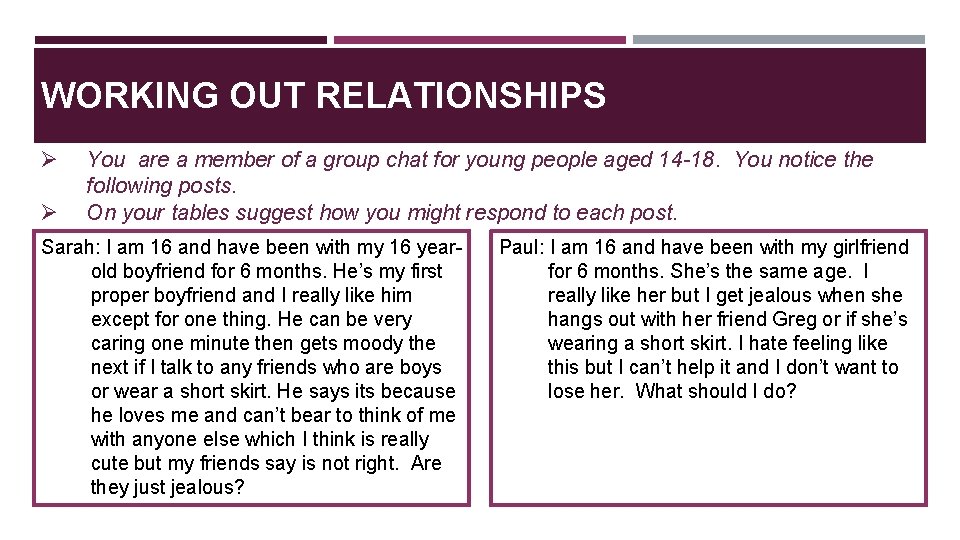
WORKING OUT RELATIONSHIPS Ø Ø You are a member of a group chat for young people aged 14 -18. You notice the following posts. On your tables suggest how you might respond to each post. Sarah: I am 16 and have been with my 16 yearold boyfriend for 6 months. He’s my first proper boyfriend and I really like him except for one thing. He can be very caring one minute then gets moody the next if I talk to any friends who are boys or wear a short skirt. He says its because he loves me and can’t bear to think of me with anyone else which I think is really cute but my friends say is not right. Are they just jealous? Paul: I am 16 and have been with my girlfriend for 6 months. She’s the same age. I really like her but I get jealous when she hangs out with her friend Greg or if she’s wearing a short skirt. I hate feeling like this but I can’t help it and I don’t want to lose her. What should I do?
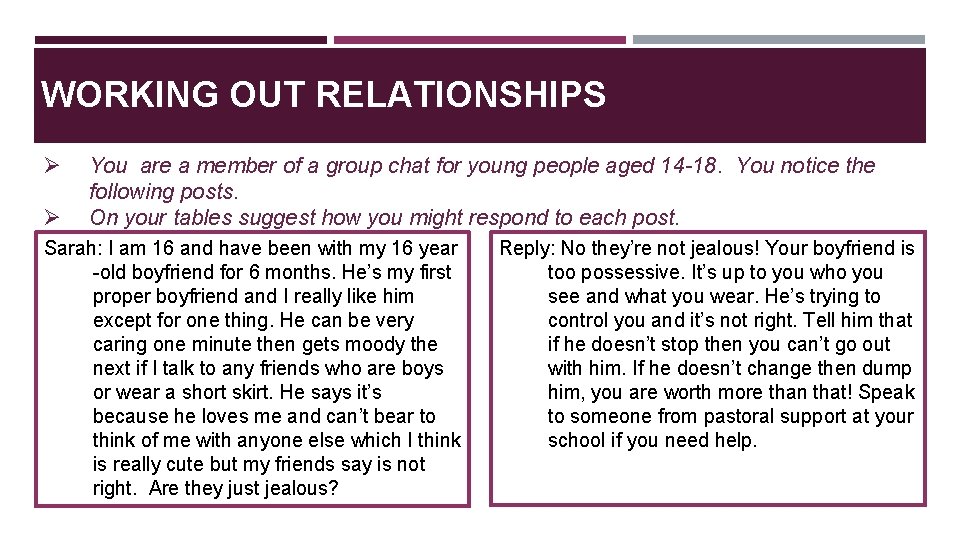
WORKING OUT RELATIONSHIPS Ø Ø You are a member of a group chat for young people aged 14 -18. You notice the following posts. On your tables suggest how you might respond to each post. Sarah: I am 16 and have been with my 16 year -old boyfriend for 6 months. He’s my first proper boyfriend and I really like him except for one thing. He can be very caring one minute then gets moody the next if I talk to any friends who are boys or wear a short skirt. He says it’s because he loves me and can’t bear to think of me with anyone else which I think is really cute but my friends say is not right. Are they just jealous? Reply: No they’re not jealous! Your boyfriend is too possessive. It’s up to you who you see and what you wear. He’s trying to control you and it’s not right. Tell him that if he doesn’t stop then you can’t go out with him. If he doesn’t change then dump him, you are worth more than that! Speak to someone from pastoral support at your school if you need help.
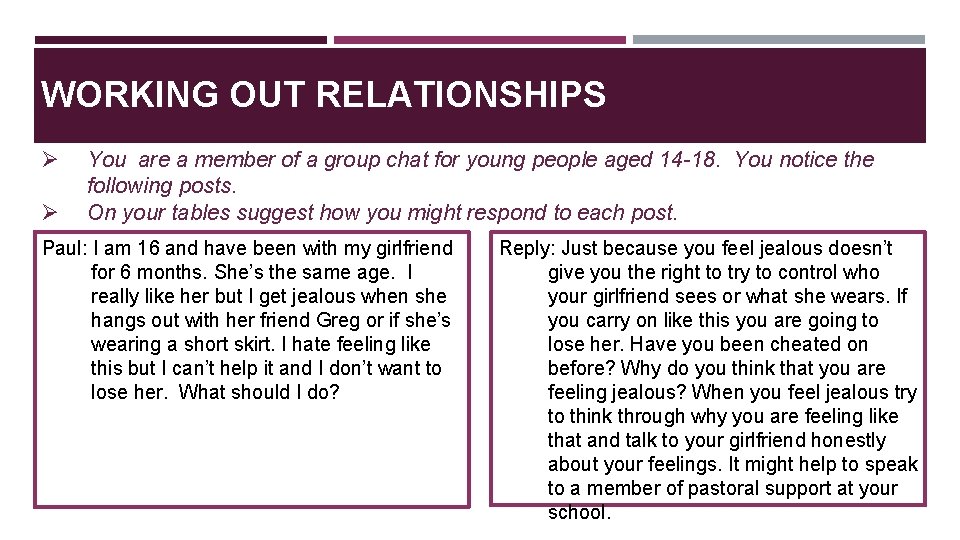
WORKING OUT RELATIONSHIPS Ø Ø You are a member of a group chat for young people aged 14 -18. You notice the following posts. On your tables suggest how you might respond to each post. Paul: I am 16 and have been with my girlfriend for 6 months. She’s the same age. I really like her but I get jealous when she hangs out with her friend Greg or if she’s wearing a short skirt. I hate feeling like this but I can’t help it and I don’t want to lose her. What should I do? Reply: Just because you feel jealous doesn’t give you the right to try to control who your girlfriend sees or what she wears. If you carry on like this you are going to lose her. Have you been cheated on before? Why do you think that you are feeling jealous? When you feel jealous try to think through why you are feeling like that and talk to your girlfriend honestly about your feelings. It might help to speak to a member of pastoral support at your school.
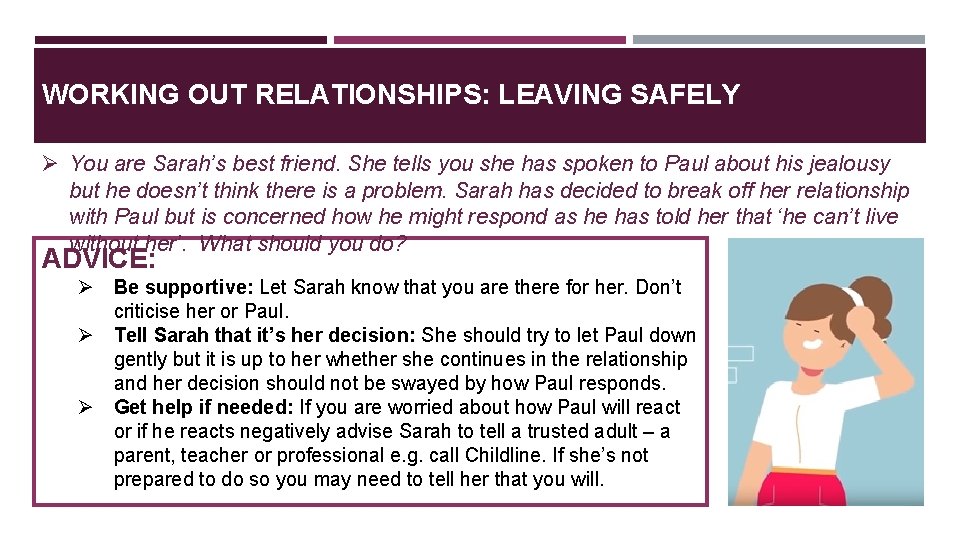
WORKING OUT RELATIONSHIPS: LEAVING SAFELY Ø You are Sarah’s best friend. She tells you she has spoken to Paul about his jealousy but he doesn’t think there is a problem. Sarah has decided to break off her relationship with Paul but is concerned how he might respond as he has told her that ‘he can’t live without her’. What should you do? ADVICE: Ø Be supportive: Let Sarah know that you are there for her. Don’t criticise her or Paul. Ø Tell Sarah that it’s her decision: She should try to let Paul down gently but it is up to her whether she continues in the relationship and her decision should not be swayed by how Paul responds. Ø Get help if needed: If you are worried about how Paul will react or if he reacts negatively advise Sarah to tell a trusted adult – a parent, teacher or professional e. g. call Childline. If she’s not prepared to do so you may need to tell her that you will.
WORKING OUT RELATIONSHIPS Task Ø Write down 3 things that would have to change about Sarah and Paul’s relationship for it to be healthy.
WORKING OUT RELATIONSHIPS: HOMEWORK TASK Before your next PSHE lesson: Ø Create an information leaflet aimed at your year group to highlight the ‘warning signs’ that indicate that a relationship is unhealthy.
- Slides: 13