
Working Memory Effects on Interlanguage Variation in using
- Slides: 20
Working Memory Effects on Interlanguage Variation in using complex grammar by advanced adult learners of English, often not overcome even in immersion settings “Who does play the music? ” “What did Mary think it tasted delicious? ” Clare. wright 1@ncl. ac. uk
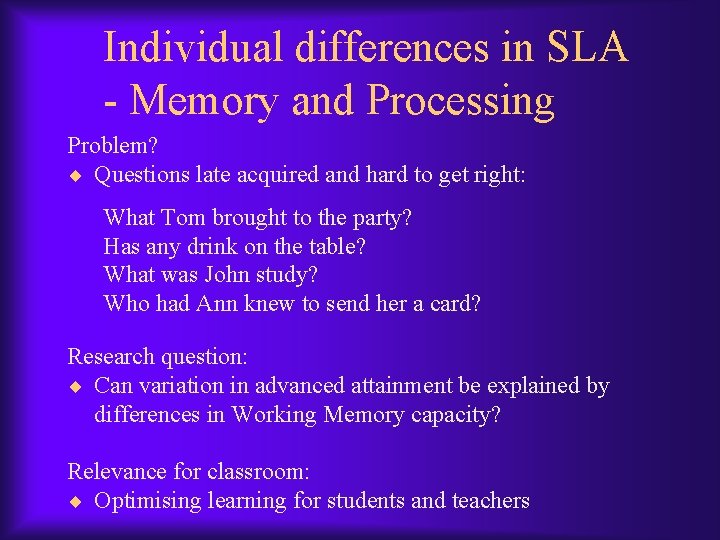
Individual differences in SLA - Memory and Processing Problem? ¨ Questions late acquired and hard to get right: What Tom brought to the party? Has any drink on the table? What was John study? Who had Ann knew to send her a card? Research question: ¨ Can variation in advanced attainment be explained by differences in Working Memory capacity? Relevance for classroom: ¨ Optimising learning for students and teachers
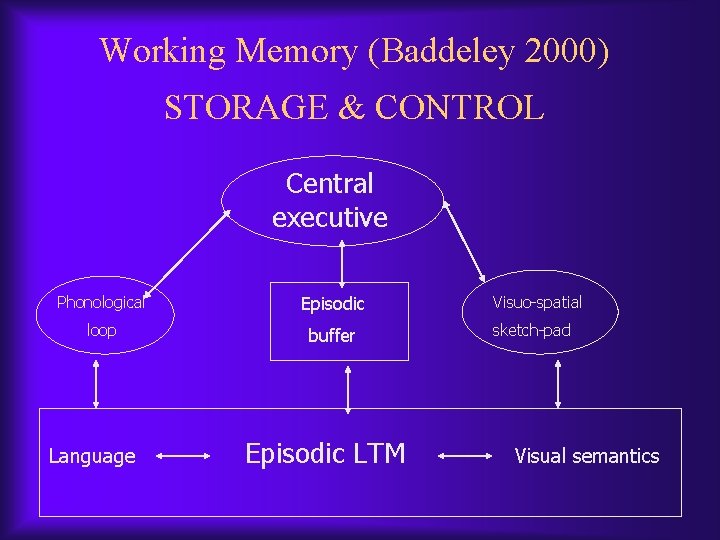
Working Memory (Baddeley 2000) STORAGE & CONTROL Central executive Phonological Episodic loop buffer Language Episodic LTM Visuo-spatial sketch-pad Visual semantics
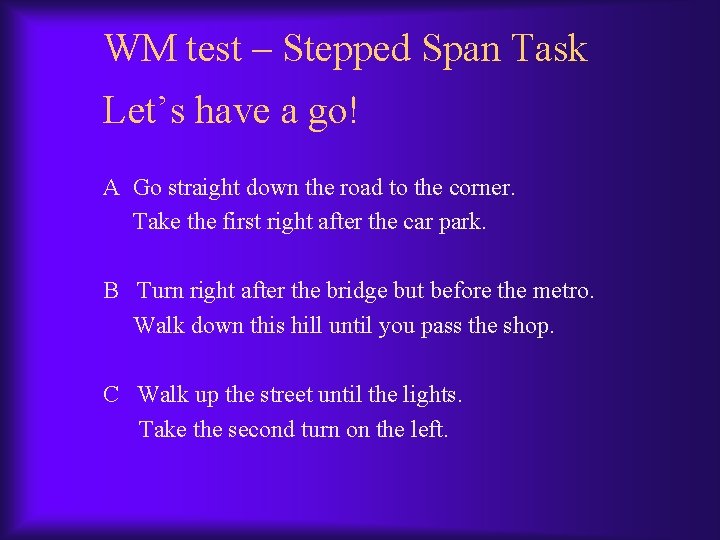
WM test – Stepped Span Task Let’s have a go! A Go straight down the road to the corner. Take the first right after the car park. B Turn right after the bridge but before the metro. Walk down this hill until you pass the shop. C Walk up the street until the lights. Take the second turn on the left.
WM “key” to Language Acquisition? ¨ Hypothesis 1: WM can affect conscious control over correct grammatical forms ¨ Hypothesis 2: WM correlates with faster improvement in production of correct grammatical forms
My Study Investigated variation in question formation ¨ 10 Mandarin-speaking postgraduates at a UK university ¨ Tested on arrival and after 6 months
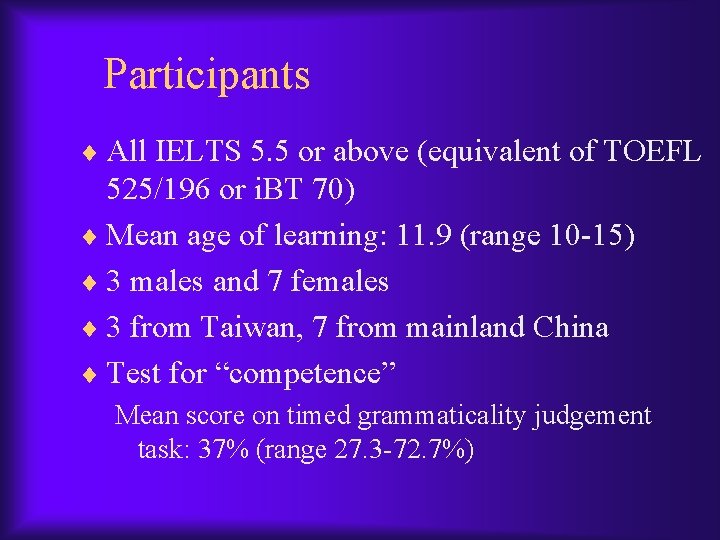
Participants ¨ All IELTS 5. 5 or above (equivalent of TOEFL 525/196 or i. BT 70) ¨ Mean age of learning: 11. 9 (range 10 -15) ¨ 3 males and 7 females ¨ 3 from Taiwan, 7 from mainland China ¨ Test for “competence” Mean score on timed grammaticality judgement task: 37% (range 27. 3 -72. 7%)
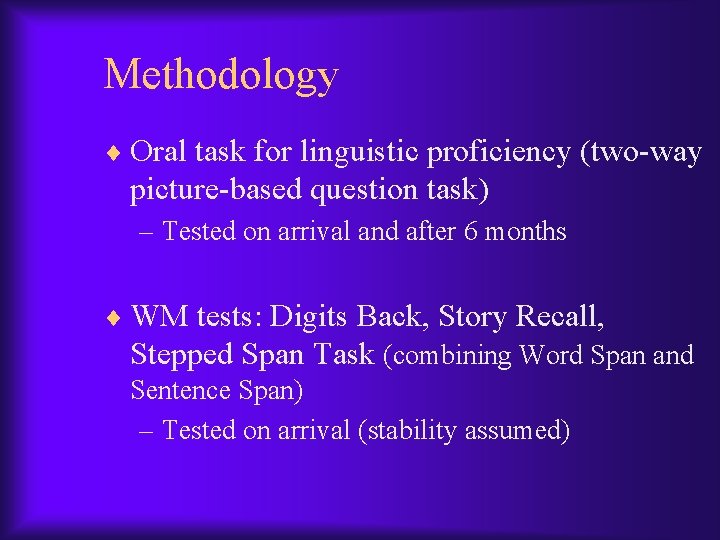
Methodology ¨ Oral task for linguistic proficiency (two-way picture-based question task) – Tested on arrival and after 6 months ¨ WM tests: Digits Back, Story Recall, Stepped Span Task (combining Word Span and Sentence Span) – Tested on arrival (stability assumed)
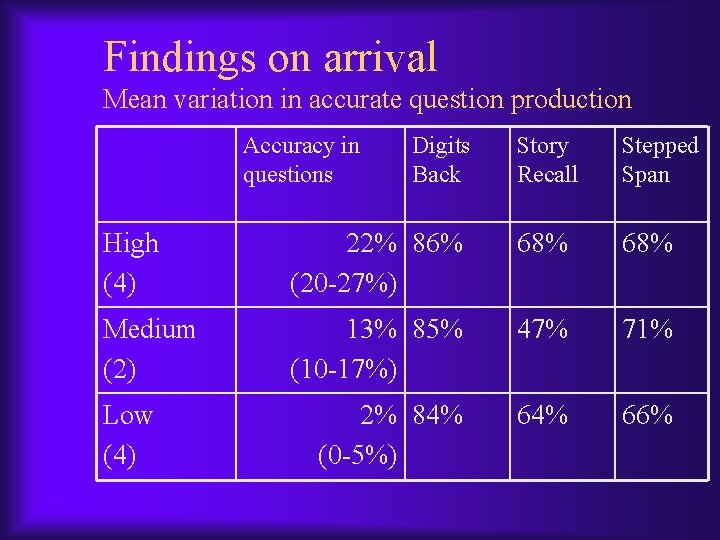
Findings on arrival Mean variation in accurate question production Accuracy in questions Digits Back Story Recall Stepped Span High (4) 22% 86% (20 -27%) 68% Medium (2) 13% 85% (10 -17%) 47% 71% 2% 84% (0 -5%) 64% 66% Low (4)
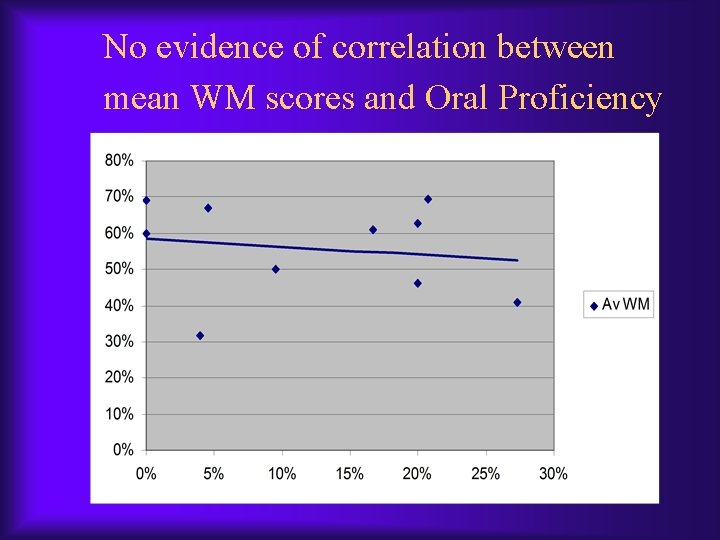
No evidence of correlation between mean WM scores and Oral Proficiency
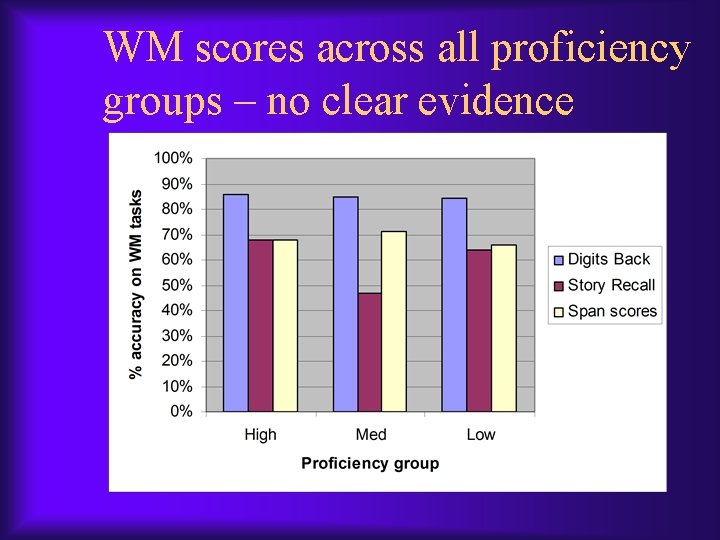
WM scores across all proficiency groups – no clear evidence
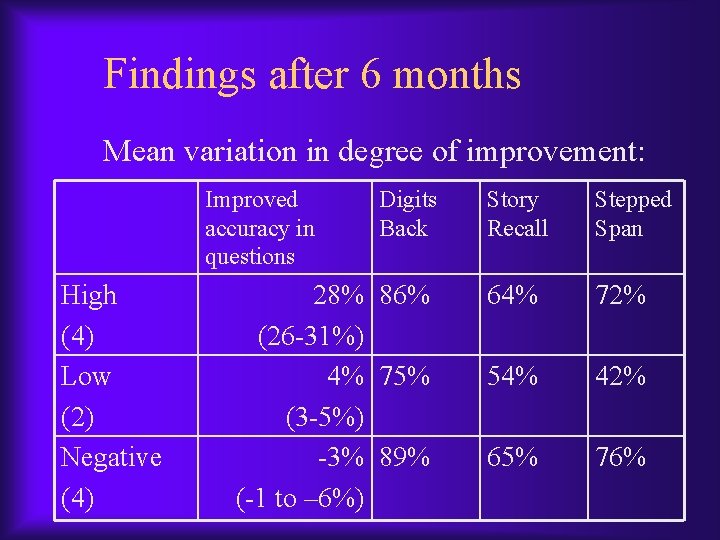
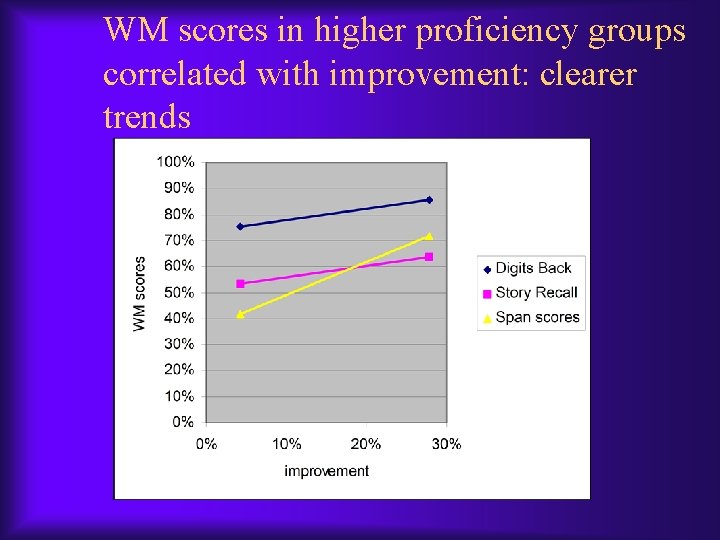
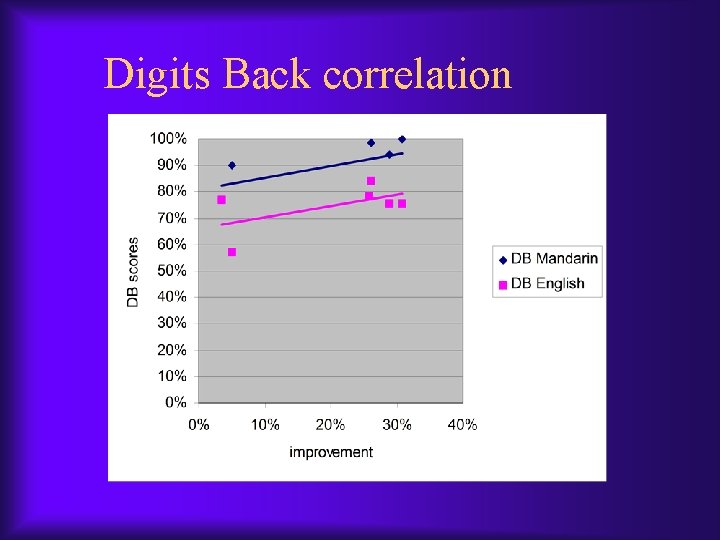
Findings after 6 months Mean variation in degree of improvement: Improved accuracy in questions High (4) Low (2) Negative (4) Digits Back 28% 86% (26 -31%) 4% 75% (3 -5%) -3% 89% (-1 to – 6%) Story Recall Stepped Span 64% 72% 54% 42% 65% 76%
WM scores across all proficiency groups – no clear trend
WM scores in higher proficiency groups correlated with improvement: clearer trends
Digits Back correlation
Story Recall correlation
Word and Sentence Span correlation
Working Memory “key to language learning”? ¨ Hypothesis 1: WM affects control of correct grammatical forms – No clear evidence ¨ Hypothesis 2: WM correlates with faster rates of improvement – Some evidence? ¨ Further research - phonological loop in the classroom: importance for noticing feedback?
Working Memory not so much a “key” as a “bottle neck”. Thank you! clare. wright 1@ncl. ac. uk
References Baddeley, A. (2003). Working memory and language: an overview. Journal of Communication Disorders 36. 189 -208. Baddeley, A. and Hitch, G. (1974). Working memory. In G. H. Bower (ed. ), The psychology of learning and motivation: advances in research and theory. New York: Academic Press. 47 -89. Daneman, M. . and Carpenter, P. (1980). Individual differences in working memory and reading. Journal of Verbal Learning and Verbal Behavior 19. 450– 466. De Gelder, B. , Vroomen, J. , & Bertelson, P. (1993). The effects of alphabetic-reading competence on language representation in bilingual Chinese subjects. Psychological Research 55. 315 -321. De. Keyser, R. (1997). Beyond explicit rule learning: Automatizing second language morphosyntax. Studies in Second Language Acquisition 19. 195 -221. Gathercole, S. and Baddeley, A. (1993). Working Memory and Language. Hove: L. Erlbaum. Harrington, M. & Sawyer, M. (1992). L 2 working memory and L 2 reading skill. Studies in Second Language Acquisition 14 (1). 25 -38. Miyake, A. & Friedman, N. (1998). Individual differences in second language proficiency: working memory as language aptitude. In Healy, A. & Bourne, L. (eds. ), Foreign Language Learning. Mahwah, NJ: Lawrence Erlbaum. 339 -364 Ullman, M. (2001). The neural basis of lexicon and grammar in first and second language: the declarative/procedural model. Bilingualism: Language and Cognition 4 (2). 105 -122.