
Working memory and second language learning Elvira Masoura



- Slides: 55
Working memory and second language learning Elvira Masoura School of Psychology Department of Experimental Cognitive psychology Aristotle University of Thessaloniki
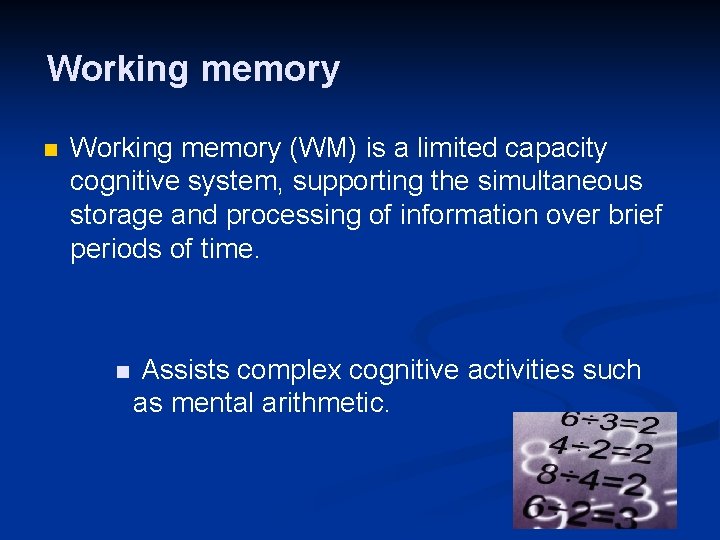
Working memory n Working memory (WM) is a limited capacity cognitive system, supporting the simultaneous storage and processing of information over brief periods of time. n Assists complex cognitive activities such as mental arithmetic.
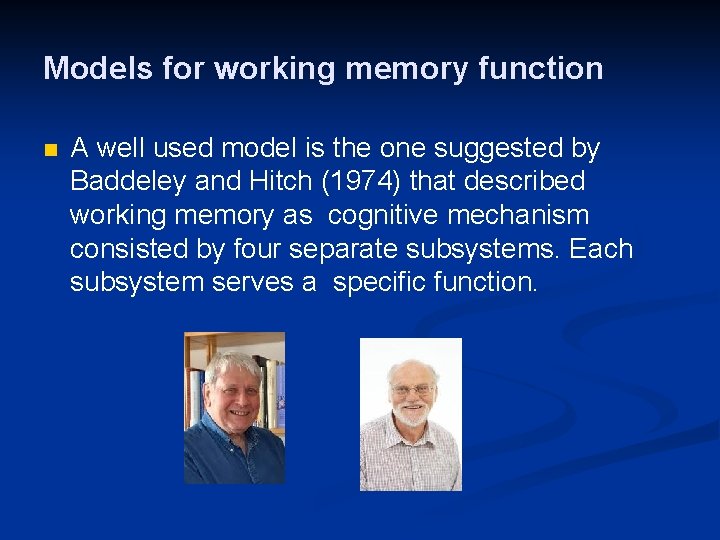
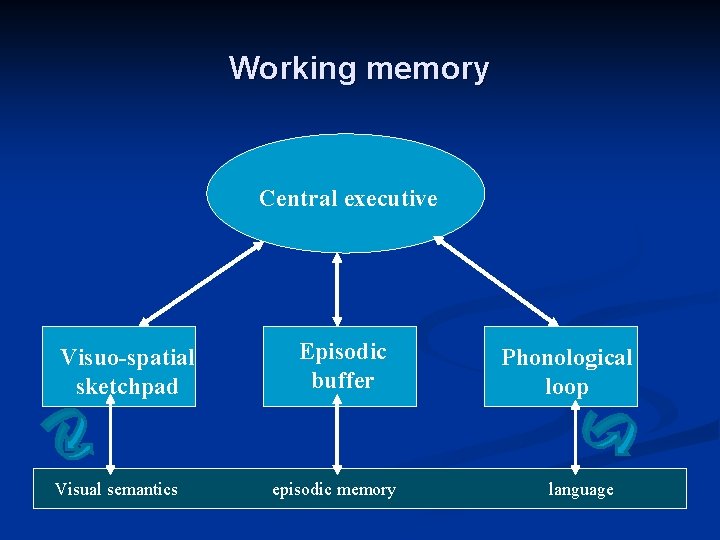
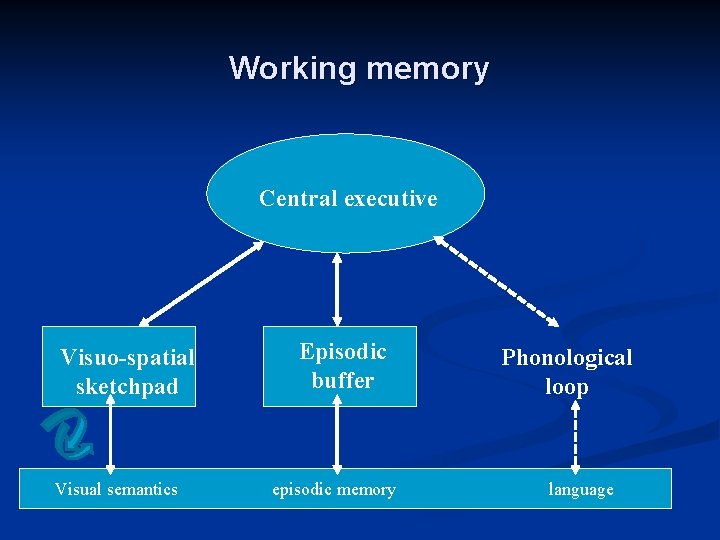
Models for working memory function n A well used model is the one suggested by Baddeley and Hitch (1974) that described working memory as cognitive mechanism consisted by four separate subsystems. Each subsystem serves a specific function.
Working memory Central executive Visuo-spatial sketchpad Visual semantics Episodic buffer episodic memory Phonological loop language
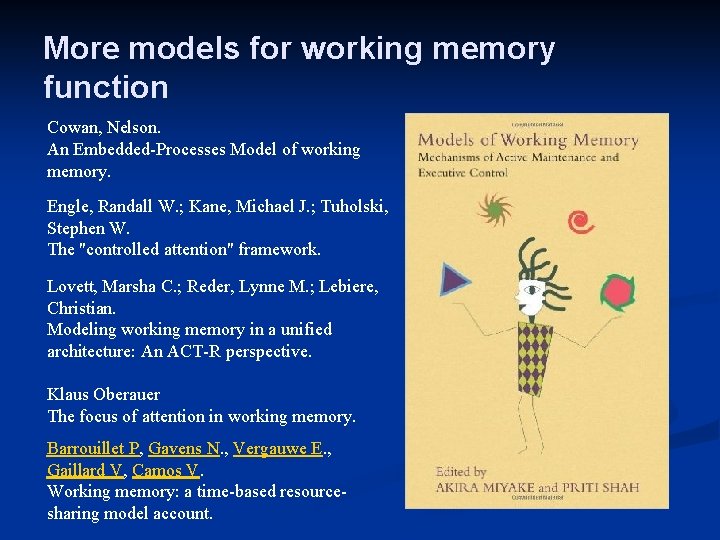
More models for working memory function Cowan, Nelson. An Embedded-Processes Model of working memory. Engle, Randall W. ; Kane, Michael J. ; Tuholski, Stephen W. The "controlled attention" framework. Lovett, Marsha C. ; Reder, Lynne M. ; Lebiere, Christian. Modeling working memory in a unified architecture: An ACT-R perspective. Klaus Oberauer The focus of attention in working memory. Barrouillet P, Gavens N. , Vergauwe E. , Gaillard V, Camos V. Working memory: a time-based resourcesharing model account.
Characteristics of working memory n Mental workspace n Capacity limitation that varies between individuals n Catastrophic loss https: //www. youtube. com/watch? v=IQJl. DEQ 0 Myo
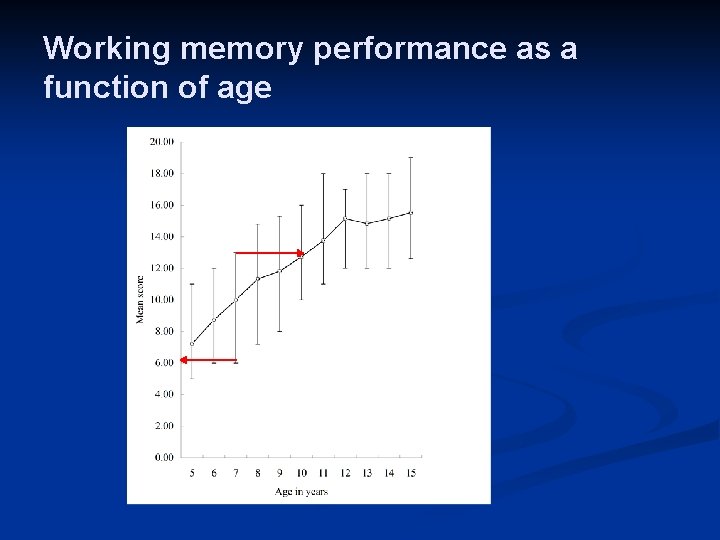
Working memory performance as a function of age
Characteristics of children with poor working memory 1. 2. 3. 4. Poor academic progress Difficulties in following instructions Lose track in complex tasks Teachers say: short attention span and highly distractible
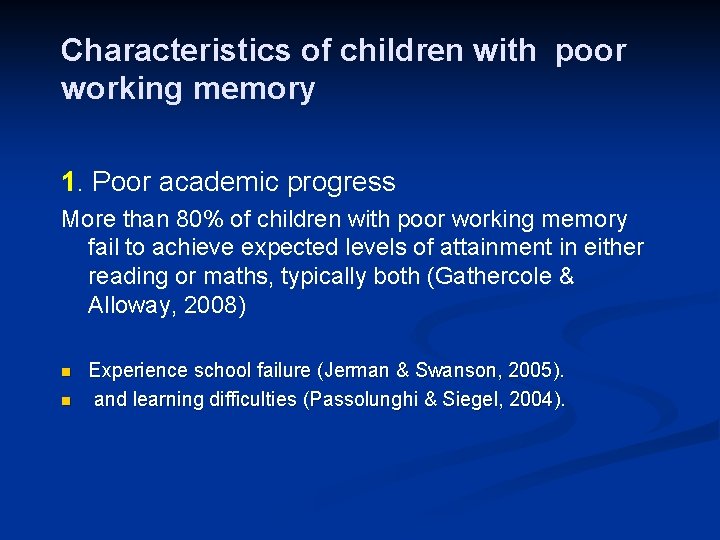
Characteristics of children with poor working memory 1. Poor academic progress More than 80% of children with poor working memory fail to achieve expected levels of attainment in either reading or maths, typically both (Gathercole & Alloway, 2008) n n Experience school failure (Jerman & Swanson, 2005). and learning difficulties (Passolunghi & Siegel, 2004).
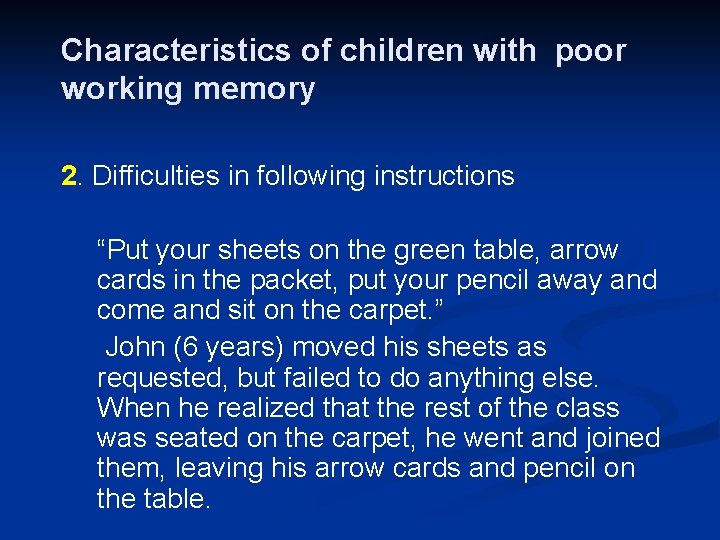
Characteristics of children with poor working memory 2. Difficulties in following instructions “Put your sheets on the green table, arrow cards in the packet, put your pencil away and come and sit on the carpet. ” John (6 years) moved his sheets as requested, but failed to do anything else. When he realized that the rest of the class was seated on the carpet, he went and joined them, leaving his arrow cards and pencil on the table.
Characteristics of children with poor working memory 3. Lose track in complex tasks
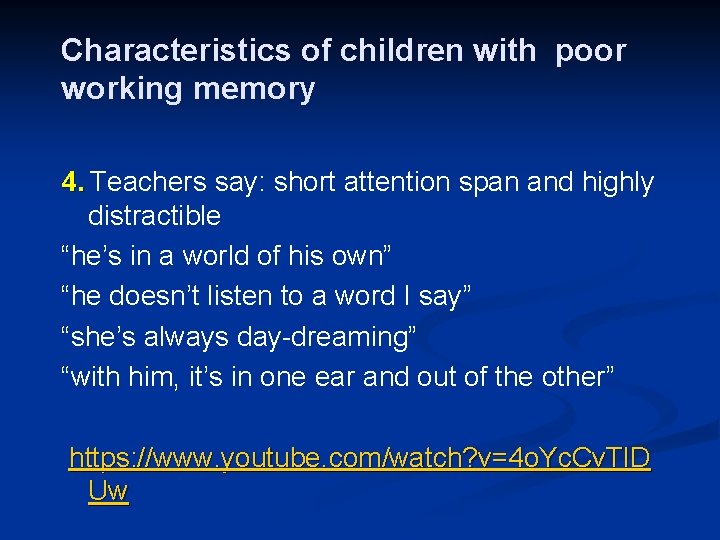
Characteristics of children with poor working memory 4. Teachers say: short attention span and highly distractible “he’s in a world of his own” “he doesn’t listen to a word I say” “she’s always day-dreaming” “with him, it’s in one ear and out of the other” https: //www. youtube. com/watch? v=4 o. Yc. Cv. Tl. D Uw
Low working memory performance n children with low performance in objective measures of WM often struggle with various learning tasks (Gathercole, Lamont, & Alloway, 2006). Why? n An explanation for such observations is that when an activity requires simultaneous storage and manipulation of material, limited capacity WM is overloaded leading to task failure (Alloway, 2006).
Features of working memory WM is strongly associated with: n children's learning and educational attainment (Gathercole, Pickering, Knight, & Stegman, 2004). n vocabulary acquisition (Baddeley, Gathercole, & Papagno, 1998). n reading comprehension (Engel de Abreu, Gathercole, & Martin, 2011). n mathematical skills (Bull, Espy, & Wiebe, 2008; Reuhkala, 2001). Μasoura, Ε. (2006). Establishing the link between working memory function and learning disabilities. Learning Disabilities: A Contemporary Journal, 4(2), 29 -41.
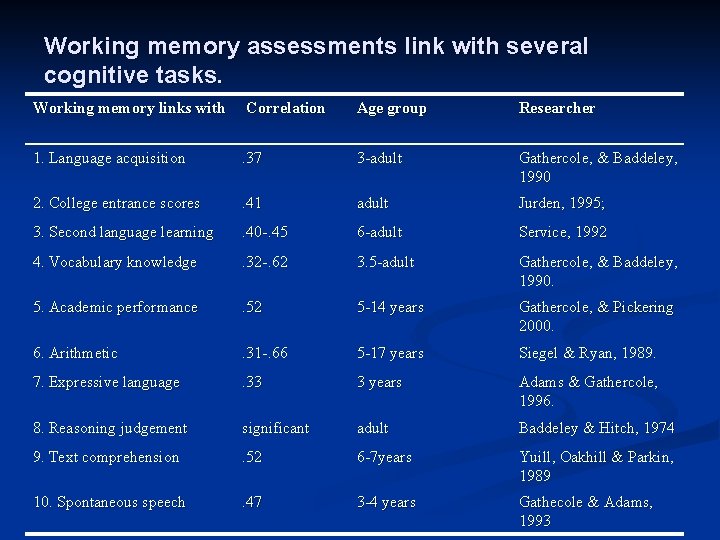
Working memory assessments link with several cognitive tasks. Working memory links with Correlation Age group Researcher 1. Language acquisition . 37 3 -adult Gathercole, & Baddeley, 1990 2. College entrance scores . 41 adult Jurden, 1995; 3. Second language learning . 40 -. 45 6 -adult Service, 1992 4. Vocabulary knowledge . 32 -. 62 3. 5 -adult Gathercole, & Baddeley, 1990. 5. Academic performance . 52 5 -14 years Gathercole, & Pickering 2000. 6. Arithmetic . 31 -. 66 5 -17 years Siegel & Ryan, 1989. 7. Expressive language . 33 3 years Adams & Gathercole, 1996. 8. Reasoning judgement significant adult Baddeley & Hitch, 1974 9. Text comprehension . 52 6 -7 years Yuill, Oakhill & Parkin, 1989 10. Spontaneous speech . 47 3 -4 years Gathecole & Adams, 1993
Working memory problems in many developmental disorders n n n Reading difficulties/ dyslexia Maths difficulties/ dyscalculia Specific Language Impairment ADHD Genetic disorders – Downs, Williams, Fragile X
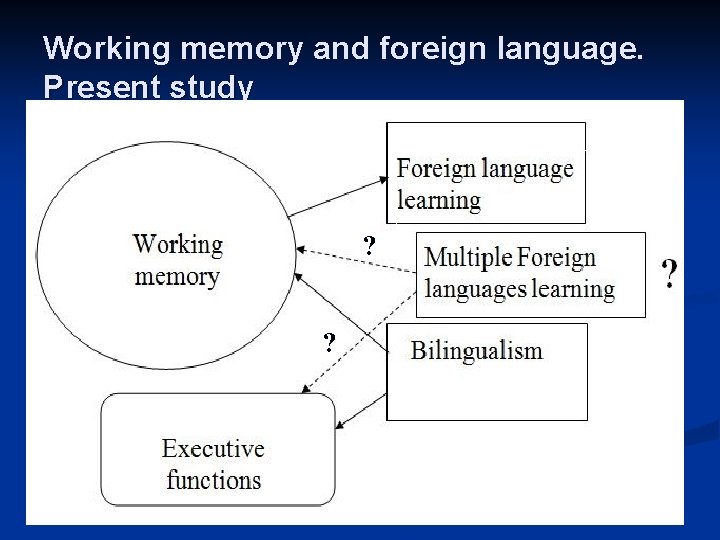
Working memory and foreign language n Strong links between foreign language learning and phonological loop capacity -stronger for new vocabulary learning in foreign language (Service, 1992; Masoura, & Gathercole, 1999). n The relationship is stronger at the initial stages of learning (Masoura & Gathercole, 2005)
Working memory and new word learning in a foreign language. Baddeley, Papagno, & Vallar, (1988).
Working memory Central executive Visuo-spatial sketchpad Visual semantics Episodic buffer episodic memory Phonological loop language
Working memory and second language learning n Strong links between foreign language learning and phonological loop capacity (Service, 1992). n Links are stronger for new vocabulary learning in foreign language (Service, 1992).
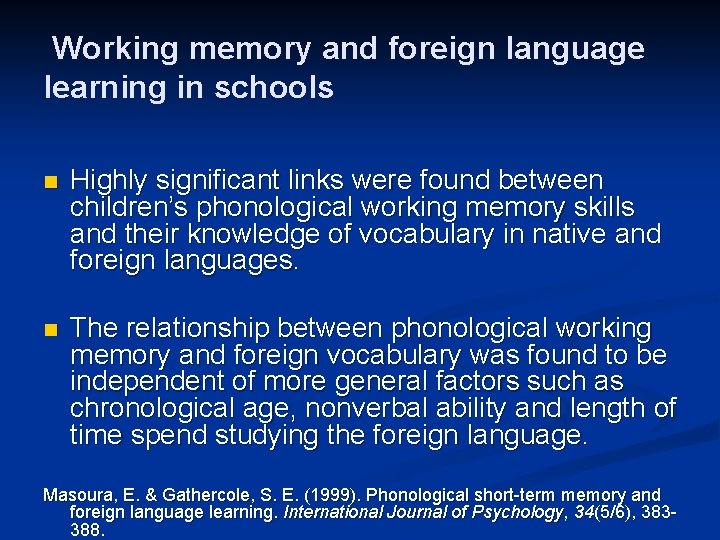
Working memory and foreign language learning in schools n Highly significant links were found between children’s phonological working memory skills and their knowledge of vocabulary in native and foreign languages. n The relationship between phonological working memory and foreign vocabulary was found to be independent of more general factors such as chronological age, nonverbal ability and length of time spend studying the foreign language. Masoura, Ε. & Gathercole, S. E. (1999). Phonological short-term memory and foreign language learning. International Journal of Psychology, 34(5/6), 383388.
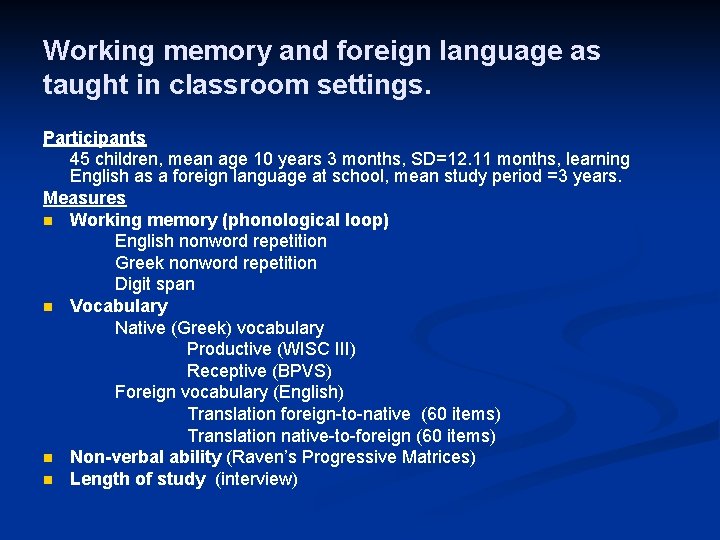
Working memory and foreign language as taught in classroom settings. Participants 45 children, mean age 10 years 3 months, SD=12. 11 months, learning English as a foreign language at school, mean study period =3 years. Measures n Working memory (phonological loop) English nonword repetition Greek nonword repetition Digit span n Vocabulary Native (Greek) vocabulary Productive (WISC III) Receptive (BPVS) Foreign vocabulary (English) Translation foreign-to-native (60 items) Translation native-to-foreign (60 items) n Non-verbal ability (Raven’s Progressive Matrices) n Length of study (interview)
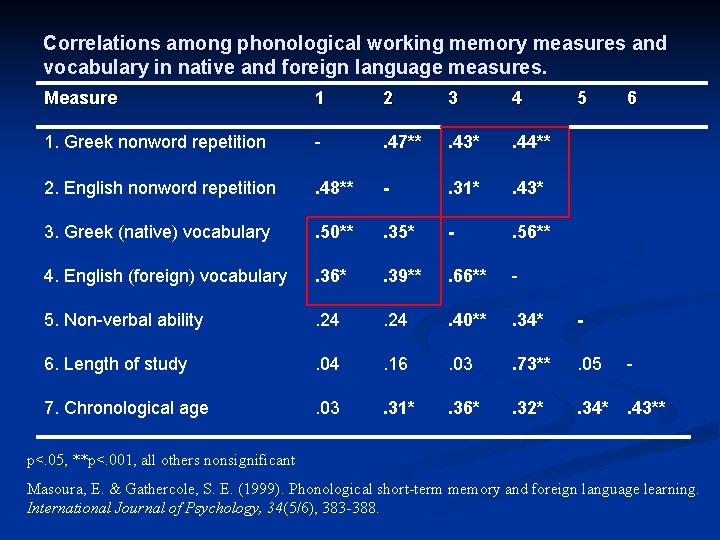
Correlations among phonological working memory measures and vocabulary in native and foreign language measures. Measure 1 2 3 4 5 6 1. Greek nonword repetition - . 47** . 43* . 44** 2. English nonword repetition . 48** - . 31* . 43* 3. Greek (native) vocabulary . 50** . 35* - . 56** 4. English (foreign) vocabulary . 36* . 39** . 66** - 5. Non-verbal ability . 24 . 40** . 34* - 6. Length of study . 04 . 16 . 03 . 73** . 05 - 7. Chronological age . 03 . 31* . 36* . 32* . 34* . 43** p<. 05, **p<. 001, all others nonsignificant Masoura, Ε. & Gathercole, S. E. (1999). Phonological short-term memory and foreign language learning. International Journal of Psychology, 34(5/6), 383 -388.
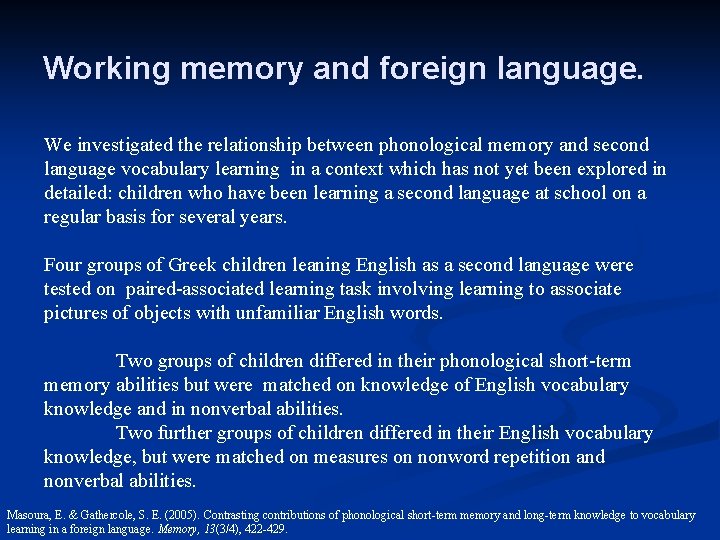
Working memory and foreign language. We investigated the relationship between phonological memory and second language vocabulary learning in a context which has not yet been explored in detailed: children who have been learning a second language at school on a regular basis for several years. Four groups of Greek children leaning English as a second language were tested on paired-associated learning task involving learning to associate pictures of objects with unfamiliar English words. Two groups of children differed in their phonological short-term memory abilities but were matched on knowledge of English vocabulary knowledge and in nonverbal abilities. Two further groups of children differed in their English vocabulary knowledge, but were matched on measures on nonword repetition and nonverbal abilities. Masoura, Ε. & Gathercole, S. E. (2005). Contrasting contributions of phonological short-term memory and long-term knowledge to vocabulary learning in a foreign language. Memory, 13(3/4), 422 -429.
Masoura, Ε. & Gathercole, S. E. (2005). Contrasting contributions of phonological short-term memory and long-term knowledge to vocabulary learning in a foreign language. Memory, 13(3/4), 422 -429.
Working memory and foreign language. Present study ? ?
Working memory and bilinguals n Bilingual children manifest greater performances n on short-term memory tasks (Engel de Abreu, 2011). n on working memory function (Morales, Calvo, Bialystok, 2013; Bialystok, Craik, & Luk, 2008).
Bilingual Advantage n n n Better executive functions (Bialystok, 2011). Faster on processing speed (Bialystok, 2011). Better use of symbols (Adescope, Lavin, Thompon & Undeleider, 2010). n Better use of numbers (Adescope, Lavin, Thompon & Undeleider, 2010). n Better on non-verbal tasks (Carlson & Meltzhoff, 2008).
Bilingual Advantage Why? n bilinguals are trained to resist to interference, as they often need to solve linguistic completions between two languages and to inhibit one language while using the other. n This advantage may transfer to shortterm and to working memory function (Morales, Calvo, Bialystok, 2013)
Question n How does the learning of several foreign languages effects working memory and executive functions?
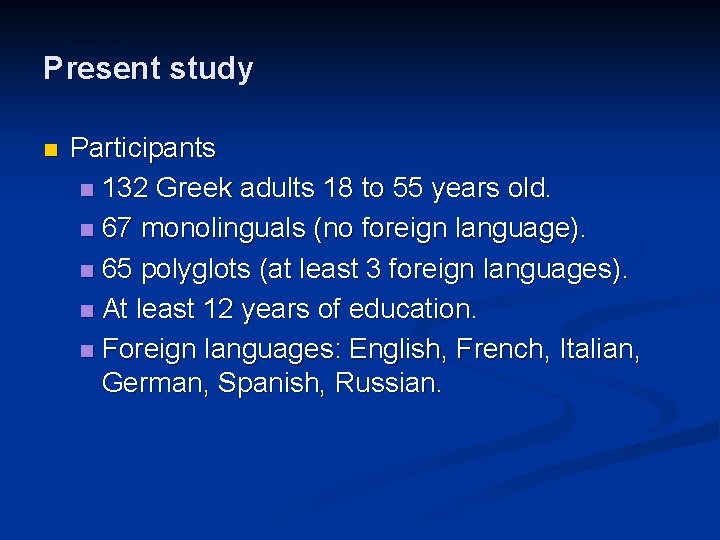
Present study n Participants n 132 Greek adults 18 to 55 years old. n 67 monolinguals (no foreign language). n 65 polyglots (at least 3 foreign languages). n At least 12 years of education. n Foreign languages: English, French, Italian, German, Spanish, Russian.
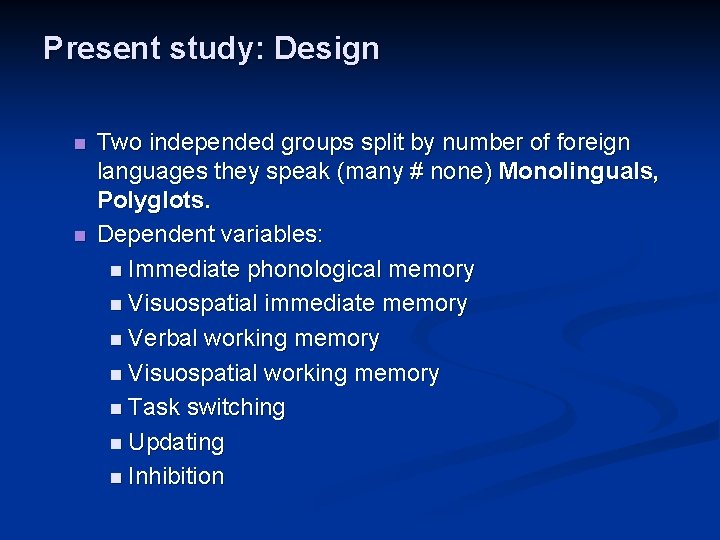
Present study: Design n n Two independed groups split by number of foreign languages they speak (many # none) Monolinguals, Polyglots. Dependent variables: n Immediate phonological memory n Visuospatial immediate memory n Verbal working memory n Visuospatial working memory n Task switching n Updating n Inhibition
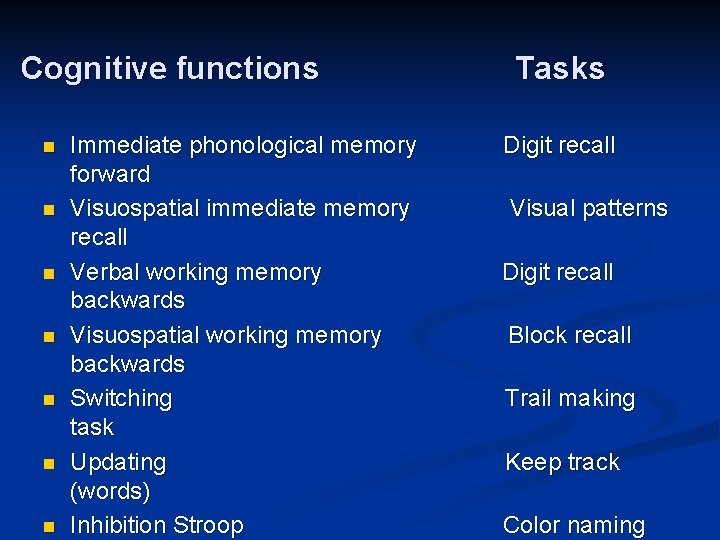
Cognitive functions n n n n Immediate phonological memory forward Visuospatial immediate memory recall Verbal working memory backwards Visuospatial working memory backwards Switching task Updating (words) Inhibition Stroop Tasks Digit recall Visual patterns Digit recall Block recall Trail making Keep track Color naming
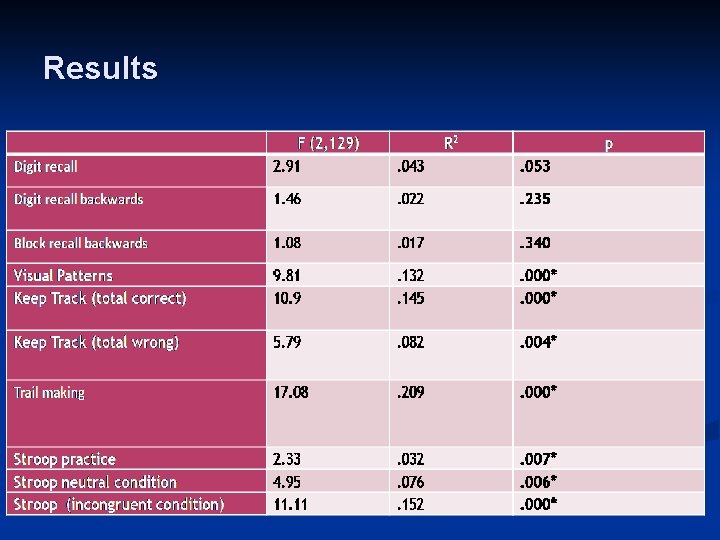
Results
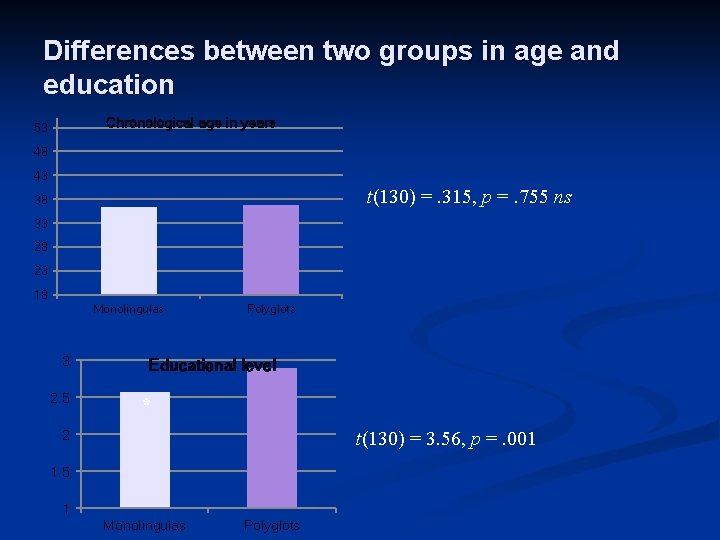
Differences between two groups in age and education Chronological age in years 53 48 43 t(130) =. 315, p =. 755 ns 38 33 28 23 18 Monolingulas 3 2. 5 Polyglots Educational level * 2 t(130) = 3. 56, p =. 001 1. 5 1 Monolingulas Polyglots
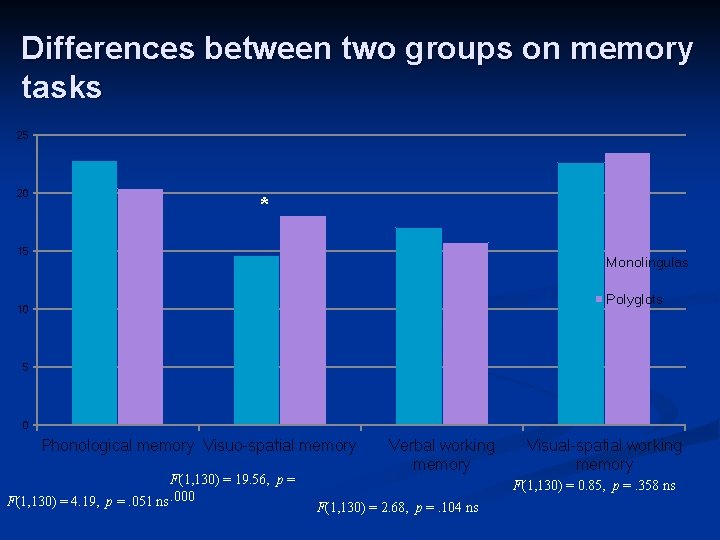
Differences between two groups on memory tasks 25 20 * 15 Monolingulas Polyglots 10 5 0 Phonological memory Visuo-spatial memory F(1, 130) = 19. 56, p = F(1, 130) = 4. 19, p =. 051 ns. 000 Verbal working memory Visual-spatial working memory F(1, 130) = 0. 85, p =. 358 ns F(1, 130) = 2. 68, p =. 104 ns
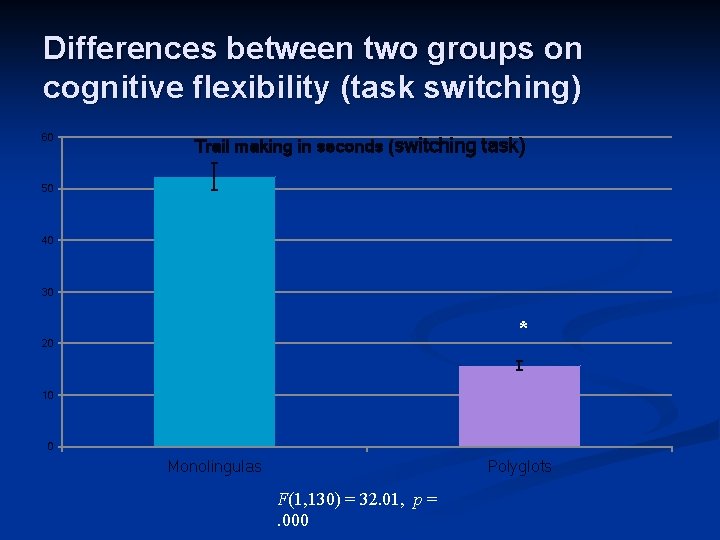
Differences between two groups on cognitive flexibility (task switching) 60 Trail making in seconds (switching task) 50 40 30 * 20 10 0 Monolingulas Polyglots F(1, 130) = 32. 01, p =. 000
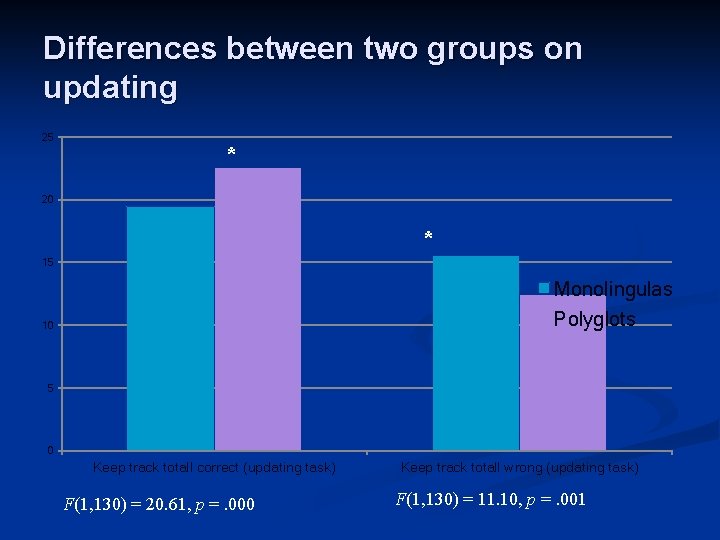
Differences between two groups on updating 25 * 20 * 15 Monolingulas Polyglots 10 5 0 Keep track totall correct (updating task) F(1, 130) = 20. 61, p =. 000 Keep track totall wrong (updating task) F(1, 130) = 11. 10, p =. 001
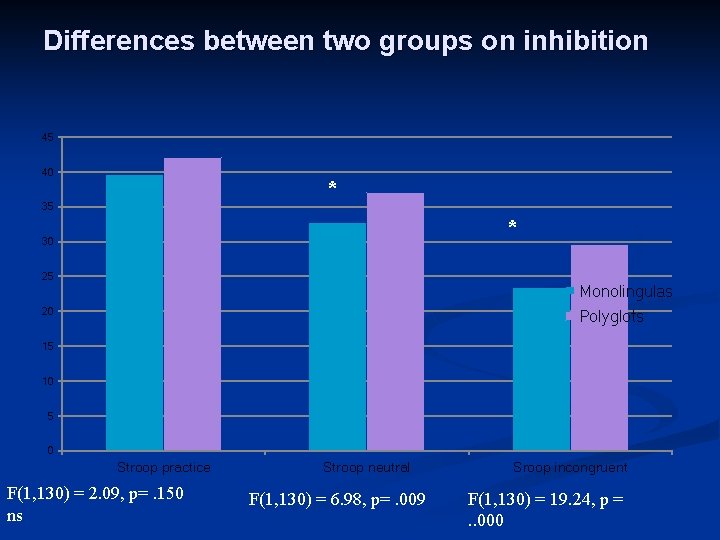
Differences between two groups on inhibition 45 40 * 35 * 30 25 Monolingulas 20 Polyglots 15 10 5 0 Stroop practice F(1, 130) = 2. 09, p=. 150 ns Stroop neutral F(1, 130) = 6. 98, p=. 009 Sroop incongruent F(1, 130) = 19. 24, p =. . 000
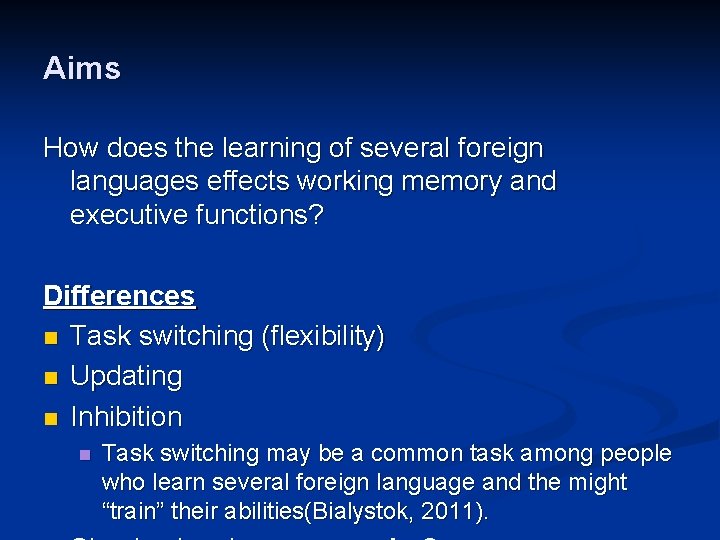
Aims How does the learning of several foreign languages effects working memory and executive functions? Differences n Task switching (flexibility) n Updating n Inhibition n Task switching may be a common task among people who learn several foreign language and the might “train” their abilities(Bialystok, 2011).
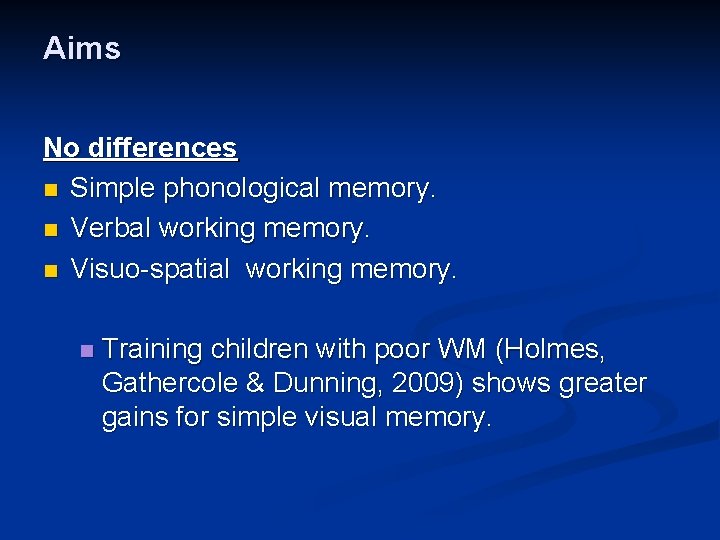
Aims No differences n Simple phonological memory. n Verbal working memory. n Visuo-spatial working memory. n Training children with poor WM (Holmes, Gathercole & Dunning, 2009) shows greater gains for simple visual memory.
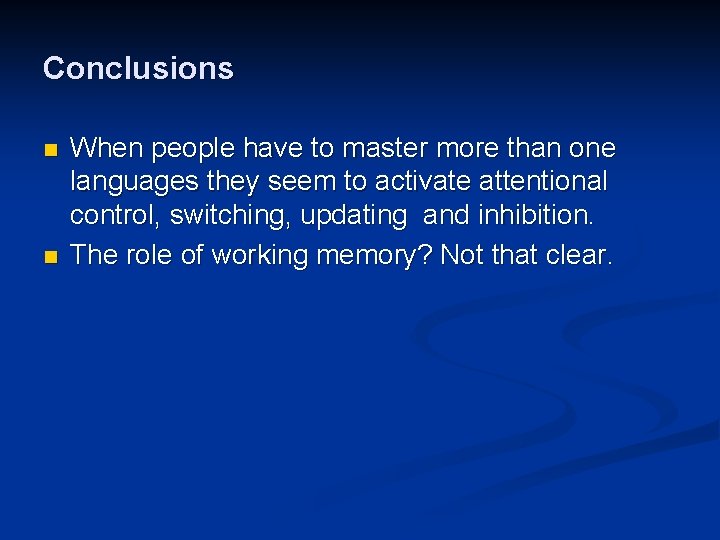
Conclusions n n When people have to master more than one languages they seem to activate attentional control, switching, updating and inhibition. The role of working memory? Not that clear.
Can we do something to improve working memory capacity? n Given the important role working memory plays in the process of learning, a possibility to improve working memory could have beneficial effects on learning and in education. n Working memory training programmes: 1. Intervention techniques (Gathercole & Alloway, 2008). 2. Computerized activities (Klingberg, Forssberg, Westerberg, 2002). &
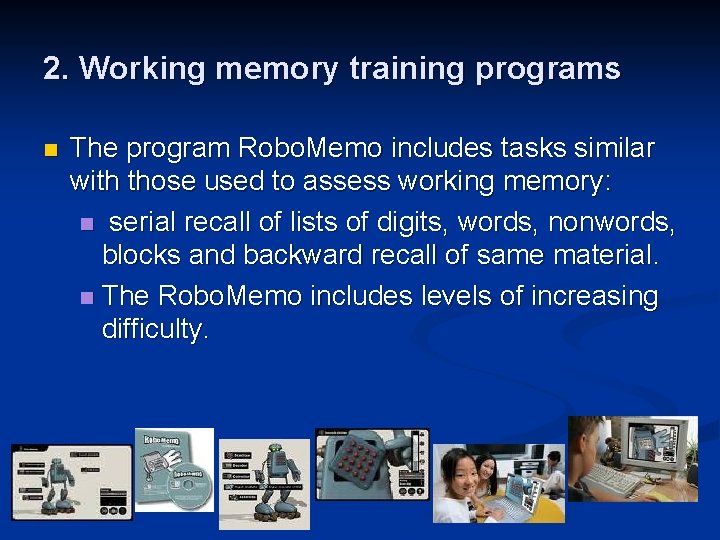
2. Computerized applications for working memory enhancement n Computer based activities that aim to train directly working memory function by employing tasks that engage and activate working memory. n The result of such attempts is the Robo. Memo, developed by COGMED (Klingberg, Forssberg, & Westerberg, 2002; Martinussen & Tannock, 2006; Olesen, Westetberg & Klinberg, 2004).
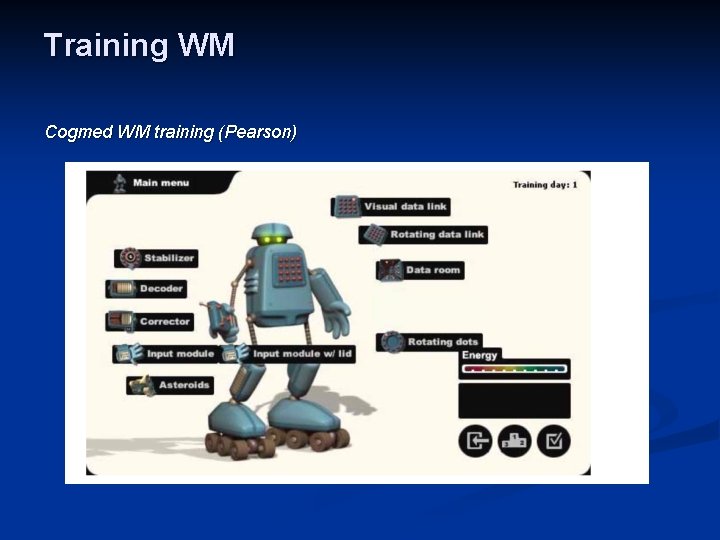
Training WM Cogmed WM training (Pearson)
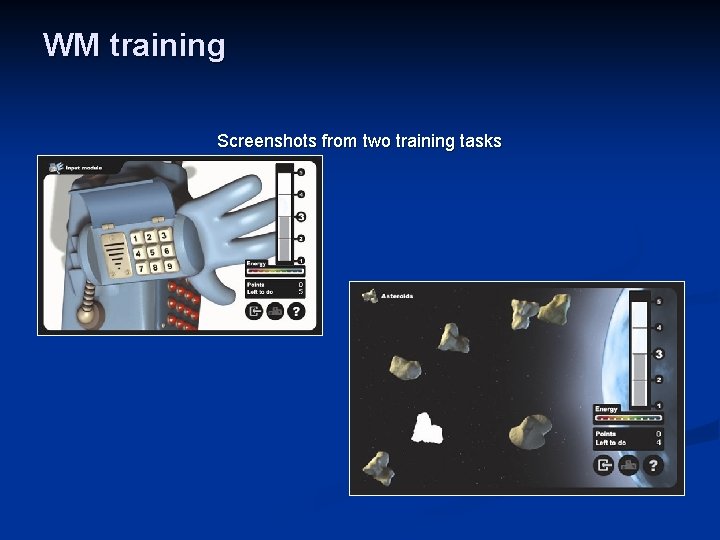
WM training Screenshots from two training tasks
2. Working memory training programs n The program Robo. Memo includes tasks similar with those used to assess working memory: n serial recall of lists of digits, words, nonwords, blocks and backward recall of same material. n The Robo. Memo includes levels of increasing difficulty.
Training working memory with Robo. Memo n Klingberg, Forssberg, & Westerberg, 2002. n Initially a small group of 7 children with Attention Deficit Disorder (ADHD) participated in the training. n Children trained for 5 -6 weeks with everyday sessions. The session lasted for 20 -25 minutes. n By the end of the training their visuospatial memory span increased by 1. 72 items and their verbal span by 1. 96 digits.
Training working memory with Robo. Memo n The same training programme was used with a larger group of 44 children with Attention Deficit (Klingberg, Fernell, Olesen, Johnson, Gustafsson, Dahlstrom, Gillberg, Forssberg, Westerberg, 2005). n n Half of those children were training with Robo. Memo for 5 weeks, with everyday session lasting for less than half an hour. The researchers observed improvement on children’s digit span but also on their ability to perform reasoning tasks. Most importantly, some of their attention deficit symptoms moved away.
Training working memory with Robo. Memo n Recently, the same programme was used with 9 adults who suffered brain stroke (Westerberg, Jacobaeus, Hirvikoski, Clevberger, Ostensson, Bartfat, & Klingberg, 2007). n The training took place 1 -3 years after the stroke and lasted for 5 weeks. The researchers observed an improvement on their ability to hold verbal information by 1. 5 items.
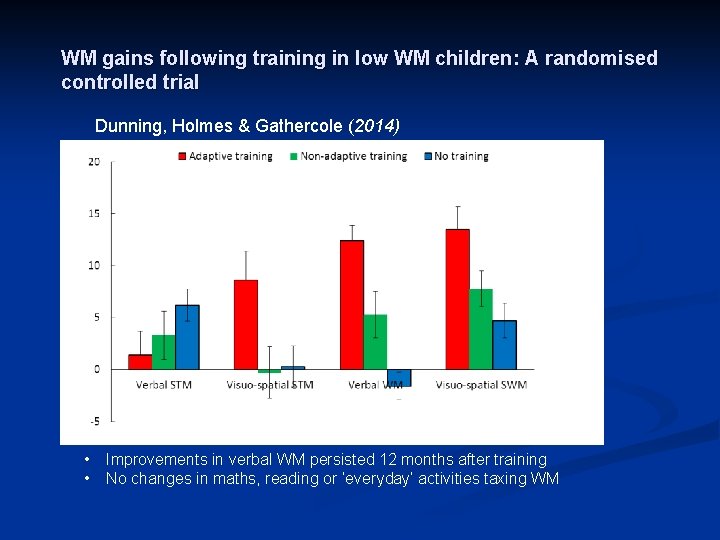
WM gains following training in low WM children: A randomised controlled trial Dunning, Holmes & Gathercole (2014) • • Improvements in verbal WM persisted 12 months after training No changes in maths, reading or ‘everyday’ activities taxing WM
Evaluating the programme. Does it work? n n Generally speaking, the 80% of the children who were trained with the Robo. Memo improved their working memory capacity. Furthermore, the 79% of those children retained the improvement 1 year after their completion of their training.
n https: //www. youtube. com/watch? v=6 bz. Y 2 1 t 9 h. WE
Does WM training ‘cure’ WM problems? n n No: training gains are limited to other highly similar tasks No benefits for: n Classroom activities that depend on WM n Reading, maths n Behaviour (inattentivity, hyperactivity)
Summary n Both classroom management and intensive training may be able to help.