
Working In Cold Environments Things to Consider Where




- Slides: 28
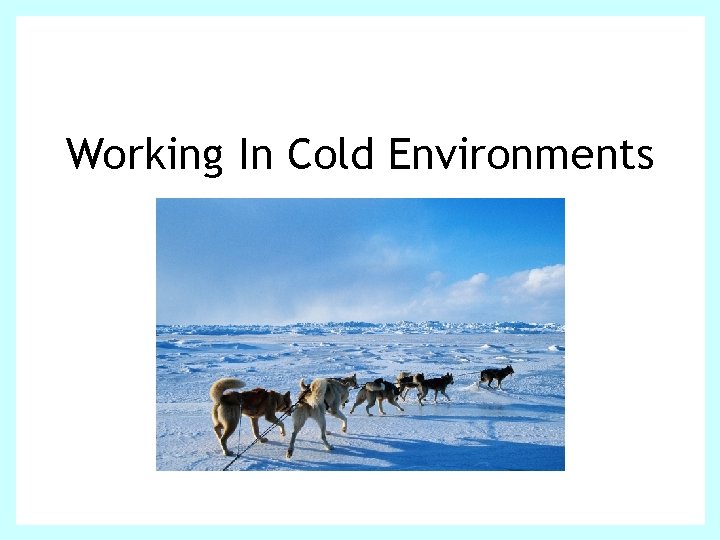
Working In Cold Environments
Things to Consider • • • Where is cold a problem? Effects of cold on the body Regulations covering cold Risk Assessment Controls
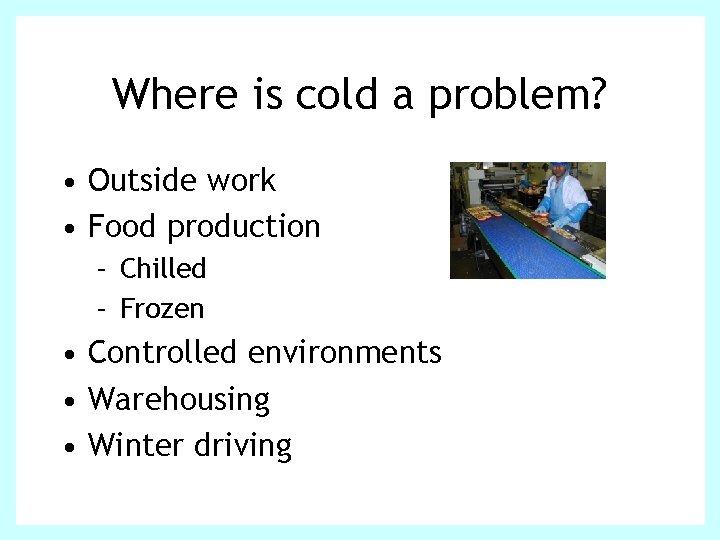
Where is cold a problem? • Outside work • Food production – Chilled – Frozen • Controlled environments • Warehousing • Winter driving
Why Be Concerned? • The body needs to maintain a core temperature of 37 C. This thermal balance must be maintained.
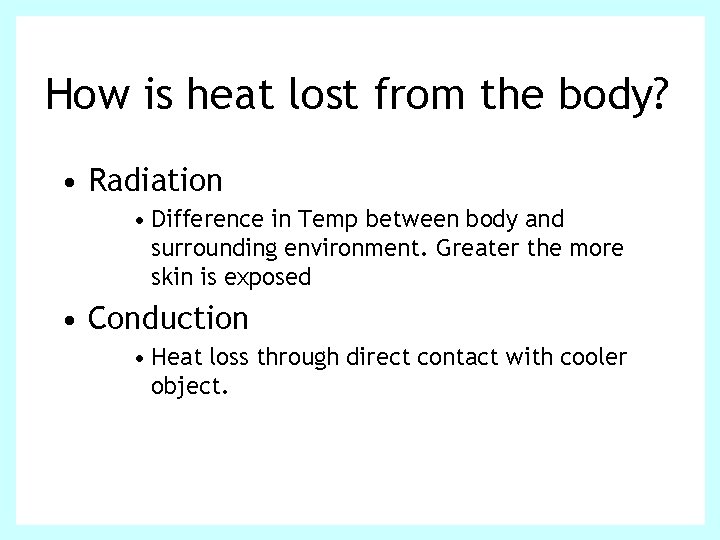
How is heat lost from the body? • Radiation • Difference in Temp between body and surrounding environment. Greater the more skin is exposed • Conduction • Heat loss through direct contact with cooler object.
How is heat lost from the body? • Convection • Loss of heat to the surrounding air as the air moves across the surface of the skin. Heat loss depends upon air temperature and wind speed. Wind speed ceases to have an increased effect above 50 mph
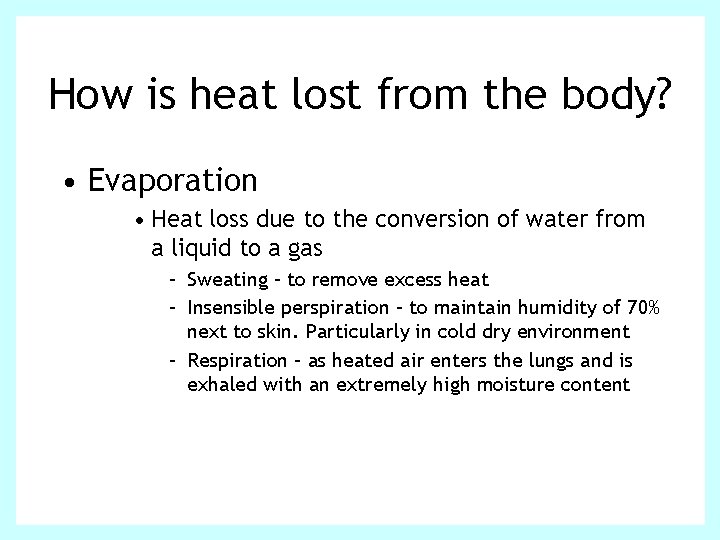
How is heat lost from the body? • Evaporation • Heat loss due to the conversion of water from a liquid to a gas – Sweating – to remove excess heat – Insensible perspiration – to maintain humidity of 70% next to skin. Particularly in cold dry environment – Respiration – as heated air enters the lungs and is exhaled with an extremely high moisture content
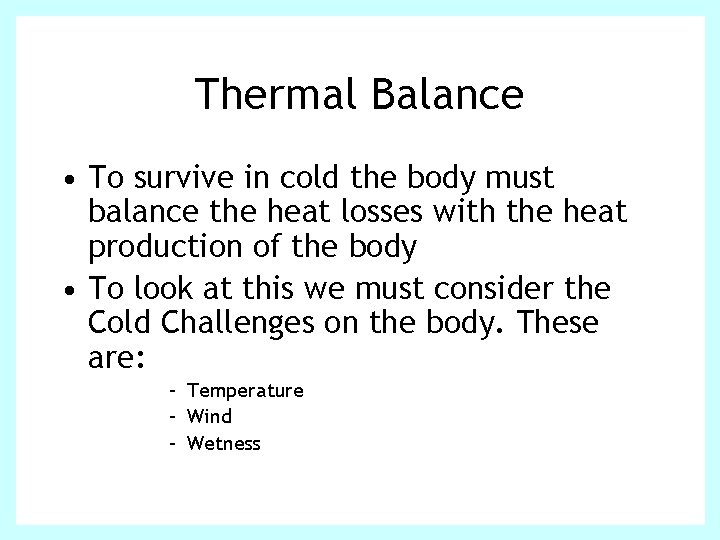
Thermal Balance • To survive in cold the body must balance the heat losses with the heat production of the body • To look at this we must consider the Cold Challenges on the body. These are: – Temperature – Wind – Wetness
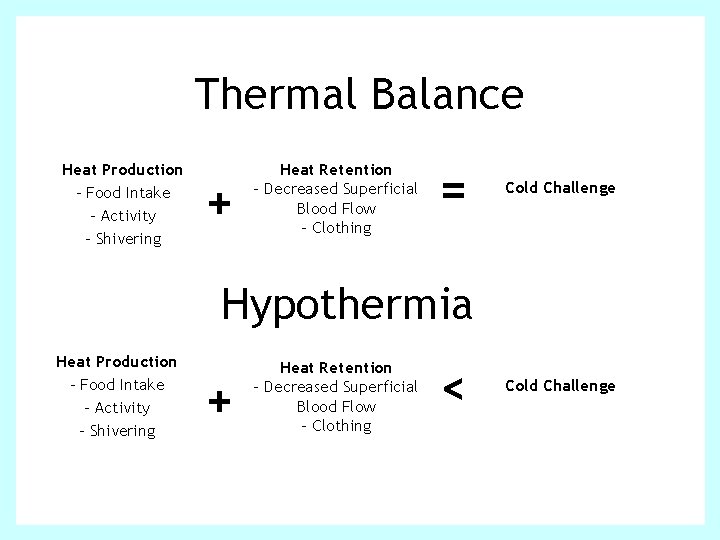
Thermal Balance Heat Production - Food Intake - Activity - Shivering + Heat Retention - Decreased Superficial Blood Flow - Clothing = Cold Challenge Hypothermia Heat Production - Food Intake - Activity - Shivering + Heat Retention - Decreased Superficial Blood Flow - Clothing < Cold Challenge
Personal Factors • Size and shape of the body (surface to volume ratio) • Layer of fat under the skin • Decreased the blood flow through the skin and outer parts of body • Insulation (layering and type of clothing)
Personal Factors • Response in Men and Women – Core cools more slowly in women. However, they are not able to create as much metabolic heat – Extremities cool more quickly in women – As a result women are at a greater risk of cold injury
Personal Factors • Predisposing conditions – Age – old and very young – Diseases of the blood circulatory system – Injuries resulting in blood loss or altered blood flow – Previous cold injury – Fatigue – Consumption of alcohol or nicotine
Personal Factors • Acclimatisation – People do not acclimatise to cold very well – Frequently exposed body parts can develop some degree of tolerance to the cold
Effects of cold on the body • Impairment of complex mental processes • Manual tasks impaired due to loss of dexterity • Blood redirected from extremities to keep core warm • Reduced muscular strength
Effects of cold on the body • Stiffened joints • Reduced mental alertness • Corneas of eyes can freeze with high wind chill • Cold injuries
Cold injuries • Non freezing • Freezing • Hypothermia
Non Freezing Injuries • Chilblains • Mild injury caused by prolonged and repeated exposure for several hours to air tempretures from 0 c to 16 c. Redness of skin, swelling, tingling and pain • Immersion foot • Where foot has been wet but not freezing cold for days or weeks. Can occur up to 10 c. Primary injury to nerve and tissue. Symptoms include tingling, numbness, itching, pain, swelling of legs, feet or hands, Blisters may develop. Gangrene can develop
Non Freezing Injuries • Trenchfoot • Wet cold disease. Similar to Immersion Foot but occurs at lower temperatures. Onset can range from hours to many days. Average three days.
Freezing Injuries • Frostnip • Mildest form of freezing injury. Occurs when ear lobes, noses, cheeks, fingers or toes are exposed to cold and top layers of skin freeze. Affected area turns white and feels numb • Frostbite • Common injury on exposure to extreme cold or contact with extremely cold objects. May occur on contact with cold gases. Occurs when tissue temp falls below 0 c or blood flow is obstructed. Blood vessels can be severely and permanently damaged. In mild cases symptoms include inflammation of skin accompanied by slight pain. Severe cases can lead to burning or prickling sensations resulting in blisters. Frostbitten skin is susceptible to infection leading to gangrene. Can lead to amputations
Hypothermia • This is the condition that is caused by the bodies core temperature dropping. • First symptom is feeling of cold and pain in exposed parts of body • As temp drops the feeling of cold and pain diminishes
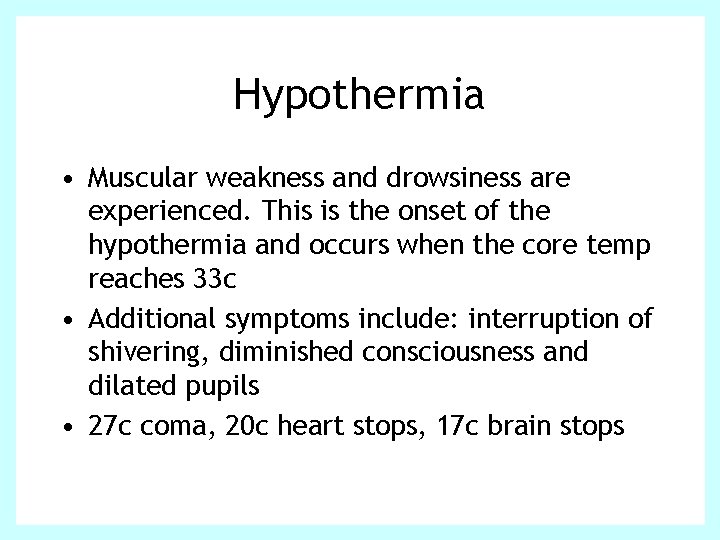
Hypothermia • Muscular weakness and drowsiness are experienced. This is the onset of the hypothermia and occurs when the core temp reaches 33 c • Additional symptoms include: interruption of shivering, diminished consciousness and dilated pupils • 27 c coma, 20 c heart stops, 17 c brain stops
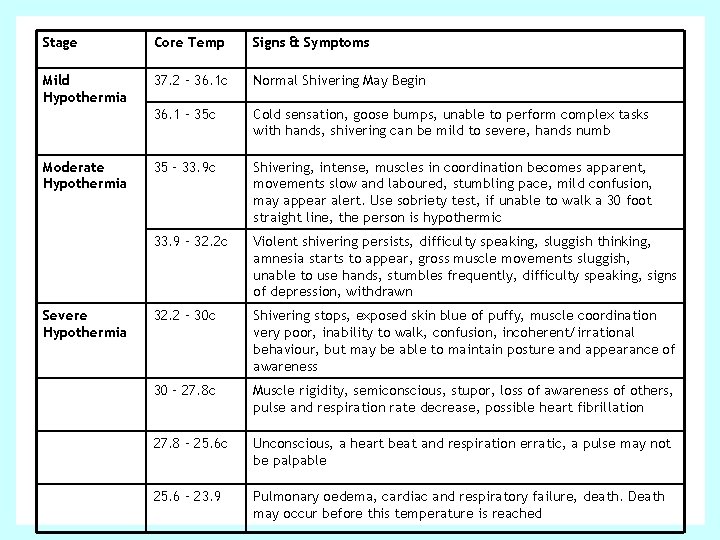
Stage Core Temp Signs & Symptoms Mild Hypothermia 37. 2 – 36. 1 c Normal Shivering May Begin 36. 1 – 35 c Cold sensation, goose bumps, unable to perform complex tasks with hands, shivering can be mild to severe, hands numb 35 – 33. 9 c Shivering, intense, muscles in coordination becomes apparent, movements slow and laboured, stumbling pace, mild confusion, may appear alert. Use sobriety test, if unable to walk a 30 foot straight line, the person is hypothermic 33. 9 – 32. 2 c Violent shivering persists, difficulty speaking, sluggish thinking, amnesia starts to appear, gross muscle movements sluggish, unable to use hands, stumbles frequently, difficulty speaking, signs of depression, withdrawn 32. 2 – 30 c Shivering stops, exposed skin blue of puffy, muscle coordination very poor, inability to walk, confusion, incoherent/irrational behaviour, but may be able to maintain posture and appearance of awareness 30 – 27. 8 c Muscle rigidity, semiconscious, stupor, loss of awareness of others, pulse and respiration rate decrease, possible heart fibrillation 27. 8 – 25. 6 c Unconscious, a heart beat and respiration erratic, a pulse may not be palpable 25. 6 – 23. 9 Pulmonary oedema, cardiac and respiratory failure, death. Death may occur before this temperature is reached Moderate Hypothermia Severe Hypothermia
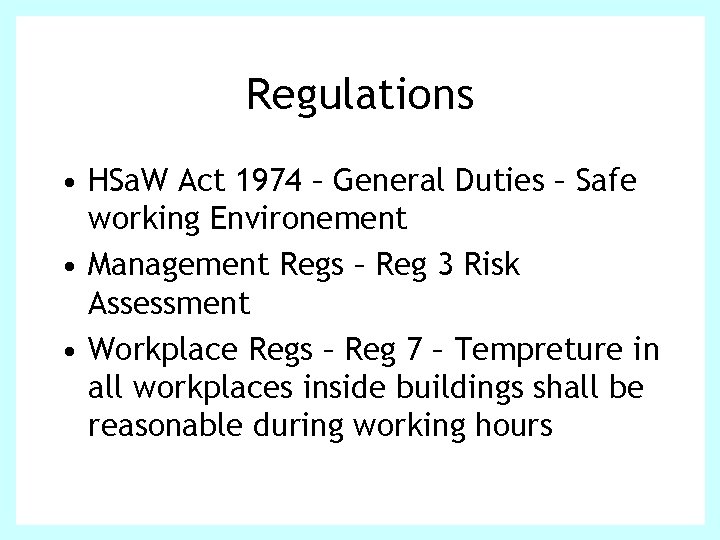
Regulations • HSa. W Act 1974 – General Duties – Safe working Environement • Management Regs – Reg 3 Risk Assessment • Workplace Regs – Reg 7 – Tempreture in all workplaces inside buildings shall be reasonable during working hours
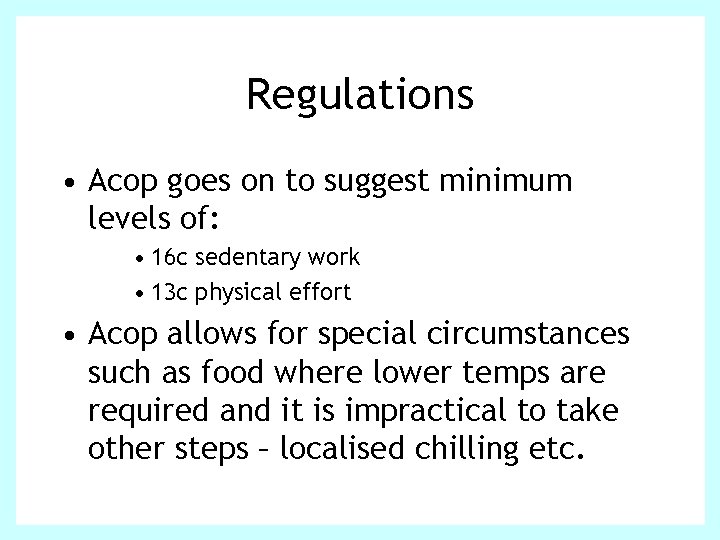
Regulations • Acop goes on to suggest minimum levels of: • 16 c sedentary work • 13 c physical effort • Acop allows for special circumstances such as food where lower temps are required and it is impractical to take other steps – localised chilling etc.
Risk Assessment • • Use the normal hierarchy Is cold process required? Can exposure to cold be prevented? Consider how people may be affected by the cold? • Select suitable controls for residual risk • First Aid Risk Assessment
Controls • Warm working station within cold area • Exposure product to warm room for short period • Pre-chill products • Chilling stations on line • Floor matting to raise feet off cold floors
Controls • Suitably heated rest rooms • Work rest regimes to limit time spent in cold area • PPE – free to user and suitable for conditions • Training for First Aiders
Further information • BS 7915: 1998 Ergonomics of thermal Environment – Guide to the design and evaluation of working practices for cold indoor environments • HSE Information Sheet – FIS 3(rev 1) March 1999