
Working Group 3 Emergency Alert System Status Update
- Slides: 18
Working Group 3: Emergency Alert System Status Update September 14, 2016 Kelly Williams, Co-Chair National Association of Broadcasters Steve Johnson, Co-Chair National Cable & Telecommunications Association
TOPICS • WG 3 Background – Objectives, Deliverables, Membership • Status update • EAS Multilingual Report & Recommendations 2
WG 3 Objectives Working Group Description: • WG 3 will make recommendations to the Commission for the continued improvement and development of the EAS as a secure, effective alerting tool for the American public: – Improving EAS Security – Provisioning EAS in languages other than English – Developing updated operational handbooks for EAS Participants. 3
WG 3 Objectives • Security – • Assess industry awareness of EAS Security Best Practices adopted by CSRIC IV • Assess Barriers to implementing Security Best Practices • Create recommendations to implement Best Practices • Multilingual EAS – • Assess State of Multilingual Alerting • Recommend best practices for the delivery of multilingual emergency communications • EAS Handbooks – • Update document to reflect rule & procedure changes • Create an effective tool for EAS Participants 4
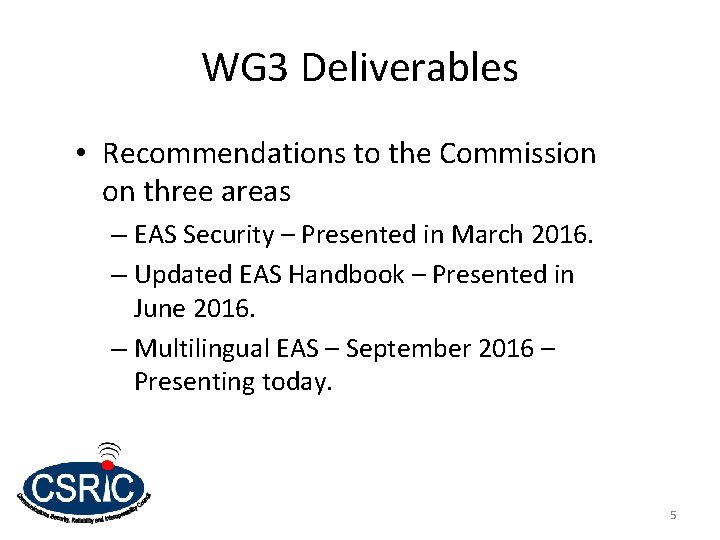
WG 3 Deliverables • Recommendations to the Commission on three areas – EAS Security – Presented in March 2016. – Updated EAS Handbook – Presented in June 2016. – Multilingual EAS – September 2016 – Presenting today. 5
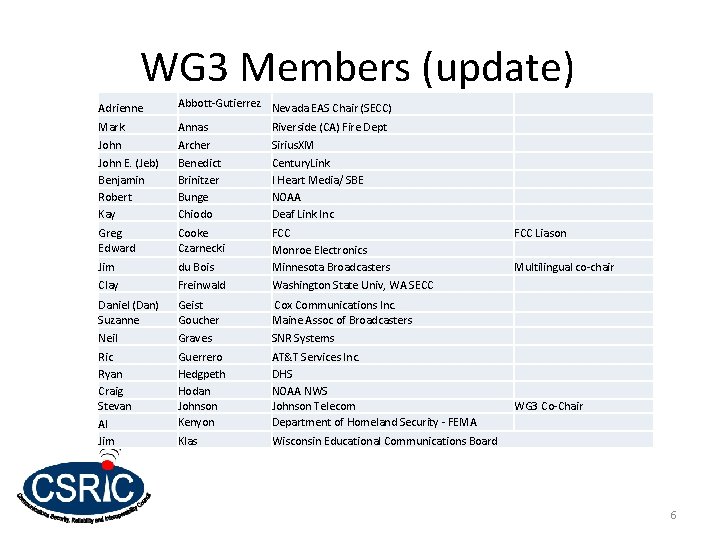
WG 3 Members (update) Adrienne Abbott-Gutierrez Nevada EAS Chair (SECC) Mark John E. (Jeb) Benjamin Robert Kay Annas Archer Benedict Brinitzer Bunge Chiodo Riverside (CA) Fire Dept Sirius. XM Century. Link I Heart Media/ SBE NOAA Deaf Link Inc Greg Edward Cooke Czarnecki Jim Clay du Bois Freinwald FCC Monroe Electronics Minnesota Broadcasters Washington State Univ, WA SECC FCC Liason Multilingual co-chair Daniel (Dan) Suzanne Neil Geist Goucher Graves Cox Communications Inc. Maine Assoc of Broadcasters SNR Systems Ric Ryan Craig Stevan Al Jim Guerrero Hedgpeth Hodan Johnson Kenyon AT&T Services Inc. DHS NOAA NWS Johnson Telecom Department of Homeland Security - FEMA Klas Wisconsin Educational Communications Board WG 3 Co-Chair 6
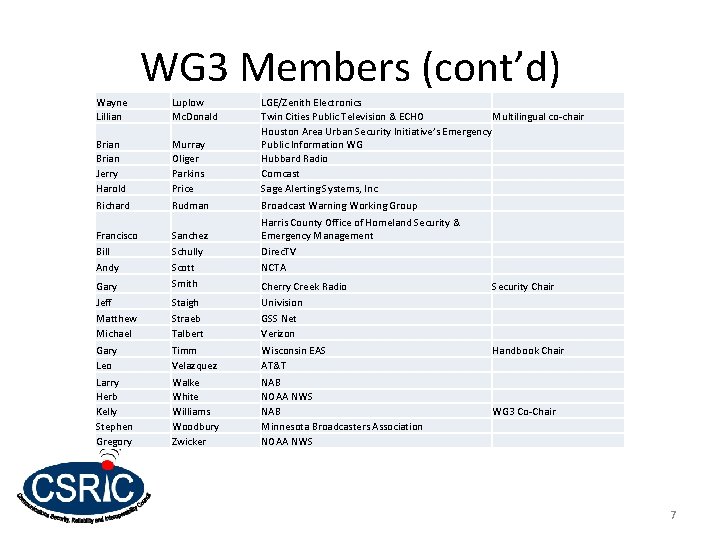
WG 3 Members (cont’d) Wayne Lillian Luplow Mc. Donald Brian Jerry Harold Richard Murray Oliger Parkins Price Rudman LGE/Zenith Electronics Twin Cities Public Television & ECHO Multilingual co-chair Houston Area Urban Security Initiative’s Emergency Public Information WG Hubbard Radio Comcast Sage Alerting Systems, Inc Broadcast Warning Working Group Francisco Bill Andy Sanchez Schully Scott Harris County Office of Homeland Security & Emergency Management Direc. TV NCTA Gary Jeff Matthew Michael Smith Gary Leo Larry Herb Kelly Stephen Gregory Staigh Straeb Talbert Cherry Creek Radio Univision GSS Net Verizon Security Chair Timm Velazquez Walke White Williams Woodbury Zwicker Wisconsin EAS AT&T NAB NOAA NWS NAB Minnesota Broadcasters Association NOAA NWS Handbook Chair WG 3 Co-Chair 7
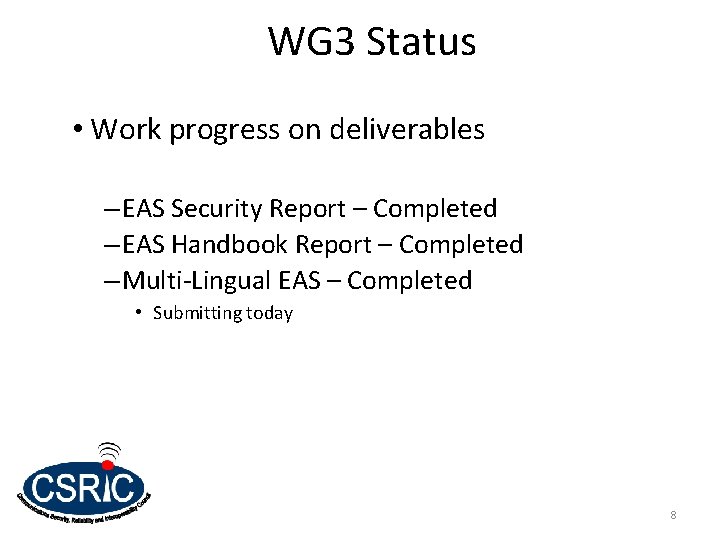
WG 3 Status • Work progress on deliverables – EAS Security Report – Completed – EAS Handbook Report – Completed – Multi-Lingual EAS – Completed • Submitting today 8
WG 3 EAS Multilingual Report • Scope – Recommend best practices for delivery of multilingual EAS and emergency communications – Discussions among experts in EAS – Discussions with state organizations – Anecdotal information – Lack of consensus on best practices – Minimal deployment – Established recommendations 9
WG 3 EAS Multilingual Report • Project Team (representative group) – EAS Participants – State Emergency Communications Committee Chairs & Members – Emergency Alert Originators – EAS Equipment Manufacturers – U. S. Government (FEMA & FCC) – EAS Experts and Consultants 10
WG 3 EAS Multilingual Findings • A handful of communities have made progress in multilingual EAS trials • Multilingual capabilities are still in early stages • Too little experience to form best practices • No regulatory barriers found in 47 CFR 11 11
WG 3 EAS Multilingual Findings • FCC R&O EB Docket No. 04 -296 – New reporting rules – Gather information through these reports 12
WG 3 EAS Multilingual Findings (cont’d) • All crisis starts at the local level • Each community, with guidance from state and national level, can best address its local needs 13
WG 3 EAS Multilingual Findings (cont’d) • Capability to support alerts in multiple languages exists • The challenge remains creating the content in those multiple languages by originators – EAS participants generally do not have the ability to translate alerts into multiple languages • Automated translating approaches are still under development 14
WG 3 EAS Multilingual Recommendations • Refrain from creating additional multilingual alerting regulations • The use of multilingual alerting should remain voluntary for EAS Originators and Participants • Continue to allow, but not require, experimentation and development on multilingual functionality with collaborative leadership from local communities 15
WG 3 EAS Multilingual Recommendations • Locally determine the usage and needs regarding languages • Government partners should continue to make state and local emergency managers aware of CAP technology and its capabilities • Alert originators should leverage CAP for multilingual support 16
WG 3 EAS Multilingual Recommendations • FCC and FEMA - collaborate to keep alerting originators informed of multilingual capabilities in the existing EAS system • FCC – encourage use of existing tools and capabilities to facilitate the delivery of multilingual alerts on a voluntary basis • Develop best practices learned from experience 17
Thank You Questions? ? 18