
Working Capital Management by Binam Ghimire 1 Learning
Working Capital Management by Binam Ghimire 1
Learning Objectives q Concept and Significance of WC management q Cash Conversion Cycle q Receivables Management and Credit Policy q Inventory Management q Cash Management and Cash Budget 2
WC: Concept q Is Cash really a King? 3
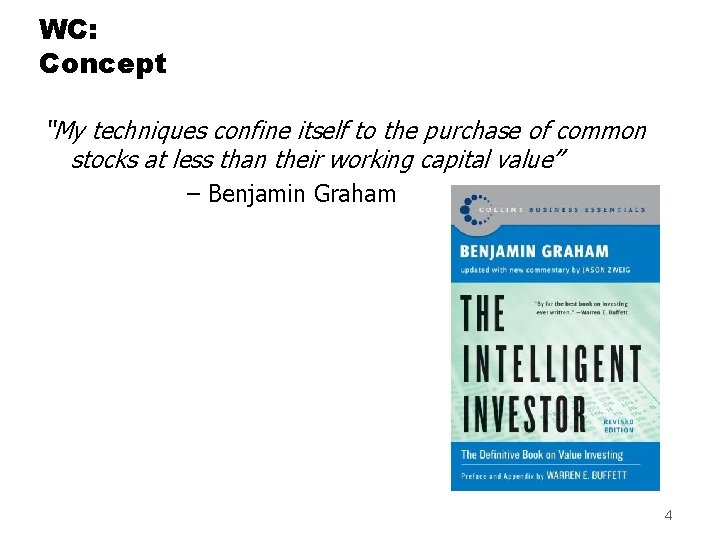
WC: Concept “My techniques confine itself to the purchase of common stocks at less than their working capital value” – Benjamin Graham 4
WC: Concept q Look at the Balance Sheet given and find out the followings q. Gross Working Capital q. Net Working Capital/ Net Operating Working Capital 5
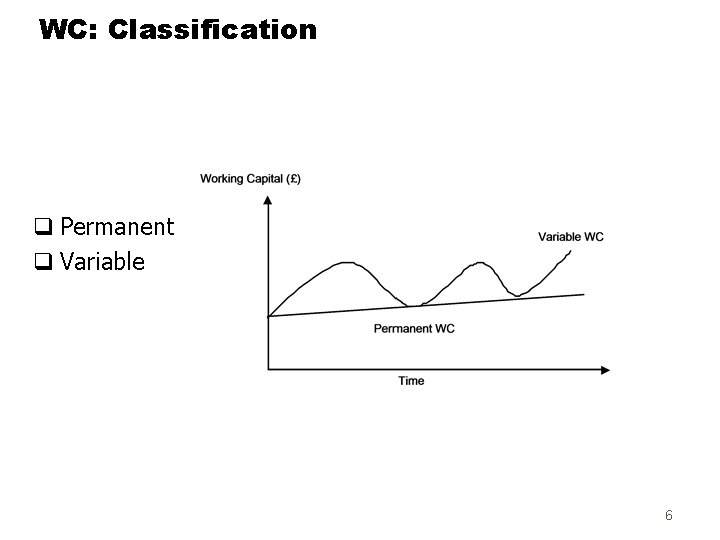
WC: Classification q Permanent q Variable 6
WC Management q Short-term financial management q The management of current assets investment and their financing q Zero Working Capital q Level of Working Capital: Optimal 7
WC Management q Policies q. Working Capital Investment Policy q. Working Capital Financing Policy 8
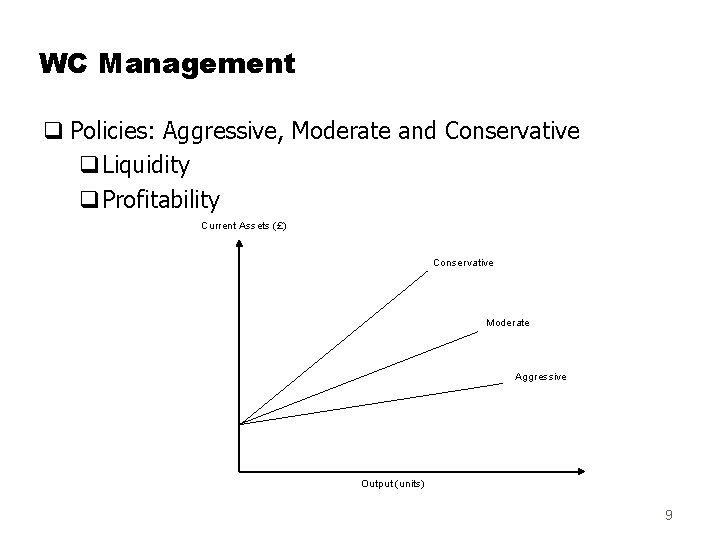
WC Management q Policies: Aggressive, Moderate and Conservative q. Liquidity q. Profitability Current Assets (£) Conservative Moderate Aggressive Output (units) 9
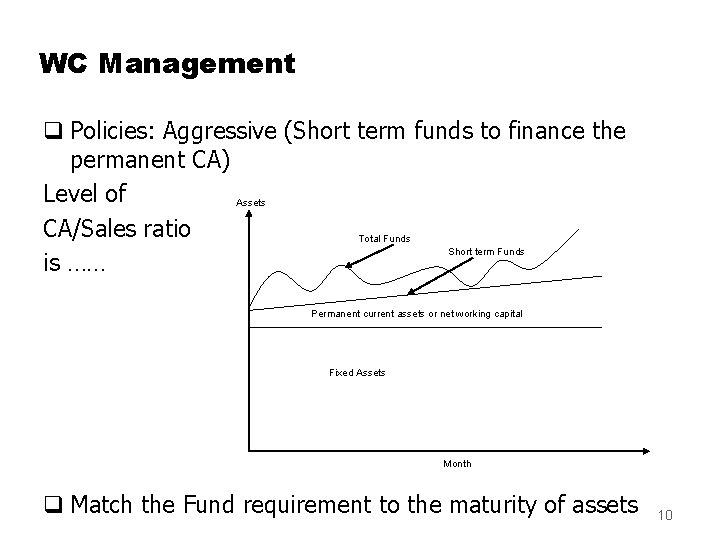
WC Management q Policies: Aggressive (Short term funds to finance the permanent CA) Level of Assets CA/Sales ratio Total Funds Short term Funds is …… Permanent current assets or net working capital Fixed Assets Month q Match the Fund requirement to the maturity of assets 10
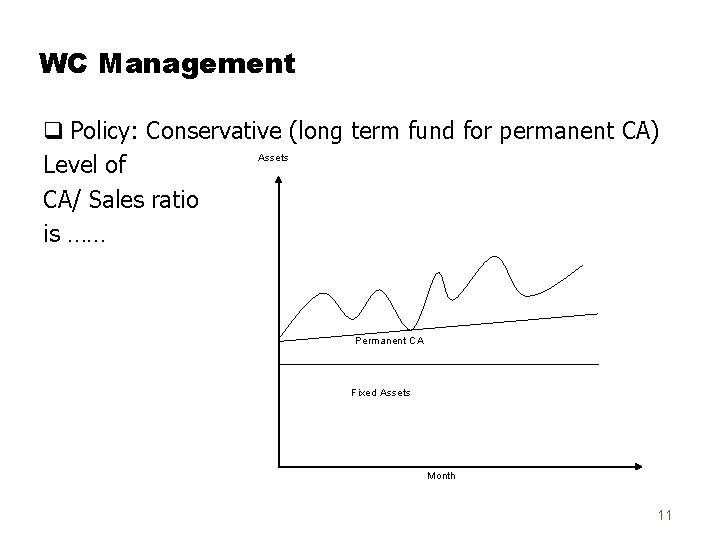
WC Management q Policy: Conservative (long term fund for permanent CA) Assets Level of CA/ Sales ratio is …… Permanent CA Fixed Assets Month 11
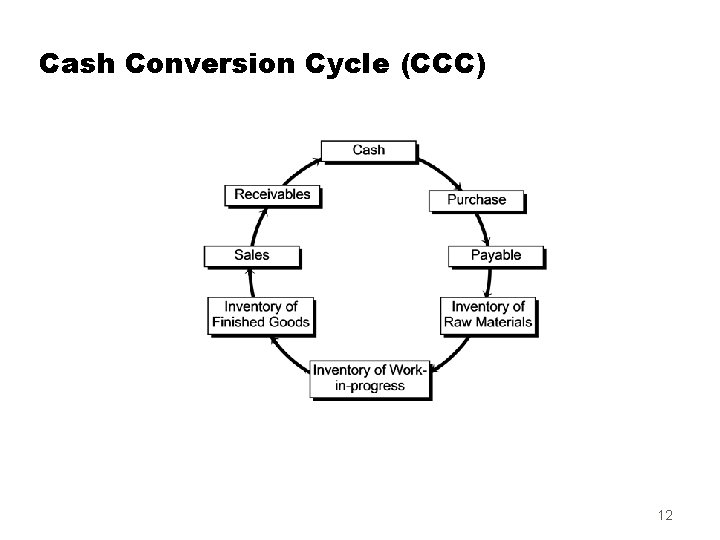
Cash Conversion Cycle (CCC) 12
CCC q The time intervals between outflow of cash and its inflow through sales and collection from customers. q CCC also known as trading cycle, Cash cycle, Operating cycle (Operating also includes the Date the order is placed i. e. the date firm purchases the inventory) 13

CCC, Formula CCC = Inventory Turnover Period (Inventory Days) + Average Collection Period (Receivable Days) – Average Payable Period (Payable Days) 14
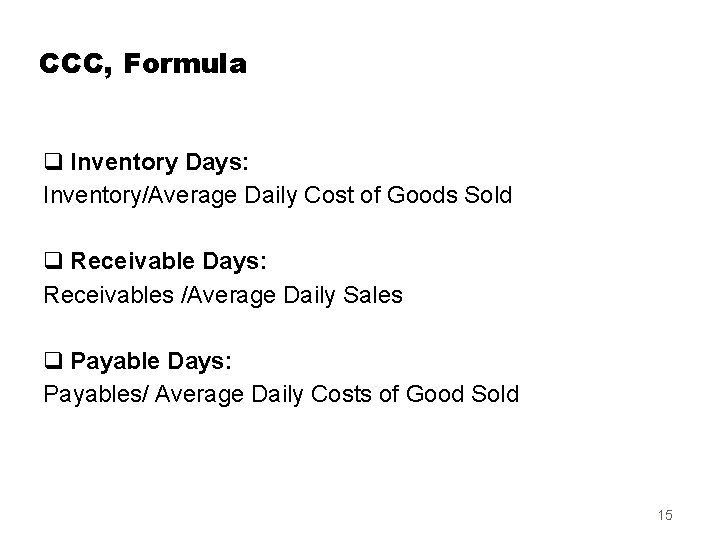
CCC, Formula q Inventory Days: Inventory/Average Daily Cost of Goods Sold q Receivable Days: Receivables /Average Daily Sales q Payable Days: Payables/ Average Daily Costs of Good Sold 15

CCC q Consider the following information taken from a company’s statements Income Statement £ Balance Sheet £ Sales 600, 000 Receivables 100, 000 Gross Profit 200, 000 Inventory 80, 000 Payables 120, 000 q Receivable Days = (100, 000/ 600, 000) x 365 = 61 days q Inventory Days = (80, 000/400, 000) x 365 = 73 days q Payable Days = (120, 000/400, 000) x 365 = 110 days q CCC = 24 days 16

CCC, Example 1 Extracts for A Ltd. (£) Income Statement: Balance Sheet: Turnover 250, 000 Gross Profit 90, 000 Inventory 30, 000 Receivables 60, 000 Payable 50, 000 Prepare the operating cycle 17
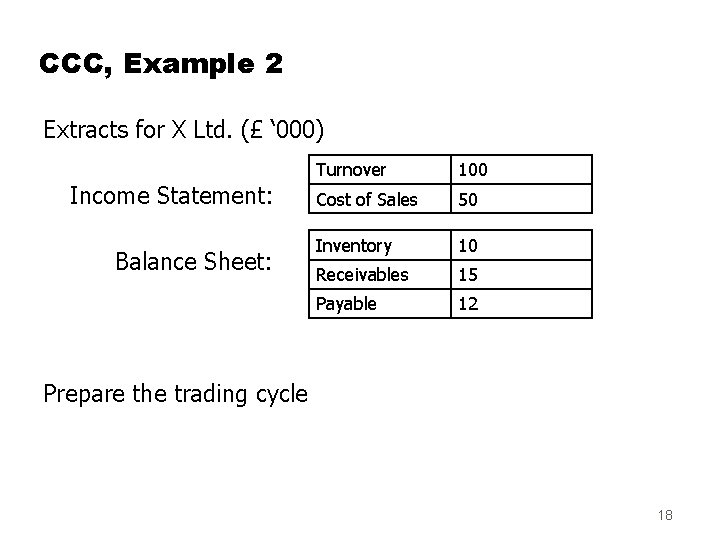
CCC, Example 2 Extracts for X Ltd. (£ ‘ 000) Income Statement: Balance Sheet: Turnover 100 Cost of Sales 50 Inventory 10 Receivables 15 Payable 12 Prepare the trading cycle 18
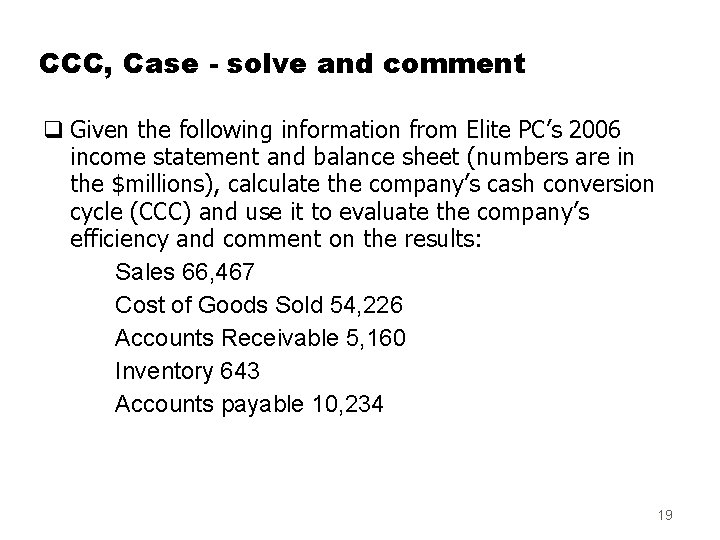
CCC, Case - solve and comment q Given the following information from Elite PC’s 2006 income statement and balance sheet (numbers are in the $millions), calculate the company’s cash conversion cycle (CCC) and use it to evaluate the company’s efficiency and comment on the results: Sales 66, 467 Cost of Goods Sold 54, 226 Accounts Receivable 5, 160 Inventory 643 Accounts payable 10, 234 19
Managing Receivables (MR) q Offer Credit q Advantages q Retain customers q More (old and new) customers q Disadvantages q Bad Debts q Slow Payers that increase WC q Higher monitoring expenses q How can we manage credit? 20
MR: Aspects to Credit Management q Assessing Credit Status q Terms of Trade q Day to Day Management 21
MR: Aspects to Credit Management q Assessing Credit Status q Own record of sales q Bank Reference q Trade Reference q Published Accounts q Credit Rating Agencies q Credit Scoring: subjective guidelines such as 5 Cs (Character, Capacity, Capital, Collateral, Conditions) q Altman Z score (Edward Altman Z Score) 22
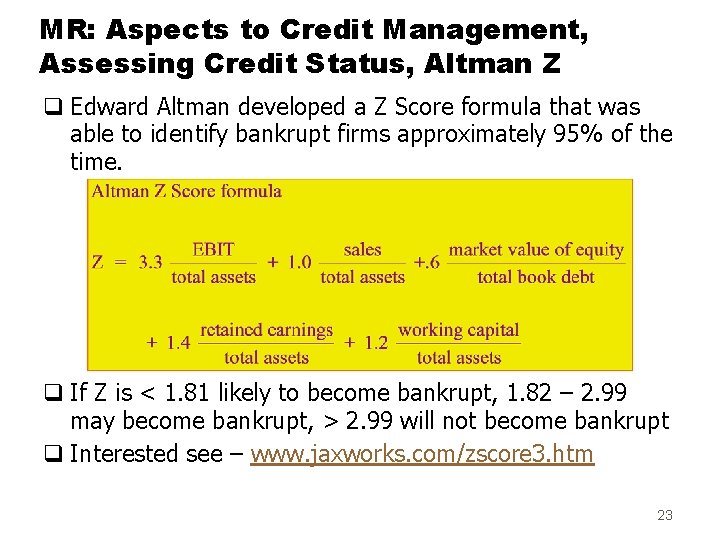
MR: Aspects to Credit Management, Assessing Credit Status, Altman Z q Edward Altman developed a Z Score formula that was able to identify bankrupt firms approximately 95% of the time. q If Z is < 1. 81 likely to become bankrupt, 1. 82 – 2. 99 may become bankrupt, > 2. 99 will not become bankrupt q Interested see – www. jaxworks. com/zscore 3. htm 23
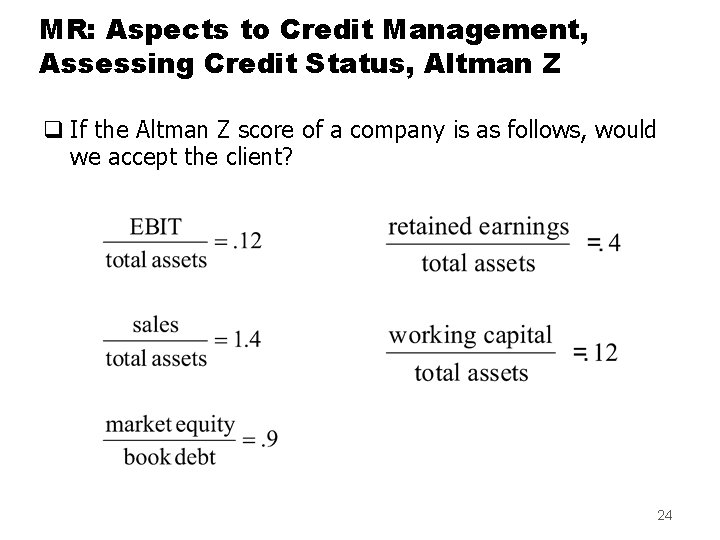
MR: Aspects to Credit Management, Assessing Credit Status, Altman Z q If the Altman Z score of a company is as follows, would we accept the client? 24
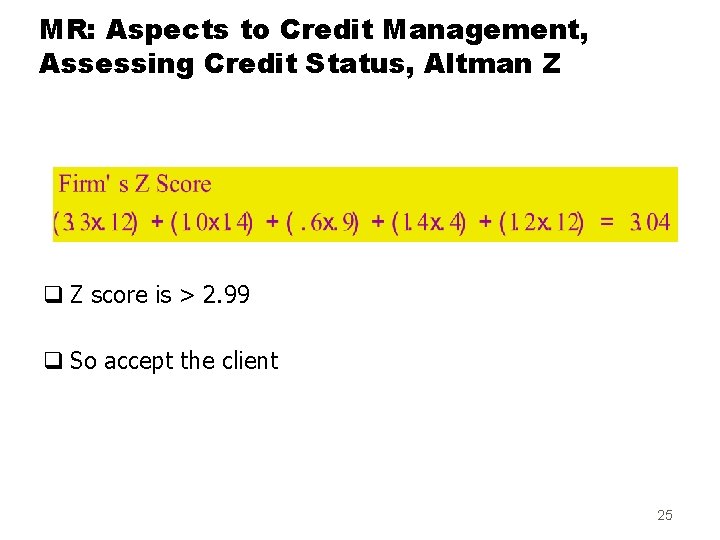
MR: Aspects to Credit Management, Assessing Credit Status, Altman Z q Z score is > 2. 99 q So accept the client 25
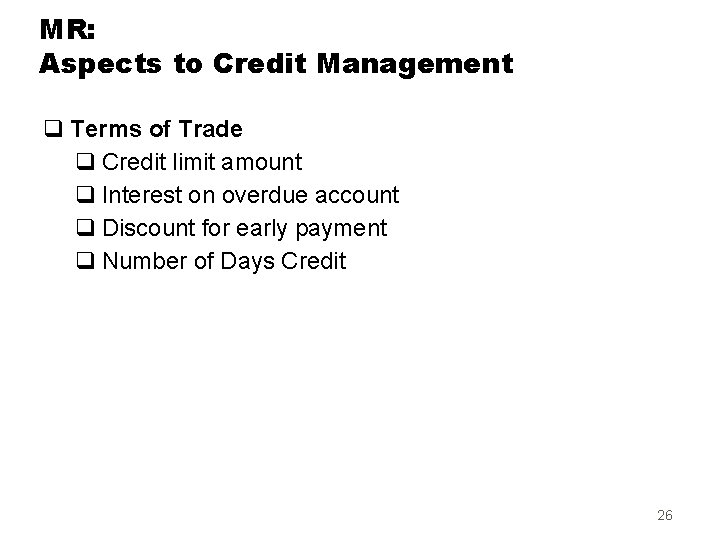
MR: Aspects to Credit Management q Terms of Trade q Credit limit amount q Interest on overdue account q Discount for early payment q Number of Days Credit 26
MR: Aspects to Credit Management, Terms of Trade, Discount for early payment q If a firm sells goods on terms of 2/30, net 60 q This means a 2% discount for payment within 30 days or else must pay in full within 60 days. If the term is only net 60 days then no discount pay by 60 days 27
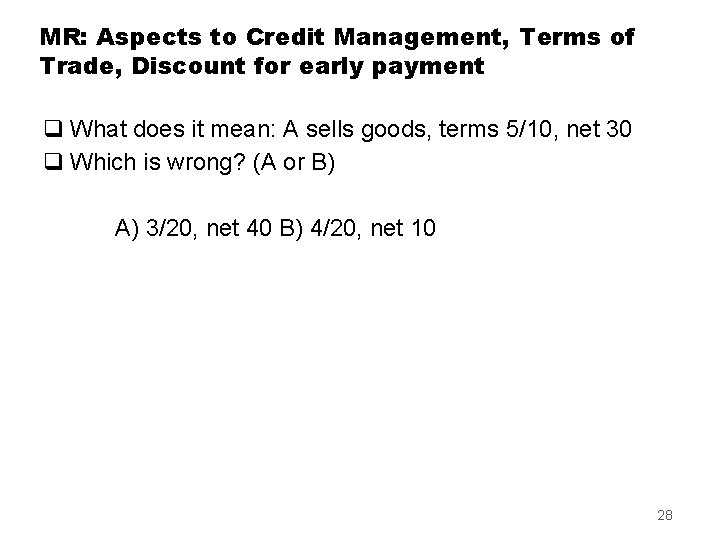
MR: Aspects to Credit Management, Terms of Trade, Discount for early payment q What does it mean: A sells goods, terms 5/10, net 30 q Which is wrong? (A or B) A) 3/20, net 40 B) 4/20, net 10 28
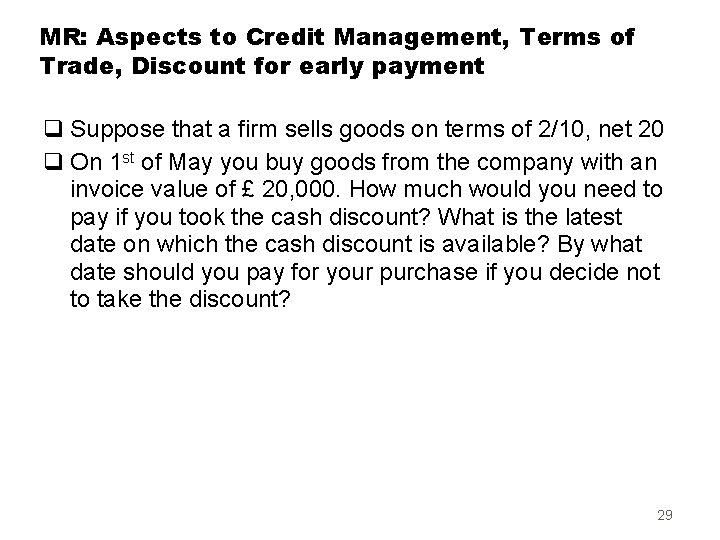
MR: Aspects to Credit Management, Terms of Trade, Discount for early payment q Suppose that a firm sells goods on terms of 2/10, net 20 q On 1 st of May you buy goods from the company with an invoice value of £ 20, 000. How much would you need to pay if you took the cash discount? What is the latest date on which the cash discount is available? By what date should you pay for your purchase if you decide not to take the discount? 29
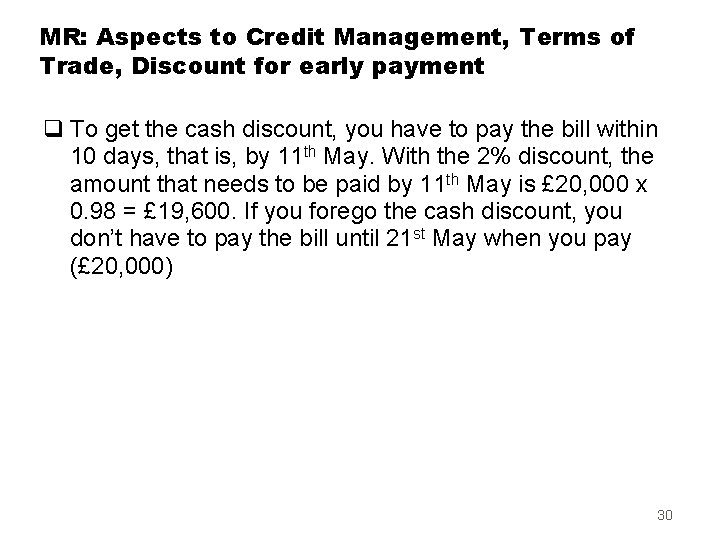
MR: Aspects to Credit Management, Terms of Trade, Discount for early payment q To get the cash discount, you have to pay the bill within 10 days, that is, by 11 th May. With the 2% discount, the amount that needs to be paid by 11 th May is £ 20, 000 x 0. 98 = £ 19, 600. If you forego the cash discount, you don’t have to pay the bill until 21 st May when you pay (£ 20, 000) 30
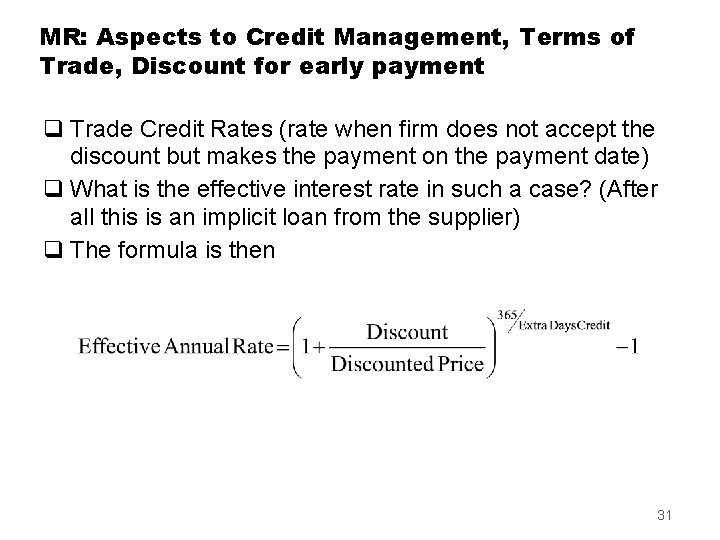
MR: Aspects to Credit Management, Terms of Trade, Discount for early payment q Trade Credit Rates (rate when firm does not accept the discount but makes the payment on the payment date) q What is the effective interest rate in such a case? (After all this is an implicit loan from the supplier) q The formula is then 31
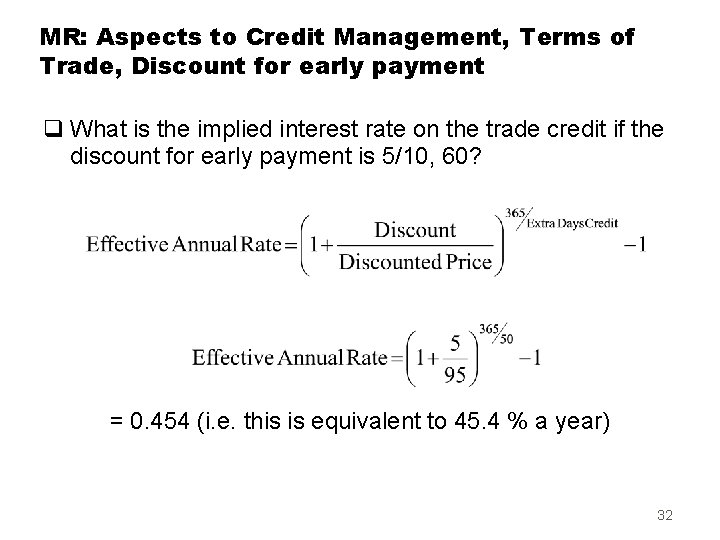
MR: Aspects to Credit Management, Terms of Trade, Discount for early payment q What is the implied interest rate on the trade credit if the discount for early payment is 5/10, 60? = 0. 454 (i. e. this is equivalent to 45. 4 % a year) 32
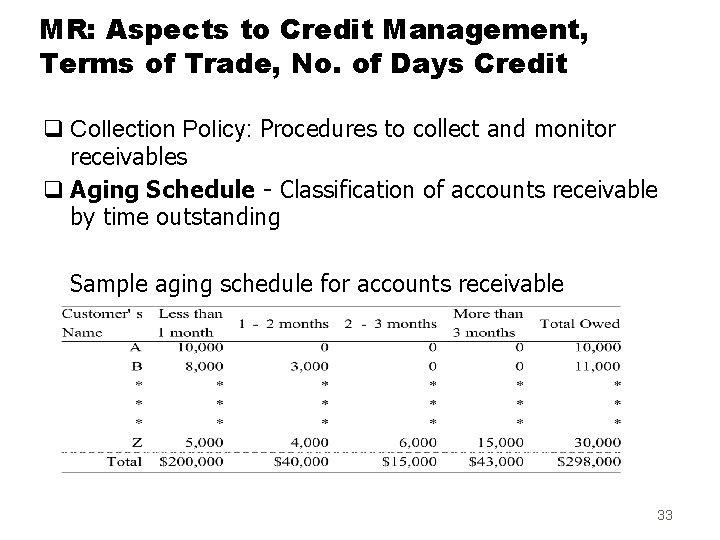
MR: Aspects to Credit Management, Terms of Trade, No. of Days Credit q Collection Policy: Procedures to collect and monitor receivables q Aging Schedule - Classification of accounts receivable by time outstanding Sample aging schedule for accounts receivable 33
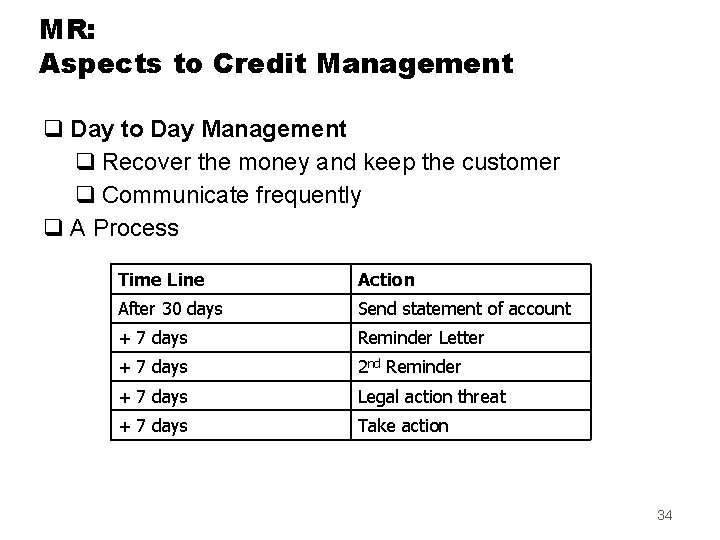
MR: Aspects to Credit Management q Day to Day Management q Recover the money and keep the customer q Communicate frequently q A Process Time Line Action After 30 days Send statement of account + 7 days Reminder Letter + 7 days 2 nd Reminder + 7 days Legal action threat + 7 days Take action 34
MR: Cost of financing receivables q Total cost for a year q How much the receivables are costing in the course of a year q What interest rate to apply? 35
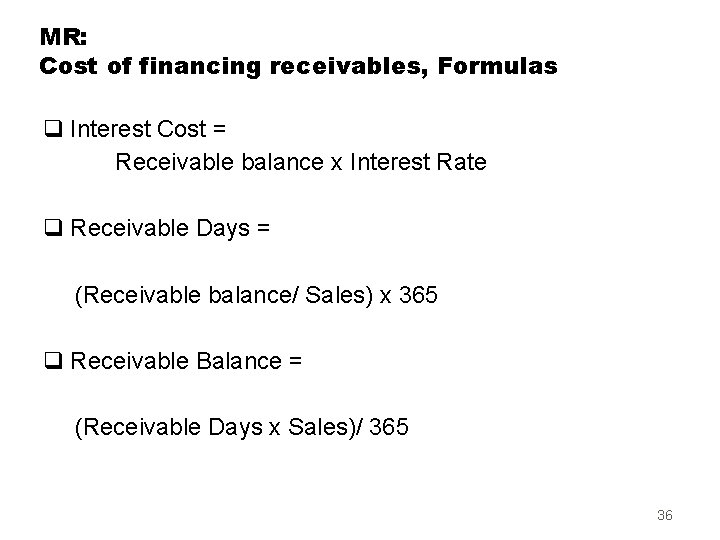
MR: Cost of financing receivables, Formulas q Interest Cost = Receivable balance x Interest Rate q Receivable Days = (Receivable balance/ Sales) x 365 q Receivable Balance = (Receivable Days x Sales)/ 365 36
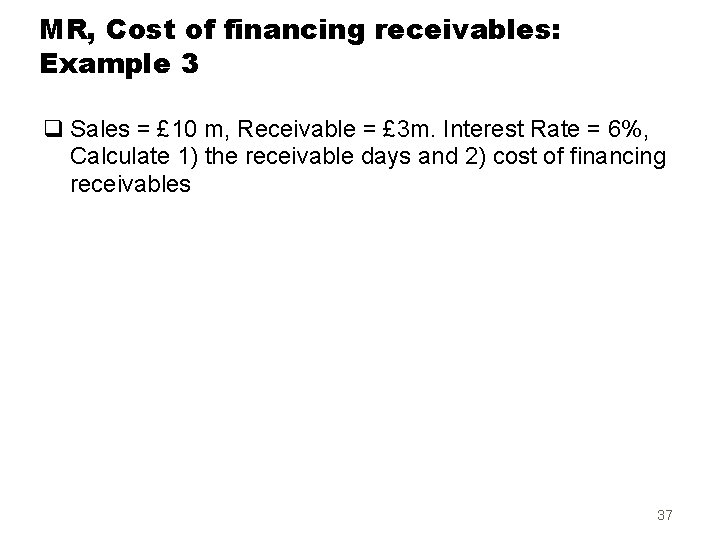
MR, Cost of financing receivables: Example 3 q Sales = £ 10 m, Receivable = £ 3 m. Interest Rate = 6%, Calculate 1) the receivable days and 2) cost of financing receivables 37
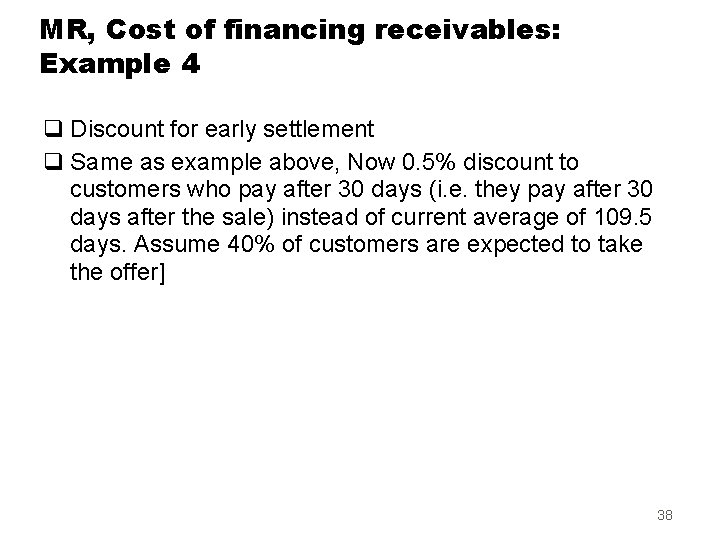
MR, Cost of financing receivables: Example 4 q Discount for early settlement q Same as example above, Now 0. 5% discount to customers who pay after 30 days (i. e. they pay after 30 days after the sale) instead of current average of 109. 5 days. Assume 40% of customers are expected to take the offer] 38
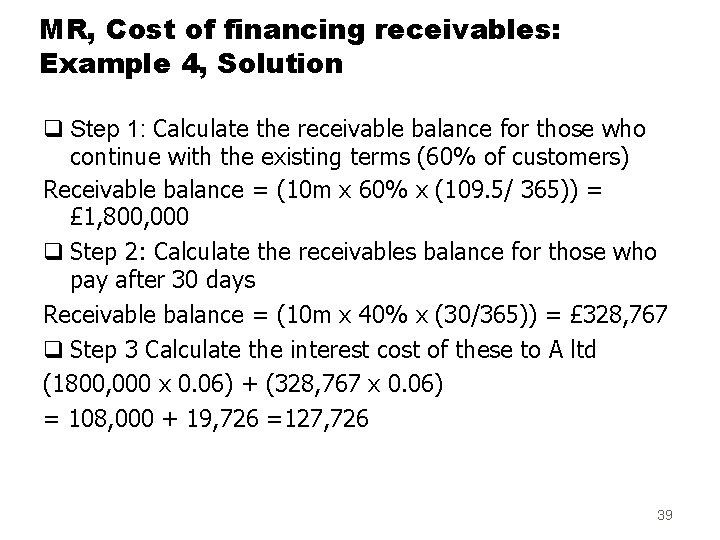
MR, Cost of financing receivables: Example 4, Solution q Step 1: Calculate the receivable balance for those who continue with the existing terms (60% of customers) Receivable balance = (10 m x 60% x (109. 5/ 365)) = £ 1, 800, 000 q Step 2: Calculate the receivables balance for those who pay after 30 days Receivable balance = (10 m x 40% x (30/365)) = £ 328, 767 q Step 3 Calculate the interest cost of these to A ltd (1800, 000 x 0. 06) + (328, 767 x 0. 06) = 108, 000 + 19, 726 =127, 726 39
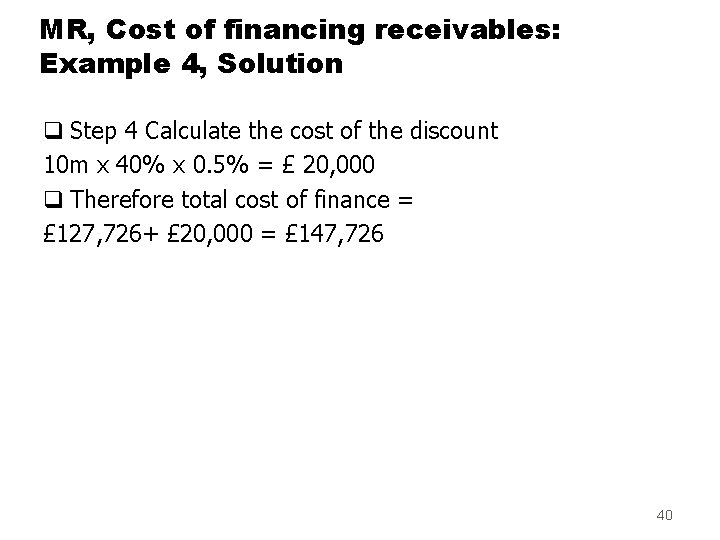
MR, Cost of financing receivables: Example 4, Solution q Step 4 Calculate the cost of the discount 10 m x 40% x 0. 5% = £ 20, 000 q Therefore total cost of finance = £ 127, 726+ £ 20, 000 = £ 147, 726 40
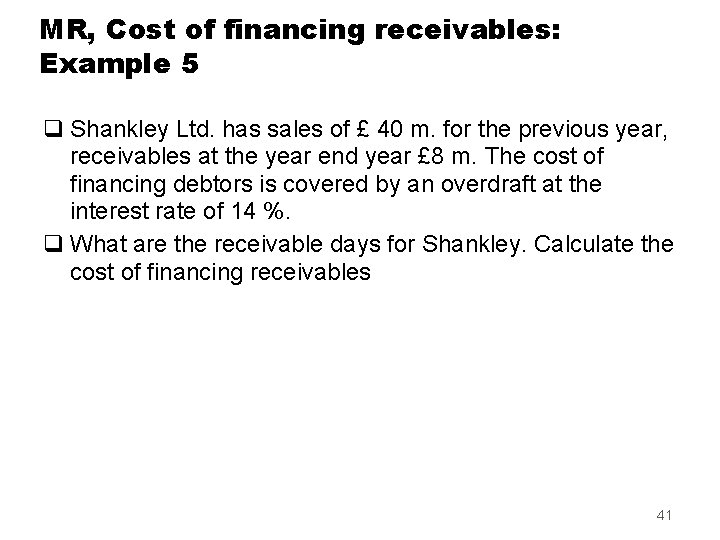
MR, Cost of financing receivables: Example 5 q Shankley Ltd. has sales of £ 40 m. for the previous year, receivables at the year end year £ 8 m. The cost of financing debtors is covered by an overdraft at the interest rate of 14 %. q What are the receivable days for Shankley. Calculate the cost of financing receivables 41
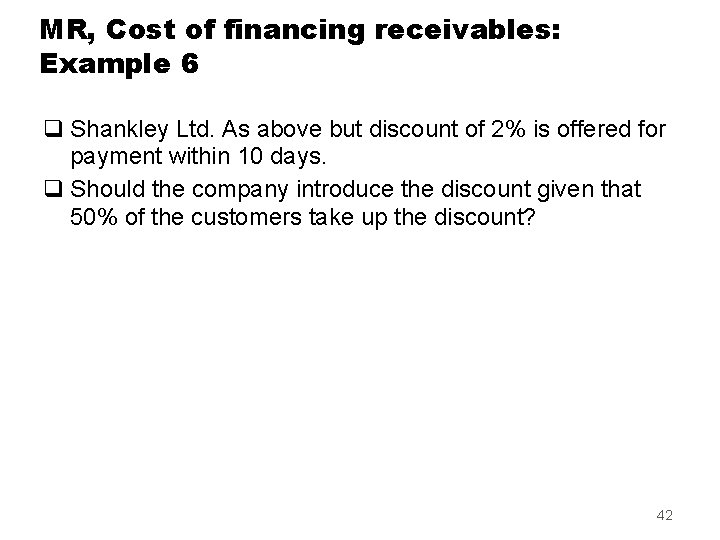
MR, Cost of financing receivables: Example 6 q Shankley Ltd. As above but discount of 2% is offered for payment within 10 days. q Should the company introduce the discount given that 50% of the customers take up the discount? 42
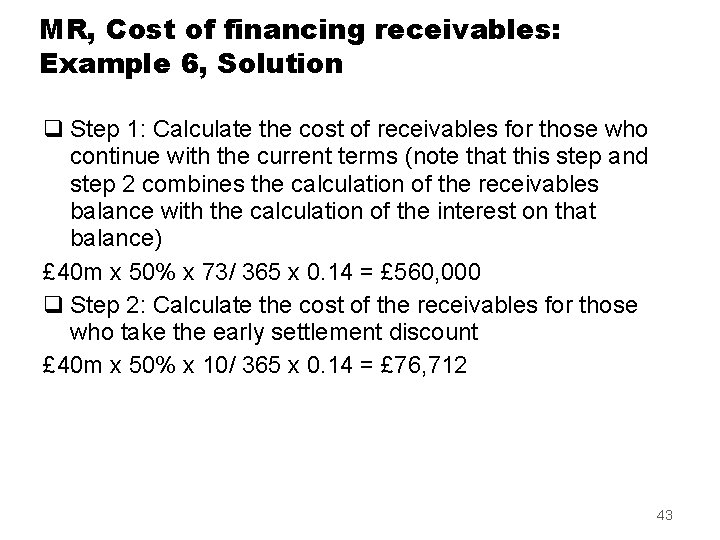
MR, Cost of financing receivables: Example 6, Solution q Step 1: Calculate the cost of receivables for those who continue with the current terms (note that this step and step 2 combines the calculation of the receivables balance with the calculation of the interest on that balance) £ 40 m x 50% x 73/ 365 x 0. 14 = £ 560, 000 q Step 2: Calculate the cost of the receivables for those who take the early settlement discount £ 40 m x 50% x 10/ 365 x 0. 14 = £ 76, 712 43
MR, Cost of financing receivables: Example 6, Solution q Step 3: Calculate the cost of the discount £ 40 m x 50% x 2% = £ 400, 000 q Step 4: Calculate the total cost of finance £ 560, 000 + 76, 712+ 400, 000 = £ 1, 036, 712 This is cheaper than the previous cost of £ 1, 120, 000. therefore the new offer is cost effective 44
MR, Factoring q Factoring: Outsourcing of credit control department to a third party q The factor takes the responsibility to collect the debt for a fee 45
MR: Factoring, Example 7 q Continue Example 6. Rather than offer a discount, the company has been offered a contract by a factor whereby the factor offers to collect the debt for a fee of 0. 75% of turnover. They believe they can collect the debt in 80 days. Admin savings of £ 20, 000 are expected. q Should A Ltd. accept the offer? 46
Inventory Management (IM): Concept q Minimise Total Inventory Cost q Two basic but conflicting issues q How? q Neither inadequate nor excessive inventory 47
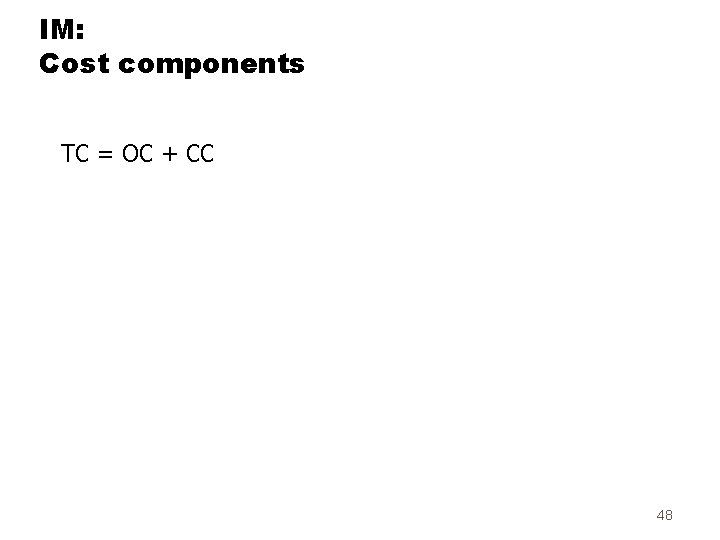
IM: Cost components TC = OC + CC 48
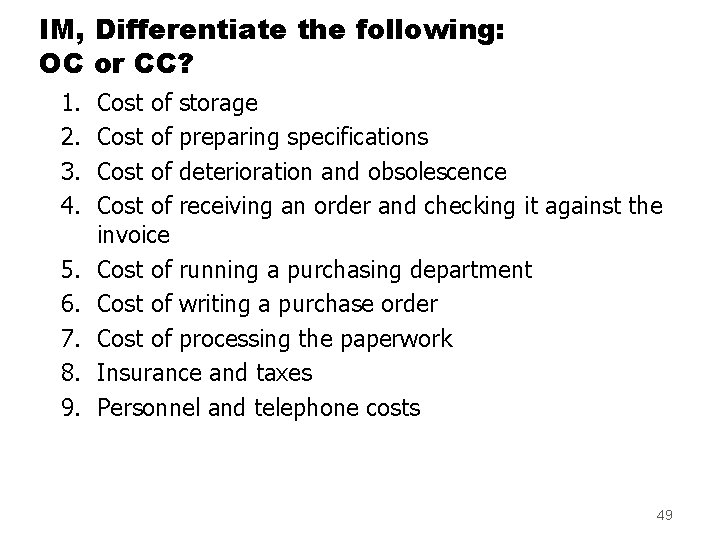
IM, Differentiate the following: OC or CC? 1. 2. 3. 4. 5. 6. 7. 8. 9. Cost of storage Cost of preparing specifications Cost of deterioration and obsolescence Cost of receiving an order and checking it against the invoice Cost of running a purchasing department Cost of writing a purchase order Cost of processing the paperwork Insurance and taxes Personnel and telephone costs 49
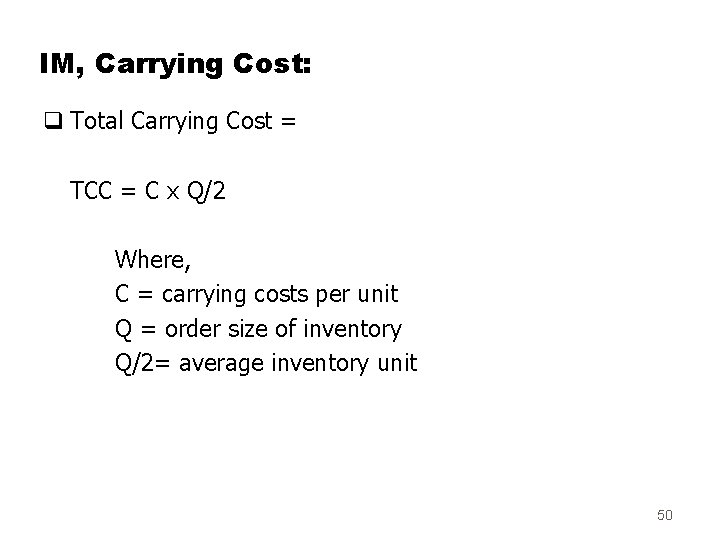
IM, Carrying Cost: q Total Carrying Cost = TCC = C x Q/2 Where, C = carrying costs per unit Q = order size of inventory Q/2= average inventory unit 50
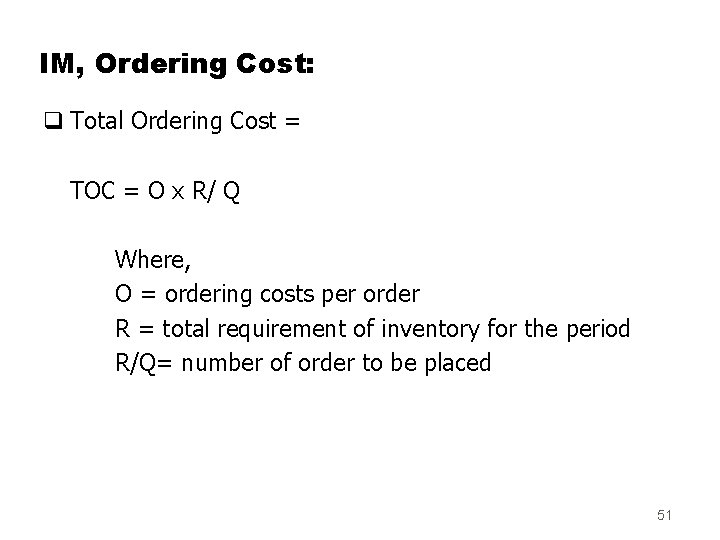
IM, Ordering Cost: q Total Ordering Cost = TOC = O x R/ Q Where, O = ordering costs per order R = total requirement of inventory for the period R/Q= number of order to be placed 51
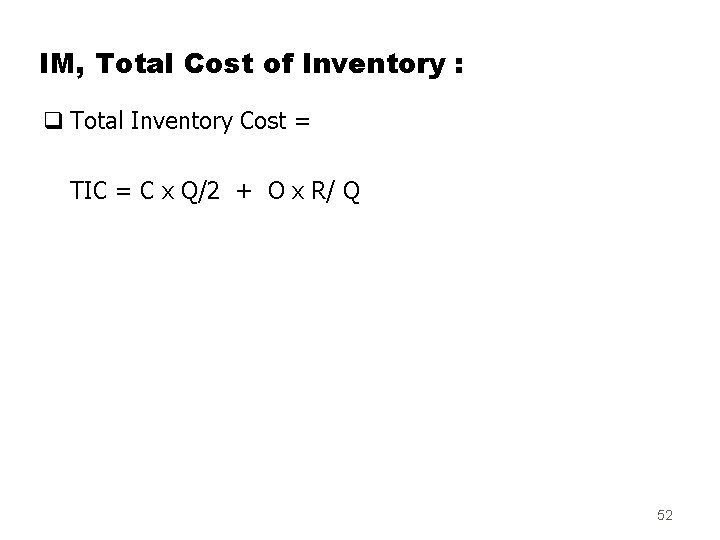
IM, Total Cost of Inventory : q Total Inventory Cost = TIC = C x Q/2 + O x R/ Q 52
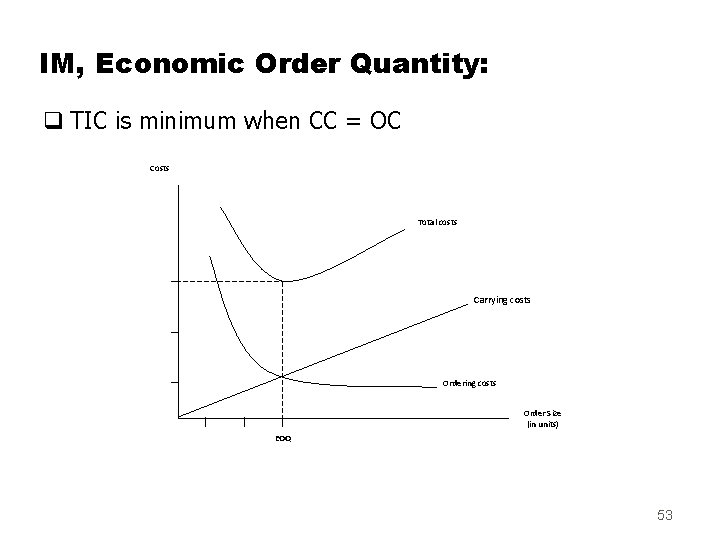
IM, Economic Order Quantity: q TIC is minimum when CC = OC Costs Total costs Carrying costs Order Size (in units) EOQ 53
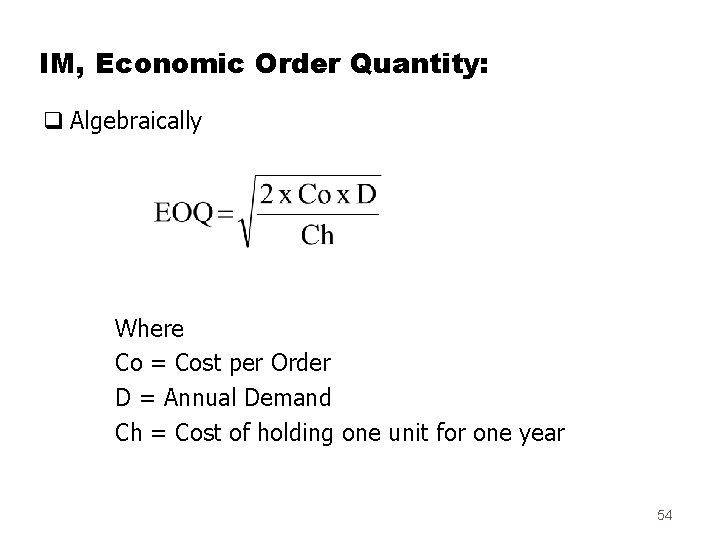
IM, Economic Order Quantity: q Algebraically Where Co = Cost per Order D = Annual Demand Ch = Cost of holding one unit for one year 54
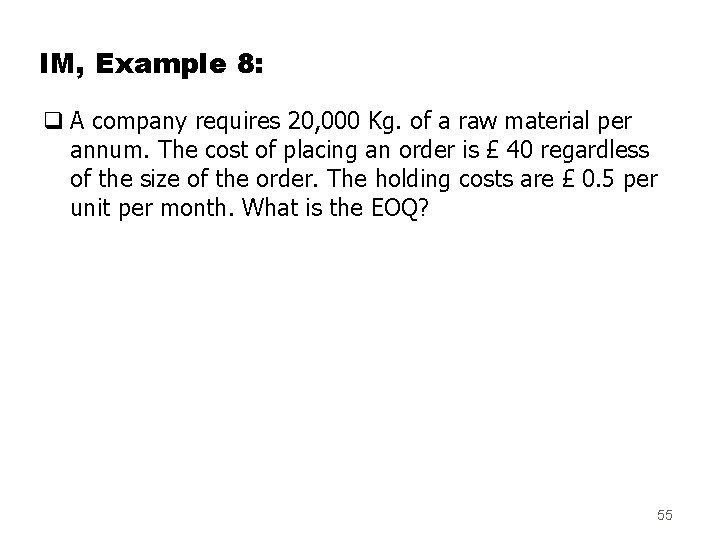
IM, Example 8: q A company requires 20, 000 Kg. of a raw material per annum. The cost of placing an order is £ 40 regardless of the size of the order. The holding costs are £ 0. 5 per unit per month. What is the EOQ? 55
Cash Management q Reasons for Holding Cash q. Transaction q. Precautionary q. Speculative q How much to hold? q. Liquidity and Profitability 56
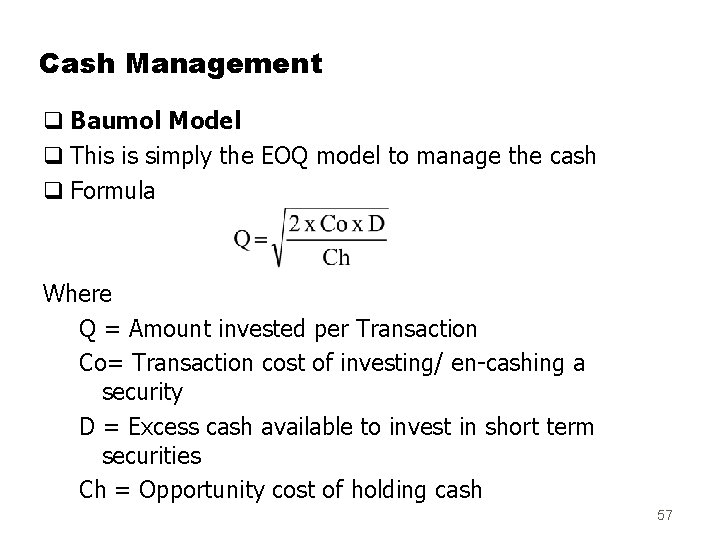
Cash Management q Baumol Model q This is simply the EOQ model to manage the cash q Formula Where Q = Amount invested per Transaction Co= Transaction cost of investing/ en-cashing a security D = Excess cash available to invest in short term securities Ch = Opportunity cost of holding cash 57
Cash Management q Baumol Example q A company generates £ 5, 000 per month excess cash. The interest rate it can expect to earn on its investment is 6% p. a. The transaction cost associated with its separate investment of funds is constant at £ 50. q What is the optimum amount of cash to be invested in each transaction. How many transaction will arise each year 58
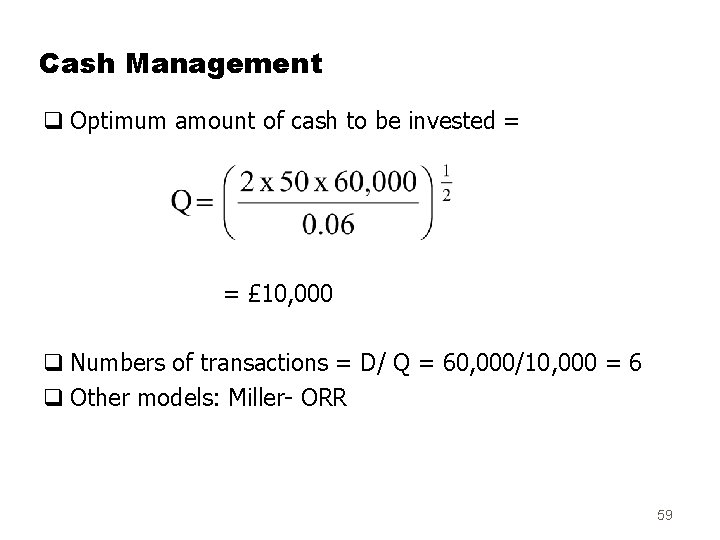
Cash Management q Optimum amount of cash to be invested = = £ 10, 000 q Numbers of transactions = D/ Q = 60, 000/10, 000 = 6 q Other models: Miller- ORR 59
Cash Budget q A cash budget is a statement of all the inflows and outflows of cash for a given period q Financial Manager can use the Cash Budget to identify short-term financial needs. q The cash budget tells the manager what borrowing is required or what lending will be possible in the short term. q The firm has a number of possible ways of acquiring funds to meet short-term shortfalls, including unsecured (line of credit from a bank) and secured loans (accounts receivable or inventories). 60
“Revenue is vanity, Profit is sanity” Thank You 61
- Slides: 61