
Working at Height from Ladders Steps A Toolbox

Working at Height from Ladders & Steps A Toolbox Talk covering the use of Ladders, Steps and associated Work at Height Equipment TB Davies Lewis Road, Cardiff CF 24 5 EB T: 029 2132 0000 https: //www. tbdavies. co. uk
Falls from height are a leading cause of serious and fatal injuries in the workplace. Introduction The goals of this talk are to help you: manage risk by educating your team on how to select and use the most appropriate piece of equipment when working at height understand how to anticipate the risks of fall hazards in your work place understand the Health & Safety Executives short duration and low level safety requirements when working at height
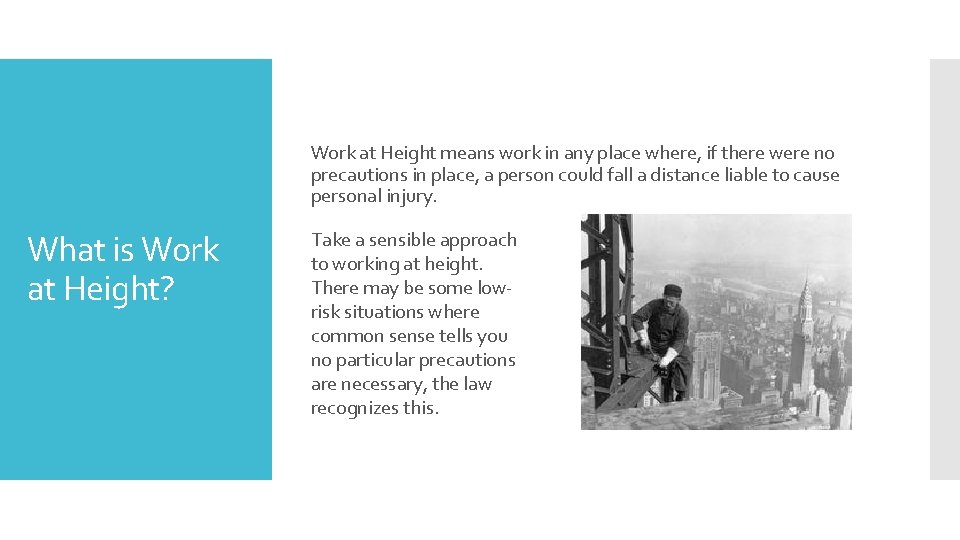
Work at Height means work in any place where, if there were no precautions in place, a person could fall a distance liable to cause personal injury. What is Work at Height? Take a sensible approach to working at height. There may be some lowrisk situations where common sense tells you no particular precautions are necessary, the law recognizes this.
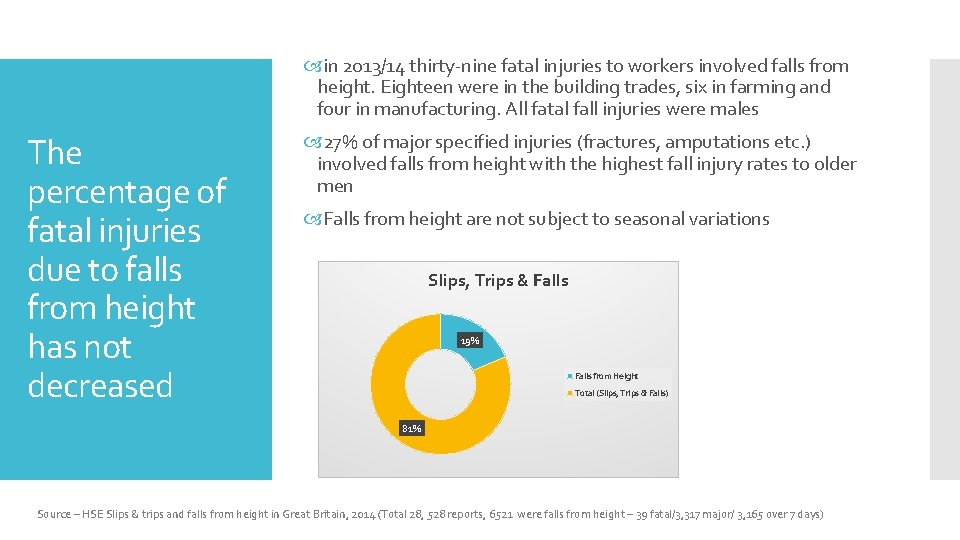
in 2013/14 thirty-nine fatal injuries to workers involved falls from height. Eighteen were in the building trades, six in farming and four in manufacturing. All fatal fall injuries were males The percentage of fatal injuries due to falls from height has not decreased 27% of major specified injuries (fractures, amputations etc. ) involved falls from height with the highest fall injury rates to older men Falls from height are not subject to seasonal variations Slips, Trips & Falls 19% Falls from Height Total (Slips, Trips & Falls) 81% Source – HSE Slips & trips and falls from height in Great Britain, 2014 (Total 28, 528 reports, 6521 were falls from height – 39 fatal/3, 317 major/ 3, 165 over 7 days)
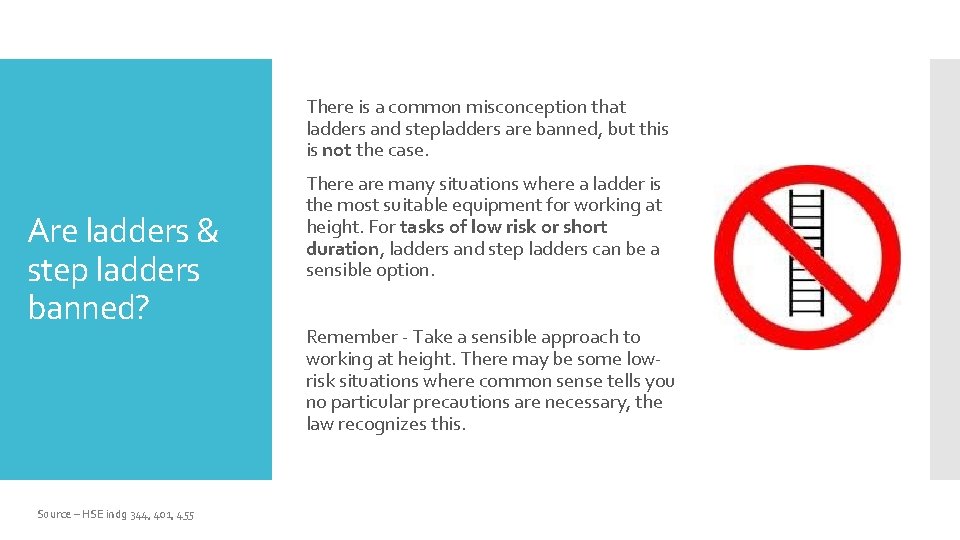
There is a common misconception that ladders and stepladders are banned, but this is not the case. Are ladders & step ladders banned? Source – HSE indg 344, 401, 455 There are many situations where a ladder is the most suitable equipment for working at height. For tasks of low risk or short duration, ladders and step ladders can be a sensible option. Remember - Take a sensible approach to working at height. There may be some lowrisk situations where common sense tells you no particular precautions are necessary, the law recognizes this.

Avoid Working at Height Hierarchy of Fall Protection Guard the Hazard Where there are no fixed parapets or guardrails consider a Freestanding Guardrail System or else other collective protection plant such as MEWPS, Scaffold, Towers, or at lower heights Podiums. Protect the Worker If the risk of a fall remains minimise the distance or consequence of the fall with a suitable Fall Protection System. Low Risk Short Duration Work MEWPS – Mobile Elevated Work Platforms (Eg Scissor Lifts) Avoid working at height were possible using tools and plant from ground level. For tasks of low risk or short duration, ladders and step ladders can be a sensible option.

Freestanding Guardrail Systems Kee. Guard Examples of temporary products that help us ‘Guard the Hazard’ Versi. Rail Mobile Elevated Work Platforms (MEWPS) Genie Scissor Manitou Articulated Boom Mobile Scaffold Towers & Podiums TB Davies Podium Step TB Davies Contractor Tower

• ‘Protect the Worker’ • • Personal Fall Arrest Systems • Class A – Fixed Anchor Points • Class B – Temporary Systems • Class C - Horizontal Lifelines Safety Nets Demarcation Systems (an economical solution to Freestanding Guardrail Systems providing it is placed at least 2 m from the roof edge. ) Types of Fall Protection Systems Freestanding Weighted Anchor to BS EN 795 Safesite Demarcation Systems Temporary Eyebolts
When is a ladder the most suitable equipment? Source – HSE indg 344, 401, 455 The law says that ladders can be used for work at height when a risk assessment has shown that using equipment offering a higher level of fall protection is not justified because of the low risk and short duration of use; or there are existing workplace features which cannot be altered.
You should make sure that people with sufficient skills, knowledge and experience are employed to perform the task, or, if they are being trained, that they work under the supervision of somebody competent to do it. Training often takes place on the job, it does not always take place in a classroom. Is specialized training required to use ladders? In the case of low-risk, short duration tasks (short duration means tasks that take less than 30 minutes) involving ladders, competence requirements may be no more than making sure employees receive instruction on how to use the equipment safely (eg how to tie a ladder properly) and appropriate training. When a more technical level of competence is required, existing training and certification schemes drawn up by the Ladder Association is one way to help demonstrate competence. Source – HSE indg 344, 401, 455

What is Short Duration Work? Source – HSE indg 344, 401, 455 As a guide, if your task would require staying up a leaning ladder or stepladder for more than 30 minutes at a time, it is recommended that you consider alternative equipment.

The guidance from the HSE leaves this to your judgment but do allude to examples such as ‘Starting a Screw’, ‘Hanging Wallpaper’, ‘Installing a Smoke Detector’ etc. What is Low Risk? Source – HSE indg 344, 401, 455 Using these examples should provide an idea of what you may define as Low risk.

You should only use ladders and steps in situations where they can be used safely. Source – HSE indg 344, 401, 455 Ladders and steps needs to be Level Stable Ladders need to be secured (where it is reasonably practicable to do so). You can source ladders or accessories that can help make your ladder meet these requirements Check all four stepladder feet are in contact with the ground and the steps are level
At the beginning of the working day the user should make the following checks or after something has changed (eg a ladder has been dropped or moved from a dirty area to a clean area). Check the stiles – make sure they are not bent or damaged Check the feet – if they are missing, worn, damaged or dirty (eg soil, chippings or embedded stones) the ladder could slip. Pre Use Checks Check the rungs – if they are bent, worn, missing or loose the ladder could fail. Check any locking mechanisms – if they are bent or the fixings are worn or damaged the ladder could collapse. Ensure any locking bars are engaged. Check the stepladder platform – if it is split or buckled the ladder could become unstable or collapse. Check the steps or treads on stepladders – if they are contaminated they could be slippery; if the fixings are loose on steps, they could collapse.

Leaning Ladders Setting up. • Don’t overload it – consider workers’ weight, equipment & materials • Don’t try to move or extend ladders while standing on the rungs • Don’t work off the top three rungs • Don’t stand ladders on moveable objects • Don’t work within 6 m horizontally of any overhead power line Source – HSE indg 344, 401, 455 / Image courtesy of Work. Safe. BC Canada

Leaning Ladders Setting up • Make sure the ladder angle is at 75° • Tie the ladder to a suitable point, making sure both stiles are tied • Where this is not practical, secure with an effective ladder stability device, ‘footing’ is the last resort. Source – HSE indg 344, 401, 455 / Image courtesy of Work. Safe. BC Canada

Leaning Ladders Climbing • Always grip the ladder and face the ladder rungs while climbing or descending • Avoid holding items when climbing (consider using a tool belt) • Maintain three points of contact when climbing (this means a hand two feet) • Do not rest a ladder against weak upper surfaces (eg glazing or plastic gutters) Source – HSE indg 344, 401, 455 / Image courtesy of Work. Safe. BC Canada
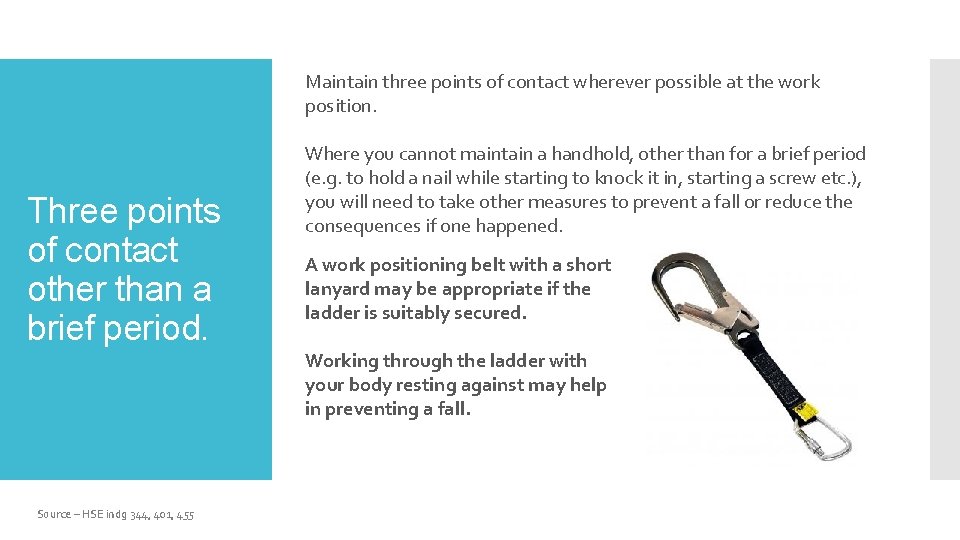
Maintain three points of contact wherever possible at the work position. Three points of contact other than a brief period. Where you cannot maintain a handhold, other than for a brief period (e. g. to hold a nail while starting to knock it in, starting a screw etc. ), you will need to take other measures to prevent a fall or reduce the consequences if one happened. A work positioning belt with a short lanyard may be appropriate if the ladder is suitably secured. Working through the ladder with your body resting against may help in preventing a fall. Source – HSE indg 344, 401, 455
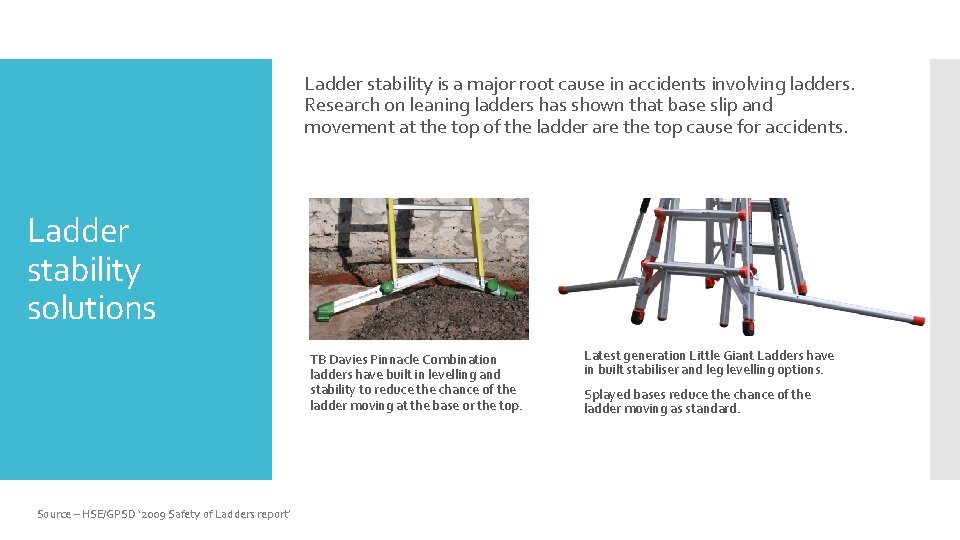
Ladder stability is a major root cause in accidents involving ladders. Research on leaning ladders has shown that base slip and movement at the top of the ladder are the top cause for accidents. Ladder stability solutions TB Davies Pinnacle Combination ladders have built in levelling and stability to reduce the chance of the ladder moving at the base or the top. Source – HSE/GPSD ‘ 2009 Safety of Ladders report’ Latest generation Little Giant Ladders have in built stabiliser and leg levelling options. Splayed bases reduce the chance of the ladder moving as standard.
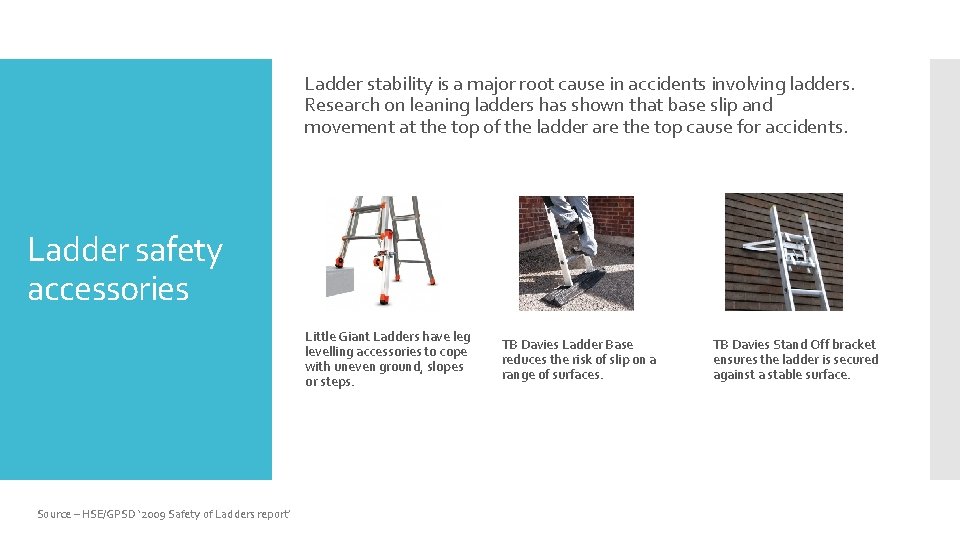
Ladder stability is a major root cause in accidents involving ladders. Research on leaning ladders has shown that base slip and movement at the top of the ladder are the top cause for accidents. Ladder safety accessories Little Giant Ladders have leg levelling accessories to cope with uneven ground, slopes or steps. Source – HSE/GPSD ‘ 2009 Safety of Ladders report’ TB Davies Ladder Base reduces the risk of slip on a range of surfaces. TB Davies Stand Off bracket ensures the ladder is secured against a stable surface.
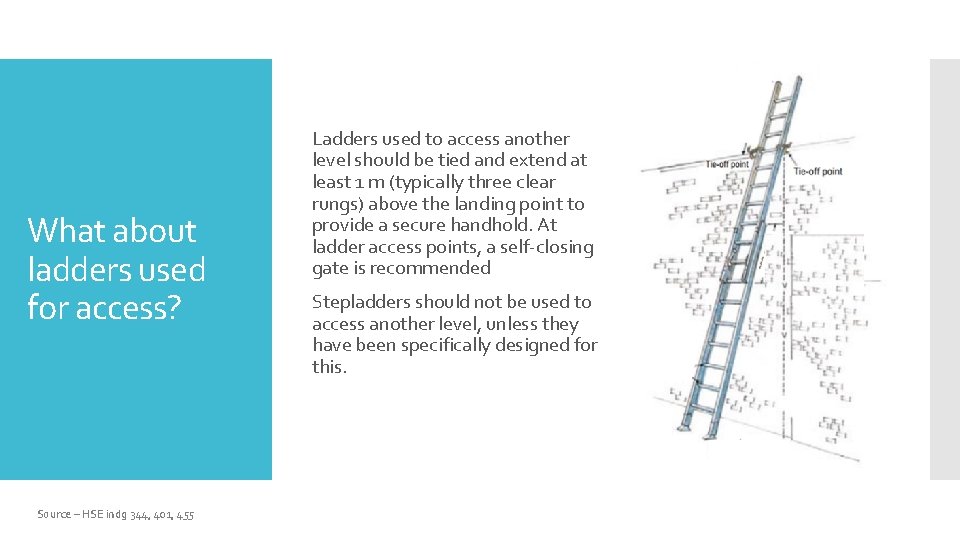
What about ladders used for access? Source – HSE indg 344, 401, 455 Ladders used to access another level should be tied and extend at least 1 m (typically three clear rungs) above the landing point to provide a secure handhold. At ladder access points, a self-closing gate is recommended Stepladders should not be used to access another level, unless they have been specifically designed for this.

When deciding if it is safe to carry out a particular task on a stepladder where you cannot maintain a handhold (eg to put a box on a shelf, hang wallpaper, install a smoke detector on a ceiling), this needs to be justified, taking into account: Step Ladders Source – HSE indg 344, 401, 455 The height of the task Whether a handhold is still available to steady yourself before and after the task Whether it is light work Whether it avoids side loading Whether it avoids overreaching Whether the stepladder can be tied (e. g. when side-on working)

A study by the HSE has shown sideways tipping accounts for 40% of stepladder accidents. Step Ladders Positioning and working ‘Side on’ However, there are occasions when a risk assessment may show it is safer to work side on, eg in a retail stock room when you can’t engage the stepladder locks to work face on because of space restraints in narrow aisles, but you can fully lock it to work side on. 3 Try to avoid work that imposes a side loading, such as side-on drilling through solid materials (e. g. bricks or concrete) Where side-on loadings cannot be avoided, you should prevent the steps from tipping over. If you cannot secure the step you need to consider using a more suitable type of access equipment such as a podium step. Source – HSE/GPSD ‘ 2009 Safety of Ladders report’ / HSE indg 344, 401, 455 / Try to position the stepladder to face the work activity and not side on.

Step Ladder Stability • Check all four stepladder feet are in contact with the ground and the steps are level. Some step ladders may have stability solutions built in to help adjust the step on uneven ground surfaces • Only carry light materials and tools and consider a tool belt or a steps with a built in work tray. • Don’t overreach Source – HSE/GPSD ‘ 2009 Safety of Ladders report’ / HSE indg 344, 401, 455 Little Giant Select Steps can work on stairs and adjust to different heights reducing the risk of overreaching.

Don’t stand work on the top three steps (including a step forming the very top of the stepladder) unless there is a suitable handhold. Can I stand on the Platform of a Platform Step? The red line indicates this is the highest tread you can work from on a Swingback or Builders type step. Source – HSE indg 344, 401, 455 / Here you can stand on the platform as the parapet or continuous handrail provides a suitable handhold and third point of contact.

Maintain three points of contact at the working position. This means two feet and one hand, or when both hands need to be free for a brief period, two feet and the body supported by the stepladder. You can use both hands for brief periods on a step ladder! Source – HSE indg 344, 401, 455 Where two hands need to be free for a brief period for light work. Keep two feet on the same step and the body (knees or chest) supported by the stepladder to maintain three points of contact. Make sure a safe handhold is available. Large working platform shows space for both feet Knee Bar or continuous Handrail provides a third point of contact for the Knee or Thigh area and a safe handhold as required.
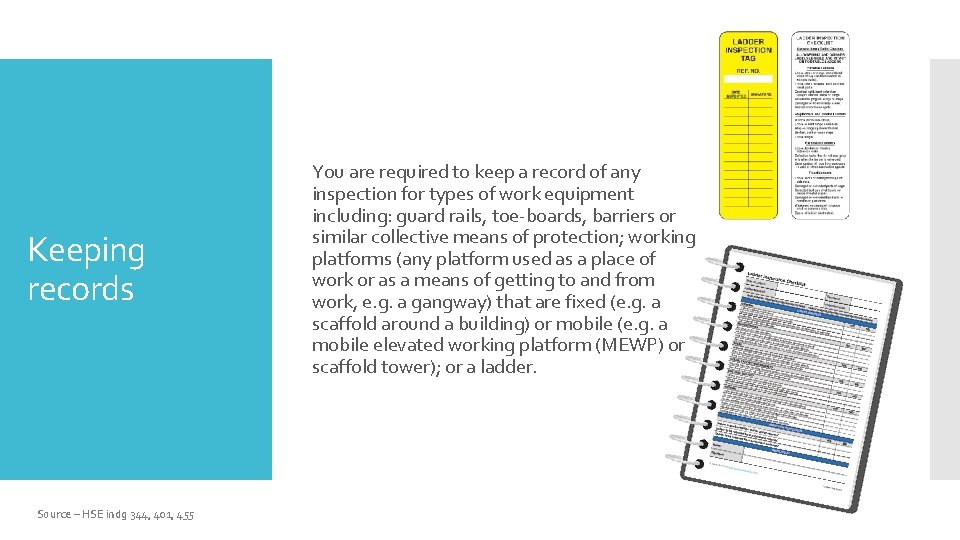
Keeping records Source – HSE indg 344, 401, 455 You are required to keep a record of any inspection for types of work equipment including: guard rails, toe-boards, barriers or similar collective means of protection; working platforms (any platform used as a place of work or as a means of getting to and from work, e. g. a gangway) that are fixed (e. g. a scaffold around a building) or mobile (e. g. a mobile elevated working platform (MEWP) or scaffold tower); or a ladder.
Employees have general legal duties to take reasonable care of themselves and others who may be affected by their actions, and to co-operate with their employer to enable their health and safety duties and requirements to be complied with. Users responsibilities Source – HSE indg 344, 401, 455 For an employee, or those working under someone else’s control, the law says they must: Report any safety hazard they identify to their employer; Use the equipment and safety devices supplied or given to them properly, in accordance with any training and instructions (unless they think that would be unsafe, in which case they should seek further instructions before continuing).
Employers need to make sure that any ladder or stepladder is both suitable for the work task and in a safe condition before use. As a guide, only use ladders or stepladders that: Employers responsibilities Source – HSE indg 344, 401, 455 Have no visible defects. They should have a pre-use check each working day Have an up-to-date record of the detailed visual inspections carried out regularly by a competent person. These should be done in accordance with the manufacturer’s instructions Are suitable for the intended use, ie are strong and robust enough for the job

Thank You for attending this Toolbox talk. We hope you found it informative and will help you select the most appropriate equipment and work more safely when using ladders. Disclaimer While every care has been taken in compiling the information contained in this document, we do not make any representations as to the completeness, accuracy or up-to-date nature of such information. We do not accept any liability for any loss or damage arising directly or indirectly from reliance on any of the contents of this information. TB Davies Lewis Road, Cardiff CF 24 5 EB T: 029 2132 0000 https: //www. tbdavies. co. uk
- Slides: 30