
Workforce Prioritisation Tool Providing Operational Advice Process into
- Slides: 25
Workforce Prioritisation Tool Providing Operational Advice Process into ER Negotiations May 2012
Background � Commenced 2009 � Informing BSG development � Lack of current tools available to DHBs to critically evaluate the relationship between health workforces and the operation of wider systems / services � FW informants, A, T&S Strategy Group, prioritisation for 44+ workforces � Action research approach to development � Rationale: consistency, standardised, endorsed, adaptable approach � Iterative development
Framework Requirements � The need for more suitable frameworks for health workforce monitoring and development not new � Previous assessments have not taken a ‘whole of systems approach' nor provide a logical framework as to how workforces can be compared to each other or within a broader systems perspective � Ability to assess and classify health workforces whilst taking cognisance of the wider contextual factors which impact on the overall New Zealand health system � Move from anecdotal to more evidential view � Provision of evidence to make better informed ER and IR decisions, specifically with MECA agreements
Requirement: Screening Tool Design � Identify areas of operational pressure where intervention may be required � Use across multiple areas, service settings or with specific occupational group � Reliant on consensus achieved via focus group and cross section of expertise � Provision of rationale for further investigation to occur; Macro-Micro � Tool is time dependent - however has ability to repeat the process at a later date in order to review any changes or other such trends
Research Component � Purpose to develop and validate a framework to allow classification of health workforces according to their current status within the New Zealand health system � Allows workforces to be examined from a system perspective as to whether they are stable or under pressure, offers potential to tailor funding to match the classification � Study further developed FW, in depth interviews DHBNZ, pilot testing, Delphi process over 3 months.
Methodology � Delphi Method, iterative process used to accumulate/refine anonymous opinions of experts using data collection and analysis techniques combined with feedback (Skulmoski, Hartman & Krahn, 2007). � Well suited method when there is incomplete knowledge about a problem � Interviews – DHBNZ 2011 � Prototype – pilot testing � Delphi – 3 round testing
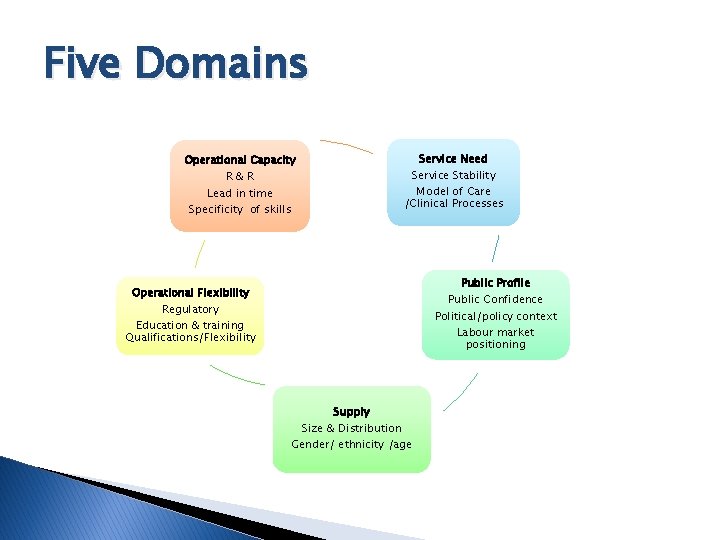
Five Domains Operational Capacity R&R Lead in time Specificity of skills Service Need Service Stability Model of Care /Clinical Processes Public Profile Public Confidence Political/policy context Labour market positioning Operational Flexibility Regulatory Education & training Qualifications/Flexibility Supply Size & Distribution Gender/ ethnicity /age
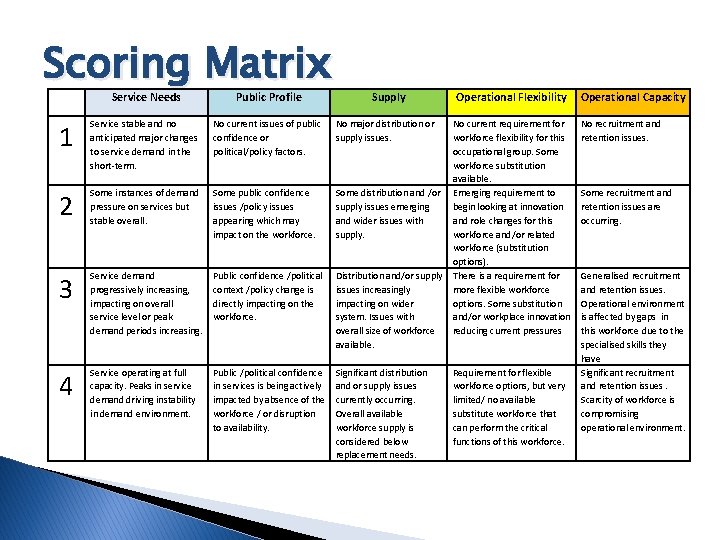
Scoring Matrix Service Needs Public Profile Supply 1 Service stable and no anticipated major changes to service demand in the short-term. No current issues of public confidence or political/policy factors. No major distribution or supply issues. 2 Some instances of demand pressure on services but stable overall. Some public confidence issues /policy issues appearing which may impact on the workforce. Some distribution and /or supply issues emerging and wider issues with supply. 3 Service demand progressively increasing, impacting on overall service level or peak demand periods increasing. Public confidence /political context /policy change is directly impacting on the workforce. Distribution and/or supply issues increasingly impacting on wider system. Issues with overall size of workforce available. 4 Service operating at full capacity. Peaks in service demand driving instability in demand environment. Public /political confidence in services is being actively impacted by absence of the workforce / or disruption to availability. Significant distribution and or supply issues currently occurring. Overall available workforce supply is considered below replacement needs. Operational Flexibility No current requirement for workforce flexibility for this occupational group. Some workforce substitution available. Emerging requirement to begin looking at innovation and role changes for this workforce and/or related workforce (substitution options). There is a requirement for more flexible workforce options. Some substitution and/or workplace innovation reducing current pressures Requirement for flexible workforce options, but very limited/ no available substitute workforce that can perform the critical functions of this workforce. Operational Capacity No recruitment and retention issues. Some recruitment and retention issues are occurring. Generalised recruitment and retention issues. Operational environment is affected by gaps in this workforce due to the specialised skills they have Significant recruitment and retention issues. Scarcity of workforce is compromising operational environment.
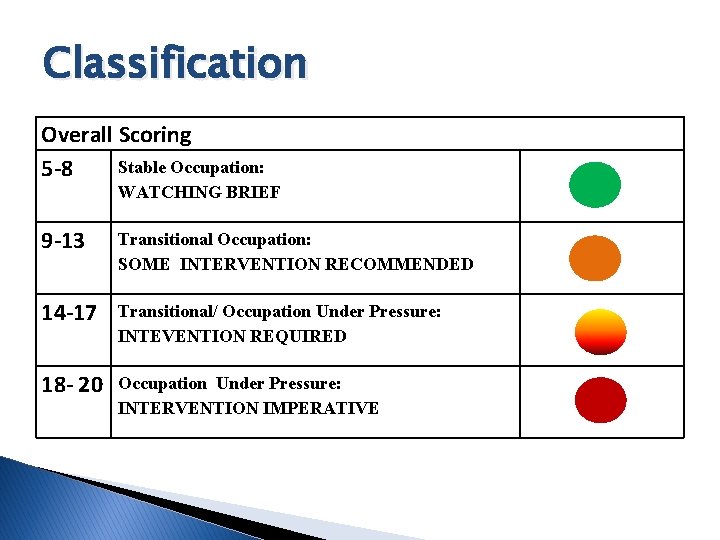
Classification Overall Scoring Stable Occupation: 5 -8 WATCHING BRIEF 9 -13 Transitional Occupation: SOME INTERVENTION RECOMMENDED 14 -17 Transitional/ Occupation Under Pressure: INTEVENTION REQUIRED 18 - 20 Occupation Under Pressure: INTERVENTION IMPERATIVE
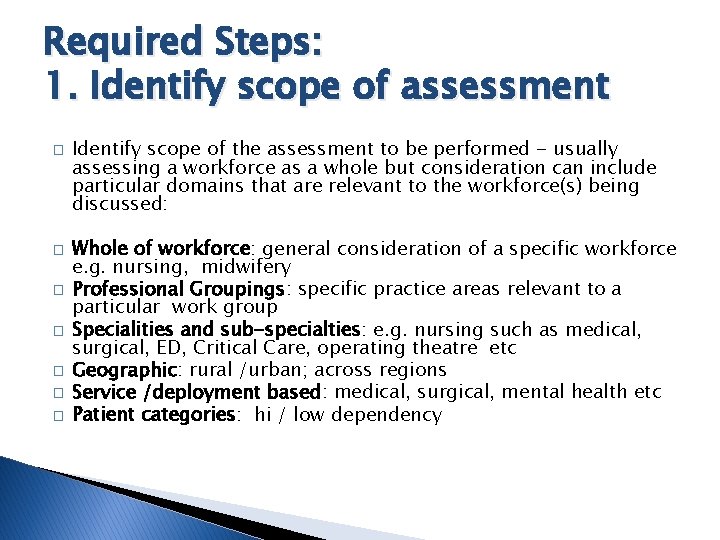
Required Steps: 1. Identify scope of assessment � � � � Identify scope of the assessment to be performed - usually assessing a workforce as a whole but consideration can include particular domains that are relevant to the workforce(s) being discussed: Whole of workforce: general consideration of a specific workforce e. g. nursing, midwifery Professional Groupings: specific practice areas relevant to a particular work group Specialities and sub-specialties: e. g. nursing such as medical, surgical, ED, Critical Care, operating theatre etc Geographic: rural /urban; across regions Service /deployment based: medical, surgical, mental health etc Patient categories: hi / low dependency
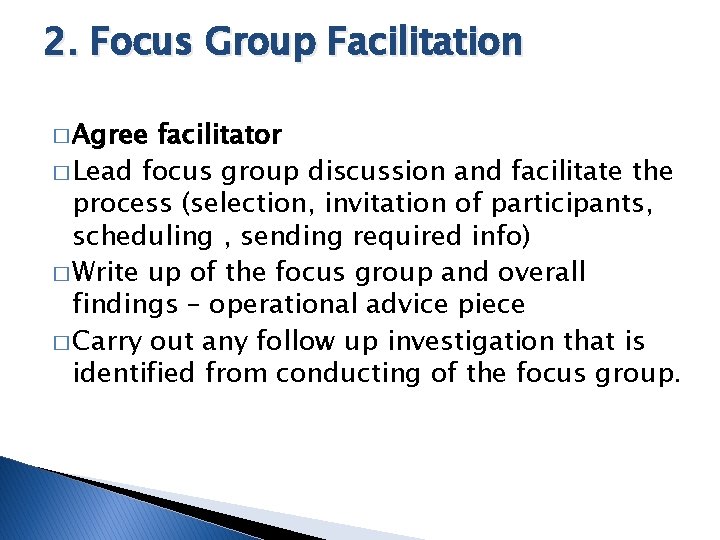
2. Focus Group Facilitation � Agree facilitator � Lead focus group discussion and facilitate the process (selection, invitation of participants, scheduling , sending required info) � Write up of the focus group and overall findings – operational advice piece � Carry out any follow up investigation that is identified from conducting of the focus group.
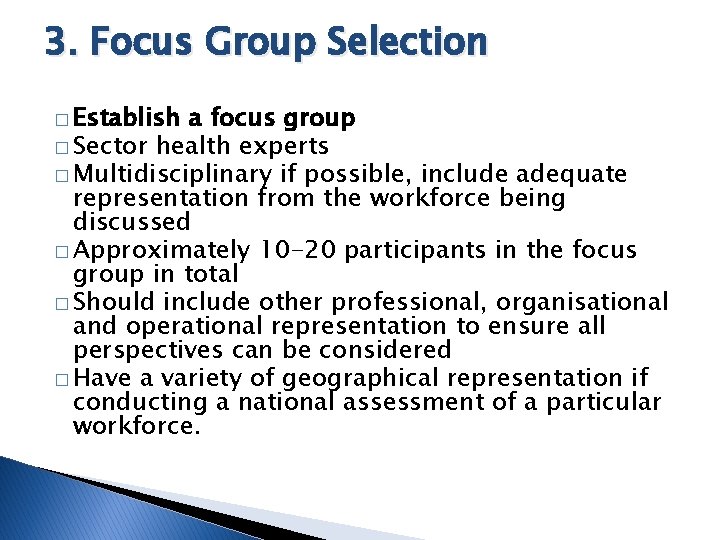
3. Focus Group Selection � Establish a focus group � Sector health experts � Multidisciplinary if possible, include adequate representation from the workforce being discussed � Approximately 10 -20 participants in the focus group in total � Should include other professional, organisational and operational representation to ensure all perspectives can be considered � Have a variety of geographical representation if conducting a national assessment of a particular workforce.
4. Background information relevant data on the workforce � Gather all available background information /data on workforce to help inform group discussion and ensure adequate preparation � Data should include relevant operational DHB, regulatory and strategic workforce information from Health Workforce New Zealand � Data template.
5. Conduct the focus group � Can be conducted either face to face or by teleconference. Teleconference is a preferred method and can facilitate the assessment tool process well � Approximately 60 -90 minutes should be sufficient to conduct the process.
6. Overview of Process & Booklet � The 5 domains � Workforce classification – provide an overview of the four potential outcomes of scoring; stable , transitional / underpressure, underpressure � Scoring matrix
7. Meeting Completion � Reconfirm final classification reached � Reiterate any additional issues which have arisen from group discussion that require further investigation as part of any ER/IR processes � Classification then provides a basis from which other discussions can be generated and also helps to provide direction on what areas are causing pressure or particular issues to workforce being reviewed.
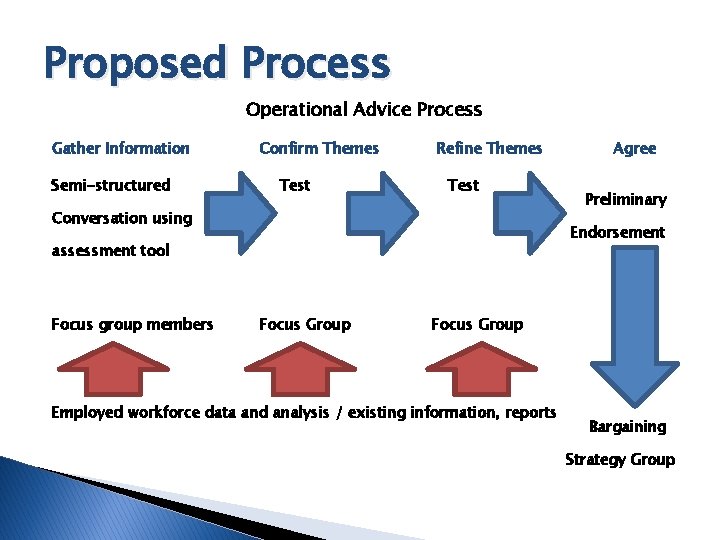
Proposed Process Operational Advice Process Gather Information Semi-structured Confirm Themes Test Refine Themes Test Conversation using Preliminary Endorsement assessment tool Focus group members Agree Focus Group Employed workforce data and analysis / existing information, reports Bargaining Strategy Group
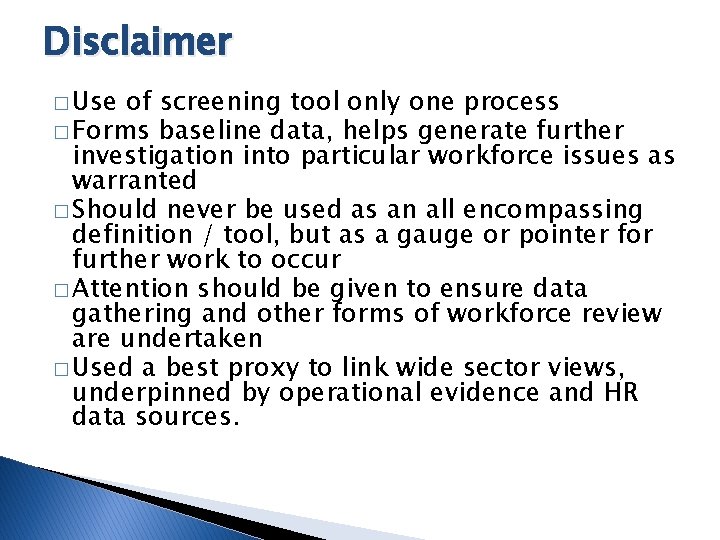
Disclaimer � Use of screening tool only one process � Forms baseline data, helps generate further investigation into particular workforce issues as warranted � Should never be used as an all encompassing definition / tool, but as a gauge or pointer for further work to occur � Attention should be given to ensure data gathering and other forms of workforce review are undertaken � Used a best proxy to link wide sector views, underpinned by operational evidence and HR data sources.
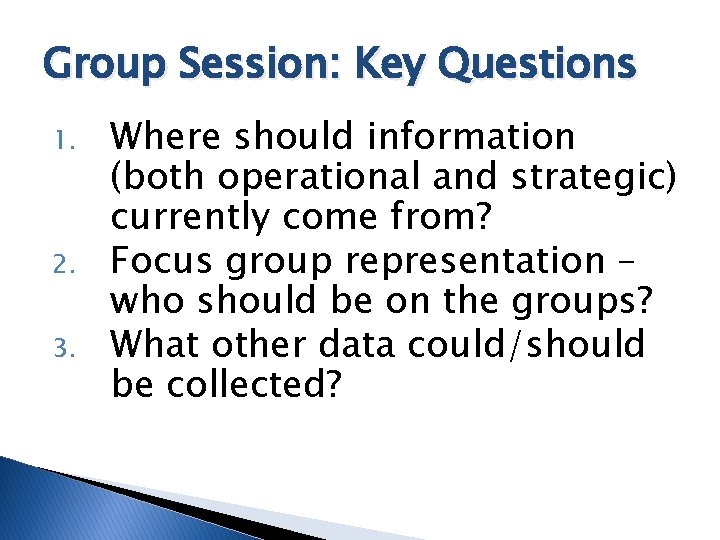
Group Session: Key Questions 1. 2. 3. Where should information (both operational and strategic) currently come from? Focus group representation – who should be on the groups? What other data could/should be collected?
Feedback �What worked, what didn’t? �Information gathering conclusions �Focus group suggestions
Research Findings: Future Use � Build this into highly interactive tool and place online so that DHBs can use at the macro and possibly micro level as an input to carry out their workforce planning and not just limit to a feed into the employment relations and bargaining (panellist 15). � The real strength of this tool would be to scope all parts of the workforce and then use the appropriate part during bargaining (panellist 2)
Future Use Continued � � � Need to identify a further part of the tool that serves to measure the “value” added by a workforce to the health system. It must link to an efficiency/productivity base so that we can demonstrate true value (panellist 7). Beneficial to establish a tripartite work group of representatives of (say) employers, unions and central government to achieve a common view of pressure points and priorities. This should be supported by an analytical unit and, if warranted, sub-work groups that would be focussed on specific workforces or perceived problematic areas (panellist 14). A system that makes prioritisation transparent is important, although still vulnerable to political will. The above would assist in reflecting a bargaining strategy environment where trade-offs are made in the light of both quantitative measurement but supported also by qualitative feedback. An example of this would be the value of “MRTs” as a collective grouping in the provision of diagnostic services versus the patient journey around say cancer treatment (panellist 5).
Future Use continued � � � One thing that would significantly increase the value of this type of prioritisation framework in an ER/IR context would be to apply the framework to all health sector workforces at the same time, at a point identified as the ‘beginning’ of the bargaining round (accepting that the cyclical nature of bargaining could make the identification of a beginning somewhat arbitrary). . . would mean that when the health sector is considering where to best invest the limited additional funding available, this would be informed by operational and strategic workforce imperatives across the sector and could be targeted accordingly (panellist 11). At present, with the framework being applied to specific workforce groups as their collective agreements come up for renewal, there is not an overarching sector-wide view of the various workforce priorities against each other (panellist 10). A standard tool such as this will ensure consistent measurement across and between workforces and should enable prioritisation and planning based on risk, and anticipated change (panellist 8).
Further Research � Links to productivity measures as a means of comparison of workforces was also suggested � Feedback re the need to combine both quantitative and qualitative measurement in any approach to workforce prioritisation in the ER/IR context and to ensure that one measurement was not prioritised above another
Recommendations � Tool be further developed and undergo wider sector testing. Could allow sector embedding and engagement as well as build on current findings � The framework be used with all MECA renewals. Use as a standardised tool as it could ensure consistent measurement across and between workforces and could enable prioritisation and planning based on risk and anticipated change � Could be applied to all health sector workforces at the same time, therefore allowing identification at the beginning of the bargaining round.