
Workforce Opportunity for Rural Communities WORC Initiative Round



- Slides: 40
Workforce Opportunity for Rural Communities (WORC) Initiative Round 2 Potential Applicant Webinar May 29, 2020
Today’s Moderator Robert Kight Division Chief, Office of Workforce Investment, US Department of Labor/ Employment and Training Administration 2
Today’s Objectives Provide high-level overview of the WORC FOA in advance of technical assistance sessions Provide information to help you understand the concepts and major elements of the FOA Answer your questions where we can (because these grants are competitive there will be many questions we cannot legally answer) 3
Your Presenters Emela Halilovic Program Analyst-Workforce & Education Appalachian Regional Commission Aury Kangelos Program Manager Delta Regional Authority Lynn Fraga Grant Officer US Department of Labor/ ETA 4
Background ARC and DRA Descriptions, Grant Overview, Congressional Requirement and the Vision for WORC 5
Appalachian Regional Commission (ARC) The Appalachian Regional Commission (ARC) is a regional economic development agency that represents a partnership of federal, state, and local government. Established by an act of Congress in 1965, ARC is composed of the governors of the 13 Appalachian states and a federal co-chair, who is appointed by the president. Local participation is provided through multicounty local development districts. ARC invests in activities that address the five goals identified in the strategic plan: Goal 1: Economic Opportunities Invest in entrepreneurial and business development strategies that strengthen Appalachia's economy. Goal 2: Ready Workforce Increase the education, knowledge, skills, and health of residents to work and succeed in Appalachia. Goal 3: Critical Infrastructure Invest in critical infrastructure—especially broadband; transportation, including the Appalachian Development Highway System; and water/wastewater systems. Goal 4: Natural and Cultural Assets Strengthen Appalachia's community and economic development potential by leveraging the Region's natural and cultural heritage assets. Goal 5: Leadership and Community Capacity Build the capacity and skills of current and next-generation leaders and organizations to innovate, collaborate, and advance community and economic development. 6
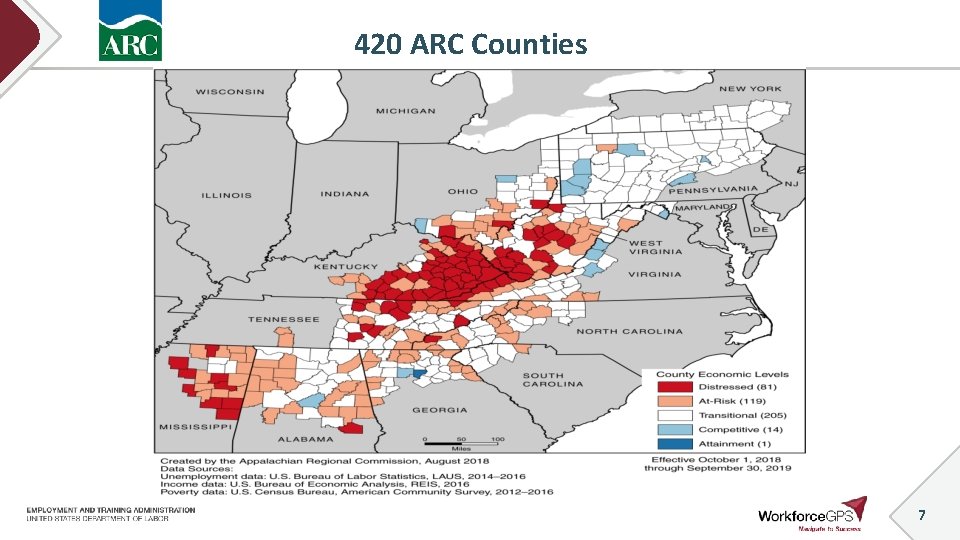
420 ARC Counties 7
Delta Regional Authority (DRA) The Delta Regional Authority (DRA) is a regional economic development agency that represents a partnership of federal, state, and local government. Established by an act of Congress in 2000, DRA is composed of the governors of the 8 Delta states and a federal co-chair, who is appointed by the president. Local participation is provided through multi-county local development districts. DRA invests in activities that address the three goals identified in the strategic plan: Goal 1: Improved Workforce Competitiveness Advance the productivity and economic competitiveness of the Delta workforce. Goal 2: Strengthened Infrastructure Strengthen the Delta’s physical, digital, and capital connections to the global economy. Goal 3: Increased Community Capacity Facilitate local capacity building within Delta communities, organizations, businesses, and individuals. 8
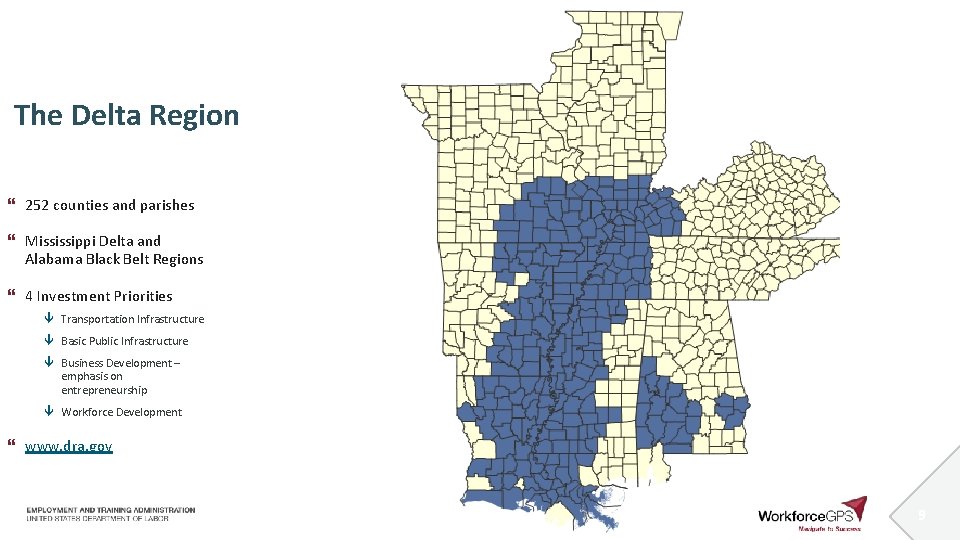
The Delta Region 252 counties and parishes Mississippi Delta and Alabama Black Belt Regions 4 Investment Priorities Transportation Infrastructure Basic Public Infrastructure Business Development – emphasis on entrepreneurship Workforce Development www. dra. gov 9
What is the WORC Initiative? Workforce Opportunity for Rural Communities Initiative WORC is a partnership between the Employment & Training Administration (ETA), the Appalachian Regional Commission (ARC) and the Delta Regional Authority (DRA) Grant awards for eligible entities serving participants who live and work in the Appalachian and Delta regions 10
What is the WORC Initiative? This is the 2 nd round of the WORC Initiative The 2019 the Department of Defense and Labor, Health and Human Services and Education Appropriations Act 2019 and the Continuing Appropriations Act 2019 reserved funding to promote economic recovery across the Appalachian and Delta regions These regions have been particularly hard hit by industrial downsizing and closures, and this funding is designed to target these areas The WORC grants therefore are designed to address the workforce and economic development challenges facing communities in these regions 11
What is the Goal of the WORC Initiative? The goal of this grant opportunity is to create economic prosperity and gainful employment opportunities for eligible residents in impacted ARC and DRA regions, enabling them to remain and thrive in these communities. Successful applicants must demonstrate coordinated economic development and workforce strategies in the ARC and DRA regions and help the regions achieve long-term economic success. 12
Grant Objectives Implement innovative, sustainable service delivery strategies to address economic and workforce-related impacts Provide or facilitate the provision of new or enhanced training, job placement and support activities to the following eligible participants including those affected by substance use disorder (e. g. , opioids, stimulants, cocaine, and other substances), who reside in ARC and DRA regions Align and integrate workforce development activities with existing state, regional, or community economic development strategies Develop and expand partnerships, including industry partnerships that build and sustain capacity, maximize available resources, and establish community-based approaches for addressing workforce challenges and industry needs; and, Provide or facilitate delivery of support services to assist employers and industry in meeting workforce challenges and industry needs 13
FOA Overview Eligibility, Grant Activities, Alignment and Impact, Addressing SUD, and Role of Employers 14
Eligibility: Applicants Wide range of entities eligible to apply, as described in the FOA However, regardless of type of organization, or where an organization is located, services MUST be delivered only to eligible participants who live and work in the Appalachian or Delta regions 15
Eligibility: Participants Three types of eligible participants Dislocated workers (as defined in WIOA sec 3(15)) Incumbent workers (individuals who are currently working) New entrants to the workforce We define new entrants as those who have never worked before or who have been out of the workforce for a long enough time to make it as if they are entering the workforce for the first time But applicants have some discretion on determining eligibility for new entrants as appropriate 16
Additional Considerations: Eligibility Applicants are encouraged to develop plans to serve individuals who reside in economically distressed counties and parishes In addition, applicants are encouraged to serve individuals affected by substance use disorder 17
Strategic Alignment & Grant Impact Applicants must ensure that planned activities will achieve outcomes that are aligned with existing local or regional economic development and other strategic plans Applicants must also demonstrate that their plan aligns with at least one element of the relevant ARC or DRA state plan Applicants must demonstrate that their plan aligns with the relevant WIOA State Plan And applicants must demonstrate that their plan specifically addresses the current or future workforce needs of at least two local employers You will be expected to demonstrate how your project will achieve positive outcomes in the short- and medium terms But most importantly you will be expected to demonstrate long-term economic and workforce benefits to the communities served in the grant 18
What does “alignment” with economic development mean? As mentioned, a key element of the WORC Initiative is the alignment of proposed activities with existing plans We expect that these grants will help economic transformation that is sustainable and leads to opportunity for workers and businesses You will be expected to present a coherent strategy that aligns the strategies proposed with existing, demonstrated needs of employers and with the broader economic development strategies in the community We encourage applicants to truly embed this alignment into their applications, make it fully part of the concept, not simply addressing it in one section 19
Grant Activities These grants are designed to be flexible and promote innovative solutions to specific challenges Allowable activities in the following categories Delivering training or other workforce-related services Developing other “Innovative” approaches to meet specific challenges Providing a wide range of support services to participants Serving and Partnering with Employers Equipment Purchase and Facility Renovations 20
Addressing SUD Impacts Applicants proposing to specifically address the workforce impacts of substance use disorder are encouraged to consider the following when framing the project: Projects that address the substance misuse crisis should focus on creating a recovery ecosystem that will lead to workforce re-entry The recovery ecosystem is a complex linkage of multiple sectors designed to help individuals in recovery access the support services and training they need to maintain recovery and successfully obtain sustainable employment. Initiate or expand programs designed to eliminate or reduce the harm to the workforce and economic growth of the region that results from substance misuse; attract and retain relevant health care services, businesses, and workers. 21
Employers: Demonstrating Need vs Partners Two roles for employers/industry in the WORC grants: 1. Demonstrating Workforce Needs: To ensure that your project is addressing specific workforce needs of local employers, you must include letters attesting to this from TWO employers 2. Employers as Partners in the Grant: Applicants must also demonstrate collaboration with a strong and diverse community-wide coalition that must include engagement with at least two employers/industry partners Employer or industry partnerships increase the likelihood of establishing work-based learning programs and ensure that training and workforce development efforts are relevant to the needs of the employer community. Employers provide valuable insight into the development of innovative training approaches, as well as leadership in aligning/enhancing existing strategic plans for the economic diversification and development of the region or community. 22
Grant Performance 23
Grant Performance Grant proposals must indicate the performance metrics that you will collect and share as part of the project Proposals must demonstrate how these measures are reflective of the project goals and the regional strategy Reporting on the grant will include a quarterly narrative description to provide an update on progress toward grant goals 24
Performance Outcomes Data WORC grants partner with the workforce system to report employment outcomes Grantees will be required to provide state or local workforce agencies with the necessary information to register those participants who receive employment-related services described in section III. C. 4(b) or classroom training These participants can then be registered in the Wagner-Peyser Employment Service where they can access additional services as appropriate ETA will provide further technical assistance post-award on this process 25
Application Requirements Details and Deadlines 26
Application Deadline July 29, 2020, @ 4: 00 p. m. Eastern Time Hardcopy submissions by mail, hand delivery, or overnight delivery WILL NOT BE ACCEPTED 27
Funding Opportunity Announcement – Read Carefully The Funding Opportunity Announcement (FOA) postings: Grants. gov: https: //www. grants. gov/web/grants/view-opportunity. html? oppld=315986 ETA website: https: //www. doleta. gov/grants/find_grants. cfm ARC website: https: //www. arc. gov/index. asp DRA website: https: //dra. gov/. 28
Application Screening Requirements Use the checklist in Section 3. C. 1 of the FOA to ensure your application package is complete: On-time application Applicant eligibility Electronic files are readable/not corrupt Funding requests between $150, 000 and $1. 5 million Current registration with Systems Award Management (SAM) Current Dun and Bradstreet (DUNS) number on the SF-424 29
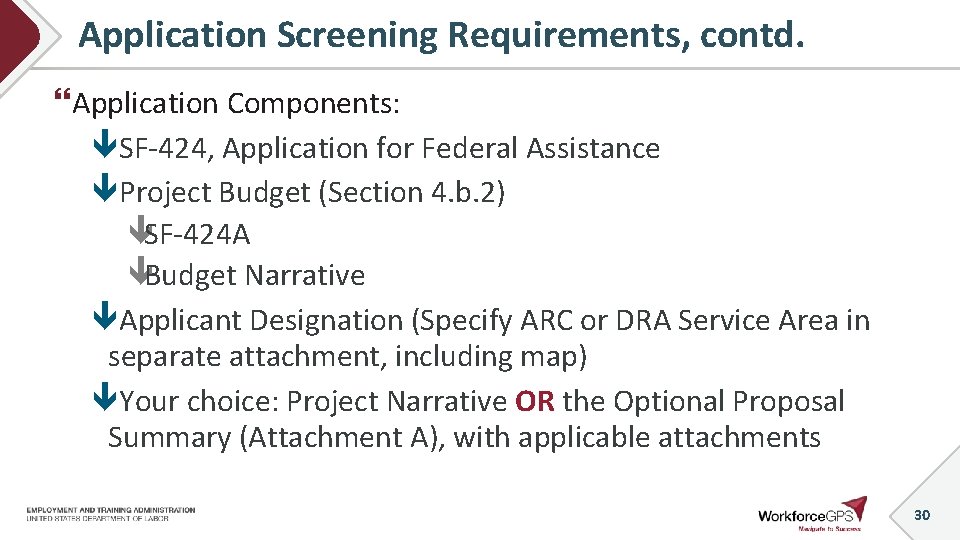
Application Screening Requirements, contd. Application Components: SF-424, Application for Federal Assistance Project Budget (Section 4. b. 2) SF-424 A Budget Narrative Applicant Designation (Specify ARC or DRA Service Area in separate attachment, including map) Your choice: Project Narrative OR the Optional Proposal Summary (Attachment A), with applicable attachments 30
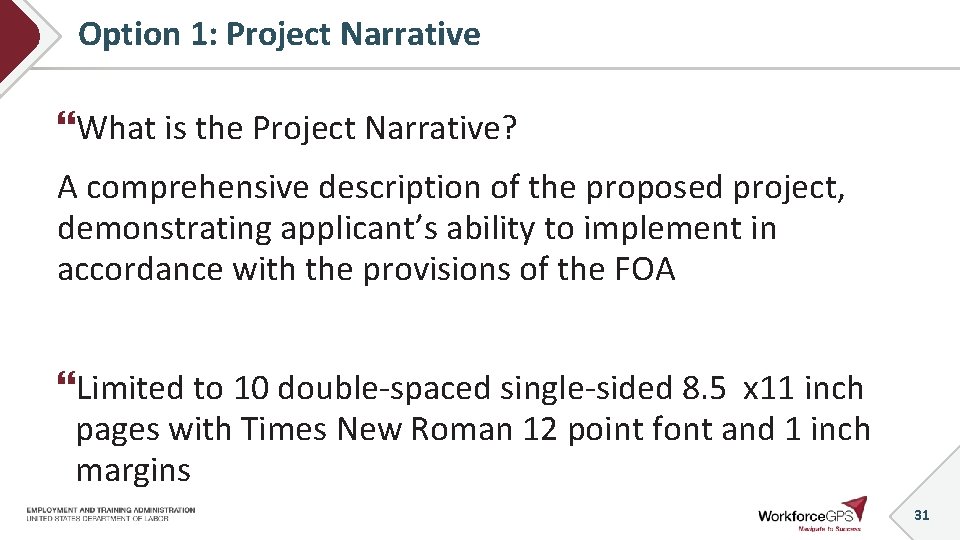
Option 1: Project Narrative What is the Project Narrative? A comprehensive description of the proposed project, demonstrating applicant’s ability to implement in accordance with the provisions of the FOA Limited to 10 double-spaced single-sided 8. 5 x 11 inch pages with Times New Roman 12 point font and 1 inch margins 31
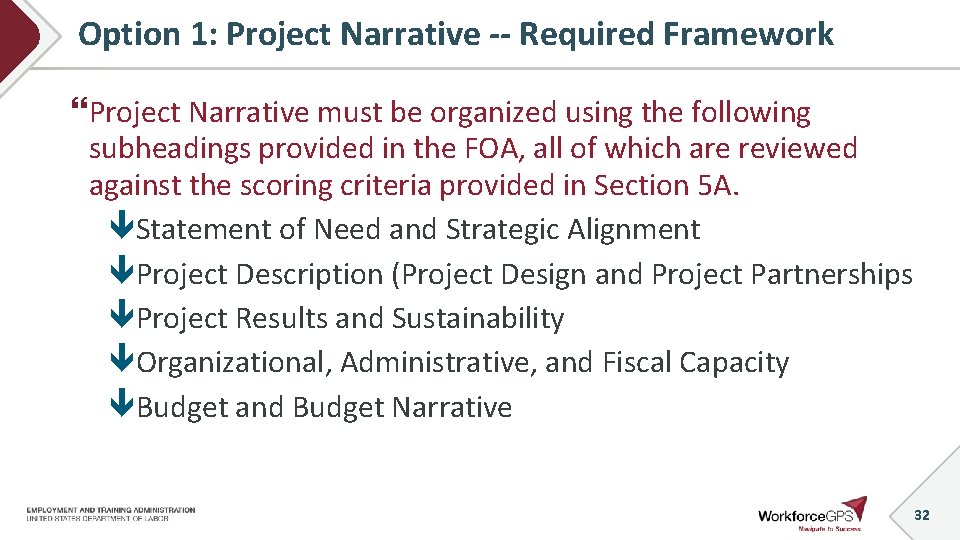
Option 1: Project Narrative -- Required Framework Project Narrative must be organized using the following subheadings provided in the FOA, all of which are reviewed against the scoring criteria provided in Section 5 A. Statement of Need and Strategic Alignment Project Description (Project Design and Project Partnerships Project Results and Sustainability Organizational, Administrative, and Fiscal Capacity Budget and Budget Narrative 32
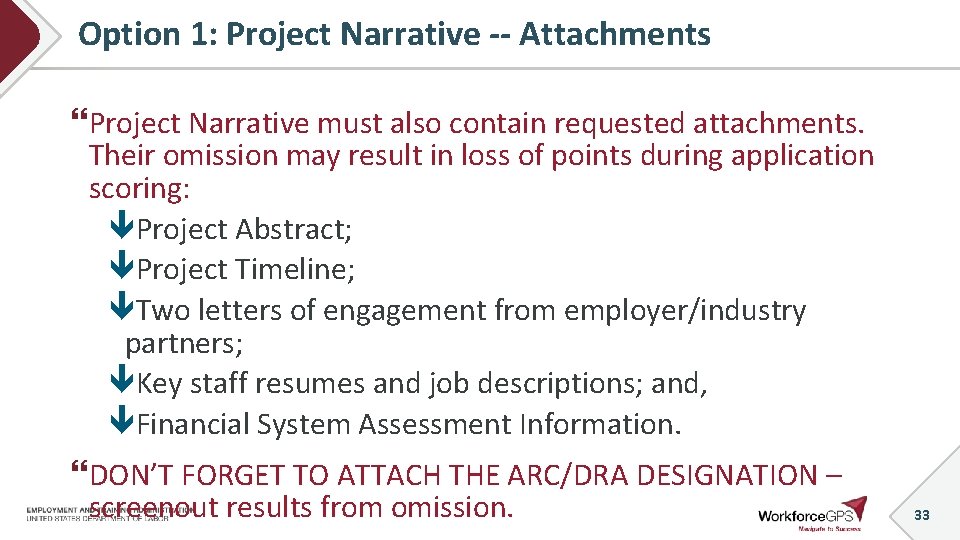
Option 1: Project Narrative -- Attachments Project Narrative must also contain requested attachments. Their omission may result in loss of points during application scoring: Project Abstract; Project Timeline; Two letters of engagement from employer/industry partners; Key staff resumes and job descriptions; and, Financial System Assessment Information. DON’T FORGET TO ATTACH THE ARC/DRA DESIGNATION – screenout results from omission. 33
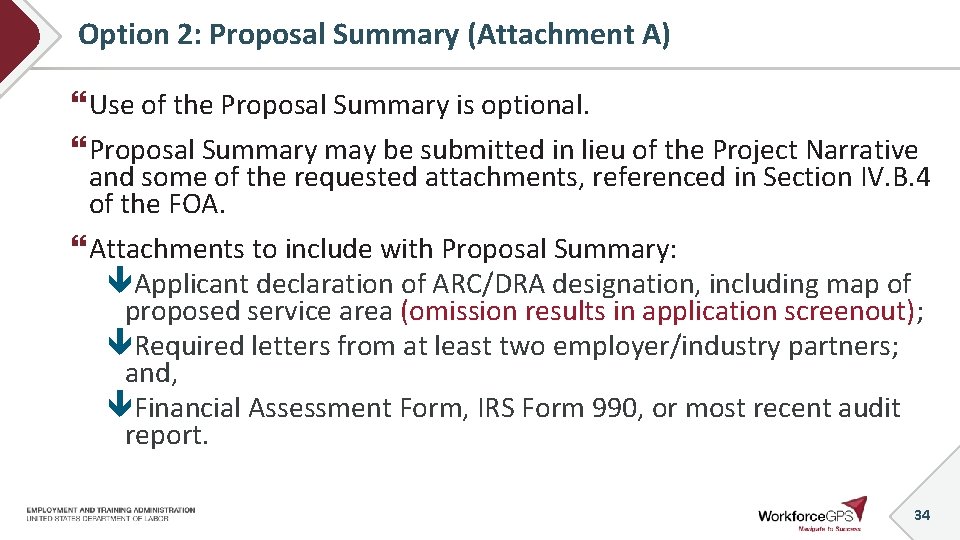
Option 2: Proposal Summary (Attachment A) Use of the Proposal Summary is optional. Proposal Summary may be submitted in lieu of the Project Narrative and some of the requested attachments, referenced in Section IV. B. 4 of the FOA. Attachments to include with Proposal Summary: Applicant declaration of ARC/DRA designation, including map of proposed service area (omission results in application screenout); Required letters from at least two employer/industry partners; and, Financial Assessment Form, IRS Form 990, or most recent audit report. 34
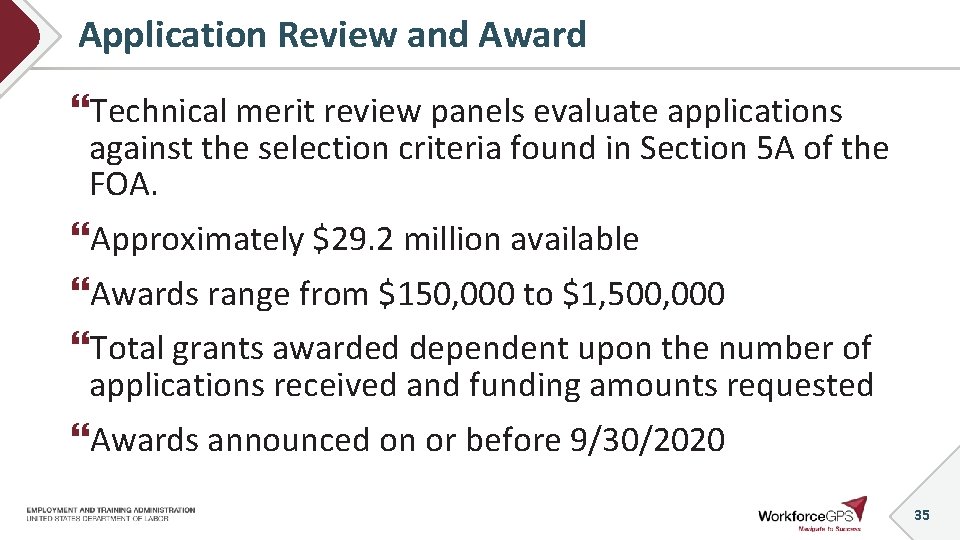
Application Review and Award Technical merit review panels evaluate applications against the selection criteria found in Section 5 A of the FOA. Approximately $29. 2 million available Awards range from $150, 000 to $1, 500, 000 Total grants awarded dependent upon the number of applications received and funding amounts requested Awards announced on or before 9/30/2020 35
Applicant Support If you have questions during the grant writing process, submit them per the FOA to mcenery. jenifer@dol. gov Please note that we can only answer questions related to the application process or to help clarify the requirements of the FOA. Grant staff cannot discuss the content of your application, or provide any other support as you develop the application. 36
Applicant Support & Technical Assistance Events 37
Technical Assistance Workshops ARC and DRA have delivered or are planning virtual technical assistance sessions for potential applicants Information and registration information is available at: ARC: FOA/Application Webinar Series May 28 -June 8: https: //www. arc. gov/news/article. asp? ARTICLE_ID=694 DRA: Recorded Applicant Technical Assistance Sessions: https: //dra. gov/initiatives/strengthening-the-delta-workforce/2020 resources/ 38
Any Questions? Add guidance for how to answer questions here. (If more info is needed as a parenthetical, add here. If not needed, delete this block. ) 39
Thank You! Need help? Email: Support@workforce. GPS. org