
Workforce Innovation and Opportunity Act Adult Eligibility As
Workforce Innovation and Opportunity Act Adult Eligibility As of September 14 th, 2020 1
WIOA Title 1 Authority • Workforce Innovation and Opportunity Act of 2014 • Training and Employment Guidance Letter 19 -16 – Guidance on Services Provided through Adult and Dislocated Worker under WIOA – dated March 1 st, 2017 • WIOA E-Policy Chapter 5 - General Eligibility • WIOA E-Policy Chapter 5. 1. 1 – 1. 1. 4 – Selective Service • WIOA E-Policy Chapter 5. 2 – Adult Eligibility • WIOA E-Policy Chapter 5. 5 - Low-Income Individuals • WIOA E-Policy Chapter 5. 6 – Service Priorities • Commerce Notice NO. 19 -NOT-01, Change 2 – Basic Skills Deficiency 2
General Eligibility and Low Income • Prior to reviewing this presentation on Adult Eligibility, it is important that you view and understand the details that were covered in the 9 -10 -20 presentation on: • WIOA General Eligibility • WIOA Low Income 3
WIOA Adult Eligibility • WIOA E-Policy Chapter 5. 2 – Adult Eligibility – WIOA Legislation requires that an Adult be 18 years of age or older – Be a citizen or noncitizen authorized to work in the US; and – Meet Military Selective Service registration requirements (males only) 4
Changes from WIA to WIOA Adult • There is no longer a sequence of services; a participant may receive services in any order that is deemed appropriate. • Core and Intensive WIA services were combined into “Career Services” under WIOA. • Coordination with outside agencies (WIOA partners) is permitted to provide comprehensive services to participants. 5

WIOA Adult Priority • WIOA Adult clients who meet WIOA Low Income criteria are a priority under WIOA Legislation. • WIOA Adult clients who are determined “Basic Skills Deficient” (BSD) or are considered English Language Learners (ELL) are a priority under WIOA Legislation. • It is important to understand, Low Income, BSD & ELL are equal priorities under the Adult title. 6
Veterans Priority of Service • As was addressed in the WIOA General Eligibility presentation, based on guidance in the Jobs for Veterans Act, a Veteran or Qualified Spouse of a Veteran must receive priority of service over other qualified individuals who are not a Veteran or Qualified Spouse of a Veteran. 7
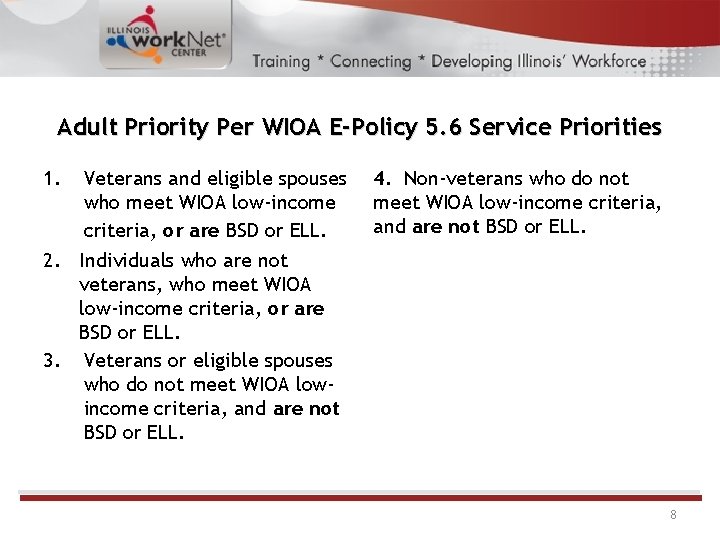
Adult Priority Per WIOA E-Policy 5. 6 Service Priorities 1. Veterans and eligible spouses who meet WIOA low-income criteria, or are BSD or ELL. 2. Individuals who are not veterans, who meet WIOA low-income criteria, or are BSD or ELL. 3. Veterans or eligible spouses who do not meet WIOA lowincome criteria, and are not BSD or ELL. 4. Non-veterans who do not meet WIOA low-income criteria, and are not BSD or ELL. 8

WIOA Low Income • As was addressed in the WIOA Low Income presentation there are eight different ways an Adult client could meet WIOA Low Income criteria. • If a client meets any one of the eight WIOA Low Income criteria, they should receive priority under the WIOA Adult title for the Apprenticeship Expansion program. 9
Basic Skills Deficient • Basic Skills Deficient – respect to an individual— (A) who is a youth, that the individual has English reading, writing, or computing skills at or below the 8 th grade level on a generally accepted standardized test; or (B) who is a youth or adult, that the individual is unable to compute or solve problems, or read, write, or speak English, at a level necessary to function on the job, in the individual’s family, or in society. 10
Basic Skills Deficient (BSD) • If an individual scores at or below 8 th Grade Level on either their Math or Reading Assessment test they would be determined BSD. • In WIOA Notice NO 19 -NOT-01, Change 2 that was released by OET Policy in September 2020, it includes an alternative way an individual can be determined BSD using the Basic Skills Screening Tool (more on this on the next slide). • Lastly, if an individual is assessed as an English Language Learner (ELL), they are also determined to meet BSD criteria. 11
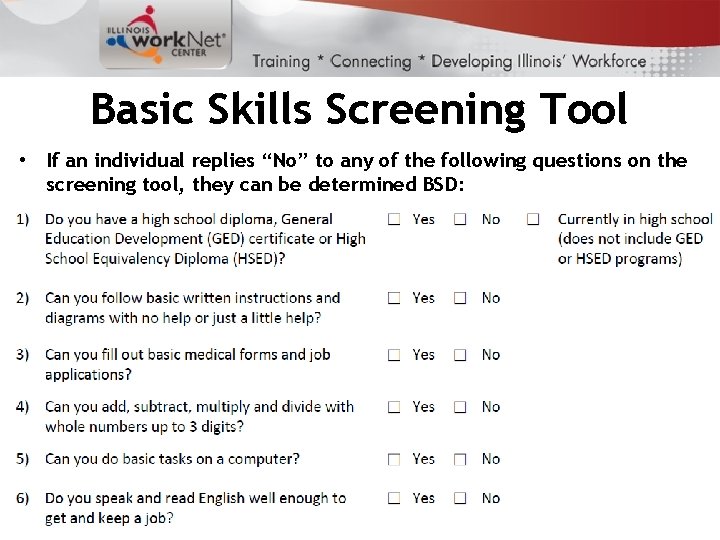
Basic Skills Screening Tool • If an individual replies “No” to any of the following questions on the screening tool, they can be determined BSD: • y of 12
Basic Skills Screening Tool • Within IWDS, on the “Education Status” screen within the application, is where the question has been added when a client is being determined BSD due to the new screening tool. • If any question on the screening tool is answered “No” by the client, then the question related to the BSD screening tool on the “Education Status” screen should be answered “Yes”; (see example on next slide). 13
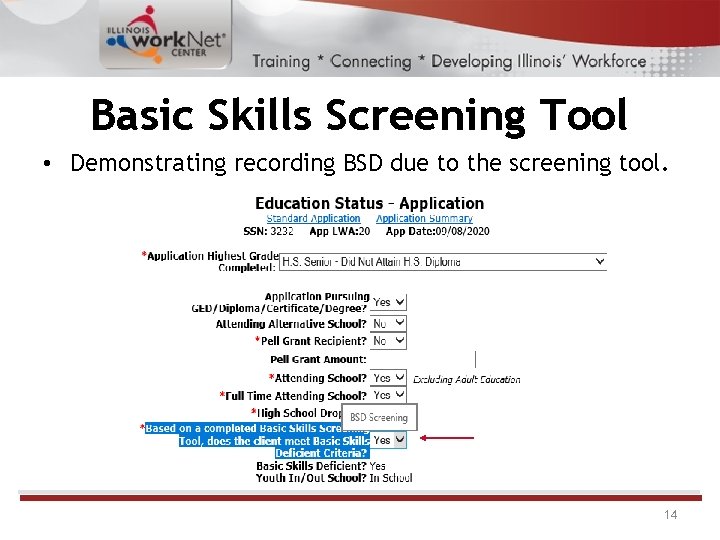
Basic Skills Screening Tool • Demonstrating recording BSD due to the screening tool. 14
English Language Learner • English Language Learner – when used with respect to an eligible individual, means an eligible individual who has limited ability in reading, writing, speaking, or comprehending the English language, and (A) whose native language is a language other than English; or (B) who lives in a family or community environment where a language other than English is the dominant language. 15
English Language Learner • Within IWDS, on the “Characteristics and Barriers” screen within the application, is where the question has been added when a client is being determined an English Language Learner (ELL). • If the question is populated with a “Yes”, the client must pass on a Language of Preference; (see example on next slide). 16
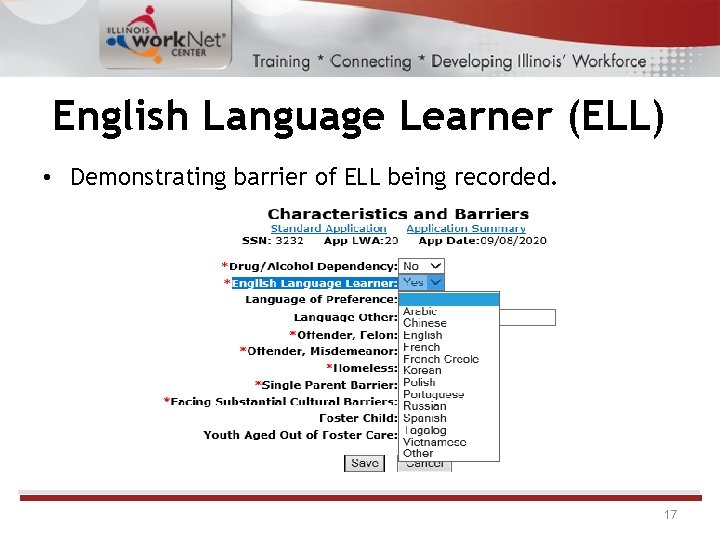
English Language Learner (ELL) • Demonstrating barrier of ELL being recorded. 17
Basic Skills Deficient (BSD) • A key internal logic item in IWDS to understand about BSD from assessment tests: – The assessment test date must be, on or before the application date before the internal logic within IWDS is going to pick up the client as BSD due to the assessment test: • Example, if a client has an application date of 8/1/2020, but was not given the assessment test(s) on a date after the application date, even if the client scores at or below 8 th Grade Level on the assessment test(s), the internal IWDS logic will not determine the client BSD based on a test dated after the application date. 18
Adult Training Services • Prior to certification under “Training Services” an Adult client must have: – Documented Assessment – Individual Employment Plan (IEP) 19
Individual Employment Plan (IEP) • IEP - A plan developed by the participant and the career planner to identify the participant's employment goal, the appropriate achievement objectives, and the appropriate combination of services for the participant to achieve the employment goal, including providing information on eligible providers of training services and career pathways to attain career objectives. 20
Adult Training Services • The “Assessment” and “IEP” could be completed by either the LWIA staff (Career Planner); WIOA Core partner staff (Adult Ed. , Wagner Peysner, Vocational Rehab, TANF staff); Training Provider or staff from some other agency. – Most often the assessment and IEP will be completed by the WIOA Adult Career Planner at the LWIA. 21
Co-Enrolled Adult • WIOA Adult client who meets the priority of services – Low Income and/or Basic Skills Deficient can be co-enrolled with age appropriate Youth and IF qualified, a Dislocated Worker title to break up funding of services: – If this is done, the client cannot exit from one title until services from all titles are completed. – If this is done, the client would fall into performance outcomes for each title that the client is registered. 22
WIOA Adult Eligibility • To recap, for overall WIOA Adult Eligibility a client must be 18 years of age or older, be legally authorized to work in the U. S. and if born a male, who was born on or after 1/1/1960, must be compliant with Selective Service requirements. 23
Adult Eligibility and Priorities • However, it is important that the priorities laid out in the OET WIOA Priorities Policy is followed, meaning: – Veterans Priority of Service must be followed. – Any qualified Adult who meets WIOA Low Income criteria (please separate power point on WIOA Low Income) or is Basic Skills Deficient or is considered an English Language Learner must be served priority to eligible Adults who do not meet the priorities laid out. 24
WIOA Adult Eligibility • This concludes the presentation on WIOA Adult Eligibility. • If you have any questions feel free to contact me at james. potts@Illinois. gov or you can call me at (217) 416 -7097. 25
- Slides: 25