
Workforce Development System Joint Legislative Audit and Review


- Slides: 25
Workforce Development System Joint Legislative Audit and Review Committee September 9, 2015 Carolyn Cato, Senior Performance Auditor William Clark, Performance Auditor
Audit objectives What are Washington’s workforce development programs? How are they funded and administered? Is there overlap, duplication or fragmentation within the workforce development system? Washington State Auditor’s Office 2
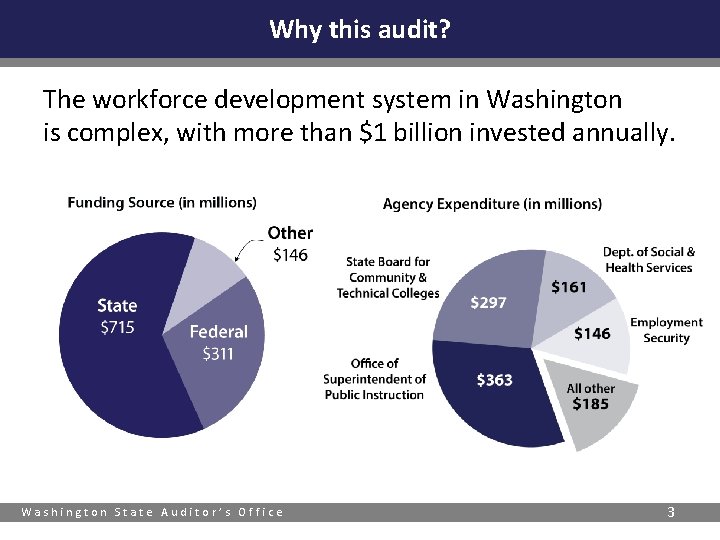
Why this audit? The workforce development system in Washington is complex, with more than $1 billion invested annually. Washington State Auditor’s Office 3
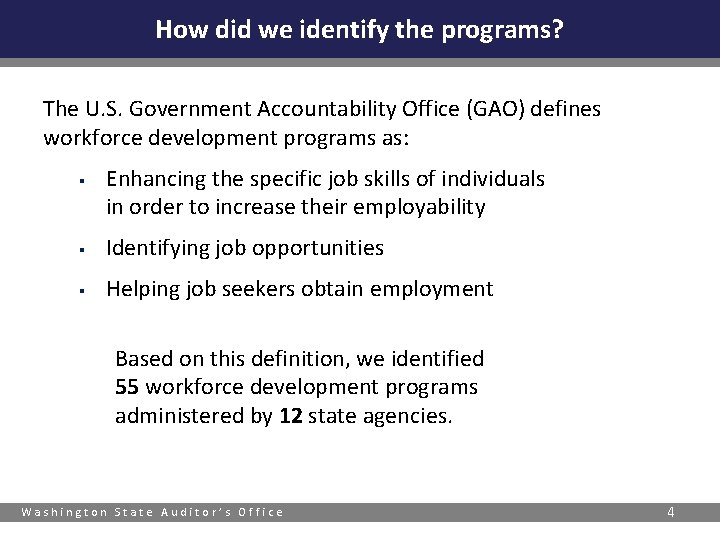
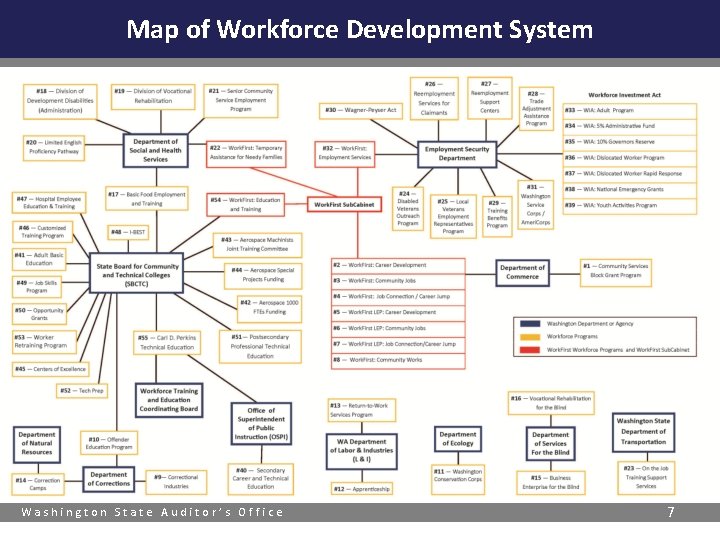
How did we identify the programs? The U. S. Government Accountability Office (GAO) defines workforce development programs as: § Enhancing the specific job skills of individuals in order to increase their employability § Identifying job opportunities § Helping job seekers obtain employment Based on this definition, we identified 55 workforce development programs administered by 12 state agencies. Washington State Auditor’s Office 4
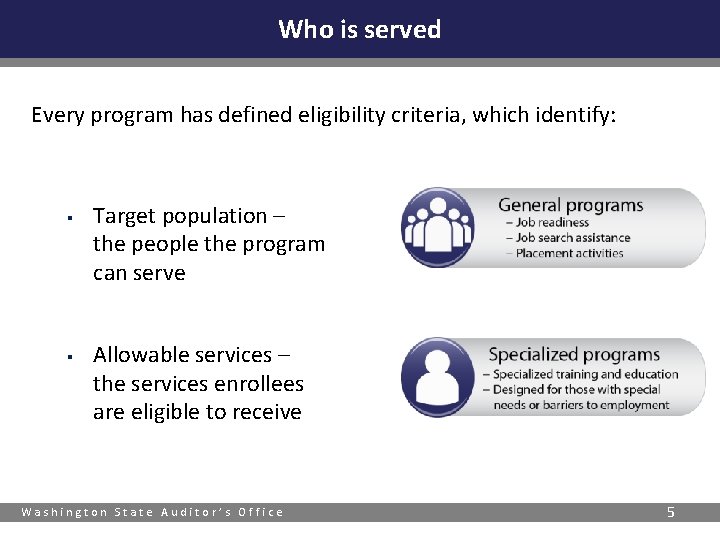
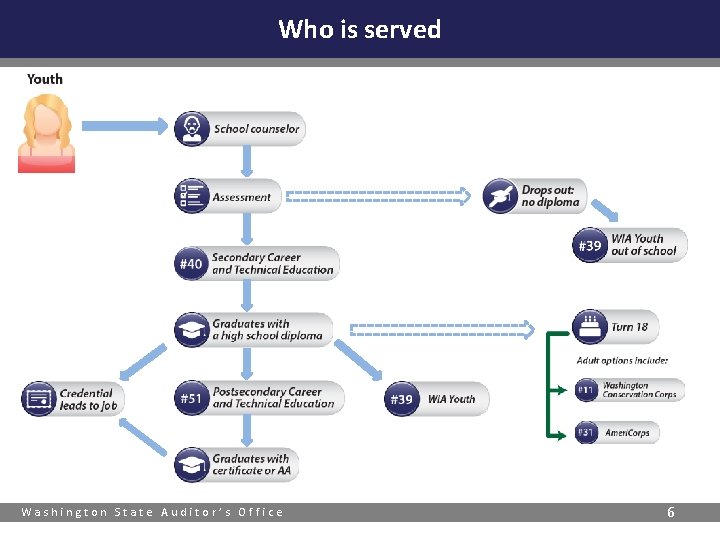
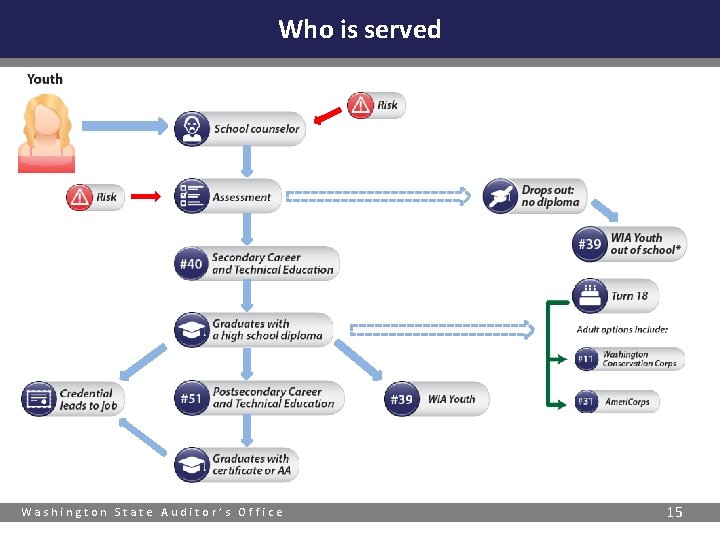
Who is served Every program has defined eligibility criteria, which identify: § § Target population – the people the program can serve Allowable services – the services enrollees are eligible to receive Washington State Auditor’s Office 5
Who is served Washington State Auditor’s Office 6
Map of Workforce Development System Washington State Auditor’s Office 7
How is the system organized? The federal Workforce Investment Act (WIA) established the nation’s current workforce development system infrastructure. Three main tenets of WIA: § Local control § The one-stop service delivery model § Business involvement Washington State Auditor’s Office 8
How is the system organized? Strong local partnerships are critical between: § State agencies § Workforce Development Councils (WDCs) § Community and technical colleges § School districts § Community-based organizations Their goal: develop a skilled workforce able to meet the diverse needs of business and industry in Washington State Auditor’s Office 9
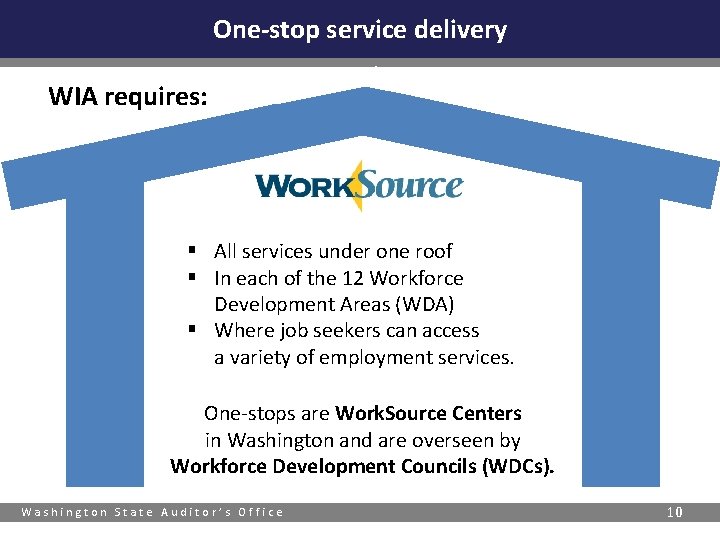
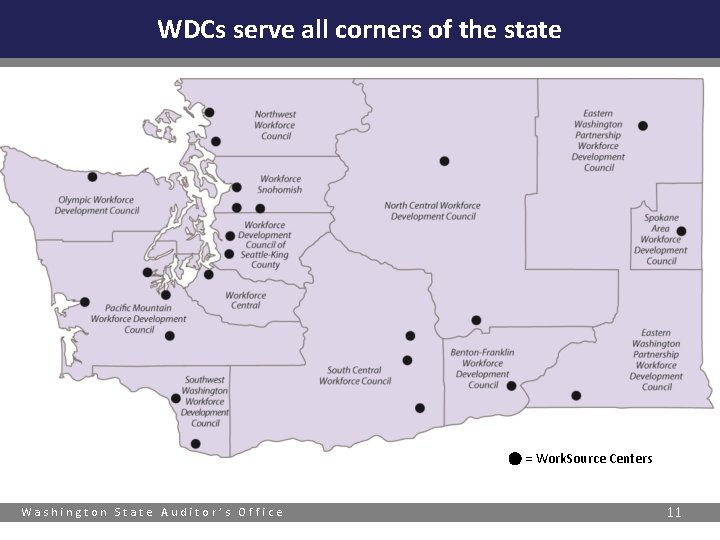
One-stop service delivery WIA requires: § All services under one roof § In each of the 12 Workforce Development Areas (WDA) § Where job seekers can access a variety of employment services. One-stops are Work. Source Centers in Washington and are overseen by Workforce Development Councils (WDCs). Washington State Auditor’s Office 10
WDCs serve all corners of the state = Work. Source Centers Washington State Auditor’s Office 11
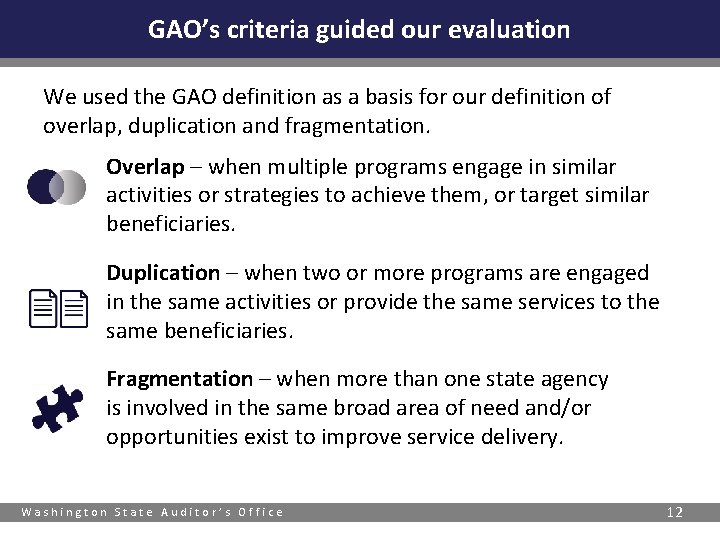
GAO’s criteria guided our evaluation We used the GAO definition as a basis for our definition of overlap, duplication and fragmentation. Overlap – when multiple programs engage in similar activities or strategies to achieve them, or target similar beneficiaries. Duplication – when two or more programs are engaged in the same activities or provide the same services to the same beneficiaries. Fragmentation – when more than one state agency is involved in the same broad area of need and/or opportunities exist to improve service delivery. Washington State Auditor’s Office 12
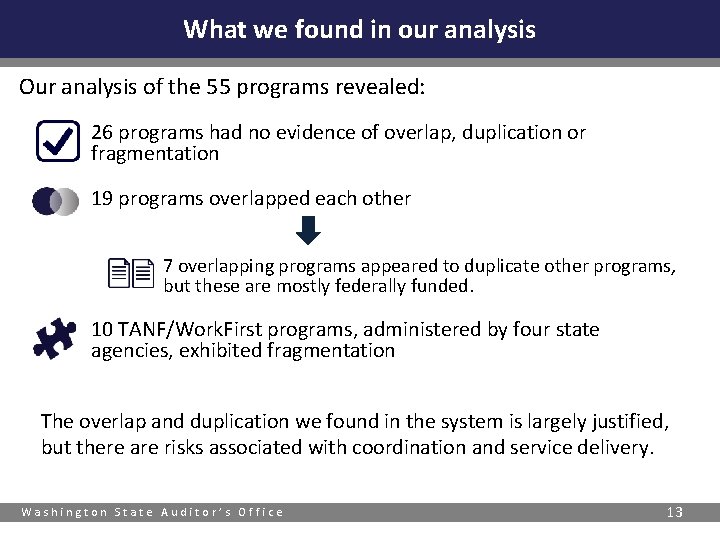
What we found in our analysis Our analysis of the 55 programs revealed: 26 programs had no evidence of overlap, duplication or fragmentation 19 programs overlapped each other 7 overlapping programs appeared to duplicate other programs, but these are mostly federally funded. 10 TANF/Work. First programs, administered by four state agencies, exhibited fragmentation The overlap and duplication we found in the system is largely justified, but there are risks associated with coordination and service delivery. Washington State Auditor’s Office 13
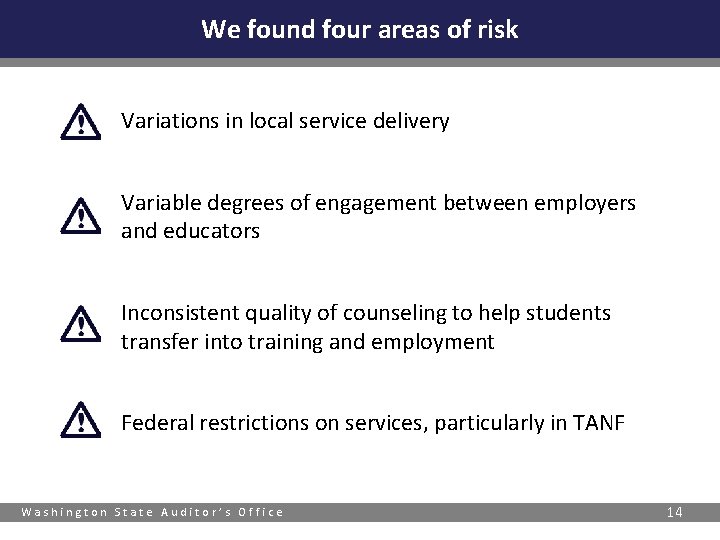
We found four areas of risk Variations in local service delivery Variable degrees of engagement between employers and educators Inconsistent quality of counseling to help students transfer into training and employment Federal restrictions on services, particularly in TANF Washington State Auditor’s Office 14
Who is served Washington State Auditor’s Office 15
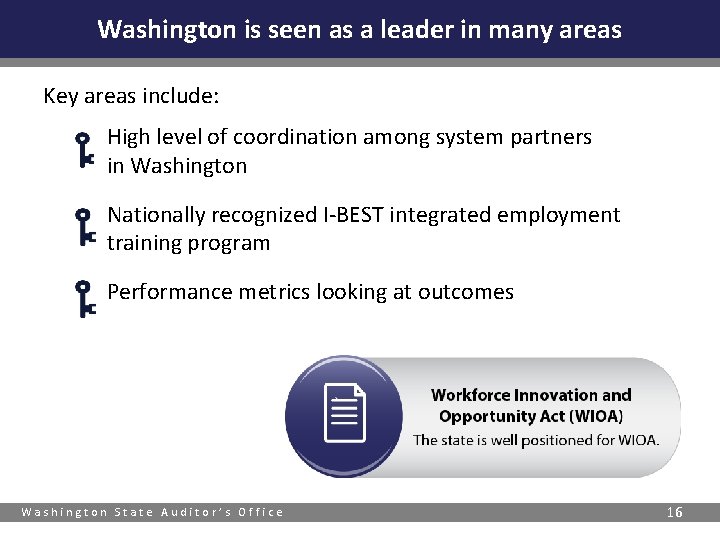
Washington is seen as a leader in many areas Key areas include: High level of coordination among system partners in Washington Nationally recognized I-BEST integrated employment training program Performance metrics looking at outcomes Washington State Auditor’s Office 16
WIA and WIOA share many components The basic structure of WIA is maintained under WIOA § Core programs (adults, youth, dislocated workers, Wagner-Peyser employment services, Basic Education for Adults and vocational rehabilitation) § Leadership roles of the Governor and the Workforce Investment Board § Importance of local control by WDCs Washington State Auditor’s Office 17
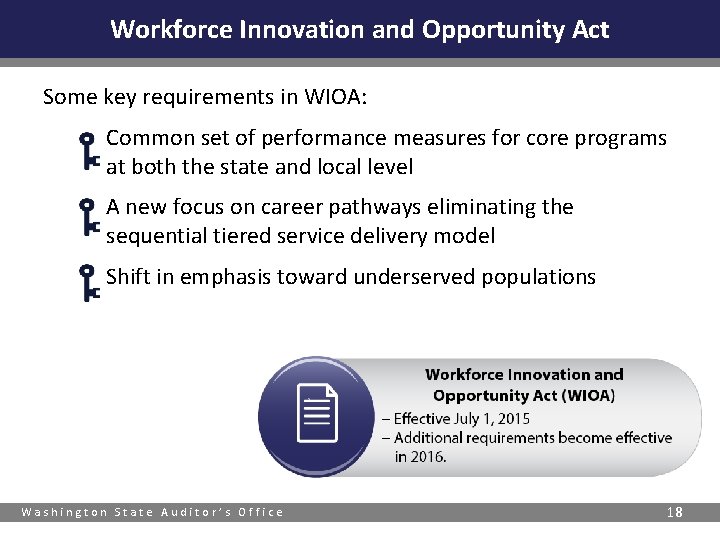
Workforce Innovation and Opportunity Act Some key requirements in WIOA: Common set of performance measures for core programs at both the state and local level A new focus on career pathways eliminating the sequential tiered service delivery model Shift in emphasis toward underserved populations Washington State Auditor’s Office 18
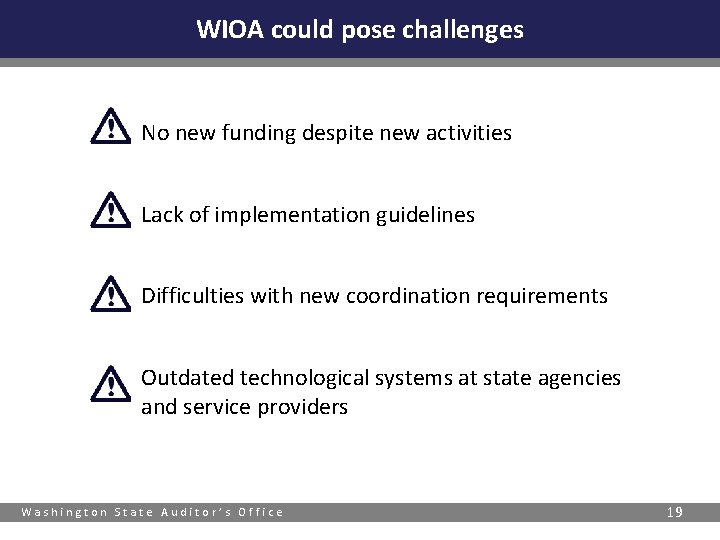
WIOA could pose challenges ü No new funding despite new activities ü Lack of implementation guidelines ü Difficulties with new coordination requirements ü Outdated technological systems at state agencies and service providers Washington State Auditor’s Office 19
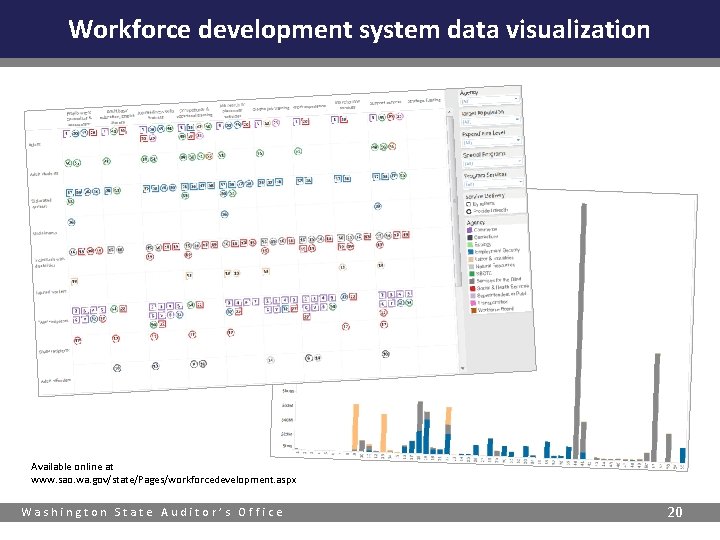
Workforce development system data visualization Available online at www. sao. wa. gov/state/Pages/workforcedevelopment. aspx Washington State Auditor’s Office 20
Next steps We did not make any specific recommendations, but… Future audits will look at risky areas identified in the workforce development system in more depth. We are conducting additional research to finalize the topic for the second workforce development audit. Washington State Auditor’s Office 21
Contacts Jan M. Jutte, CPA, CGFM Acting State Auditor (360) 902 -0363 Auditor@sao. wa. gov Chuck Pfeil, CPA Director of Performance Audit (360) 902 -0366 Chuck. Pfeil@sao. wa. gov Carolyn Cato Senior Performance Auditor (360) 725 -5551 Carolyn. Cato@sao. wa. gov William Clark Performance Auditor (360) 725 -5632 William. Clark@sao. wa. gov Website: www. sao. wa. gov Washington State Auditor’s Office 22
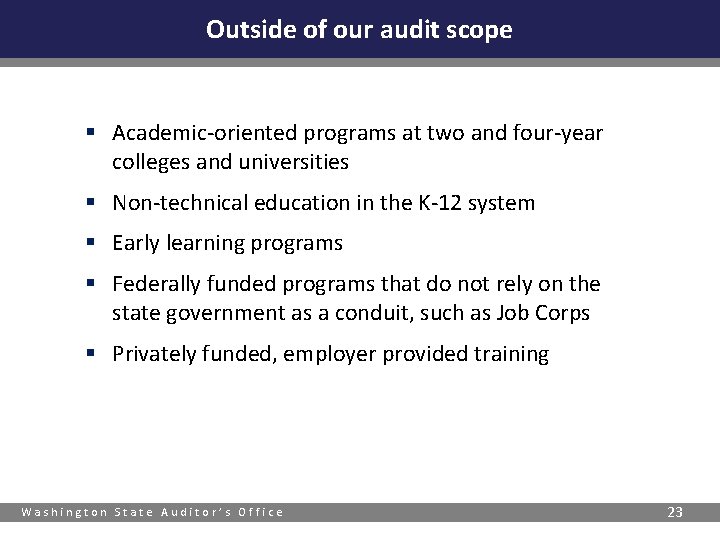
Outside of our audit scope § Academic-oriented programs at two and four-year colleges and universities § Non-technical education in the K-12 system § Early learning programs § Federally funded programs that do not rely on the state government as a conduit, such as Job Corps § Privately funded, employer provided training Washington State Auditor’s Office 23
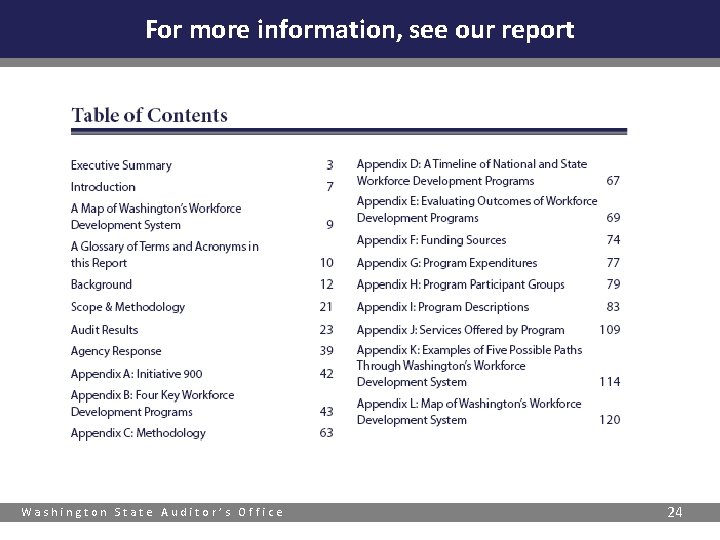
For more information, see our report Washington State Auditor’s Office 24
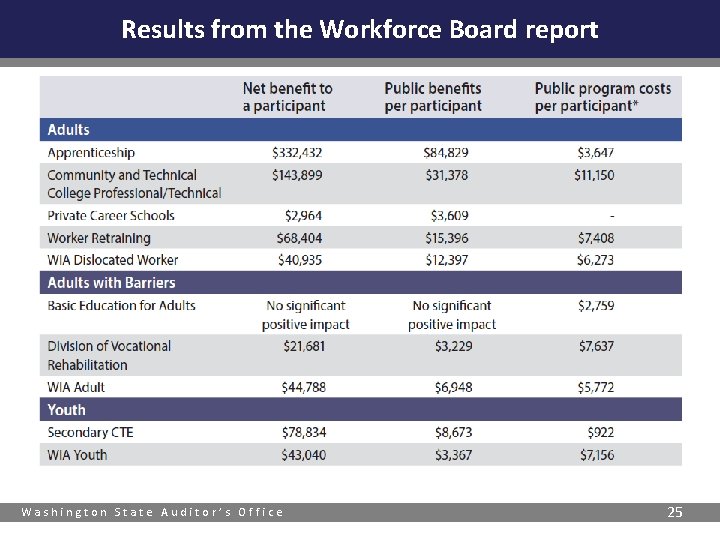
Results from the Workforce Board report § Table from WFD Washington State Auditor’s Office 25