
Workforce Development A Critical Component of Economic Growth
- Slides: 22
Workforce Development: A Critical Component of Economic Growth Strategies Sharon Sewell Vice President Workforce Services Wadley-Donovan Growth. Tech, LLC
AGENDA ● ● ● ● WDG Overview Current Workforce Situation Public Workforce System (WIBs) The Recovery Act (ARRA) Aligning Workforce & Economic Development Action Steps/Recommendations Questions?
Wadley-Donovan Growth. Tech, LLC (WDG) ● 34 year old consulting company ● Specializes in workforce and economic development consulting ● Sister firm Wadley-Donovan-Gutshaw is a leader in corporate relocation consulting WDG MISSION ● To enhance the well-being and communities and their residents through creation and delivery of innovative solutions ● Connecting the silos (Workforce, Economic Development, Education)
Need for Workforce Development Critical ● Growing need for a skilled workforce (knowledge workers) ● Education & Training critical for economic recovery, growth and global competition ● Key to filling labor force gaps
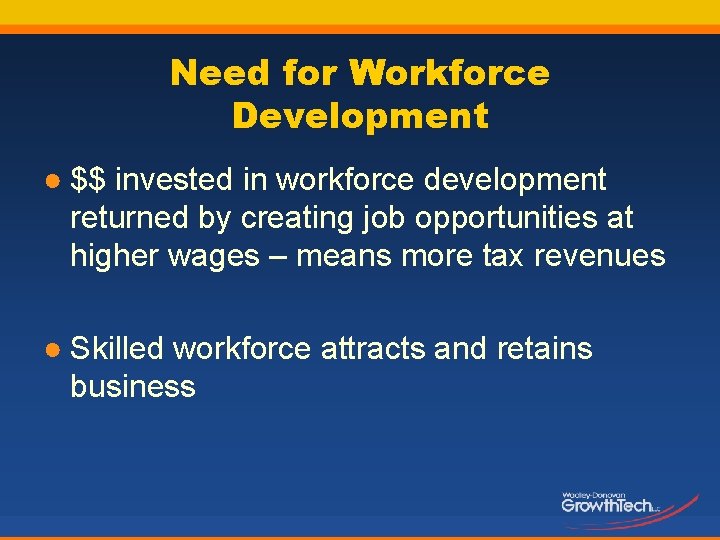
Need for Workforce Development ● $$ invested in workforce development returned by creating job opportunities at higher wages – means more tax revenues ● Skilled workforce attracts and retains business
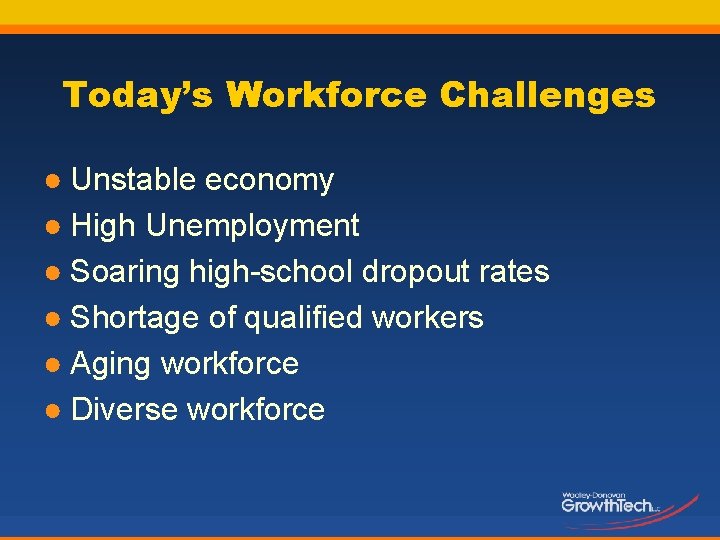
Today’s Workforce Challenges ● Unstable economy ● High Unemployment ● Soaring high-school dropout rates ● Shortage of qualified workers ● Aging workforce ● Diverse workforce
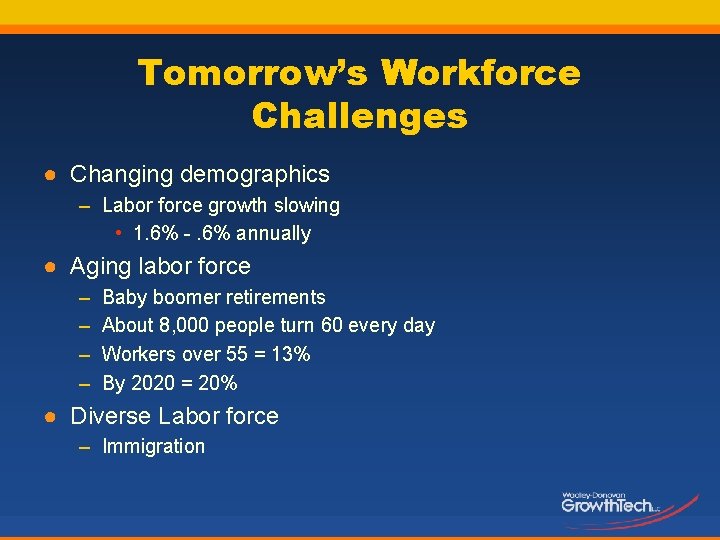
Tomorrow’s Workforce Challenges ● Changing demographics – Labor force growth slowing • 1. 6% -. 6% annually ● Aging labor force – – Baby boomer retirements About 8, 000 people turn 60 every day Workers over 55 = 13% By 2020 = 20% ● Diverse Labor force – Immigration
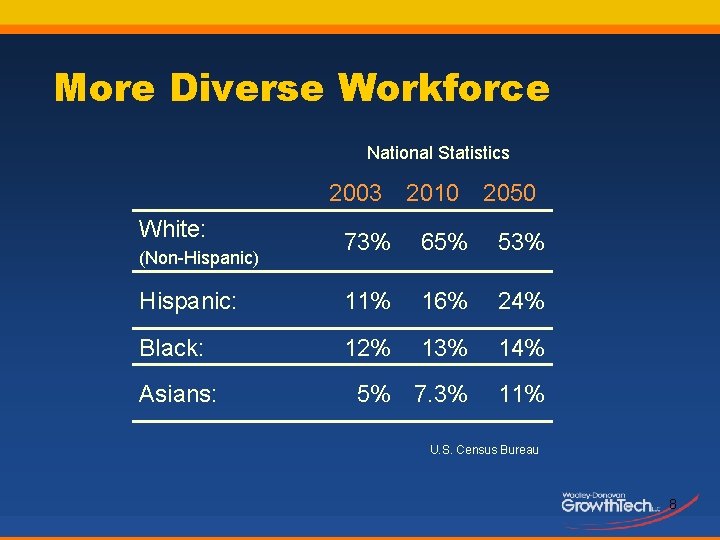
More Diverse Workforce National Statistics 2003 2010 2050 White: 73% 65% 53% Hispanic: 11% 16% 24% Black: 12% 13% 14% 5% 7. 3% 11% (Non-Hispanic) Asians: U. S. Census Bureau 8
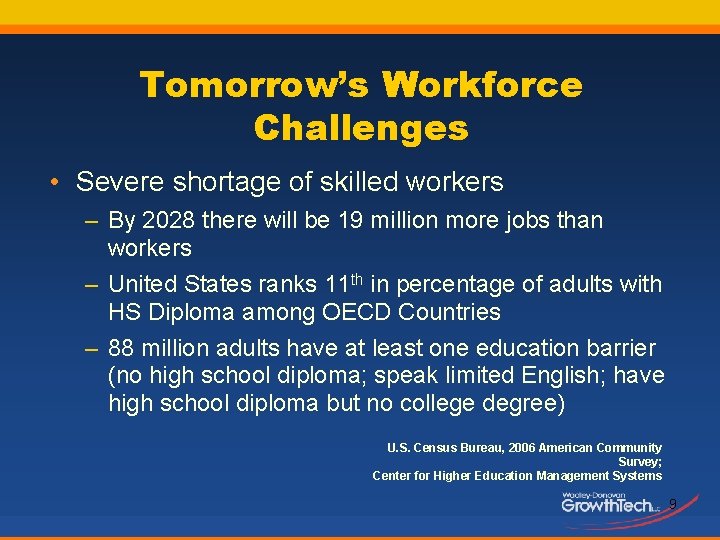
Tomorrow’s Workforce Challenges • Severe shortage of skilled workers – By 2028 there will be 19 million more jobs than workers – United States ranks 11 th in percentage of adults with HS Diploma among OECD Countries – 88 million adults have at least one education barrier (no high school diploma; speak limited English; have high school diploma but no college degree) U. S. Census Bureau, 2006 American Community Survey; Center for Higher Education Management Systems 9
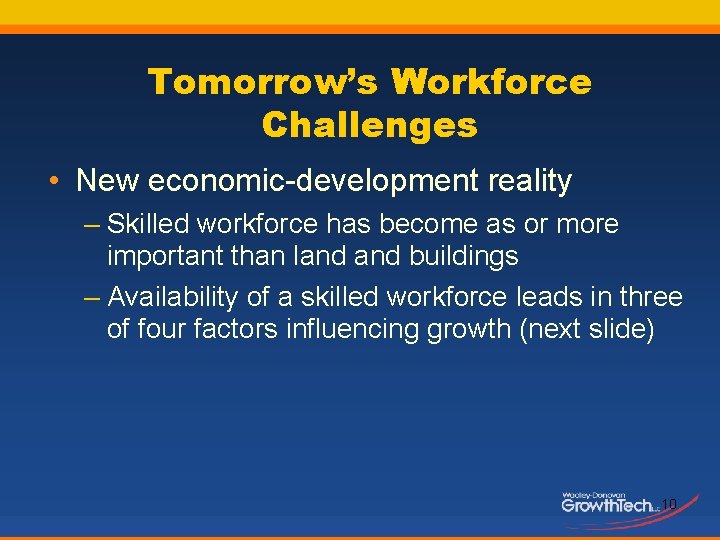
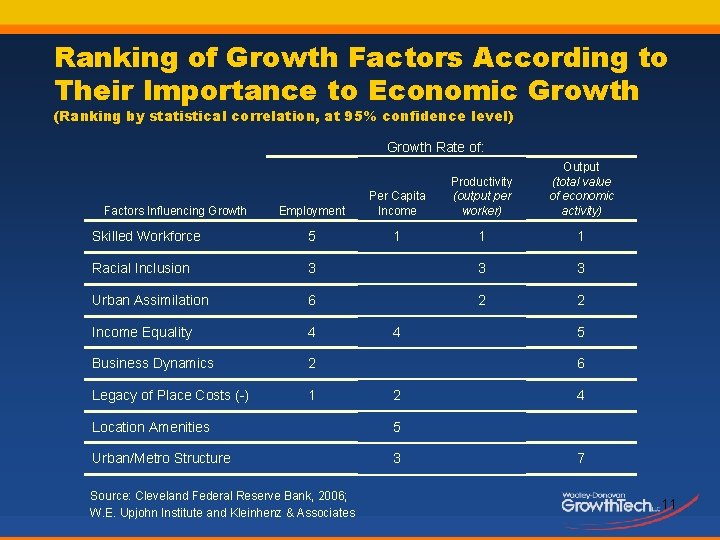
Tomorrow’s Workforce Challenges • New economic-development reality – Skilled workforce has become as or more important than land buildings – Availability of a skilled workforce leads in three of four factors influencing growth (next slide) 10
Ranking of Growth Factors According to Their Importance to Economic Growth (Ranking by statistical correlation, at 95% confidence level) Growth Rate of: Output (total value of economic activity) Employment Per Capita Income Productivity (output per worker) Skilled Workforce 5 1 1 1 Racial Inclusion 3 3 3 Urban Assimilation 6 2 2 Income Equality 4 Business Dynamics 2 Legacy of Place Costs (-) 1 Factors Influencing Growth 4 6 2 Location Amenities 5 Urban/Metro Structure 3 Source: Cleveland Federal Reserve Bank, 2006; W. E. Upjohn Institute and Kleinhenz & Associates 5 4 7 11
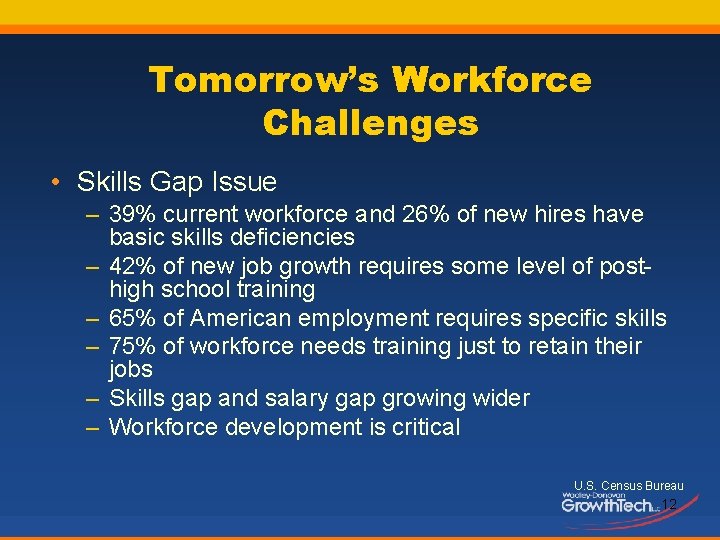
Tomorrow’s Workforce Challenges • Skills Gap Issue – 39% current workforce and 26% of new hires have basic skills deficiencies – 42% of new job growth requires some level of posthigh school training – 65% of American employment requires specific skills – 75% of workforce needs training just to retain their jobs – Skills gap and salary gap growing wider – Workforce development is critical U. S. Census Bureau 12
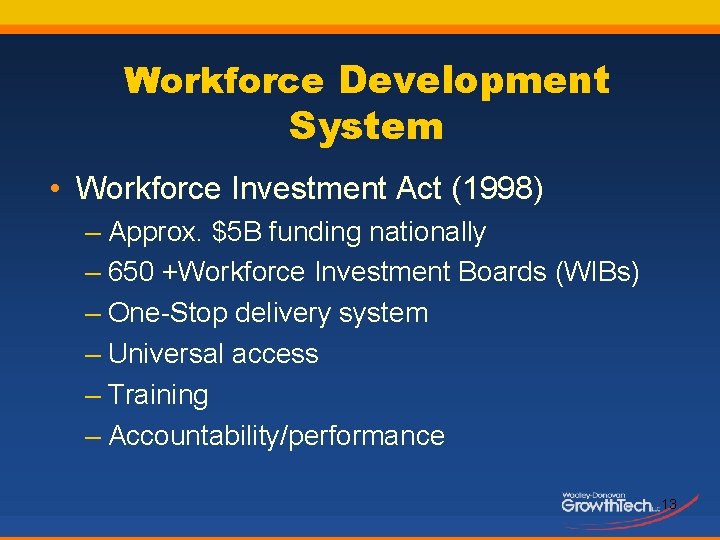
Workforce Development System • Workforce Investment Act (1998) – Approx. $5 B funding nationally – 650 +Workforce Investment Boards (WIBs) – One-Stop delivery system – Universal access – Training – Accountability/performance 13
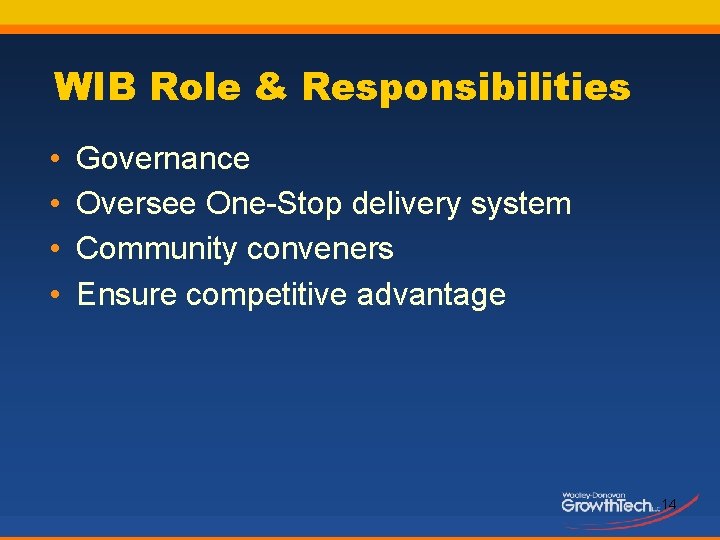
WIB Role & Responsibilities • • Governance Oversee One-Stop delivery system Community conveners Ensure competitive advantage 14
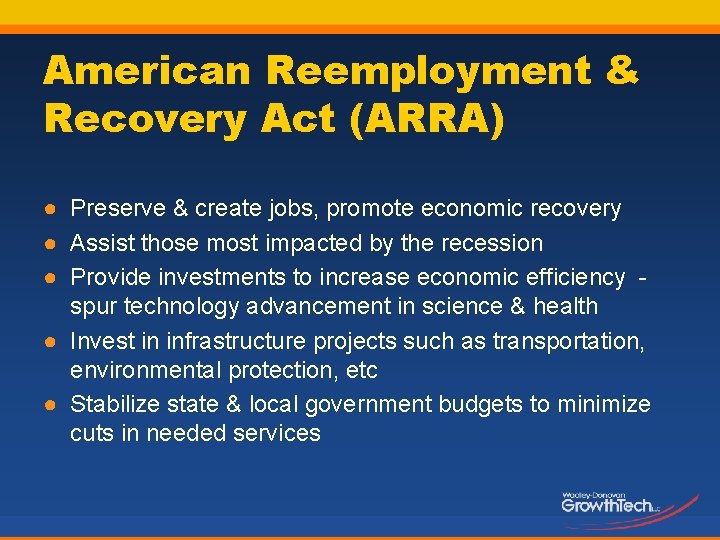
American Reemployment & Recovery Act (ARRA) ● Preserve & create jobs, promote economic recovery ● Assist those most impacted by the recession ● Provide investments to increase economic efficiency spur technology advancement in science & health ● Invest in infrastructure projects such as transportation, environmental protection, etc ● Stabilize state & local government budgets to minimize cuts in needed services
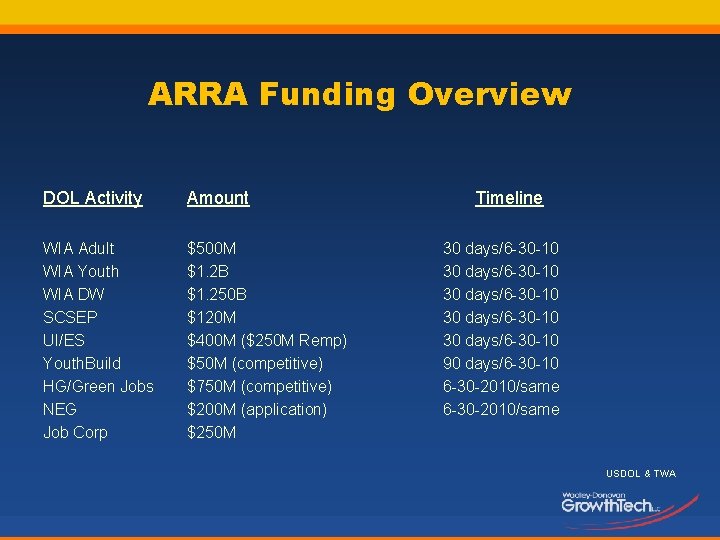
ARRA Funding Overview DOL Activity Amount WIA Adult WIA Youth WIA DW SCSEP UI/ES Youth. Build HG/Green Jobs NEG Job Corp $500 M $1. 2 B $1. 250 B $120 M $400 M ($250 M Remp) $50 M (competitive) $750 M (competitive) $200 M (application) $250 M Timeline 30 days/6 -30 -10 30 days/6 -30 -10 90 days/6 -30 -10 6 -30 -2010/same USDOL & TWA
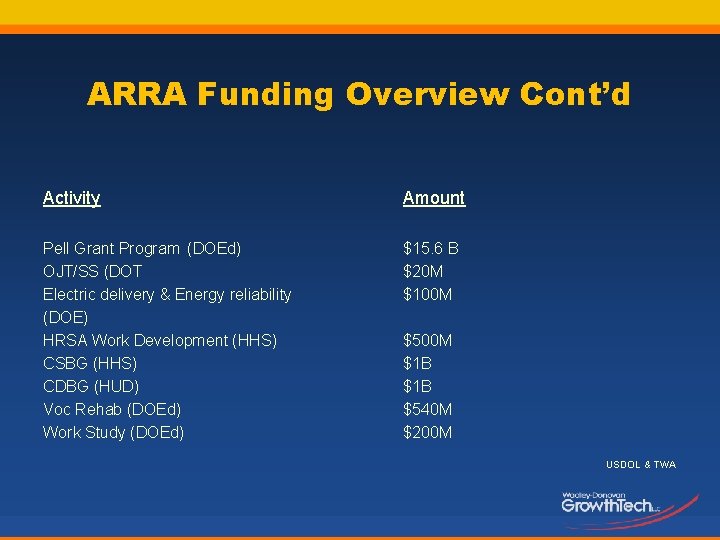
ARRA Funding Overview Cont’d Activity Amount Pell Grant Program (DOEd) OJT/SS (DOT Electric delivery & Energy reliability (DOE) HRSA Work Development (HHS) CSBG (HHS) CDBG (HUD) Voc Rehab (DOEd) Work Study (DOEd) $15. 6 B $20 M $100 M $500 M $1 B $540 M $200 M USDOL & TWA
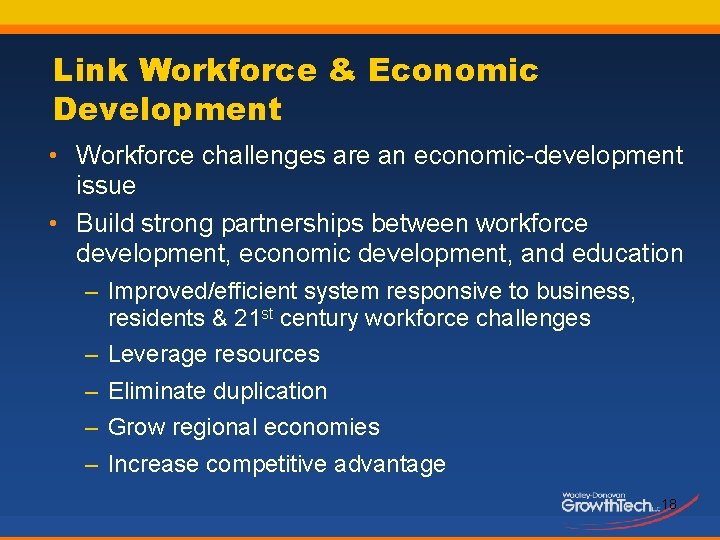
Link Workforce & Economic Development • Workforce challenges are an economic-development issue • Build strong partnerships between workforce development, economic development, and education – Improved/efficient system responsive to business, residents & 21 st century workforce challenges – Leverage resources – Eliminate duplication – Grow regional economies – Increase competitive advantage 18
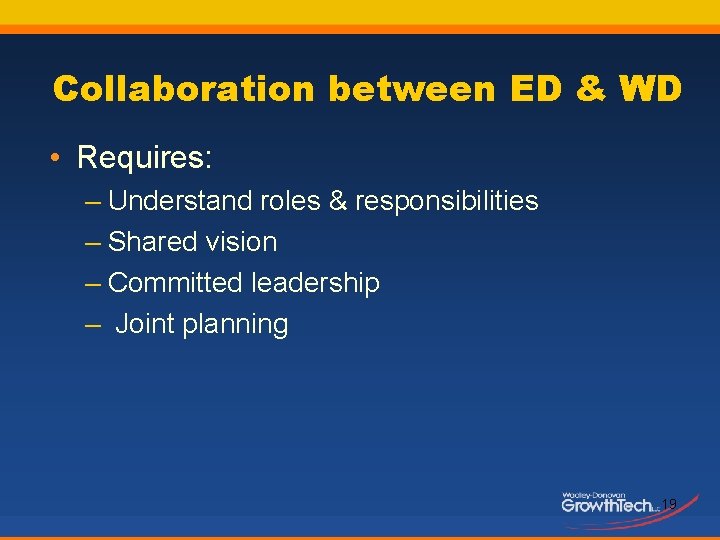
Collaboration between ED & WD • Requires: – Understand roles & responsibilities – Shared vision – Committed leadership – Joint planning 19
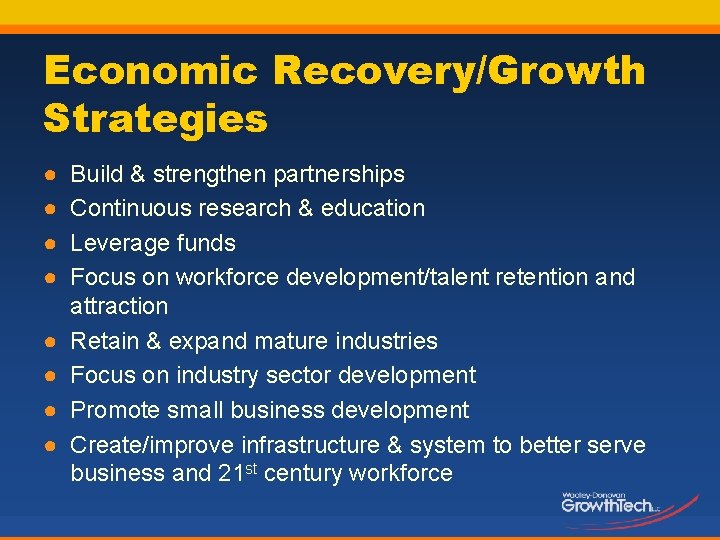
Economic Recovery/Growth Strategies ● ● ● ● Build & strengthen partnerships Continuous research & education Leverage funds Focus on workforce development/talent retention and attraction Retain & expand mature industries Focus on industry sector development Promote small business development Create/improve infrastructure & system to better serve business and 21 st century workforce
Federal & State Efforts • Federal Funds – Workforce Innovation Regional Grants (WIRED) $$ – Regional Innovations Grants (RIGS) $$ – Stimulus $$ (Formula, competitive, application, leverage) • State Grants – Minnesota First Grants – New York 13 M Grants 21
Q&A ● For more information, contact ● Sharon Sewell, Vice President Workforce Development Services ● www. wdgtech. com ● ssewell@wadley-donovan. com ● or call (973) 379 -7700 ext. 106 22 Image credit: : NASA, ESA, and the Hubble Heritage (STSc. I/AURA)-ESA/Hubble Collaboration