
Workers Compensation Ratemaking An Overview Rating Bureau Perspective
Workers Compensation Ratemaking— An Overview Rating Bureau Perspective Jay Rosen, NCCI, Inc. Insurance Company Perspective Dan Perry, QBE Regional Companies (N. A. ), Inc. CAS 2012 Ratemaking and Product Management Seminar Philadelphia, Pennsylvania – March 20, 2012
Workers Compensation Ratemaking— An Overview Rating Bureau Perspective
Rating Bureau Perspective Outline • Overview of Workers Compensation Insurance • NCCI Filing • Overall Rate / Loss Cost Level Change • Classification Rate / Loss Cost Changes 3
Loss Costs—What Are They? In general, a loss cost represents a provision for losses and LAE per $100 of payroll for each classification Loss costs are not final rates because they do not include provisions for the remaining expenses (including production expenses, profit and contingencies, etc. ) of an insurer 4
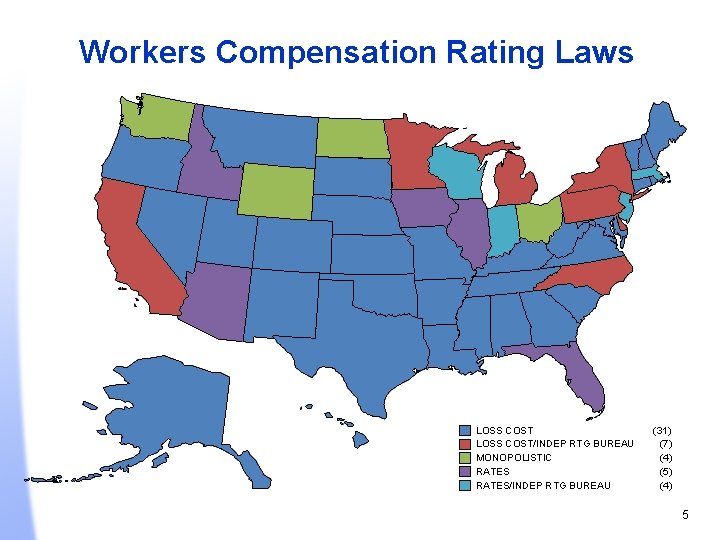
Workers Compensation Rating Laws LOSS COST/INDEP RTG BUREAU MONOPOLISTIC RATES/INDEP RTG BUREAU (31) (7) (4) (5) (4) 5
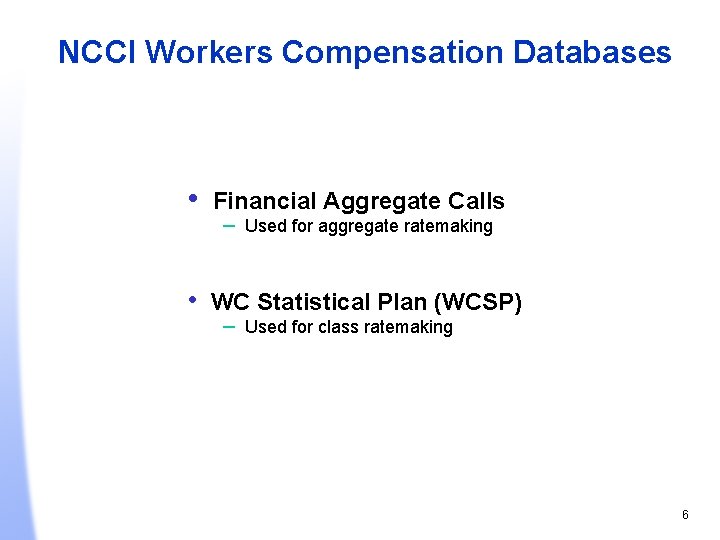
NCCI Workers Compensation Databases • Financial Aggregate Calls – Used for aggregate ratemaking • WC Statistical Plan (WCSP) – Used for class ratemaking 6
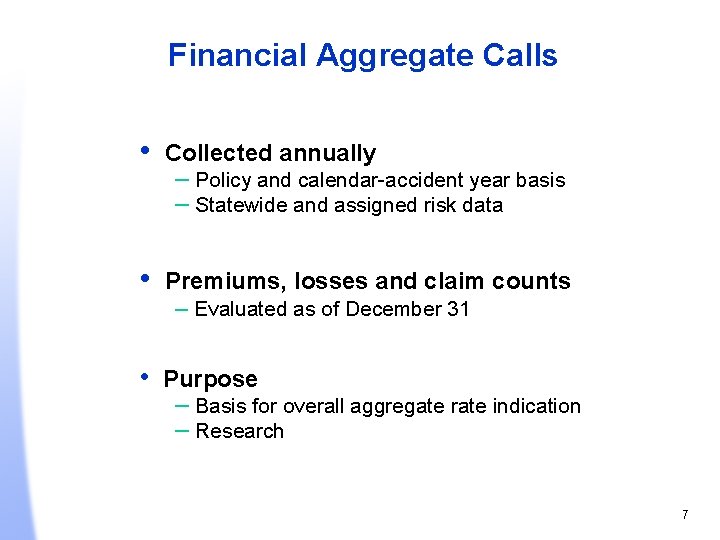
Financial Aggregate Calls • Collected annually • Premiums, losses and claim counts – Evaluated as of December 31 – Policy and calendar-accident year basis – Statewide and assigned risk data • Purpose – Basis for overall aggregate rate indication – Research 7
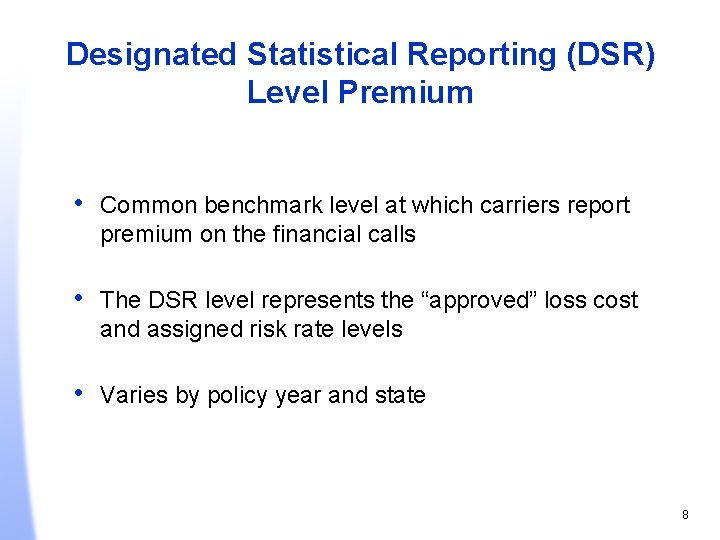
Designated Statistical Reporting (DSR) Level Premium • Common benchmark level at which carriers report premium on the financial calls • The DSR level represents the “approved” loss cost and assigned risk rate levels • Varies by policy year and state 8
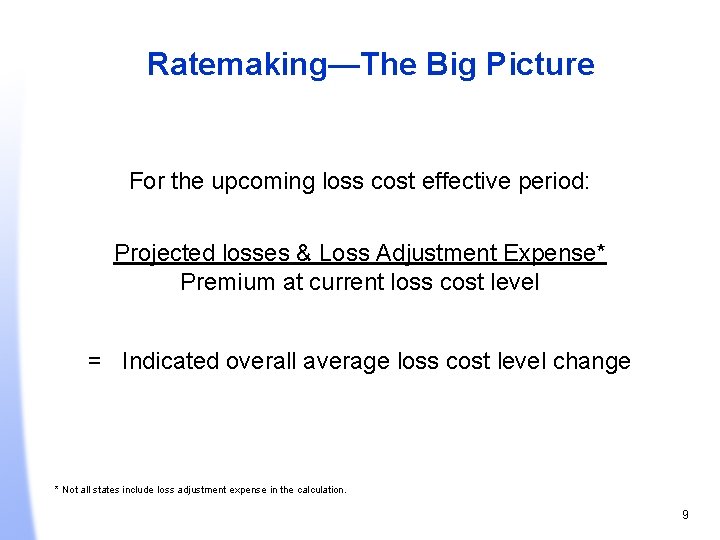
Ratemaking—The Big Picture For the upcoming loss cost effective period: Projected losses & Loss Adjustment Expense* Premium at current loss cost level = Indicated overall average loss cost level change * Not all states include loss adjustment expense in the calculation. 9
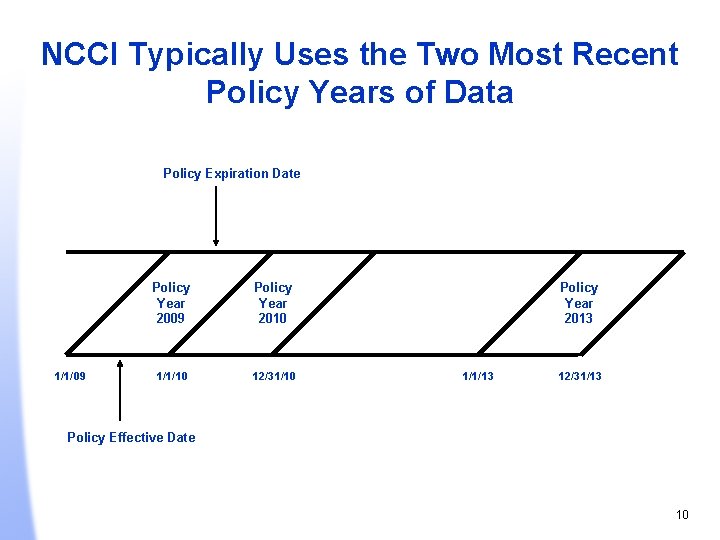
NCCI Typically Uses the Two Most Recent Policy Years of Data Policy Expiration Date 1/1/09 Policy Year 2010 1/1/10 12/31/10 Policy Year 2013 1/1/13 12/31/13 Policy Effective Date 10
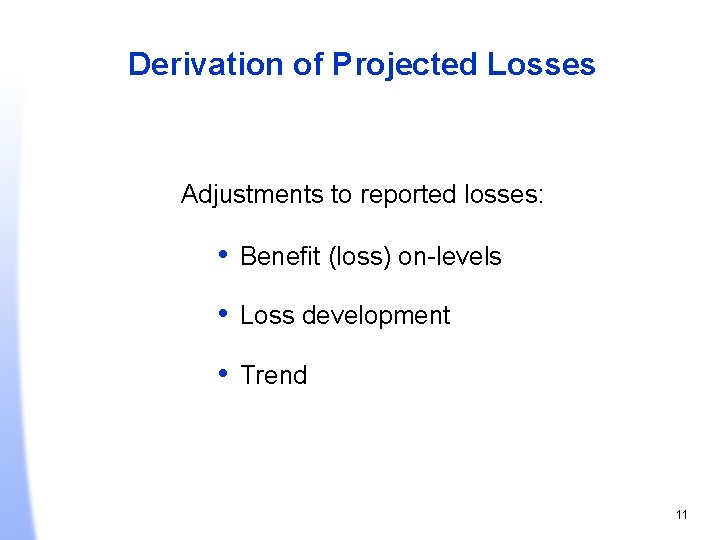
Derivation of Projected Losses Adjustments to reported losses: • Benefit (loss) on-levels • Loss development • Trend 11
Benefit Changes that occur subsequent to the filing data must be reflected: • Legislated benefit changes • Court decisions • New regulations 12
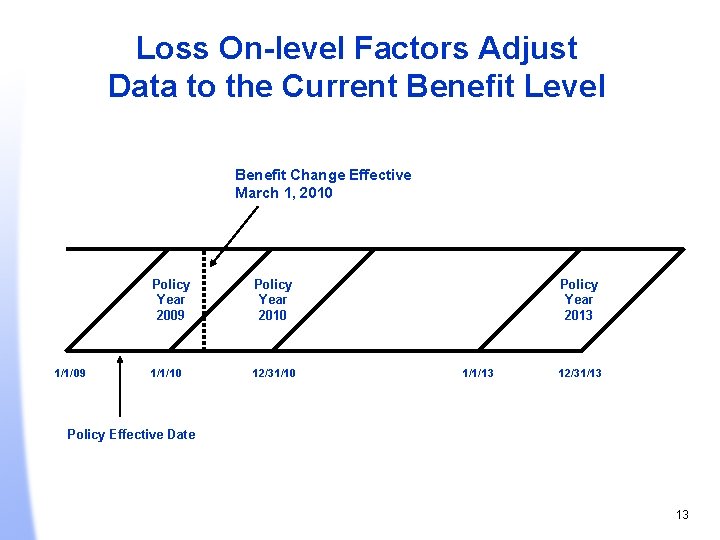
Loss On-level Factors Adjust Data to the Current Benefit Level Benefit Change Effective March 1, 2010 1/1/09 Policy Year 2010 1/1/10 12/31/10 Policy Year 2013 1/1/13 12/31/13 Policy Effective Date 13
Loss Development The ultimate cost of a reported claim may not be known for many years. Therefore, an initial estimate of the ultimate settlement value is made at the time the claim is reported. This estimate may change over time as the prognosis of the injury changes, the expected life-span shortens/ lengthens, the cost of medical services increases/ decreases, etc. 14
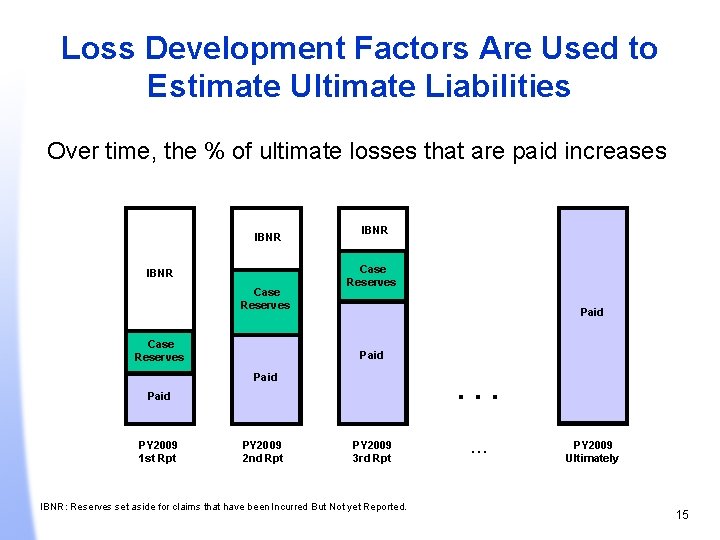
Loss Development Factors Are Used to Estimate Ultimate Liabilities Over time, the % of ultimate losses that are paid increases IBNR Case Reserves Paid . . . Paid PY 2009 1 st Rpt PY 2009 2 nd Rpt PY 2009 3 rd Rpt IBNR: Reserves set aside for claims that have been Incurred But Not yet Reported. . PY 2009 Ultimately 15
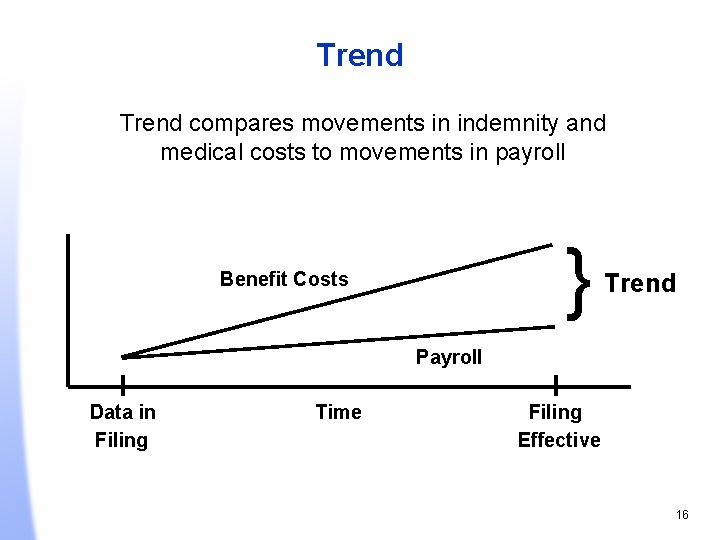
Trend compares movements in indemnity and medical costs to movements in payroll } Benefit Costs Trend Payroll Data in Filing Time Filing Effective 16
Techniques to Measure Trend • Fitting curves to Historical Loss Ratios • Use of Frequency and Severity Data • Econometric Analysis • Outside Sources (AHA, DOL) A positive trend assumes that losses are growing faster than wages. A negative trend assumes the opposite. 17
Derivation of Premium at Current Loss Cost Level Adjustments to reported financial data premium: • Premium on-levels • Policy year premium development 18
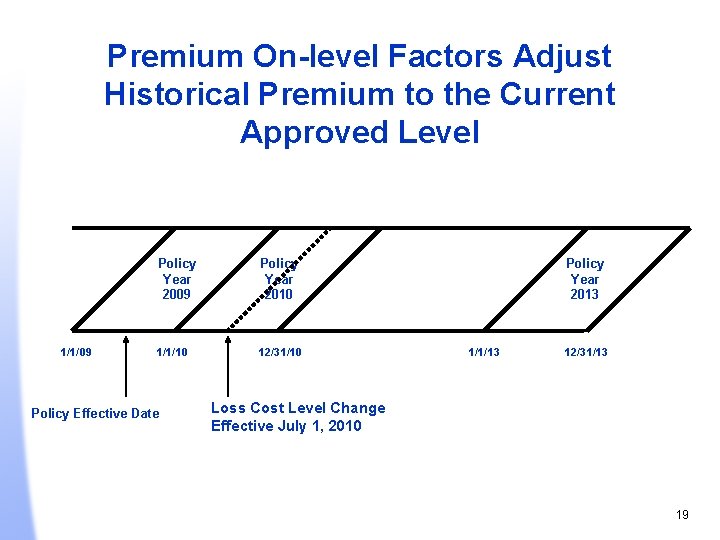
Premium On-level Factors Adjust Historical Premium to the Current Approved Level 1/1/09 Policy Year 2010 1/1/10 12/31/10 Policy Effective Date Policy Year 2013 1/1/13 12/31/13 Loss Cost Level Change Effective July 1, 2010 19
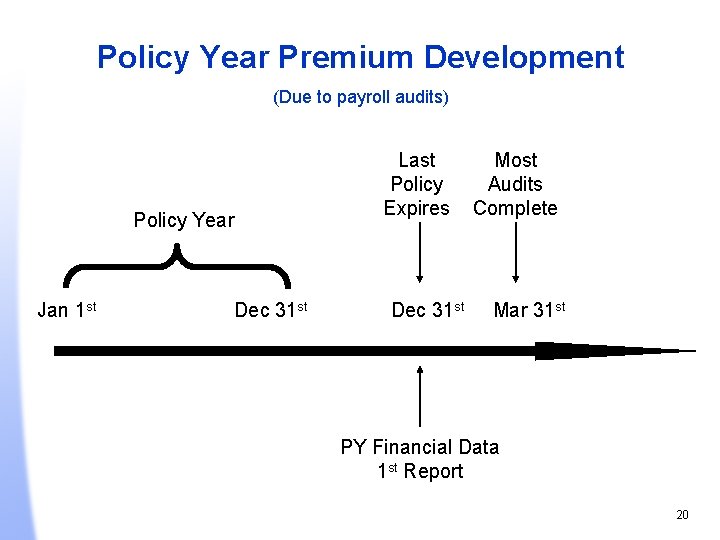
Policy Year Premium Development (Due to payroll audits) Policy Year Jan 1 st Dec 31 st Last Policy Expires Dec 31 st Most Audits Complete Mar 31 st PY Financial Data 1 st Report 20
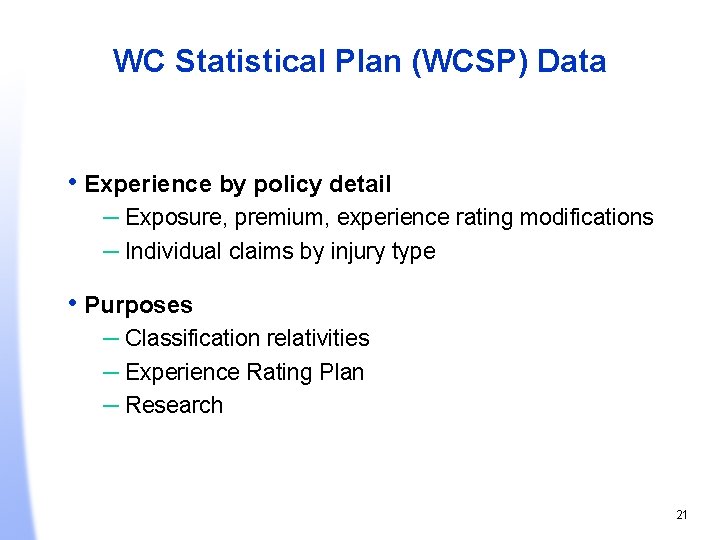
WC Statistical Plan (WCSP) Data • Experience by policy detail – Exposure, premium, experience rating modifications – Individual claims by injury type • Purposes – Classification relativities – Experience Rating Plan – Research 21
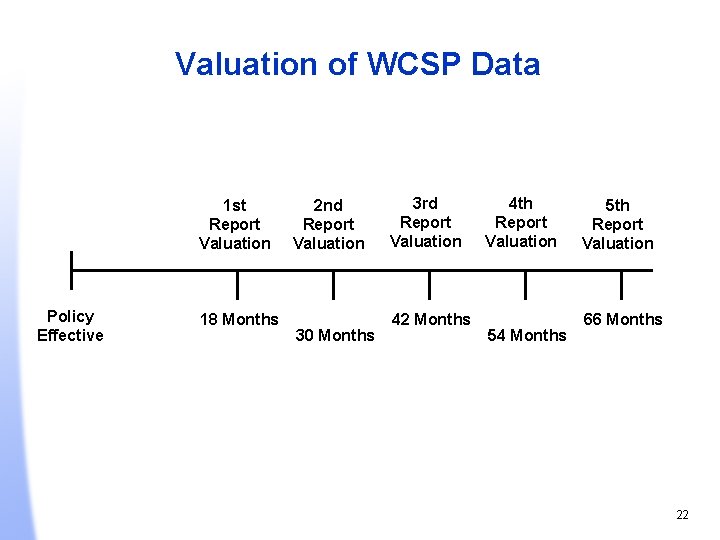
Valuation of WCSP Data 1 st Report Valuation Policy Effective 18 Months 2 nd Report Valuation 30 Months 3 rd Report Valuation 42 Months 4 th Report Valuation 54 Months 5 th Report Valuation 66 Months 22
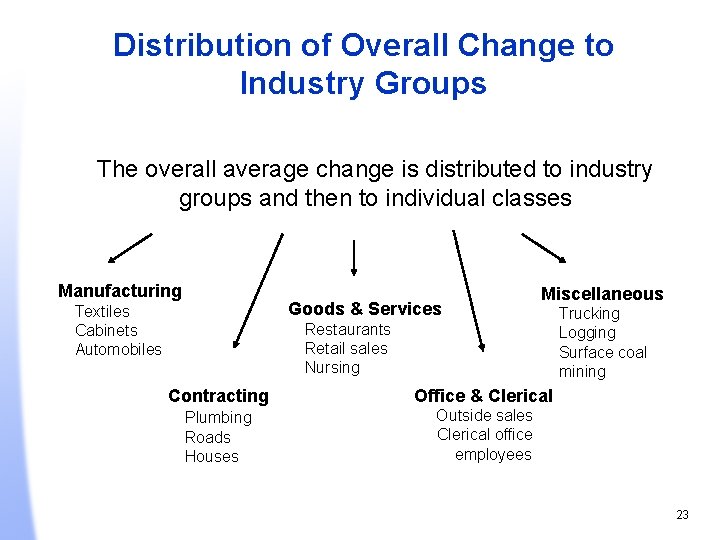
Distribution of Overall Change to Industry Groups The overall average change is distributed to industry groups and then to individual classes Manufacturing Goods & Services Textiles Cabinets Automobiles Miscellaneous Restaurants Retail sales Nursing Contracting Office & Clerical Plumbing Roads Houses Outside sales Clerical office employees Trucking Logging Surface coal mining 23
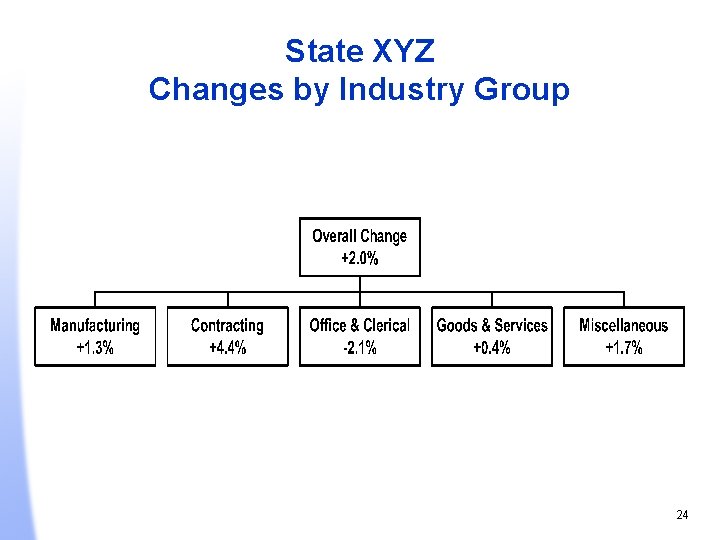
State XYZ Changes by Industry Group 24
Individual Classifications • Five years of WCSP experience used • Individual claims are limited • Credibility is assigned • National data is used in low volume/credibility classes 25
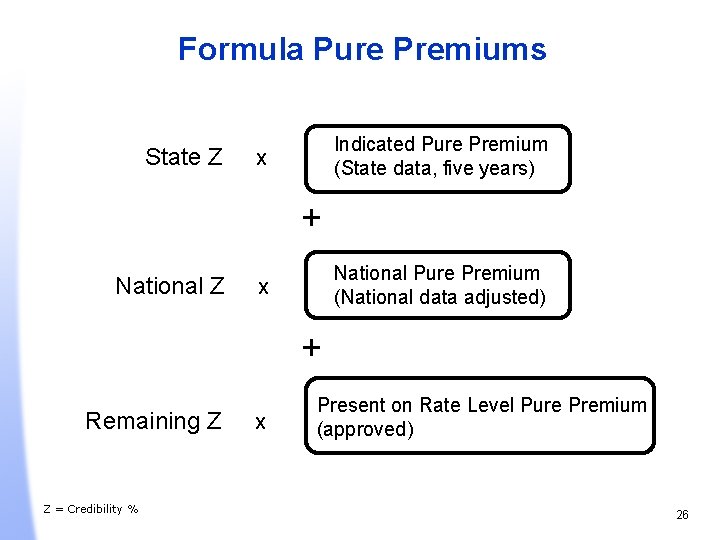
Formula Pure Premiums State Z Indicated Pure Premium (State data, five years) X + National Z National Pure Premium (National data adjusted) X + Remaining Z Z = Credibility % X Present on Rate Level Pure Premium (approved) 26
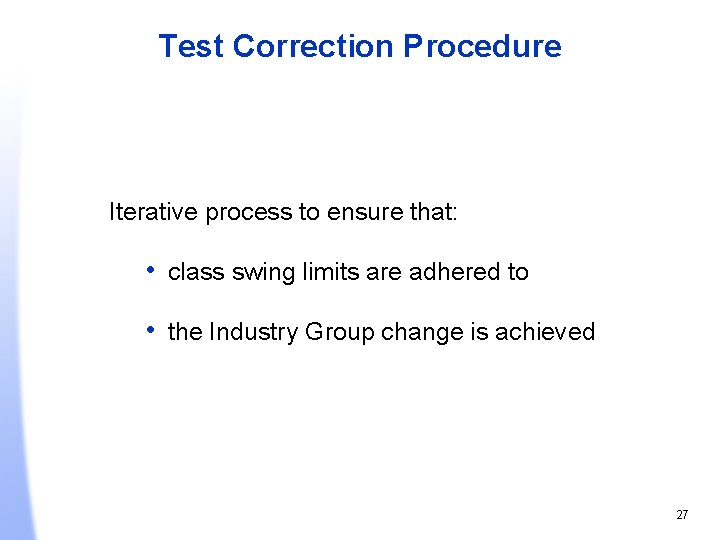
Test Correction Procedure Iterative process to ensure that: • class swing limits are adhered to • the Industry Group change is achieved 27
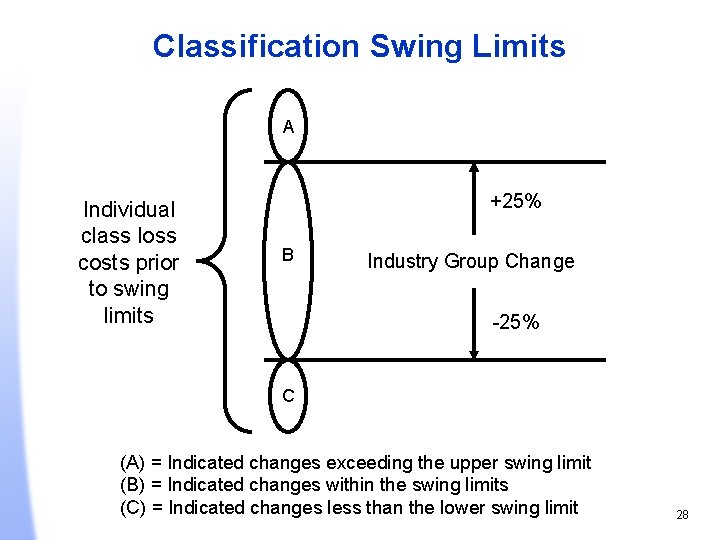
Classification Swing Limits A Individual class loss costs prior to swing limits +25% B Industry Group Change -25% C (A) = Indicated changes exceeding the upper swing limit (B) = Indicated changes within the swing limits (C) = Indicated changes less than the lower swing limit 28
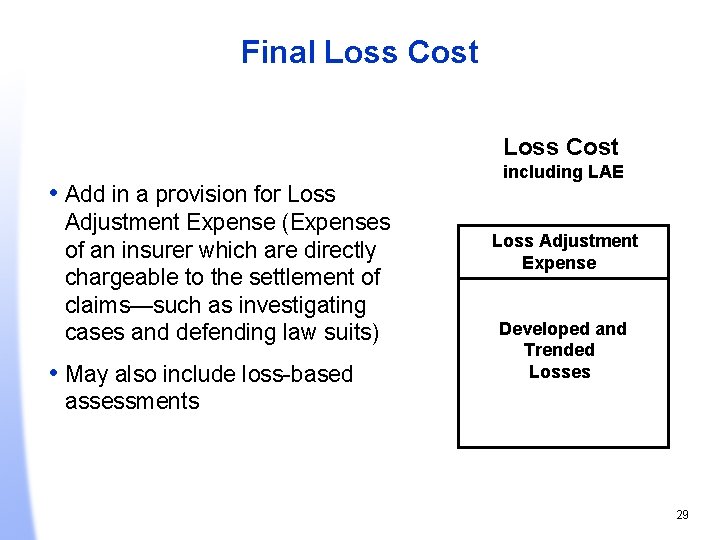
Final Loss Cost • Add in a provision for Loss Adjustment Expense (Expenses of an insurer which are directly chargeable to the settlement of claims—such as investigating cases and defending law suits) • May also include loss-based including LAE Loss Adjustment Expense Developed and Trended Losses assessments 29
Workers Compensation Ratemaking— An Overview Insurance Company Perspective
Insurance Company Perspective Outline • Expenses • Loss Cost Multipliers • Company Pricing Programs • Predictive Modeling • Current Workers Compensation Market 31
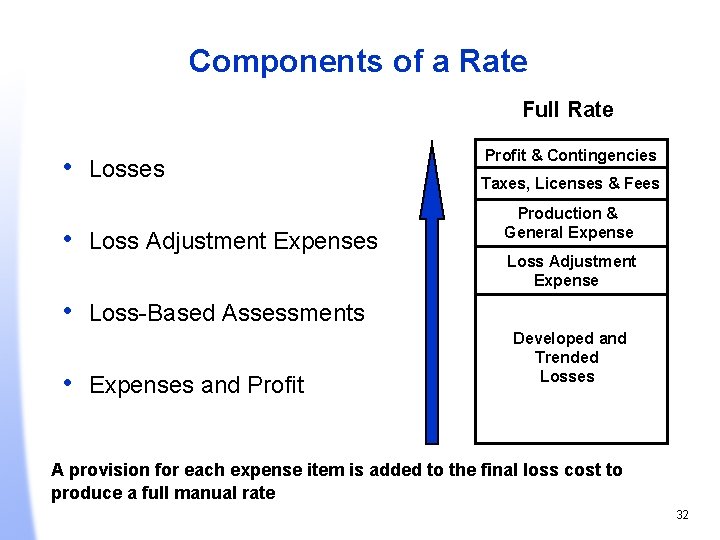
Components of a Rate Full Rate • Losses • Loss Adjustment Expenses Profit & Contingencies Taxes, Licenses & Fees Production & General Expense Loss Adjustment Expense • Loss-Based Assessments • Expenses and Profit Developed and Trended Losses A provision for each expense item is added to the final loss cost to produce a full manual rate 32
Expense Components • Production – commissions, premium collection, underwriting • Taxes, Licenses, and Fees – various premium taxes, bureau and filing fees • General – policy processing, overhead, premium audits, actuarial • Profit and Contingencies – combined with investment income 33
Evaluation of the Needs Outside of the Loss Cost • Items Always Outside of the Loss Cost – Production – Taxes, Licenses, and Fees – General – Profit and Contingencies • Items Sometimes Outside of the Loss Cost – Loss Adjustment Expenses – Loss-Based Assessments • Items Rarely Outside of the Loss Cost (MN) – Trend – Loss Development beyond 8 th report 34
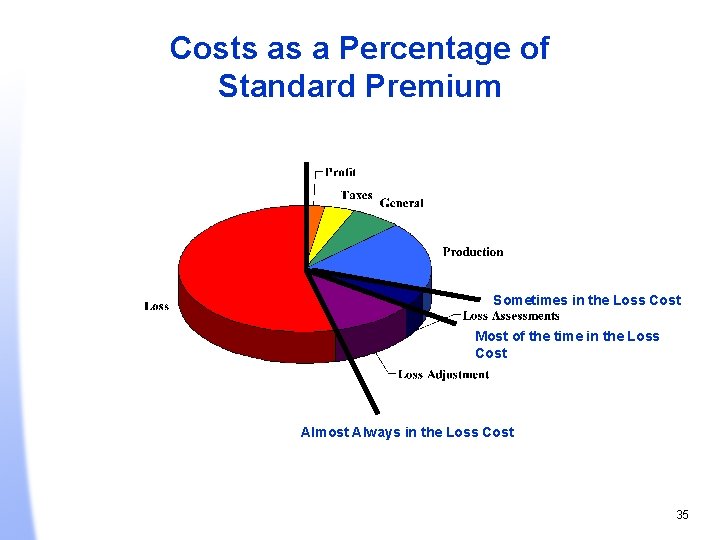
Costs as a Percentage of Standard Premium Sometimes in the Loss Cost Most of the time in the Loss Cost Almost Always in the Loss Cost 35
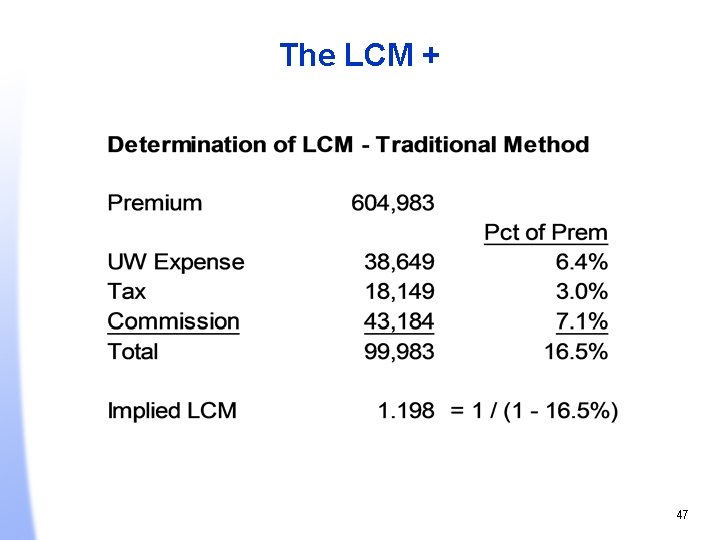
How to Account for Items Outside of the Loss Cost The Loss Cost Multiplier (LCM) • Also known as a Pure Premium Multiplier • Loss Cost x LCM = Rate • Factor to load loss costs for insurer’s expense and profit • Must also consider other items not included in the Loss Cost (trend, development, etc. ) • Insurance companies must file LCMs for approval in loss cost states 36
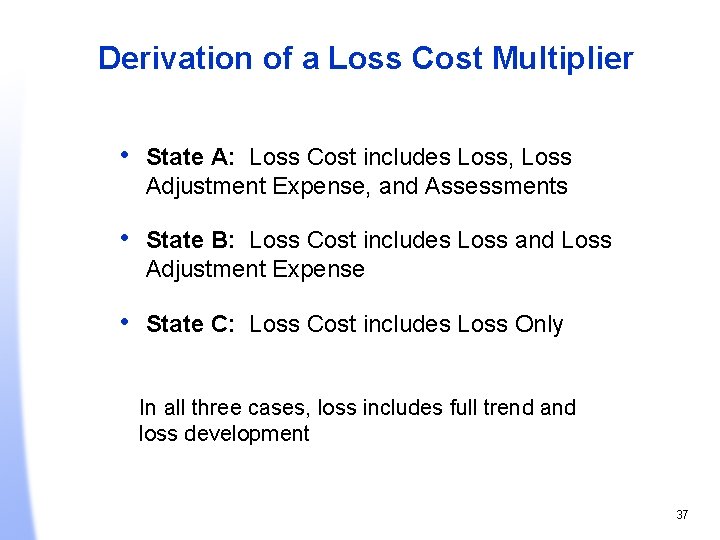
Derivation of a Loss Cost Multiplier • State A: Loss Cost includes Loss, Loss Adjustment Expense, and Assessments • State B: Loss Cost includes Loss and Loss Adjustment Expense • State C: Loss Cost includes Loss Only In all three cases, loss includes full trend and loss development 37
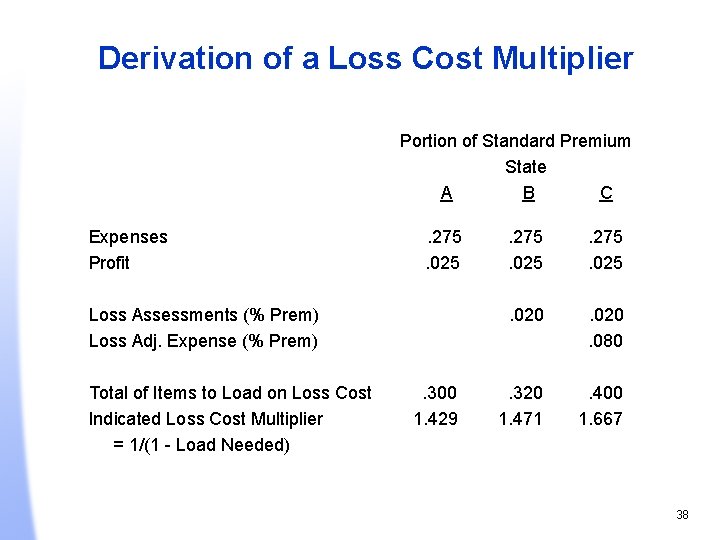
Derivation of a Loss Cost Multiplier Portion of Standard Premium State A B C Expenses Profit . 275. 025 Loss Assessments (% Prem) Loss Adj. Expense (% Prem) Total of Items to Load on Loss Cost Indicated Loss Cost Multiplier = 1/(1 - Load Needed) . 300 1. 429 . 275. 025 . 020. 080 . 320 1. 471 . 400 1. 667 38
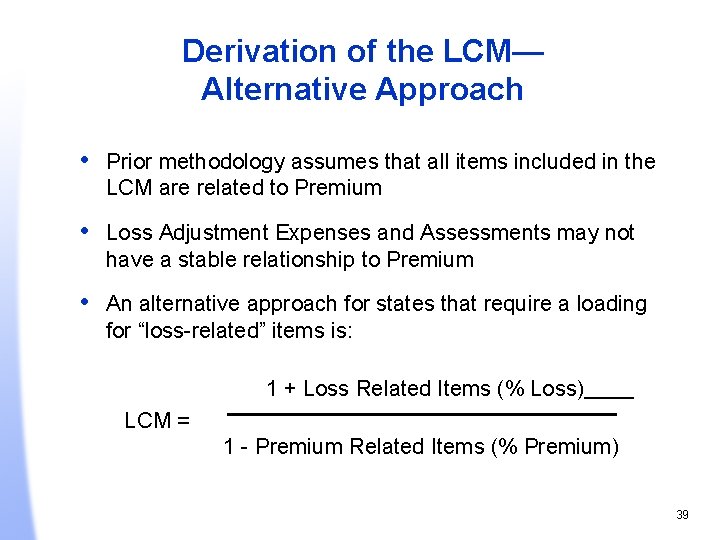
Derivation of the LCM— Alternative Approach • Prior methodology assumes that all items included in the LCM are related to Premium • Loss Adjustment Expenses and Assessments may not have a stable relationship to Premium • An alternative approach for states that require a loading for “loss-related” items is: 1 + Loss Related Items (% Loss) LCM = 1 - Premium Related Items (% Premium) 39
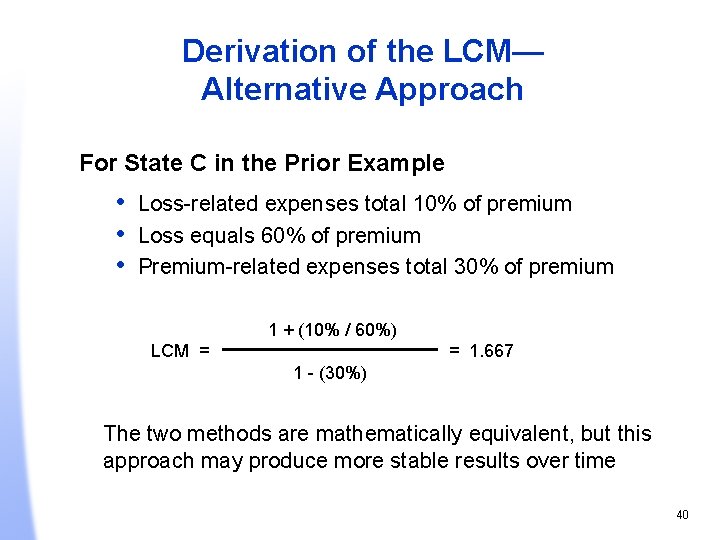
Derivation of the LCM— Alternative Approach For State C in the Prior Example • Loss-related expenses total 10% of premium • Loss equals 60% of premium • Premium-related expenses total 30% of premium 1 + (10% / 60%) LCM = = 1. 667 1 - (30%) The two methods are mathematically equivalent, but this approach may produce more stable results over time 40
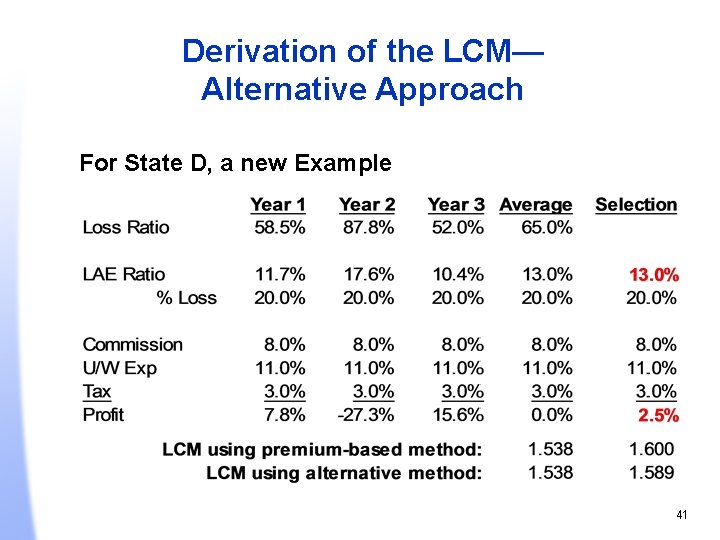
Derivation of the LCM— Alternative Approach For State D, a new Example 41
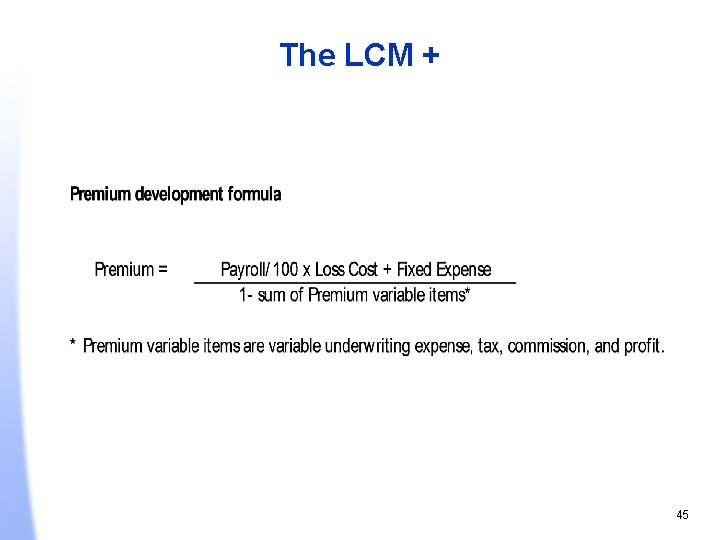
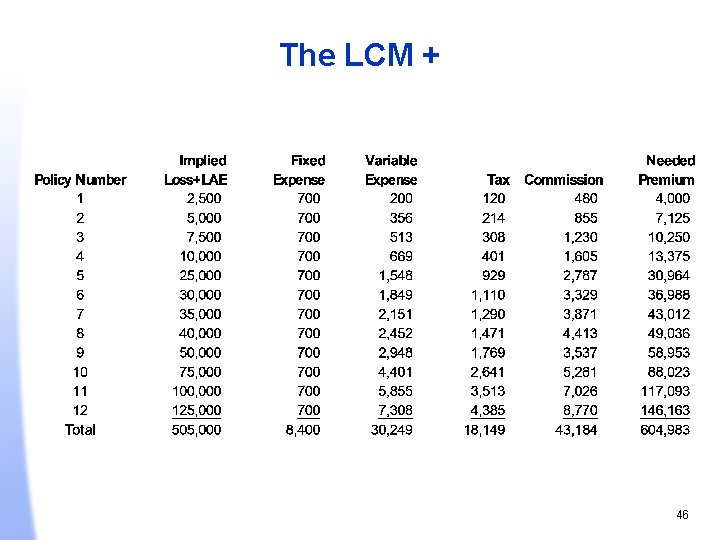
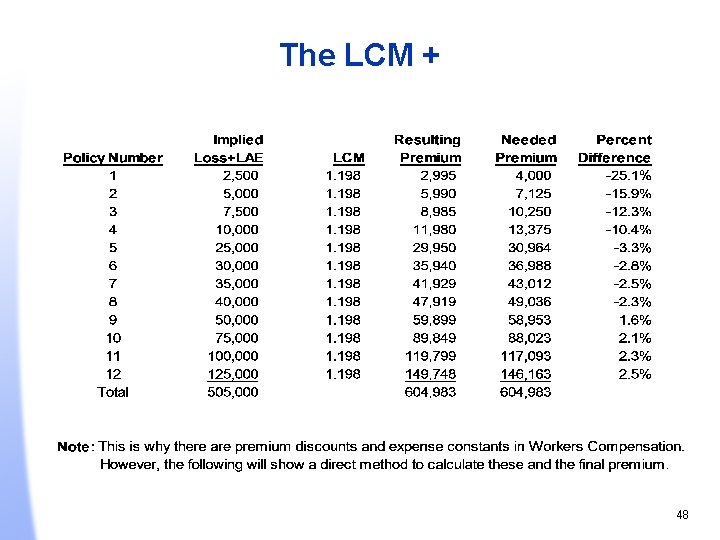
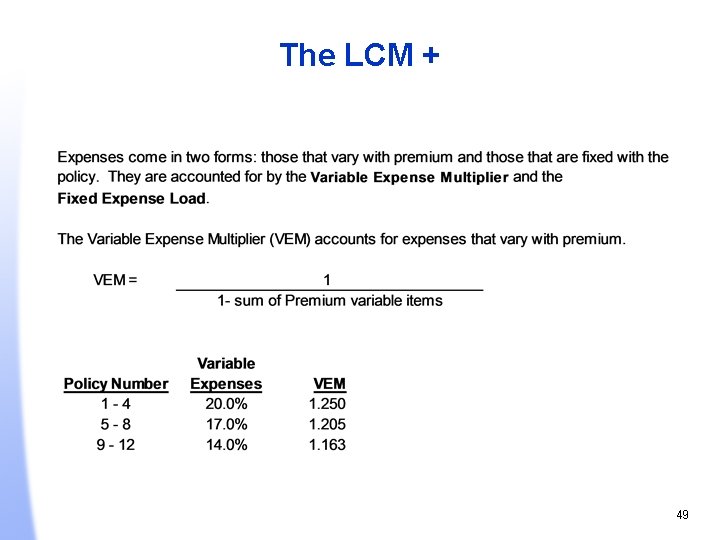
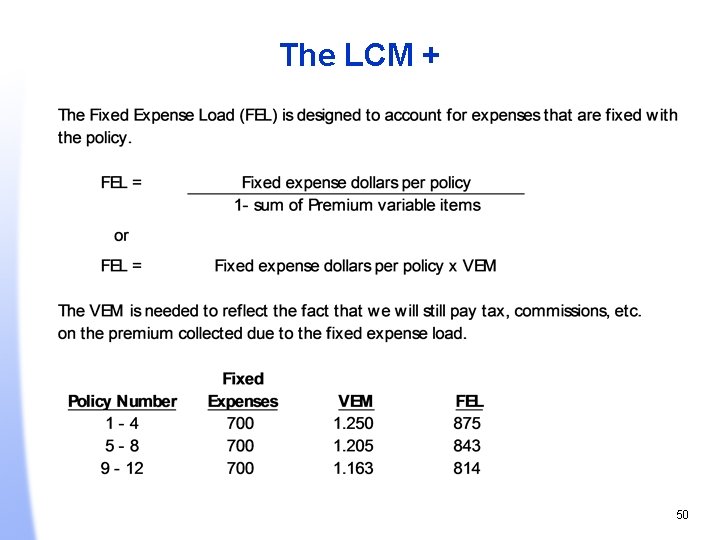
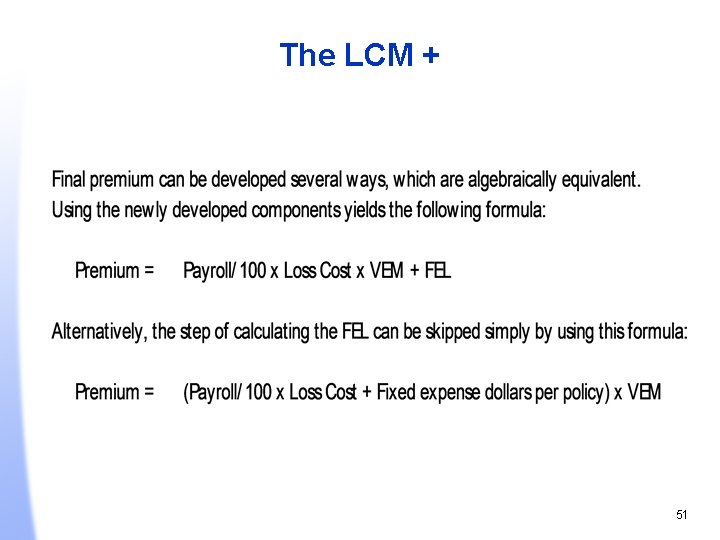
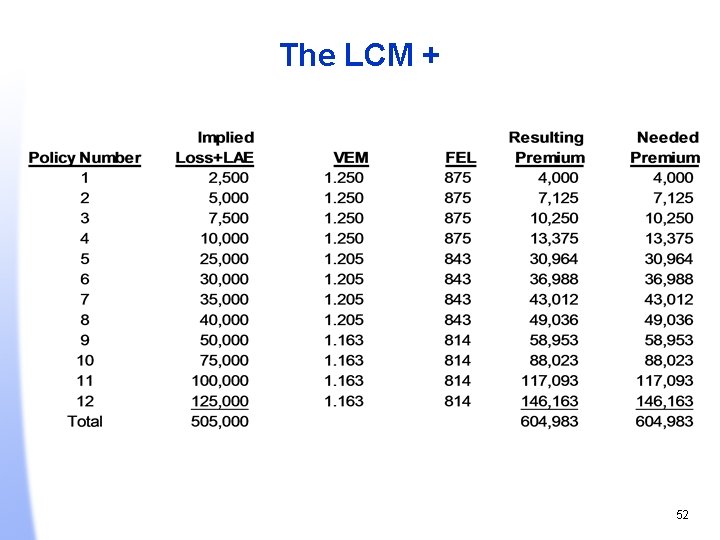
The LCM + • The LCM, as originally defined, requires the use of expense constants and premium discounts to more accurately charge for individual risks • There is a method that can accomplish the same goal without the need for these two other components and can be developed by individual companies • Disclaimer: All of the information that follows is completely fictitious and is not meant to resemble any actual carrier’s data or experience 42
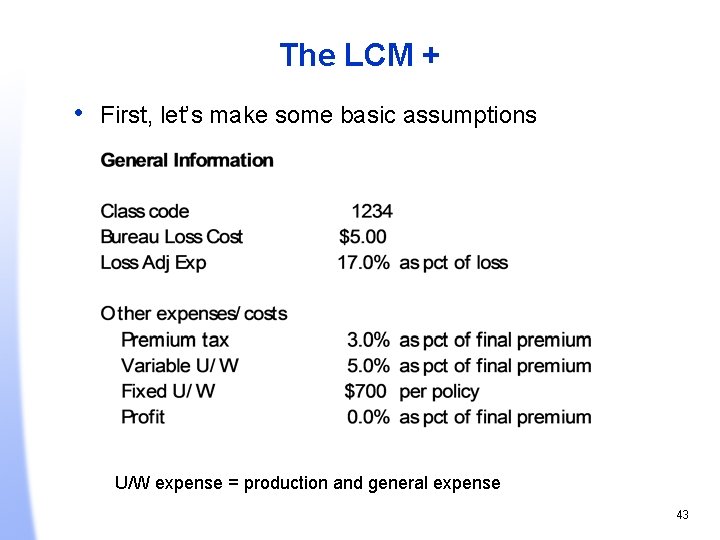
The LCM + • First, let’s make some basic assumptions U/W expense = production and general expense 43
The LCM + 44
The LCM + 45
The LCM + 46
The LCM + 47
The LCM + 48
The LCM + 49
The LCM + 50
The LCM + 51
The LCM + 52
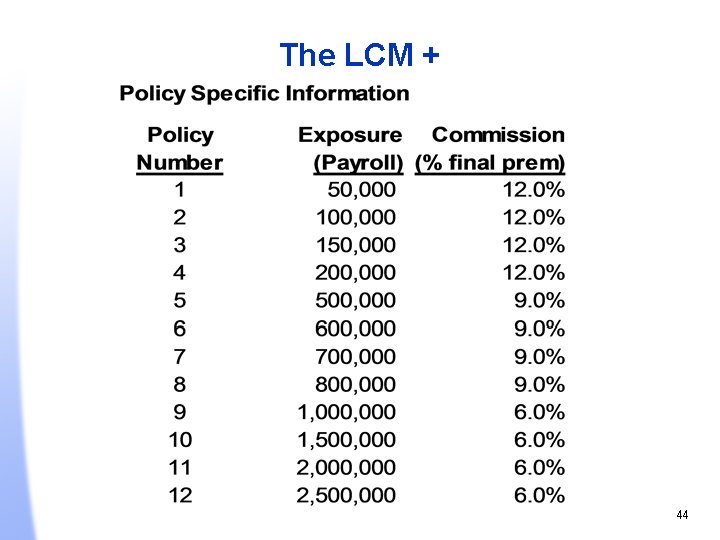
The LCM + • Therefore, we should be able to solve for an accurate premium directly, without extra rating factors • In addition, this would allow for a more companyand insured-specific price But, … • This method requires a fixed/variable expense analysis, similar to what would go into the development of premium discount tables and expense constants. This is not a trivial task. 53
Additional Considerations for the LCM • Bureau Rates vs. Loss Costs • Evaluation of the Bureau Loss Cost Filing – Do you agree with the various assumptions? – How does your book compare? – Is there additional, more current info? • Consideration of the company’s experience – How does your experience compare? – Are there changes in your company’s operations to consider? – When will you implement the change? 54
Manual Rates Are Just the Beginning Additional Pricing Elements Are an Individual Company Decision • Deviations • Premium Discount • Expense Constant • Schedule Rating • Experience Rating • Dividend Plans • Retrospective Rating • Deductibles (Small and Large) 55
Additional Pricing Elements • Deviations – filed by companies to reflect anticipated experience differences (rate or LCM) • Premium Discount – by policy size; reflects that relative expense is less for larger insureds • Expense Constant – reflects that relative expense is greater for smaller insureds • Schedule Rating – recognizes characteristics not reflected in experience rating 56
A Predictive Modeling Application Schedule rating is defined as: “The premium for a risk may be modified according to the Schedule Rating Table to reflect such characteristics of the risk that are not reflected in its experience. Seven categories are considered when determining any credit or debit under this Plan: • • Premises Classification Peculiarities Medical Facilities Safety Devices Employees —Selection, Training, Supervision Management —Cooperation With Insurance Carrier Management —Safety Organization 57
A Predictive Modeling Application • Schedule rating table provides a range of credits/debits for each of the seven categories • Quantifying specific characteristics within each category allows for more accurate account specific pricing • May also be able to identify other characteristics that may not traditionally be considered in the seven categories • The end result is to enhance the experience mod with an additional mathematical model 58
Programs That Adjust Premium to Reflect Actual Loss Experience • Experience Rating – Mandatory tool that compares actual and expected losses • Dividend Plans – Meant to reflect favorable experience • Retrospective Rating – Premium is adjusted based on insured’s experience during the time the policy is in force • Large Deductibles – The employer opts to pay claims below a certain threshold (usually $100, 000 or greater) 59
Workers Compensation Climate and the Role of the Actuary • Beginning in 2008, underwriting gains were no longer present on either a calendar year or an accident year basis • During NCCI's 2011 filing season, for those states in which NCCI provides ratemaking services, over three-quarters of the filed rate / loss cost level changes were increases; the remainder either had no change or were decreases • Current economic and market conditions may impact workers compensation results • Actuaries must be aware of changing environments, how pricing tools are used, and how that will impact results • Actuaries must communicate findings with management 60

Thank You for Your Attention! Questions/Comments?
- Slides: 61