
Workers Compensation Economic Regulatory Considerations Workers Compensation Educational
- Slides: 38
Workers Compensation: Economic & Regulatory Considerations Workers Compensation Educational Conference Orlando, FL August 17, 2010 Download at www. iii. org/presentations Robert P. Hartwig, Ph. D. , CPCU, President & Economist Insurance Information Institute 110 William Street New York, NY 10038 Tel: 212. 346. 5520 Cell: 917. 453. 1885 bobh@iii. org www. iii. org
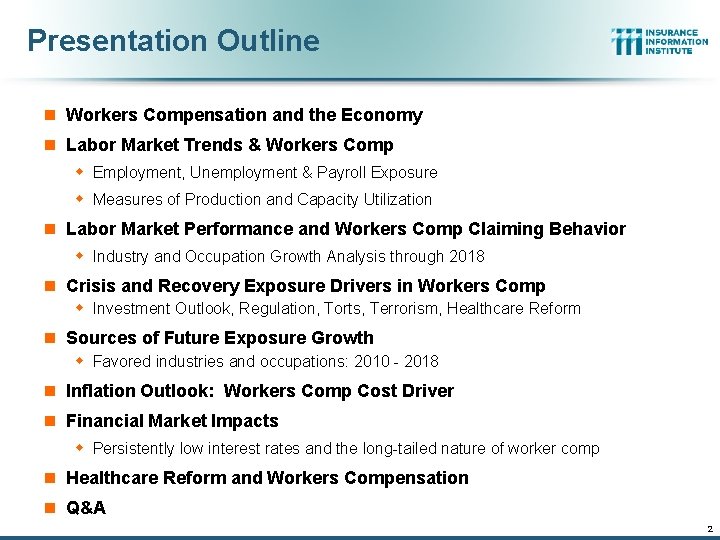
Presentation Outline n Workers Compensation and the Economy n Labor Market Trends & Workers Comp w Employment, Unemployment & Payroll Exposure w Measures of Production and Capacity Utilization n Labor Market Performance and Workers Comp Claiming Behavior w Industry and Occupation Growth Analysis through 2018 n Crisis and Recovery Exposure Drivers in Workers Comp w Investment Outlook, Regulation, Torts, Terrorism, Healthcare Reform n Sources of Future Exposure Growth w Favored industries and occupations: 2010 - 2018 n Inflation Outlook: Workers Comp Cost Driver n Financial Market Impacts w Persistently low interest rates and the long-tailed nature of worker comp n Healthcare Reform and Workers Compensation n Q&A 2
Workers Compensation and the Economy Workers Comp Exposure and Performance is Intimately Linked to the Economy and Labor Market 3
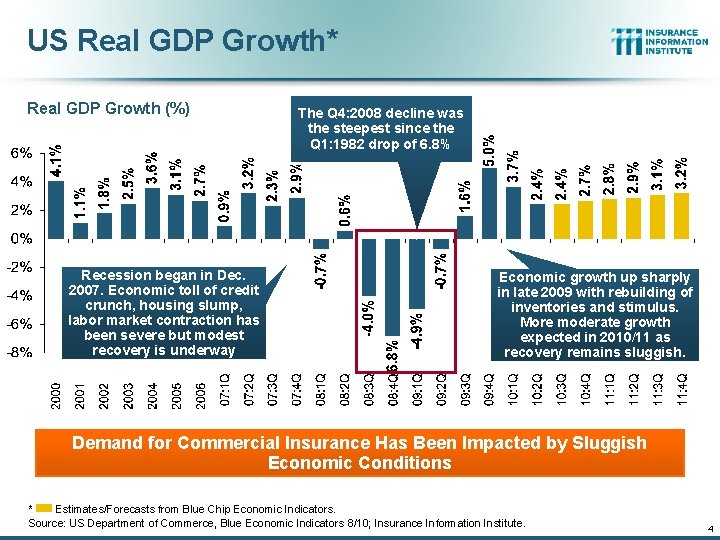
US Real GDP Growth* Real GDP Growth (%) Recession began in Dec. 2007. Economic toll of credit crunch, housing slump, labor market contraction has been severe but modest recovery is underway The Q 4: 2008 decline was the steepest since the Q 1: 1982 drop of 6. 8% Economic growth up sharply in late 2009 with rebuilding of inventories and stimulus. More moderate growth expected in 2010/11 as recovery remains sluggish. Demand for Commercial Insurance Has Been Impacted by Sluggish Economic Conditions * Estimates/Forecasts from Blue Chip Economic Indicators. Source: US Department of Commerce, Blue Economic Indicators 8/10; Insurance Information Institute. 4
Labor Market Trends Massive Job Losses Sapped the Economy and the Workers Comp Payroll Exposure Base The Long Road to Recovery 7
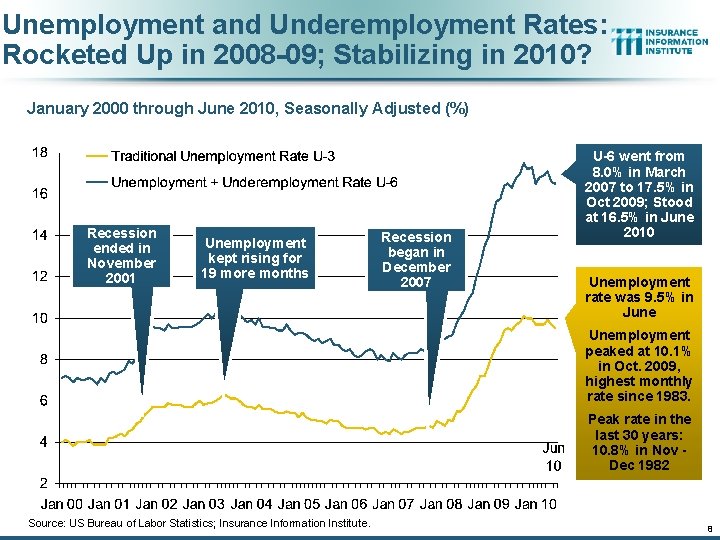
Unemployment and Underemployment Rates: Rocketed Up in 2008 -09; Stabilizing in 2010? January 2000 through June 2010, Seasonally Adjusted (%) Recession ended in November 2001 Unemployment kept rising for 19 more months Recession began in December 2007 U-6 went from 8. 0% in March 2007 to 17. 5% in Oct 2009; Stood at 16. 5% in June 2010 Unemployment rate was 9. 5% in June Unemployment peaked at 10. 1% in Oct. 2009, highest monthly rate since 1983. Peak rate in the last 30 years: 10. 8% in Nov Dec 1982 Source: US Bureau of Labor Statistics; Insurance Information Institute. 8
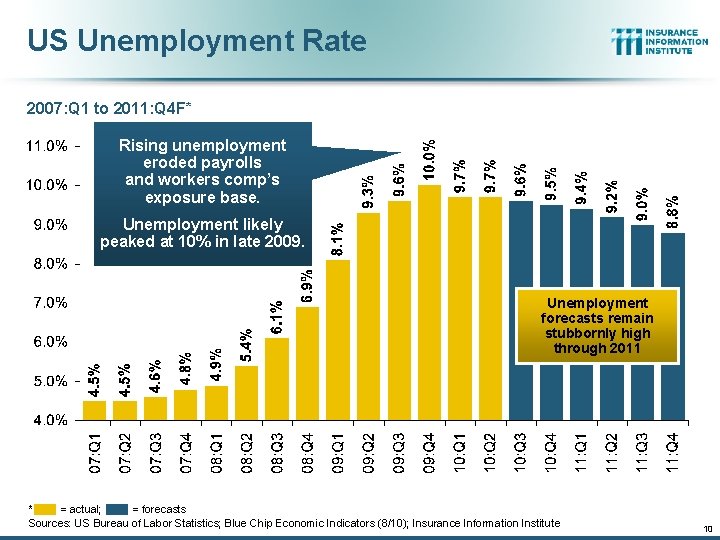
US Unemployment Rate 2007: Q 1 to 2011: Q 4 F* Rising unemployment eroded payrolls and workers comp’s exposure base. Unemployment likely peaked at 10% in late 2009. Unemployment forecasts remain stubbornly high through 2011 * = actual; = forecasts Sources: US Bureau of Labor Statistics; Blue Chip Economic Indicators (8/10); Insurance Information Institute 10
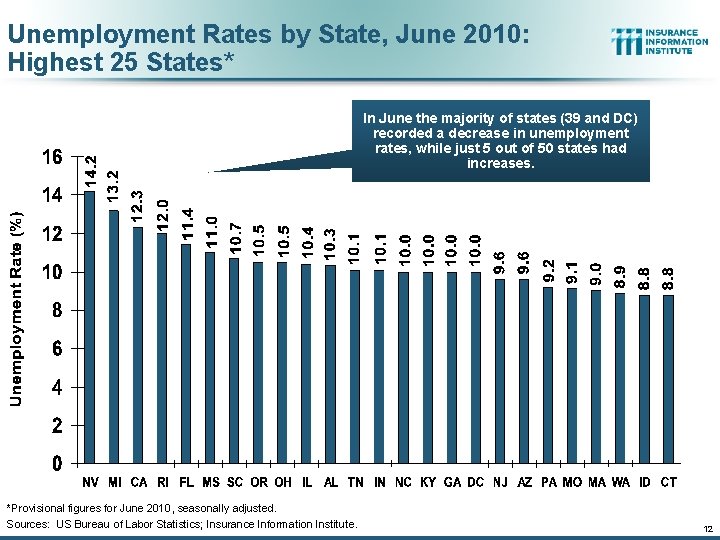
Unemployment Rates by State, June 2010: Highest 25 States* In June the majority of states (39 and DC) recorded a decrease in unemployment rates, while just 5 out of 50 states had increases. *Provisional figures for June 2010, seasonally adjusted. Sources: US Bureau of Labor Statistics; Insurance Information Institute. 12
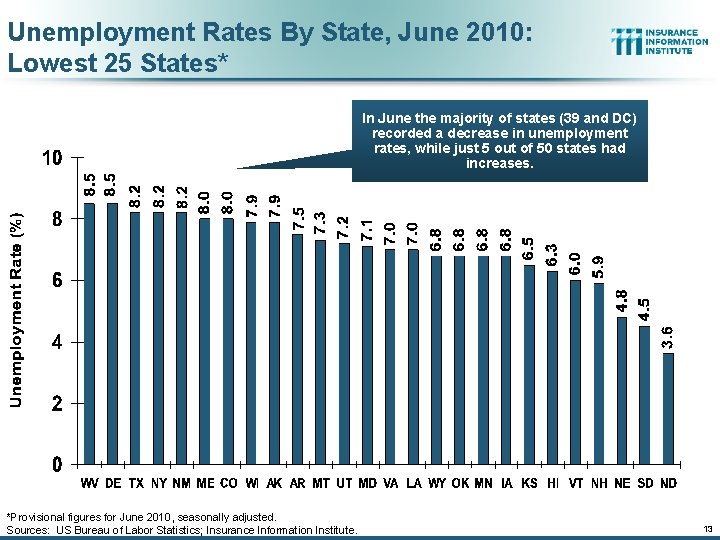
Unemployment Rates By State, June 2010: Lowest 25 States* In June the majority of states (39 and DC) recorded a decrease in unemployment rates, while just 5 out of 50 states had increases. *Provisional figures for June 2010, seasonally adjusted. Sources: US Bureau of Labor Statistics; Insurance Information Institute. 13
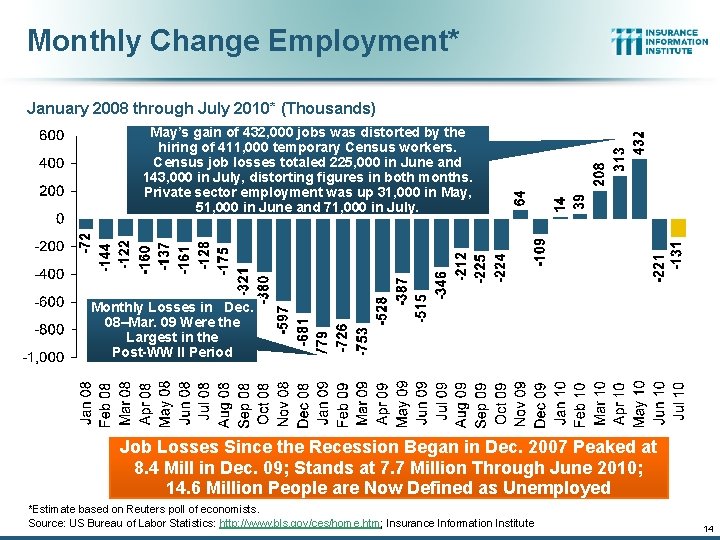
Monthly Change Employment* January 2008 through July 2010* (Thousands) May’s gain of 432, 000 jobs was distorted by the hiring of 411, 000 temporary Census workers. Census job losses totaled 225, 000 in June and 143, 000 in July, distorting figures in both months. Private sector employment was up 31, 000 in May, 51, 000 in June and 71, 000 in July. Monthly Losses in Dec. 08–Mar. 09 Were the Largest in the Post-WW II Period Job Losses Since the Recession Began in Dec. 2007 Peaked at 8. 4 Mill in Dec. 09; Stands at 7. 7 Million Through June 2010; 14. 6 Million People are Now Defined as Unemployed *Estimate based on Reuters poll of economists. Source: US Bureau of Labor Statistics: http: //www. bls. gov/ces/home. htm; Insurance Information Institute 14
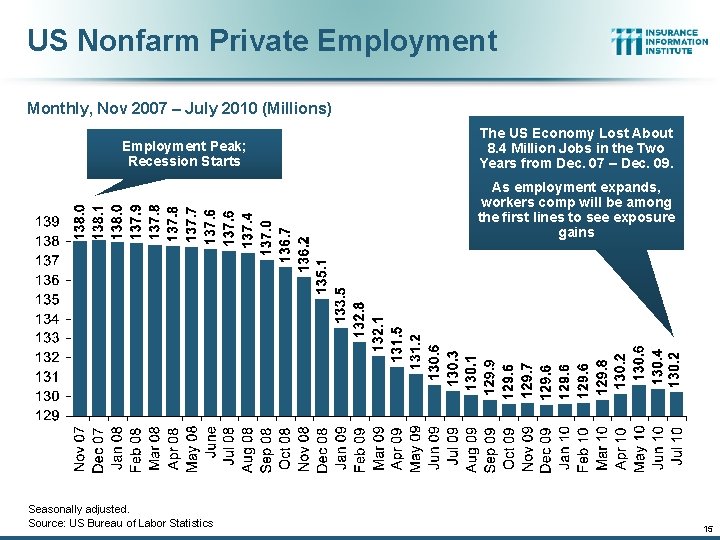
US Nonfarm Private Employment Monthly, Nov 2007 – July 2010 (Millions) Employment Peak; Recession Starts The US Economy Lost About 8. 4 Million Jobs in the Two Years from Dec. 07 – Dec. 09. As employment expands, workers comp will be among the first lines to see exposure gains Seasonally adjusted. Source: US Bureau of Labor Statistics 15
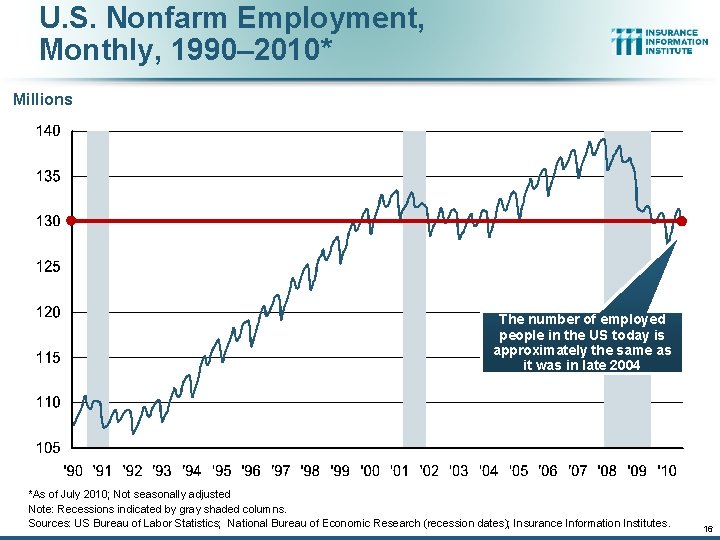
U. S. Nonfarm Employment, Monthly, 1990– 2010* Millions The number of employed people in the US today is approximately the same as it was in late 2004 *As of July 2010; Not seasonally adjusted Note: Recessions indicated by gray shaded columns. Sources: US Bureau of Labor Statistics; National Bureau of Economic Research (recession dates); Insurance Information Institutes. 16
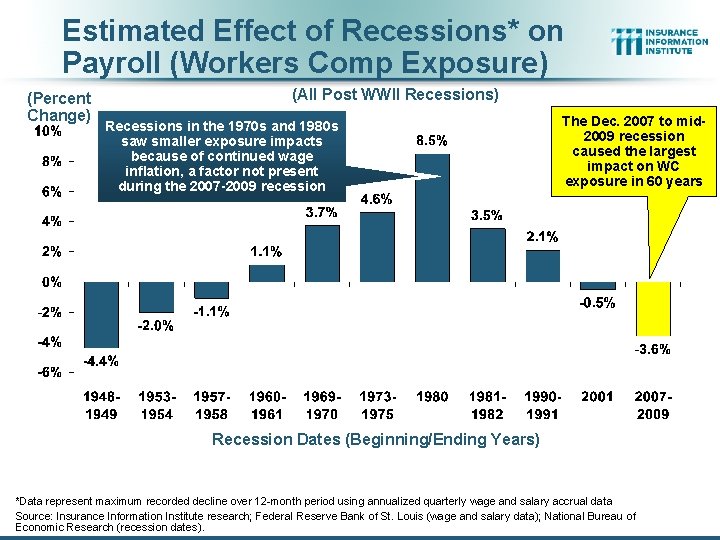
Estimated Effect of Recessions* on Payroll (Workers Comp Exposure) (Percent Change) (All Post WWII Recessions) Recessions in the 1970 s and 1980 s saw smaller exposure impacts because of continued wage inflation, a factor not present during the 2007 -2009 recession The Dec. 2007 to mid 2009 recession caused the largest impact on WC exposure in 60 years Recession Dates (Beginning/Ending Years) *Data represent maximum recorded decline over 12 -month period using annualized quarterly wage and salary accrual data Source: Insurance Information Institute research; Federal Reserve Bank of St. Louis (wage and salary data); National Bureau of Economic Research (recession dates).
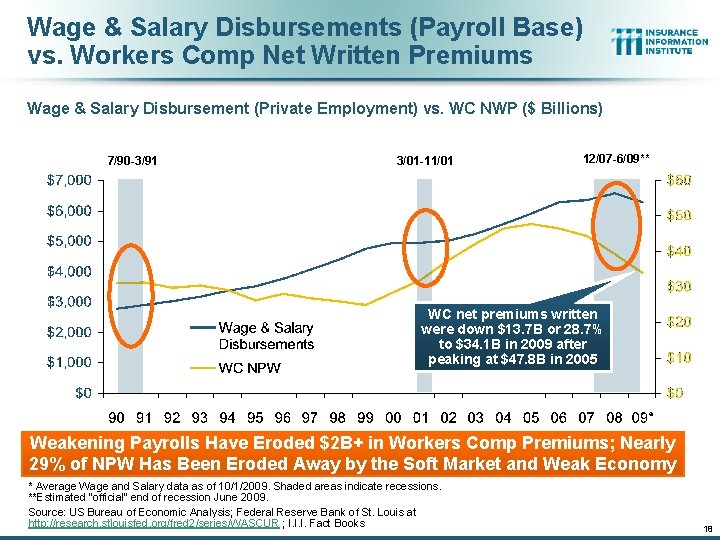
Wage & Salary Disbursements (Payroll Base) vs. Workers Comp Net Written Premiums Wage & Salary Disbursement (Private Employment) vs. WC NWP ($ Billions) 7/90 -3/91 3/01 -11/01 12/07 -6/09** WC net premiums written were down $13. 7 B or 28. 7% to $34. 1 B in 2009 after peaking at $47. 8 B in 2005 Weakening Payrolls Have Eroded $2 B+ in Workers Comp Premiums; Nearly 29% of NPW Has Been Eroded Away by the Soft Market and Weak Economy * Average Wage and Salary data as of 10/1/2009. Shaded areas indicate recessions. **Estimated “official” end of recession June 2009. Source: US Bureau of Economic Analysis; Federal Reserve Bank of St. Louis at http: //research. stlouisfed. org/fred 2/series/WASCUR ; I. I. I. Fact Books 18
Soft Labor Markets and Impacts on WC Claim Frequency Net Impact of Recession Appears to Be a Decline in Frequency; Swaps and Layoff-Induced Effect 19
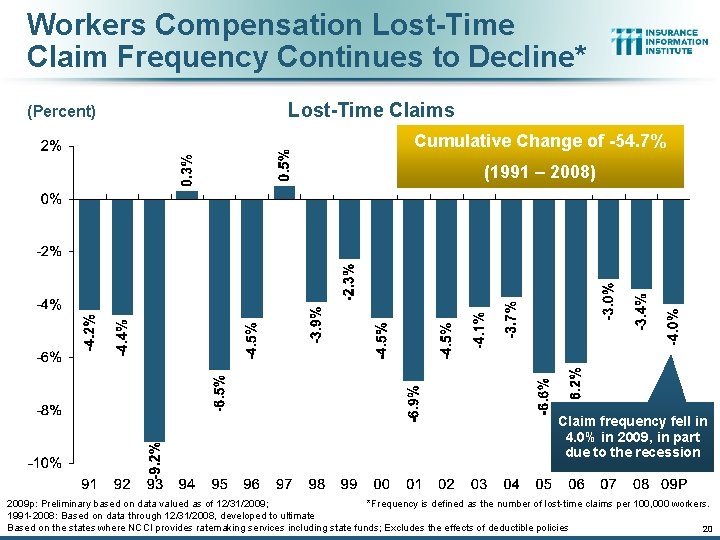
Workers Compensation Lost-Time Claim Frequency Continues to Decline* (Percent) Lost-Time Claims Cumulative Change of -54. 7% (1991 – 2008) Claim frequency fell in 4. 0% in 2009, in part due to the recession 2009 p: Preliminary based on data valued as of 12/31/2009; *Frequency is defined as the number of lost-time claims per 100, 000 workers. 1991 -2008: Based on data through 12/31/2008, developed to ultimate Based on the states where NCCI provides ratemaking services including state funds; Excludes the effects of deductible policies 20
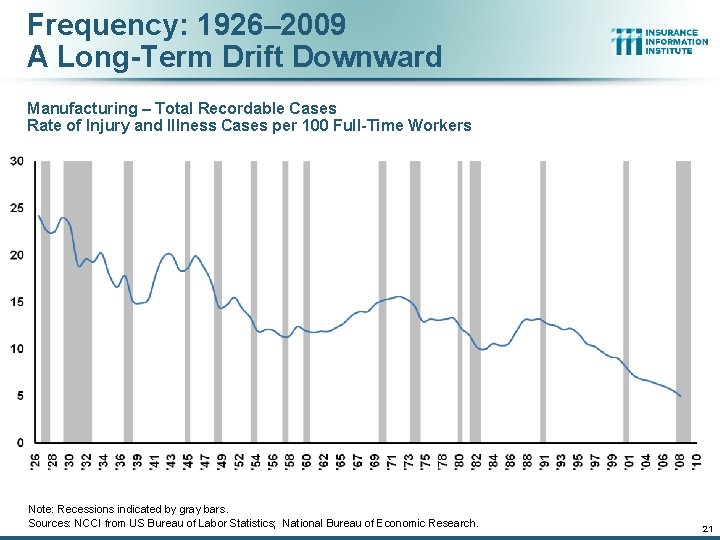
Frequency: 1926– 2009 A Long-Term Drift Downward Manufacturing – Total Recordable Cases Rate of Injury and Illness Cases per 100 Full-Time Workers Note: Recessions indicated by gray bars. Sources: NCCI from US Bureau of Labor Statistics; National Bureau of Economic Research. 21
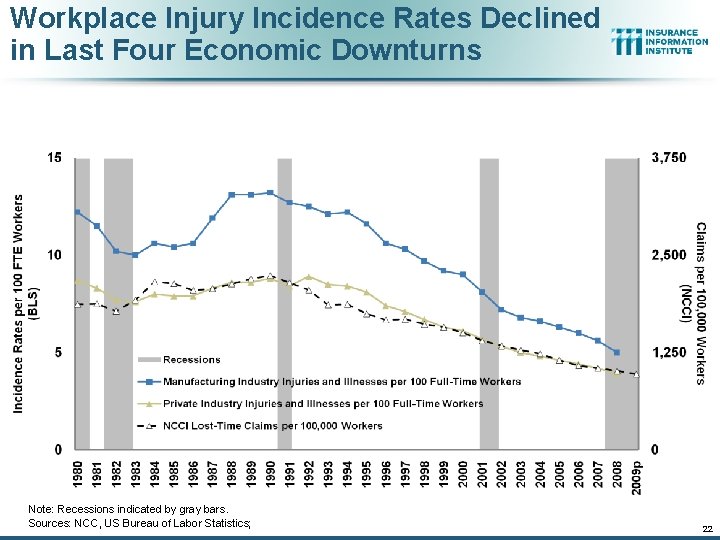
Workplace Injury Incidence Rates Declined in Last Four Economic Downturns Note: Recessions indicated by gray bars. Sources: NCC, US Bureau of Labor Statistics; 22
Crisis and Recovery-Driven Exposure Drivers in WC Myriad of Impacts on Workers Comp Exposure Filling the Economic Crater 23
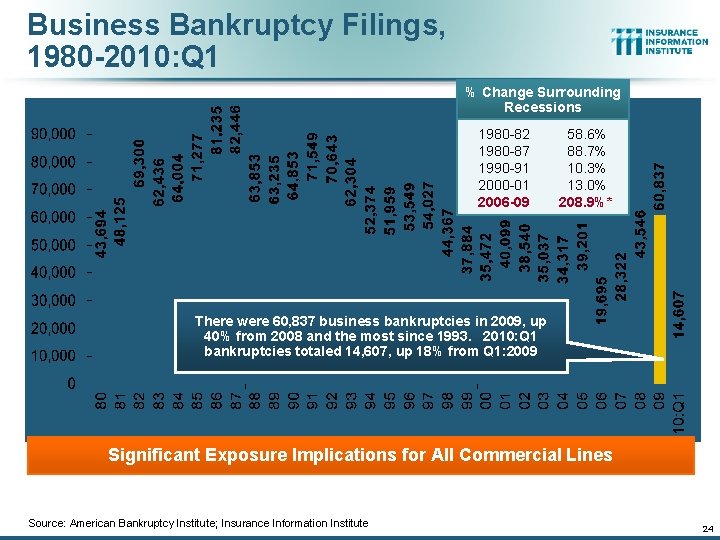
Business Bankruptcy Filings, 1980 -2010: Q 1 % Change Surrounding Recessions 1980 -82 1980 -87 1990 -91 2000 -01 2006 -09 58. 6% 88. 7% 10. 3% 13. 0% 208. 9%* There were 60, 837 business bankruptcies in 2009, up 40% from 2008 and the most since 1993. 2010: Q 1 bankruptcies totaled 14, 607, up 18% from Q 1: 2009 Significant Exposure Implications for All Commercial Lines Source: American Bankruptcy Institute; Insurance Information Institute 24
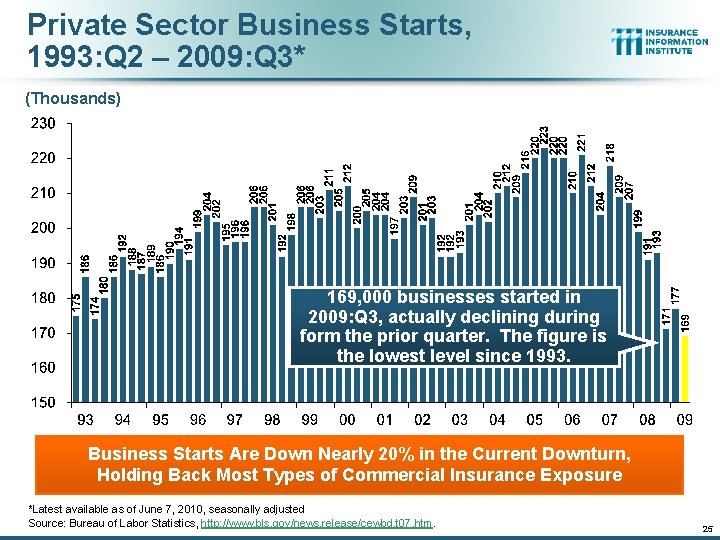
Private Sector Business Starts, 1993: Q 2 – 2009: Q 3* (Thousands) 169, 000 businesses started in 2009: Q 3, actually declining during form the prior quarter. The figure is the lowest level since 1993. Business Starts Are Down Nearly 20% in the Current Downturn, Holding Back Most Types of Commercial Insurance Exposure *Latest available as of June 7, 2010, seasonally adjusted Source: Bureau of Labor Statistics, http: //www. bls. gov/news. release/cewbd. t 07. htm. 25
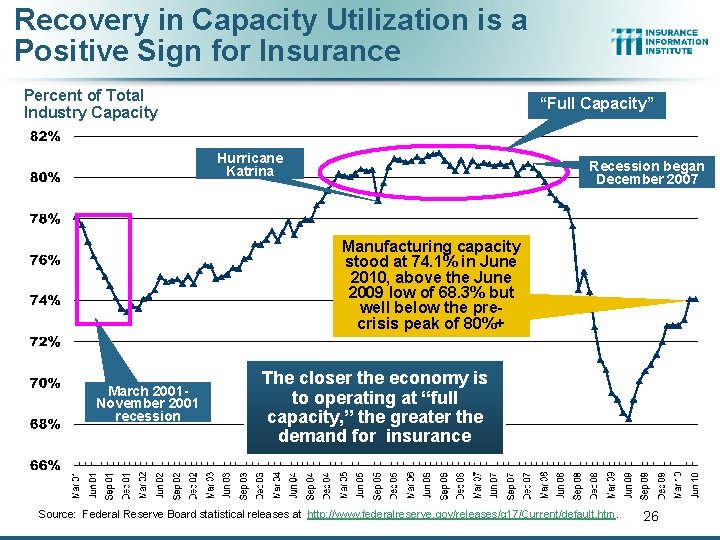
Recovery in Capacity Utilization is a Positive Sign for Insurance Percent of Total Industry Capacity “Full Capacity” Hurricane Katrina Recession began December 2007 Manufacturing capacity stood at 74. 1% in June 2010, above the June 2009 low of 68. 3% but well below the precrisis peak of 80%+ March 2001 November 2001 recession The closer the economy is to operating at “full capacity, ” the greater the demand for insurance Source: Federal Reserve Board statistical releases at http: //www. federalreserve. gov/releases/g 17/Current/default. htm. 26
Where Will the Growth in WC Exposure Come From? Industry and Occupation Growth Analysis 27
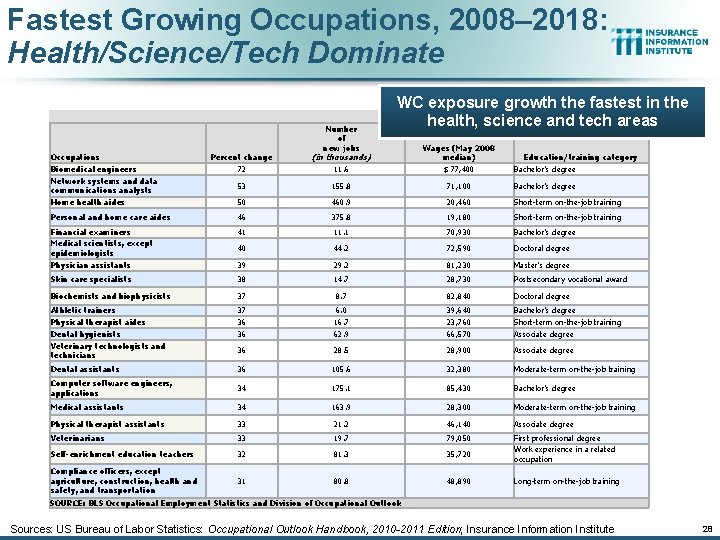
Fastest Growing Occupations, 2008– 2018: Health/Science/Tech Dominate Occupations Biomedical engineers Network systems and data communications analysts Home health aides Number of new jobs WC exposure growth the fastest in the health, science and tech areas Percent change 72 (in thousands) 11. 6 Wages (May 2008 median) $ 77, 400 53 155. 8 71, 100 Bachelor's degree Education/training category Bachelor's degree 50 460. 9 20, 460 Short-term on-the-job training Personal and home care aides 46 375. 8 19, 180 Short-term on-the-job training Financial examiners Medical scientists, except epidemiologists Physician assistants 41 11. 1 70, 930 Bachelor's degree 40 44. 2 72, 590 Doctoral degree 39 29. 2 81, 230 Master's degree Skin care specialists 38 14. 7 28, 730 Postsecondary vocational award Biochemists and biophysicists 37 8. 7 82, 840 Doctoral degree Athletic trainers Physical therapist aides Dental hygienists Veterinary technologists and technicians 37 36 36 6. 0 16. 7 62. 9 39, 640 23, 760 66, 570 Bachelor's degree Short-term on-the-job training Associate degree 36 28. 5 28, 900 Associate degree Dental assistants 36 105. 6 32, 380 Moderate-term on-the-job training Computer software engineers, applications 34 175. 1 85, 430 Bachelor's degree Medical assistants 34 163. 9 28, 300 Moderate-term on-the-job training Physical therapist assistants 33 21. 2 46, 140 Associate degree Veterinarians 33 19. 7 79, 050 Self-enrichment education teachers 32 81. 3 35, 720 First professional degree Work experience in a related occupation Compliance officers, except agriculture, construction, health and safety, and transportation 31 80. 8 48, 890 Long-term on-the-job training SOURCE: BLS Occupational Employment Statistics and Division of Occupational Outlook Sources: US Bureau of Labor Statistics: Occupational Outlook Handbook, 2010 -2011 Edition; Insurance Information Institute 28
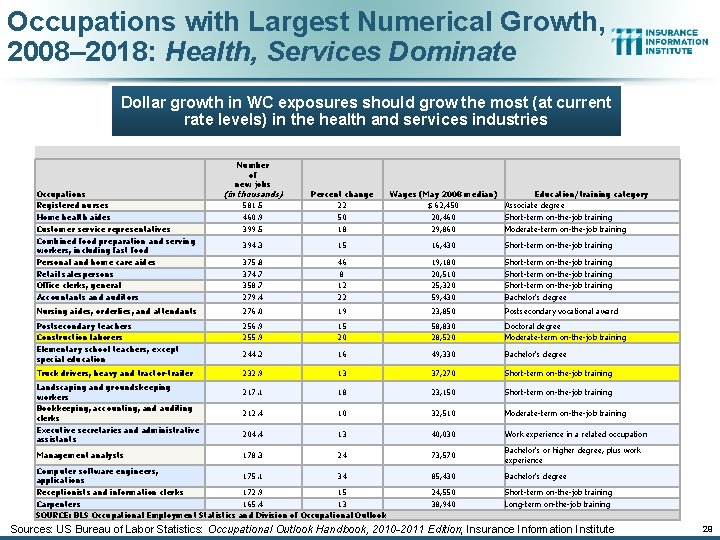
Occupations with Largest Numerical Growth, 2008– 2018: Health, Services Dominate Dollar growth in WC exposures should grow the most (at current rate levels) in the health and services industries Number of new jobs Occupations Registered nurses Home health aides Customer service representatives Combined food preparation and serving workers, including fast food Personal and home care aides Retail salespersons Office clerks, general Accountants and auditors (in thousands) 581. 5 460. 9 399. 5 Percent change 22 50 18 394. 3 15 16, 430 Short-term on-the-job training 375. 8 374. 7 358. 7 279. 4 46 8 12 22 19, 180 20, 510 25, 320 59, 430 Short-term on-the-job training Bachelor's degree Nursing aides, orderlies, and attendants 276. 0 19 23, 850 Postsecondary vocational award Postsecondary teachers Construction laborers Elementary school teachers, except special education 256. 9 255. 9 15 20 58, 830 28, 520 Doctoral degree Moderate-term on-the-job training 244. 2 16 49, 330 Bachelor's degree Truck drivers, heavy and tractor-trailer 232. 9 13 37, 270 Short-term on-the-job training 217. 1 18 23, 150 Short-term on-the-job training 212. 4 10 32, 510 Moderate-term on-the-job training 204. 4 13 40, 030 Work experience in a related occupation 178. 3 24 73, 570 Bachelor's or higher degree, plus work experience 85, 430 Bachelor's degree 24, 550 38, 940 Short-term on-the-job training Long-term on-the-job training Landscaping and groundskeeping workers Bookkeeping, accounting, and auditing clerks Executive secretaries and administrative assistants Management analysts Computer software engineers, 175. 1 34 applications 172. 9 15 Receptionists and information clerks 165. 4 13 Carpenters SOURCE: BLS Occupational Employment Statistics and Division of Occupational Outlook Wages (May 2008 median) Education/training category $ 62, 450 Associate degree 20, 460 Short-term on-the-job training 29, 860 Moderate-term on-the-job training Sources: US Bureau of Labor Statistics: Occupational Outlook Handbook, 2010 -2011 Edition; Insurance Information Institute 29
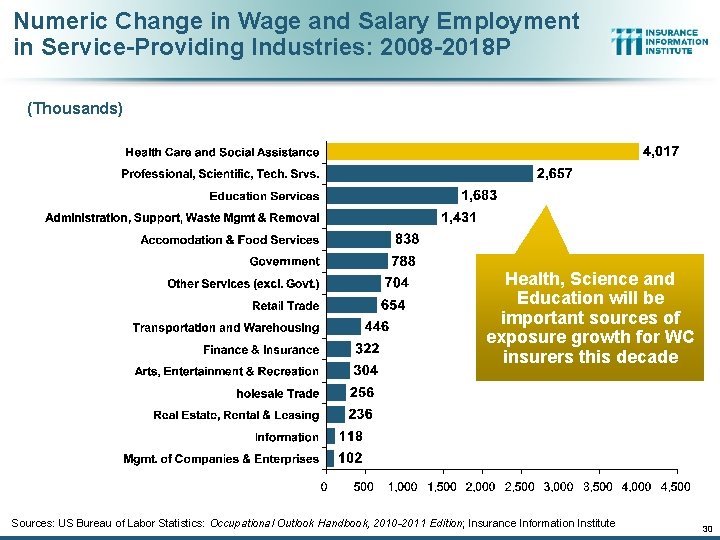
Numeric Change in Wage and Salary Employment in Service-Providing Industries: 2008 -2018 P (Thousands) Health, Science and Education will be important sources of exposure growth for WC insurers this decade Sources: US Bureau of Labor Statistics: Occupational Outlook Handbook, 2010 -2011 Edition; Insurance Information Institute 30
Inflation Trends: Concerns Over Stimulus Spending and Monetary Policy Mounting Pressure on Claim Cost Severities? 31
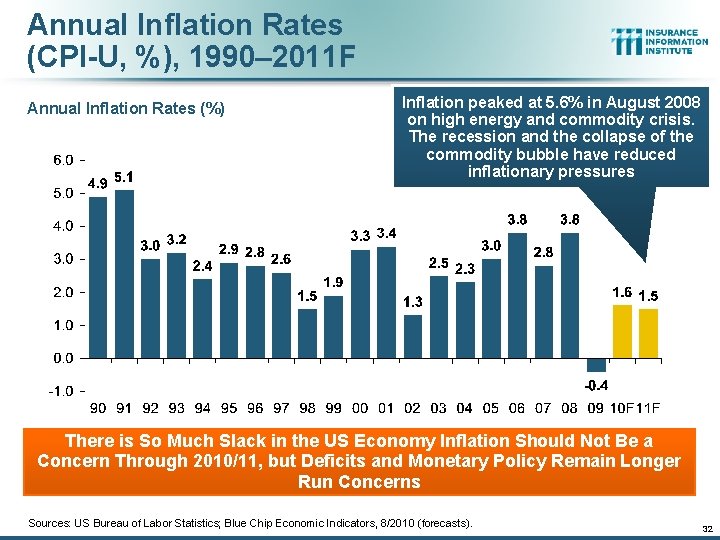
Annual Inflation Rates (CPI-U, %), 1990– 2011 F Annual Inflation Rates (%) Inflation peaked at 5. 6% in August 2008 on high energy and commodity crisis. The recession and the collapse of the commodity bubble have reduced inflationary pressures There is So Much Slack in the US Economy Inflation Should Not Be a Concern Through 2010/11, but Deficits and Monetary Policy Remain Longer Run Concerns Sources: US Bureau of Labor Statistics; Blue Chip Economic Indicators, 8/2010 (forecasts). 32
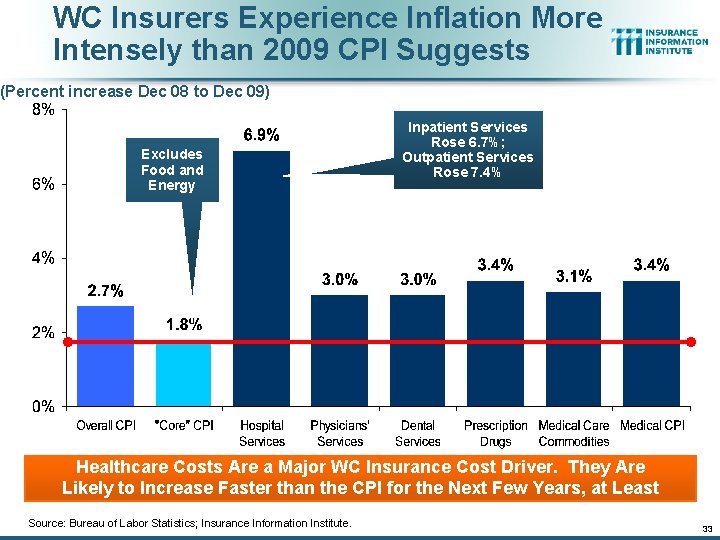
WC Insurers Experience Inflation More Intensely than 2009 CPI Suggests (Percent increase Dec 08 to Dec 09) Excludes Food and Energy Inpatient Services Rose 6. 7%; Outpatient Services Rose 7. 4% Healthcare Costs Are a Major WC Insurance Cost Driver. They Are Likely to Increase Faster than the CPI for the Next Few Years, at Least Source: Bureau of Labor Statistics; Insurance Information Institute. 33
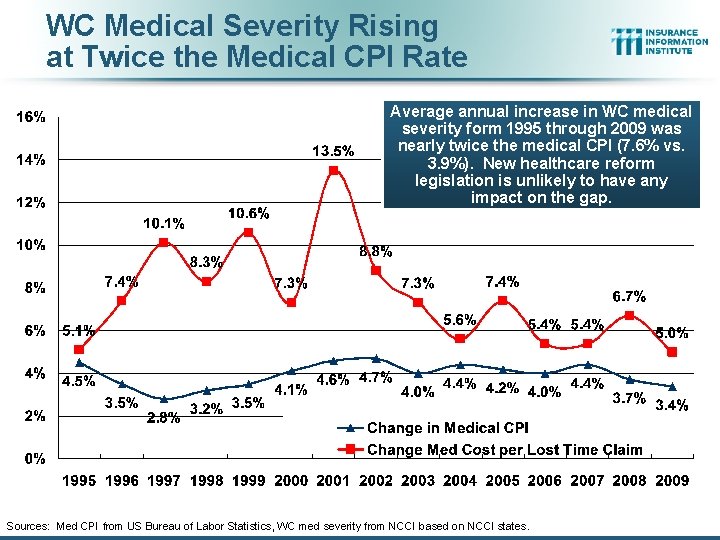
WC Medical Severity Rising at Twice the Medical CPI Rate Average annual increase in WC medical severity form 1995 through 2009 was nearly twice the medical CPI (7. 6% vs. 3. 9%). New healthcare reform legislation is unlikely to have any impact on the gap. Sources: Med CPI from US Bureau of Labor Statistics, WC med severity from NCCI based on NCCI states.
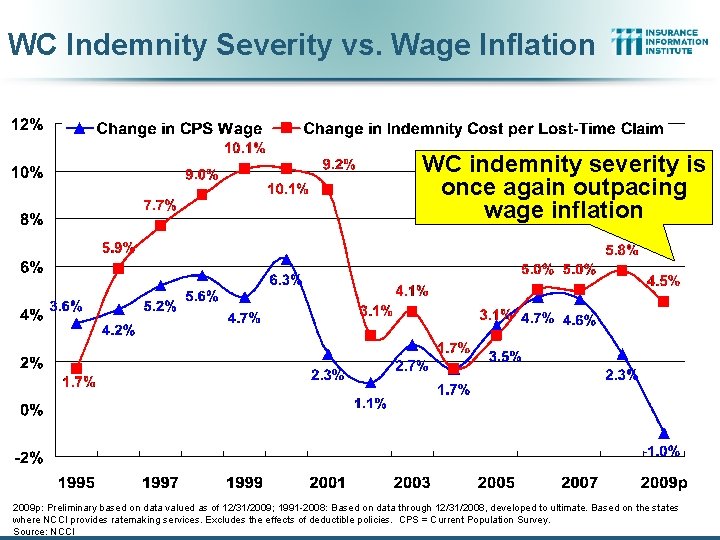
WC Indemnity Severity vs. Wage Inflation WC indemnity severity is once again outpacing wage inflation 2009 p: Preliminary based on data valued as of 12/31/2009; 1991 -2008: Based on data through 12/31/2008, developed to ultimate. Based on the states where NCCI provides ratemaking services. Excludes the effects of deductible policies. CPS = Current Population Survey. Source: NCCI
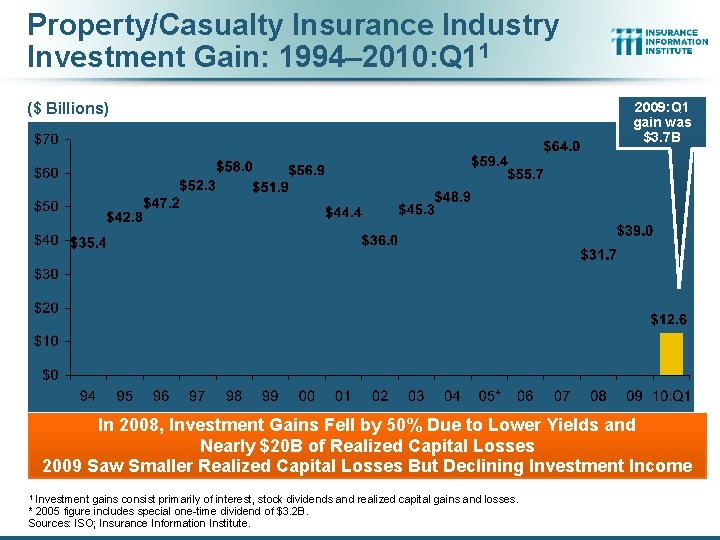
Investment Performance Persistently Low Interest Rates Must Eventually Impact Pricing as Underwriting Losses Mount 36
Property/Casualty Insurance Industry Investment Gain: 1994– 2010: Q 11 ($ Billions) 2009: Q 1 gain was $3. 7 B In 2008, Investment Gains Fell by 50% Due to Lower Yields and Nearly $20 B of Realized Capital Losses 2009 Saw Smaller Realized Capital Losses But Declining Investment Income Investment gains consist primarily of interest, stock dividends and realized capital gains and losses. * 2005 figure includes special one-time dividend of $3. 2 B. Sources: ISO; Insurance Information Institute. 1
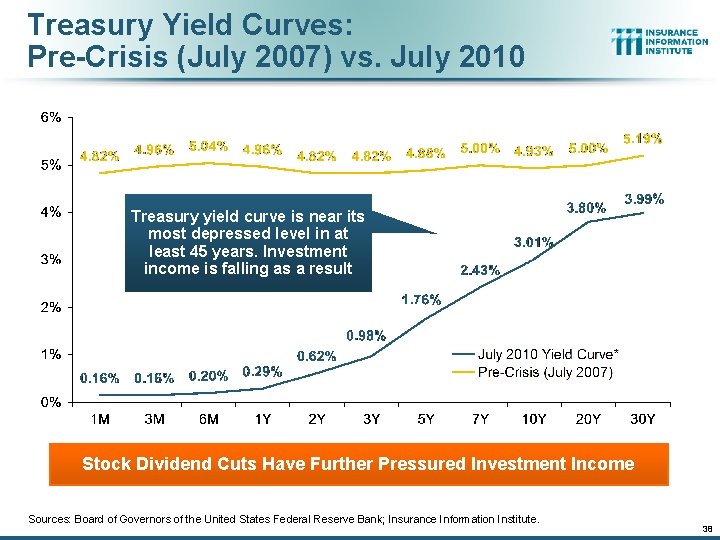
Treasury Yield Curves: Pre-Crisis (July 2007) vs. July 2010 Treasury yield curve is near its most depressed level in at least 45 years. Investment income is falling as a result Stock Dividend Cuts Have Further Pressured Investment Income Sources: Board of Governors of the United States Federal Reserve Bank; Insurance Information Institute. 38
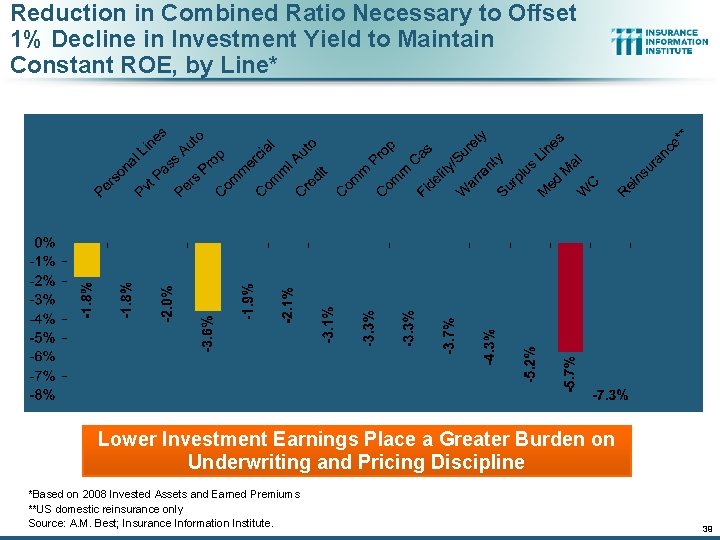
Reduction in Combined Ratio Necessary to Offset 1% Decline in Investment Yield to Maintain Constant ROE, by Line* Lower Investment Earnings Place a Greater Burden on Underwriting and Pricing Discipline *Based on 2008 Invested Assets and Earned Premiums **US domestic reinsurance only Source: A. M. Best; Insurance Information Institute. 39
Healthcare Reform & Workers Compensation Likely a Slight, Net Positive for Workers Comp in the Long Run 40
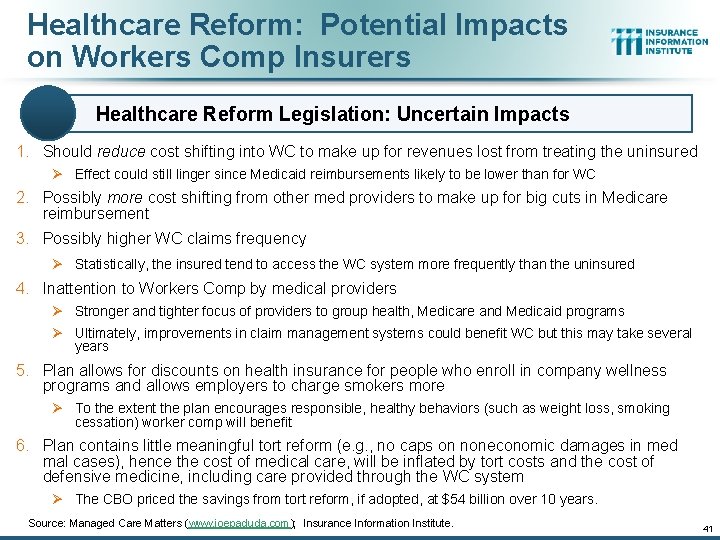
Healthcare Reform: Potential Impacts on Workers Comp Insurers Healthcare Reform Legislation: Uncertain Impacts 1. Should reduce cost shifting into WC to make up for revenues lost from treating the uninsured Ø Effect could still linger since Medicaid reimbursements likely to be lower than for WC 2. Possibly more cost shifting from other med providers to make up for big cuts in Medicare reimbursement 3. Possibly higher WC claims frequency Ø Statistically, the insured tend to access the WC system more frequently than the uninsured 4. Inattention to Workers Comp by medical providers Ø Stronger and tighter focus of providers to group health, Medicare and Medicaid programs Ø Ultimately, improvements in claim management systems could benefit WC but this may take several years 5. Plan allows for discounts on health insurance for people who enroll in company wellness programs and allows employers to charge smokers more Ø To the extent the plan encourages responsible, healthy behaviors (such as weight loss, smoking cessation) worker comp will benefit 6. Plan contains little meaningful tort reform (e. g. , no caps on noneconomic damages in med mal cases), hence the cost of medical care, will be inflated by tort costs and the cost of defensive medicine, including care provided through the WC system Ø The CBO priced the savings from tort reform, if adopted, at $54 billion over 10 years. Source: Managed Care Matters (www. joepaduda. com); Insurance Information Institute. 41
Insurance Information Institute Online: www. iii. org Thank you for your time and your attention! Twitter: twitter. com/bob_hartwig