
Workers Compensation An Introduction Tee L Guidotti George
- Slides: 21
Workers’ Compensation: An Introduction Tee L. Guidotti George Washington University Medical Center
Workers’ Compensation is • nation’s first social insurance scheme • a state responsibility, organized by state • a compromise • mostly for industrial workers • funded by employers through premiums is not • a welfare scheme or entitlement program • a federal government responsibility • a single plan • required for very small employers • tax supported
What existed before WC? • Crisis during the Industrial Revolution • Injured workers had to sue employer • Courts deliberately tried to protect employers in interest of increasing employment, wages • Legal defenses for employers insurmountable: – “assumption of risk” = worker voluntarily accepts risk of a dangerous job – “fellow servant doctrine” = employer is not responsible if injury due to action of another employee – “contributory negligence” = if any action by injured worker can be construed to have contributed to risk
What forced the change? • Skyrocketing injury rates created social, political problems • Labor unions started using this as an organizing issue • As economy settled down, courts became more open to worker-initiated lawsuits • Muckraking (e. g. The Jungle) • Political climate changed: Progressive movement • Model available: Germany, UK
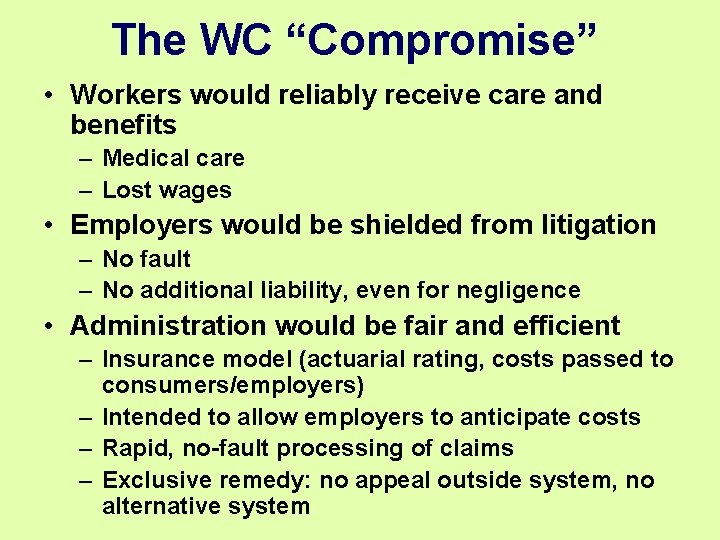
The WC “Compromise” • Workers would reliably receive care and benefits – Medical care – Lost wages • Employers would be shielded from litigation – No fault – No additional liability, even for negligence • Administration would be fair and efficient – Insurance model (actuarial rating, costs passed to consumers/employers) – Intended to allow employers to anticipate costs – Rapid, no-fault processing of claims – Exclusive remedy: no appeal outside system, no alternative system
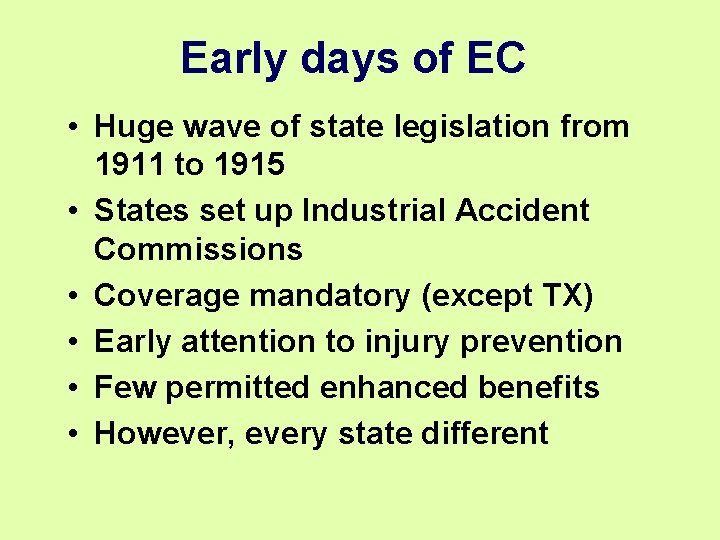
Early days of EC • Huge wave of state legislation from 1911 to 1915 • States set up Industrial Accident Commissions • Coverage mandatory (except TX) • Early attention to injury prevention • Few permitted enhanced benefits • However, every state different
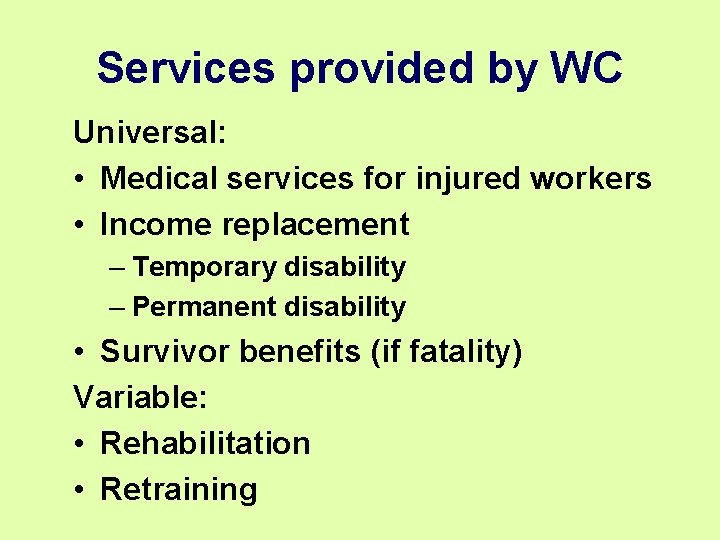
Services provided by WC Universal: • Medical services for injured workers • Income replacement – Temporary disability – Permanent disability • Survivor benefits (if fatality) Variable: • Rehabilitation • Retraining
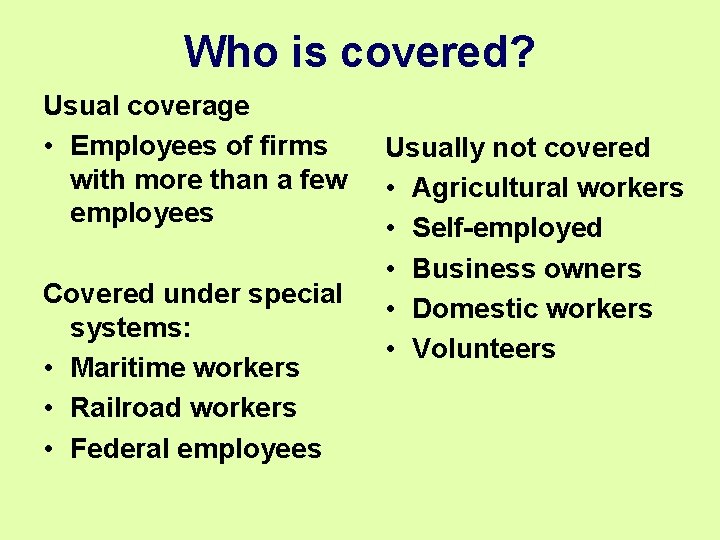
Who is covered? Usual coverage • Employees of firms with more than a few employees Covered under special systems: • Maritime workers • Railroad workers • Federal employees Usually not covered • Agricultural workers • Self-employed • Business owners • Domestic workers • Volunteers
Permanent disability benefits • Two-thirds of WC disability benefits • Wide variation in adjudication, criteria • Ratings are based on: – Impairment assessment (medically discernable injury) – Actual wage loss – Permanent loss of earnings potential (considering job market) • Scheduled awards for specific impairments are trend (since NJ 1911) – Covers future wage loss – Unjust for injured workers to forgo benefits even if little wage loss at the time
How permanent disability is rated Three basic approaches • Impairment model – Based on schedules – Based on guidelines (e. g. AMA Guides) • Wage-loss formula Calculates actual loss of wages due to injury • Loss of earnings capacity Loss of future wages based on actuarial model
The AMA Guides to the Evaluation of Permanent Impairment • • Like any tool, needs to be used properly Not a cookbook: often gives a range Achieves some consistency Face validity in terms of relative impairment within functional systems • Expert consensus
Downside to the AMA Guides • No objective validation • Often used indiscriminately as a formula for disability • Avoids many important types of disability: – – – Chronic pain Mental changes, depression Reversible conditions, such as airways reactivity Dermatitis Stress-related disorders (e. g. irritable colon) • Has become a self-perpetuating industry involving complicated revisions, guides to the Guides, training programs and even a certification scheme
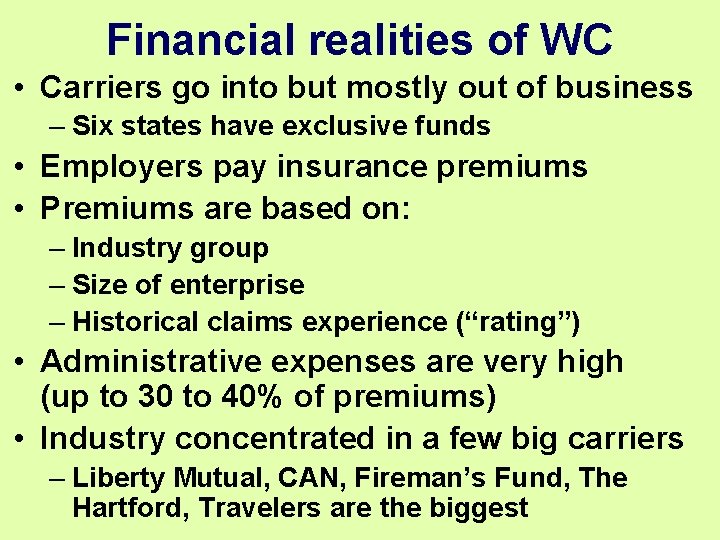
Financial realities of WC • Carriers go into but mostly out of business – Six states have exclusive funds • Employers pay insurance premiums • Premiums are based on: – Industry group – Size of enterprise – Historical claims experience (“rating”) • Administrative expenses are very high (up to 30 to 40% of premiums) • Industry concentrated in a few big carriers – Liberty Mutual, CAN, Fireman’s Fund, The Hartford, Travelers are the biggest
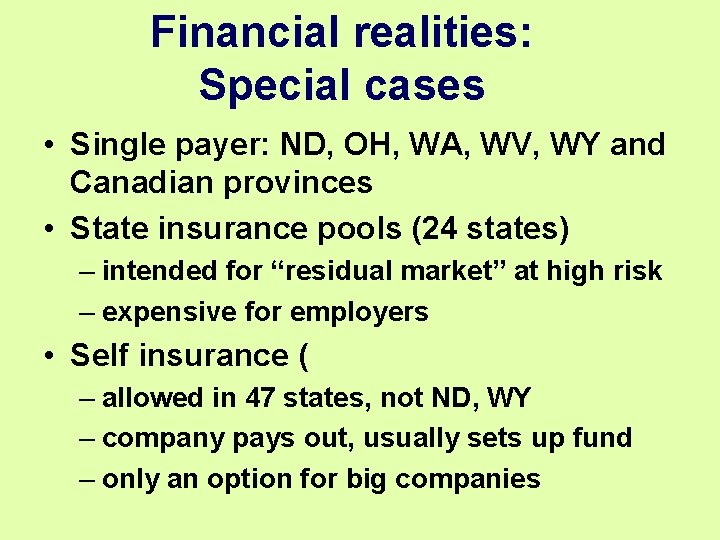
Financial realities: Special cases • Single payer: ND, OH, WA, WV, WY and Canadian provinces • State insurance pools (24 states) – intended for “residual market” at high risk – expensive for employers • Self insurance ( – allowed in 47 states, not ND, WY – company pays out, usually sets up fund – only an option for big companies
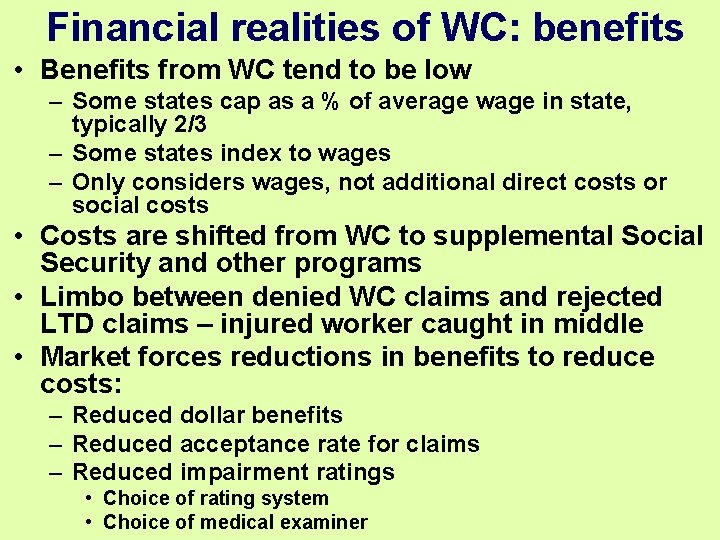
Financial realities of WC: benefits • Benefits from WC tend to be low – Some states cap as a % of average wage in state, typically 2/3 – Some states index to wages – Only considers wages, not additional direct costs or social costs • Costs are shifted from WC to supplemental Social Security and other programs • Limbo between denied WC claims and rejected LTD claims – injured worker caught in middle • Market forces reductions in benefits to reduce costs: – Reduced dollar benefits – Reduced acceptance rate for claims – Reduced impairment ratings • Choice of rating system • Choice of medical examiner
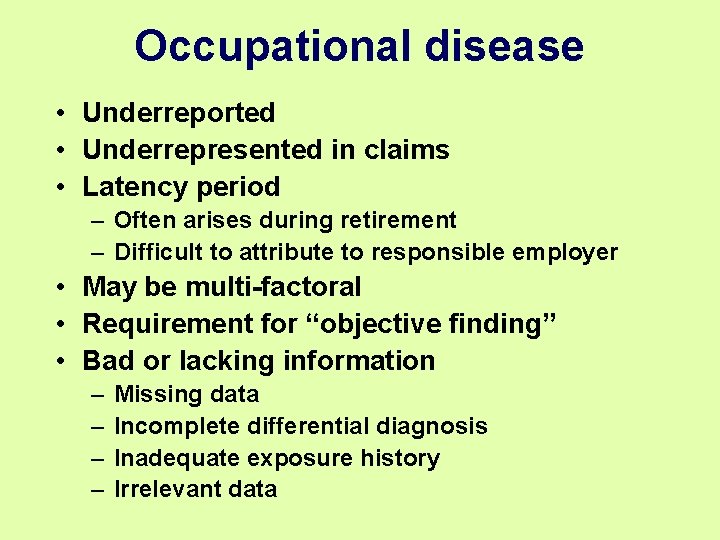
Occupational disease • Underreported • Underrepresented in claims • Latency period – Often arises during retirement – Difficult to attribute to responsible employer • May be multi-factoral • Requirement for “objective finding” • Bad or lacking information – – Missing data Incomplete differential diagnosis Inadequate exposure history Irrelevant data
Sociology of WC • Deeply rooted distrust – Of workers – Of employers – Of carriers • Abuse of system – By injured workers – By malingering workers – By employers – By carriers • Fear of consequences of filing a claim • Emphasis on “moral hazard”
Sociology of injured workers • Filing claim may bring stimatizaiton – Esp. if injury is not obvious – Esp. if embarrassing to employer – Esp. if highly visible to other workers • PD or prolonged rehabilitation – Wearing on family – Coworkers often turn unsympathetic, even hostile – Neighbors, friends get tired, even suspicious of abuse • Injured worker gets depressed – Depressed people are difficult to be around – Intimations of fraud, exaggeration, abuse – Involutional cycle
Role of physician • Who picks: the right of choice of physician: – Worker (half of states and DC) • Usually family physician – Employer or insurer (half of states, inc. VA) • Often on list of approved providers • Has given rise to PPO, other managed care models • Control over medical records is lost by worker
Federal and Special Programs • Federal workers – Federal Employees Compensation Act – Do. E Office of Compensation Programs • nuclear workers (radiation exposed) • nuclear workers (chemical exposure) • Federally administered – Longshore and Harbor Workers’ Compensation Act – Federal Black Lung Program
Occupations not covered by workers’ compensation These workers have programs that cover disability whether work-related or not; worker retains access to tort litigation • US Merchant Marine • Railroad workers in interstate commerce