
Worker Protection Standard WPS Federal Changes Oregon OSHA

- Slides: 17
Worker Protection Standard (WPS) Federal Changes? Oregon OSHA Changes to Federal WPS Rose Kachadoorian Oregon Department of Agriculture (ODA) Oregon Association of Nurseries Annual Meeting Salishan Lodge & Golf Resort November 3, 2017
Background Worker Protection Standard (WPS) Compliance Enforcement in Oregon Department of Agriculture (ODA): • Enforces label provisions of WPS, usually found in “Agricultural Use Requirements” box • Restricted Entry Interval (REI) • Personal Protective Equipment (PPE)
OR-OSHA Enforces: Background Other aspects of WPS, including workplace compliance aspects of: • • training of workers, recordkeeping, placement of decontamination supplies, notification information, etc.
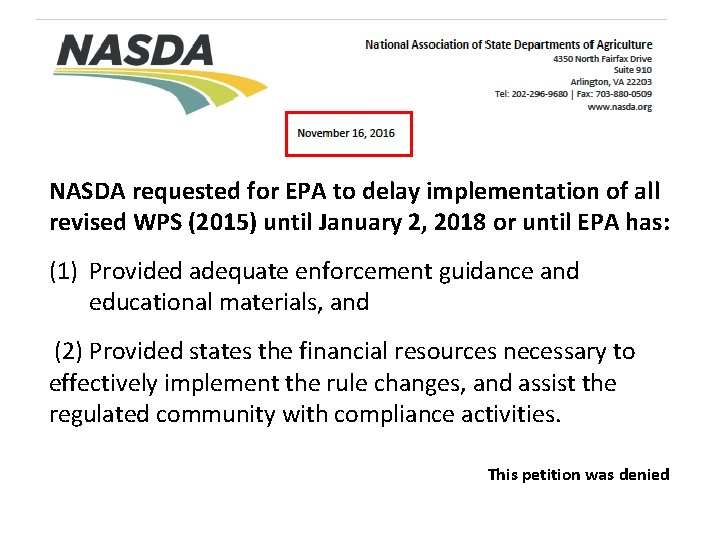
NASDA requested for EPA to delay implementation of all revised WPS (2015) until January 2, 2018 or until EPA has: (1) Provided adequate enforcement guidance and educational materials, and (2) Provided states the financial resources necessary to effectively implement the rule changes, and assist the regulated community with compliance activities. This petition was denied
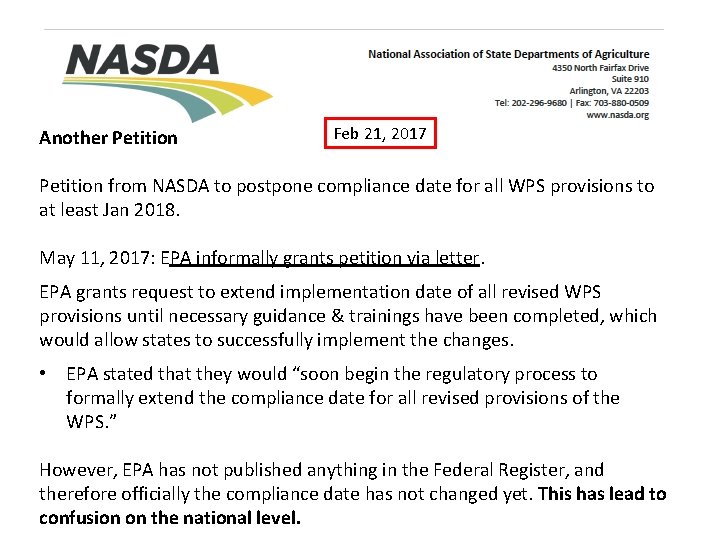
Another Petition Feb 21, 2017 Petition from NASDA to postpone compliance date for all WPS provisions to at least Jan 2018. May 11, 2017: EPA informally grants petition via letter. EPA grants request to extend implementation date of all revised WPS provisions until necessary guidance & trainings have been completed, which would allow states to successfully implement the changes. • EPA stated that they would “soon begin the regulatory process to formally extend the compliance date for all revised provisions of the WPS. ” However, EPA has not published anything in the Federal Register, and therefore officially the compliance date has not changed yet. This has lead to confusion on the national level.
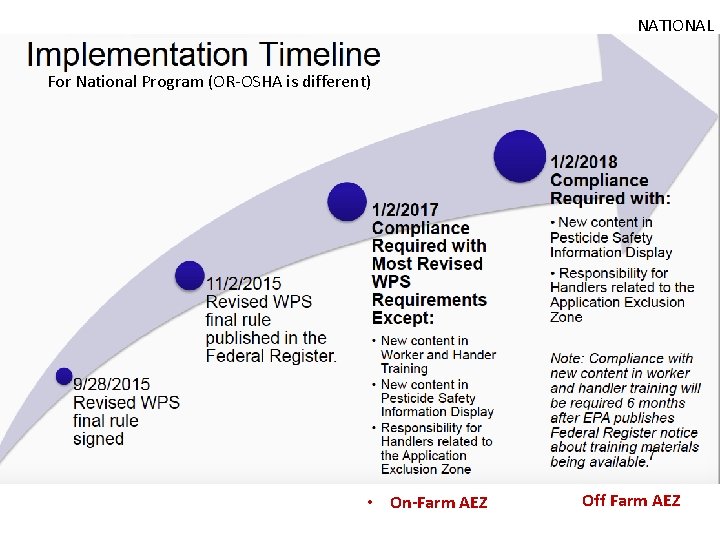
NATIONAL For National Program (OR-OSHA is different) • On-Farm AEZ Off Farm AEZ
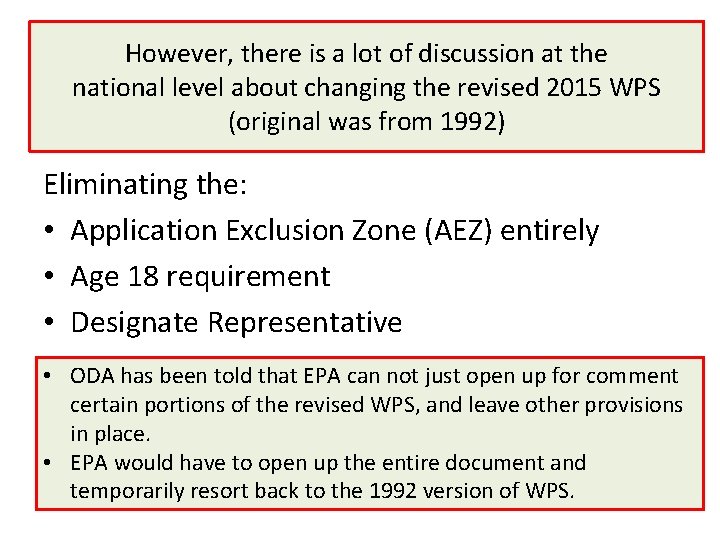
However, there is a lot of discussion at the national level about changing the revised 2015 WPS (original was from 1992) Eliminating the: • Application Exclusion Zone (AEZ) entirely • Age 18 requirement • Designate Representative • ODA has been told that EPA can not just open up for comment certain portions of the revised WPS, and leave other provisions in place. • EPA would have to open up the entire document and temporarily resort back to the 1992 version of WPS.
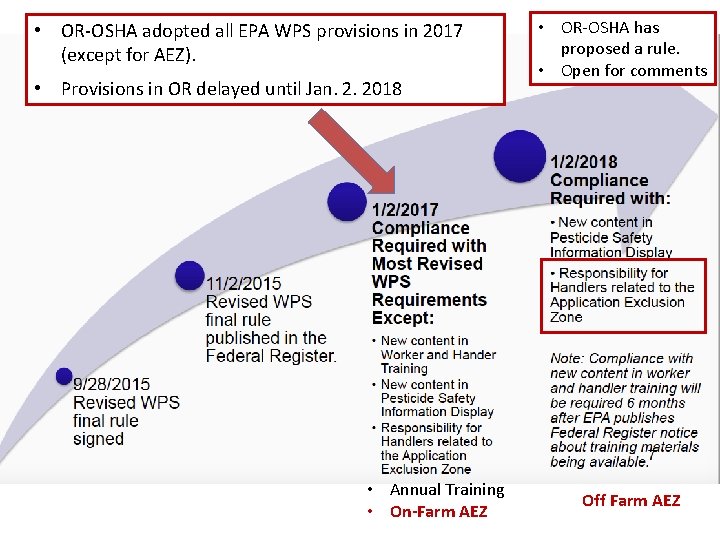
• OR-OSHA adopted all EPA WPS provisions in 2017 (except for AEZ). National Program (OR-OSHA is different) • For. Provisions in OR delayed until Jan. 2. 2018 • Annual Training • On-Farm AEZ • OR-OSHA has proposed a rule. • Open for comments Off Farm AEZ
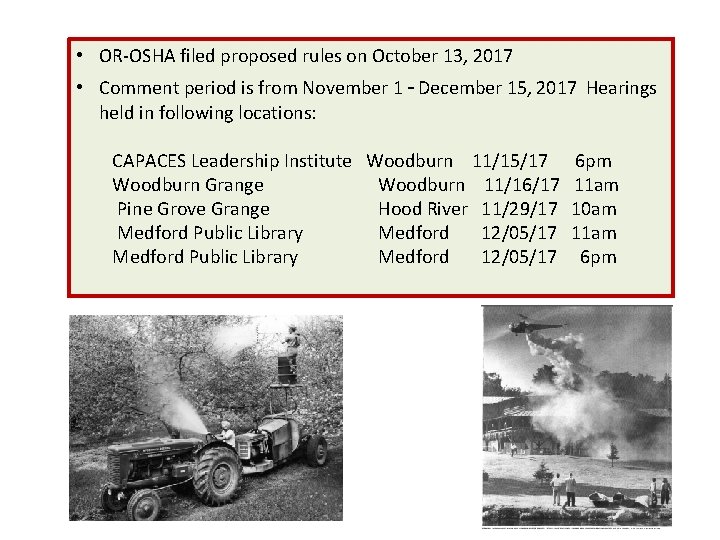
• OR-OSHA filed proposed rules on October 13, 2017 • Comment period is from November 1 – December 15, 2017 Hearings held in following locations: CAPACES Leadership Institute Woodburn 11/15/17 Woodburn Grange Woodburn 11/16/17 Pine Grove Grange Hood River 11/29/17 Medford Public Library Medford 12/05/17 6 pm 11 am 10 am 11 am 6 pm
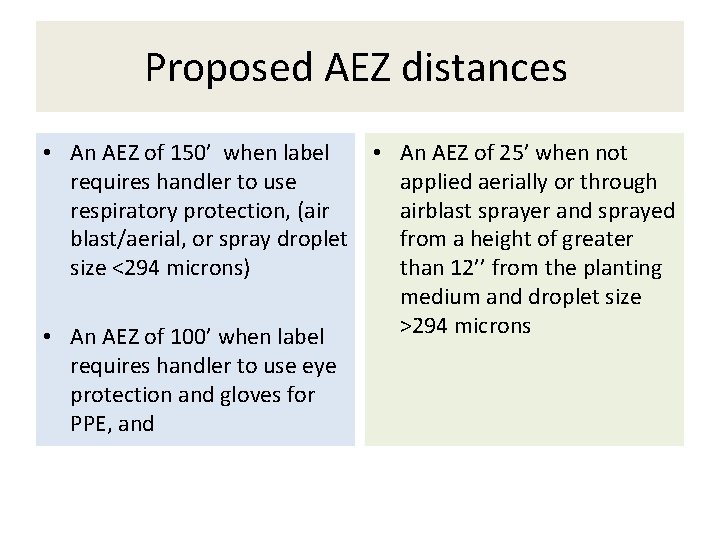
Proposed AEZ distances • An AEZ of 150’ when label requires handler to use respiratory protection, (air blast/aerial, or spray droplet size <294 microns) • An AEZ of 100’ when label requires handler to use eye protection and gloves for PPE, and • An AEZ of 25’ when not applied aerially or through airblast sprayer and sprayed from a height of greater than 12’’ from the planting medium and droplet size >294 microns
Appropriately trained and equipped handlers involved in the application are not subject to AEZ rules
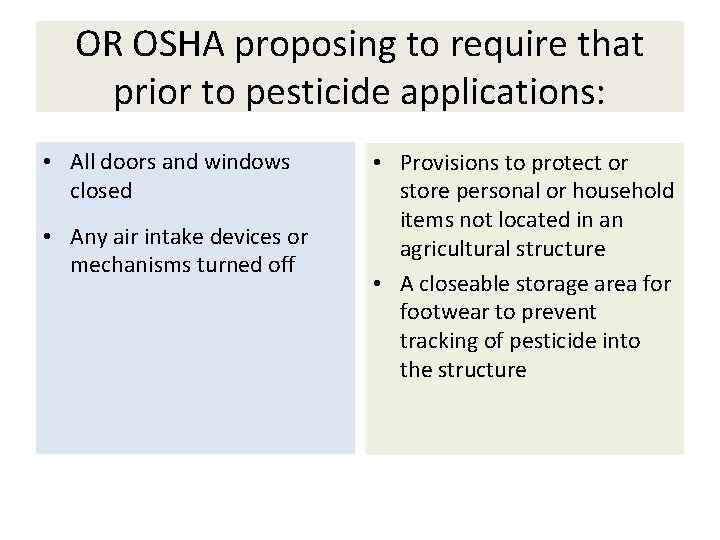
OR OSHA proposing to require that prior to pesticide applications: • All doors and windows closed • Any air intake devices or mechanisms turned off • Provisions to protect or store personal or household items not located in an agricultural structure • A closeable storage area for footwear to prevent tracking of pesticide into the structure
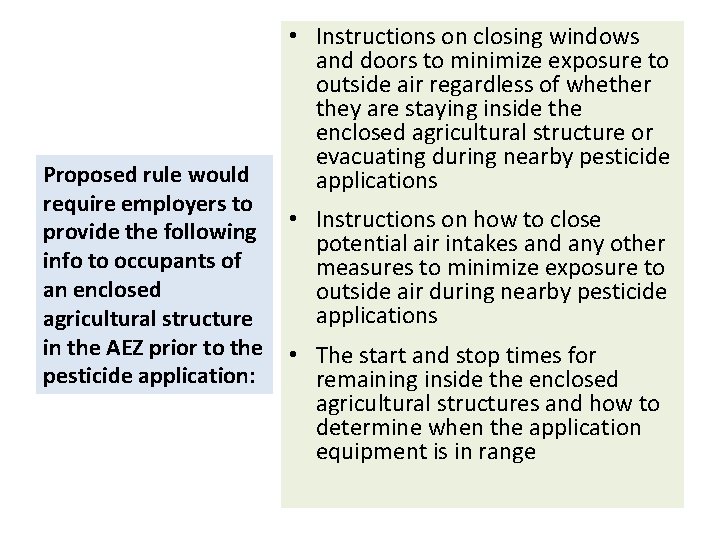
Proposed rule would require employers to provide the following info to occupants of an enclosed agricultural structure in the AEZ prior to the pesticide application: • Instructions on closing windows and doors to minimize exposure to outside air regardless of whether they are staying inside the enclosed agricultural structure or evacuating during nearby pesticide applications • Instructions on how to close potential air intakes and any other measures to minimize exposure to outside air during nearby pesticide applications • The start and stop times for remaining inside the enclosed agricultural structures and how to determine when the application equipment is in range
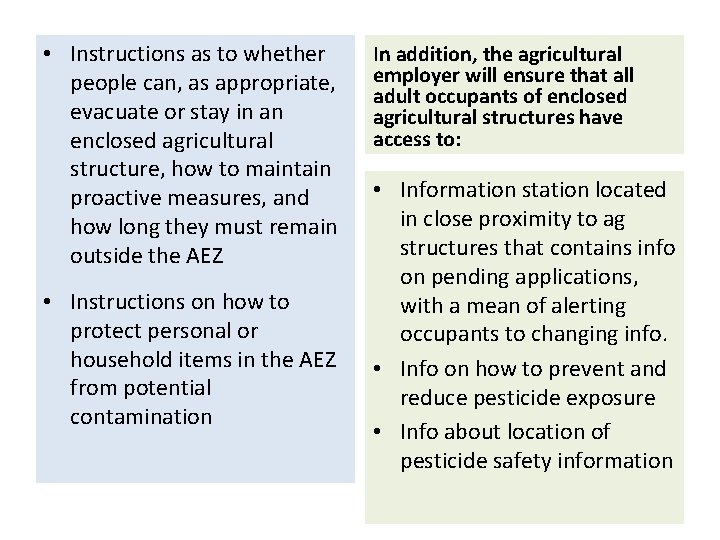
• Instructions as to whether people can, as appropriate, evacuate or stay in an enclosed agricultural structure, how to maintain proactive measures, and how long they must remain outside the AEZ • Instructions on how to protect personal or household items in the AEZ from potential contamination In addition, the agricultural employer will ensure that all adult occupants of enclosed agricultural structures have access to: • Information station located in close proximity to ag structures that contains info on pending applications, with a mean of alerting occupants to changing info. • Info on how to prevent and reduce pesticide exposure • Info about location of pesticide safety information
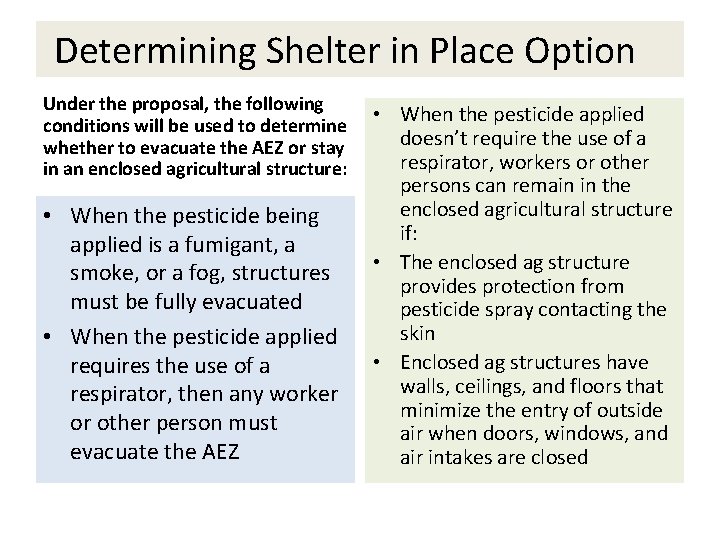
Determining Shelter in Place Option Under the proposal, the following conditions will be used to determine whether to evacuate the AEZ or stay in an enclosed agricultural structure: • When the pesticide being applied is a fumigant, a smoke, or a fog, structures must be fully evacuated • When the pesticide applied requires the use of a respirator, then any worker or other person must evacuate the AEZ • When the pesticide applied doesn’t require the use of a respirator, workers or other persons can remain in the enclosed agricultural structure if: • The enclosed ag structure provides protection from pesticide spray contacting the skin • Enclosed ag structures have walls, ceilings, and floors that minimize the entry of outside air when doors, windows, and air intakes are closed
Innovation Incentive • As a way to encourage innovation, OR-OSHA may grant approval for AEZs that differ from the rule requirements yet meet the intent of the rules through OR-OSHA’s Variance process
Examples: • EPA’s Drift Reduction Technology • Advanced application practices for handlers in the prevention of spray drift • The use of two applicators to improve communication and monitoring of weather conditions