
Workbook for Designing Implementing and Evaluating a Sharps
Workbook for Designing, Implementing and Evaluating a Sharps Injury Prevention Program
The Problem of Sharps Injuries • CDC estimates ~385, 000 sharps injuries annually among hospital-based healthcare personnel* • Sharps injuries are a hazard – Increased risk for bloodborne virus transmission – Cost to workers and healthcare system *Panlilio AL, et al. Infect Control Hosp Epidemiol, 2004
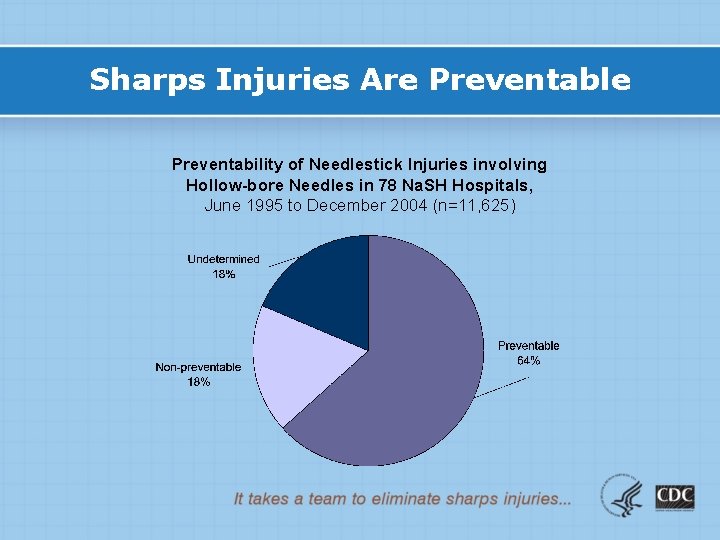
Sharps Injuries Are Preventable Preventability of Needlestick Injuries involving Hollow-bore Needles in 78 Na. SH Hospitals, June 1995 to December 2004 (n=11, 625)
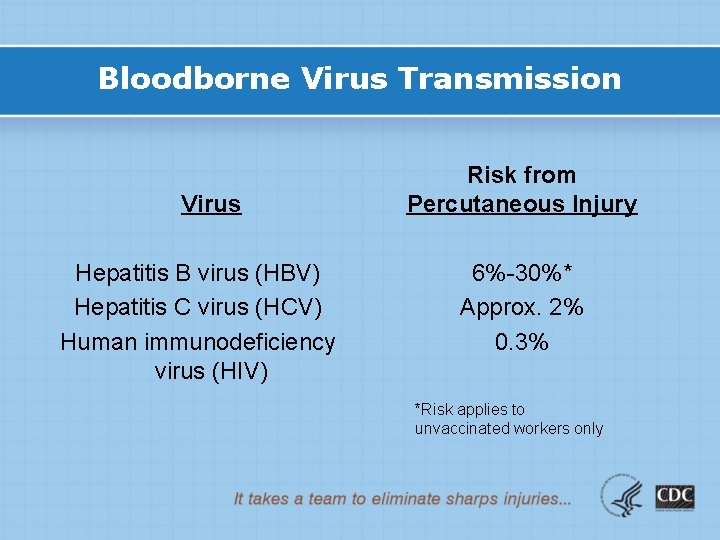
Bloodborne Virus Transmission Virus Hepatitis B virus (HBV) Hepatitis C virus (HCV) Human immunodeficiency virus (HIV) Risk from Percutaneous Injury 6%-30%* Approx. 2% 0. 3% *Risk applies to unvaccinated workers only
The Costs of Sharps Injuries • Medical costs – $71 to ~$5, 000 per exposure* • Lost time from work • Emotional cost • Long-term costs * O’Malley EM, et al. Infect Control Hosp Epidemiol, 2007

Needlestick Safety and Prevention Act (2000) • Federal OSHA standard requires: – Use of engineering and work practice controls – Recordkeeping on a Sharps Injury Log – Written Exposure Control Plan

Exposure Control Plan • Must reflect changes in technology use for prevention • Document annual consideration, evaluation of safer sharps devices – Employers are required to solicit input from direct patient care personnel regarding the identification and selection of engineering and work practice controls.
Recent OSHA Citations • July 2003: Fined nursing home $92, 500 for “serious” and “willful” violations – Levied maximum fine for willful violations: failure to utilize sharps safety devices • September 2003: Hospital fined $9, 000 – Complaint filed by staff that safety-engineered devices were not available Source: Advances in Exposure Prevention
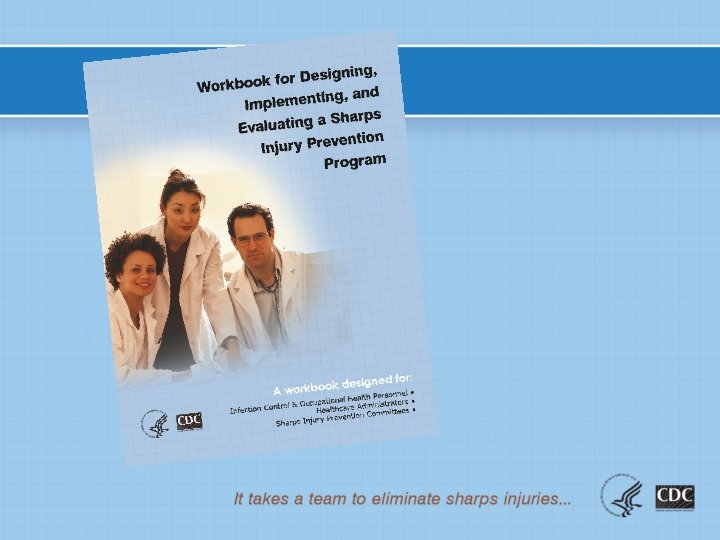
Purpose of Workbook • Assist healthcare facilities to organize a sharps injury prevention program • All-in-one tool that helps: – Develop and maintain a program – Enhance or augment existing programs

The Workbook will help… • Assess a facility’s sharps injury prevention program • Document a prevention plan and implementation of activities • Evaluate the impact of prevention measures
Contents of the Workbook • Overview of sharps injury epidemiology and prevention strategies • Organization-wide method of developing prevention program – Based on model of Continuous Quality Improvement (CQI) • Program model of operational processes • Program resources
Organizational Steps 1. Develop organizational capacity – Form a multidisciplinary leadership team 2. Assess the operational processes of the prevention program 3. Prepare a baseline profile of sharps injuries and current prevention activities
Organizational Steps (cont’d. ) 4. Determine prevention priorities 5. Develop and implement Action Plan – Action plan focuses on reducing injuries and improving program activities 6. Monitor performance improvement

Operational Processes Essential activities of any sharps injury prevention program
Operational Processes • The 5 processes: – Develop an institution-wide culture of safety in the work environment – Promote reporting of sharps injuries and injury hazards – Analyze sharps injury data for prevention planning – Select/evaluate sharps injury prevention devices – Educate and train healthcare personnel
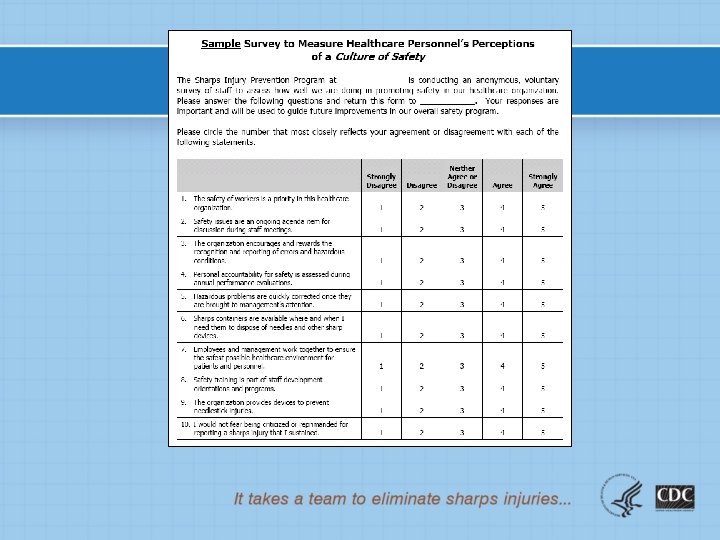
Operational Processes: Culture of Safety Culture of safety: the shared commitment of management and employees to ensure the safety of patients and personnel • Measures of safety culture are linked to: – Reductions in sharps injuries – Personnel compliance with safe work practices – Availability of devices with engineered safety features • Workbook contains: – Strategies for creating a culture of safety – Survey form for measuring the safety “climate” among personnel
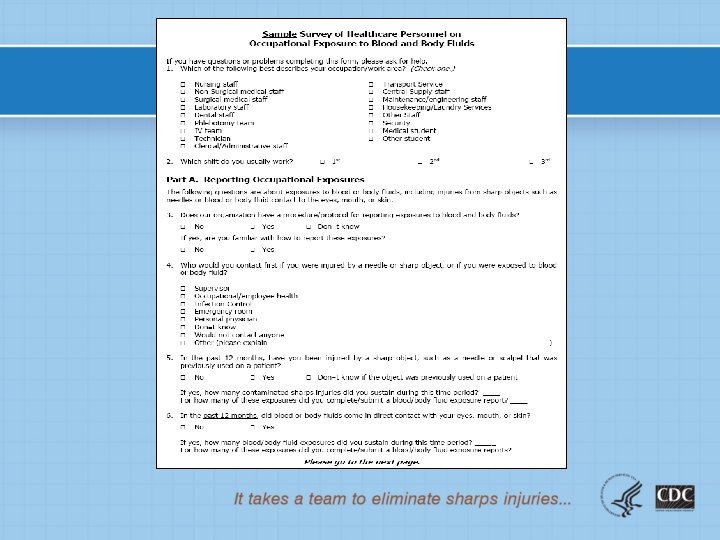
Operational Processes: Injury Reporting • Under-reporting of sharps injuries continues to be an issue at healthcare facilities – Varies by occupation, department and facility – Is influenced by the safety culture and safety climate • CDC Na. SH data from 38 hospitals, 1996 -2003 – only 45% of total injuries are reported
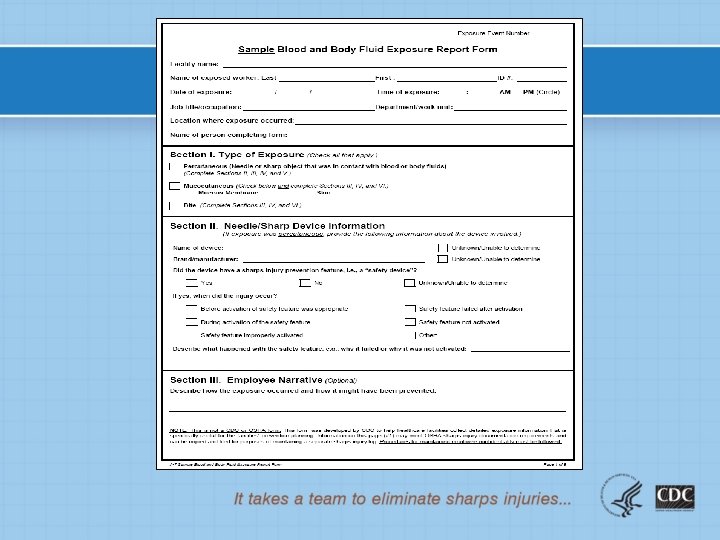
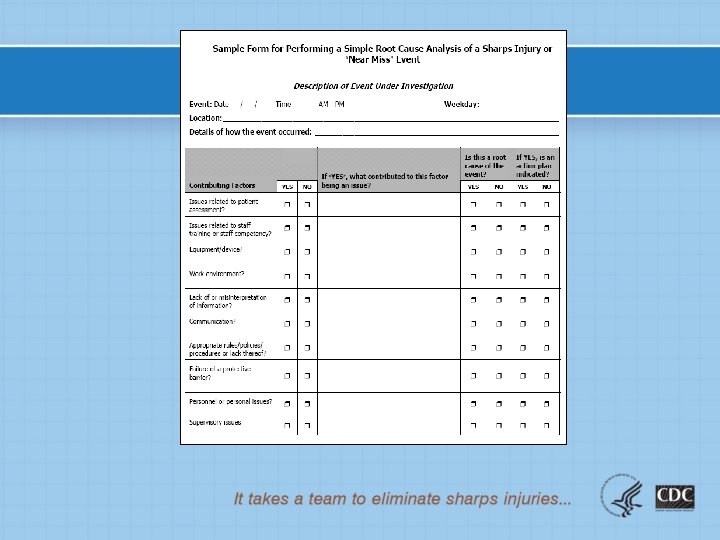
Operational Processes: Injury Reporting (cont’d. ) • Workbook tools: – Reporting survey – Blood and body fluid exposure report form – Sharps injury hazard observation and report forms – Root cause analysis form
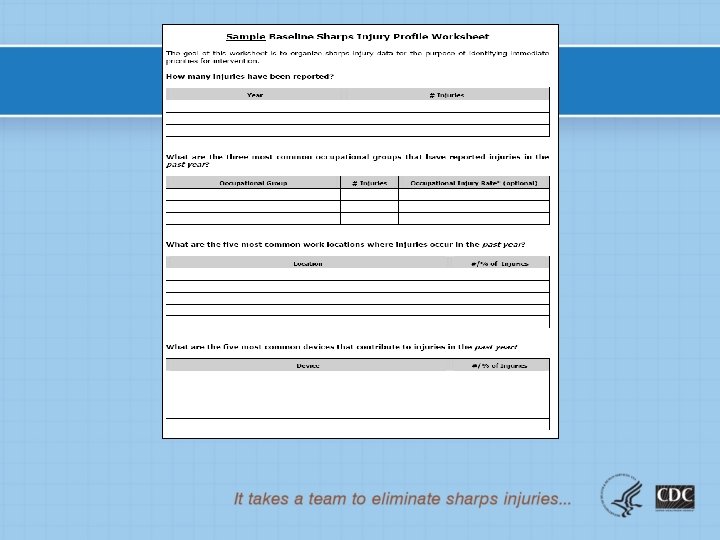
Operational Processes: Analysis of Data • Analysis of sharps injury data drives prevention planning • Workbook features: – Instructions for compiling and analyzing data – Directions for calculating sharps injury rates
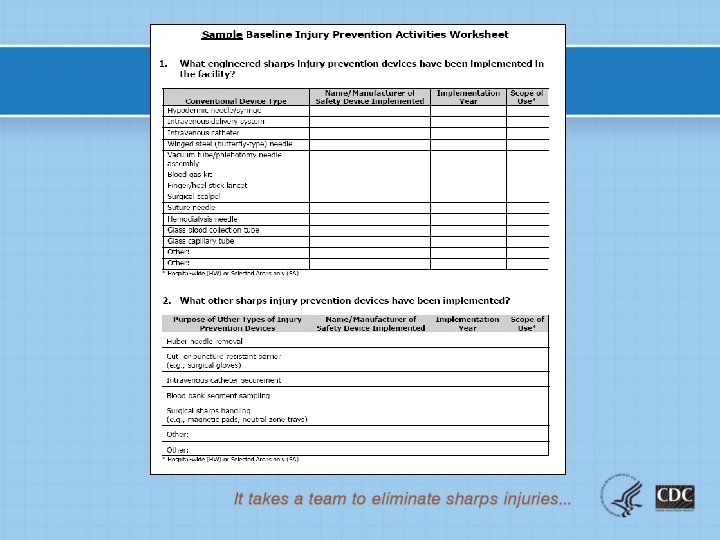
Operational Processes: Selection/Evaluation of Devices • A Systematic approach for selecting devices ensures: – comprehensive review of devices – thorough selection process • Key elements of this approach: – Team input – Review current device use, prioritize devices for consideration – In-use evaluation of new devices
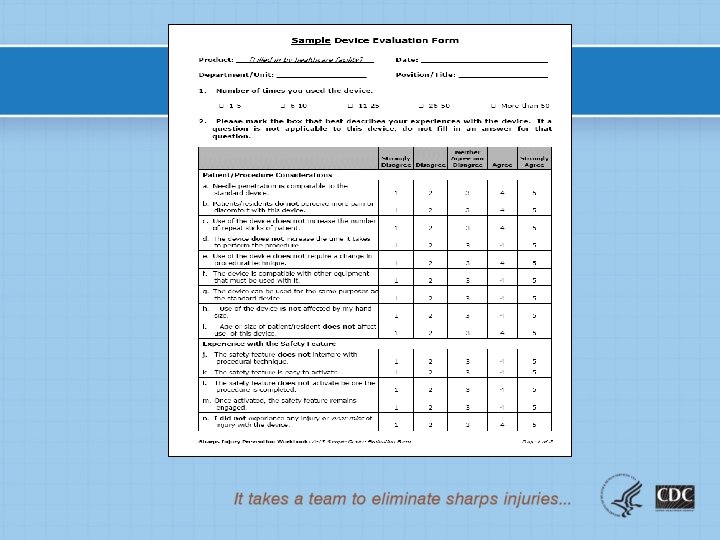
Operational Processes: Selection/Evaluation of Devices (cont’d. ) • Workbook tools: – Survey of device use (by department or unit) – Device pre-selection worksheet – Device evaluation form
Operational Processes: Education and Training of Personnel • Workbook features: – General guidance on sharps injury prevention education and training – List of websites of other educational resources

Other Resources • Sections on safe work practices and problemspecific strategies for preventing sharps injuries • Cost analysis – Sample form for estimating cost of needlesticks – Sample form for estimating device-specific injury costs – Sample form for estimating device implementation costs
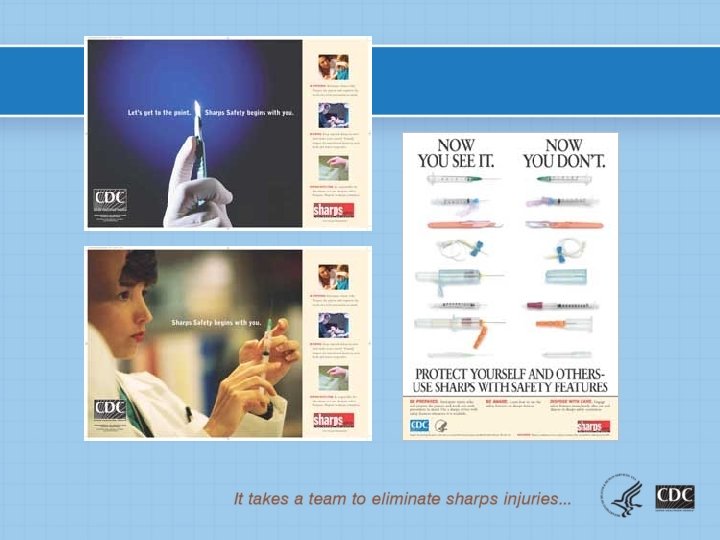

Summary • Sharps injuries are an important concern – Increased risk of disease transmission – High costs to personnel and healthcare system • Most sharps injuries are preventable • Needlestick Safety and Prevention Act requires prevention efforts be undertaken
Summary (cont’d. ) • Workbook is a comprehensive collection of valuable resources • Valuable in development of sharps injury prevention program • Potential to enhance current prevention activities
Summary (cont’d. ) • Useful Workbook tools may benefit other organizational processes by: – Enhancing teamwork – Improving perceptions of safety culture – Reducing costs due to more effective, focused prevention efforts
Optional Extra Slides

![Sharps Injuries at [insert your hospital name] by Distribution of Safety Device](http://slidetodoc.com/presentation_image_h/e10f5979f6c21523c7ceec9b21b4d6ad/image-39.jpg "Sharps Injuries at [insert your hospital name] by Distribution of Safety Device")
Sharps Injuries at [insert your hospital name] by Distribution of Safety Device
![Sharps Injuries at [insert your hospital name] by Device](http://slidetodoc.com/presentation_image_h/e10f5979f6c21523c7ceec9b21b4d6ad/image-40.jpg "Sharps Injuries at [insert your hospital name] by Device")
Sharps Injuries at [insert your hospital name] by Device
![Sharps Injuries at [insert your hospital name] by Work Location](http://slidetodoc.com/presentation_image_h/e10f5979f6c21523c7ceec9b21b4d6ad/image-41.jpg "Sharps Injuries at [insert your hospital name] by Work Location")
Sharps Injuries at [insert your hospital name] by Work Location
![Sharps Injuries at [insert your hospital name] by Occupational Group](http://slidetodoc.com/presentation_image_h/e10f5979f6c21523c7ceec9b21b4d6ad/image-42.jpg "Sharps Injuries at [insert your hospital name] by Occupational Group")
Sharps Injuries at [insert your hospital name] by Occupational Group
- Slides: 42