
Workbook 6 Money safety Welcome to Money Matters
Workbook 6 Money safety
Welcome to Money Matters! What will you learn? In today’s workshop, you will learn about: Online safety Phishing scams Identity theft Financial abuse
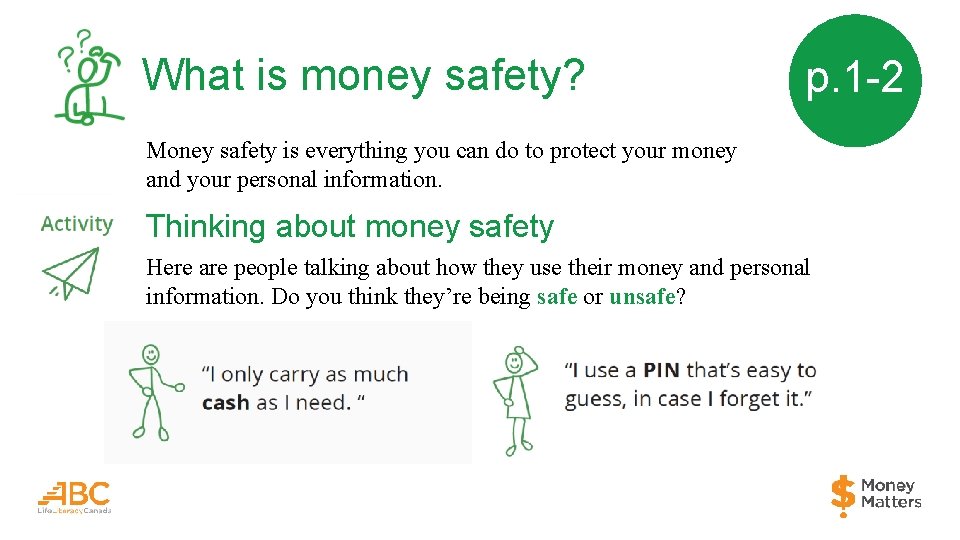
What is money safety? p. 1 -2 Money safety is everything you can do to protect your money and your personal information. Thinking about money safety Here are people talking about how they use their money and personal information. Do you think they’re being safe or unsafe?
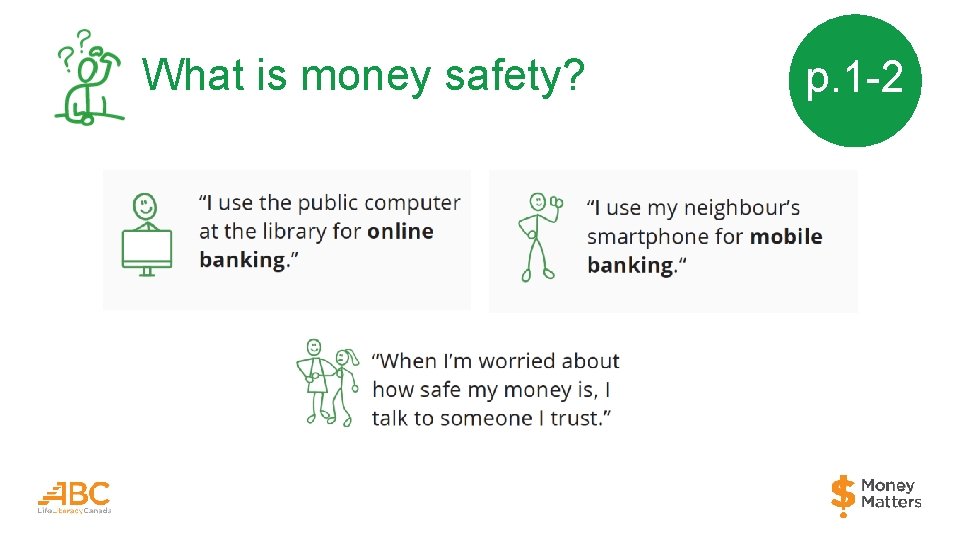
What is money safety? p. 1 -2

Keeping your money and personal information safe Here are some tips that might help you keep your money and personal information safe. Carry only as much cash as you need Use passwords and PINs that are hard to guess Use a private computer (like a computer at home, if you have one) for online banking p. 3
Keeping your money and personal information safe Here are some more tips that might help you keep your money and personal information safe. Use a private internet connection for online and mobile banking Only use your personal smartphone or the smartphone of someone you trust for mobile banking Talk to someone you trust if you’re not sure p. 4
Why is money safety important? Money safety means protecting your money and your identity. Protecting your identity It’s very important to protect your identity. Your personal information is private, and you should only share it with people you trust. If dishonest people steal your personal information, they can pretend to be you. This is a crime called identity theft. p. 5
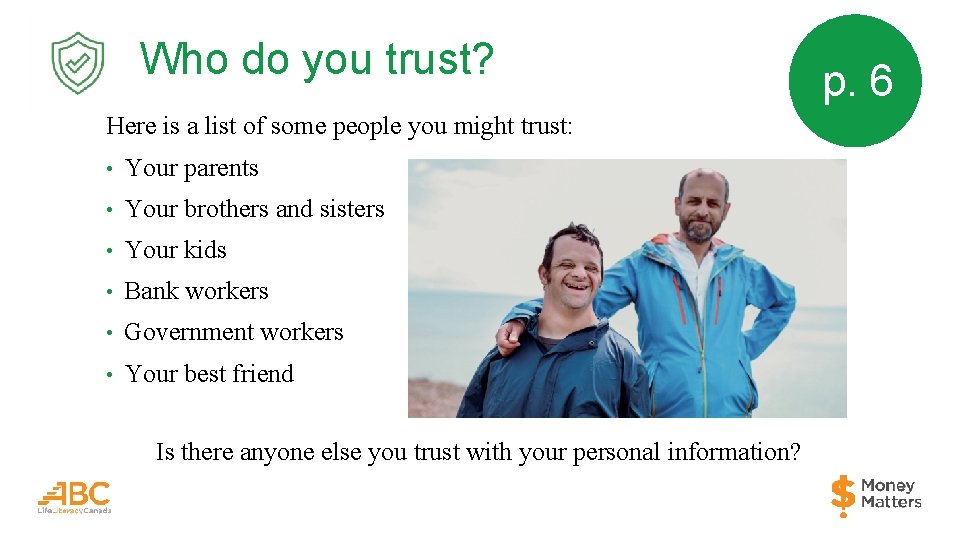
Who do you trust? Here is a list of some people you might trust: • Your parents • Your brothers and sisters • Your kids • Bank workers • Government workers • Your best friend Is there anyone else you trust with your personal information? p. 6
Online banking and mobile banking p. 7 Here are some things you can do with online and mobile banking: • Check your bank account activity and balance • Pay your bills online • Move money between your bank accounts • Send money to other people through e-transfers Different banks let you do different things with online banking, like open a new account or pay your bills.
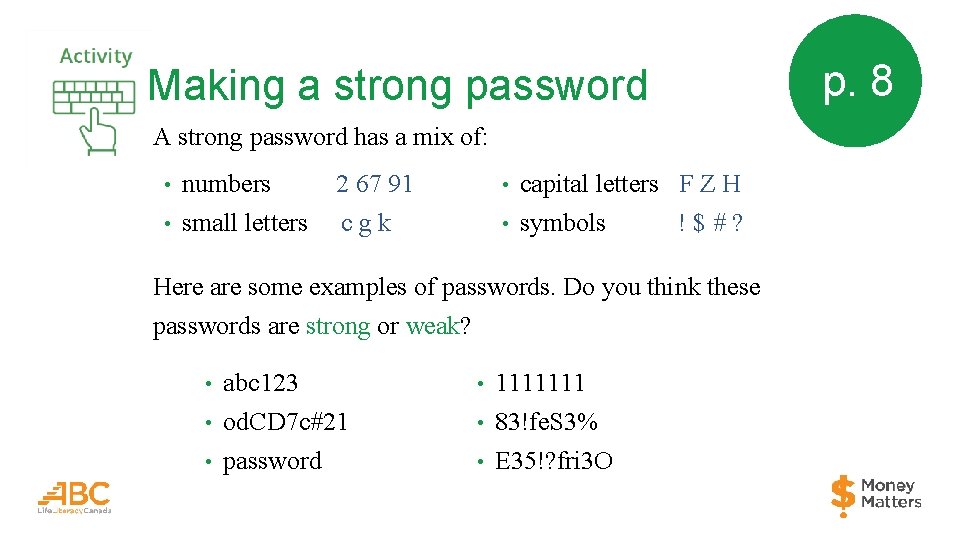
Making a strong password A strong password has a mix of: • • numbers small letters 2 67 91 cgk • • capital letters F Z H symbols !$#? Here are some examples of passwords. Do you think these passwords are strong or weak? • • • abc 123 od. CD 7 c#21 password • • • 1111111 83!fe. S 3% E 35!? fri 3 O p. 8
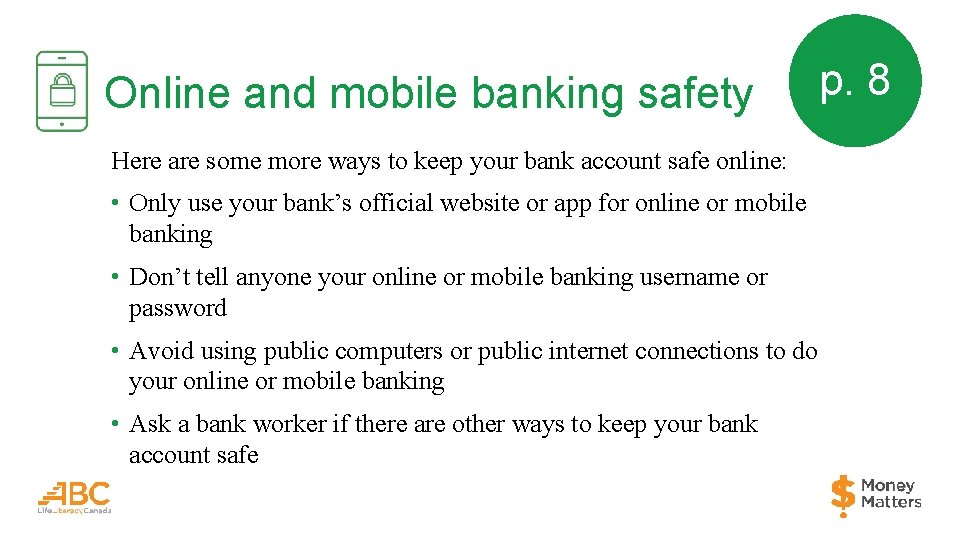
Online and mobile banking safety Here are some more ways to keep your bank account safe online: • Only use your bank’s official website or app for online or mobile banking • Don’t tell anyone your online or mobile banking username or password • Avoid using public computers or public internet connections to do your online or mobile banking • Ask a bank worker if there are other ways to keep your bank account safe p. 8
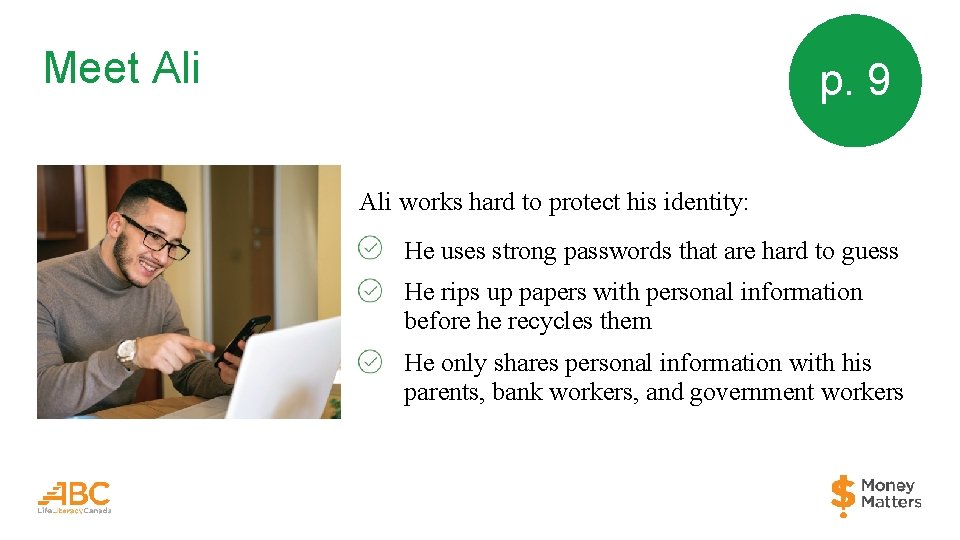
Meet Ali p. 9 Ali works hard to protect his identity: He uses strong passwords that are hard to guess He rips up papers with personal information before he recycles them He only shares personal information with his parents, bank workers, and government workers
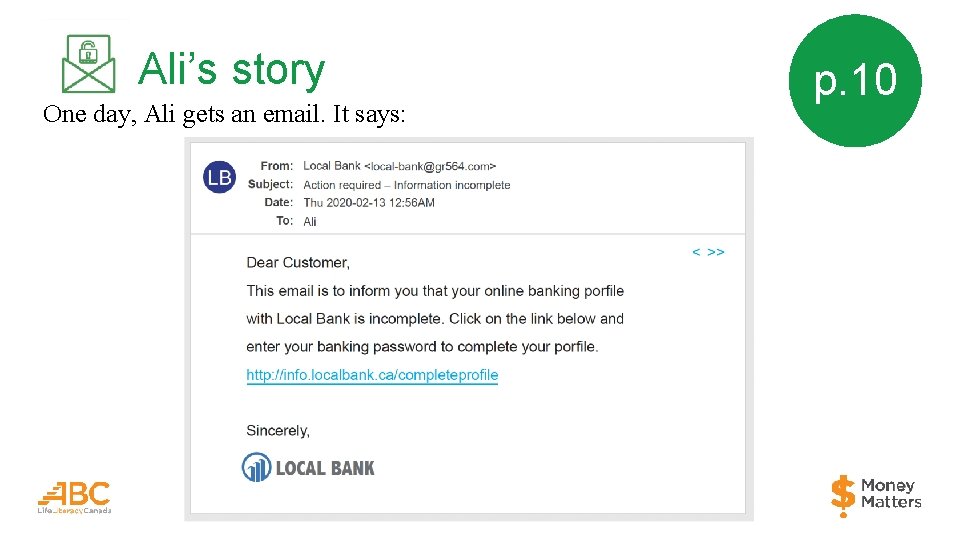
Ali’s story One day, Ali gets an email. It says: p. 10
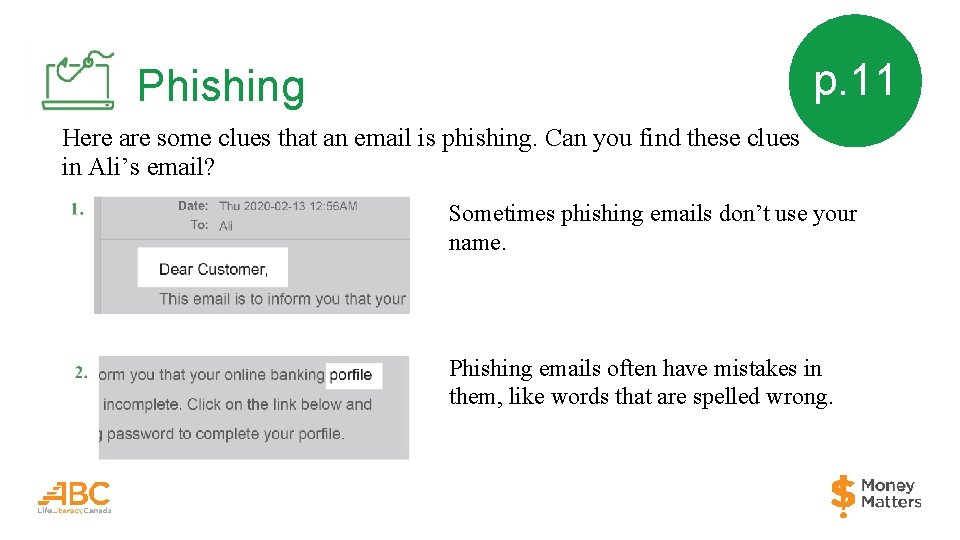
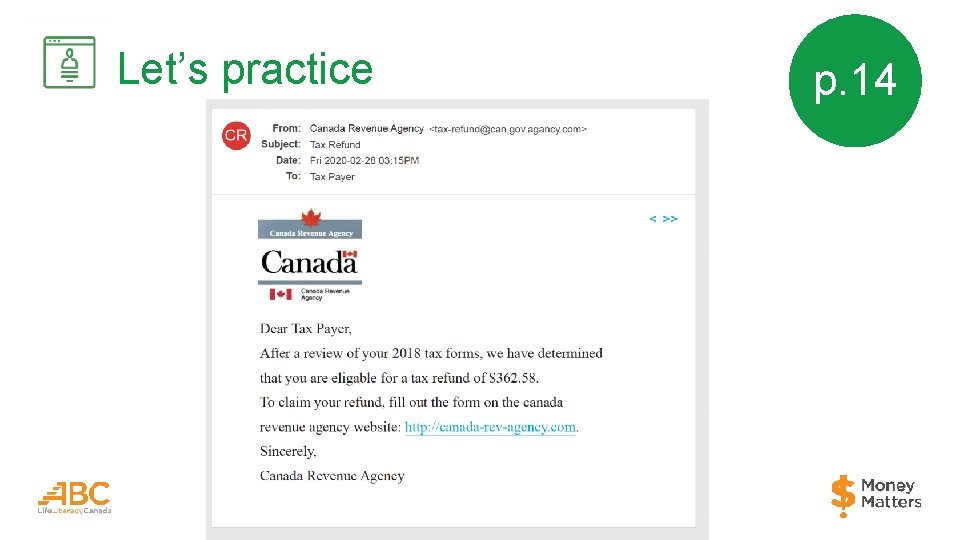
p. 11 Phishing Here are some clues that an email is phishing. Can you find these clues in Ali’s email? Sometimes phishing emails don’t use your name. Phishing emails often have mistakes in them, like words that are spelled wrong.
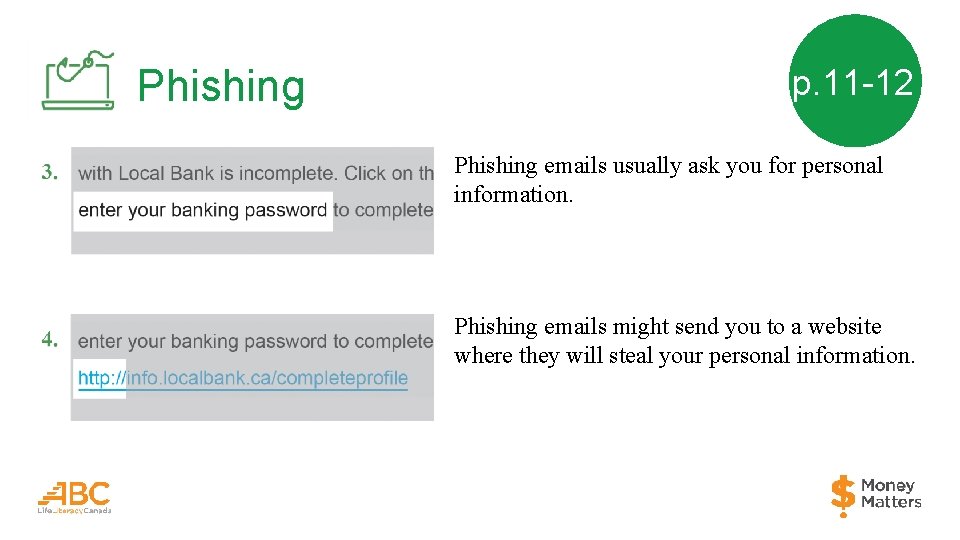
Phishing p. 11 -12 Phishing emails usually ask you for personal information. Phishing emails might send you to a website where they will steal your personal information.
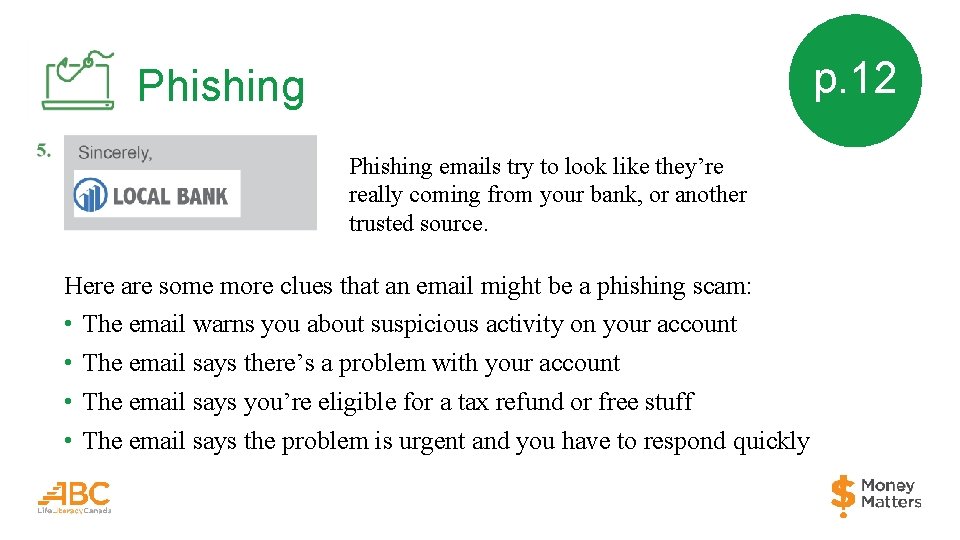
p. 12 Phishing emails try to look like they’re really coming from your bank, or another trusted source. Here are some more clues that an email might be a phishing scam: • The email warns you about suspicious activity on your account • The email says there’s a problem with your account • The email says you’re eligible for a tax refund or free stuff • The email says the problem is urgent and you have to respond quickly
Phishing scams – What to do If you get an email and you think it’s a scam, don’t share any information with them! Search online for the organization’s phone number. Contact the organization and ask if they sent you an email Don’t open any attachments or click on any links in the email Don’t reply to the email Mark the email as spam Delete the email p. 13
Let’s practice p. 14
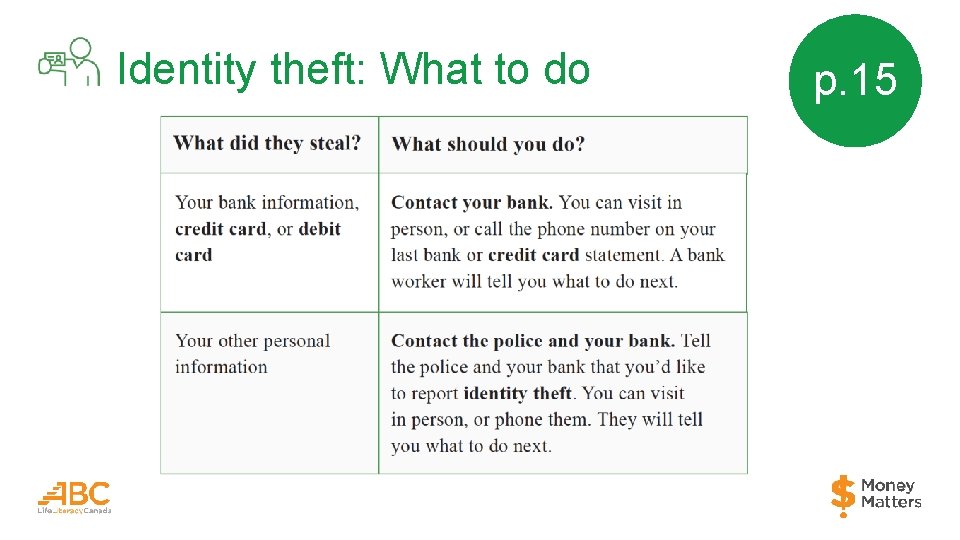
Identity theft: What to do p. 15
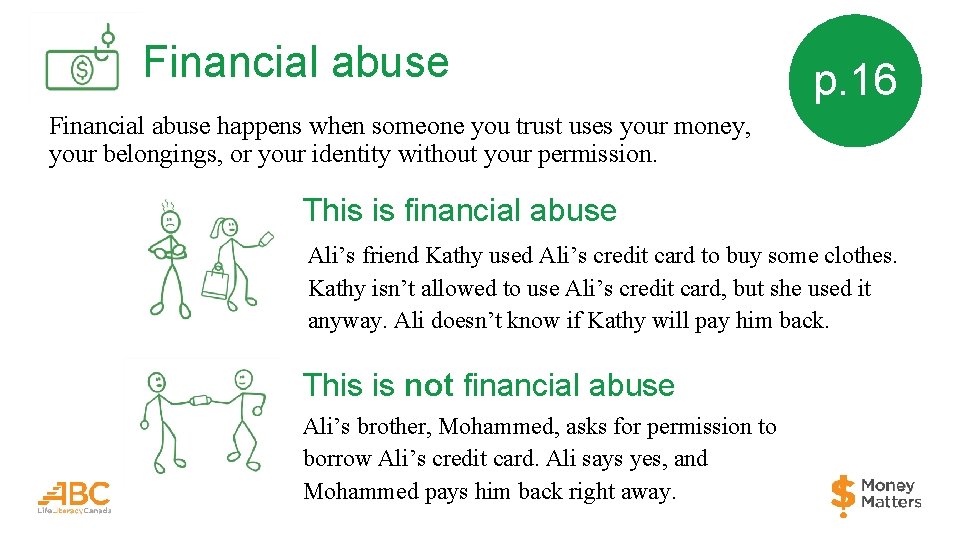
Financial abuse p. 16 Financial abuse happens when someone you trust uses your money, your belongings, or your identity without your permission. This is financial abuse Ali’s friend Kathy used Ali’s credit card to buy some clothes. Kathy isn’t allowed to use Ali’s credit card, but she used it anyway. Ali doesn’t know if Kathy will pay him back. This is not financial abuse Ali’s brother, Mohammed, asks for permission to borrow Ali’s credit card. Ali says yes, and Mohammed pays him back right away.
Financial abuse p. 17 Signs of financial abuse Look at the signs of financial abuse on page 17 of your workbook. Do any of these signs sound true to you? Did you answer “Yes” or “Not sure” to any questions? You might be going through financial abuse. Did you answer “No” to every question? That’s great! Remember to keep your money and your personal information safe.
Financial abuse: What to do It’s important to tell someone that you think you’re going through financial abuse. Talk to someone you trust, such as: • a family member • a close friend • a bank worker at your bank • your doctor If you feel like you’re in immediate danger, call the police and ask for help. p. 18
Financial abuse: What to do p. 18 Do you want to make sure you’re safe from financial abuse? Here are some things you can do: • Keep track of your money • Ask for help with important decisions • Keep in touch with family and friends
Money safety Today we learned about • Online safety • Phishing scams • Identity theft • Financial abuse Remember You have the right to keep your money and your personal information safe. No one is allowed to take your money or your personal information without your permission. p. 19
Thank you for participating in Money Matters for People with Diverse Abilities!
- Slides: 25