
Work Review Work force N x distance m



- Slides: 28
Work Review - Work = force (N) x distance (m) - Work is measured in Joules (J) which is a N-m - For work to be done, the object must move in the same direction as the force. - Power = work (J) / time (s) - Power is measured in watts (W)
How machines do work - Machines make work easier by: 1. Changing the amount of force you exert. 2. Changing the distance over which you exert your force. 3. Changing the direction of your force - Mechanical Advantage is the number of times a machine increase the input force on it. - Output Force is the force the machine exerts on an object.
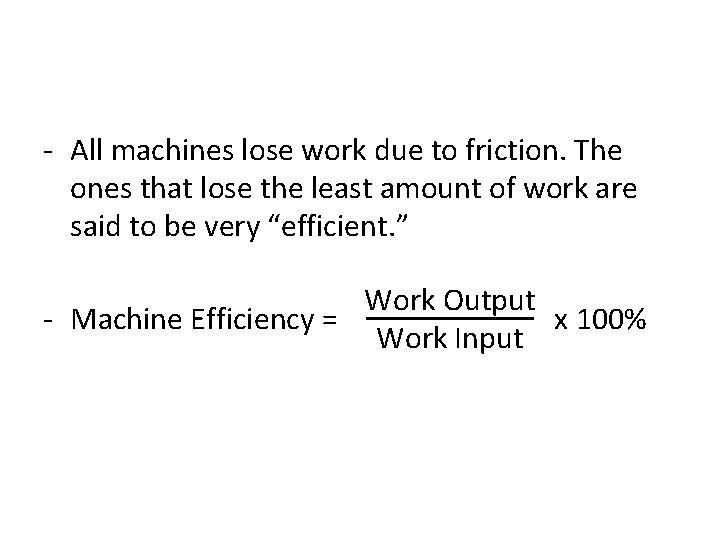
- All machines lose work due to friction. The ones that lose the least amount of work are said to be very “efficient. ” Work Output - Machine Efficiency = x 100% Work Input
Chapter 12 ~ Section 3 6 Simple Machines
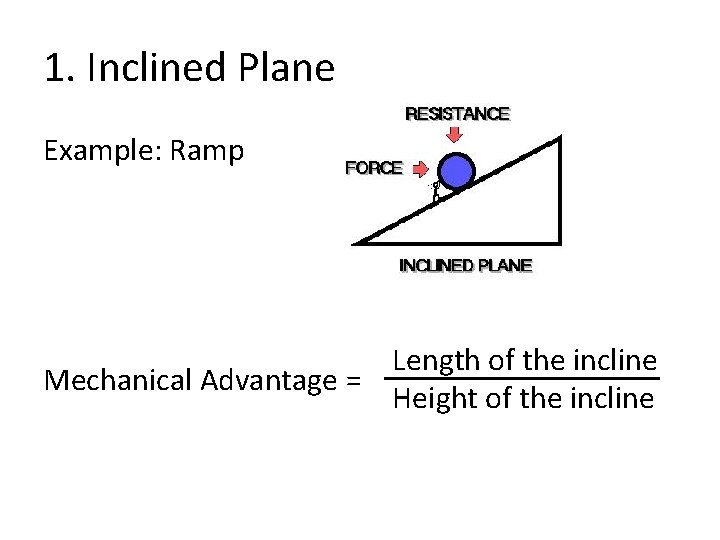
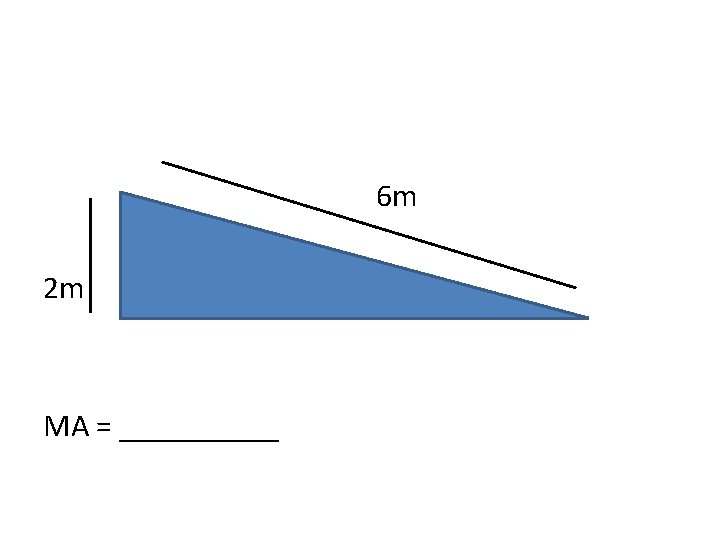
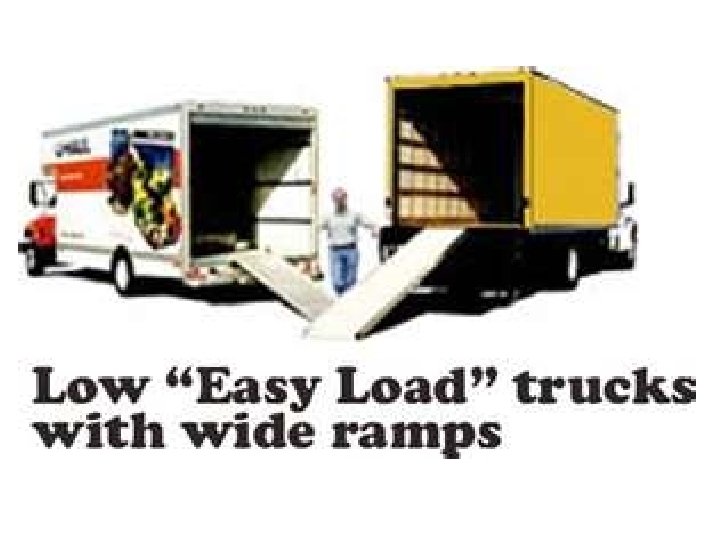
1. Inclined Plane Example: Ramp Length of the incline Mechanical Advantage = Height of the incline
6 m 2 m MA = _____
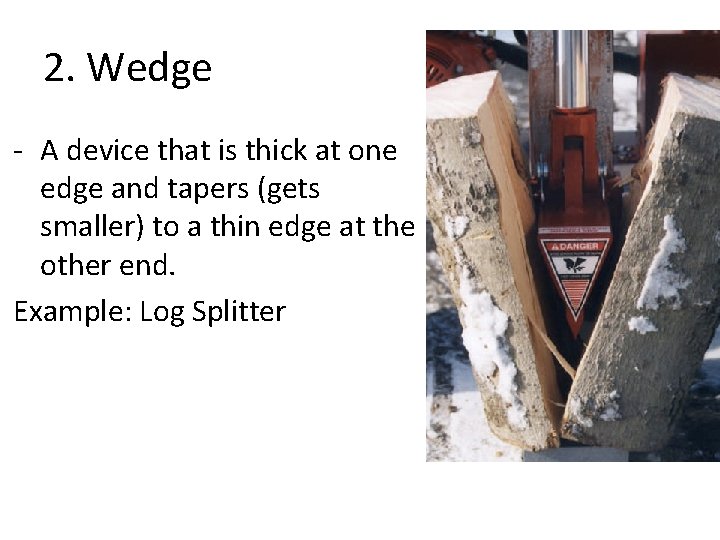
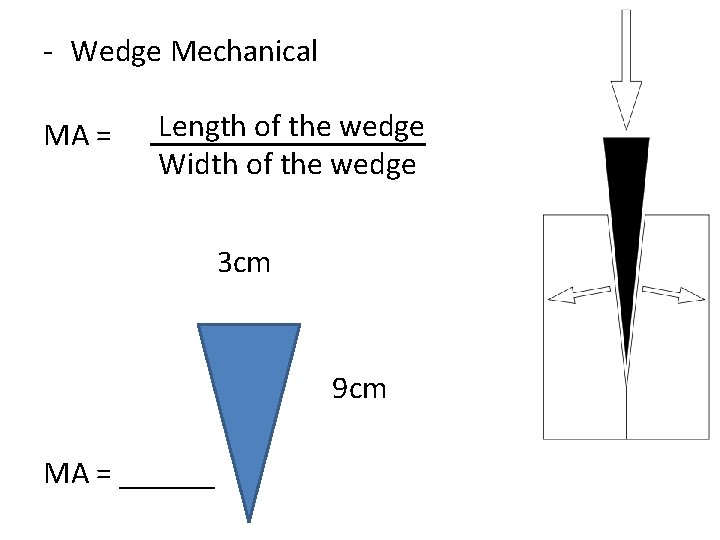
2. Wedge - A device that is thick at one edge and tapers (gets smaller) to a thin edge at the other end. Example: Log Splitter
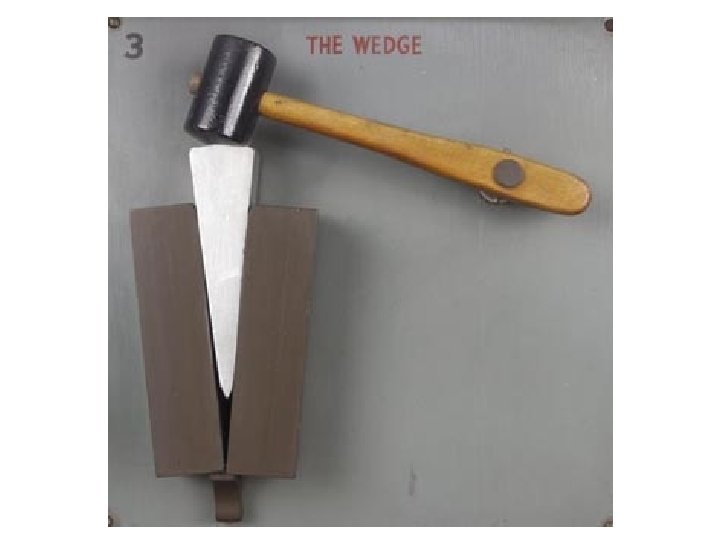
- Wedge Mechanical MA = Length of the wedge Width of the wedge 3 cm 9 cm MA = ______
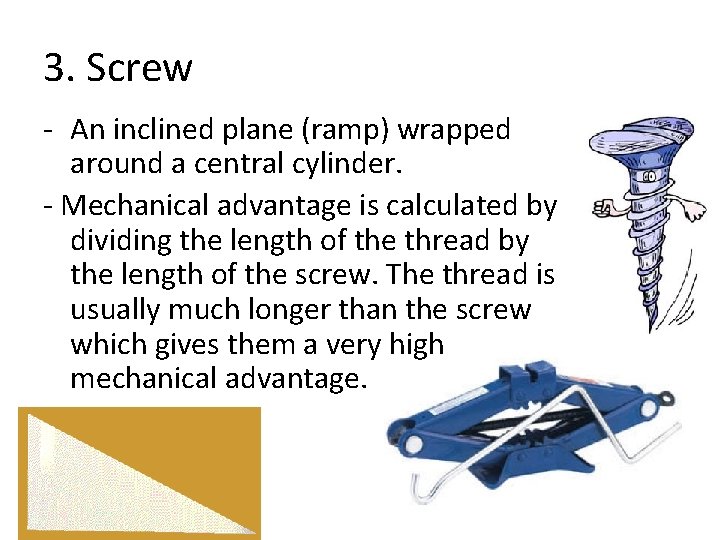
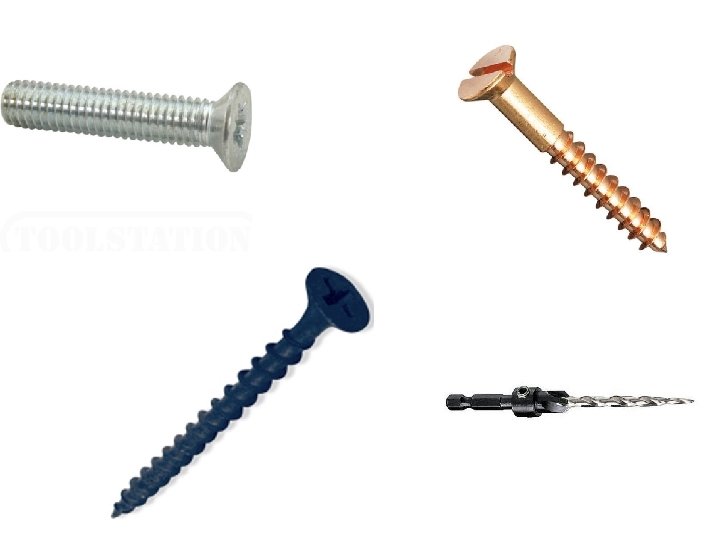
3. Screw - An inclined plane (ramp) wrapped around a central cylinder. - Mechanical advantage is calculated by dividing the length of the thread by the length of the screw. The thread is usually much longer than the screw which gives them a very high mechanical advantage.
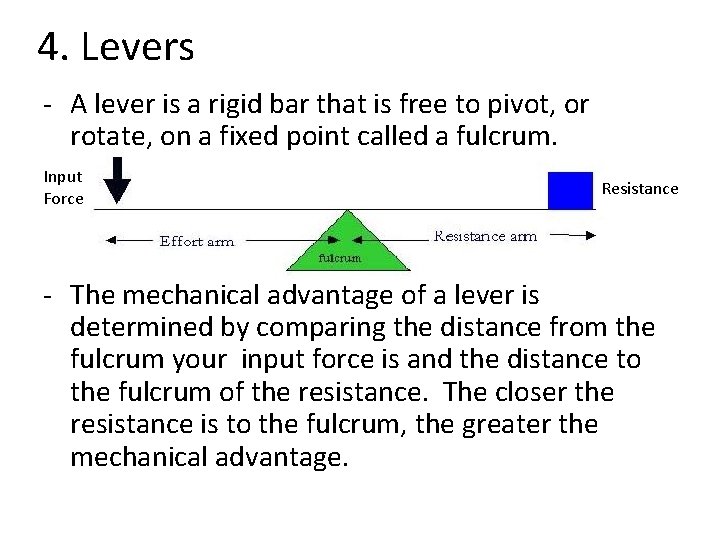
4. Levers - A lever is a rigid bar that is free to pivot, or rotate, on a fixed point called a fulcrum. Input Force Resistance - The mechanical advantage of a lever is determined by comparing the distance from the fulcrum your input force is and the distance to the fulcrum of the resistance. The closer the resistance is to the fulcrum, the greater the mechanical advantage.
3 Classes of Levers - Your way to remember which lever is which type is FREE (or FRE). Which ever lever part is in the middle determines the class of lever. - Class 1 has the Fulcrum in the middle. - Class 2 has the Resistance in the middle. - Class 3 Has the Effort (input force) in the middle.
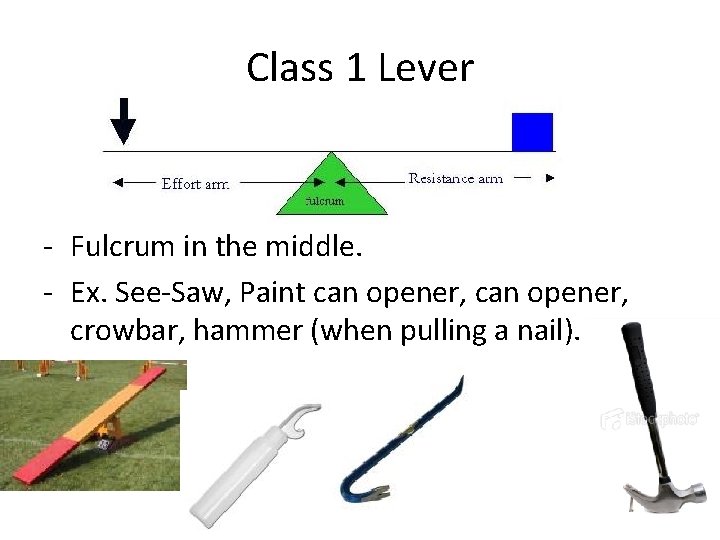
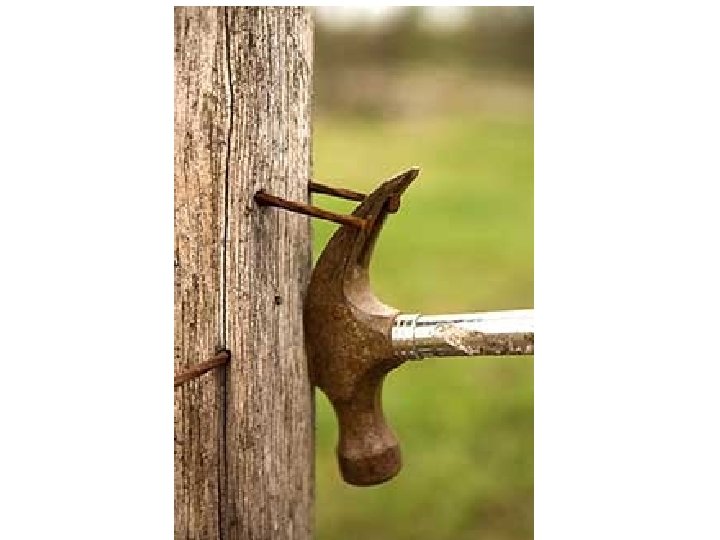
Class 1 Lever - Fulcrum in the middle. - Ex. See-Saw, Paint can opener, crowbar, hammer (when pulling a nail).
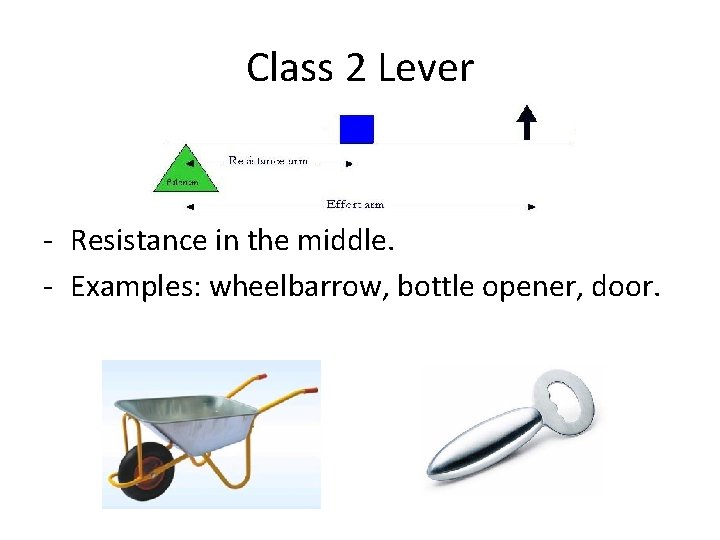
Class 2 Lever - Resistance in the middle. - Examples: wheelbarrow, bottle opener, door.
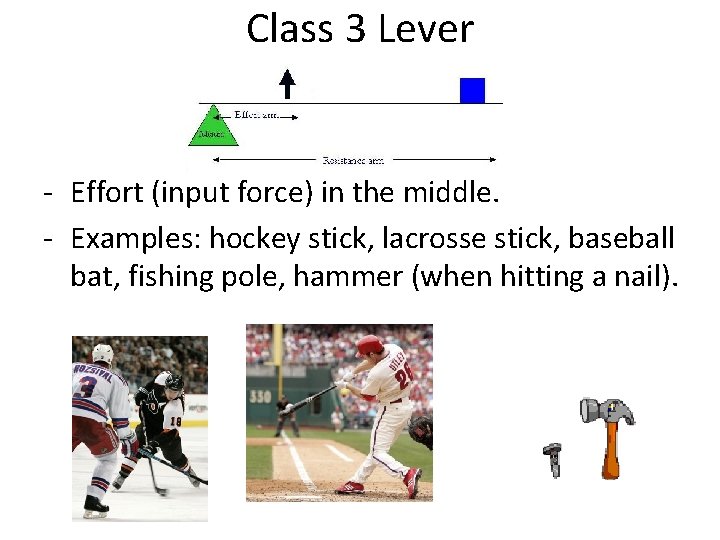
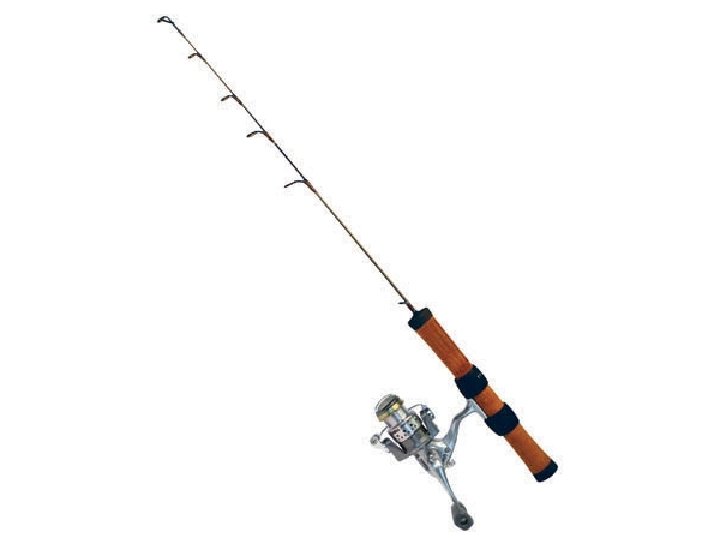
Class 3 Lever - Effort (input force) in the middle. - Examples: hockey stick, lacrosse stick, baseball bat, fishing pole, hammer (when hitting a nail).
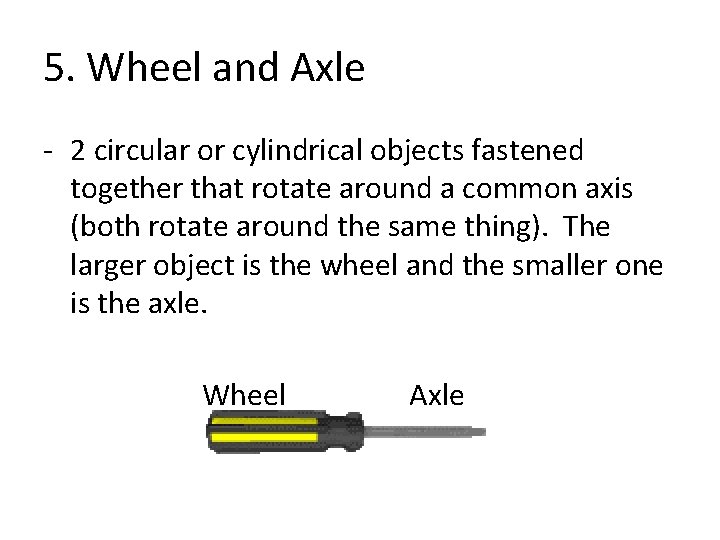
5. Wheel and Axle - 2 circular or cylindrical objects fastened together that rotate around a common axis (both rotate around the same thing). The larger object is the wheel and the smaller one is the axle. Wheel Axle
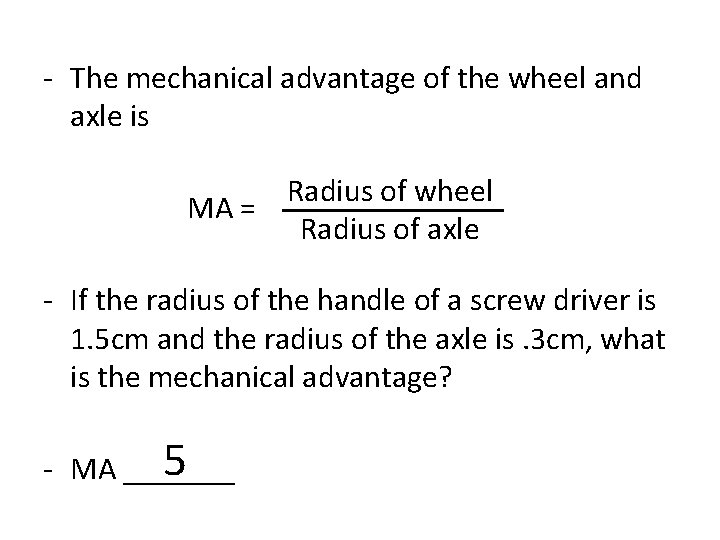
- The mechanical advantage of the wheel and axle is Radius of wheel MA = Radius of axle - If the radius of the handle of a screw driver is 1. 5 cm and the radius of the axle is. 3 cm, what is the mechanical advantage? 5 - MA _______
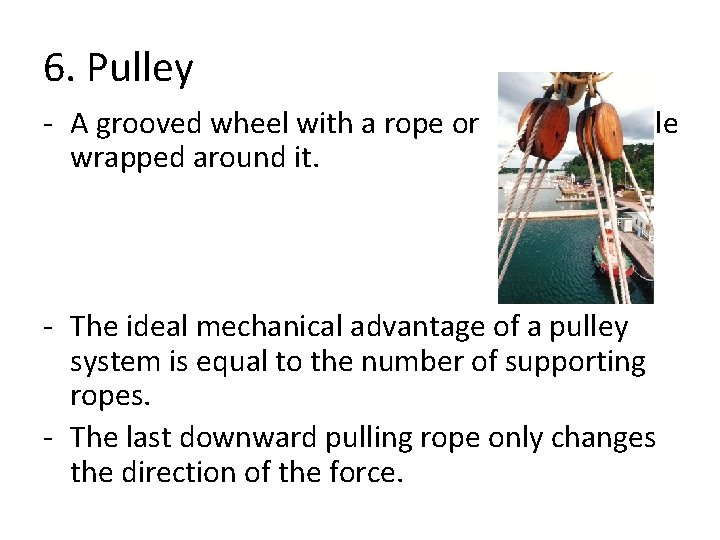
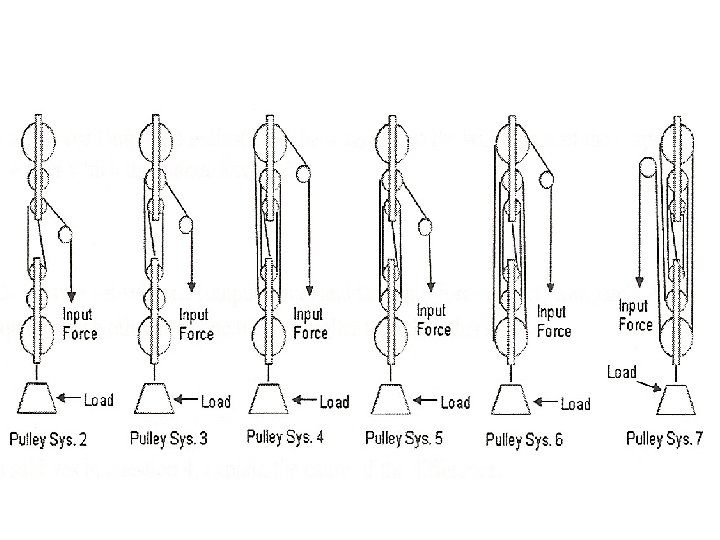
6. Pulley - A grooved wheel with a rope or wrapped around it. cable - The ideal mechanical advantage of a pulley system is equal to the number of supporting ropes. - The last downward pulling rope only changes the direction of the force.
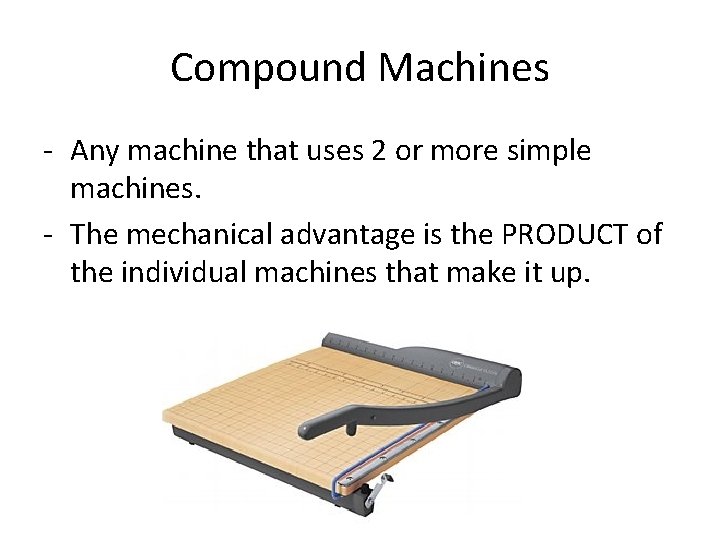
Compound Machines - Any machine that uses 2 or more simple machines. - The mechanical advantage is the PRODUCT of the individual machines that make it up.
$200 Bounty!