
Work Replication with Parallel Region pragma omp parallel
![Fortran section clause !$omp parallel sections [clause. . ] [!$omp section] code for 1](https://slidetodoc.com/presentation_image/3d44d2a311e7ba8aad47acdbd99f5af4/image-4.jpg "Fortran section clause !$omp parallel sections [clause. . ] [!$omp section] code for 1")
![C/C++ section clause #pragma omp parallel sections [clause…] { [#pragma omp section] code for](https://slidetodoc.com/presentation_image/3d44d2a311e7ba8aad47acdbd99f5af4/image-5.jpg "C/C++ section clause #pragma omp parallel sections [clause…] { [#pragma omp section] code for")
![ordered example parallel loop (with parallel do/for) ordered loop I=1 : n a[I] =.](https://slidetodoc.com/presentation_image/3d44d2a311e7ba8aad47acdbd99f5af4/image-14.jpg "ordered example parallel loop (with parallel do/for) ordered loop I=1 : n a[I] =.")
- Slides: 19
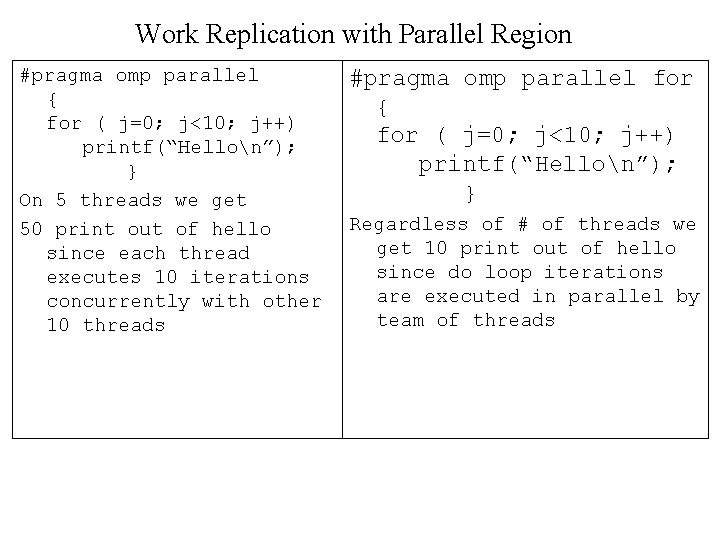
Work Replication with Parallel Region #pragma omp parallel { for ( j=0; j<10; j++) printf(“Hellon”); } On 5 threads we get 50 print out of hello since each thread executes 10 iterations concurrently with other 10 threads #pragma omp parallel for { for ( j=0; j<10; j++) printf(“Hellon”); } Regardless of # of threads we get 10 print out of hello since do loop iterations are executed in parallel by team of threads
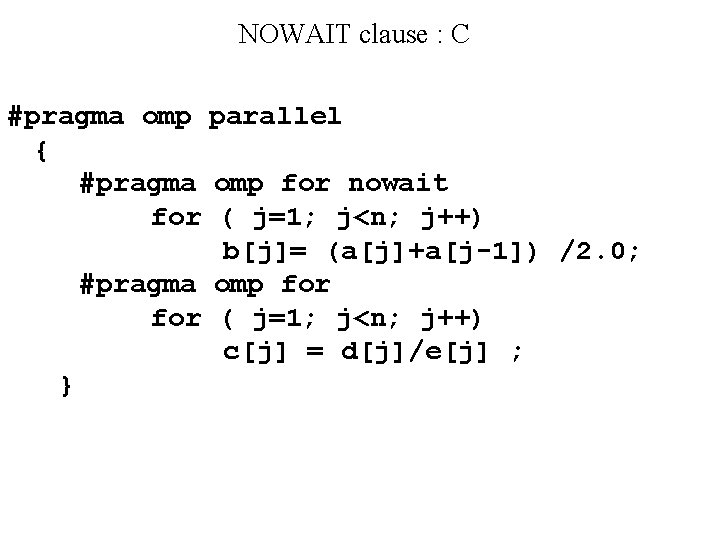
NOWAIT clause : C #pragma omp parallel { #pragma omp for nowait for ( j=1; j<n; j++) b[j]= (a[j]+a[j-1]) /2. 0; #pragma omp for ( j=1; j<n; j++) c[j] = d[j]/e[j] ; }
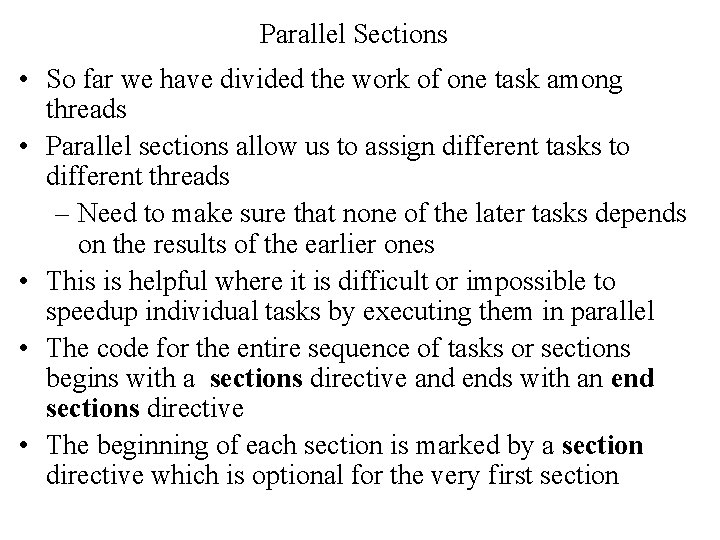
Parallel Sections • So far we have divided the work of one task among threads • Parallel sections allow us to assign different tasks to different threads – Need to make sure that none of the later tasks depends on the results of the earlier ones • This is helpful where it is difficult or impossible to speedup individual tasks by executing them in parallel • The code for the entire sequence of tasks or sections begins with a sections directive and ends with an end sections directive • The beginning of each section is marked by a section directive which is optional for the very first section
Fortran section clause !$omp parallel sections [clause. . ] [!$omp section] code for 1 st section !$omp section code for 2 nd section !$omp section code for 3 rd section. . !$omp end parallel sections
C/C++ section clause #pragma omp parallel sections [clause…] { [#pragma omp section] code for 1 st section #pragma omp section code for 2 nd section #pragma omp section code for 3 rd section. . }
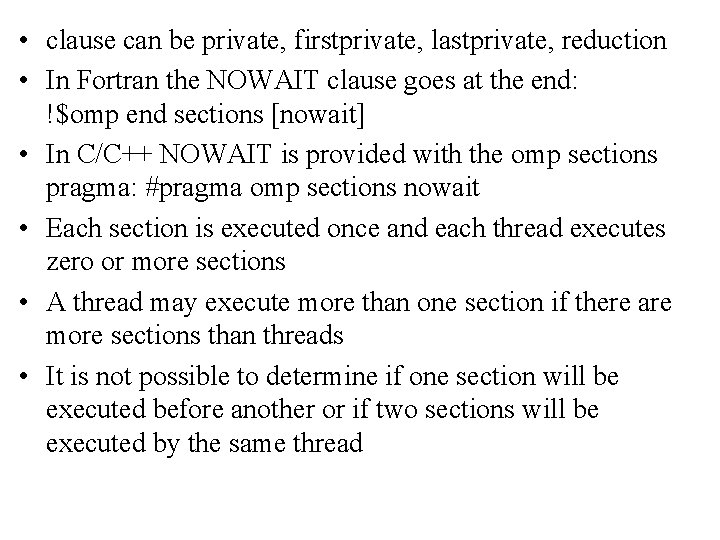
• clause can be private, firstprivate, lastprivate, reduction • In Fortran the NOWAIT clause goes at the end: !$omp end sections [nowait] • In C/C++ NOWAIT is provided with the omp sections pragma: #pragma omp sections nowait • Each section is executed once and each thread executes zero or more sections • A thread may execute more than one section if there are more sections than threads • It is not possible to determine if one section will be executed before another or if two sections will be executed by the same thread
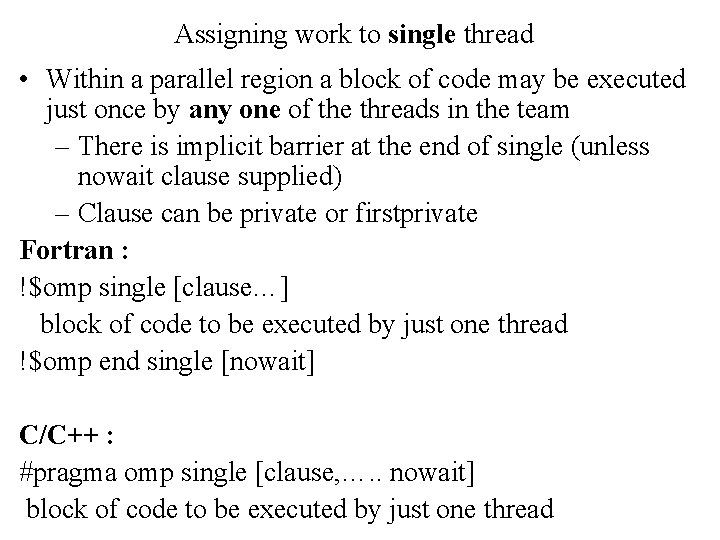
Assigning work to single thread • Within a parallel region a block of code may be executed just once by any one of the threads in the team – There is implicit barrier at the end of single (unless nowait clause supplied) – Clause can be private or firstprivate Fortran : !$omp single [clause…] block of code to be executed by just one thread !$omp end single [nowait] C/C++ : #pragma omp single [clause, …. . nowait] block of code to be executed by just one thread
single for I/O • Common use of single is for reading in shared input variables or writing output within a parallel region • I/O may not be easy to parallelize
omp_get_thread_num, omp_get_num_threads • Remember Open. MP uses fork/join model of parallelization • Thread teams are only created within a parallel construct (parallel do/for, parallel) • omp_get_thread_num and omp_get_num_threads are only valid within a parallel construct where you have forked threads
Synchronization • Critical - for any block of code • Barrier – where all threads join • Other synchronization directives : – master – ordered
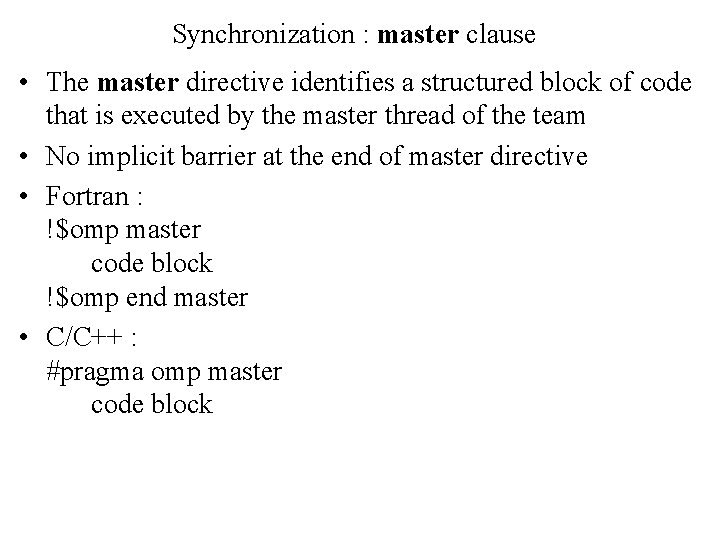
Synchronization : master clause • The master directive identifies a structured block of code that is executed by the master thread of the team • No implicit barrier at the end of master directive • Fortran : !$omp master code block !$omp end master • C/C++ : #pragma omp master code block
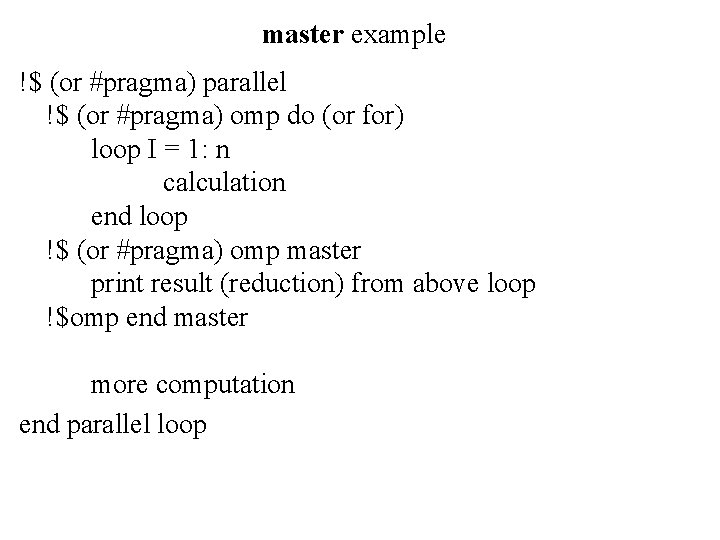
master example !$ (or #pragma) parallel !$ (or #pragma) omp do (or for) loop I = 1: n calculation end loop !$ (or #pragma) omp master print result (reduction) from above loop !$omp end master more computation end parallel loop
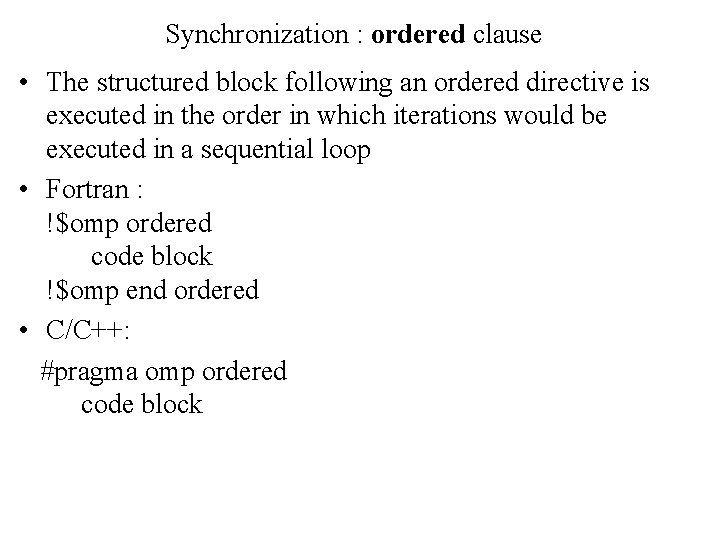
Synchronization : ordered clause • The structured block following an ordered directive is executed in the order in which iterations would be executed in a sequential loop • Fortran : !$omp ordered code block !$omp end ordered • C/C++: #pragma omp ordered code block
ordered example parallel loop (with parallel do/for) ordered loop I=1 : n a[I] =. . calculation… !$ [OR #pragma] omp ordered print a[I] !$omp end ordered end parallel loop
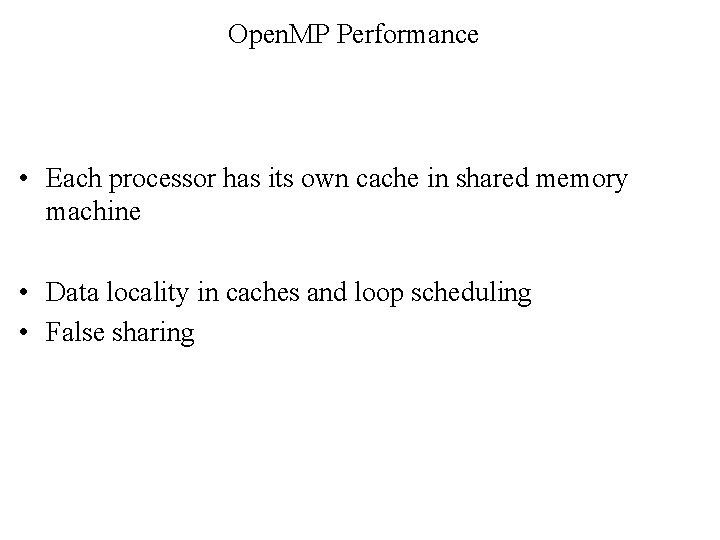
Open. MP Performance • Each processor has its own cache in shared memory machine • Data locality in caches and loop scheduling • False sharing
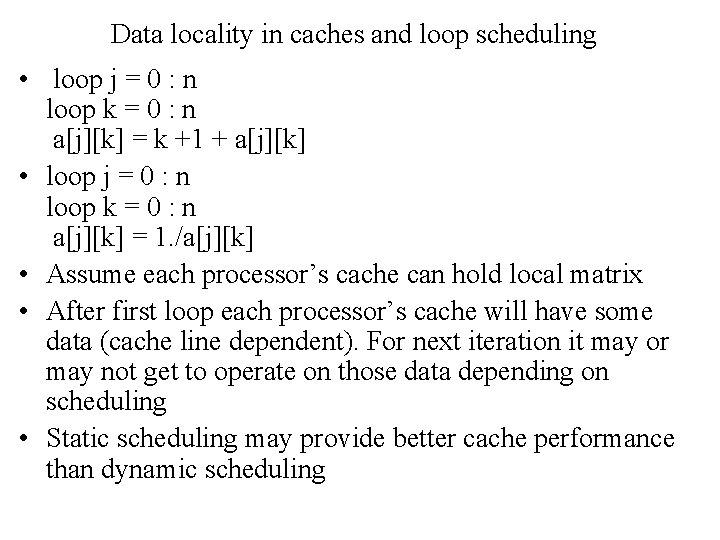
Data locality in caches and loop scheduling • loop j = 0 : n loop k = 0 : n a[j][k] = k +1 + a[j][k] • loop j = 0 : n loop k = 0 : n a[j][k] = 1. /a[j][k] • Assume each processor’s cache can hold local matrix • After first loop each processor’s cache will have some data (cache line dependent). For next iteration it may or may not get to operate on those data depending on scheduling • Static scheduling may provide better cache performance than dynamic scheduling
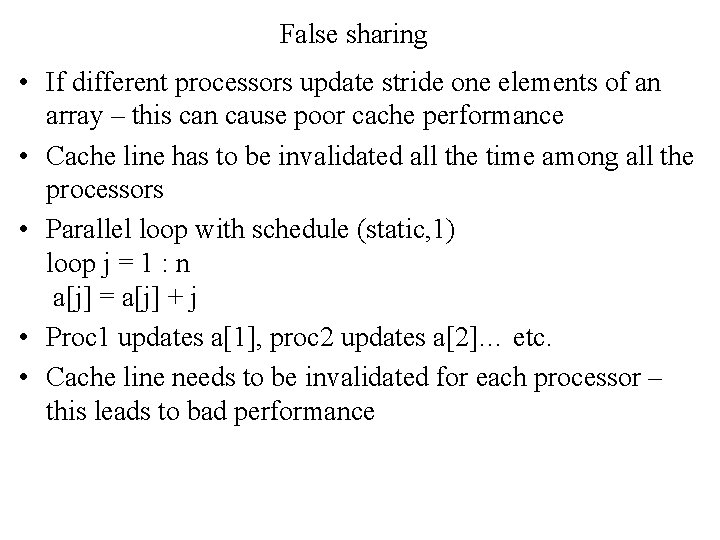
False sharing • If different processors update stride one elements of an array – this can cause poor cache performance • Cache line has to be invalidated all the time among all the processors • Parallel loop with schedule (static, 1) loop j = 1 : n a[j] = a[j] + j • Proc 1 updates a[1], proc 2 updates a[2]… etc. • Cache line needs to be invalidated for each processor – this leads to bad performance
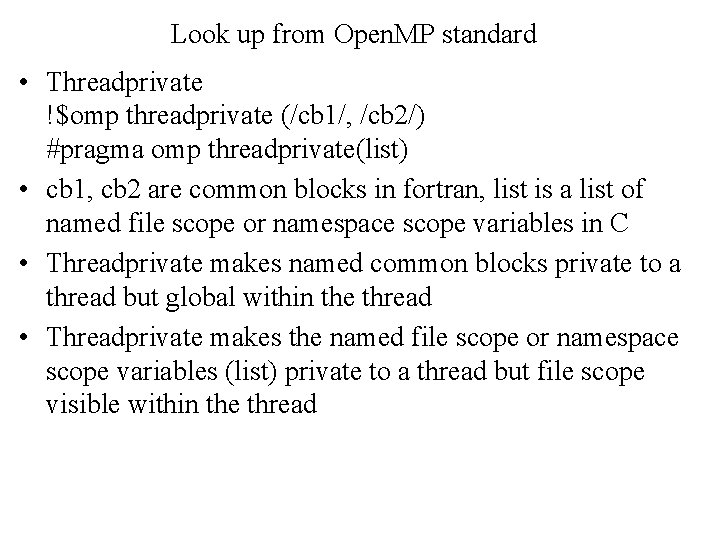
Look up from Open. MP standard • Threadprivate !$omp threadprivate (/cb 1/, /cb 2/) #pragma omp threadprivate(list) • cb 1, cb 2 are common blocks in fortran, list is a list of named file scope or namespace scope variables in C • Threadprivate makes named common blocks private to a thread but global within the thread • Threadprivate makes the named file scope or namespace scope variables (list) private to a thread but file scope visible within the thread
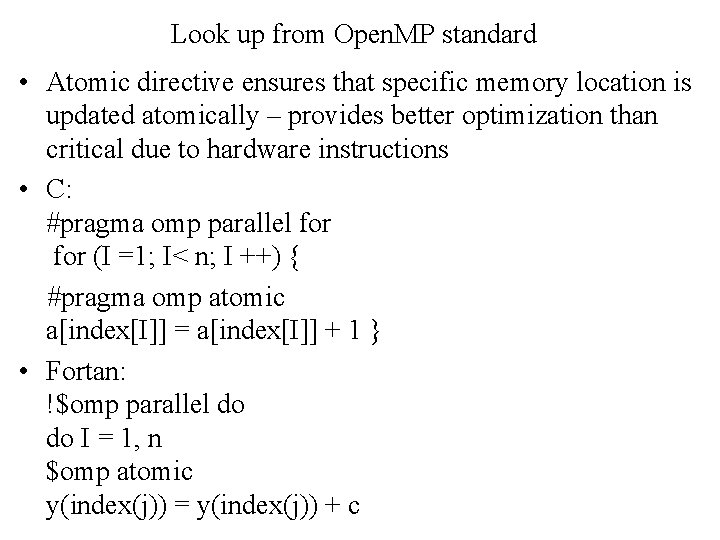
Look up from Open. MP standard • Atomic directive ensures that specific memory location is updated atomically – provides better optimization than critical due to hardware instructions • C: #pragma omp parallel for (I =1; I< n; I ++) { #pragma omp atomic a[index[I]] = a[index[I]] + 1 } • Fortan: !$omp parallel do do I = 1, n $omp atomic y(index(j)) = y(index(j)) + c